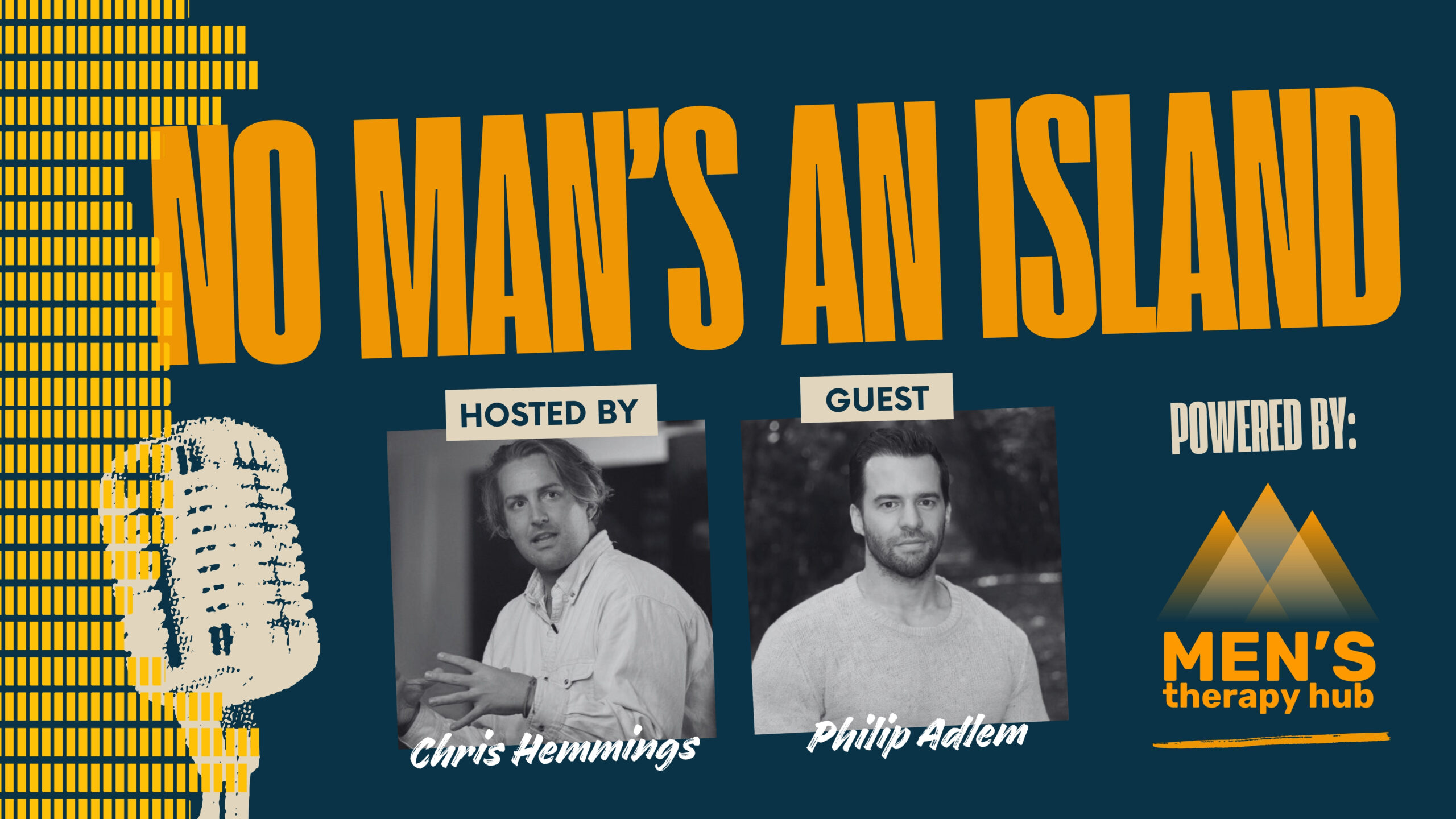
In this episode of No Man’s An Island (powered by Men’s Therapy Hub), Chris Hemmings is joined by Philip Adlem, a psychodynamic psychotherapist whose path into therapy was shaped by years working in high-pressure emergency services roles as well as therapeutic work within the NHS, bereavement services and the criminal justice system. Philip recently joined Men’s Therapy Hub and has also published a paper exploring what he calls gender split social defences – a concept describing how unconscious beliefs about gender shape who is seen as vulnerable, who is believed and who is misunderstood in therapy and society more broadly.
Our conversation moves between Philip’s personal story and the wider psychological patterns he sees within the mental health field. He shares experiences of trauma, homophobia and violence, as well as the unexpected consequences of becoming the subject of a viral video when he proposed to his partner at a Pride march while serving as a police officer. We talk about how prejudice operates across political and social divides and how deeply ingrained ideas about gender influence who receives empathy and who does not.
Philip also reflects on his experiences within psychotherapy training and how unconscious assumptions about men can shape therapeutic spaces. We explore why men’s distress is often minimised, how gender expectations affect the way vulnerability is perceived and why the profession itself needs to examine its own blind spots if it wants to reach more men.
The conversation ultimately asks a difficult but important question: who gets to be seen as a victim and who is expected to endure their suffering in silence?
What we cover
- Philip’s journey from emergency services work into psychotherapy
- Growing up with homophobia, violence and religious pressure
- The viral Pride proposal and the backlash that followed
- How trauma, prejudice and identity shaped Philip’s therapeutic perspective
- What “gender split social defences” means and why it matters
- Why male vulnerability is often overlooked or misinterpreted
- The role of unconscious bias in therapy training and mental health services
- The cultural expectations placed on men to suppress fear and emotion
- How psychotherapy could better reach and support men
Listen and watch
YouTube – (embed here)
Apple Podcasts – (link here)
Spotify – (link here)
Takeaways for men
- Your pain does not become less real simply because others struggle to recognise it
- Many men suppress vulnerability because they have learned it will not be received safely
- Therapy can provide a space where your full story is heard without judgement
- Cultural expectations about strength often prevent men from seeking support
- Finding supportive relationships is one of the most powerful buffers against trauma
Quotes to share
“I saw psychotherapy as a chance to go somewhere where you could take in someone’s entire story.” – Philip Adlam
“We think men isolate themselves. Often society isolates them first.” – Philip Adlam
“No one wakes up and decides to suppress fear and vulnerability. That happens because of what we learn.” – Philip Adlam
“Men have been killing themselves for hundreds of years and the message still isn’t getting through.” – Philip Adlam
Resources and links
Men’s Therapy Hub – Find a male therapist
https://menstherapyhub.co.uk
Philip Adlem therapist profile
https://menstherapyhub.co.uk/philip-adlem/
Related Men’s Therapy Hub resources:
Workplace Mental Health – https://menstherapyhub.co.uk/workplace-mental-health/
Anger Management in Men – https://menstherapyhub.co.uk/anger-management-in-men-causes-effects-and-how-to-take-control/
Episode credits
Host – Chris Hemmings
Guest – Philip Adlem
Podcast – No Man’s An Island
Produced by – Men’s Therapy Hub
Transcript
Chris (00:01)
Welcome to No Man’s An Island, a podcast powered by Men’s Therapy Hub, a directory of male therapists for male clients. On this episode, I’m joined by Philip Adlam, a psychodynamic psychotherapist whose route into the therapy room was shaped by working in demanding high stakes emergency services settings. He’s also held therapeutic roles within the NHS, bereavement services and the criminal justice system. Philip joined Men’s Therapy Hub recently. And when I checked out his website, I noticed he had recently published a paper on gender and masculinity in therapy.
It introduces the idea of gender split social defences, which we’re going to get him to explain, a way of describing how unconscious anxiety, power and trauma can shape who feels welcome, seen or misrecognized in therapeutic spaces and training. So obviously we had to get him on the podcast. Hey Philip.
Philip Adlem (00:48)
Hello.
Chris (00:50)
How are you feeling about doing this? This is your first ever podcast, is that right?
Philip Adlem (00:53)
is my first podcast. This is the first time I’ve heard ⁓ my directory blurb kind of sit back at me. It makes me sound very impressive.
Chris (01:02)
Yeah, it often does. mean, that’s why you’ve written it that way, I guess. So you’ve listened to some episodes, so you know what’s coming, the first question. How did you end up in this space? So for you, how did you end up becoming a therapist? And in particular, how did you end up being interested in researching men’s experiences in the therapy room?
Philip Adlem (01:21)
so, so I think there’s the, the, the usual things that bring people to therapy difficulties in childhood, ⁓ very traumatic experiences, ⁓ throughout my life. But I think what, why I found the solution in therapy and not, for example, other sectors such as the charity sector or, ⁓ other helping and support avenues was that what, what I experienced this is related to who I am as an entire person is that being, ⁓
a gay man who has experienced homelessness, who has also been a police officer, ⁓ who is also autistic, who has an immigrant mother, an Indian mother. And I have like, I have a lot of things that people can be prejudiced about me. ⁓ And what, what I noticed was, so if I can give a very brief example, I was at a friend’s wedding and they were their commandos and at the time they were
in Afghanistan and coming back and forth. And so I was at this wedding and one of our friends asked me something about my romantic life because I was out at the time, but in front of these guys that I was not out to. And after a while I was a bit uncomfortable and one of these friends, I think he was the best man or a groom’s man, stood up at the table and said, I can’t sit at a table where a gay man is talking about his love life and left. And it was very embarrassing and humiliating.
Um, and then what happened when I started working in the charity sector, when I first started working there and it had got around to everyone that I was a police officer, someone, an LGBT person stood up and said, I can’t work with someone that used to be a police officer and got up and left. And that was also permitted. And no one said anything. No one, you know, came to my defense in either of these scenarios. And to me, they were the same thing.
I was treated the same way. was dehumanized in front of everyone and no one helped. To what I perceive in organizations in the world is that these are opposite ends of the spectrum. This is someone with a very right-wing traditional view and this is someone with a very left-wing traditional view. But for me, it’s the same sort of prejudice and it’s the same ability to treat someone you don’t know worse based on prejudice. So I really saw psychotherapy as a chance to go somewhere where you could take in
someone’s entire story, everything they are, and use that to look at their behaviors, look at how they operate and their problems that they have now. And that’s what I like about it. I don’t think there’s another job in the whole world where you get to work one-to-one with someone in such a detailed way where they can be misunderstood by the rest of the world and understood in the third.
Chris (04:10)
You told me just before we started that actually you had an opportunity to do this sort of thing in the past because there was a viral video from 2016 of a police officer at the Pride march in 2016 asking another police officer to marry them and that was you and you rejected then the opportunity to speak publicly about it. So what has changed that has meant that you are able
to sit here today and tell the stories that you just told, which are harrowing and really, as you say, dehumanising and deeply unfair, and we’ll get into the kind of politics around that, I hope too. What has changed within you that means that you actually want to be here today and dare to tell your story?
Philip Adlem (04:58)
So at the time I was quite young ⁓ and I didn’t upload anything to social media. This was all kind of done for me by other people that I didn’t know the media and all that. So I became involved suddenly overnight in this, you know, I was getting international messages, public messages of, you know, death threats, all that sort of stuff, but also private messages. were people taking the time to find me, privately message me and say, you know, horrible things. And I was just not prepared for it in any way.
And what this really was, from my job in emergency response in the police, I had lot of holding a lot of trauma, holding a lot of images that aren’t particularly pleasant. And then in my personal life, I’ve got a lot of trauma to do with homophobia from my family, from other people I know. And this really was a clashing of both those worlds all at once. I just, I fell to pieces. I was not prepared for anything. I said no to everything.
Um, I did actually leave the place a couple of months after because I was so embarrassed that I was affected so badly. Um, that I felt I had to leave. Um, I did not, there was something I just could not do. People were suggesting me you can take time off. can, you you can look at your mental health and that felt so, I don’t know, just not approachable. was just something that I couldn’t do. It felt like I was, I don’t know how to describe it better than that. It’s just something that I think a lot of men feel.
But since then I’ve had, I’ve gone on a therapy journey. I’ve had some very, very kind, very, ⁓ wonderful people in my life since then ⁓ who have just shown that I think it’s in the body keeps the score. If you’ve read it, there’s a line that always makes me cry that says study after study shows the single greatest defense against trauma is a good support network. And that really
was what I’ve gained in the last 10 years is a good support network that I didn’t have before through therapy mainly.
Chris (07:02)
It’s a support network of therapists and people you can go to to be held therapeutically.
Philip Adlem (07:09)
Yeah, but also the ability to, you know, to rid myself of these homophobic influences, of these influences that tell me that because I’m a man, I shouldn’t be feeling this or what. So all of these sort of negative conversations are no longer in my life.
So I think I’ve always had influences in my life that as a man, as a visibly white man, despite having South Asian heritage and being gay and homosexual, people do feel like I can take a bit more than I can maybe. So, you know, they’ll tell me their homophobic thoughts and they’ll tell me
other things that they perhaps wouldn’t do to someone else. ⁓ And I just I’ve read myself with that. So as an example, my family would, you know, send me conversion therapy stuff would send me ⁓ stuff to do with let’s read the libraries of gay books and all and I would just be receiving this sort of messaging constantly. ⁓ And that is part of what I’ve cut out my life that’s I’ve moved. I’ve moved on this support network that I’ve got now.
Unfortunately, it’s not my family and it’s not all my old friends. It’s a new, much more healthy, much more socially aware, awareness of mental health and other types of health. So it’s just a more positive support network that allows me to do this and not fall to pieces basically.
Chris (08:40)
And that gives you the grounding to find the courage to speak up. you know, I’m always… And it’s why we ask this question, because so many people have such fascinating and rich and sad, often as yours is, stories of how they end up doing this work. And yet I’m always in awe of the courage that it takes to come and do this, because it’s not easy to say, I am all of these things. I’ve had all of these experiences.
and I’m here to try to help others to not go through what I went through.
Philip Adlem (09:16)
Yeah, I think that that’s a big part of it. It’s the sort of, I want to offer the help and support that I wish I had. And that when you speak to men, that’s quite often the case of what they say that this is not what my dad was like, this is not what my friends were like, and this was really horrible for me. Therefore, I want to provide this to other young men or other boys or whatever it is. And that is not just true for men, I think it’s true for lots of people.
Chris (09:42)
That time when you were blowing up online against your will, it wasn’t consensual and then the hatred that came with it, was that lumping on top of the experiences you’d had with family previously with the homophobia and the conversion and all of that?
Philip Adlem (10:06)
Yeah, so what happened? this is, I’m a firm believer that to get over the stigma of mental health and trauma, we have to talk about trauma and mental health. So this is not particularly pleasant conversation that I’m about to embark on. But so I grew up in a very, very, very homophobic place, ⁓ family, friends, church, and that imparted on me.
and I had those feelings and I rid myself. I think there was a guest on a few weeks ago that talked about that they did something in theater in school. And I noticed my reaction to that was one of bitterness because what I was doing at that age was ridding myself of anything that could be seen as gay or feminine. I was removing it. So I really wanted to do, for example, drama and music, but that was too gay. So I did maths and PE. So it was not my part. So I’d already been
sort of self-sabotaging based on this rhetoric that was being fed to me.
Chris (11:04)
Yeah, the therapeutic
term there would be incongruent. But you know, it’s living a life that is not true to who you really are.
Philip Adlem (11:08)
Oh, with it. That’s not one that I use. But yeah.
Right. So, so,
so it starts off conscious. So this is what psychodynamic I would call Winnicott’s false self that I was moving towards this false self image of myself. And slowly it moves from conscious decision to actually you believe this is you. And so what happened on my 18th birthday? So this is my 18th birthday. I had a secret, I had a secret boyfriend that I’d had for a while. And there’s a whole story there, but I went out on a night out as a lot of people do. You can drink legally for the first time. So you’re drinking quite a lot.
I was in a town in England and as we moved from the pub to the club, there was me, a couple of other guys and a few girls.
As we went, I wouldn’t normally have done this, but there was a feeling that I was going, you know, this was the start of my adult life. I was going to get out of my home. I was going to move on and everything is going to be great. And so was in this like really, really high, really excited place. And I held the hand of my boyfriend, is something that I would not have done sober at that stage at all. This was clocked by a group of men kind of around my 10 o’clock. And I instantly knew.
something was about to go down that wasn’t pleasant just from their faces. And what happened next was I was dragged away. My memory is a bit patchy of this because I was hit over the head lots of times, but I was dragged away from my friends. I was bleeding on the floor. was kicked on, stomped. I had my skull smashed against a brick wall. Two of them held me against the wall and just laid into me. And I was 100 % going to die there. And part of the reason that I know that is because my
my, I started to have that former reaction in my brain. Everything started to numb out and go dark.
but what happened afterwards was these words that they were saying as this was happening, that is disgusting, gays, faggots, all of that stuff. My family was repeating that at home. So my…
My support network was completely aligned with what was being said, with the sentiment that was happening when someone was trying to kill me. And this is not that uncommon. I speak about my case study in the workplace, which is very, very similar. It’s a working class man, gay, who had a very similar experience, a religious family and an attack. And this is where this
sort of came into play. So this was my only attempt at coming out and it went, ended in hospitalization. And then 10 years later, this happens and people are again, I’ve proposed to my boyfriend and I’m getting messages that I should be dead. This is around the world. So this is also from countries where you can be killed for being gay. At a pride march as well. And going back to sort of the flip side of it, five years later,
Chris (14:02)
A fucking pride march. ⁓
Philip Adlem (14:11)
police officers, including myself, have been kicked out of pride marches. So it’s, it’s, it’s, again, it’s this feeling that I get from every group I go into that I’m not welcome there. ⁓ that therapy for me was somewhere that I could find someone that would be willing to hear this story and not treat me as less human because of it, because of the prejudices that they have. And this is really the basis of the paper, which is looking at what prejudices
we allow as a society and what prejudices we say, well, that’s fine. And you can speak to that person like that. Yeah, and that’s how I learned it. And that’s kind of the journey that led up to this paper. It involves the proposal and it involves a lot of other things that come to me. I think one of the things that I just want to say very quickly on that is, so I’ve been hospitalized, had black eyes, swelling.
and other bits and pieces. But by time I’d recovered and out of hospital, all that was left was a black eye and a bit of swelling. So I went back to work in my minimum wage retail job that I had. And I was behind the checkout. It was quite a small store in a small town. And I had a black eye. And I only know this because my boss was a legend. She was great. But what had happened was that
While I was on the tail, at the back of the store, there was some sort of shouting. didn’t even know what was going on. I went to look for those other staff members that could deal with it. And what I got told was that a woman who happened to be a middle-aged, middle-class white woman complained to my boss that there was a thug on the checkout and I shouldn’t be there. And it was intimidating for customers. And this is, I’ve been dragged down in any way.
by five men and had, you know, the absolute shit beating out me. And I then went into public with black eye and everyone treated me like I was a thug. I was the thug that brought this upon myself. I actually had, this has happened again recently. I had, I think you just about see it there, but I’ve gone through skin cancer treatment recently and I had this mark on my face and people will be like, you’ve been in a fight, haven’t you?
And I thought about this coming onto this podcast and I thought about the early experience and I thought this is so far outside the experience of I think generally middle-class white women that they would be injured and then the assumption would be that you’re the violent one and you’re the thug and you’re and this is what my paper is all about. And because I’m skipping ahead, I’m skipping way too far ahead. Sorry. ⁓ this is so far out of experience and this is
Chris (16:55)
Sorry, no, keep going.
Philip Adlem (17:00)
the percentages that talk about in the paper that make up such a disproportionate chunk of the psychotherapeutic community. And when you’re not teaching anyone about this experience of men, because I know there’ll be working class men, there’ll be black men, there’ll be black working class men listening to that going, yeah, of course that happens. We’re treated like thugs no matter where we go. Most of my friends who are working class or black, we have this experience when we go on the London Underground, for example, of watching every single seat in that carriage fill up.
apart from the ones next to us, because people just assume that we are dangerous, that we are bad, that we are thugs or whatever it is. There is this prejudice that kind of stays there. And this is what I’ve experienced, but I’ve experienced it at the times that I needed support the most, at the times where I need to be treated like a victim, like a survivor, whatever you want to call it. And I didn’t have support for my family. It was reinforced by the public. This idea that I was bad. So I’m in my head.
I’m going to conversion therapy to try and stop this happening again at the time as a child. And what society is saying is, well, yeah, no, you, there were just different versions of I deserved it from all sorts of places based on being a man, based on being working class, based on being gay. was just the constant message from absolutely everyone in my life. Yeah. And later being a police officer. it’s this, and that’s why I became a police officer is because
Chris (18:16)
Being a police officer.
Philip Adlem (18:23)
the only reason these men stopped attacking me, stopped trying to murder me. And the reason why I’m so quick to say trying to murder me is because I went to a school where two weeks before, one of the guys in my year was murdered on a night out. And it was very, very, we were all aware of it. It was not, you know, I didn’t go to a very protected school. And the, so there was this feeling and then I show up and it’s happened again. this
And again, two men in a row. But no one makes this link. No one kind of says, this is a problem. This is a problem that’s facing men. It’s just a problem. It’s just what happens. It’s part of boys will be boys. know, boys will get attacked and boys will attack other people. That’s part of what we were experiencing.
Chris (19:11)
Which is true, but doesn’t make it any less devastating that it is true. The sense that the violence is so normalized by all parts of society for men that we just go, ah well, okay, that’s just how it is. It’s a big frustration, we’ve spoken about a lot on this podcast. I do want to talk about this paper because that is the reason that I got you on in the first place. You have explained so much more about you that wasn’t on your website, so I have many more questions that I hadn’t planned for now.
One of the things that I’m curious about here, and I just want to caveat this by saying, I am in no way conflating my experience of my queerness with yours and your homosexuality, I’ve never told this story publicly before, but I recall making out with a guy at a party when I was 17, 18 years old and basically running down the stairs and being like, this guy tried to make out with me and disgusting. And like, know, rejecting that part of myself.
I grew up in the 80s and 90s in the UK. There is ingrained homophobia. It took me a long time to work through my internalized homophobia about myself so that I can, 27, came out as bisexual. For you, you’re not just growing up in the UK, you’re also growing up in religious, you’re also growing up in a cultural, ⁓ deeply homophobic, homophobia squared by the sounds of it.
And I wonder how that played against your sense of masculinity, your sense of being male. Did that affect the way that you saw yourself? you just said you wanted to do drama and music, know, way to be a cliché in a sense, but you didn’t allow yourself to be that because something told you that you had to, what, prove that you weren’t? Like, what was it that was playing against you in that?
Philip Adlem (21:09)
I… So this sounds crazy. When I think about it, I think crazy. I had a genuine, genuine fear of going to hell because I was gay driven into me. And what that means to a religious person is you’re going to… You’re doing something that deserves to be tortured for. That’s the mentality.
And that’s what I genuinely believe, because that’s I was told by everyone from age one. And so you will do anything to stop that happening. That’s the psychological defense of it. And I’m saying it now and it sounds like I had nightmares about going to hell until I was like 28. So it’s, it’s, I’m laughing now and I’m doing, I can hear myself do this is a very typical male thing that happens in male therapy.
is you can talk about these things and not be connected to the trauma. And what that does is it gives the impression that either it’s not that bad or you’re not that sad about it,
what that did is made me run towards the masculine traits that I had. Any way I could prove my toughness, my strength and masculinity, I went for that. So I chose work that was difficult. I chose jobs in security. I chose jobs working with young offenders. chose, you know, I chose anything that I thought would make me do two things because of the religious element as well. had this…
real fear of going to hell as a kid because I was gay. And what that literally means in your head is that you have a fear that your behavior is deserving of torture. And that is a psychological, horrible place to be. ⁓ And so I was trying to get away from that by doing two things. One, proving that I was good and two, proving that I was male and masculine and tough. So those were the driving factors in all my decisions. What to do, what not to do.
what jobs to go for. They had to be something that would test my strength and toughness and I would rise above it and it had to be something that I could say I was a good person. So I ended up doing a lot of youth work with people that society might consider dangerous, people that society might consider not worth helping and I dove, I kind of dove headfirst into that.
Chris (23:33)
what we’re talking about here is a guy who has been through a lot of really difficult, traumatic experiences where he hasn’t felt accepted in many places anywhere in his life until…
more recently when you have, as you talked about earlier, you have been much more, much more discerning with who you spend your time and energy with.
What brought you into wanting to train to be a psychotherapist?
Philip Adlem (24:09)
it was driven by witnessing what my colleagues were doing and observing some really abusive behaviors in my colleagues within the charity and caring sector that coming from the police would have been called out or would have been potential to get someone fired. ⁓ there was, there’s loads of times in the caring profession that I’ve thought if you said that, or if you did that.
to a victim in the police and that was caught on camera, you would be in misconduct hearings right now. But it’s just one of those things that there’s less scrutiny on caring professions, there’s less scrutiny than there is on the police. it’s why I wanted to, I guess I felt disillusioned with other helping professions and thought I would like to go work with people in a way where I don’t have to.
Because I was in these positions to help people. I didn’t want to be thinking about what was going on next door and trying to fight that as well and make positive change for service users and clients. So this was really the logical step for me to be able to do that.
Chris (25:22)
So then as a gay man with mixed heritage, you go into the therapeutic training space and I wonder what your experiences were of that and how that has contributed to this focus that your paper has and that your work has that you’ve clearly been desperately trying to talk about because it’s been the kind of the answer to your answer of many questions so far.
which is clearly a passion of yours. So like what happened for you to start to look at the therapeutic training space critically in the way that you have?
Philip Adlem (26:06)
It was essentially an experiential ⁓ journey of, you know, perhaps very, very naively, I thought that therapists would be this breed of superhuman that would recognize prejudice and would recognize ⁓ issues and try to solve them, which is completely unfair on therapists because we’re all human. but it…
Chris (26:27)
Right. Yeah, Matt Pinkett
said the same about teachers. It’s like we think that teachers aren’t going to have like bias and hey, come on, like they’re human too, right?
Philip Adlem (26:37)
Exactly. Yeah. But what I began to notice was a similar pattern to what I’ve experienced elsewhere. That if I chose to present myself, which I’ve already done, and I could arguably have done that to try and gain empathy from yourself and anyone listening, is to put forward the more vulnerable parts of me. And what would happen? So I’ll give you an example. Whenever we went into a class, there would be a circle of seats or whatever it was, the set up.
And if I arrived early as being one of the few men, I would watch every single seat fill up apart from the ones next to me. And I did this for about five years of constantly watching that. And one of the things that I thought this happened three times during this, that during the experiential group, when you’re meant to kind of discuss the dynamic in the room and learn from it. One of the females in the cohort said, I think it’s interesting.
how the man has isolated himself. And that was the comment and everyone was like, yeah, yeah. And I was like, I don’t know if I’ve done that. But after a few years, I became more confident in this. And the last time someone said this repeated the same thing, I think it’s interesting how the men have isolated themselves. This is when I finally kind of snapped back and said, I didn’t isolate myself. I was here first. Everybody here isolated me.
you all chose not to sit next to me and then you have told me that I have isolated myself and there was no room for arguing there was no that was empirically what had happened there was nothing I had done it’s not like I put up signs that said don’t sit next to me ⁓ and I was being friendly I was smiling I wasn’t doing anything I was very aware of it and this this in my opinion sparked the whole thing it’s what
changed it from being quite angry about some of these issues, you know, where I’ve been called a thug, where I’ve been beaten up myself. It changed it from being angry to being, ⁓ you don’t even realize you’re doing this. You are, this is a psychological problem that you can’t even see the evidence and the facts in the room because I’ve isolated myself as a man. And this is what I think is happening to men in society in such a huge, huge way that
Society isolates men and asks them to be isolated, asks them to be strong, asks them to historically to go to war. That’s the role that men have taken to fight for governments. The role that women have had for governments is to stay home making babies essentially. And feminism has fought against that. The other view that society asks men to be strong and ask men to suppress these emotions. That hasn’t really been tackled because the psychological
thing is still there that we think these men are isolating themselves. They wake up and say, I fancy suppressing all my fear. That sounds fun. And then I’ll try and kill myself 30 years later. No one chooses that. Nobody chooses that. But that that instant really highlighted to me that I’m not dealing with malicious behavior here or nobody. Sorry, not just me. Nobody is dealing with malicious sexism here. It’s not intentional and it’s not meant to, but it’s
There’s a psychological difference, it’s deeply unconscious. I believe, as say on the paper, this is thousands of years old that men are put into these roles. And it’s just not on people’s awareness. And when it does come into people’s awareness, it quickly gets squashed again.
Chris (30:19)
I was going to ask that. What happened when you finally said, actually, I was here first and you all chose not to sit next to me?
Philip Adlem (30:26)
I you could guess what Ramaphara did. Everyone nodded silently, nicely and we moved on. That was kind of it. It was just, it’s just, ⁓ it was a reflective space. I don’t, I don’t know. You know, none of these women in this group reached out to me in any way to say, that was a good point or, or this is how that impacted me. So I don’t know. I don’t, they could have dismissed it. They could be dwelling on it right now. I have no idea. ⁓
Chris (30:58)
This is so interesting and this is exactly why I wanted to get you on because I had not identical but similar experiences in my training and I’ve told this story once before but I do want to tell it again to you because I think it’s incredibly relevant is that we were doing a seminar on differences in therapy and we talked about everywhere on the intersection rightly of course rightly and of course I put my hand up and my colleagues at this point know what’s coming because it’s like 18 months into our course.
And I say, hey, we’re talking about differences. And I think I said, like, there are more women of color in this room than there are men. And we are not talking about the fact that men experience the world differently. Male socialization is real, and yet we’re not talking about how to work with men and the importance of recognizing that. So then a bit of a debate opens up. And at some point, for some reason, I say, okay, Boris Johnson was prime minister at the time. I say…
If Boris Johnson comes into therapy, does he not deserve the same level of empathy and compassion that we give to any other client? You might despise him and as somebody who has been affected by Brexit directly because I tried to move to Denmark after it and it’s been a nightmare, like I can despise that man, but would I still not need to meet him with the unconditional positive regard? And there was uproar. And I was then later called in the next…
I was called in for a conversation with somebody senior on the course to say Chris we need to we need to have a talk with you about white privilege And I said well, okay, but I wasn’t talking about being white I’m talking about being male and actually what you’re saying by saying this is actually what you’re saying is no that that certain men because of whatever it is aren’t actually entitled to the same level of Compassion and care and empathy than than anybody else
And it was just this, that was the moment for me where I was like, men’s therapy up exists because of that moment. Where it’s just, and it’s blind spots, right? And this is the thing, there was no hatred, was a woman on my course, Nicole, who I’m gonna get on at some point, you and she put her hand up and she was like, you know, she’s a black woman and she’s like, don’t tell me that I’m not privileged. I grew up in a really loving home with lots of money and a safe part of the country.
And now you’re just telling me that I’m not privileged simply because I’m a black woman. And she’s like, I don’t experience myself as not privileged. Like, of course I am in some ways. And it’s this idea of universal privilege that we can just use as a battering ram against men. And for you, it’s this, okay, I’m bringing something into the attention of the room. And for me, it was just countered. For you, it was just ignored.
And I assume you were left sitting there as I was with this like wry smile on your face of like, ⁓ this belief that I had that my experience here is less valid. ⁓ that is true. Holy shit.
Philip Adlem (34:08)
one of the things I talk about in my paper is, the people that have been supportive of me, people that have seen me as a whole person and not a collection of characteristics defined by the Equality Act, which is a hideous way to think of any human being,
Chris (34:08)
Sure.
Philip Adlem (34:29)
have been women of colour, actually. It’s been, and I talk about this in my paper, and I talk about this in the minorities. I talk specifically about a black feminist called Belle Hooks, who said that actually men, she says underprivileged men, but underprivileged can mean a whole variety of things. It could mean abused, could mean, you know, whatever you want it to mean. And she says that women of colour, black women and men share this experience, share this experience of not being seen fully.
or when they when they experience victimization, when they experience former, they have this other experience that is separate from which the majority of people in the psychothec food field, is white, middle class, well educated women, straight women as well, that they because it’s not when when you when you itemize it, you get majority white, get majority women get majority straight.
But actually in the psychotherapeutic field, that intersection, is not as representative as, because you think of they represent the majority of they don’t. It is all of those intersections that is the hugely majority, the majority in psychotherapeutic field. And with that comes power and there’s always power in majority. ⁓ and it is very difficult task at the moment. What in
bringing men into the mental health field and saying that actually there’s a problem with how they’re being treated. There’s a lack of outreach for men. There’s a lack of training in how to work with men.
It’s very difficult for, I think, this group of people to consider themselves in the seat of power. Incredibly difficult because that’s not what we’re taught about gender. And actually on a day-to-day basis, and you can point to CEOs, can point to people right at the top and say, well, they’re men, but actually the day-to-day gatekeeping, the day-to-day work in the mental health field is almost entirely women in this area. So it’s…
It’s a problem that I think is actually very, very similar to what feminists experience in male dominated environments where they cannot be heard, where they are fighting to get fairness and gender equality. And it’s not dissimilar. This is a field that has historically community issues, emotional issues, whose trauma is valid. This has been a historically female.
middle-class white area, the community groups, the wives of powerful men going back in history, they have always had that power. And it hasn’t changed that much. It’s still an area that men are trying to be seen in. And I’ll give you a really, really good example of this. So I was listening to a historian, female professor of witchcraft, and she was talking about how…
If you want to make, if a government or a powerful organization wants to make a certain group hated or scapegoated or used as a scapegoat, they will make that group an enemy of women and children, a danger to women and children. And one of the early examples of this was women. Women were used as this. So in the witch trials, these women were dangerous to children. They were going to kidnap children. They were going to affect good women with bad behaviors.
Women have experienced this with things related to sex, things related to not being a dutiful wife, things related to alcohol, anything that was considered bad behaviour. Those women are a danger to other women and children, you they’re a bad mother. It’s the sexism that women have had to deal with. And every single group has, Eastern Europeans, black men, slavery, you name it, you name any social group, they have had this treatment at some point in the world that they have been made to be a danger to women and children.
Now the really obvious one that is not in the group of women and children is men. So what happens is if men are being hurt and someone is a danger to men, it doesn’t make the same impact. It doesn’t make the same impact at all. The best example I can give of this is if you watch an action movie, if you watch an action movie, like a James Bond movie, and you see men getting shot and dying left, right and center, replace those men with middle-class white women.
and they’re being shot and their dead bodies are on the floor. You’ve got a very different movie. You’ve got actually a quite horrific movie when you think about it. ⁓ And there’s a reason why we have this phrase, scream queens, right? So this, this enginue, innocent, white blonde, usually a character in these horror movies that are escaping. And that’s not because they’re more vulnerable to knives. There’s nothing in my male body that makes me invulnerable to…
butchers, hooks and knives, or being shot or anything like that. It just is the audience will not be scared for that man. If you have a big, if you have a large black working class man in that role, the audience will not fear for his safety, even though he’s just as much as a threat. It is so deeply psychologically programmed for us not to care as much about men. And this is what is really difficult. When I’ve heard people speak on this, we talk as if we’re trying to tackle
know, a few things that exist in the modern age. We’re not, we’re trying to tackle thousands of years of gender roles, gender splitting, which I talk in this paper, and we are behind the curve. Feminism has, for a long time, women’s studies, feminism and gender studies were all the same thing. So you could, you could be an expert in gender studies and only have looked at the experience of Exactly. So it’s,
Chris (40:19)
And have never looked at men. Yeah, exactly.
Philip Adlem (40:24)
There’s lots and lots of biases in society that actually favor women in some way. This idea of privilege, this is why I understood white privilege very easily because I grew up on a council state. There was a Nigerian family that I was friends with. They experienced racism on that state. You know, they went down this road and one of the girls had to ask her mother at the age of six, what the N word meant. What a horrible thing for a six year old to have to have, you know, for a mom to have to explain to a six year old what the N word means.
Chris (40:54)
and
Philip Adlem (40:55)
I lived in that same state. had no idea that had happened until she told me in adulthood, right? Quite privileged. I didn’t have to deal with racism. Same thing goes, like people don’t have to deal with homophobia. But I could never figure out male privilege fully in the same way because I kept thinking about it. And every time I heard an example of male privilege, I heard middle-class jobs, boardrooms, meetings. I heard domestic settings, straight domestic settings, sexual settings.
I never heard anything that was as all encompassing as white privilege, as straight privilege, as able-bodied privilege. And there has been a slow effort, I think, to bring male privilege and misogyny in line with these other forms of prejudice. But they’re not. They’re very, very, very different. And there’s similarities and there’s differences like there are across all of them. But
Chris (41:32)
Hmm.
Philip Adlem (41:50)
with gender roles, and this is why I talk about gender splitting, there are disadvantages to being a man. There are ways in which it’s very, very tough to be a man. And like I said at the beginning in the story with, I can have a black eye, I can be brought close to death and still people are treating me like I deserve it. one of the things that even suicide, one of the really sad things about suicide is it’s all horrible.
But one of the really sad things is even part of the reason when I’ve worked with men and what I’ve observed from men is that when they’re thinking about suicide, part of it is a message. Part of it is no one believes me that things are bad. No one believes how awful I feel. And this is supposed to, and this is then they’ll get it. If I kill myself and I’m not here, they’ll finally get that things were bad. Men have been killing themselves for hundreds of years at
Chris (42:45)
Wow, yeah.
Philip Adlem (42:50)
such a crazy rate and the message still isn’t getting through. And it’s just, it is very easy to be defeatist, really easy to be defeatist with it. ⁓ But what I do want to say is this is not something against women. I’ve said multiple times during this that the empathy that I’ve received has been from women. It’s not been from women’s organizations, but it has been from women. And ⁓ the ⁓
One of the people that I’m contacting at the moment is the head of service who’s read the paper and has recognized it in her own team, which I think is a huge step because that’s the other thing that’s really, really difficult. It’s really, really difficult to look at ways in which your behavior affects other people negatively because we all do. Every single one of us has hurt people, every single one of us. it’s six years of reflective practice in psychotherapists.
Chris (43:39)
Absolutely.
Philip Adlem (43:45)
Not, you know, people came up with stories of being victims, people came up stories of how they were treated badly. Not once in six years did someone volunteer a story where they had been the person that was, you know, a behavior they weren’t proud of. We’re just reluctant to do it. We’re so reluctant to look at our own prejudices. We’re so reluctant to look at the ways we hurt other people. So it’s actually quite a huge thing we’re asking people to do. We’re asking organizations to recognize that they have let down men.
Chris (44:01)
Mm.
Philip Adlem (44:16)
And to do that, they have to look at why that is and they have to look at it. It’s not as simple and asked as it seems at first. It’s going to take, and this is why I’m starting with psychotherapists. It’s why the paper that could have been about a lot of sectors was about psychotherapy, because there’s part of psychotherapist remit that you have to look at it. You have to challenge your own prejudices. That’s part of the BICP ethical framework. It’s entrenched in
most training courses that you need to provide people with the ability to challenge their preconceptions. So it’s a good place to start the psychotherapeutic field because people are required to look into it.
Chris (44:55)
And that’s the thing that I hope in my preamble to that question that I didn’t suggest in any way that white privilege doesn’t exist because I am the living embodiment of it. Like I am a privately educated middle-class English guy, right? So like that can all be true and yet my pain and my suffering is also true at the same time. And so…
going into a therapeutic setting, right? So this is where I wanna get into the, I’ve read your paper and ⁓ academic language makes my brain hurt. So this is where I’m really excited to get to ask you now. So gender split social differences. What is it that this is a term that you have coined and having read the research, I really liked it, which is why you’re here. So what is it and why did you feel like we needed a specifically new term for it?
needed… Sorry,
Philip Adlem (45:57)
Social defenses, sorry, not differences, social defenses.
⁓
So this was needed, I think, because what I was observing constantly is that because there’s something about masculinity and the suppression of fear and vulnerability, feminisms have argued this, like it’s fairly well established that masculinity goes hand in hand with that a lot of the time. Yeah, yeah. But it’s also so, to me, it’s really obvious, and that might be my experience in the police scene. But.
Chris (46:18)
Well that’s Bell Hooks 101, right? That’s, yeah.
Philip Adlem (46:31)
What it was about was when I witnessed men finally kind of wake up and say, I’m not, I haven’t been treated very well. And you’re telling me that I’ve got all this privilege and I haven’t been treated well. They go so far in the other direction. They become angry and they can become misogynistic and they actually become, know, the baby out of the bath water. There’s a valid point somewhere in there that based on their trauma, they have not been treated very
but it gets encompassed in all this anger and all these other issues that add to the splitting. So the splitting is essentially this very old idea that on one side you have femininity. This is Western as well, I want to specify. My partner is a Pacific Islander. This doesn’t exist there to the same extent at all. So it is very Western. And ⁓ it’s this idea that women are feminine.
Chris (47:16)
Okay, that’s interesting.
Philip Adlem (47:25)
innocent, sit still, look pretty, and kind. It’s the very typical sort of Cinderella, ingenue thing. And then on the other side is this boys are slugs and snails. They are strong, but they’re also violent. They’re also a bit gross. They don’t mind a bit of badness. don’t like it. So it’s this split that we have in our minds that girls and men are inherently like just by being boys and girls.
is there’s nursery rhymes about it. There’s all sorts of other stuff. One of the, one of the, I just want to address one point on that. One of the biggest areas that is a very valid point is to do with another form of gender splitting that women aren’t always treated like that. And it’s, what we’ve already talked about is the whole sex, domestic be a good, so in a domestic and sexual violence context,
Women are taken out of this role of being innocent, virtuous women, and they’re placed in actually they’re now bad and we don’t believe them. it’s, so it’s that it affects women. So women have done, or feminism, I should say, have done a lot of work on one end of this gender-splitting. They sit still, look pretty, that’s not us. Men, we haven’t done so much work on the other end of the spitting. So we, and there are advantages to it. The strength thing, for example, that comes with power.
And it’s very one sided that men have had power, but it also comes with the suppression of vulnerability. It comes with actually, well, we’re not immune. We’re not psychologically tougher than women. We don’t have less nerve endings. don’t have like none of this is true, but the way you would talk about men being assaulted by women, you would think that like, we just don’t feel any pain.
Chris (49:11)
Right.
Philip Adlem (49:19)
I can give you a really good example of this. When I was doing police training, we were learning about how not to injure someone, but to get them to stop attacking people, which was shins. And if you push down on their shins, there’ll be a burst of pain. It won’t cause them any harm, but it will get them to drop their weapon or whatever it is. And we were doing this pain compliance thing on everyone in the room so they could feel it, how it feels like. There was one girl who was a trained ballet dancer. She was…
very, very slim, very, very slight, very petite. She could not feel anything. could force, you know, she just had no pain threshold. There were these big men who were yelling and screaming and crying. I was one of them. And it shocked everyone, but it shouldn’t have done. She put her body through training and she could take that. But what surprised everyone was that she was, but there is no connection at all with nerve endings and being
the victim of an assault or whatever painful experience you have and being a man or being a woman, it’s inherently worse because you’re a woman. It’s not inherently more painful because you’re a woman. There is just something in splitting that we think that’s true. We think that a man can take more punishment. We actually believe that in a large scale. what I think, because when I’ve gone to, for example, trainings and learning about racism,
I’ll give you an example, ⁓ adultification. Be with me on that one. Yeah, so this is, this is used or this is spoken about as a way of saying that, well, when I’ve heard it in this context, it’s that young black girls are treated as older than they are, then they’re white girls equivalent, that they’re not, there’s less concern, there’s less empathy, there’s less, you know, for their safety. And I’ve listened to all of these, and every time I think that’s what boys feel like.
Chris (50:51)
Mm-hmm. Yeah.
Philip Adlem (51:16)
That’s the boy experience as well. That’s the boy experience of when you are the same age as your sister, as a girl, your welfare is genuinely less concerning for those that are involved with. So, and this is again what Bell Hooks talks about. Bell Hooks talks about similarities between women of colour, black women and the experience of men. And it is, in my opinion, related to this rejection of these very, very old gender split views.
Chris (51:27)
Mm.
Philip Adlem (51:44)
this idea of white and feminine innocence, this idea of white beauty standards that play into this as well. And that women when they stop being sit still and pretty, when they speak out on the internet, when they get jobs, when they go into the working, but they are rejected from this, they immediately lose that. we’re gonna, we kind of think, okay, we can be, not we, the society guys, we can be mean to you now, because you’ve decided to drop that role.
Men never get that. Men never get that experience. we, and the two case studies that I talk about, this as well, that, and there’s all these social experiments that show if on the street, if someone is assaulting, if someone is being verbally aggressive or physically aggressive to a man, then passersby just react less than they would do for a woman. And
Chris (52:39)
Yeah.
Philip Adlem (52:42)
you can only really explain that through the idea that it’s not that much of a problem if it happens to men. And this is so entrenched in society. One of the conversations that really, really annoys me is in this fight for gender equality, which I’m a fighter for gender equality, I’m just approaching it a bit differently. I’m approaching it from both sides of the gender spectrum rather than one. one of the…
One of the things, discussions that I hear is that the assumption that a woman is weak forces people to offer them help. And that is a misogynistic thing to do. That’s one way. Stopping offering, helping women is one way of getting gender equality. The other way of getting gender equality that doesn’t seem to occur to anyone is to offer the same help to men. Like, why is that so out of reach of people’s mentality?
that instead of stopping helping women, you can start helping men. And it’s so removed from what we’re taught from birth, our society. The Disney prince and princess thing, the princess has had a lot of work. She shouldn’t be encouraged just to sit still, look pretty, wait to be rescued. That’s very, very misogynistic and it’s a very terrible role for women. Meanwhile, you’ve got the prince who just has to fight a fire-breathing dragon.
to save someone that isn’t himself. So there’s a disregard in these stories for the wellbeing of the men and there’s a disregard for women’s abilities to save themselves. So both is happening simultaneously in this gender splitting. The issue is that we tend to side with one. So men tend to recognize their experience, women tend to recognize their experience and there’s very few voices that are in the middle saying actually both are valid.
Chris (54:10)
Yeah.
Philip Adlem (54:36)
I’m a victim of domestic assault and I’m a victim. I’m a rape victim as well. And
I do understand where women’s organizations are coming from. Large groups of men are scary. They are scary people and they might attack you and it’s horrible. The difference between me and a female rape victim is I don’t have the benefit of gender splitting. I don’t have the ability to go, you’re really bad. And that’s how splitting works. We get rid of all the badness and we put it in someone else. And we say this group of people,
they’re the bad ones. I can’t do that because I am a man. And if I did do that, which I actually did for a while, it becomes internalized, that hatred becomes internalized. So it might lead me to suicide, it might lead me to lots of things. It has to go either internally or externally. So this gender splitting that I’m talking about is not available to me for these experiences. It is available to lots of other groups. And this splitting, we do it all the time.
Chris (55:16)
Right.
Hmm.
Philip Adlem (55:35)
We do this is kind of a Melanie Klein really basic psychodynamic principle of splitting and internal objects that I talk about. And when we don’t have the option of split, so we can’t see a difference between us that we can go, that’s it. That’s what makes you bad. We keep seeing similarities. You will find something. So for example, someone who has internalized working class hatred, internalized racism and internalized misandry. So for example, a 18 year old
black kid in one of the states that I grew up with as an example. All the messaging they’re getting about racism, about maleness, about being a thug. If they internalize it, that’s a horrible place for them to be mentally. But they can do some sort of splitting, they just can’t do it along those lines. So what they’ll start to do is someone from another school, someone from another estate, someone from another gang, they become, yeah, they become the problem, they become the badness.
Chris (56:28)
postcode was…
Philip Adlem (56:33)
And the problem is with ideas of badness is if you see someone as bad, you can justify doing horrible things to them. You can justify excluding them. You can justify harming them. You can justify turning a blind eye to suicide statistics and violence statistics that affect men. So this is all for me incredibly complex socially that we’re trying to untangle and doing it in a minefield of sensitive issues because
Chris (56:57)
Sure.
Philip Adlem (57:01)
I’ve already covered a huge amount of them. Domestic abuse, sexual violence, women’s rights, suicide, racism, gang warfare. These are all incredibly sensitive social issues. And I’m trying to navigate them basically and bring people with me instead of pissing them off, which is a real, difficult task. ⁓
Chris (57:21)
Yeah, good luck with that.
There’s so much there that I want to get into. And there is one thing, maybe you’re not aware that you did this. And in essence, it’s really interesting how it kind of speaks to what we’re talking about here is when you talked about the ballet dancer ⁓ in the police force, you called her a girl, and then you said there was a load of men who were on top of her. And in essence, that speaks to this idea of like a small, vulnerable ballet dancer girl.
Philip Adlem (57:42)
I’ll do that.
Chris (57:48)
Just so simple how our language can just show up in the exact ways that you’re talking about.
Philip Adlem (57:52)
Right.
Though I’m really glad you said that. So this is really important point as I’m getting more passionate and talking more, I’m not immune to any of this. I’m involved in the whole system. And this, this is a really good example of actually the kind of the costs and the benefits is that in doing that, make her seem weaker and more vulnerable, which even though she wasn’t, yeah, she wasn’t. And that was the whole point of the story. But
Chris (58:00)
Exactly! Yes, yes!
Even though she wasn’t, that was the story.
Philip Adlem (58:21)
It’s again, it’s this split side of the coin. There are advantages to being seen like that. I would have killed for someone to have seen me that way when I was dragged down an alleyway and I was beaten up, but nobody saw me that way because I was an 18 year old bloke. were, you know, I was just on that threshold of boy to man. was working class. There was nobody that saw me as weak and vulnerable. It’s so in programmed in it. And I’m really glad you said that because that is a really, really good example. is.
What we are dealing with is deeply, deeply unconscious, deeply psychological. It’s not malicious. And that’s where the problem starts is where you start accusing people who are just as susceptible to all these prejudices as you are, as everyone else is. And you start thinking you’re doing that maliciously. You’re saying that maliciously.
Chris (59:08)
Yeah.
There was a great example from years ago for me. So I used to sit on a lot of panels when I was, when my book came out many years ago. And I’m not sure if I’ve told this story before, but we’re doing so many episodes. I’m going to repeat myself time to time. ⁓ Where for a long time
I would talk about male victims and men also being victims of violence and then the response would be yes, but it’s mostly men who are being violent and I would go yes exactly that’s why we need to talk about male violence which I agree with but over the years what I’ve come to realize is that then is victim blaming that is saying that you Philip were somehow responsible for the violence that men enacted upon you because you are male and and Right exactly and then
Philip Adlem (59:52)
It’s outrageous.
Chris (59:55)
So what I want to ask you is, I wonder how much that shows up unconsciously with, you know, 80 % of psychotherapists according to the UKCP are female, and if anything is to go by the numbers of men who are on training courses right now, that number is in steep decline, because 20 % of men are not currently in training courses as far as I could see anecdotally. How much does that blaming men for their own problems show up in a therapeutic setting, unconsciously?
And also not just from female therapists, from male therapists too. non-binary trans, no, across the gender spectrum, that blaming men and therefore saying that your problems are less important.
Philip Adlem (1:00:42)
It shows up all the time in a variety of ways, in a variety of intersectionalities.
What I always have this sort of experience to pull on, which is my role in the policing and my role in psychotherapy. And in policing, you see people in emergency states, you see people as they are in these horrific circumstances. And in therapy, you hear about their interpretations of it, you hear about their memories of it, and you hear about their experience of it. And they don’t always…
aligned, there’s a whole bunch of psychological protections and trauma that can change memories can change all sorts of stuff. one of the things that I that I always think about. So one of the things that people ask me quite a lot, no one in the job and no one with military service ever asked this, but there’s you know, the sort of the true crime is becoming a real sort of entertainment area. And
Chris (1:01:43)
for women.
Philip Adlem (1:01:44)
But I didn’t want say it. I went into a supermarket the other day, ⁓ next to those celebrity trashy magazines. There was one that was Murder Weekly or something like that. That was a women’s magazine. Had the same format, had the same, you you won’t believe this, all that stuff, but it was about real life, former and murders. And I was like, wow, that’s, that’s disturbing. Yeah, generally, next time you go to supermarket, have a look.
Chris (1:02:06)
Really? That exists? I almost don’t want
to believe you. I don’t want to believe you, but okay.
Philip Adlem (1:02:11)
No, it’s there.
It’s the same thing that said, look, you know, all that awful stuff of like, she’s stressed over marriage now says she decapitated her children. Like it’s there. It’s next to look at it when you go to supermarket, I promise you it’s there.
Chris (1:02:28)
So the final question, Philip, and I think I’m change it very slightly for you because I think I want to make sure that it’s in this area because to me, if I’m gonna give you unlimited funds right now, what change are you gonna make within the therapeutic sphere? I presume you’re gonna change it within the therapeutic sphere because that’s what we’re talking about. What change are you gonna make that is gonna have the biggest impact long-term?
within our profession.
Philip Adlem (1:02:57)
That’s a good question, not one I’d thought about. ⁓
I think, and this is key to my paper, it’s simply about training. what I say in my paper is that there’s all these therapists and theorists that say that prejudices can be useful in the therapy room because you can recognize it and you can use it to understand a little bit of what they’re going through or to help the patient work through a more benign version of prejudice. So it’s not entirely unhelpful. I’m not trying to
say, let’s rid the world of prejudice, that’s not possible. The other ring starts at a very young age. So what I think is key is to have a curriculum in training. And this is what I would put in that talks about the principles behind prejudice more so than the actual prejudices and start that as a foundation. So you can understand that we all have them. And then from then go on to the more societal ones. Cause at the moment, that’s where you start. You start with
sort of the Equality Act defined prejudices. And you think in these terms and that’s, if there is a little bit of intersectionality mentioned, it’s not done particularly well because intersectionality is the theory that everything we are forms unique experience. So by breaking that down and creating models, you’re already kind of going against it a little bit. So it would be around a really, really robust training of the psychosocial that includes
everybody. And then if you do want to have a conversation about privilege as part of that, then have it as part of that. But you don’t start with exclusion. You don’t start by saying, these people are worthy of being talked about and these people are not. You bring everybody into that conversation, whether it’s individually or one at a time or whatever. But what I would also do with unlimited money is to get everyone who
as in the psychotherapeutic field and the mental health field more broadly. If you have a recognize that your team is majority female, your clients are majority female, and you know that statistics say men are experiencing trauma and have psychological problems, where are the men? Where is your outreach? Why aren’t you doing outreach? So this, would fund it. would give them, because part of the ability is we don’t have the time.
but there is outreach to other groups. So if you’d give the funding, it would be to fund this more equal, more outreaching to the people that are missing. There’s society’s problems, but within the psychotherapeutic field in particular, there are different people missing. So who’s missing and why? And I would explore that and train it out with people.
Chris (1:05:53)
Yeah.
Yeah, and the thing for me is like I’ve tried to reach out to some organizations and tried to explain like if if fewer than a third of therapy clients are male and the dropout rate is around 50 % which is what Zach Seidler’s research shows then we are missing out on untapped resource right as a as an industry like there’s a huge amount of humans who could benefit from the work of therapy that aren’t in so to me it makes so much sense to
do anything that we can to call more men into therapeutic work.
Philip Adlem (1:06:36)
It’s looking at being more articulate from listening to you speak. It’s diversity. It’s the importance of diversity rather than the importance of targeting specific groups. So look at your own diversity. Who is missing? And start there, basically.
Chris (1:06:53)
Thank you, Philip. ⁓ So great to talk to you. Thank you for being so vulnerable. I know there is a movement towards therapists being more open and vulnerable. We’ve spoken about that a few times. So thank you for that. If people want to work with you, if you want to find out more, where do they go?
Philip Adlem (1:07:09)
I’ve got an advert on every directory going. So yeah, if you Google my name or Men’s Therapy, your men’s therapy hub I’m on, contact me anytime.
Chris (1:07:25)
Ray, go via Men’s Therapy Hub. That’s the first time a guest has said that. Thank you. All right. Thanks for coming on, Philip. Really appreciate your time. Speak to you soon.
Philip Adlem (1:07:27)
Yeah.
Welcome, bye.