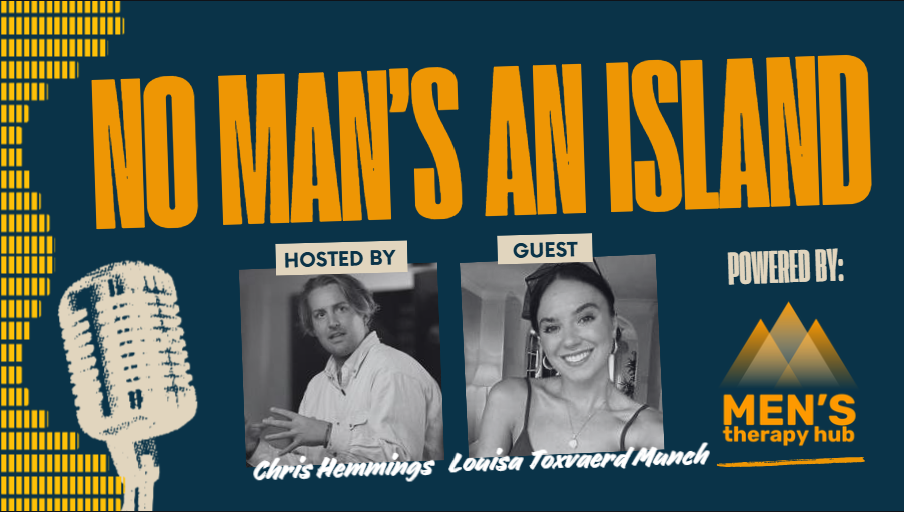
In this episode of No Man’s an Island, Chris Hemmings speaks with critical theorist Louisa Toxvaerd Munch about the social, emotional and political conditions that have helped fuel the rise of the manosphere. Drawing on her doctoral research into nostalgia, masculinity and power, Louisa offers a wide-ranging analysis of what happens when men experience loss, alienation and disconnection in a society shaped by neoliberalism and patriarchy.
What follows is a sharp and compassionate conversation about class, loneliness, anger and the search for meaning. Louisa argues that many men are not simply being pulled towards harmful online figures because they are shallow or hateful, but because they are trying to make sense of loss in a world that has stripped away work, community, stability and language. Chris and Louisa explore why figures like Andrew Tate and Donald Trump can appear powerful to wounded and disconnected men, how misogyny can become a false answer to real pain and why shame will never be enough to bring men into healthier conversations.
What emerges is not just a discussion about the manosphere, but a deeper examination of how economic systems, social collapse and emotional isolation shape men’s lives. It is also a call for compassion, critical thinking and new spaces where men can talk honestly about what they have lost and what kind of future they want.
What we cover
Louisa’s 30-second explanation of how the manosphere emerged
How nostalgia, masculinity and loss are linked
What critical theory is and how it helps us understand power
Why capitalism and patriarchy must be examined together
How neoliberalism reshaped work, status and identity for men
Why the collapse of community spaces has left many men feeling powerless
The emotional appeal of strongman figures like Donald Trump and Andrew Tate
How misogyny can become a scapegoat for deeper pain and disconnection
Why loneliness is about more than simply being alone
How father figures, authority and fascist politics can become psychologically seductive
What football culture reveals about class anger and emotional repression
Why white working-class boys are too often ignored in progressive spaces
The difference between self-esteem and self-worth
Why compassionate conversation works better than blame or shame
How education could help boys and men build critical language for their experience
Why mental health must be understood as a political issue, not just a personal one
Listen and watch
🎧 Listen to all episodes here: No Man’s an Island
🎥 Watch on YouTube: No Man’s an Island
🎧 Listen on Apple Podcasts
🎧 Listen on Spotify
Takeaways for men
Feeling lost or angry does not make you broken, but it does matter what you do with those feelings.
Loneliness can exist even when you are constantly surrounded by people or online all day.
Quick answers and strongman figures often appeal most when life feels uncertain or powerless.
Misogyny and scapegoating do not solve pain. They only move it somewhere more destructive.
Real strength may begin with having language for what you have lost.
Compassion and challenge can sit side by side. Men need both.
Your struggles are not only personal. They are also shaped by the world you are trying to survive in.
There are healthier ways to seek belonging than chasing status, dominance or certainty.
Quotes to share
“Nostalgia is simply about loss.” – Louisa Toxvaerd Munch
“You’re only nostalgic when times are bad. You’re not nostalgic when the future looks bright.” – Louisa Toxvaerd Munch
“When you feel powerless, it’s a very dangerous feeling.” – Louisa Toxvaerd Munch
“They are so close to illuminating the system that is oppressing them.” – Louisa Toxvaerd Munch
“We need to create a space where it’s acceptable to talk about your feelings.” – Louisa Toxvaerd Munch
“Patriarchy is not masculinity. It’s a power system.” – Louisa Toxvaerd Munch
“Mental health is a political issue. It needs to be re-politicised.” – Louisa Toxvaerd Munch
“We’ve all lost under this system because it creates winners and losers.” – Louisa Toxvaerd Munch
Why this conversation matters
This episode gets underneath a question that is often handled far too simply: why are so many men being drawn towards the manosphere, reactionary politics and online cultures of grievance? Louisa Toxvaerd Munch brings a perspective that is rarely included in mainstream discussion. Rather than treating this purely as a story about toxic influencers or individual moral failure, she places it in the wider context of economic collapse, emotional isolation and the disappearance of collective life.
That matters because many men are not entering these spaces from a position of confidence. They are entering from confusion, loneliness and loss. They may feel shut out of older promises about work, status and identity, but lack the language to describe what has changed. In that vacuum, simple answers can become extremely powerful. Blame women. Blame immigrants. Blame social change. Blame anyone except the system itself. That is where the manosphere becomes so dangerous. It offers certainty and belonging, but only by deepening alienation.
One of the most useful parts of this conversation is the distinction between understanding and excusing. Louisa is not defending misogyny or far-right politics. She is asking what conditions make them appealing and what kind of emotional and political failure allows them to flourish. That is a far more useful question than simply deciding who is good and who is bad.
The episode also speaks directly to something many men feel but struggle to articulate: the fear that worth is conditional. If your value depends on income, status, toughness or success, any loss can feel existential. That helps explain why some men cling so tightly to rigid performances of masculinity and why stepping outside them can feel unbearable. As Chris points out, the performance itself can become psychological torture.
What makes the conversation especially strong is that it does not stop at critique. It points towards alternatives. Men need spaces where they can talk honestly, think critically and feel less ashamed of their vulnerability. They need compassion without being patronised and challenge without being humiliated. They also need a culture that sees mental health not just as a private struggle, but as something shaped by economics, class, education and power.
This episode is valuable because it invites a fuller picture of men’s distress. It suggests that if we want healthier men, safer communities and a more honest politics, we have to look beyond individual behaviour and ask what kind of world men are being asked to live in.
Resources and links
Louisa Toxvaerd Munch – Instagram
Men’s Therapy Hub – Find a Male Therapist
No Man’s an Island – Podcast archive
Episode credits
Host: Chris Hemmings
Guest: Louisa Toxvaerd Munch
Produced by: Men’s Therapy Hub
Music: Raindear
TRANSCRIPT:
Chris (00:00)
Welcome to No Man’s An Island, a podcast powered by Men’s Therapy Hub, a directory of male therapists for male clients. Now, a few weeks back, there was a lot of content being made in response to the Louis Theroux documentary on the Manosphere. A lot of it, understandably, focused on masculinity, psychology, and the perils of social media itself. And I was on one of my rare Instagram doom scrolls. I came across the critical theorist, Louisa Toxved Monk, who was articulating something I’d been thinking about for a long time, but…
didn’t really have the knowledge or courage to pull together into a coherent take. So, had to get Louisa on. Hey, Louisa.
Louisa (00:35)
Hi! I like how you pronounce my name! That was expert and well done! Dear! No way.
Chris (00:40)
Yeah, got a Danish wife, you see, makes it much easier. Yeah, yeah, yeah.
I asked her how I should pronounce it. I’ve also done my A2 Danish, so you know, I’m on my way to learning. Yeah, thank you very much. Your take on this has been brewing for a long time because you wrote about this in your doctoral thesis. Now I’m gonna put you on the spot here a little bit, because I don’t wanna do it in justice.
Louisa (00:50)
my god, I’m so impressed.
Chris (01:02)
So before we get properly started, can you give us your like Instagram pithy 30 second explanation on how you think we ended up with what has now been determined to be the Manosphere?
Louisa (01:14)
Yeah so this is good practice actually for my viva, I’ve got it in a few weeks. But my PhD is actually about nostalgia and nostalgia and masculinity in the banister is so linked because it’s regressive. These men are harking back to a story about masculinity that they’re telling themselves and it’s one about patriarchy, it’s about domination and
That is the nature of nostalgia, is looking back to the past, but it’s… you’re only nostalgic when times are bad, you’re not nostalgic when the future looks bright, you only look back when you can’t see a future generally. And it’s always about loss. Nostalgia is… is simply about loss and what has been lost is how men can define themselves within capitalism because ultimately…
capitalism patriarchy has always been intertwined and we know this because the man has always been seen as the provider and things like that and then when that story starts to wane and it doesn’t work anymore we know that if you work hard it’s very difficult to do well that story isn’t holding up for a lot of men then what happens is that that feeling of loss is internalized because the identity
and capitalism for men is so intertwined and it’s really tragic because they don’t have an outside. know, they generally, especially white men haven’t seen kind of this level of oppression under a system that is meant to historically benefit them. So it’s almost a new, a new feeling for men and especially
working-class men because working-class men used to have like social clubs used to have like football clubs you just go to the pub like the public house to talk about issues so about social issues talk about politics but now nobody believes in politicians we don’t have those spaces because obviously they’ve been financialized and who’s who’s going to watch Manchester United unless you’re like absolutely wadded these days exactly
Chris (03:22)
Loaded. Yeah.
Louisa (03:24)
So all these spaces where men could go and talk about how they felt and feel empowered now have been removed and they feel powerless. And when you feel powerless, it’s a very dangerous feeling because we, people look to anything that looks powerful because it’s what they lack. And they think that, you know, Donald Trump will embody that or Andrew T, you know.
Chris (03:46)
Yeah. Okay. So the first lesson here is, with, an academic, when you say 30 seconds, expect them to take five minutes. No, it’s all right. It’s all right. It’s great because I, I, I can’t explain that in the way that you did. Right. I, and because the way that you understand this is because you are trained as a critical theorist. And I want to ask you, first of all, it’s like a different question than I usually ask at the start of this, which is, I think people have only heard of critical theory in
Louisa (03:51)
I know. ⁓ god.
Chris (04:12)
backlash to critical race theory in the US and At least that’s what I that’s how I heard first heard of critical theory. So can you explain what critical theorist is and What is it about critical theory that has allowed you to Understand this in a way that perhaps other ways of viewing this might not
Louisa (04:15)
yeah.
Mm.
So critical theory sits in the middle of like all the disciplines basically. It’s in between psychology, sociology, I’m in an English department so I teach English literature and critical theory yeah. It’s also in anthropology, it’s part of the sciences like the social sciences but also the arts if you do history you’ll do critical theory so if you do yeah it’s very interdisciplinary.
Chris (04:43)
Okay, right.
Louisa (04:58)
but it’s about challenging power. So it’s looking at the links, the fabric of society and how power manifests and illuminating power. it’s, I mean, it’s close to philosophy because it’s about asking questions, but where philosophy is about asking like how and why, critical theory takes it that next step to praxis. So…
It’s almost like philosophy with a conscience. I like to think of it. It’s about what do we do with this knowledge and how do it’s all about emancipation, basically like freedom. And yeah, that’s why I like it. I find it really empowering.
Chris (05:25)
Mmm, I like that, Mmm.
And understandably then if you’ll focus on power that you will be focusing on capitalism and or patriarchy, which is a term that I I’m always interested in kind of understanding better. But also with that, we’re often talking about, you know, the small percentage of men at the top of capitalism who are making the rules, right? So what was it that you were seeing when you first entered into this space that made you want to look specifically at capitalism in terms of critical theory, but also to look
Louisa (05:46)
Mm-hmm.
Mm-hmm.
Chris (06:03)
within your PhD about the impact it’s having on men.
Louisa (06:07)
Well, we live in a capitalist society so there’s like everywhere you turn if you’re critiquing power, power is money and it’s everywhere. Even our social relations now are mediated by finance. Like the first thing you ask somebody when you meet them is, what do you do for a living? You know, so it’s everything, yeah. And everything is tied, even your worth, you know, is tied to what you do as in what you do in your labor.
Chris (06:24)
hate that.
Louisa (06:32)
what do you do for work? What do you do for money? And we’re sort of living now in like the extreme version of that where we construct an entire view of our worth and value on social media. think so. I think, I mean, you can’t study sort of philosophy or theory or ask how we make about world without understanding the economic system that basically controls everything.
So I mean, capitalism, neoliberalism, whatever people wanna call it, like it’s just about looking at how economics affects the social sphere as well, how it affects people. Because if you go and study economics, you won’t do critical theory, which is crazy because it’s like, it’s numbers up here and it never is reflected onto like wealth inequality, for example. You’ll learn about how…
finance works but you won’t learn about how we have a system that is essentially making sure that poor people are getting poorer and the wealth getting wealthier so it’s
Chris (07:32)
So
wait, they don’t do the political aspects on economics degrees. Wow.
Louisa (07:34)
No. No. And it’s a big thing. There are a lot
of projects and groups that are trying to make their curriculum and the syllabus more about social issues and feed them through. But I think Gary Stevenson, Gary’s economics, he talks a lot about that as well. And he went into city bank trading. Izzy. We’re quite good friends, so I’ll put a good word in for you.
Chris (07:54)
He’s on my dream guest. Yeah. Yeah, yeah, yeah.
Very nice, that’ll
be good.
Louisa (08:02)
Yeah but he talks a lot about this that you know it you don’t get to really understand what what the economy is doing to people without well in a university you have to either well in economics I suppose you do if you do like the humanities but it’s about understanding how it’s affecting people’s lives every day you know
Chris (08:26)
Mm. Yeah. And so as I said in the intro, like when I was having one of my very rare doom scrolls around the time of the… There was just so much content about the Manosphere and I just could learn so much from so many different people’s takes on it because I had my take, but my take isn’t the right take. It’s just a take out of, well, billions these days. But… ⁓ So my take was that what we’re dealing with here is a load of wounded men who are now given…
Louisa (08:38)
Mmm.
What was your take?
Mm-hmm.
Chris (08:53)
a platform to project their wounds onto equally wounded men. But all it is, it’s the schoolyard bully. But it is the schoolyard bully en masse because now they can bully people into, you know, it’s the cool kid at the party who says, well, I’m smoking weed and I’m hooking up with the hot chick. So if you smoke weed, you will too. And so then all the boys are smoking weed, even though some of them are whiting and throwing up in the corner. But like they’re doing it because they want to be cool. And all it is, is just playing on insecurity. But you can do that now on a
Louisa (08:57)
Mm-hmm.
Mm.
Mm-hmm. Mm.
Mmm.
Chris (09:21)
mass scale, right? And those wounds are coming from exactly what this question I’m going to ask you about now, which is the point that you determined the ills that men, and not just men, I know because you used the term neoliberalism and that’s not just affecting men, but men up until the mid-80s-ish, early 90s probably, it was still even for working class men. It was still quite easy.
Louisa (09:23)
Mm-hmm.
Mm-hmm.
Hmm.
Chris (09:49)
for men to hit what I have coined this term, think, I’ve never heard anyone else use it, the markers of esteem, right? When we’re trying to think about someone’s self-esteem, not their self-worth, their self-esteem, it is, doesn’t matter even if I’m on a low paying job, I can still afford the two up two down house. can have some social stability, right? And maybe I can afford to go on a beach holiday, you know, even in the UK, I could do something for my family, but at least I can have that security.
Louisa (09:54)
Mm-hmm.
you
Mm.
Chris (10:17)
Now,
this term neoliberalism, and I don’t know if everybody knows what it means. So can you give us a brief history of that and also explain how you see it that that fired the starting gun for where we’re at today?
Louisa (10:23)
Yeah.
Yeah, okay, I’ll try keep this one brief. So, all right, okay. God, right, okay. So after World War II, we had a different type of economics. It was called Keynesian economics and that’s when we got the NHS. We had all this social housing. People in the 1950s, 1960s generally could have a council house, a social house, whatever.
Chris (10:32)
you don’t have to now. No, now is a full podcast. The intro is just a 30 seconds. Yeah.
Louisa (10:58)
we had all these basically like public goods, know, we owned the state, we had a bigger state, so the state owned healthcare, the state owned industry, these are things. And where we had all these like blue collar workers and communities, so like mining, steel work, stuff like that in the 1970s. So there was a few different reasons why Keynesian economics like sort of crashed and it was…
do with the peak oil and the gold standard. it was like quite a complicated complex situation but it meant that it really faced a crisis. and neoliberalism was an idea. so after world war two there was neoliberalism was sort coined by this guy called Hayek and Friedrich Hayek i think he was austrian guy and he talked about how there are
people who should lead and people who should follow. There are people that will win and there will always be losers. And it was a completely competition-based system. And that’s what neoliberalism was about. It was, the markets should have the most freedom, whereas socialism, which is, you know, about freedom for, like, as a collective, is the worst thing possible. And it’s gonna lead to everybody feeling unfree and all the rest of it.
So when Keynesian economics crashed, another idea that was around was neoliberalism that Margaret Thatcher, had read Hayek, who’d read his famous book, The Road to Serfdom, was her favourite book, she carried it around everywhere. She had this new idea, was like, I’ve got a new economic plan and actually Milton Friedman as well, he was also constructing this over in America in the Chicago school.
And his famous quote was, in times of crisis, the new order will be established from the ideas that are lying around in the ruins. And that’s what neoliberalism was, but neoliberalism, sounds great, doesn’t it? It’s like new freedom, but it’s not new freedom for people. It’s new freedom for the markets. So what this new economic plan was, was to remove, move power from the state.
which is essentially us, to finance and allowing the markets to control everything. So the invisible hand, there’s a sense that the markets know better than we ever could. The algorithms know better than we ever could. We need to give the power to the market. So she started deregulating all of the markets. She’s sold off all of the industries. So we no longer owned industry in this country. Obviously it was all, you know, moved elsewhere.
and we had like globalization and that at the time meant that if you were in this sort of it was like a small opening where if you had a bit of money then you could buy your council house all of a sudden you know like working-class people like sorry I can’t hear you
Chris (13:59)
I coughed. The expanding middle class.
Louisa (14:01)
Yeah exactly so there was this social mobility window and people were able to buy their house, people were able to you know have their own assets and it also became important because she wasn’t going to build any more social housing it was very much this idea of there are going to be winners and there are going to be losers and if you didn’t get on this train back in the 1980s you’re sort of in trouble now and it’s quite possible you will never get on that like housing market.
ladder and but what she said which i think is really important with neoliberalism is economics is the method the goal is to change the heart and soul and she did that because she created the age of the individual she created the age of everything is about the self and it’s interesting when you when you talk about like esteem markers because to me i think well what is esteem
Esteem is related to the self. It’s this like sense of identity, of power, of autonomy, of agency maybe. those sort of things when you say about like housing, I’m sort of on the side of those should be a given in society. If we have a state, if we have a society, then you should be entitled to housing, healthcare. Exactly, exactly.
Chris (15:17)
Well they were.
Louisa (15:20)
But she made it into this thing of some people deserve this and other people don’t. So obviously down the line we have benefit street, we have people mocking other people for not having wealth or of not getting on this social mobility ladder and things and to be fair I think it’s probably the root of most of our problems now but in 2008 her economic plan, neoliberalism, crashed.
That crisis, yeah, it failed. And since then, like Milton Friedman said, the new order will be established from the ideas around crisis. No new ideas have come about or, know, supposedly nobody has picked them up. So now we’re living in this kind of like constant crisis because it’s already failed, you know, it’s over. And we’ve seen this like nostalgia and melancholy.
Chris (15:47)
It failed, yeah.
Louisa (16:12)
and regression because no one can see a future because there were no, she kept saying it shit, there’s no alternative. There’s no alternative. So that was my short history.
Chris (16:18)
Yeah. Yeah. And, that, yeah,
and I like that because that nostalgia part, I think is the bit that, it really spoke to me in terms of what we’re not talking about when it comes to, of course this podcast and our work is about identifying and challenges with men, right? And that nostalgia part, you spoke about it before is it used to be so easy for men. and, and I will challenge because I think we’re
Louisa (16:36)
Mmm.
Mm-hmm.
Chris (16:43)
What you said before was that the esteem markers was about the self. Well, actually there’s a difference between self-esteem and self-worth. And esteem is how we are perceived by the world around us. know, it’s the, it’s the, when you’re a kid, you have that little trophy shelf, right? With all of your certificates on that gives you esteem, right? But if I was to take all of those away, aren’t you still a good kid? You know, you’re not a good kid because you finished first at maths or because you got a bronze medal in the sack race.
Louisa (16:50)
Mmm.
Yeah.
Chris (17:11)
You’re a good kid because you’re a good kid and you’re deserving of love regardless. And so that’s what socialism is, right? And the reason that I got your name right earlier is because regular listeners will know that I live in Denmark and Denmark is still capitalist, it’s like socialism light. And I pay a fuck ton of tax, like an insane amount of tax. I, well, I see where it goes, right? I see on the streets, you have to kind of choose to be homeless here.
Louisa (17:11)
Mm-hmm.
Yeah.
Yeah. But what do you get for it? Exactly, erm…
And yeah.
Chris (17:40)
It’s kind of absurd. And so this individual responsibility was always going to end with the losers, like you say, right? But then there is this, because I’ve been thinking about this a lot in the build-up to coming on, there’s this idea of like loss aversion, Which is that actually the theory is that it is more painful to lose than it is to never have had. And so there’s this, so there is this great
Louisa (17:55)
Mm-hmm. Yeah.
Yeah.
Chris (18:07)
quote that I use when I talk in businesses, is, you’re used to entitlement, equality feels like oppression. And what we forget there is it’s been used by like a lot of feminist thinkers understandably to say, you see, but you’re not oppressed. But the thing is, no, but it still feels like oppression. And then we’re not talking to the working class. We’re not talking to men about this felt sense of loss. You know what Michael Kimmel calls the aggrieved entitlement.
Louisa (18:11)
Mm-hmm. Yeah.
Mm-hmm.
Mm-hmm.
Yep. Yep.
Chris (18:35)
Right? We’re not talking to men about that. Instead, we’re just saying tough shit. And it’s why we have people in that Manisfair documentary who are homeless, chasing the dream in Miami, desperate, so desperate to make it. Because the only way that they feel like they can survive in this world is if they make it big. And, go on.
Louisa (18:43)
Mm-hmm.
Mmm.
Yeah.
And it’s where this… sorry.
It’s where this misogyny comes in as well because I think that, you know, it is the sense of loss and it’s lost without a go- without a way out, you know. It’s a melancholy I suppose and because we don’t have a language and men typically don’t have a language and don’t even have the means to construct a language about these feelings then that sort- those feelings
need a way out, you know, it’s like death drive, like they need a place to go and that the perfect place for it to go, the most satisfying place sort of psychologically, I guess, is a scapegoat and often women become that or, you know, that’s why we see all this like scapegoat of homophobia on in the Louis Theroux documentary and it’s because it’s all this loss is so internalized, it’s so destructive to them.
they need an outlet to put it somewhere else. They need to define themselves against something else. And I think it’s tragic because they are so close as well to creating this language. They’re so close to illuminating the system that is oppressing them inherently. And just before they get to the point where they’re like, it’s, know, capitalism or it’s this economy or it’s a socioeconomic system, whatever.
they just create a simple answer. It’s a conspiracy theory isn’t it? It’s like it’s the women or it’s you know choose whatever group and obviously I do critical theory. Critical theory is about asking what the right question is not what is the answer and it’s it’s also all about compassion like academics generally I’m so used to being critiqued but it’s so productive it’s so nice to hear people challenge it because you’re like I don’t think of it that way but
Chris (20:21)
Mm-mm.
Louisa (20:43)
when it’s constructed within the ego, can’t, you’re not thinking about these questions, you’re just desperate for the right answer, then I think we get these issues and it’s tragic because I just think like if we had this way of educating young boys and men into talking about their oppression and what they’ve lost and what kind of future they’d like, then maybe we wouldn’t have this system.
Chris (21:07)
And you said that they’re so close to having the language. I’ve seen on your Instagram, you are as close to calling for revolution as you can do without being arrested these days, right? But we seem to find it so difficult as a species to come together these days for a common good. Because what you’ve just articulated there, like I can easily sit here and point out the three and a half thousand billionaires in the world and be like, guys, what the hell? Like, instead men blame feminism.
Louisa (21:10)
Mmm.
I don’t know.
Mm-hmm.
Chris (21:33)
Women blame toxic masculinity, the right blames immigrants and trans women, and the left is continually eating itself up in a game of who is more progressive. And then we fail to come together in a meaningful way, right? And so actually, here’s where I go back to something that you said at the start, which is you used the word patriarchy. I would like you to kind of extrapolate a little bit what you consider the patriarchy, because I think for a lot of people in my sphere, it can be a dirty word.
Louisa (21:38)
Mm-hmm. Yeah. That’s how we want.
Yeah.
Mm-hmm.
Yeah.
Chris (22:01)
But actually when I now think of patriarchy, those three and a half thousand billionaires who are buying up everything to, know, Jeff Bezos owning the Washington Post, right, is just an example. That’s patriarchy like modern day version because I don’t get to control everything in my marriage and you can meet my wife and she will tell you that, right? Like I don’t want to, that sounds like a lot of effort.
Louisa (22:11)
Mm.
Mmm.
Chris (22:24)
But like there are still mostly men who are fighting to control everything because to me, patriarchy is the tiny, tiny percent of men at the top. It’s not the white working class boys struggling in school. They are not a representation of the, they are victims of.
Louisa (22:32)
Mm-hmm.
mm
yeah i think it’s interesting because i mean i think where you’re using the word patriarchy you’re talking about like ruling class men and patriarchy isn’t a particular person it’s not a particular group of men it’s just a power system and you know it’s it’s it’s the same as capitalism it’s like capitalism isn’t just billionaires and rich people it’s also like
poor people, it’s middle class. It’s a social fabric rather than a particular person. It’s not something you can point to. It’s like, I have a problem with people saying like, it’s all the billionaire’s fault. Like it’s not, it’s not billionaire’s fault at all. It’s a system that has allowed them to be in that position. And the patriarch is the same. It’s no man’s fault that this is, probably, I don’t know, take it back to some guy in like…
Roman times or whatever. Yeah, but it’s nobody’s fault and it’s oppressive both to men because it means that they have to define themselves within this system and it’s really interesting to me because women have always been seen in patriarchy as the other. So like there’s all this kind of literature about like the second sex and you know, but it also means
Chris (23:36)
Rome, yeah.
Louisa (24:01)
that we can reconfigure our identity because the system is so obvious to us. We are the oppressed one in patriarchy and men, because they are told a story about that they have like a God given right to to certain powers or whatever, that’s the kind of story of patriarchy. Then when…
that is lost or when that is waning or taken away, they can’t define themselves. it’s because women have, they’ve had to think about their identity in opposition to something that like an alienation, when men feel alienated, it’s alienated within a system that’s meant to help them. And that’s even worse. that’s, you know, and that’s why I think, you know, at this point in like history,
Men are being oppressed doubly than women are under the patriarchy. my God, don’t clip that and that in.
Chris (25:06)
I was just thinking that as you were saying it, like I would like to, why not? Tell me why not.
Louisa (25:10)
Let me, let me, because, because ultimately women have spaces to talk about this alienation. They have always created spaces to, we call it in, in like theory, we call it Eros, which is the life drive where you feel really alienated, feel really shit, then you get…
Chris (25:19)
Yes.
Louisa (25:32)
you can either be self-destructive, you can internalize that, that’s the death drive or you can make something good out of it, you can be productive with it so you can make art, you can make symphonies, you can talk to your friends, you can go to therapy so there is a space where you can make this feeling of disenchantment, disillusionment, oppression into a space that is productive that allows you to transgress the oppression men don’t have that, men have been told they don’t need that
So it’s like in Fight Club, know, instead of just going to therapy and, you know, talking about his feelings, he creates a place where he can self-destruct and destroy others. And exactly, and internalize in this, and that’s what the death drive is. It’s like this drive to destruction of both the self and the other, because you simply cannot place this, you cannot transgress this oppression.
Chris (26:11)
Externalize. Yeah.
Mm.
Funny because I was thinking as you were saying that that would be a really interesting clip to put out. But what you’re saying is, correct me if I’m wrong, What you’re saying is that we are never, and on this podcast I have never nor will I ever say that women don’t need support in many different areas. And so do trans and non-binary people. of course, like I hate that we have to caveat. And the fact that you even were worried that I was going to clip that up.
Louisa (26:30)
God.
Yeah.
Yeah.
Chris (26:54)
which I won’t do by the way, I’m gonna leave it in the podcast but I won’t clip it up, is testament to the fact that we are so scared of advocating for men, we are so scared of saying that men are struggling and men need support, which is why this podcast exists. And yet for a, I’m assuming relatively youngish still woman, right? It’s still not even your generation, I know it’s becoming slightly more popular.
Louisa (26:54)
Mmm. Okay.
Yeah.
Mmm. Yeah.
Chris (27:18)
It’s still not popular. I’ve had like third wave feminists in schools all but cancel me for daring to say the reality that 16 to 25 year old boys now earn less than 16 to 25 year old girls. And that is something that we need to be aware of and understanding of because that doesn’t fit in with what has been, again, understandably the narrative for decades.
Louisa (27:33)
Mm.
Mm-hmm. Yeah.
And I think, you know, it’s important to say that ultimately women are being killed in, you know, under patriarchal society. Like a woman is killed every two days by their husband, by their partner. So in this sense, obviously, women are oppressed in a different, in a very violent and real way, but
Chris (28:04)
Yes.
And our men also oppressed in a violent way by each other. And this is the thing, I don’t like to do the them and us thing, it’s everyone is suffering under this.
Louisa (28:10)
Yeah.
Yeah, exactly. And that’s why I’m trying to define this patriarchy through a lens of power systems that is basically destroying everyone at like the planet, each other. Like it’s not masculinity. Patriarchy is not masculinity. And I think that’s where it gets confused and you know, is it these boys? Is it these boys? It’s a power system. it means that…
basically men, particularly white men, because it is again, it’s a white supremacist, know, patriarchal capitalism have felt that they are entitled to the domination of the planet, of extracting and exploiting, you know, the planet. So, and that extended to women, to anything that is outside of this construction of like a patriarchal masculinity, which isn’t being a man.
You know, it’s a story, it’s a myth about what manhood should be about when it’s alive.
Chris (29:18)
And the irony of all of this for me is that everything we’re talking about, neoliberalism, the patriarchy in the way that you defined it, and I like how you define it actually, because it doesn’t come from a place of just speaking ill of men. It is about the system and structures. Because I think sometimes we can hear, you know, like, you know, the patriarchy, all men are responsible for it. And it’s like, hey, what have I done? Like, you know, I’m a therapist. you know, but the irony for me is that it’s the working class.
Louisa (29:32)
Hmm.
Chris (29:43)
have suffered the most. And I live in a country where there isn’t much of a class system, but I come from a country where there’s a very clear defined class system. And it is the working class who lost out on neoliberalism and all of the factories and the mines were sent abroad, all of the manufacturing left, all of the wars that were fought, all of the colonialism. Those were working class men that were going fighting and dying for money that they were never, of course they were benefiting in some ways, but never really benefiting from.
Louisa (29:44)
Yeah.
Yeah.
Yeah.
Mm-hmm.
Hmm.
Chris (30:11)
And it’s the white working class boys that I worry about the most. It’s the young men who don’t have those jobs anymore. They don’t have the, you know…
Louisa (30:15)
Yeah. Yeah.
Yeah, and who’s
speaking to them? Who is speaking to them? And this is what I get so frustrated about on the left because nobody is talking to these white working class men and it’s like the only person, exactly, the only person who’s doing this is Andrew Tate, Nigel Fraz, Donald Trump, and we have to create a space where it’s acceptable to talk about your feelings because what they are doing is just manipulating and exploiting.
Chris (30:30)
Or forageous?
Louisa (30:46)
boys and men and the sense of loss, you know, it’s, they are exploiting the patriarchy and that’s all they can offer. They can offer just more harsher patriarchal systems that are going to make them feel more alienated, that are going to make them feel more lonely. And it’s a self-fulfilling, self-destructive, it’s honest, it’s so tragic that they are being herded into this space where…
it’s only gonna lead further. This is what the Manosphere is, you know, the Louis Theroux documentary. Like they will only feel more lonely the further they get from what they have really lost. yeah, you know, they really, all they want is to feel understood, to feel recognized, to feel loved. To see, yeah, exactly. And the, it’s just terrifying because if we don’t have a way of…
Chris (31:28)
Scene? Yeah.
Louisa (31:36)
creating space on the left or anywhere that is basically not patriarchal. I don’t even care about what we call it anymore. Just anything but like what we’ve got and where we’re going, you know? yeah.
Chris (31:50)
And you’re
very incensed and angry by this and I love that. And I think there’s not enough space on the left of politics to be angry because do you know what? Do you know what the right and like far right fascism allows? It allows vitriol, it allows anger. And on the left, it’s what I said in my intro, was it my intro or near the start, which is that the left has this like, who’s the most progressive contest. And if you’re standing in a room and you’re getting angry,
People are like, ooh, you shouldn’t be getting angry about it. We have to be kind and to each other. And it’s like, I admire your anger. I can feel your anger. I also admire your accent because I’m from a nearby town. So it’s good to hear that. It’s good to hear an angry man accent being celebrated on social media. Yeah, tell me about it. I’m six foot three and I shout in Mank and people are terrified of me. But there’s a lot to talk about with loneliness, right? And we are talking here about the law of
Louisa (32:21)
Mm.
It’s quite scary.
Yeah.
Mm-hmm.
Chris (32:46)
Demagogues right and you could even like Andrew Tate is a form of demagogue right these these people who are presenting themselves as the saviors of whoever and What is it about those spaces because I know you’ve talked about this before about? The the pull for those men who are lonely right now and there is I know it’s been overused to the male loneliness epidemic right, but there is
Louisa (32:54)
Mm-hmm.
Mm-hmm.
Chris (33:08)
a growing sense of loneliness. Just generally in society there’s a lack of connection. We think because we have mobile phones we’re connected to each other and we’re spending less and less time face to face as humans. And I understand the irony that I’m recording this online with you. don’t, like I get that. Yeah, fair enough. I technically do and I hate it. But your work links loneliness to the rise of the far right. So what is that link? How do you see that?
Louisa (33:21)
Yeah, but I do TikTok, you know?
Well, so loneliness is different to being alone. Like loneliness is feeling that you can no longer connect with other people and connect with the world. So you can be surrounded by people. Social media, for example, is this kind of space where people feel lonely, but we’re surrounded and completely connected to people all of the time. And this is actually Hannah Iran, if anyone wants to read more on this, but she talks about how
you know, when we lose connection to the world and you can no longer, you can no longer remove yourself. So you can no longer have that like solitude to think critically, which is so important. Everybody needs space to think about things. So now we’re just bombarded with information all of the time, TikTok, the news, whatever, it’s just constant. And it’s not encouraging you to think about these things, it’s encouraging to digest them.
even the way we talk about social media, like binge watch, know, binge watch is like this insatiable, just consuming of whatever it is, TV, culture, instead of actually grappling with issues, thinking critically about things. So we need space, but then on top of, after you’ve had space to think and sort of understand your own position in relation to what you’re hearing, what you’re seeing.
Chris (34:32)
Mmm, yeah.
Yeah.
Louisa (34:56)
online or whatever it is, you also need a community for other people to challenge you. You need the other. You need that alienation to help you better understand the world but also feel recognized within the group. And that’s, we have neither of those things now. So that creates this deep sense of not only loneliness but like, lots of understanding of things. There’s like this lot of sense of understanding the truth or being able to tell a story about where we’re going.
or feeling empowered in knowledge and then you in the same vein you’ve got this like anti rise of anti-intellectualism where we don’t trust experts and we don’t trust you know the university exactly yeah so all this combined creates this sense of you cannot be in the world like you don’t understand yourself in relation to the world anymore and when
Chris (35:36)
fucking Michael Gove.
Louisa (35:52)
you do that then you become well you become extremely lonely but you also because you are looking for somewhere else to feel empowered and a lot of that time a lot of the times it can be this patriarchal father figure which men generally you know that’s that’s what is always looked for within patriarchal capitalism is the father figure and then obviously we have people like all you know all fascist regimes have been
patriarchal father figures, Hitler, it was the fatherland, know, return to the fatherland. So it’s this sense of lack of power, but it also puts it somewhere else and it’s like, well, this guy has the power, which means like vicariously I have the power. And if I support him, then that’s what I get. So it becomes a very slippery slope to fascism when we have this society that can’t think critically, but also can’t…
Chris (36:42)
Mmm.
Louisa (36:47)
feel that it’s safe to explore ideas either.
Chris (36:51)
Just reminded me, I went out the other day and one of my probably coolest friends, Freya, had a pin badge that said, cool people don’t have a fatherland on it in German. Yeah. So yeah, exactly. But it is that. And I think that is what is so enticing, right? My colleague Will, who now runs empath, he talked about the influence, the masculinity influence that he was first drawn into in the Manosphere. It was because he was a pseudo father figure.
Louisa (36:58)
I love that. Love that.
Mm-hmm.
Chris (37:18)
And I go back to what I said at the start is about it’s wounded men, right? It’s wounded men because, so here’s a fresh take from me, right? So I’ve talked about this part before, which is what we’ve done with the kind of concept of manhood and masculinity is we’ve scooped out the old way and said, we need to not be like that anymore. And then what has been left behind is a vacuum because nobody has said, and here’s how it should be, or here’s how it can be.
Louisa (37:18)
Mmm.
Mm-hmm.
Mm.
Chris (37:47)
Or you can be it in whatever way you want. It was just don’t be like that. So then what happens in a power vacuum, any historian will tell you, is nefarious characters creep in, right? But when you do that on a personal level, if you’ve had a kind of destructive family life, if you’ve had a dad who is not around anymore, and I know there’s such a pushback against, we shouldn’t blame fatherlessness for the plight of men. And it’s like, well, actually, I’m sorry, but all of the research shows that
Louisa (37:51)
Mmm.
Mm-hmm. Mm-hmm.
Chris (38:14)
Kids who don’t grow up, like boys who grow up without fathers have lower life chances. There’s just, like, evidence.
Louisa (38:19)
Yeah, but
also it’s because we have a story about the nuclear family in Western society. you know, maybe it would be different if you’re from a society where children were brought up by a village of people and by communities. Yeah, and you know, that’s probably a better way to live anyway, you know, it’s not…
Chris (38:33)
by village, Yeah.
Louisa (38:38)
don’t think we… the patriarchal capitalism that we have isn’t conducive even within a nuclear family setting necessarily but because we tell boys a story about fatherhood as well and that fatherhood is almost like the pinnacle of like power and things like that and it is a lack you know so yeah i think it’s yeah there’s there’s a lot to sort of unpack and explore in that idea of
father figure because he becomes just the externalization of the loss, he becomes the lack that’s placed somewhere else that you know you feel like a connection to.
Chris (39:12)
Yes,
exactly that. And because if I’ve grown up in an environment where, and I see this with clients, where my father is destructive or he doesn’t praise me or he doesn’t make me feel worthy or he’s just, he can continually let me down. First of all, that boy can grow up into a man who doesn’t know his own worth, but then suddenly, and he hasn’t felt worthy, maybe he hasn’t felt confident with hitting on women or getting jobs or whatever.
Louisa (39:22)
Mmm.
Mm-hmm.
Chris (39:39)
And then suddenly someone comes along and say, I’ve got the answer to your problem. Well, they don’t have the answer to your problem. They have the answer to their own problem, which is pay me 50 quid a month into my hustler’s university or whatever it might be. Right. And I’m going to show you that you can get rich and that’s just a pyramid scheme. Right. And that’s all, that’s, that’s, that’s, that’s all it is for those guys. But there’s actually something like deeply psychologically smart, unfortunately about those men.
Louisa (39:43)
Mm-hmm.
Mm.
Yeah.
Mm.
Chris (40:08)
know, H.S. Tiki Toki, he even said at the end, like, he doesn’t care that he’s a bad guy. He doesn’t care. Like, and he even said, like, if I was putting out good vibes, he wouldn’t be as successful as he is. And it’s like, because what he’s doing is he’s tapping into that underlying sense of malaise that so many men are feeling. And it works. And this doesn’t, us having nuanced debate doesn’t travel as far.
Louisa (40:13)
Yeah.
Because
Mm-hmm. Yeah. Yeah.
Hmm.
Well, yeah, and it’s it’s nihilism. It’s pure nihilism. Like I look at these Manosphere guys and I look at Donald Trump and it’s just nihilism. We no longer believe in the social structures We no longer believe in economic systems. We no longer believe in politicians. We believe in nothing We believe in nothing and when like Nietzsche came up with this idea of like nihilism and stuff when you get to this point where you No, I’m believe in anything at all all that is left
all that is left to believe in is your own ego and that’s all you see you know Donald Trump it’s just the the end point is pure narcissism and you can facilitate any contradiction inside yourself because you have your ego and it’s it’s and that’s it and
Chris (41:16)
But do you believe
them? Do you believe that they don’t believe in it? Or is it like, again, on the documentary when the fresh and fit guy, his now ex-girlfriend, was like, but when the camera’s off, he’s not like this?
Louisa (41:29)
Yeah, they, what do you mean do I not believe, like what? What do mean?
Chris (41:31)
Because it’s a performance, right? Do you believe,
because they’re saying that they don’t believe in the structures of they don’t believe in this stuff. Do you believe that they don’t believe it or is it just part of their performance?
Louisa (41:37)
Mm.
Well, yeah, I don’t think they do believe in anything and that allows them if they don’t believe in anything they don’t believe in morality either. They don’t believe in right or wrong. So they don’t feel any sort of like guilt in doing it. So I think that’s where that kind of comes. But they can recognize that there are systems in place that, you know, they’re all worried that the women that they are oppressing and that, you know, they’re doing…
Chris (41:45)
Okay.
Wow.
Louisa (42:07)
you know, it’s horrendous part of the documentary but like they’re so scared that these women are gonna clock on for a second and the whole world’s gonna crash down because what they are doing
is constructing a different world for them women and for these young boys. They’re not saying let’s tear down this system and create a new one and let you know this is what we’re doing on the left by the way if anyone wants you to join me but yeah you know if anyone we don’t have to call it the left if you don’t want to call it the left like you know but
Chris (42:20)
Mm.
If anyone wants to join the left.
Louisa (42:37)
yeah instead of saying right okay let’s as a unit as in solidarity, compassionately let’s take down this system and think of a new one, it’s like let me construct this shadowy reality where we have a different inverted set of truths and it’s like the matrix isn’t it? they leave the matrix to construct another matrix rather than taking the matrix down, that’s what conspiracy theory does it just sort of it’s very much like
it pulls the curtain to the Wizard of Oz and it’s like the Wizard of Oz. They pull the curtain and they realize, the wizard doesn’t know what he’s doing. He’s not knowing what he’s doing the whole time because that is the nature of the system. The nature is a power structure. It’s not some evil person behind everything. It’s not the Illuminati. It’s literally like the socioeconomic system that we have and it’s boring, but it’s the truth.
and it’s not satisfying because it just leaves you with more questions and a complexity that’s difficult to access if you’re I don’t know, like trained in a way to access them, to deconstruct them which is why I did critical theory and I talk about critical thinking online so much because I’m like, guys, if we can just understand this is just another system and we can take it down and we can construct a new one.
and we can have a completely different system and it’s like, that’s what we’re missing.
Chris (44:02)
But we got close with masculinity, because I remember like probably in the 10 years, so I finished school 2005. I reckon in the 10 years from 05 to 15, I think there was quite a big social movement in terms of not like huge, but like reduction in misogyny, ⁓ more like social cohesion. And you know, there was the, you know, what were they called?
Louisa (44:21)
Mmm.
Chris (44:28)
the protests in Wall Street, I’ve forgotten now. yeah. Occupy, the Occupy protests, right? Like, which were all about like real socialism happening in real time, right? What I find really interesting here is, and I’m gonna pull a quote from one of your Instagram posts, and, I think it’s good, no, it’s really good, it’s really good. Which is, and what it is, before I say it, is what you’re talking about here is,
Louisa (44:30)
yeah the what’s going on occupy occupy what yeah
gosh.
Chris (44:54)
is these structures, capitalism, patriarchy, these people, the Tates, the Trumps, the Fresh and Fits, these guys, right? They are so frightened of what will happen if this thing that they have believed in crumbles, because then what’s left, right? And that’s the self-esteem versus self-worth bit as well. But what you said was, it’s mad how these men think gender is inherent and biological. They bend over backwards for the performance.
Louisa (45:03)
Mm-hmm.
Yeah, exactly.
Mm-hmm.
Chris (45:22)
And they’re so tangled in contradiction, it must be psychological torture. And that’s it. That’s it for me, is that they are so terrified of what will happen if their ideology fails, that they are constantly determined. I was caught up in it as a kind of university rugby lout. I was caught up in that. Like, this is the way that I have to be. This is the way the world wants me to be. And I didn’t know that there was any other way. And it was…
Louisa (45:26)
Mm-hmm.
Mm-hmm.
Mm.
Chris (45:48)
It was psychological torture at the time. It was also psychological torture to get out of it. Like thankfully I did in the end. I’m still working on it, but I’m getting there, right? Like it’s really difficult. And this is where our work is as therapists and particularly male therapists who want to work with men is to meet these men who come in to see us not with fire and fury, but with compassion and care to say, yeah, man, isn’t it hard?
Louisa (45:52)
Mmm.
Yeah.
Mm-hmm.
Yeah.
Chris (46:15)
to keep that mask on the whole time? Isn’t it hard to keep up the pretence? Isn’t it hard to live in a culture where you feel like nobody cares that a quote from one of my clients recently, nobody gives a shit about me unless I’m literally valuable? Like that’s how these people feel, that’s how these men feel.
Louisa (46:19)
Mm-hmm.
yeah yeah
and to go back to what i saying about like in history that you know that relatively men are having it’s psychological it’s because psychologically this this violence for for men you know obviously the violence for women is pervasive but this is a psychological violence on to men on a scale that is it’s because they’re
they are the system, they are within it. So when it’s almost easier for women to understand the system because we’re outside of it, we are the oppressed, but there’s also like this philosophy called like the master slave dialectic. And the master and the slave are both oppressed within the dynamic because the master can’t have, can’t identify himself, can not recognize himself without the slave. He’s nothing if he doesn’t have this other person. And…
that’s what we also have to understand about this power system and bell hooks she has honestly meant masculinity and love one of the best books on talking about masculinity on how exactly exactly wills change so good about you know how obviously patriarchy is affecting men and it’s it’s
Chris (47:36)
Yeah, the will to change.
Louisa (47:46)
because this violence is turned on the self, it’s so self-destructive which is why male suicides are so high and I think we need to force these spaces for men to talk about their feelings and like you said, we need to have more compassionate spaces, compassionate ways of talking to each other and you know, it’s… it is difficult, I don’t even understand, you know, sort of like the…
how women this constrictor of like i hate men and things like that what we need is to understand that this isn’t like it is a power dynamic that we can change that we can we can have a more equal society and if we have that then men and women will feel will not be oppressed under this and men need a space to redefine themselves outside of money and finance and capital and
what that story has told for them because this system has failed which means what it means to be a man and the story of what it means to be a man is also failing and we can’t dig our heels into you know into the ground and say let’s just double down on the system we need to talk about a different system of transgressing it of going beyond it of taking it down and you know that i think there are there are places that are doing that but it needs to come from
compassion and understanding and talked about what does this loss feel like to you and asking what is the next question not this is the easy answer, you
Chris (49:17)
Yeah, and the thing is is that I learned very early on that there weren’t easy answers to this because and My recollection of my history is a little vague But when I was first starting out on this journey around 2014 I asked I asked Dame Jenny Murray now late Dame Jenny Murray I asked her what book I should read and she suggested the book you mentioned earlier Which is the second sex by Simone de Beauvoir and that was probably the hardest book I ever read because it is just like thick it is It’s thick with way too many C’s right? It’s it’s so
Louisa (49:35)
Mm.
Yeah, it’s not an easy one to start with, but yeah.
Chris (49:47)
Rich and juicy, it’s crazy, right? But then I asked, I think it was Sophie Walker who launched the Women’s Equality Party a year or so later. She said to read the Bell Hooks book, The Will to Change. Because what was interesting about that was, I then got like, here’s the thick, rich feminist text, but then, wait, this is also feminist? Wait a second. And I’ve been kind of taught that feminism is something that’s for women and like, here’s a black woman in the US.
Louisa (49:54)
Mm-hmm.
Yeah.
Yeah.
Mm-hmm.
Chris (50:17)
Speaking about men with such compassion and when you put those two things together Hopefully we can get to a place where you and I are getting to here. It is where we can say yes, and which again Regular listeners of this podcast. I’m sorry. You’re gonna hear me say it so many times. It’s yes and always It’s always yes and it’s this is happening over here and this is happening over here And if we keep fight fighting against each other neither gender is gonna win Like that’s that’s what Sophie King Hill said a few episodes ago
Louisa (50:19)
Hmm.
Mm.
Mm-hmm.
Yeah. Well… Yeah.
Chris (50:46)
We’re like, if we keep fighting against you, then nobody wins. And it’s about coming together. And how do you think we do that?
Louisa (50:49)
Yeah.
And we need men,
we need men on, we need male allies because, you we do live in a patriarchal society generally, you know, we have these, there is a material reality to this obviously, there’s a gender pay gap and things like that. And it’s important that we see that everybody’s oppressed under this system and that we, I mean, it’s a problem on the, I come from academia, right? So this is not hostile.
it’s not hostile at all. I’m so new to like the left political space and I’m like why is everybody so like at each other’s throat and I just think you know it is that is yes and no and it’s like in academia we can understand that all these people can be written about till the end of time and you can create new things new things new things they don’t
Chris (51:27)
Yeah. It’s why the left fails repeatedly.
Louisa (51:42)
have to, not, my PhD is not an endorsement of saying this is the answer guys, like this is the way it is. It’s gonna get critiqued. I’m going to critique it myself. Like it’s holding all these different ideas and thinkers who don’t agree with each other, but we have this idea in like philosophy and it’s called like the thesis, the antithesis and the synthesis. And the contradiction.
is what creates something new and that is the most important bit. It’s like the contradiction is the production. It’s what gives the ideas life. It’s what creates anything. So we need that contradiction. We need to create spaces where it’s okay to talk about these contradictions. And when you work in education and it’s about like critical thinking, you realize there were so many different ways and so many different lenses to understand something and there isn’t…
right way. There’s just a way of like of asking okay well what way is going to make everybody’s lives easier or you know lift people out of oppression and we need to think about that rather than getting so hung up in you know the sort of I mean they call it culture wars whatever it is of feeling recognized we need to think more as a collective and how we bridge
how we we bridge these huge gaps between you know like the white working class and people who are being roped into like racist ideologies and things like that we need the only way we’re to reach them is like through compassion and conversation and i’m sorry it’s not going to be it’s not going be easy but my Nana votes reform you know my Nana is like has a bloody what’s it called St George’s flag out of a window and every day i know
All I can do is gently and compassionately have conversations with her about really what it is she has lost and why she feels that what has been taken away because that’s what it’s about. We’ve all lost under this system because it creates winners and losers. And ultimately there’s only probably going to be one winner at Seal on Musk. So we either unify, we either unify, is, or we’re going down.
Chris (53:55)
Fuck. Yeah. Yeah.
Louisa (53:59)
Like it’s an emergency, like I say in all my videos, literally an emergency.
Chris (54:00)
Yeah.
Yeah. Yeah. And this is why I wanted to get you on, right? Because what I like about your approach is that it is unapologetic. You are speaking actually in the same tone that you would expect people on the other side of the political spectrum to speak. I think so, yeah, but that’s a compliment, right?
Louisa (54:19)
What do you think?
Well, this
is because people think of like the left or the academics as like elitist and you know, we’re just, yeah.
Chris (54:27)
Exactly. Exactly.
Yeah. Yeah. You’re a man class. You’re from Rochdale, right? And you’ve got some shit to stay.
Louisa (54:32)
I’ve had good practice.
I’ve had good practice. I’ve been doing this in the pub for like years.
Chris (54:38)
Right. And
I like that because it’s unapologetic and actually it is something that I think partly is easier for you to do because if I started a YouTube channel or an Instagram and I’m just some like shouty bloke on the left, I don’t think it’ll travel very far these days, right? But I think it’s part of like a subtle privilege of yours that you’re allowed to be angry more these days and I’m not. And I think it’s understandable that I’m not. So.
Louisa (55:00)
Hmm
Chris (55:05)
That was just, that’s just an aside, right? I’ve got two more questions that I want to ask you. The one is the question that we always ask at the end, but there’s also, you have spoken, you’ve done two different videos on this. You have a super hot take on football, right? And how nostalgia and football and the far right all kind of play into each other. So I thought about this today because right now in the Spanish league, something like…
Louisa (55:06)
Hmm.
yeah!
Chris (55:31)
40 out of 42 clubs are participating in wearing club shirts from a hundred years ago or whatever, right? And they’re talking about the importance of nostalgia in football. Yeah, yeah, yeah. So I thought right now I’d ask you, yeah, I right now I’d ask you, like, what is it that you see about football culture and the nostalgia and what maybe is being lost? Because it all, I think it all ties in with everything we’ve been talking about so far.
Louisa (55:37)
Mm-hmm.
Really? Oh my god. I to get on this.
Mmm.
yeah
yeah definitely well you know it’s this place of like it was i mean it’s a working class sport for for one and it’s something that any anyone can go out and do on the street like that’s why a lot of generally football famous footballers are like working class and stuff and but it’s also traditionally been the one space where men have been able to come together on communities have been centered around this space it’s almost
It’s a hub of community and obviously that’s been financialised, it’s been taken away from something that was completely social, public owned to being something that’s just for profit and I don’t even like watching it. I’ll go watch Rochdale but I hate Premier League football because it’s encouraging. It’s now just created a space where…
white working class men can go and let out this rage and generally it’s on each other or it’s on the players and we see all this like, you know, racism and like nasty behavior. Yeah. Well, yeah. And I would never go like, I think I’ve been once and I’m like, this is terrifying. You know, I feel like I’m gonna die. So, you know, it’s created an outlet where it’s like, okay, so we have all this working class rage. You know, we talk about this anger and how I’m allowed to be angry.
Chris (56:58)
It’s horrendous on a match day.
Louisa (57:17)
Class anger to me, so interesting. Cause I’m like, why wouldn’t we be angry? Like, you know, there’s this almost, we’re above emotions. You know, this is like ruling class elite. Like Rory Stewart said to Gary Stevenson that time, I think your class anger is not allowing you to see some of the realities of the economy. And it’s like, no. Yeah, I made a video about it cause I was like.
Chris (57:38)
my God, I didn’t know he’d said that.
Okay, wow. Yeah. The lived reality. Yeah.
Louisa (57:42)
⁓ your class privilege is not allowing you to see the realities of the situation. Exactly,
exactly. So, you know, this anger is real. It’s obviously through oppression. Oppression creates repressed anger and repressed rage. And when you don’t have an outlet to put that, like we’re talking about a death drive, life drive, you don’t have a place to go and talk about your feelings and unpack it. You either internalize it and, you know, you become self-destructive.
commit suicide, all these horrible things that you know happens. sorry. Yeah. really? I didn’t know that.
Chris (58:13)
kill yourself, we don’t say commit suicide anymore. That’s a, yeah, yeah, yeah. Just, yeah, yeah.
Because it used to be, to commit suicide was a crime. And so that is inherently, that is inherently judgmental towards somebody that they have committed suicide, because it’s a crime. So we no longer say that. So now we say they took their own life or completed suicide. It’s all part of the progressive movement. We can help each other. Yeah.
Louisa (58:29)
Yeah, commit.
Okay.
Yes, exactly. Yeah,
well, thank you. Thank you for that. Yeah. So, yeah, it either manifests in that way or it’s the destruction of others. And then obviously the football stadium creates this space where there’s so much class anger and so much repression that gets let out in that space. And I think it’s so, we can see this because in rugby, it’s a middle-class sport, isn’t it? It’s like richer people do rugby. And…
there’s not that much class rage. So we can, you’re allowed to sit with the opponent. You’re allowed to sit with the other fans. So it’s almost like a controlled space of, okay, this is where you’re allowed to be emotional. Where we should be allowing other spaces where we can be emotional, especially men can be emotional and it’s productive and it’s compassionate. And it’s about recognizing that rage and it doesn’t just get, you know, short-circuited to some poor lad on the pitch that’s missed his penalty.
Chris (59:30)
Yeah. And I think it’s fair because it’s very obvious that that hatred, it’s also coming out, it’s not just in the arena, the stadium anymore, right? You’ve got when those three black England players missed the penalty in the Euros final, there was just an outpouring of racism towards them online. And it’s like, that’s not about missing a penalty. That is an opportunity.
Louisa (59:31)
That’s my analysis.
Mmm.
Mmm.
That’s loss.
Chris (59:58)
That is an opportunity and an excuse to take the lid off the anger and the rage because you didn’t get to have the celebration. So you’re going to blame them when actually you don’t have much to celebrate in your life and that’s not your fault.
Louisa (1:00:07)
Yeah. Yeah.
But this is exactly what we’re seeing in politics. This is what Nigel Farage is doing. He’s just saying, look, it’s this poor immigrant that you should blame, you should be angry about because you’ve lost the game. Because we’re all losers in this game and you are desperate to put it somewhere because then it doesn’t mean that you have to go home and be upset about it. And also we don’t have a space to reconfigure this system to a way out. We don’t think, my, it’s the end of the match. Nobody.
there is no more goals left, know, the potential is gone. So he’s like, right, okay, well blame these people coming over on the small boats. And it’s not even the people, it’s the small boats. They’re so dehumanized, it gets to the point where they’re just, you know, a boat, an object. Yeah, yeah.
Chris (1:00:39)
Yeah.
Yeah.
A unit on a boat.
So what I will say is my final take, which won’t be very popular, but I’ve kind of given up trying to be popular, is that recently Elon Musk even tweeted, I don’t know what you call it, X’d, I don’t know what you call it these days. He put out that basically he has all of this stuff and he’s still quite miserable and lonely. And it’s like, yeah, dude, like many of us could have told you that. It’s the young kids in schools.
Louisa (1:01:07)
Yeah, I don’t know.
Mm-hmm.
Mm-hmm.
Chris (1:01:21)
that would desperately try to tell me that what I was saying doesn’t make sense because when they’re rich it won’t matter. And the question I would always ask them is, well, what happens if you’re not rich? What happens if you don’t make it? Because it’s not about that. It’s about the connection and all of this, this capitalism, this patriarchy, whatever you want to call it, it’s all actually disconnecting. It’s disconnecting. It’s disconnecting. And it makes me so sad. It makes me so sad.
Louisa (1:01:29)
Hmm.
Yeah. Yeah, why is that
a controversial take?
Chris (1:01:47)
What, to have compassion for Elon Musk?
Louisa (1:01:48)
Well, I don’t… You’re not being comp… like…
Chris (1:01:51)
I am being compassionate towards him. I’m saying I understand his predicament. I’m saying that it makes sense where he’s at. I’m being empathetic towards him.
Louisa (1:01:58)
Yeah, but
this is again, like we’re talking about the power structures. We’re not making the, we’re not scapegoating the people. You know what mean? Well, it is on the side of critical theory. You know, we, it’s not about, I don’t look at Donald Trump and think, my God, this guy is just the worst guy. And he’s like, no, he’s a symptom of a system that we can dismantle. it’s…
Chris (1:02:05)
I know, but I don’t think that’s popular.
Okay.
Louisa (1:02:22)
It’s not, if Donald Trump wasn’t born, it doesn’t mean we wouldn’t have what’s going on in America. It’s like if Hitler wasn’t born, we would still, yeah. And I do think that. do think, you know, it is the systems, the invisible systems, and these people come out, like, you know, the time of monsters I did, these power vacuums when we no longer believe in anything, and the morality is turned upside down, and good people look bad, and all the rest of it. So I think, you know, it’s, we don’t have to…
Chris (1:02:30)
Somebody else would have done it. Yeah.
Okay.
Louisa (1:02:51)
We can look at people, we can look at all these different aspects, but we can’t scapegoat, because that’s an easy answer. Just saying, look, this person’s a bad guy. That’s it. know, like it’s, people are symptoms. Elon Musk is a symptom of this system.
Chris (1:03:01)
Yeah.
So maybe
this is where, I mean, you did say critical theory was partly about working with psychology, right? So maybe this is where there’s a nice crossover is actually what we are trying to do both in our spheres is to constantly try to shine a light of compassion on everyone. Because actually that’s also how you bring them in. That’s how you call them in, right? You don’t call people in by shaming them and blaming them. You call them in like you do with your nan and saying, why are you doing that, nan? Like, what is it about? What is it, you know, like…
Louisa (1:03:11)
Yeah.
Yeah. Yeah.
Yeah.
Mmm.
Chris (1:03:34)
Me and my brothers, we managed to get my mum to read the mail rather than the express, which is the smallest win. Still a win though, right? Still a movement. We did that with compassion, not by shaming her.
Louisa (1:03:38)
Hmm. Yeah. Exactly. And that’s
how it starts. And yeah, no, you’re never gonna get anywhere with shame. Also, you’re never gonna get anywhere really with like rationalizing people’s feelings because ultimately people have to recognize their own feelings and where they come from. As you would know, as a therapist, you can’t just say, you know, you’re anxious. Well, don’t worry. You have nothing to be anxious about, you know? So people…
Chris (1:04:02)
Stop it. great.
Thank you. One session of therapy and I’m done.
Louisa (1:04:07)
Yeah, exactly. I’m You have to have
this and then once you get to that point of, okay, I understand this feeling, it has to be replaced with something else. You can’t then say, right, okay, you’re cured. Like it has to… And this is why I think what you’re doing as a therapist is so important because we have this like self-help thing at the minute. know, all you can do, again, it’s like this end point.
of capitalism where it’s like, all you’ve got is yourself now. All you’ve got is your ego. There’s a hyper individualism, which is like the only improvement you can make is on yourself and self optimization, know, entrepreneurship, whatever it is. And we have to understand that depression, anxiety, all these different things are symptoms of a system that is making us depressed, that’s making us anxious. And, know,
Chris (1:04:55)
Yep. Yep.
Louisa (1:04:57)
Byung-Chul Han, he does psychoanalysis and stuff and I really recommend any of his books like Psychopolitics or The Burnout Society. But this is so important because mental health is a political issue. It needs to be re-politicised because we can’t just keep telling people go for a walk or just, I don’t know, you know what I mean?
Chris (1:05:22)
Yeah. Just ice bath every morning and you’ll be fine. And I do that. I swim in the Baltic, but I also do work, do internal work on myself. yeah, so it’s…
Louisa (1:05:24)
Yeah. Drink Huel!
Yeah and it’s important
obviously because we all have to survive and you know I we have to look after our mental health but it’s it’s we can’t just say this is a personal problem and it’s not reflective of a system. Exactly, exactly. It is a political problem.
Chris (1:05:46)
No, it’s a collective problem. Yeah.
And what I will say is just for listeners who don’t know, I’m going to toot men’s therapy hubs horn here, which is most therapy directories charge between 18 and 24 quid a month. Right now we’re charging five pounds a month and we give 10 % of our money away to charity because I know that I haven’t said specifically what my political bent is, but I think you can understand it based on that. So that’s just my little toot toot for myself. Just before we go, final question. And I’m really interested in your answer on this, which is…
Louisa (1:05:59)
Mmm.
Chris (1:06:17)
I’m going to give you unlimited funds. I’m going to give you the keys to the vault. You can do anything that you want that is going to have the biggest social impact in the way that you want it to. What are you going to do and what impact is it going to have?
Louisa (1:06:26)
Yeah.
So I would set up like just, I would change education completely. I would make education this thing that you do all the way through your life. Like places are just full of, you can go see a lecture whenever you want. You can learn new things all of the time.
in a pedagogical way where people can share ideas and change the way like primary schools are you’d be learning philosophy, theory from the start, questioning the world, challenging the world, psychology obviously, sociology, know opening the world up for people to decide what kind of future they would like and what also they would like to do with their lives I would
Chris (1:06:59)
Psychology. Yeah. Yeah. Okay.
Louisa (1:07:13)
Make sure people had time to explore what they want to do, what they enjoy, and not make everybody’s life just about work. None of this 40 hours a week, till I’m 60, no thank you. Let’s all, we’ve been here long enough, I’m sure we could have worked out a better system than every single person needing to be in work 40 hours a week. So give people more time, change their education system, and…
Yeah, make people feel more at home in the world together. Like create this sense of community. sorry, someone’s at the door. But yeah.
Chris (1:07:50)
Okay. All right. If you need to go, I’ll let you go in a second. so basically what you would do is you would create the Scandinavian system and, and, and, multiply it by two because, because in Scandin, in Scandinavia, you can go back to school as a 30 year old and be paid to go to school. Right. You can retrain.
Louisa (1:08:00)
Yeah, pretty much.
exactly and i say this you know i said this on
i said this on the bbc a moles podcast radical and he was like really how can they afford to do that and it’s like just ask them there is another way just look anywhere else guys there are other alternatives there are other ways of doing this please ⁓
Chris (1:08:18)
Yeah. Yeah.
Yeah, yeah.
Well, yeah, I mean, you’ve got the passport. can, you can move back here anytime.
Louisa (1:08:30)
I
don’t have the passport. No, I know, but you have this thing where you can’t have like two passports, don’t they? Yeah, yeah, I can’t.
Chris (1:08:32)
What? You don’t? Your dad’s Danish.
Who? In Denmark? Do they? I don’t know, I’m desperately trying
to get my Danish one so I don’t know. I’ll happily give up.
Louisa (1:08:44)
⁓ Are
you a Danish citizen?
Chris (1:08:48)
No, not yet. Not been here long enough. I’ve only been here two and a bit years. So I’m working on it, working on it. Yeah. Hey, thank you. ⁓ Yeah, well, I’m jealous of your mind because I love the way that you think. It’s a real privilege to have someone like you come on and entertain me and to school me and to really like expand on some theory and thinking that I’d had, I didn’t have the intellect and the reading to put. So thank you for that.
Louisa (1:08:50)
⁓ yeah. Well, I’m jealous.
Mmm.
Chris (1:09:13)
Good luck with your Viva. For those that don’t know, the Viva is where you have to go and explain to a panel what your PhD is and hopefully soon you’ll be Dr. Louisa. Yeah. Okay. All right. Well, if you get it, need to tell me because in the show notes, I’ll make sure you’re Dr. Louisa. But yeah, if you want to find you, because actually the reason that I found you is because you are a social media phenomenon. Where do people find you and what would you like them to find of yours?
Louisa (1:09:21)
Yeah, in a few weeks as well, so…
So I’m on Instagram and TikTok, it’s just at Louisa Munch Theory and yeah, I just make videos about critical theory, how we can understand the world and I hope that it’s a nice space for people to share ideas and there’s no right way, know, please challenge me if that’s the point and yeah, I just hope it’s a compassionate space, people can think of alternatives to what we have.
Chris (1:10:03)
which is exactly what we’re trying to do here. So thank you so much. And yeah, I am really happy that you came on. So thank you. was a really good conversation and I’ll speak to you soon. Bye. Hang on. Don’t leave yet. Don’t leave yet. Don’t leave yet.
Louisa (1:10:05)
Mm-hmm. Yeah.
Oh thanks Chris, this is great. Bye. Okay.