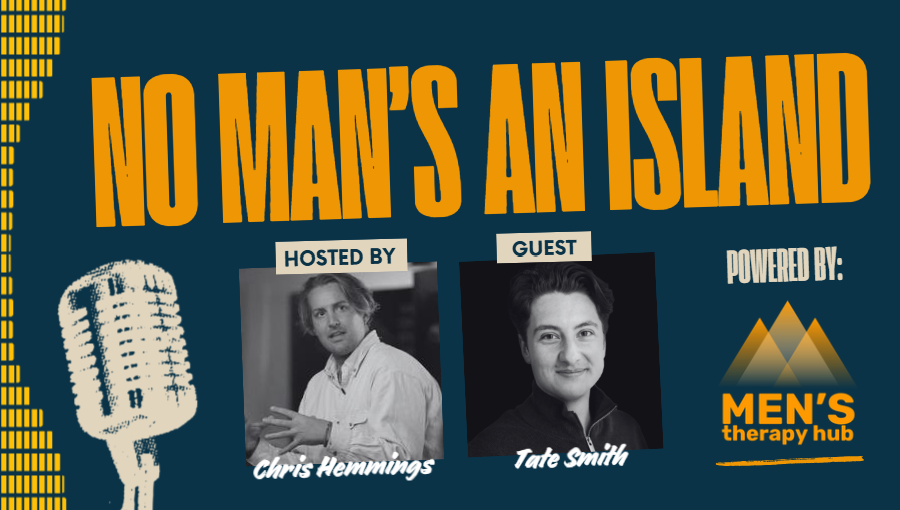
No Man’s an Island episode 26
In this episode of No Man’s an Island, Chris Hemmings speaks with Tate Smith, an award-winning activist and speaker whose work explores trans visibility, gender equality and masculinity. Released on Trans Day of Visibility, this conversation offers a thoughtful and deeply personal look at what it means to live openly as a trans man in a culture that still misunderstands both men’s mental health and trans lives.
Tate shares how beginning his transition in the workplace led him unexpectedly into public speaking and advocacy. What follows is a rich discussion about gender dysphoria and gender euphoria, the emotional realities of transition and the very different way mental health disclosures are often received once someone is perceived as male. Drawing on his own lived experience, Tate also reflects on male friendship, emotional invalidation, privilege, safety and why trans men are so often left out of public conversations about gender.
What emerges is not just a conversation about trans identity, but a wider exploration of what it means to be a man, to be seen and to live more fully as yourself.
What we cover
- Tate’s journey into public speaking and advocacy
- Beginning medical transition while working
- The difference between gender dysphoria and gender euphoria
- How men’s mental health disclosures are often ignored or shut down
- Why being perceived as male changes how the world responds to you
- The pressures and privileges that can come with masculinity
- How trans men are often missing from public conversations about gender
- Why trans masculine visibility matters
- Male friendship, emotional openness and the struggle to ask for help
- Why inclusion work must bring men into the room rather than push them away
Listen and watch
🎧 Listen to all episodes here: No Man’s an Island
🎥 Watch on YouTube: No Man’s an Island – Episode 26
🎧 Listen on Apple Podcasts
🎧 Listen on Spotify
Takeaways for men
- There is no single right way to be a man.
- Confidence often grows when you stop performing and start living more truthfully.
- Men do open up, but too often people do not know how to respond.
- Feeling joy in your identity matters just as much as understanding your pain.
- You can be strong and still ask for support.
- Male friendship needs more honesty, care and emotional depth.
Quotes to share
“I love being trans and the unique perspectives that I bring in order to educate people.” – Tate Smith
“I don’t think people have the toolkit in order to talk to men about mental health.” – Tate Smith
“Men need to open up more. I see men opening up all the time. I don’t think people are actually listening.” – Tate Smith
“The word masculinity makes me feel warm and fuzzy inside and it makes my heart go because that word describes who I am.” – Tate Smith
“It is great to be a man.” – Tate Smith
“I just get to make this up as I go along.” – Tate Smith
Why this conversation matters
One of the most striking parts of this episode is Tate’s reflection on how differently his mental health is received now that he is perceived as male. Before transitioning, disclosures about anxiety were met with care, softness and concern. Afterwards, they were often met with silence. That contrast says a great deal about the state of men’s mental health conversations.
Tate does not speak about this to diminish the struggles faced by women or trans people. He speaks about it because it reveals something many men already know but often struggle to articulate. Men are frequently told to open up, but when they do, the response is often uncertainty, awkwardness or withdrawal. Tate’s perspective makes that reality newly visible.
The conversation also opens up a more hopeful question. What would it look like if men were encouraged not just to unlearn harmful versions of masculinity, but to actually enjoy being men in healthier, more expansive ways? Tate’s reflections on gender euphoria point towards something many men rarely hear discussed: that masculinity can be joyful, creative and deeply personal.
This is what makes the episode so powerful. It is not simply a conversation about being trans. It is a conversation about how identity, confidence and emotional safety are built. It asks what happens when someone is finally able to live in a way that feels congruent and what the rest of us might learn from that.
Resources and links
Men’s Therapy Hub – Find a Male Therapist
Episode credits
Host: Chris Hemmings
Guest: Tate Smith
Produced by: Men’s Therapy Hub
Music: Raindear
TRANSCRIPT:
Chris (00:01)
Welcome to No Man’s in Ireland, a podcast powered by Men’s Therapy Hub, a directory of male therapists for male clients. On this episode, I’m speaking to Tate Smith. Now we’re recording this episode on Friday, March 27th. If you’re one of our keen regulars who listens on release day, hi, Tuesday, March 31st, that’s trans day of visibility. So given that Men’s Therapy Hub is trans inclusive and proud, Tate and I agreed that Tuesday would be the perfect day to release this chat because he is a trans man.
He is of course much more than that. He’s an award-winning activist and speaker who was recently named out of Attitude Magazine’s LGBTQ plus trailblazers. has become a leading voice on trans visibility, gender equality and the evolving conversation around masculinity. Hey Tate.
Tate Smith (00:46)
Hi, thanks so much for having me.
Chris (00:49)
That is quite
all right. Thank you for coming on. First question on this podcast is always the same. So how did you get into this space, which given how I’ve just introduced you, I’m presuming is going to be quite an interesting story. So take it away.
Tate Smith (01:01)
Yeah, I got into it by accident actually. So I came out and started transitioning in the workplace at the same time. So I’ve been transitioning medically since the spring of 2019 and it was the following spring in 2020 that I started speaking publicly about my transition and I didn’t want to speak about just my transition. I’ve always lived with anxiety and experience issues.
with my mental health and I really wanted to weave that into my talks and so I feel like I naturally went into the men’s mental health space just by speaking about it and I’ve been really fortunate that there’s been some great charities out there and people like yourselves who have reached out and wanted to hear my perspectives whether it’s by podcasts or campaigns and that’s just by posting on LinkedIn and Instagram so it’s been very very powerful.
and yeah the last six years have really evolved into speaking about gender equality and masculinity and actually the joys that that brings for me as a transgender man.
Chris (02:08)
What’s that been like to not only transition, which of course is going to have its challenges in itself, and I would like to hear a little bit about that. I don’t want to focus too much on the transitioning aspect of this within this conversation, but also doing that semi publicly, doing that in a spirit of, I want to be open about it, know, it’s Trans Day of Visibility when this has been released and you have been extremely visible within your transition.
Tate Smith (02:32)
Yes, I mean it’s been really really interesting for me but honestly I’ve just had to have a get on with it mentality and you know nothing is a taboo for me. I could just stick to talking about transitioning and do terminology training in corporates and other organisations but I choose not to do that. I want to speak from the heart about my lived experience and for me that’s about
about how much I love being trans and the unique perspectives that I bring in order to educate people but like you say to be that visible trans person which I think we need now more than ever but not just that a visible transgender man which unfortunately we are lacking in UK I’m not trying to say I want to be the one visible transgender man because that’s definitely not what I want to do and that’s a lot of pressure but if I can educate people by
my
unique perspectives, whether it be menopause, my lived experience with that, sexism and the misogyny I face living as a woman, how invalidated I feel when I share about my mental health versus the adulation I received as a woman, things like that. think they can actually help people to better understand cis people. So really what I’m doing is just trying to help people of all genders.
Chris (03:53)
Tell us about that, because we spoke about this when we had a chat the other day and that was something that really stuck with me, was this sense of when you presented as female, your mental health concerns were taken more seriously than they are now. And I think this is where we actually miss a trick in terms of trans people, not just obviously treating trans people as people, which in my opinion is absurd that some factions don’t do that, but also that…
there is a real like, and this isn’t why you should exist to help cis people understand and learn, but of course we can all learn from each other. And you have had this experience of living and presenting as both genders and you have had this experience of being treated very differently. So what was that like for you to suddenly go like, wow, this is different, this is not the same, I’m becoming unequal in this way.
Tate Smith (04:28)
Yes, obviously.
Yeah.
Mmm.
So for me, I’ve had anxiety since I was living as a woman in my teens and I always found that when I would open up about that I was met with, you’re okay response and let’s have a chat about it hon. was, know, females tend to look after each other and there was always that chat that was offered to me and then I found that after I transitioned and started living as a man and I would
drop into conversation that I have anxiety or I see a therapist, people would not respond. People would just go silent. And this was both men and women. And it was incredibly awkward for me to go from receiving, you know, outpouring of love and support to people just moving the conversation along. okay. And then just going on to something else. And I think naturally,
actually somebody might want to go okay I’m never going to speak about it ever again but the activist in me was like no and I have you know called people in on that sorry I just mentioned something really personal when you didn’t respond and then I leave it there and let them kind of you know and try and have a conversation about it because I you know I don’t want to assume and maybe somebody doesn’t have the mental capacity that day but I think just to shut down after someone says something so personal you should actually
be quite honoured they’ve opened up to you and try and have a mini conversation if you can.
Chris (06:16)
And of course, as you rightly say, some people don’t have capacity certain times, some people don’t ever have capacity and that’s fair, but what you saw was a wider trend. How did you personally respond to that internally? Because suddenly you’re experiencing what I, a man who’s lived as a, know, presenting as a man my whole life, have reckoned with and it’s a lot of what my work has been about and a lot of listeners who are, most of our listeners are male, that won’t surprise you.
have experienced a lot, but maybe we weren’t really fully aware of, but to you it was very, very clear because you’d had the alternate experience. So how did that sit with you? how did that play against you? And I know, cause we’re going to get on to talk about gender euphoria. How did that sit with you in terms of you actually expressing your fullness as a trans man, as a man?
Tate Smith (06:54)
Yeah.
I’ll be honest, it made me feel really sad. mean, in retrospect, I can say, you know, I call people in and I challenge people where I could. And, you know, I didn’t always have the confidence to do that. I do remember the first time that happened. It was like, okay. And it’s continued happening over my near seven year transition. And I’ll be honest, I’ve got used to it, which I think is quite bad. But…
Yeah, it’s just been really weird to navigate. mean, I never want to complain about living authentically and, you know, the privilege to live as a man because I absolutely love it and I waited years for this to happen. But I do get upset about it because there are times where I do just want to open up and talk to somebody and not just about my transness either, just about maybe anxious feelings and being human, yes, and being
Chris (07:56)
Better human.
Tate Smith (07:59)
overwhelmed and from what I can observe and these are just my personal observations is that I don’t think people have the toolkit in order to talk to men about mental health. I mean I see a lot of campaigns, I see a lot of conversations that say men need to open up more, men need to open up more and I see men opening up all the time. I’m one of them. I don’t think people are actually listening and I think people could do better to listen.
Chris (08:27)
Mmm.
Tate Smith (08:27)
as well.
Chris (08:28)
Yeah, what a great message. completely agree with that. I’m curious also, so as well as having your emotional reality invalidated, probably I’m assuming the more and more you presented as masculine, the more and more it was invalidated. I wonder what other emotional challenges came with, you know, perhaps the use of testosterone or, you know, whatever else it might be. Like what were the biggest emotional challenges for you in
in the transition that perhaps you’re still reckoning with.
Tate Smith (08:57)
So testosterone, I think is quite well known to increase your irritability and anger. So it doesn’t mean that I turned into the Hulk overnight, but I certainly got a lot more irritable and I’m hungry actually. I mean the first three weeks since starting my hormones, I was eating two dinners a night, I was having vivid nightmares and night sweats. It was crazy, but yeah testosterone is… Yeah, I mean it’s quite…
Chris (09:22)
Really? I’ve never heard about that before. Okay.
Tate Smith (09:26)
a taboo within our community and I found out through a trans male friend I was not warned about this but you can’t possibly be because any every transition is so different you get told by you know the clinic before you start your hormones like the course stuff that’s gonna happen to you which which basically reads like a male puberty sex education book you’re gonna get sweaty you’re gonna get acne your shoulders are gonna get more broad and I think naturally these are probably obvious things
and then they say you know increased appetite and maybe your mood will change some people go calmer some people grow irritable it depends and for me that’s what happened within the first three weeks and I’ll be honest I had to learn how to like control my emotions particularly when I was getting closer to the date of needing my injection because naturally your hormones spike so like I said doesn’t mean that I was having an angry meltdown but I would find
myself being more irritable or maybe I needed my own space a bit more. One of the great changes that comes with hormones is the lovely deepening of your voice and growing that Adam’s apple when I had to learn how to speak from my chest and my stomach so that I could make my voice sound deeper. That was just for me personally but with that I had to learn how to reign it in sometimes and that naturally where you’ve got a loud booming voice.
particularly if you say it in certain settings or in a certain way, it can come across as angry or too powerful or too confrontational and I was pulled up on it early in my transition. So I had to sort of train myself how to use all these new changes that were happening to my body but mostly it gave me confidence as much as it gave me hunger pains. mean…
They told me, my endocrinologist, when I started testosterone, you’re going to be more focused, confident and productive. And for me, I’ve definitely lived up to all three of those. But the confidence I love, because I needed it throughout my transition, know, those emotional periods where maybe you’re looking in the mirror, you’re over analysing your appearance and you’re going, why don’t I have a beard yet? And then you have to go, oh God, because you’re going through like a 13 year old boy’s puberty. Some men don’t get kids until they’re early 20s, you know, and just
learning to love yourself and just give yourself the grace to just enjoy yourself and enjoy seeing these changes happen to you and you know what the emotional rollercoasters figuring it all out is all part of it just like a cisgender man going through their puberty in their teens that’s exactly what I’m going through now which is obviously why I look so young for 27
Chris (12:11)
Well, yeah, and many men would be jealous of that. So you’ve explained really eloquently actually some of the challenges there. I know that there will be listeners who are interested in the kind of gender dysphoria angle of this. So I would like, if it’s okay with you, just to talk a little bit about that, about what that experience was. But actually I’m really, really interested because I think that a lot of us can learn about…
Tate Smith (12:14)
Thank you.
Chris (12:40)
gender euphoria because they think we’re living in a culture where you know masculinity for example is being derided and how can we help young men young like boys to feel more comfortable and confident within their masculinity not to shame their masculinity and for you you’ve had to learn on the hoof like as all of us are to be fair but in a much shorter time frame how to feel that sense of gender euphoria so
Tate Smith (12:42)
Okay.
Yeah.
Chris (13:07)
Can you take us a little bit through the journey, first of all, a little bit about the dysphoria and then how you found gender euphoria or is that something that you’re still working on?
Tate Smith (13:17)
Great question. For me, dysphoria, so for anybody who’s listening or watching and doesn’t know what gender dysphoria is, that’s effectively the mismatch a trans person has between their brain and their body. in my case, I was assigned female at birth, but I knew that I was a man and I wanted to live as a man. I’ve taken, that was probably around…
Chris (13:36)
when
Tate Smith (13:39)
16, it took me quite a while, I’ll be honest. A lot of trans people that I’ve met say they knew from the age of two, which definitely wasn’t my experience for other reasons. My upbringing, not knowing the language, not even knowing that transitioning was possible, not seeing a trans person in my community or on the TV or in a magazine, all sorts of reasons. But once I found that language at 16, I was off.
came out, went back into the closet because my family didn’t support me unfortunately and then a couple of years later at 19, just as I was turning 20, I decided to put myself first and fund my own transition through private healthcare because the NHS waiting list was too long. Even then, two years they told me. That was October 2018 and I still haven’t been seen yet. So I spent thousands of pounds to live authentically as myself and I’m still
still
on a waiting list which now has an average wait time of 10 years just to get this diagnosis of gender dysphoria so that you can access hormones and surgery and obviously like I say I’m seven years into my transition so by the time I see them it will just be for blood tests so but that’s just a state of the healthcare but for me that that mismatch brings on feelings of dysphoria so that I would say is the extreme discomfort
you feel so the looking in the mirror and not seeing who you feel inside staring back at you and once I started taking testosterone and all these lovely physical changes started happening to me the chiseled jaw line the Adam’s apple some bit of stubble the shoulders broadening that dysphoria started alleviating but not only that it turned into euphoria so the really exciting thing about transitioning
trans man is just how excited you get to see all these changes. Like I remember when I first started getting chest hairs and toe hairs and arm hair and just being so excited about that and then when I started looking like my dad who was my absolute hero as a kid that was euphoric for me because he was the most manly guy to me and he’s fortunate enough to be somewhat
attractive and I thought well if I can be as good looking as he is then I’ll be off to the races but yeah I was really happy to see those changes happen and with that confidence the hormones brings you you’re just in like this bubble of joy all the time and and it’s honestly guided me through my transition and obviously there have been times where I felt dysphoric so unfortunately I can still get misgendered so people call
in me she or her but it’s by accident it’s a quick glance I think where they see maybe I’m five foot three and you know I don’t know pretty features I don’t know it’s on the other person and obviously that brings on feelings of dysphoria but luckily where I’m so far into my transition I have that toolkit to not let it affect me and to take a step back to breathe and just let it pass through you know I can be sad for that day but I don’t want to be sad for that week
which is what used to happen early in my transition when I was getting misgendered all the time. So euphoria really is that flip side of that discomfort and I think men could maybe learn from that. You know, I love being a man. In fact, the word masculinity makes me feel warm and fuzzy inside and it makes my heart go because that word describes who I am.
Chris (17:13)
Yes.
Tate Smith (17:24)
and I’ve observed and I’ve been a fool of this myself in my talk saying that I speak about toxic masculinity.
not that masculinity is toxic because it’s definitely not but some aspects of it that are toxic and I really have been detaching myself from that term because I don’t think it’s productive particularly with the conversations we’re having recently with Manosphere and certain men also named Tate I mean I picked the right name didn’t I but no
Chris (17:52)
Yeah.
Tate Smith (17:53)
Things
like this, think actually I just want to talk about the joys that come with being a man and I think cisgender men can learn from that. Get excited over changes in your appearance. When you get a nice haircut, be confident, love yourself. When you get a new outfit, these are things I do for myself. When I went up a size in Primark t-shirts, that was the best day ever. And men don’t compliment each other and I think they should compliment each other more.
like have your own feelings of gender euphoria because they’re going to help you with your confidence and your self-esteem no matter if you’re trans or not
Chris (18:29)
And I think one of the challenges that we face in an increasingly binary world is that we do talk about gender as if it is a binary. But the thing is Tate, is that your expression of masculinity and my expression of masculinity and anybody else’s expression of masculinity is unique to them. And if we are focused on there being a unified
rigid concept of what masculinity is, then we are all far less likely to experience gender euphoria. And I think that was something for me that was incredible that once I softened from the university rugby lad phase and realized that actually my expression of manhood sure can be big and loud and brash and confident and angry sometimes. Hopefully not as often as I am calm and grounded and soft and…
and unable to hold myself. And that all of that is me. And not just the bit of me that should be, and I say should with air quotes, that should be brave and tough and strong. But also do you know what? Brave enough to ask for help, strong enough to hold my friends when they’re struggling, like tough enough to speak my boundaries. Those are all incredibly like masculine things to do if I choose that they are within my wheelhouse of masculinity.
Tate Smith (19:49)
I love that.
Chris (19:49)
So I
have such affinity with this idea of gender euphoria, and yet it isn’t something that we really talk about.
Tate Smith (19:57)
I know and I think we should and actually just jumping off the back of what you said, I mean, in the beginning of my transition, I thought that I had to be this one version of a man because I grew up in a council estate in Essex and all I saw was geezers and lads or people, you know, projecting as that at least and alpha males and Danny diatops. And I thought that’s the way that I had to be. And it’s just not. I mean, I would never refer.
to
my childhood where I used to love playing with dolls and watching Hannah Montana and I even stopped listening to like things like Madonna because I thought that wouldn’t make me manly and just like really pushing these weird ideals on myself and then as I’ve you know discovered my identity and got settled with my masculinity and I actually started meeting other men who you know maybe
some traits that I thought weren’t aligned with stereotypical masculinity. You’ve only got to look at society and see all the different types of men to realize there really is no one way and I know that may sound basic but it’s really not this stereotype ideal but in the beginning I pushed that onto myself and it was only really through exploration and I think just going you know what I just get to make this up as I go along.
Let’s embrace it, the music, loving theatre and film and not being into sports. I don’t like going to the gym. I don’t want my body to look that way. I’m not really a big drinker. I don’t need to pretend to knock back six pints. You know, I even had height dysphoria at one point and got shoe inserts from Amazon, which was a silly idea because I’m five foot three, because I thought I’ve got to try and look taller. need to present, you know, that way. And it just did.
me a disservice and you know when I stopped concentrating on my appearance and fixating on what sort of man I wanted to project that’s when I started looking inward and as a result I’m much happier and that’s contributed to my feelings of euphoria and joy.
Chris (22:09)
How much was that partly an internal process and with it an external process? Because you mentioned there, first of all, you were kind of aping the Essex geezer and then you realized actually that wasn’t who you are. And so then were you looking around at role models and like, you know, trying on different types of masculinity for size for a while? how did you learn or like, were you looking around for inspiration?
Tate Smith (22:34)
Yeah, I mean, listen, at heart, and I say this to quite a few people, I’m a working class boy from Essex that just happens to be trans. That’s at the core of who I am, but I don’t need to be this hyper ideal of an Essex boy, and I certainly don’t need to live up to that. And I didn’t have any role models as per se, but I did look at people who speak about redefining masculinity as it
like people like Jordan Stevens and and you know Dr Alex George and people like this who who represent this more softer version and speak from the heart and eloquently like I do and I think I sort of absorbed that throughout my transition but it definitely was an internal process because there was a lot of expectations I was putting on myself up here and I
really had to sort that out. But the last couple of years, would say that really took me to the half point of my transition about three and half years in. And these last three years have been the best because I’m settled. I don’t overanalyze changes in my appearance. I’ve actually focused on who I am as an individual, which I think is really important. What are my hobbies? What are my interests? You know, and I…
did as you put so eloquently there tried different types of masculinity on for size. The geezer. At one point I lived as a gay man because before I realized I was trans I realized I was pansexual and as I transitioned
preferences lean towards men, I started living as a gay man and then that came with all of its own things and then I started dating women and then people thought presumed that I was straight and now I just don’t have a label for my sexuality and then I was a legal secretary for many years that came with its own sort of expectations and working in law and being that corporate sort of finance bro type of masculine
and really I just settled on…
Being a gentleman, you know, I love my old Hollywood movies, I love vintage stuff. It doesn’t mean that I’m engaged in chivalry or, you know, being super traditional and toxic. I just like to look after people around me because ultimately I want people to look after me and care for me as well. It’s like you say, you can be strong, but you can also ask for help as well.
Chris (25:13)
Well, hopefully you can. I know it’s something that lot of us still struggle with and is that something that you still struggle with?
Tate Smith (25:19)
Definitely, I mean…
Even with all this exploration and giving it large, I’m still going to struggle when I need help. I’ve been to men’s mental health groups. I sought crisis counselling through the charity mind a couple of years ago. I definitely have some tough times. So I’m not always asking for help, even with how extroverted I am. But I’ve been quite lucky that after the lack of family support I received,
I built a chosen family in London, which I think is really important, but I’ve also Tried to make a conscious effort to nurture male friendships as well Which is still something I’m exploring actually because I don’t actually have that many close male friends whereas when I was living as a woman I had like tons of female friends and I think what I’m still navigating is having those like
and quite emotional conversations. I’m not saying men are incapable of having them, it’s just that they don’t happen as frequently as they did when I was…
Chris (26:23)
or as easily.
Tate Smith (26:25)
Well, always easily. I mean, I, when I was on a men’s mental health campaign once, somebody gave me this great analogy and I’m probably going to mess it up because I can’t quote it verbatim. But they, this man said to me, you know, men tend to stand shoulder to shoulder. You know, they, go fishing, they go for darts, they go for pints. They’re not looking at each other talking. But women, go for catch ups, brunches, they share lipstick in the bathroom. They’re standing opposite each other talking. And I thought that was really
interesting. mean it could be a tad bit of generalisation but from my experiences that’s definitely what I’ve seen and lived through.
Chris (27:03)
Well, there is some research or theory into that in that evolutionarily men were on sentry duty, for example, so would sit side by side looking out of the village, like scanning for danger. They would be walking and going hunting. I know a lot of research now shows that women would hunt too, but men would obviously do the lion’s share. And women would be behind in the village safer.
talking to each other face to face with children, right? And playing and so there is some evidence and that’s actually why when I work face to face with clients, which I don’t do at the moment, which is sad, but I sit, my chair is 45 degree angles. So we’re not facing each other because actually when we do face each other as men, there’s also research to show that we are constantly scanning to see whether or not the other man is uncomfortable with what we’re talking about because we are looking for the confirmation of the bias.
that you’re not gonna be able to deal with the challenge that I’m bringing. So I could be chatting to you Tate face to face and you could just get like a bit of dust in your nose and just like wrinkle your nose. But my psyche will tell me there’s evidence that he’s not comfortable. Tate’s not comfortable listening to what I’ve got to say. So I’m not gonna talk about it anymore. So actually in my men’s mental health workshops I get them to experience the difference of being face to face and being side to side and speaking out into the room.
And they’re all just like, wow, it’s so much easier to speak side by side because, yeah, not only are you not then scanning the other person, you’re also just speaking it into the room and it’s much more freeing. So there is evidence and research to back that
Tate Smith (28:38)
That’s something.
That is so interesting, I never knew that, but that does make sense. mean, I think even just struggling with eye contact as well, like it can be so awkward and it does feel a bit like overperformance and like the pressure to get this information across. And if you say someone does a slight movement, because I certainly have thought that. So yeah, that’s really interesting.
Chris (29:06)
It would be remiss of me on Trans Day of Visibility to not ask a trans person about their experiences of the current conversations going on around trans people. And what I will say is, and I’m assuming you will recognise this, that a lot of the conversation about trans people is about trans women and about trans women taking up space. You know, the constant ridiculous conversations about public bathrooms, which by the way, when…
women first started like entering the public space hundreds of years ago. Women weren’t allowed to use public bathrooms. When black people started being a thing in public spaces, black people weren’t allowed to use public bathrooms. When gay men started to become more prominent, gay men weren’t allowed to use public bathrooms at first. were all these questions about safety of all of these people using public bathrooms. So here we are again talking about public bathrooms. Anyway, away from that…
What is it like for you to be a trans person and to have a kind of, let’s say a decade where there was liberalisation of the mentality towards trans people and then over the past what, like three, four years there seems to have been this pushback that must have been really difficult for you.
Tate Smith (30:14)
Yeah, and actually I came out in 2015 and 2014, if you remember, was when Time Magazine did a cover with Laverne Cox and called it the year of the transgender tipping point because the amount of representation we had on screen in the media then increased and it worked for me because that gave me the language that I needed even though all I saw was trans women and the only trans male representation I saw was
Hillary swank in Boys Don’t Cry, which was a movie that came out the year that I was born 1999, none in the UK and that hasn’t changed at all and it felt like actually for a couple of years with Caitlyn Jenner coming out and you know, know, Elliot Page even, Trans Man over in the US, the dial started to sort of shift and then like you said, the last three, four years it’s become so fixated on
gender agenda, LGBT, alphabet mafia, these horrible terms people throw at us, the bathroom debate, I mean this has become such a sensationalised issue and even in the last day we’ve seen trans women are now banned from the Olympics which is going to affect cisgender women because there are some cis women out there who naturally have higher testosterone levels but let’s not get into that
So there’s all these debates about sports and bathrooms when us trans people don’t speak about that at all. And we just want to live our lives and not have to worry about our safety all the time. The world can be cruel to us anyway. It’s already a big deal to come out and live as our true and authentic selves. Most of us don’t receive the acceptance from our family, our friends, our communities, our schools, our workplaces, a lot of trans
and meeting people I’m not coming out but I appreciate what you do and when I started talking and meeting I know and when I started talking and meeting these people and
Chris (32:18)
Wow.
Tate Smith (32:24)
and seeking out older corporate trans male role models, that’s when I realised I’m probably never going to meet them because they’ve gone stealth because this is what they’re telling me in private. the last couple of years has been difficult. mean, I’ve actually, you kindly referred to me as an activist in my bio at the beginning, but in the last, I would say, year or so, I’ve really left that world behind and shifted more into storytelling and I’m now focusing
on learning my craft with writing and speaking and still working in corporate spaces because I just I don’t have the mental capacity to fly that flag quite literally especially after the DI backlash we saw last year the Supreme Court ruling like you say trans men were just left out of the conversation and I’ve been speaking for six years about this this lack of trans masculine visibility and after last year what we saw on both
Chris (33:08)
Mm.
Tate Smith (33:21)
sides of the pond in the US and UK we were only used as a gotcha moment. When the bathroom debate was being brought up and people going yeah trans women shouldn’t use women’s bathrooms and then someone would turn around and go but what about trans men so what would you want people like Tate using the women’s bathroom how’s that going to help the epidemic of violence against women and girls then people will go aha gotcha and that’s the only time trans men are being spoken about it’s unacceptable we bring
much to unique perspectives, to gender equality, to what it’s like to live as a woman and a man. These things we’re talking about mental health, even menopause. I have gone into corporate spaces and men have come up to me after I’ve done a talk about experiencing menopause as a result of taking my hormones and they’ve gone, well now I care about menopause now because I’ve heard a man speak about it. So I’m seeing this
impact this change through just sharing my experiences and people seem to forget about that which really frustrates me and I really want people to really start thinking more about the great things that trans men can bring to society but also to really pay them some love and attention because you know we we have to deal with masculine stereotypes and ideals and actually we’re expected to get on
with it, living as a man, and then people forget the trans part and it’s like, no, no, we still need the love from our community too. So I’d really like to see that improving and say the next three or four years. But I will say this, I do think it is improving because since the start of this year, the talks I’ve been doing, the press, even me going on Good Morning Britain and speaking to, you know, the Times radio even, which is more right wing last week, people are starting to go,
Chris (34:47)
Hmm.
Tate Smith (35:13)
why aren’t we hearing from trans men which i think is great people actually specifying this now which is great because last year i was actually getting asked what a trans man is and people was asking me so does this mean you’re transitioning to become a woman and i’d go no i used to be one and i’d go wait what because they just don’t know that trans men exist yeah
Chris (35:36)
Right, yeah.
And why do you think that is? Why do you think that, I think there’s an obvious answer as to why trans women are taking up more of the headlines. Why do you think that trans men take up so little of that airspace?
Tate Smith (35:48)
I think because this notion of being a man is just the best thing to be. This is for me personally, I think it’s much easier to understand.
Somebody assigned female at birth transitioning to male and this is what people have said to me They’ve said tell you I can get behind you because you were born a woman and you wanted to become a man But I can’t understand why a man would want to become a woman So they’re instantly invalidating the trans woman’s experience because they’re just referring to them as a man that wants to Play dress up as a woman, which obviously is not the case and if you could go deeper into it and talk about pay
patriarchy and things like that but I don’t like to get into things like that. I just think it’s just easier to understand because we aren’t sensationalised or seen as predators or people to be feared. I think they then transfer that hate and that anti-trans rhetoric and transphobia onto trans women and there’s that real lack of understanding there which can be turned into hate and violence and all the rest of it.
It’s very unfortunate. I don’t have the perfect academic answer, but that’s definitely my felt sense.
Chris (36:59)
Well, I’m not sure that anybody does. And I think that’s part of the problem is it’s still a much misunderstood issue. One thing I am interested in, you mentioned it much earlier in our conversation, was this idea of privilege. Because what I’m curious about is, I have a trans male friend who I’ve known for many years. And as he started to transition, he started to have conversations with me about how I navigate through public spaces. I mean, I’m also six foot three and he’s not, right? But…
Tate Smith (37:02)
Yeah.
Chris (37:26)
how he had to start to change the way that he would stand on a bus, like where would he sit? Like, you know, be more careful because he presented as male. As he was taking testosterone, he starts to realize he was just like staring at boobs on the tube. And he was like, I can’t do that because now I look like a man. I can’t just stare at boobs. Like that makes people feel uncomfortable. Like actually starting to recognize that
the more that you present as a man, the more that people will respond to you as a man. So like, what was that like for you, like out in public day to day? How did people start responding to you differently? Like people that you didn’t know, and how did you have to navigate that?
Tate Smith (37:58)
Yes.
Well, one of the first…
instances where I knew was when I saw a woman across the road from me later at night when I was walking behind her and she kept turning her head to look at me as if to say, oh, is he still walking behind me? And I remember being in that position maybe a year before and just being bewildered as to why somebody would be scared of me walking behind them when I’m only five foot three and baby face. But I thought, no, take, come on. It’s just the fact a guy is walking behind
Chris (38:21)
Mmm.
Tate Smith (38:39)
you used to do exactly the same walking home from work on an unlit street and I remember when I was about to start my hormones and I was at a birthday party with a friend and I was playing with children and there’s this friend of mine it was her nieces and nephews and I remember just a plaiting a girl’s hair
And I remember thinking, I’m not going to be able to do this when I start transitioning, because I’m going to look creepy. And even now, if I go to parks, I can’t sit on a bench near Yon Trudron, because I’m a guy. I’m just going to be people going to presume that I’m a creep. So I’ve had to adjust my behavior. And I think it’s really interesting what you said about your friend being on the bus and staring at booze, because that’s definitely happened to me.
I can’t compliment women on their outfits because I’m worried they’re gonna think I’m chatting them up and I’m also too worried to compliment guys on their outfits. I ask where the shoes are from in case I get punched, things like this.
and even like my voice and having to reign that in because I’ve been told it sounds like you’re raising your voice at me and I’m like god I’m definitely not and I had to realise my god there’s this new power that’s come in with my deep booming voice that sort of softened really for this podcast but out and about I guess I sound quite loud
And I would say that really ties into my feelings of privilege, I guess, when it comes to safety and navigating the world and being able to walk to Sainsbury’s at nine o’clock at night in the dark and not have to worry about…
being harassed or being catcalled by builders, stuff like that. But then on the flip side, there are moments where I haven’t felt very privileged. So for example, people not listening to me share about my mental health or this expectation that I’ve got to be strong. Something I really struggle with, which is a bit lighter, is on the train station when I see somebody struggling with a pram and they look to me and I know they think he’s
gonna help me because he’s a man and I’m like I’m not strong enough to help you with this pram up these stairs so I always just like run off because I just don’t want that expectation put on me or I find that when I’m on public transport
Chris (41:04)
Hmm.
Tate Smith (41:07)
I get glared at sometimes just for sitting if there’s women standing around me and they give me this glare and I don’t know if this is correct but this is just my felt sense that they give me this glare as if to say why haven’t you given your seat up for me but it’s not because they need the seat by the looks of it I don’t want to presume but I think it’s just based off being a woman and I’m like okay you know things like that so
I mean there’s just so many examples but that would take up another hour of your time I think.
Chris (41:37)
I think there’s a big conversation going on in the world right now about what like healthy masculinity or a good man should be, right? And I balk whenever I hear someone say should because in our kind of therapeutic training, we always talked about, well, can you change the should for a could? Because should is inherently judgmental, like the concept of should. Like, you know, as a man, you should be helping somebody. You should be giving up your seat. You know, sometimes I’m sitting on a seat and I’m like,
Tate Smith (42:02)
Yeah.
Chris (42:04)
You don’t know that I’ve got like a knackered back from cricket and it’s flaring up right now. You just see a young-ish, I’m nearly 40 now, fit-ish, I’m nearly 40 now. Yeah, yeah, like man, right? And therefore you should give up. And it’s like, okay, so for you, where does that sit with you? Because you’ve had to learn this on the fly in quick time. You know, I’ve had 40 years of practicing and I’m still struggling to know what a good man looks like.
Tate Smith (42:07)
Yeah, exactly.
Still, yeah.
Yeah.
Chris (42:32)
You know, what healthy masculinity truly is. And I educate people on that, right? It’s not, there’s no unified theory. So like, come on, what’s your theory of what a good man is?
Tate Smith (42:43)
Thank
For me, it’s just looking after people and showing respect. You can still open doors for people. In fact, I loved opening doors for men because it makes them feel really uncomfortable and I get a kick out of it. It’s like my favourite thing I like to do once a day to give myself a little laugh. But just, you know, looking out for people, looking out for the underdog, especially people from marginalised communities, helping people and leveraging that privilege that you saw.
Chris (42:55)
it does, yeah. Yeah.
Tate Smith (43:13)
sometimes have. For me it’s offering a seat at the table to somebody who needs it, to speak up for people, which in a bigger scale I’ve done with my activism, but doing it like day to day as well. you know, when I worked in corporates I would always make a point and it’s not my knight in shining armour thing or anything, but just where I spent years and years living as a woman and being spoken over and not being listened to or having my ideas.
you know, not giving the credit for my ideas and sometimes I would say things in meetings or offer up something and a woman would say the exact same thing and I’d get the credit for it as a man and I’d say no, no, no, no, she said the same thing. Just even just things like that, just looking out for people, using your platform, using your privilege and you know, just be yourself ultimately, you know, it’s okay to be masculine.
You know these things we’re talking about or something completely different they’re toxic masculinity or whatever Buzzword you want to attach to it. It is great to be a man And I know that because I’ve lived luckily as one for seven years and I can’t wait until I’m a 40 year old man and All the exciting things I’ll have learned by then I’m you know If you’re still figuring it out that makes me feel better because that means I’m still gonna be figuring it out But that’s that’s part of being human which I
think is so beautiful.
Chris (44:38)
Do you know the
one thing I haven’t figured out is why at 39 years old, I’ve suddenly started sprouting hairs on my ears and my nose. I want to understand the evolutionary benefits of suddenly starting to grow hairs on places that make no sense because I’m having…
Tate Smith (44:52)
Listen, I started getting nose
hairs and that’s been awful for me. I feel really old and I like it. Yeah. my goodness,
Chris (44:58)
Those are internal nose hairs, right? I’m talking about external nose hairs. Yeah, yeah, yeah.
You’ve got this all to look forward to, Tate. Don’t worry about it. You’re going to have hairs growing from places you didn’t think you had follicles. So if anybody can explain the evolutionary reason for ear hair and why suddenly at 40 years old, I’m starting to sprout it, I would love to know. So please let me know. I know you don’t necessarily do this work a huge amount now in terms of your consultancy work in business.
Tate Smith (45:09)
Great.
Me too.
Chris (45:26)
What would you say would be the biggest challenge? You mentioned some of them there in terms of the way that women are still treated in the workplace. And of course we are moving towards, perhaps not quite swiftly as some would like, towards gender equity, which is a good thing. What do you say the biggest challenge is in terms of workplace culture that we’re failing? Because when I still did this work, and I still do if anybody is interested, I don’t particularly do it very much anymore.
of going into a workplace. And I remember standing in like one of the world’s biggest sportswear brands and all of their heads of DEI were in the room, right? Every single one. So there’s like 25 people in the room. And I’m standing there and I say, do what’s interesting? There are zero straight white men in this room. You are talking about inclusivity. There are zero straight white men. Because they assumed that I was and I’m like, no, I’m bisexual. I’m like, he’s the head of the LGBT.
employee resource group and he’s the head of the Latina employee resource group. So there’s no straight white guys in the room and we’re talking about inclusion. So like how do you as a trans man and as somebody who is wanting to engage men and apparently successfully doing so by the sounds of it, so kudos for that because I know how difficult that is. How have you tried to bring men into this conversation around inclusion? What have been your tactics and what have you found has worked because
I still think that a lot of DEI practices and part of the reason there was such a pushback against them is because a lot of men did feel maligned by them, that they were pushed out of these conversations that they weren’t welcome.
Tate Smith (47:00)
And there’s a lot of data to support that as well. for me, the tactics that I’ve used are, I would say, first of all, offering more topics to speak about than just my transness. Speaking about social mobility, so being working class from Essex, from a council estate receiving free school meals, parents living off benefits, because that for many people, and especially for many
is their buying to listening to me. So it’s kind of like a Trojan horse. They come to hear, they want to attach themselves to an element of my story because they’re not going to be able to relate to it. But they find a little piece, just like maybe some older women might go, he speaks about menopause. I might learn something from him. And then they hear about the transitioning. And then as I’ve transitioned, maybe I’ve experienced accent bias, having a strong Essex accent.
and they can see themselves in it. And like for example, then when you start to bring up, and by the way, I’m a gender equality advocate and I’m a feminist and I always have been, and I do this in meeting rooms, or I then speak about menopause, that then inspires them to get involved in DEI. And I also make a point of speaking calmly.
eloquently and on people’s level. I don’t do terminology training, we’re all adults here, they can do that themselves. I don’t patronise people. If I use terms or buzzwords, I weave them into the narrative and explain them as I go, rather than just hitting them with too much information. You have to understand, I didn’t know that I was trans until I was 16, so I can’t expect people to know all the terms because I didn’t. And I still don’t, you know, I still don’t know all the terms.
things wrong all of the time and that’s okay and so can they and I think I teach them that too this this great thing of calling people in rather than calling people out and I think that level of understanding really helps them but I’m very fortunate that a lot of men do naturally come to my talks because I find in corporate spaces you don’t get a lot of male speakers and that’s just from my perspective speaking in London and speaking at sometimes across
the UK and I don’t know about the rest of the world so I think that’s a big draw to them but I always encourage people like you do to get the men in the room these the senior leaders you need buy-in from to make these changes to make these policy changes to make the workplace equitable for all let’s be real the senior leaders are going to be male so there’s no point alienating them
saying we don’t want no straight white men in here because these are the people you need to be your allies so you need to bring them into these conversations and get them on board that this is why I distance myself
from the violence against women and girls space because I was going into some spaces with people who were calling themselves feminists and saying they wanted male allies in the room and I would be the only man in the room but not only that trans man there was no cis men in the room and I need the cis men to support me not just women you know so we’ve got to get them in the room but also make things that want them to be there and not be using such language that
them feel like they hate it just for being something they can’t help. Some people can’t help being white or straight or cisgender. So let’s not throw these terms at them and go well what do you know because you’re this this and this it’s so counterproductive.
Chris (50:32)
Just like you can’t help being trans.
Beautiful, okay. Thank you so much for sharing your time and your story with us and your expertise and your experiences of transitioning. I genuinely believe that a lot of men can learn from the experiences of trans men like yourself. Before you go, I have to ask you the question. So I’m going to give you unlimited funds. You’re going to have the keys to the vault. With that money, you can do anything you want within reason, right? Like it has to be in terms of…
Tate Smith (50:47)
I’ll be right back.
Chris (51:07)
giving money to something that is gonna benefit the world in the way that you would see it best. So what would you do with that money and what change would it, let me ask that again. So what would you do with that money and what change would it make?
Tate Smith (51:20)
my goodness.
I would donate it to charities that support trans youth and young adults who get kicked out of home or have to go and be homeschooled because they’re not supported at school or bullied and help fund camping trips and residential trips and things that they do just to so they can just live as young people and meet other trans people.
that just happen to be trans and be themselves because they’re lacking in funding right now and I would just love to give more safe spaces for parents and carers and young people who are trans or who have loved ones who are trans.
Chris (52:08)
And what would that mean to those young people, do you think?
Tate Smith (52:12)
I think a great deal because they’re faced with a world that doesn’t understand them and then they look to older people or the world around them and think, it going to get any better for me as I get older? And I think if we give more spaces for them to hear from those role models and just meet other people just like them, they’re going to feel a lot better in themselves that they’re not alone in how they feel. And actually they can still have fun in the process and be themselves.
Chris (52:41)
Beautiful. Okay, if people want to find you and get in touch with you and book you, where do they go?
Tate Smith (52:46)
So website is tatesmith.uk not dot co dot uk because somebody stole that domain name so you can find me at tatesmith.uk and you can follow me on linkedin i’m not so active on messages now but i am comments if you want to get in touch with me my in my contact form is on my website or you can find me over at instagram and that is tate michael smith
Chris (53:13)
Great. Thank you so much, Tate. Really appreciate you giving up your time. happy Trans Day of Visibility for Tuesday or the day that this is coming out. I’m sure you’ll be busy on Tuesday. So yeah, thank
Tate Smith (53:16)
Thanks for having me.
Yes, thank you.
Thank you.