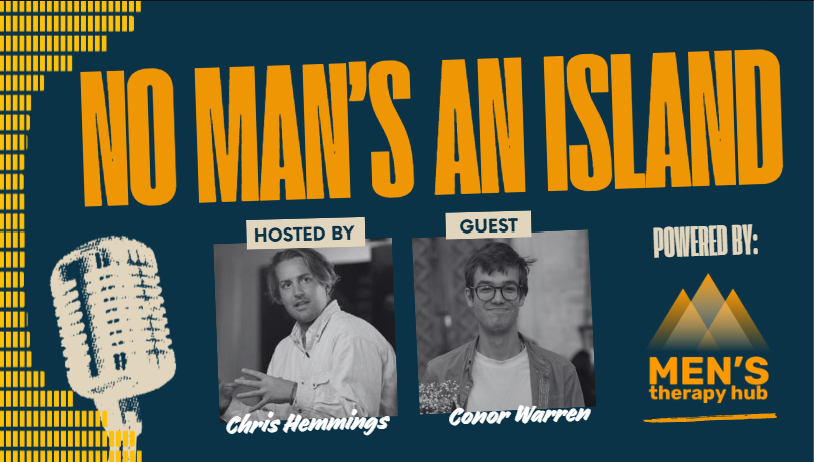
Episode 34 of No Man’s an Island
Conor Warren is the founder and CEO of Spark UK, one of the UK’s leading youth-led mental health organisations. He launched the charity at just 14 years old after seeing first-hand how disconnected and outdated many school mental health resources felt for young people.
In this episode of No Man’s an Island, Chris Hemmings speaks with Conor about growing up with anxiety, struggling with eating difficulties linked to mental health and learning to navigate therapy as a teenage boy. The conversation explores the realities facing Gen Z mental health, from social media and online radicalisation to loneliness, emotional literacy and the pressure many young men feel to perform masculinity online.
Conor also shares why youth-led mental health work matters so much and why young people are far more likely to engage when conversations are led by people who understand their lived experience.
What we cover
- Conor’s experience of anxiety and counselling as a teenager
- Starting Spark UK at 14 years old
- Why many school mental health resources feel outdated
- How Gen Z consume information differently
- The pressure social media places on young men
- The rise and decline of Andrew Tate-style influence
- Why many young men still resist therapy
- Polarisation between young men and women online
- Healthy disagreement and debate between young people
- Social media bans and online safety
- What schools still get wrong about masculinity
- Why youth voice should shape mental health education
Takeaways for men
- Young men are often more emotionally aware than older generations assume
- Therapy can take time before trust develops
- Many boys still fear being seen as weak for asking for help
- Social media can both help and harm depending on how it is used
- Young men need spaces where disagreement and nuance are allowed
- Mental health education works best when people feel represented
- Emotional strength and vulnerability are not opposites
Quotes to share
“You can’t change young people to fit mental health resources. You have to change the resources to fit young people.” – Conor Warren
“Young people want to see people their own age telling them about things.” – Conor Warren
“A lot of young men don’t believe therapy works because they think they should just deal with things themselves.” – Conor Warren
“Debate has now become argument.” – Conor Warren
“The world would be so much better if every school had young people leading conversations around mental health.” – Conor Warren
Resources and links
Conor Warren:
https://conorwarren.co.uk
Spark UK:
https://sparkuk.co.uk
Men’s Therapy Hub directory:
https://menstherapyhub.co.uk/therapist
Chris Hemmings:
https://chrishemmings.co.uk
Episode credits
Host: Chris Hemmings
Guest: Conor Warren
Powered by: Men’s Therapy Hub
Music: Raindear
TRANSCRIPT:
Chris (00:01)
Welcome to No Man’s An Island, a podcast powered by Men’s Therapy Hub, which is a directory of male therapists for male clients. On this episode, I’m joined by Conor Warren. He’s the founder and CEO of Spark UK, one of the UK’s leading youth-led mental health organizations, an organization he launched at just 14 years old. He’s an advocate for centering voices of young
people, and in particular is driven by wanting to better understand the experiences of Gen Z, which…
Given I’m now a tired old millennial and much of our audience is made
up of people who are 30 plus years old is something I’m also very much interested in. Hey Conor.
Conor (00:36)
Hey, thank you for having me.
Chris (00:38)
That’s quite all right. Thanks for coming on. So I’ve given you a little brief introduction there. The first question on this podcast is always the same. And given that you got into this work when you were 14 years old, which I think is by far a record so far, the first question is, how did you get into this work? So what was it that made you want to start to work in the space of youth mental health?
Conor (00:49)
Yes.
Yeah, I think for me it was a very unique start into the industry. As you said, I was 14 when I set up my charity, but it actually started well before that. As a kid growing up, I really suffered with anxiety. I was in and out of different counseling approaches, both at primary and secondary school, and I really didn’t understand it. I grew up in a household where my mom was a head of safeguarding, so she was working in secondary schools and she was sort of seeing the real day-to-day struggles of
many
young people. And when I joined my secondary school, there was this opportunity to become a mental health ambassador, which was basically a school council within the school that was aimed to upskill the young people to learn about mental health and then deliver assemblies within the school. And it was something I was really interested in. I thought, you know, I like to get involved in stuff. So was like, why not just get involved in this extra thing and sort of add something to my CV? And yeah, it really grew from there and sort of the interest in
understanding mental health, helping other young people understand how they can support themselves. And yeah, it just kind of grew from there.
Chris (02:09)
So 14 years old, you started to experience some mental health difficulties. I’m interested in this because when I was 14 years old, back in day, many, many thousands of years ago, it feels like now, mental health was not a conversation that was going on. I hadn’t really heard, you would hear about mental illness and there was obviously a massive taboo associated with being mentally ill.
Conor (02:15)
Yes, yeah.
Chris (02:36)
but general mental health wasn’t a conversation, and particularly not for men, but not for anybody. So what was it like for you as a 14 year old? And just remind our audience how old you are now.
Conor (02:47)
Yes, I’m 20 now and yeah, it was something that I really did not understand at the time. So I think I was going through a lot that now that I’ve been in the industry and I know a lot more, actually was like, I can see what point I was at that point of life and I could see how many issues that were going on. And yeah, when I was 14, you know, I was very up and down with my emotions. I was really struggling mentally and I kind of knew that
I needed support and sort of I’ve been as I said I’ve been through support in primary school and kind of learning through grief and stuff like that they were sort of teaching me about emotions within therapy but it was never like I am depressed I need to go and do this I didn’t understand that till actually I was probably 17 or 18 I didn’t actually myself understand what I was going through mentally it was more a kind of me looking at other people around me and seeing that they were struggling and not really much about myself
Chris (03:48)
What was that like then to suddenly start to realize, I am experiencing X, Y, Z. I am somebody who is struggling with their mental health in an environment where, as you say, actually, there seemed to be at least the beginnings of an understanding and a network of counseling professionals. You know, I went to an all boys private school. We had a nurse and that was it. There was no counselor. I know having worked in schools now, most schools have.
counselling options available to them. So was it easier for you? I guess you don’t know because you don’t know what it’s like to be my age. But from what it sounds like, it sounds like it was at least easier.
Conor (04:25)
Yeah.
Yeah, I think I was really fortunate that while I was at school there was counselors that were accessible for all students to use, but it took me a crisis to then realize actually I need support and I actually need help. it did sort of create like many people where it was I didn’t recognize that I needed help and equal I didn’t feel like I was bad enough as such to get that support, which I think is equally sort of a big thing that can stop people a lot of the time thinking that they’re, you know, what they’re struggling isn’t valid or, you know, they aren’t in crisis.
enough to be able to get that support and I think you know I was really fortunate where I had an incredible pastoral team within the sit form that I was at and they were really identifying it and said actually now I think you would benefit from going to the counselor so it was only by somebody else telling me that that I actually then recognized it and went and moved and sort of did the counseling you know even as a professional then I was I didn’t identify it myself
Chris (05:26)
What was it that you can look back on now and realize, know, hindsight is fantastic. We can go, it’s so obvious that now that I know it’s so obvious, but back then it wasn’t. Like what was it that was going on for you and how was it being expressed or not expressed that you, it was very clear to the people around you, weren’t okay, even if you weren’t willing to accept it quite yet.
Conor (05:51)
Yeah, sort of towards the end of secondary school, start of sort sit form, I was really struggling with low mood, depression, anxiety and eating disorder. So I had these whole complex things that were really struggling and really sort of making me, I would go really high and then really low quite frequently. And my friends were sort of the people around me were saying, actually these streams are becoming more and more.
and I’ll sort of be out with friends and it’ll be really high and then I’ll go home and it’ll be really like rock bottom. And I think that was something that I kind of kept overlooking.
And it was something that I kept not thinking about and equally from a, I developed anxiety and due sickness, which is something I still have now. And it basically meant that my body’s way of reacting to things was by limiting what I could eat. So for me, you know, I would become really anxious. would be out, stuff would be going on. And the only thing that my body could control was what I was eating. So I’d go to a restaurant with friends. I would be, you know, anxious. I would then be really hungry and you know, I love food.
I would order a bunch of food, really looking forward to it. The second the food comes in front of me, I would then completely lose all appetite and not be able to eat anything. And that was something that I really struggled with for about two to three years that I just did not understand. And it was only through people actually saying to me, no, this is what you’re dealing with, that it was actually, OK, this is actually something that’s related to my mental health and not just some weird thing that’s going on to me.
Chris (07:27)
And of course your work now is focused a lot on the experiences of young people Gen Z in terms of their mental health. In terms of you and your friends then, and I’m obviously particularly interested in your male friends, given that this is a podcast about men and masculinity. What were the conversations like between 15, 16 year old boys six, five years ago?
in terms of mental health, once it had been recognized in you and once you had recognized it in yourself.
Conor (07:58)
Yeah, I think it’s a very nuanced conversation in terms of there is still a lot of stigma around mental health, still in young men. But I think the people that I was surrounded with were people that were really supportive and really supported me in that journey. A lot of my male friends don’t believe that counseling works. They don’t believe therapy works. They think that actually…
Chris (08:25)
Why not?
Conor (08:27)
because they believe that actually they should just deal with the things themselves, which is something that I challenge a lot. I say, you know, come in and chatting to me is a form of therapy or counseling because you are just expressing yourself and you’re just saying what’s going on. And I think that’s something that definitely has been a barrier to a lot of conversations. But I think those conversations now as time goes on are becoming less and less frequent and more and more people are identifying and understanding
the benefits to learning about your own mental wellbeing and equally going to council and therapy.
Chris (09:03)
And within that context then, how did you begin to find the courage to dare to speak it and say to these guys who are still reluctant to engage in their own reality of their mental health struggles, which look, every 15, 16 year old boy has challenges. mean, every human has challenges. Not everybody needs therapy. think most people would benefit from therapy, but that’s a whole different podcast. You are still in an environment where…
actually, even though people of my age might think, your generation is so fantastic about speaking at their mental health. Sure, but we set a pretty low bar. So there’s still those challenges. How did you find the courage to actually be not just open and honest about it, but then to go, do you know what? I’m going to make this a project. I’m going to make this a charity. I’m going to make this at least maybe not your life’s work, but at least your early life’s work.
Conor (09:44)
Yeah.
Yeah, I think it was a really big thing that I did struggle with to begin with. So when I first started, I wasn’t looking at my mental health at all. So I was very much kind of separating myself to the charity in which we were running. And it was only when I was actually kind of overcome that hurdle that I was then opening up about my mental health publicly. And I think, you know, within my friend groups, the people that really knew me, I still wasn’t exactly telling them what was going on. And I really found myself sort of closing in and not talking
about it because I did feel that stigma still. did feel that people, you know, I got told when I first set up Spark, I was getting told in my classroom, well, you don’t have mental health, so you can’t teach people about it or you can’t talk about it. And there were still in the classroom these conversations going on about people not understanding what mental health actually was. So when it came to me trying to, you know, explore counseling and explore therapy, it was something that I was really nervous about because it was something that, I didn’t feel
myself that I was bad enough to have it but equally I didn’t want people to think that I was weak for getting it. I think that’s something as well that can be a big thing is actually that weakness to go and it can sometimes be perceived that way and it’s not that way in my eye it’s probably actually stronger to go to it because you can accept yourself that you need that support and I think that’s far stronger but there was still a stigma around that and it yeah it took a lot of courage to
talk to my friends about that and actually say, yes, I am going to counseling because I need it and because that’s what was going to make me better. There was nothing else. I knew from the CBT point of view how I could actually make myself better. But at that time, I didn’t want to do anything myself. I was very much in this whirlpool of emotion. So by going to counseling, it allowed me to express myself in that healthy way.
where I could talk about how I was feeling and that’s what worked for me. And I think those friends that didn’t agree that therapy or counseling was a good thing, I think they saw the change in me and they did start to recognize that actually, yes, there is productive elements to this for some people because yeah, it doesn’t work for everybody. For a lot of people it will work.
Chris (12:19)
And sometimes you’ve got to lead by doing because you can’t convince people. All you can do is go like, well, actually you can see the change occurring in your friend. And that’s not occurring through conversations with you guys who are being maybe not particularly helpful in this. So it must be occurring from this other place.
Conor (12:37)
Absolutely, and yeah, I think that’s so important is the fact that, you know, we all, everybody lives very different lives. So, you know, we can’t, I can sit and chat to them, but they’re not going to have any idea about how to deal with any of the stuff I’m talking to them about. And that can be really then difficult because then they don’t know what to say. And that was, you know, you go to sort of a professional situation and they are equipped to, you know, respond to what you’re saying and to be able to sort of support you through that. And I think that is so important.
Chris (13:05)
do you remember of those early therapeutic sessions? you’re going in, were you seeing, I guess you’re not seeing a child psychologist by that point or a therapist because you’re what, 16, 17 years old. How did you feel that the therapeutic environment was set up for you as a young man?
Conor (13:19)
Yeah.
Yeah, I was again, obviously really nervous when I went in. I wasn’t really opening up as much as I should have. I was just kind of saying certain things that I thought they should hear. So I wasn’t expressing everything I was feeling at that moment for the first few weeks. I was kind of…
Chris (13:46)
You’re trying to be a good
client.
Conor (13:48)
Exactly, I was trying to not go into too much detail about what I was feeling because I was worried that they’ll perceive me a certain way or that they will, you know, X, Y and Z, which is, you know, quite a, unfortunately, a normal thing that people do to begin with.
But it was as time progressed, we got more and more comfortable and it was kind of a place where it was a safe place where I could go and debrief. And obviously the more that we got to know each other, the more I could kind of fill them in. And it felt more of just a gossip session by the end of it where we were just sat and actually I was updating them and it was like, it felt right. But I think that did take a long time and it was kind of over the space of probably just over a year where we were
kind of weekly within our school, within my school timetable, I was having that sort of counselling sessions and really trying to understand myself. So I think that was a big part of what helped me was it was actually understanding me more and being able to unpick parts of my life that I wouldn’t have been able to unpick by myself and going through it with that other person and really understanding all of that.
Chris (14:59)
that part of the challenge for you? Because this is one of the most common experiences I think I have with male clients, which is why is this not working after six sessions? I’m trying to win at therapy as a classic one. I’m trying to be the best client I can be. I want to smash this. it’s like, actually, part of the big challenge for a lot of guys is to relax into the process and allow it to take whatever time it takes.
Conor (15:26)
Absolutely, I think that was something that it really was a long game. It wasn’t a quick win. And I think that’s something that is really, you’ve got to put the time and effort in. And I think that’s to start with, I was very much trying to just be like, I’m going to do this and then get it over and done with. But as I committed and sort of melted into it as such, it was much more, I was getting so much more value out of that. And over that long period of time, I did get so much more value than I thought I would have to begin with.
Chris (15:57)
I just want to pick up one thing that you said, which was that when you start a therapy, you should have been more open. There’s a really interesting distinction here. When I was doing my therapeutic training, if we can replace the should with the could, which would be to say, well, actually could you have been more open? And the reality is from what you’re saying, it sounds like actually to begin with, you really couldn’t because you didn’t have the tools, you didn’t have the capability. You didn’t feel like this was a space where you felt safe enough to do so to begin with. So that should is quite a…
judgmental term to use and actually in the long run it sounds like the process were.
Conor (16:33)
Yeah, absolutely. think it was very much a, I probably wouldn’t have got as much out of it if I had been as open to begin with. I think it was much more about, you know, those first few weeks building a comfortable space, but I could actually then share and could actually talk about how I was feeling. And I don’t think that could have been something that could have been created in the first couple of weeks. It needed that time to actually almost have that surface level
conversation where actually you do you know delve into and build that relationship and I don’t think I would have been able to open up any more than I did sort of the time frames I did.
Chris (17:14)
And okay, so then before all of this, actually, you’d started Spark, which is funny to me. It’s like you’d started Spark to help with people’s mental health at a time when you hadn’t really recognized your own challenges with mental health, which I kind of get the irony in that.
Conor (17:20)
Yes.
Chris (17:34)
Tell me about that. Tell me about what sparked the creation of Spark. And that was a pun intended. And what was it actually that led you to want to create a movement that focused on people of your own age? What were you seeing that was missing?
Conor (17:49)
Yeah, I think, you it goes back to obviously I was saying that I did a mental health ambassador course within school when I first started and we continued doing that for a few years. We were doing assemblies within our school. We were, you know, speaking at Ofsted conferences, all these different things where we were really sort of building this thing. And then the dreaded COVID came and like every extracurricular activity in school, it kind of got stopped. Funding got cut. The staff didn’t have the time anymore. And we had all these ideas that we wanted to do.
kept getting shut down. So me and a group of friends, we went for a rant in December 2020. And we were saying, in an ideal world, what do we want there to be mental health support wise for young people? And we said we want resources that are not out of date, because at the time, and still now, most mental health resources in school are early 2000 BBC3 documentaries that not a single young person actually wants to watch. And we felt that celebrities
Chris (18:46)
Are you
serious?
Conor (18:49)
Yeah, yeah. Unfortunately, still in the PSHE lessons, they will still be getting the early 2000 BBC3 documentaries that are 45 minutes long and nobody wants to watch them. And unfortunately, that is the reality of the education system back then and even now to some capacity. And yeah, we were just ranting for an hour and we said, what do we want? And then we said, why don’t we just try doing this ourselves? Why don’t we just try to fill this gap in some capacity?
Chris (18:50)
Wow, okay.
Conor (19:17)
And we expected nothing to happen. We were a bunch of 14 year olds living in North Devon with no tools, no experience, anything. We just had this idea. And yeah, we were really fortunate that we started creating resources. We’d read books about, you know, anxiety and gratitude and things like that. Then we would turn those books into lessons that could be delivered by schools. And we’d sort of work with the authors to actually make sure that it’s all correct. And then within our first year, we got featured in The Guardian.
and overnight it just completely exploded and yeah here we are six years later.
Chris (19:53)
What was it that you saw then? I mean, those BBC documentaries are a great example of where, people of my age and older, right? The older generations who were actually in charge, the kind of the Gen X generation that are actually in the seat of power now, what were they missing? What were they getting wrong? Like what was happening in those documentaries where you as 14 year olds would be rolling your eyes? You know, cause I remember,
When I was at school, we would have these documentaries of like, this is a you know, I’d have those guys speaking in that ridiculous 1940s BBC voice, but you were getting at least 2000s, but still not relatable to you. So what was wrong about it?
Conor (20:30)
Yeah.
No.
Yeah, I think it’s that relatability of the world is changing so quickly at the moment. And actually, even a video from a few years ago is so out of date. you know, back in 2019, where it was kind of all these things were going on. And actually, these early 2000 BBC3 documentaries were so cheesy. They were so cringy to sit and watch. actually engaged with them. But equally, it was information that had been, you know, mental health in the past sort of two decades has been
There’s more and more coming out about it.
Chris (21:10)
revolutionized.
Conor (21:12)
Absolutely. know, early 2000s was a very different idea of mental health to what it is now. So these documentaries and these resources as well, because a lot of the time, the resources in which the schools use the lesson plans, the PowerPoints and all that, the stuff that the school bought probably five, 10 years ago, they don’t want to spend any more money on some new ones. They just redo the same ones every year, which again, are completely out of date. And then you are still creating these environments in which the young people that actually know about mental health and are actually
going through the things themselves they don’t feel that they are being truly represented or they don’t feel that
the stuff that is being taught is relevant. And then that again creates that divide within a classroom where you’ve got one half that, you know, thinks mental health isn’t real, that thinks it’s only mental illness and that people just need to grow up. And you have the other half that are really struggling and that becomes this disconnect between the two. And I think that’s what a lot of these resources that have been, you know, out there and why it’s so important to make sure that we are keeping it up to date and we are staying, you know, with the times and it’s not just
Chris (22:04)
Mm.
Conor (22:19)
tokenistic cheesy stuff.
Chris (22:22)
It’s part of the problem here as well that I remember when I worked at the BBC, particularly when we were doing stuff on science or even on mental health, you had to speak to the audience as if they didn’t have any prior knowledge of the subject matter. But this was before the days of smartphones and AI where, you know, I remember that there’s a famous scene in Scrubs, the TV show where like Dr. Kelso, the old guy.
Conor (22:38)
Absolutely.
Chris (22:51)
he’s telling a patient something and she’s on her phone and she’s telling him before he’s even spoken it. And that’s very funny because like that’s what a lot of people are missing is that your generation isn’t not knowledgeable on this stuff now. Your generation is incredibly knowledgeable on a lot of it. And so I guess what I’m getting at is can it often feel quite patronizing some of the way that we’re trying to speak to you guys?
Conor (23:06)
Yeah.
Yeah, absolutely. think it is, you know, this generation is so on top of everything that’s going on in the world. And I think that’s something that a lot of the time these resources can feel like.
sort of an adult that’s there telling them everything, but in reality they know what a lot of that is and they know how to do it. And that’s, where we are really fortunate, where everything we do is fronted by young people. It’s created by young people. And actually we’ve understood that young people want to see people their own age telling them about things. And this is why, you know, platforms like TikTok are doing so well because people can follow people their own age and they can learn, you know, for me, even looking at accountants, I’m looking at an accountant who is similar age to me because
actually we can relate to things. And same with the education and mental health side is that actually we find that us going into schools has far more of an impact than a teacher delivering a lesson or some professional going in. Because actually we’re a similar age. We know what it’s like to be a teenager going through COVID, going through AI revolution and social media revolution, where all these things are happening and nobody else in the world knows what that’s like. That’s what’s really crucial about this generation is, as I said, how quickly things change and how no
no other generation has been through exactly what this generation has been through and the rapid time scale it’s happening and that’s what creates it.
Chris (24:41)
And that’s where, of course, we created Men’s Therapy for the same reason, which is about affinity. It’s as a man, if I’m sitting across from another man, I’m more likely, not guaranteed, but I’m more likely to have a deeper understanding of some of the issues he’s facing, particularly if they are related to him being male. So I’ve worked with many young people your age. I’m more likely to vibe with them if…
they are queer because I am too, for example, right? That is really important, but in terms of how you reach people, because you’re also, as we are, I mean, we’re both fighting against that cohort, not fighting against, I’m gonna rephrase that. We are both fighting to try to engage that cohort that don’t wanna engage the 50 % of the class that you said. You’ve already got the other 50 % on your side. So what are your tips? And I’m totally gonna…
try and access your mind here just to be clear. What are your, it’s because most of our podcast listeners are 35 plus, between 35 and 60 is so like, you know, I’m nearly 40. So that makes sense.
Conor (25:49)
Yeah.
Chris (25:51)
How do you change a narrative? How do you, as well as using people your own age, but what sort of language do you use? The TikTok language, a lot of emojis, all that sort of stuff that actually your generation relates to rather than trying to speak to them as if they’re a different generation. Anyway, I’m getting muddled here, which is kind of the point. I don’t really know how to engage with your generation and you do so.
Conor (26:15)
Yeah, absolutely.
Chris (26:20)
How do you do that? What works in particular? And also, most importantly, what immediately turns them off?
Conor (26:27)
Yeah, I think it’s a really complex issue and I think this is something that so many charities and so many organizations really struggle with is how to actually engage with Gen Z because in one aspect you do want to be, you know, very sort of Gen Z focused in terms of like emojis and social media and all that kind of stuff. But a lot of the time that does turn them off. Like if you put a hundred emojis on a resource, they’re just going to think, okay, this is a bunch of rubbish.
like I’m not gonna sit and look at this. So it’s really that fine balance and I think it can be so difficult and where we really try to feed into that is we try and create content that they would likely engage with on social media and bring that into the classroom. we, know, most of our videos are short sort of TikTok style videos that can be put into education which is informative but straight to the point. It’s not me sitting there for 30 seconds, 30 seconds, it’s not me sitting there for like 30 minutes and
in right this is what anxiety is this is how you deal with it it’s quick snappy this is anxiety this is this this is this boom boom boom and that’s what gets them because actually they want to
they want to just get that quick information rather than sitting and listening to slowly talk. And I that can be a really big thing. And yeah, what we do and what we’ve done really well is our Advent calendar every year. So one of the first projects that we ever ran was our All-Star Advent, which every day in December we would have celebrities send in videos giving tips on mental health.
And it really worked because actually that was a way that we could engage with 100 % of the class. So we would have celebrities from Judy Dench to Johnny Wilkinson, Love Islanders to Hollywood actors. We would have all of these people coming together and sharing messages on mental health. And that way we always aimed it so that every single person in that classroom throughout December would have one person that they look up to giving a tip on mental health.
that is young people, or whether that is a rugby player or a football player, that way they are listening to somebody that they like. That’s something that is really important, is that you can go to a classroom and you’re never going to be able to engage 100 % of the people at once, because everybody will be switched off by one thing. So depending on what it is you want to achieve, that will then dictate on how you market that.
So if you are specifically looking at those people that are actively already engaged in mental health, then you are going to have a far different conversation and different sort of educational point of view for them. Then you are those people that honestly have grown up in a family which don’t think mental health is real. They, you know, the banter aspect a lot of the time, you know, we look at the sort of the Manusphere aspect now as well and sort of all these different dynamics and you’d have a very different conversation with them than you would with the other group.
I think that’s really important to identify that it’s not a one size fits all. Like, you know, every generation is not a one size fits all. I think that can be really difficult sometimes to grasp and really difficult to be able to push that because, know, as a business, you can’t create 100 different resources for every member of that class. But it’s about that sort of balance.
Chris (29:34)
Mm.
And what you’re doing there is you are recognizing the reality of the environment in which you and your peers grew up in. And you had to go and mention the Manosphere, didn’t you? So here we go. Right. Like we are living in a time where, as you say, there is this like bite size information drive. And actually we are about to embark on a redesign of Men’s Therapy Hub because our UX, our user experience, I designed it based on
what has worked for me as a client, but that’s not how people use the internet anymore. So we’re getting a web agency in who will help us with the funneling and the flow through the website. And what you’re saying is actually to engage a younger generation, you can’t think about the way that legacy media has engaged. People don’t read thousand word articles anymore. People want the information in 25, 30 seconds, which I, a former radio and TV journalist,
can bang my head against the wall and say, that’s really annoying. Or I can say, that’s just how it is.
Conor (30:49)
Exactly, yeah that’s the bit that’s really difficult, it’s how it is, you can’t change that unfortunately.
Chris (30:55)
No, the cat’s out of the bag, right? So we have to react to it. It’s the same way that we say we have to try and change therapy to suit men rather than try to change men to suit therapy. We have to change mental health conversations to engage younger people rather than trying to say to them, you just need to read a book. Like, well, no, but that’s less and less likely. So how do we actually meet them in their own reality?
Conor (31:19)
Exactly, think that’s the thing that is so difficult is I love that thing that you said it’s kind of you you aren’t changing the young people to fit the mental health resources you’re changing the mental health resources to fit what the young people are engaging with so you you can you can create an hour long BBC three documentary about mental health if you really want to but you can’t expect the young people to actually be engaging with that it’s great to put on TV but it’s not great to have in a classroom and I think that’s something that’s really difficult you know young people are engaging with tip-top style content
there’s no doubt about that. That’s the content that does well. So if you want to actually do well and engage with those young people, you have to go to where they’re at and you have to meet them at that place. And I think that’s something that so many people really struggle with. As you know, well, it’s in the last 10 years, we’ve been able to do X, Y, and Z and it’s always worked. Well, we are in the last 10 years, we’re in the now. So if it’s not working now, you need to do something to change that to make it work. I think that’s really important.
Chris (32:17)
I mean and what works now in five years won’t work for Gen A. Like they will need something entirely different as well.
Conor (32:22)
Yeah,
exactly. And even probably won’t work in the next two years because it’s so changing so quickly. But you have to be responsive. And think that’s the bit that a lot of people really struggle with and a lot of companies and charities that we work with really struggle with that aspect of you have to be reactive in the world now. So many things happen all the time that the only way you’re going to keep up with it and the only way you’re going to stay relevant is by being reactive.
Chris (32:27)
Right.
Yeah. Speaking of reactive and I haven’t done this for a while and my audience knows that I love a really cheesy segue. So speaking of reactive, there has been a huge reaction to the Manosphere stuff, right? You mentioned it and it’s difficult to talk about your generation without talking about that because that is an online phenomenon. That is not a real world quote phenomenon. What impact has that had? Like you’re, you’re, you’re, you’re a young man.
you will have been fed this stuff and how much you engage with it is determinant on whether or not the algorithm keeps pushing it to you. What have you seen in the young men and boys around you in terms of the engagement with it? Because there are conflicting and contrasting narratives on this that we are over-exaggerating the impact of it and also…
You know, they’re all on the other side of this, this is terrifying and all boys are now turning into misogynistic monsters. Like, how do you see it? And how do you engage with that narrative where you as a young man are being spoken to in these negative terms or about in these negative terms?
Conor (34:01)
Yeah, I think it is a very interesting conversation that has been had. And I think we’re almost there’s there’s been two time frames of it. The wider time frame is a few years ago when it was more focused around the Tate’s and around that sort of topic. And then there’s the the last two years, which is around adolescence and the sort of wider manuscript, which is more the streamers, HST, Tiki Toki, that kind of thing. I think in the Tate’s aspect, we were seeing a lot more negative
impact on that. So I know in my local community we were getting, I was getting personally regular death threats for the work that we were doing.
because these sort of young men that were watching the Tate stuff and engaging with that sort of circle online were not believing that mental health was real, that mental health should have been spoken about. And they were feeling that we were pushing ideologies onto young people and that actually they should not be talking about mental health because we are pushing onto them when they just need to go kick a ball about outside, which obviously I agree, go outside, that’s a great way, but it doesn’t always work.
Chris (34:57)
Wow.
Yeah, do both.
Yeah.
Conor (35:08)
Exactly,
and I think that was something that yes, there was this this cohort of young men who were influenced by the Tate’s who did have these ideologies and that was something that we did get firsthand and I got firsthand experience of the repercussions of that. However, that then transitioned quite quickly as quickly as it came. It quickly disappeared again and that kind of influence that they had sort of the brothers had over that cohort did disappear.
And I think a lot of that went into two different routes. It either went into young men who kind of, you know, look at the quiet revival, they went into Christianity, they went into church and they sort of changed their behaviors. Or you’ve got the smaller cohort that has then gone into this newer sort of masculinity sphere, which is this manosphere, which is the streamers, it’s the Hs Tiki Toki. And I think these ones are a little bit more kind of online only conversations.
And obviously I can only talk from my personal experiences of what I’ve seen, but I’m seeing from the conversations I’m having with young men that they are seeing these more as entertainment now rather than education. So they are seeing these conversations around masculinity. You know what these streamers are doing. They are seeing it as actually, this is a load of rubbish. I’m watching this because it’s a bit of entertainment, not that they agree with those ideologies that they’re having. And I think, you know, there is still a…
smaller cohort of young men that do believe everything that is being said, but I believe that that is a tiny proportion now in comparison to how it was a few years ago with the Tates. And I think that’s something that we are seeing that actually, you know, those ideologies are becoming less and less and it’s not necessarily about, you know, it’s being sort of portrayed a lot in the media and equally, you know, as a young man myself, it can be difficult sometimes because the media is…
sometimes pushing these sort of viewpoints in which it can be seem to be that young men are dangerous, young men are believing this, this and this. And in reality, it’s not always the case. And it is a small, small minority that are believing that. I think, yeah, it’s been an interesting few years. And I think, yeah, we’ve seen both sides to it.
Chris (37:26)
And that is, of shines a light on the reality of it is that you are setting up or you have been setting up a youth led mental health organization charity. And for a brief period, there was such pushback from the young men around you that you were receiving death threats, which like, holy shit, that’s mad to think that that was the reality of like, you’re just trying to help people. And that was the…
divisiveness of that space and that time. It’s good to hear, and it is kind of the anecdotal evidence, it’s good to hear actually that mostly young men now are moving away from that. There is of course the kind of bone smashing look maxing to contend with. And that’s obviously a big issue. But actually I think, and I wonder here is, so I…
was out on the weekend with my wife and when I drink, I smoke, don’t judge me and I hope my mom’s not listening because she still doesn’t think I should smoke. I don’t drink very often, but when I do, I like a cigarette. And I asked a young woman on the street for a lighter and I went over to this group of young women and they were sitting there talking about how much they hate men. And they looked at me and they went, yeah, we all hate men. And I said, well, why? And they said, well, all men are terrible. And it’s very hard for me not to get drawn into that discussion given what I do for a living. And all I said was,
I could understand why you think that way, but that narrative does not end well for anybody, right? That doesn’t, and so what have you seen? Because there was recent research done, I think it was the New Statesmen have done some research around women’s attitudes to young men. And actually women have a far more negative attitude to men than men do to women. So what have you seen in your cohort in terms of the polarization that we have been witnessing and also the research points out is happening?
Conor (39:27)
Yeah, I think I’ve heard women say I hate men far more than I’ve heard men say I hate women. think once or twice have I ever heard a man say I hate women. I think once a week I hear a woman say I hate men. I think that’s something that really says it all in itself. I think there is this kind of…
villainization of young men, as I sort of mentioned a minute ago, and I think actually there is these kind of, everybody’s being put in these categories and everybody’s prejudging people before they actually know, and a lot of that is coming down to gender, and yeah, we are seeing a lot of, women have these viewpoints because they might have had one bad experience with a man before, that we’re seeing these viewpoints in which all men are categorized into this area, which actually does become
a really unhealthy thing because you you wouldn’t do that for anything else you wouldn’t do that for any other trait of anybody it is specifically that trait and I think that can be really damaging for young men as well because then it can be difficult to actually you know sometimes a lot of young men probably would take it personally and probably do you think okay what have I done wrong in this situation that has warranted that response or warranted that to be said
can be really difficult and I think a lot of the time the things that are said especially in friendship groups can often be exaggerated where actually they don’t believe that yet because they’re surrounded by a group of people they are saying these sort of exaggerated points which then don’t necessarily have
They don’t actually believe that and I think that happens in both groups where know men will sort of be saying stuff and actually in reality they don’t believe it but they’re just saying it in front of their friends and equally girls saying the same thing but I think yeah it does have a real damaging impact on young men where they do feel that actually they are being made to be the villains in stories based on what people believe men are like.
Chris (41:36)
And do you think that’s still happening in schools now, as far as you’re aware?
Conor (41:40)
Yeah, I think we are still seeing it a lot of the time where there is this sort of divide between girls and boys and there is this kind of thing that boys are, yeah, that boys are bad kind of thing and you know, this isn’t a…
all cases, but I have heard and I have witnessed it myself where these things are happening and where actually there is this big divide between boys and girls. And even in secondary school myself, it was always the boys were together, the girls were together. There wasn’t much sort of in the popular groups, there wasn’t much sort of integration between the two. It was quite separate and the kind of the girls saying, all men are the same, all men act like this, this and this and…
In reality, that’s just not the case.
Chris (42:28)
And how do you as an individual or as an organization, what is your approach to that discussion? Because we are living through a time of great polarization, not just between genders, but also between the kind of left and right. people used to be much more willing to kind of meet in the middle and have nuanced debates like this, which my audience are going to get tired of me saying, which is why we don’t have thousands and thousands of listeners because we try to have nuanced debate where we meet in the middle sometimes.
and that doesn’t travel as far. But how do you tackle that? Again, as an individual, but also with your organization, the realization that a lot of people are feeling alienated and isolated in their own tiny little cohorts now.
Conor (43:12)
Yeah, absolutely. We’re very much in a radicalized society right now, where the things that are going to make you do well are the radical point of views. And we saw that completely in the Manifest stuff, where it was, they don’t believe what they’re saying a lot of the time. They’re just saying it because it knows that they’ll get views. And I think we are seeing this especially in secondary schools and sit forms where…
because somebody believes a certain thing or they might have one opinion on something, they’re then automatically categorized as they have all of this that they believe in. And in reality, that’s not the case. know, I can, me and you can agree on some things, but as humans, we’re never going to agree on everything. That’s just not possible to agree on absolutely everything. And that’s something that people forget and almost debate has now become argument. And actually it’s really important to be able to have healthy debate.
I love a good debate with people and me and my friends always would just sit and we’ll spend evenings debating and stuff. But now it’s becoming more and more. You can’t debate, you can only argue and those arguments become unhealthy and unproductive because people quickly judge, quickly kind of say, well, you believe this or you are this. So you must believe everything else.
And then they are very quickly then elevating and changing that argument to sort of explode as such and to get that kind of heat factor. And we’re seeing that a lot, especially in the world now with obviously more and more reality TV coming in and all these kinds of things where this content is the stuff that people are watching. They’re engaging with these on Love Island. Yeah.
Chris (44:54)
It’s rage-baiting, isn’t it?
Conor (44:56)
Exactly, it’s that rage-baiting and it’s the thing that is becoming more and more apparent where people are quick to judge and quick to argue.
Chris (45:06)
How do you imagine that we start to move away from that? Because over the past many years, I mean, when I used to go into schools, I used to say to people, like, even within your friendship group, one of the girls can say something that the rest don’t agree with. And suddenly she’s socially isolated. She’s ostracized. It’s like, you don’t agree with everything that I say. Well, therefore we can’t be friends. And that just simply can’t be how we construct. I mean, it isn’t how we construct society, a community.
So how do we move away from that? What do you and your friends talk about? Do you and your 20 year old friends, do you dare to disagree with each other?
Conor (45:46)
Absolutely, we will sit and you know me and my best mate there’s most things we do agree on but there is some big things that we don’t agree on and we will sit and debate and we will whenever it gets brought up we will sit and debate for ages. There’s all sorts to be fair at the moment is social media and the social media ban that’s impending we’ve had many arguments and debates over that.
Chris (45:57)
Like what? Come on, dish the dirt. Like what? What do you disagree on with your mate?
Okay.
Conor (46:08)
But even with friends, there’s a lot of different things around, especially around mental health. And as I said earlier about counseling and therapy and sort of whether that is productive or not. And there’s all these different things that we do have healthy long debates on.
I think for us, we serve as an organization, when we go into classrooms, we try and do everything as a conversation. So we answered this to begin with saying this is what this means. We say as a class, let’s come up with a definition. Let’s come up with ideas. And I think that then allows people to share. It allows people to have that healthy debate. Or actually, when we say mental health, what is mental health? Well, one person might say it’s this. Another person might say it’s
this and actually they can have a healthy discussion about what that is. And equally something that we’ve been doing recently as well is around what does it mean to be a man? And then having these conversations in a classroom about what young people think it means to be a man. And then they can have these conversations and see different people’s viewpoints. And obviously this is a very baseline thing. But if we can introduce this concept into just having discussions into their minds, then maybe at break time they’ll continue that conversation and they’ll get onto more topics.
and it becomes more and more of a thing that they just generally do is just have these conversations and have these debates.
Chris (47:31)
What do they say to you when you ask them those questions about being a man? Because I’ve asked that question for seven, eight years in schools from about 2016 onwards. So I’m going to presume they haven’t changed very much. Like what are the most common answers you get?
Conor (47:40)
Yeah.
Yeah, I think, you know, when I ask a lot of young people what it means to be a man, you hear things like muscle and strength and being strong. I that’s a big thing that you hear is being strong. But equally, you know, I delve into that. What does being strong actually mean? Are you talking about physically strong, where you can lift X amount? Or is it that mental strength of actually being able to…
deal with X, Y and Z. And I think that’s something that brings a really interesting conversation about what strength actually means and what all of these different things, which a lot of young people will think, oh, well, I have to be young man. You scroll through TikTok nowadays. You’ve got to be an entrepreneur. You got to have millions of pounds. You’ve got to have a nice car. You’ve got to dress like this. And you’ve got to be really strong and work out 10 times a week. And in reality,
Chris (48:11)
Nice.
Mm.
Conor (48:36)
that’s not what it means. That’s what TikTok says it means is not what it means. And I think that’s something that we have these conversations with them about is trying to understand uniquely in their lives what influences, you know, whether it’s parents, whether it’s grandparents or it’s uncles, whoever it is that actually influences that. And then you can really understand where that sort of these definitions that they have in their head, where they come from.
Chris (49:03)
So yeah, things haven’t changed because 10 years ago going into schools and asking that question, those were the answers that I got. And I actually still use a PowerPoint slide in my business presentation when I’m talking about the 10 traditional ideals of masculinity. And these were the 10 most common that 15 year old boys would tell me. And they still hold true. actually, expressions of them might have changed very slightly, this traditional ideal of masculinity hasn’t really changed for a long, long time.
Conor (49:31)
Nice.
Chris (49:32)
And we’re just combating
it now. And your generation is combating being fed that narrative on a mass scale through their mobile phones day to day.
Conor (49:41)
Absolutely, you know, it is that mass scale of people are being sort of shared this through social media and it’s, you know, at your fingertips, you’ve your phone everywhere. You can literally just straight away be scrolling through TikTok. And I expect within five videos on TikTok, I’ll probably get a video saying this is how you should dress or this is how you should eat or this is how much money you should be making and you should quit your job and become an entrepreneur because we’re in the entrepreneur era where everybody should become an entrepreneur all of a sudden. And…
That’s not the way that life works. That’s not the way society works.
Chris (50:15)
And so then with that in mind, and you say that you and your bestie mate, you argue about this. So the social media ban, because a lot of what we’re talking about here with your generation, there is lots of contrasting research about whether or not social media has a net positive or not negative effect on mental health. You, I’m gonna presume and correct me if I’m wrong, that you are anti social media ban.
Conor (50:21)
Yes!
Chris (50:47)
Partly because I think you understand that social media can be harnessed for the power of good. Am I correct on that?
Conor (50:54)
Absolutely.
Chris (50:56)
Okay, why then? then from the other side, what does your friend say whose side I might take? But I’m still unsure on this, which is why I like to ask this question. So convince me then Connor, why social media should be available for 14 year olds.
Conor (51:07)
Yeah.
Yeah, I think it’s a really interesting debate that’s been had a lot over the past few months and you know for me to start off with I’d be a complete hypocrite because I wouldn’t have a career right now if I wasn’t allowed social media at 14 so to put that bluntly to begin with but I think you know exactly but for me I’m a young person that grew up in North Devon I was not exposed to much growing up you know we didn’t have
Chris (51:27)
partly why I thought you might be in favour of it.
Conor (51:39)
any kind of diversity at all within our area. You know, it was a very white straight sort of place in which I grew up. And for me, as somebody that was sort of exploring lots of different avenues, I was learning that through social media. I’ve been able to be exposed to, you know, sexuality. I’ve been able to expose to all these different things in which I would not have been able to get through my local community and through, you know, the stuff that was available if it wasn’t for social
media. I think that’s something we’re seeing quite a lot is where people are being able to find communities or being able to find information and which helps them to better understand who they are. And I think that’s, know, an age, you know, 14, 15, 16 is where a lot of young people are truly having that phase between, you know, this is the kid that I was and this is the adult I’m becoming. And it’s that phase in which they are learning a lot about themselves. And yes, don’t get me wrong.
I’d be a complete liar if I said there wasn’t many negatives for social media as well because there is there’s huge issues and then there’s the information overload but I think for so many young people it is a space in which they can learn about
so many different things and you know equally from from the band point of view of like why i’m anti-ban is because actually young people are smart you know you look at australia they have had so many workarounds to the ban so you know was in in london last week trying to some young people about this and we sort had this debate and they all said that you know they didn’t want to ban and if it was banned they would just get their parents to set them up an account or they would
sort of bypass the age verification stuff by sort of making their skin look like it’s wrinkled so that way they look older or all these different things which actually then will still mean that we’ve got these young people on social media but then because the social media companies aren’t having to do anything to make it safer because they’ve just banned it then that way actually we’ve still got all these young people on social media but it’s not any safer and that’s where stuff needs to be changed because social media can’t continue how it is because it is
Chris (53:47)
Mmm.
Conor (53:53)
unsafe and you know there’s so many different things that can be done but I think by banning it is then just quickly putting a plaster over the situation saying from from a governmental point of view we’ve got no accountability if they set up accounts that’s not our responsibility
But in reality, you know, it’s going to happen. Look at what’s going on in Australia. There’s still so many young people that are happy on social media at 14, 15, and they’ve just got their parents set up them an account and then they’re on adult accounts. So they’ve got no regulation on them whatsoever. Or equally, Australia is now one of the highest countries to have Roblox users. So all of these 13, 14 year olds have moved over to Roblox and now we’re just doing the exact same stuff on a different app because Roblox isn’t banned.
I think there is so many different aspects to this. At the bottom line and at end of the day, is everybody’s fighting for the safety of young people. I that’s something that does need to be remembered in this situation, that ban, anti-ban, whatever side you are, we just want it to be safer for young people. And I think that’s really important that whatever happens, that as long as that is happening, then that’s all that matters.
But yeah, I think it’s an interesting conversation.
Chris (55:08)
Then what does need to change? If one day, which it might be that you’re prime minister and social media is available and legal for children, because I know 14 and 15 year olds don’t like being called children, but they are, right? They’re very, very, very, very young adults, right? Particularly in these days of arrested development where…
Conor (55:28)
Yeah.
Yep.
Chris (55:37)
33 year olds are still living at home with their parents through no fault of their own, just as the caveat, don’t cancel me again. So with that in mind, what does need to change so that people aren’t falling into, I mean, right now we’re dealing with like AI psychosis and chat bots encouraging people to end their own lives and…
Conor (55:40)
Yep. Yep.
Yes.
Chris (56:03)
the amount of clients I have to say like stop using GPT, it’s not therapy, you know, because it’s not therapy. It’s, your generation is being bombarded and not just yours, but your generation is being bombarded with new ways to mess up their mind. So what checks and balances do need to be put in place so that social media can remain what it was meant to be, which is fun, informative entertainment and community building.
Conor (56:08)
Yeah. Bye.
Yeah, I think it comes down to three main points, which is obviously regulation. So regulating the content which is on there better. So ensuring that young people, they have a young person’s account and they cannot see age restricted content and that they actually do better at testing and regulating that content to ensure that young people aren’t being exposed to those risks.
Then it comes down to education, so ensuring that within schools we are teaching young people how to have a healthy relationship with technology, how to of use social media better, how to report accounts, how to mute people’s accounts, how to unfollow people, things like that, actually, yes, lots of young people, most young people know how to do, but not everybody does.
and equally about AI chatbots about how to use AI in a productive way, not using it for therapy, not using it for this because yes, it is great to have 24 seven free access to a chatbot. In reality, it’s not going to help you that well mentally. And it’s because it’s not regulated. There is no kind of professional sort of therapeutic input going into any AI software right now.
which will help people and yes, and maybe five years time, I expect there will be therapy AI chatbots, but we aren’t there yet. And until, you know, a big company, NHS, somebody creates that there’s no reason to, well, there’s no point that we should be going to AI for therapy. I think equally the human aspect of therapy is far more important than anything. And then I guess the third point is around the
Chris (58:16)
Good, I’m glad you,
I’m glad you caveated that at the end by saying that. I agree, I obviously agree, yeah.
Conor (58:19)
Yes, absolutely.
Yeah, absolutely. I think the third point is safety by design. So making sure that, you know, things like the infinite scroll is reduced. So actually there is a limit to how much you can scroll through videos that actually it’s not just infinitely videos there and things like time limits and stuff like that in which you cannot just be scrolling for five hours like many young people do and they’re up till 3am and then
they’re back at school at eight, but actually there are limits on how long and how much you can scroll on social media. And I think if we were to introduce any combination of those three, I think that would create a much safer space where young people can sort of have a healthier relationship with that social media and it can go back to what it was useful for. I think that’s really important. And I think…
That’s what a lot of charities, including myself, are really campaigning for to ensure that the government and the social media companies do actually listen, because they can listen, and they can do everything that we’re saying. It’s just bringing them to account to be able to do that.
Chris (59:30)
Okay, and so with all of that in mind, I’m to ask you the closing question, which is always the same, which is I’m going to give you unlimited funds. You’re going to have the keys to the vault, right? And I just have to make very clear. You can’t just say more spark, right? Because that’s cheating. Yeah. But what would you do? What would you implement that would have the single biggest impact in the arena that you are hoping for? So I guess with you, it would be for youth-led mental health.
Conor (59:58)
Yeah.
Chris (59:59)
what would you do and what impact would it have?
Conor (1:00:03)
I think for us it would be, well for me it would be every school training up young people to lead the conversations around mental health. I think if every school had a group of young people who understood what mental health was and could deliver lessons and assemblies, then the world would be so much better because those young people would listen to people their own age and actually they would engage with it so much more and they would take so much on board. So yeah I’d want every…
every school to have a bunch of students who are mental health ambassadors and who could go and teach all their peers about it and really upskill them and be able to fully understand and take ownership of that because I think that is such an incredible way for young people to be able to fully take ownership in their own mental health but equally the ownership of teaching their peers and everybody else learns so much more. know, equally I wouldn’t be here if it wasn’t for that. So we hopefully will have a million other sparks if stuff
that happens.
Chris (1:01:05)
Awesome Connor, thank you so much for giving us your time and well done for spotting this so early and for being so brave to set up an organization at 14. I’m sure that we’ll be hearing about you for many years to come in this space. So if you want to find you, where do they go? If people want to find Spark, where do they go? Point us in some directions, please.
Conor (1:01:10)
Thank you.
Yes, so yeah, if you want to find out more about me, go to connorwarren.co.uk. And if you want to learn more about Spark, it’s sparkuk.co.uk.
Chris (1:01:34)
Okay, and you’re on social media and stuff too, I guess?
Conor (1:01:36)
Yes,
in Instagram’s I am Connor James and same handle for every other platform and then for Spark at Sparkteens.
Chris (1:01:45)
Awesome. Thank you so much. yeah, such a big well done for me, from me for daring to do what you do. It’s so brilliant and you’re so eloquent on this and we should promote Youth Voice much more than we do. And it’s great to have you at the forefront of it. So cheers.
Conor (1:02:01)
Thank you very much. for having me.