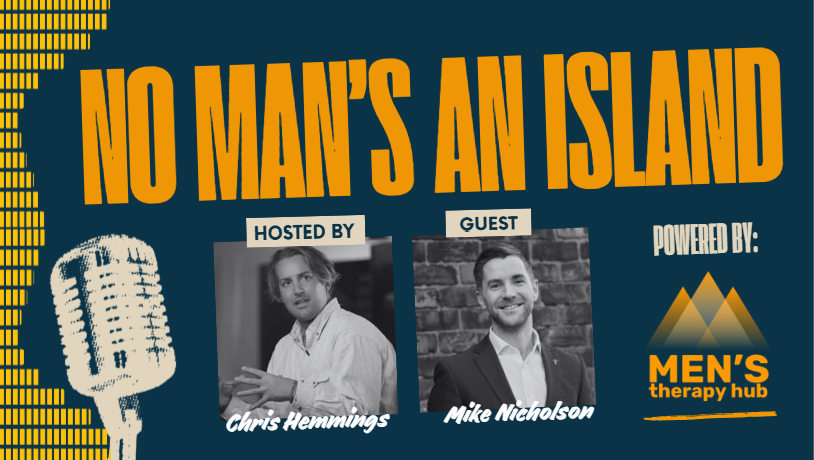
Episode 35 of No Man’s an Island
In this episode of No Man’s an Island, Chris Hemmings speaks with Mike Nicholson, founder of Progressive Masculinity and former teacher of 20 years. Mike now works across UK schools delivering workshops with boys and teaching staff, helping young men challenge restrictive ideas about masculinity and build healthier, more authentic identities.
The conversation explores the struggles many boys are facing today, including hopelessness about the future, emotional isolation, online radicalisation and the collapse of community spaces and rites of passage. Mike also reflects on his own experiences with suicidal thoughts, intrusive self-critical thinking and why boys often lack the language needed to express emotional pain.
Chris and Mike discuss the importance of male role models, why boys respond differently when men lead these conversations and how organisations working in this space can collaborate rather than compete. It is a hopeful conversation about what boys need, what schools are struggling to provide and how culture can begin to shift.
What we cover
- Mike’s transition from teaching into founding Progressive Masculinity
- The silent struggles many boys face in school
- Why boys often hide vulnerability to fit in
- Male friendship, shame and emotional literacy
- Suicide ideation and intrusive thoughts in teenage boys
- Why boys struggle to talk about emotions
- The pressures created by “guy code” masculinity
- Working-class boys and feelings of hopelessness
- Online influencers and the masculinity vacuum
- The disappearance of healthy rites of passage
- Why boys need visible positive male role models
- Accountability, allyship and challenging harmful behaviour
- Why youth spaces and community investment matter
Takeaways for men
- Boys often want to talk more than adults assume
- Emotional honesty becomes easier when someone models it first
- Many boys lack the vocabulary to explain what they feel
- Shame and silence are learned socially, not naturally
- Young men need hope, purpose and meaningful community
- Accountability works best when it comes with respect and trust
- Healthy masculinity is about freedom, not restriction
Quotes to share
“There’s four billion different ways to be a man.” – Mike Nicholson
“Boys don’t like to talk is one of the biggest fallacies in this space.” – Mike Nicholson
“When people tell boys to just talk more without giving them the tools, it’s incredibly frustrating for them.” – Mike Nicholson
“I think what surprises me now is people’s blindness to how capable boys are.” – Mike Nicholson
“Traditional rites of passage have disappeared and been replaced by shadow rites of passage.” – Mike Nicholson
Resources and links
Progressive Masculinity:
https://progressivemasculinity.co.uk
Men’s Therapy Hub directory:
https://menstherapyhub.co.uk/therapist/
Chris Hemmings:
https://chrishemmings.co.uk
Episode credits
Host: Chris Hemmings
Guest: Mike Nicholson
Powered by: Men’s Therapy Hub
Music: Raindear
TRANSCRIPT:
Chris (00:00)
Welcome to No Man’s an Island, a podcast powered by Men’s Therapy Hub, a directory of male therapists for male clients. Before we get started today, I just want to say hello to all of our new listeners. We’ve picked up quite a few over the last weeks from all over the world. If you are new to the podcast, I would really advise you to go back to the start to get a proper feel for what we’re trying to achieve here. Also, if you could help us out by rating us on Apple or Spotify,
that would be really helpful. On this episode, I’m joined by Mike Nicholson.
He’s the director of an organisation called Progressive Masculinity. They go into schools in the UK doing talks and workshops, working with boys and teaching staff as they try to expand the view of what it means to be a man. Before that he spent
20 years as a teacher and then he pivoted to doing this work. Hey Mike!
Mike Nicholson (00:43)
Yeah, hi Chris, how are you mate?
Chris (00:45)
Hey, I’m all right, thanks. Yeah, it’s good to have you on. I’m going to kind of point out the elephant in the room to begin with, and we’re going to get to this in a minute, which is like, technically, you work for what could be described as a rival organization to my other business, Empath. And I want to actually talk to you about that because there’s something interesting in the men’s space in terms of competition that I want to get to you to talk about. But before that, I have to ask you the question that I ask every guest to begin with, which is…
Mike Nicholson (00:57)
hahahaha
Chris (01:12)
How did you end up in this space? So for you, you were a teacher for 20 years. What made you want to pivot to doing this work and focusing solely on men masculinity and working with boys?
Mike Nicholson (01:22)
Yeah, so it during my time as a teacher that I really became aware of how many boys were struggling, often silently, how many were sabotaging so much about their lives to look a certain way, the way they thought they were supposed to look. So prioritizing safety over authenticity. Unfortunately, I worked with three boys in my career that took their own lives, one of whom I was very close to, how was his form tutor. So it really started for me as something very casual. I started a lunchtime dropping club where I said to
of the boys that were coming to speak to me. said, just come and bring your lunch. There’s no agenda. There’s no PowerPoint. We’ll just talk about whatever you want to talk about. it really grew from that. Everyone laughed when I did that, by the way. thought, boys want to be out playing football. They’re not going to come in and talk to you about stuff that really matters. And within about two weeks, we actually had a queue of boys down the corridor trying to get in. So then I separated it into two drop-ins, one for the younger boys, one for the older boys. And it became really, really popular.
That’s when I thought, I went to the head teacher and said, listen, these lads are coming and they’ve all got the same kind of issues and they’re realizing that they’re not on their own, they’re not weak or soft and they’re actually starting to support each other. Wouldn’t it be great if we took this seriously and did it whole school? So for the next three years, the head teacher was great. He really trusted me and he gave me little bit of time off timetable to look at the research, connect with the academics and plan something a bit more structured and formal. And that’s when really progressive masculinity was born. So after three years of doing that.
And that’s when I left them. There was really just a deficit in this space. I mean, it’s quite a few organizations now, but seven years ago, know, conversations about masculinity were particularly mainstream. This is before Andrew Tate’s rise and all that stuff before some of the social media platforms that were established today had established themselves. So it was really in just, just in response to a deficit and a gap.
Chris (03:10)
And you are another guest from the Manchester North, from the Northwest of England area. It’s kind of starts to feel like a fix this. But you started out focusing very much locally. I remember when you came on the scene. What issues was it that you were seeing in those boys and were they issues specific to the area? Was it something to do with deprivation or was it actually something that you’ve now realized are much more universal problems for boys?
Mike Nicholson (03:17)
haha
It’s both really, Chris. So there are some commonalities in our experiences as men, some things that we all experience that we can all discuss. But something that has become obvious in our work is that actually this work shouldn’t look the same everywhere. The cultural climate that you’re working in is very important. obviously I’m from Bury, a deindustrialized working class town in the Northwest. And we started off in similar kind of places. So we’re looking at the legacy of deindustrialization, young boys being told that they lack ambition.
or that they lack resilience or that they lack all these things when actually they don’t. But then as we expanded and we started working in different places, it became obvious that we had to adapt our programs based on the cultural context that, know, so if you’re delivering in Norfolk in a very rural community, that’s very different to delivering in inner city London or delivering in Belfast.
Chris (04:29)
What I always, the thing that I noticed when I started to do this work was, sorry, I’ll start that again, I’ve got a cough. The thing that I noticed when I started to do this work myself was the symptoms of the problem were very different wherever you went to deliver the work. And that would also be dependent on country as well, of course. But actually the core of the issues were very much the same. So what is it that you think that progressive masculinity is doing if you were to boil it down?
What is it that you are addressing? I was going to say attacking, but maybe that’s not the right language to use. What is it that you are addressing with these boys that throughout your work are those commonalities?
Mike Nicholson (05:12)
Yeah, so think one of our main mantras is there’s four billion different ways to be a man. I’m really uncomfortable when people say, do you go in and teach boys how to be men? That makes me so uncomfortable because I think it’s extremely arrogant. Like, who am I? Who is anyone to teach somebody how to be a man? This work is not about teaching boys how to be a man. It’s about giving them the a-phone. Also, that’s not giving them because they already had the agency. Helping them realize they have the agency to break free from cultural scripts and norms and repressive kind of codes.
and design the wonderful man, friend, partner, father that they want to be. And that’s an incredibly liberating message. We’re going in with this very aspirational view of masculinity because the boys, I mean, you’ll know the boys are very, very wary of this work because they’ll assume they’re going to be attacked. So when any of our facilitators walk in, we’ve got a room full of boys. What’s this woke snowflake nonsense? My dad said this would be rubbish. You get all that. But actually within about half an hour.
Chris (05:55)
That’s an understatement, Mike.
Mike Nicholson (06:08)
boy starts to think, you start to hear whispers like, this is actually alright, this isn’t what I it was going to be. Yeah.
Chris (06:14)
And that actually, right, I think that’s the most powerful word I’ve had lads going like, this guy’s actually all right. And it’s like, yeah, because the actually is evidence that you
really didn’t want this to be okay. You didn’t want this to be something that you would actually enjoy.
Mike Nicholson (06:25)
Yeah, yeah.
And that’s that deficit based perspective of masculinity, isn’t it, that we tend to approach it as boys need to be de-problematized rather than kind of, yes, we can hold each other to account and we’ve to have some difficult conversations, but actually can we do that through an aspirational lens?
Chris (06:42)
What’s your approach then as an organization? How do you first meet those boys when you or your facilitators walk in the room and you see them face to face and you are met with the degree of discomfort and distrust? How do you start to slowly, because you can’t just say, hey, this is a safe space and, you know, trust us because that’s not going to work. So what is your approach? How do you start to slowly break down those barriers?
Mike Nicholson (07:08)
Yeah, so we’ve been delivering these workshops for over seven years now. So the program is very grooved and it’s designed in a way that the first kind of hour and a half really are just about developing a sense of trust, a positive relationship. So you can go, like you said, you can go in and say, know, boys, this is not a school lesson. I’m not a teacher. You know, this is the place to be open and honest. But again, they’re probably not going to believe you. So the workshops are very, very practical in nature, especially at the start. You know, the boys, they don’t trust us yet.
they don’t really want to be sat down. certainly don’t want to be writing. So we’re up and we play a game and that game raises a really important talking point. And then we have a little group competition and that group competition raises and all the while they’re building this relationship with the facilitator. Now our facilitators are active facilitators. They’re very open about their experiences of men, particularly some of the struggles that they’ve been through. And that I’ll go first approach creates that psychological safety for them to reciprocate.
Chris (08:04)
Yeah, I think that’s particularly interesting for our audience because that is something that we’ve talked about a lot on this podcast already in terms of the therapy practice working with men is that traditional therapeutic practices would suggest that you don’t self-disclose. But actually for men who and boys and know, humans of any gender, but particularly for men and boys, if somebody can go first, I like that I go first approach, it kind of gives permission.
for them to start to do it themselves. At Empath, we have the of the rule that if you’re not willing to stand on the stage and own your own shit, I kind of stole this directly from the Mankind Project with their blessing, right? If you can’t stand on the stage and own your own shit, then you’re not gonna be able to get boys to do the same. And so how do you find your facilitators? How do you choose them? How do you trust them?
Right? How do you trust somebody with what started out as you in a room with some lads in one school and then obviously got to a point where you couldn’t do it because you were getting too many schools and so you brought other people in? How do you find these guys and how do you start to trust them? What conversations do you have with them?
Mike Nicholson (09:14)
Yeah, so recruitment, we’re extremely, extremely cautious with recruitment. And we’ve actually, we’ve expanded a lot slower than we could have done because we’ve been so slow on recruitment to make sure that we get it right. So the guys that work with us, they have to have had a successful history of working with boys and young men in whatever their specialized field is. So I think we’ve got seven ex-teachers, we’ve got sports coaches, we’ve got therapists, counsellors, youth workers. They’ve all got experience of working successfully with boys and young men. And more important for me,
They want to be in the room with these boys. They enjoy being in the room because you know, know, the self, the lads we’re working with, they’re so savvy. They’re so quick and intuitive. If you don’t really want to be there, they’re going to sniff you out very, very quickly. And it’s going to be awful for everybody. So we find these guys through professional networks, through recommendations, and then obviously we’ve got a vetting procedure. We’ve got a training program that they have to go through in order to become one of our facilitators where part of that is co-facilitating with me.
and learning the ropes. also, I do want to give them all a sense once they’ve got that trust from me, I also want to give them a sense of freedom. None of our facilitators deliver exactly the same content. We’re all based content, we all deliver. But everyone has got the freedom to adapt and tweak, especially for their cultural context that they’re working in. So I don’t mean when I was a teacher, I hated being given, you know, there’s a scheme of learning, don’t don’t don’t veer from it, you teach it exactly the way it is. Well, that’s not my style. And that actually doesn’t suit the class that I’m delivering it to.
and have some freedom here. So when I started this, was really keen that everybody would have the freedom to bring their own experiences, their own stories, their own style to it, whilst also keeping the kind of approach, that standardized approach that we’ve got.
Chris (10:56)
that because that was when I first brought Will in who was the first guy to take over the work. was, here’s how I do it. I want you to study exactly how I do it and then want you to forget everything that I’ve done and do it however you want. Because it has to be personal, this work has to be personal. If it’s robotic, like you say, I always talk about the boys, are looking for an off-ramp. If you give them any excuse to not engage, they will take it because it’s so easy for them to do so.
Mike Nicholson (11:06)
Hahaha, yeah.
Chris (11:22)
So you have to keep them actively engaged. And if you give the facilitators the freedom to be themselves, again, it’s the same in the therapeutic space. It’s like we had Audra Hornion, who’s like one of the biggest therapists for men in the U.S. And she’s just like, you have to be yourself with people. And it’s the only way that you’re to break down those barriers.
Mike Nicholson (11:39)
How can we encourage authenticity when we’re reading from a script or while we’re delivering something that feels robotic and modern? It doesn’t work like that, does it?
Chris (11:48)
How was that for you? Because as a teacher, there’s that the separation of church and state when you’re a teacher, right? Is that you can’t really bring your own mental health challenges, your own personal experiences into the room. So was that weird for you to start standing in front of pupils and starting to actually be honest about yourself?
Mike Nicholson (12:05)
No, it wasn’t weird. was liberating. And you’re absolutely right. There is, you have to maintain a certain professional distance when you’re a teacher. So I’ve never been ashamed of the fact that I’ve struggled with suicide ideation several times in my life, starting at 14 years old. was not, you know, as the head of the English department, I’m not talking about that. That’s it’s not, it’s not appropriate for me to be bringing that into a classroom. You know, you’re to get complaints and rightly so, you know, why is your English teacher talking about that? I’ve had an unhealthy relationship with pornography several times in my life.
Again, working in it, I’ve worked in three schools and two of them are Catholic schools. That is not something that’s, you know, it should be, it should be open with the schools, but it’s not. you know, you’re an employee of the school, you have to not toe the line, but you have to teach in a way that is consistent with the schools or the trust values. So moving away from that, I actually found it incredibly liberating. Cause like I said, I was never particularly embarrassed about it. I always wanted those spaces and me and my friends were quite open about that. talk about it. So it never really felt that weird for me.
Chris (12:40)
Wow, yeah.
Can tell us a little bit about that? Like those dark times and obviously, you know, leave out whatever doesn’t feel comfortable to share. But I think from an audience perspective, I think sometimes it’s really important for us to be like you are honest, particularly when we are going in and speaking with boys, to tell them what we’re talking about. Because particularly in the UK, not just the UK, right, we can be a bit Victorian around conversations, particularly around sex and porn, but also it’s like, don’t talk to kids about suicide. Well, no, actually.
We should specifically be talking to them about it because that will destigmatize that conversation. So what do you tell them? And also just like, what was going on in your life around those times when you were experiencing those difficulties?
Mike Nicholson (13:46)
Yeah, so it started for me around 14 years old where I was wrestling with intrusive voices, which you’ll know what they are. If people don’t, it’s these voices that pop into your head. They’re uncontrollable. You don’t know where they’re coming from. I was running myself down all the time with, you know, things like, you’re not good enough. You’re not strong enough. You’re not clever enough. You’re a failure. No one would know if you weren’t around anymore. In fact, you know, I don’t think anyone would even care. And that wasn’t true, but constantly kind of struggling with those thoughts day upon day upon day.
It gets to a point where you reach fatigue and you start thinking, well, what’s the point? What’s the point in being around here anymore? If, you know, if that’s the way I’m thinking. And then when I was 31 years old, my wife and I had a miscarriage. lost our first child quite late on in the pregnancy. And that triggered those intrusive voices coming back. This time there was a kind of added layer of the kind of father role in there. So it was things like you couldn’t even protect your own family. What kind of man are you? You know, your wife would be better off without you in the long term.
Obviously those, again, they’re not true, but this is just exactly. think I’ve struggled all of my life. No one has ever said anything as harsh to me as I’ve said to myself in my own head. And I don’t, I don’t know why I’ve been like that. I’ve got, I’ve got a lot better at dealing with it. And I’ve got strategies that now I can use. But when, when you say that to the boys, it’s amazing how many of them say, but I thought I was the only one who said those stuff. No, you have those nasty thoughts about myself in my own head. And it produces this really kind of supportive almost brotherhood in the room.
because I know I’m not the only one struggling with it. But I also know that these boys that are struggling with it probably haven’t had a space to talk about it. But also, think they’ve not seen the language required to describe it. I maybe I come at this from a very English teacher point of view, this idea that boys don’t like to talk, even if you give them the space that feels safe, do they actually possess the vocabulary? Do they know what that conversation looks like? Have they got linguistic templates to fall back on when they want to talk about?
loneliness, anxiety, love, joy. I actually don’t think they do. So even when they want to talk, they feel paralyzed because they’ve never seen what a conversation like that looks like. So if I can provide a model example, you know, maybe next time they’re struggling with it, they could use some of that for themselves.
Chris (15:55)
And that’s where I think a lot of the shame comes in when we just tell these boys they should be talking. I use this analogy and I think I’ve used it once before on the podcast of like, it’s the equivalent of giving a boy a trombone and just saying like, hey, play me a jazz solo. Well, they can’t do that. And then we’re saying, hey, lads, let’s go and start a jazz band together. Like what? We just don’t have the skills to do it. And yet then there’s the shame. And this is like 50 year old CEOs or 15 year old kids, right? Saying the same thing, which is all I should be able to do this. Well, how? If nobody’s ever taught you how to do it.
So is that part of your work, to actually give them the tools?
Mike Nicholson (16:30)
Yeah, that’s part of the active facilitator model that we adopt. If our active facilitators are actively modeling those conversations, they’re then providing vocabulary, linguistic, not just the opportunity, but the skills required. And again, this comes from a very teacher type background. Do you actually possess the skill to accomplish what it is you’re trying to do? Because like you said, it really frustrates me when people say to boys, you’d be so much happier if you just taught. Boys should just talk more, men should just talk more.
without actually giving them the spaces and the skills to be able to do so, it’s incredibly frustrating for them.
Chris (17:04)
and also shutting them down sometimes when they do, or particularly as grown adult men, not really knowing what to do with male pain and male frustration and male challenge and that being shut down. With your own personal background, you think, how old are you, mate? If don’t mind me asking. 44, okay. So a pretty similar age, we grew up in a similar time when mental health was just not even a part of the vocabulary. Nobody really knew what it was. You were either like mentally ill,
Mike Nicholson (17:21)
I’m 44. No, no, man, I’m 44.
Chris (17:33)
or you are all right. When you look back at that time now, what do you see in terms of your own socialization? Like, where do you look to see? Because one thing that always fascinates me is very rarely were we explicitly told that it wasn’t okay to talk about our feelings. It wasn’t like we sat down and given a lecture to say like, Laz, if you talk about your feelings, you have to give your man card back. But there was a sense of that. So where did it come from in your life? Where did you learn that if it wasn’t?
Explicit. Where was it implicitly told?
Mike Nicholson (18:05)
think those messages permeate from the entire culture around you. So family is the primary socializer, isn’t it? And I’m very proud of where I come from and I’m very proud of who I come from. But also I’m very aware that I came from a family during a time and a place where certain things were taboo, where certain things you just picked up that no one, again, no one ever said to me, shouldn’t talk about their mental health. I actually never heard the phrase men’s mental health. I think I was about 17, 18. I didn’t even know what to think.
Chris (18:32)
Right, yeah.
Mike Nicholson (18:34)
But never, no one ever explicitly said that to me. I just picked it up from the world around me because no one else was doing it. If anyone else dared to do it, they were treated as a bit of a leper, a bit of a weirdo, know, a of an outcast. So I think I learned that silence and that shame just from the culture around me rather than from any explicit messages that were given to me.
Chris (18:54)
And so then what do you see now in terms of the socialization happening with the boys? And of course you knew them much better when you were working one-to-one with them in schools, but that was quite some time ago now. But even back then, I kind of, I think I know the answer to this, but I want to ask it anyway, which is had things changed that much from when you were a lad?
Mike Nicholson (19:15)
And in some ways, yes, in a lot of ways, unfortunately. So one of the first activities we do in our workshop to create, we don’t call it a baseline to the boys, but it’s one of the ways we measure progress is by establishing a baseline early on and then doing a similar activity at the end. And our baseline is called the guy code. we get the boys in these kind of individual groups, three or four in a group. And we say to them, can you create what are the unwritten rules of being a high value man in our society? A man who would get respect and status, a man who
we would look up to and say, yes, that’s the guy. That’s the guy I need to be. The boys are told you do not have to be politically correct. Don’t worry about your language. Don’t worry about what you’re supposed to say. Like this work only works if we’re really honest with each other, even if that honesty takes us to some quite uncomfortable places. And what they tend to write is something that I would have written 30 years ago, you when I was in year nine at school, it pretty much worked, you know, we can never look weak. must be strong and dominant.
We must be physically imposing, maybe even intimidating. We’ve got to a six-figure salary. All these things, some of those are not. There’s some value in some of those, believe it or not. We can polish some of those off. But overall, what they produce is a very regressive model of masculinity. And it’s exactly what me and my friends would have written 30 years ago.
Chris (20:32)
And that’s a good point for me to pivot to the idea of progressive masculinity because I know that there are some people in this space and I have some understanding of why who say there are so many different forms of masculinity we talk about toxic, healthy, progressive, positive, know, whatever it might be. Why progressive masculinity? What is it about that term that stuck with you? Because
I came up with what I thought was like a double entendre, really clever. Yours is much better for SEO purposes, by the way. But why progressive masculinity? What was it about that terminology? Because you’re talking there about you think that a lot of the ideals are regressive. So is it specifically to counter that?
Mike Nicholson (21:02)
Hahaha
Yeah, it’s just moving forward. It’s making progress on this idea of what it can mean to be a man, the joy, the beauty, the limitless potential, there’s so many different ways. And I’m acutely aware, again, being an English teacher, that progressive can carry negative connotations for some people, you know, of woke culture and all that kind of stuff. And I actually quite like having that conversation. You why did you call it progressive masculinity? For me, it was just about, I feel like for a long time, we’ve been stuck as men, not just as men, it’s the culture around us as well.
So we work with parents and teachers, not just about the boys, but everyone around the boy. Masculinity is not just about poison men, you know that. So it’s just moving beyond these frustrating, regressive ideas that seems to have been holding us back and opening the potential of what it can mean to be a man, rather than I’ve got the answers, progressive masculinity knows what it means to be a man and this is what you’ve got to be like. That is not our approach.
Chris (22:08)
And how has that journey taken place in you then from that 14 year old boy who was really struggling by the sounds of it and felt alone in it. And I think one of the saddest things for me is when I’m working with young men and they’re really reluctant to go and tell people around them that they’re struggling or even say that they’re in therapy. And then when they finally do, they report back and they go, it turns out two of my mates are either in therapy or have been to therapy themselves. And it’s like, yeah, well, I’m not surprised, you know? So what’s that journey like?
for you, how has that journey been for you from being that 14 year old who has felt alone, who has been struggling with his pain and didn’t really feel like the culture around him could hear it. So now, like you say, being in a group of guy mates who are very open about their feelings, kudos to that, I am too, and it’s wonderful. It’s taken a lot of work, by the way, to get there. And some disgruntlement from my friends at times. And I know some of them are listening, so hi, lads, you know who you are.
Mike Nicholson (22:57)
Ha
Chris (23:05)
And to now also being this figurehead, because I think it’s fair to call you that, for an organisation where you are championing the very opposite of the culture that you grew up in. So how have you wrestled with that over the years?
Mike Nicholson (23:20)
I think I’ve just learned to, I mean, it sounds cheesy, but it has been a journey and it’s been a journey that’s had some pain, a lot of risk, you know, leaving teaching a very secure job, a good pension to go into a world which I really didn’t know a lot about. So it’s been a lot of risk, but a hell of a lot of reward as well. I knew after running the programs for three years while still a teacher, I knew that I had something quite special, it sounds quite arrogant to say that, but you know, I was often working with some of most high tariff boys.
And they were walking away. I really enjoyed that. And afterwards their attendance was better. Their grades would go up. Their exclusions would go down. That’s in addition to just feeling healthier and happier. So I always had the confidence that I knew I had something. And if I worked hard enough, again, it sounds cheesy, but if I worked hard enough that I probably could make it work. So yeah, it’s been, no, it’s been a fascinating experience and lots of ups and downs, but I wouldn’t try. wouldn’t trade it for the world. And again, when the boys asked me, what’s it like to be a business leader, Mike, what’s it like to be a business owner?
I I don’t really think of myself as a business owner. You guys, I’m not driving a Lamborghini around Dubai if that’s what you’re asking. That never will be. That’s okay. That’s all right.
Chris (24:26)
And you never will be in this profession,
That’s a conversation we’ve had a lot also on this, is this idea of success. So you’ve gone from that security, right? Which is, and we had Louisa Toxfed Monk on the other day and she did a great episode talking about neoliberalism and the impact of the kind of economics of masculinity and how difficult it is to secure yourself these days, particularly from a working class background. You’ve taken that risk and I think there is.
I kind of we don’t really truly recognize the level of risk it takes for men to break free from things like structures of the teaching profession which are secure things like the rigid ideals of masculinity So how did you have those conversations with yourself to actually say you know what I’ve taken the risk many times I’ve taken the risk in that school of actually asking to support boys
which will not have happened before and doesn’t happen still in many schools. Risk, risk, risk, risk. It’s kind of baked into the traditional ideals of masculinity, which is the irony here, because it’s not all bad. So you’ve taken this concept of risk and you’ve pointed it in a positive, healthy direction by the sounds of it. But how did you do that? Because you must have wavered at times.
Mike Nicholson (25:54)
did, but the risks weren’t reckless, they were managed. So, you know, by the time that I was taking progressive masculinity out into the world, I’d had three years of experience behind me, as well as 18 years as a teacher. I’d connected with a lot of the researchers and academics that were big in this space. So whilst it was a risk, whilst all the risks I’ve taken were risks, they were all managed risks and they weren’t reckless. So you said, you know, sometimes a risk, a leap of faith is necessary, but how can I mitigate the risks around that? There’s always going to be some, you know, some risk.
How can I reduce the level of risk to a point where, right, now it’s acceptable, now I can go for it?
Chris (26:29)
And when you are talking to the boys and they call you a business owner, because it’s true Mike, you are a business owner, but why do you reject that? That’s interesting for me.
Mike Nicholson (26:36)
I don’t
know. don’t know because it doesn’t fit. think coming from my dad was a teacher as well. So I’ve come from quite a liberal background and I’m certainly not anti-business. It’s all like obviously, you know, responsible capitalism. I’m all for that, but I don’t know. I don’t want to see this as a business. One of my reasons for becoming frustrated with teaching later on in my career is I felt like it was becoming quite cold. I felt like it was becoming approached as a business. So we had, you know, big multi-academy trust taking over.
large amounts of schools and saying every English lesson does this at the same time. Don’t fear from it. This is your work. These are our structures. And I know it’s a frustration that a lot of teachers have had this kind of almost corporatization of education. So as I came towards the end of my career, I was getting frustrated with teaching and the lack of individuality it allowed me and freedom. I was probably was looking for something else as well. this idea, technically I am a business owner, but I would never approach it that way because
Profit is not our driver. We have to earn enough to keep the lights on and to pay everyone. But you know, that is not our main driver. And when I think of business, corporate, that kind of what I associate it with. I know that’s not everyone’s experience of it. But yeah, I kind of struggle with that business thing, if I’m being honest.
Chris (27:55)
And I do respect that because this is passion for you. It’s not just money making. And I’m sure that the guys that you work with will very much benefit from that mentality too. So fair enough. I’m interested here because we are living in a time where boys and men are being spoken about quite often in negative terms. So this is a two-fold question. wonder how you combat that, first of all, but also…
How do we then at the same time do the accountability part? Because we hear a lot of negativity about men. And what I will say is, and this is my take on this, like we talk about patriarchy, for example, I didn’t choose this, Mike, you didn’t choose this, 14 year old boys, they specifically did not choose this, right? None of us alive today chose this framework. We’re being held accountable for the actions and behaviors of men forefathers that have come before us. And also rightly,
as I have been and I’m sure you have been, our own behaviors too. How do you have those conversations with the boys and say, like, it’s okay to have made mistakes and it’s also okay to hold your hands up and own those and say that you’re gonna try and do better and it doesn’t mean that you’re a bad person or the 15 year old version of being canceled or whatever. So how do you kind of combat that duality of you’re not bad and wrong just because you’re male, but that doesn’t mean that we don’t hold ourselves accountable for the things that we have done.
Mike Nicholson (29:24)
Yeah, Dr. Alex Blower and I talk about this a lot. I don’t think you can exist within this space and function if you can’t live within that paradox, within that dichotomy that you just explained there. So I have to acknowledge that there are some advantages and privileges to being male, just like there are, I’ve had advantages and privileges to being white and able-bodied and heterosexual. But I also acknowledge that that doesn’t mean that I can’t have struggles in my life and can’t have difficulties. And when it comes to accountability with the boys, we actually find they’re incredibly open to accountability.
as as they think it’s fair, as long as they think it’s in a way that’s going to help them. when it comes to accountability, I don’t like the idea that accountability is this external force that we’re going to apply to you. I think part of growing up and with masculinity becoming a good man is not only holding each other to account in a way that is healthy and it doesn’t escalate, but also learning to hold yourself to account and recognize moments where actually I could have done better there.
And not only does that not make you weak or soft, think that was the characteristics of actually a really good strong man, when he can hold himself and the people around him to accountability. I don’t like this idea that we’re forcing accountability on boys. We’re going in and helping them develop a sense of accountability for themselves.
Chris (30:35)
How do you do that?
Mike Nicholson (30:38)
through healthy challenge and through that, that I’ll go first mentality. So for example, on day two of our program, our program is two really intense days where we’re based in the school with the boys and every hour works on a different kind of topic or aspects of masculinity. So on day two, for example, gender allyship is one of our workshops where the female voice is brought in and this is what it’s like to be a woman in today’s world and how can we turn up for them.
And I’m very open about some of the things that I said and did when I was younger, especially things that I did and said in order to fit in, you know, with the boys, be one of the lads, be one of the Things I’m not proud of. Yeah. Things that actually that I didn’t believe that went very much against my values. I’ve shouted stuff at girls on the other side of the street when I’ve been with a group of boys, even though I was raised by wonderful women not to do that. And it made me feel like absolute shit at the time. And I went home and hated myself for it. And I was thinking like, why did I do that?
Chris (31:12)
things you’re not proud of. Yeah.
Mike Nicholson (31:33)
I would say to lads, if I’m not a sexist, why did I shout a really sexy thing? If I wasn’t a homophobe, why did I say a homophobic comment in that football changing room? Why do I need to do that? Me kind of modeling self-accountability, then they’ll often say, I’ve done that, Mike. I’ve shouted stuff at someone or I’ve said stuff with the boys that actually isn’t who I am. And they’ll say, listen, we know why we have to do it or we feel like we have to do it. Safety, belonging.
over authenticity is something that we’ve all felt. But what can we do in that situation? Let’s say your mate who sat next to you in the change room says something that disagrees with your values. How can we maybe say something to him that doesn’t make you a pariah or a target, but also draws a line and says, I don’t think that’s actually very right, mate. And we’ll just bounce ideas around. It’s like, again, I’m not there to teach you this stuff. Let’s develop it for ourselves.
Chris (32:29)
Does it still surprise you sometimes how the boys can meet you in that beautiful way? Sometimes actually from my experience, like relatively quickly once those barriers are brought down and once you’ve modeled it yourself. Cause to me, know, I’ve kind of semi retired from this work now, which is ridiculous given I’m not even 40. But I think for the first few years it really did. And towards the end, maybe I got a little bit complacent with it. But thinking back now.
some of the conversations I’ve had with those boys and some of the things I’ve learned from speaking to those boys has been fantastic. Like the courage that they have sometimes to sit in a room. And I think, I don’t know if I’ve told this story before, but I remember going into a school in a really deprived area and our facilitators do an assembly first. And then after the assembly, I remember a group of lads filed in and like the biggest, hardest, toughest looking kid sits at the back.
And these other two lads in front of him, they’re on like the steps that are, what are called? In America they’re called bleachers. I don’t even know what we called them in the UK. And the two lads in front of him started dicking about and taking a piss. And like, I didn’t really support it, but he kind of like clocked them both on the head and was like, listen to this guy. And I was like, all right, like the biggest, hardest, toughest kid in the room. Because I’ve got through to him. And so he’s like, actually we need to listen to this guy. And it’s…
I don’t know, I’ll never know what it is that I said during the course of that assembly that got through to him, but something did and when you do it’s like a light bulb turns on and magic can happen.
Mike Nicholson (34:02)
Yeah, one of the biggest fallacies in this space is that boys don’t like to talk. It’s a load of rubbish. Boys and men, we love it. It’s just so rare that we have that permission, that safety to do it. But like you said, when you provide them with that and show them how to do it, I think it stopped surprising me about two years ago because I seeing it every single week. Boys willing to be authentic, to be brave, to take risks, to actually support each other as a peer group. So after seeing it day after day after day for years, it did stop surprising me.
What surprises me now is other people’s blindness to it. Other people, and that’s kind of harsh because they don’t do what I do, but other people, their lack of willingness to believe it and to believe in boys and to believe that they are capable of this. I suppose that’s what surprises me more now.
Chris (34:45)
Does it still make you sad when you have those responses from people or have you hardened up to it because you’ve had to?
Mike Nicholson (34:50)
I think I’ve developed a callous now, Chris. I think you’ve got to accept that everyone does the work that you do. Everyone has different experiences that they bring into this space. I enjoy talking to people who disagree with me. I don’t want my life to be an echo chamber.
Chris (34:53)
Yeah. Yeah.
What do you find are the biggest challenges that the boys are facing now? from the time that you started teaching to now, it’s like 27 years, that’s a big change in culture. So what are the major challenges that you are facing and that you recognize that boys are facing now that maybe weren’t there five, 10 years ago?
Mike Nicholson (35:26)
Yeah, I think we patronize a lot of boys by assuming they’re not aware of the climate, the world climate, the geopolitical climate. They are acutely aware and it’s causing huge anxiety for them. So a lot of boys are pushing back on education saying, this is not preparing me for the modern world. I don’t think this is going to help me get a job. think I’ll never, in some ways they’re very right on that. I think we say boys, I’ll never be able to afford a house. I know I won’t, I’ll be a first time buyer, impossible.
Chris (35:43)
and they’re kind of right on that.
Mike Nicholson (35:54)
There’s war everywhere, the economy’s in absolute shambles. So I think, know, obviously there are a lot of problems in the world and the media obviously present a very negative view a lot of the time of it. But I think what gets me as a biggest difference from when I was in school is the sense of hopelessness almost that permeates the future of some of these boys. And I say, listen, lads, I am an employer. They’ve put my business out, I suppose. I would, there’s always going to be a need for good, hardworking lads like you.
Like you’re amazing. I’d employ you, you when you were 20, 21 years old, you were an incredible young man. But I think that sense of hopelessness and this bleak view of the world that’s out there is probably the biggest difference that I’ve recognized.
Chris (36:38)
And that would be a kind of, again, class issue based particularly in areas of the UK where a lot of the schools that would get organizations like us in are dealing with real serious problems. And again, we talked about it with Louisa, this issue of the economic decline of a lot of areas. So boys, I think that hopelessness word makes me, it made my heart sink when you said it, because those boys…
How can they feel anything but hopeless when they look around at the adults around them and they can see that there aren’t great job prospects out there? And unfortunately, as you will well know, a lot of schools, a lot of boys will feel like the school has given up on them by the time they’re 12, 13, if they’re not academically strong. So how do we counter that? And look, progressive masculinity, empath, beyond equality, we can’t do that, right? We can just go in and be with those boys for a short.
brief period of time and give them a little bit of a, you know, a gentle encouragement or a firm encouragement some of the time. But what, needs to change in terms of education or what needs to change culturally to stop those boys feeling hopeless? Because I had a clip out with Louisa where I talked about feeling really sad on behalf of white working class boys in the UK for health, education and employment reasons, being having the worst outcomes and all three of those. And the pushback is.
But those boys are, those are white men, they’re privileged. How dare you show compassion and empathy to them? Which is, you know, I mean, I don’t want to say fuck you to that, but I want to say fuck you to that because that’s so dismissive of a very real problem.
Mike Nicholson (38:18)
It is. I think, I think as a culture, we’re actually with that kind of narrative, we’re pushing boys further towards the very ideologies that you actually want to protect them from. That is the exact kind of attitude that will drive boys to into the arms of someone who says, yeah, you know, one of these online guys who says, yeah, the world hates you, but not me. I’ll teach you how to be a real man. Earn six figures, have the girl of your dreams, have a great body. We’re driving boys towards those kinds of ideologies. Last year I was in a school in Sunderland and I think it was probably one of the most disadvantaged communities we’ve ever worked in.
80 % of the school was on free school meals. So it was a former shipping, yeah, it was a former shipping industry. So all this infrastructure and community developed around that industry. And then when that industry went out, obviously, no, there was no jobs, crime, poverty went through the roof. And they’re dealing with the legacy of that now. And this lad who was 14 years old, he said something that I say this in our staff training and our parent workshops, said, when a lad like me, this is a white working class boy.
Chris (38:52)
Wow, okay.
Mike Nicholson (39:16)
is that when a lad like me looks around, Mike, I see Black Lives Matter, feminism, LGBTQ. And I’m really glad that those groups have that because they need them, don’t they? It’s good that they have that. But where’s my version of that? No one ever speaks up for a lad like me. In fact, all I ever hear is something negative about a lad like me. And there will be some people who jump on that and say, but you’re white and heterosexual and you’re male. The world was designed for you to succeed without seeing.
actually the pain that that boy is going through and the reality of it because I think he’s in a lot of ways, I think he’s right.
Chris (39:49)
Yeah, it’s this idea of universal male privilege. like I’ve said many times on this, I’m privileged. Absolutely I’m privileged in many ways. And you said at the start that you are. But again, even if I’m the most privileged guy on the planet, I still feel pain. I still feel hurt. And as I said, the kind of socioeconomic outcomes for white working class boys are really, really poor. In fact, the poorest of any group in the UK, and not just in the UK, it’s also true in the US.
and other countries too. And so I feel the pain of those boys. I recognize the pain of those boys. And what an amazing thing for that young lad to say, which is, because it would be very easy for him to hate on feminism, on LGBT, on Black Lives Matter. But what he’s saying is, is the yes and they all need to exist. But what about me? So what about him? What can we do for him? What can schools do? And I know schools are already so incredibly busy. Schools should not be raising children in the way that we are now expecting them to.
But I think that part of the problem is, is that so many parents, because of the economic climate, are so stretched, they’re working, some work in multiple jobs, some of them don’t have jobs, and anybody who says that not having a job is easy doesn’t understand not having a job, because all of the research shows that mental health and employment are directly linked, at least productivity, because we’re humans, we’re meant to be productive. So what do we do?
How do we combat that? do you speak to him? When he says that to you, how do you look him in the eye and say, or at make him feel like he is cared for or cared about?
Mike Nicholson (41:25)
I think first off, you gotta remember, we’re not there to provide answers and we’re not there to provide, here’s a solution to that. We’re here to provide a space where you felt like you could say that. And when you said that, you weren’t shut down, you weren’t judged. You were actually received with, we held that space for you and we held it with warmth and I value what you said. actually what you said there was incredibly brave and don’t have to probably a frustration that’s felt by many of your mates. So there’s no, I don’t think there’s a whole lot schools are underfunded over
work that understaffed. I was a teacher, my wife’s a teacher, nearly all my friends are teachers. Teachers, it’s quite less, very incestuous profession teaching. So what we’ve got to do is we’ve got to lobby for more support. And I see Will from MPath regularly down in London and Westminster at the various round tables and things that we go to. So we’re going down to London to Westminster Whitehall. And we’re sitting in these rooms where we’re saying, this is what we’re experiencing on the shop floor.
You’ve got researchers there saying this is what we’re finding in the research. We need to put more supportive structures in place because schools cannot be all things to all people. It feels like every social issue or schools feel every social issue is now theirs to solve. And it’s resulting in a huge sense of fatigue within the workforce, which is contributing to the shortage of teachers and the retention of teachers. So we need funded proper plans and strategies that we can take into schools and local communities.
that are going to actually provide pathways and rites of passage. I’m a big one for rites of passage. You ever heard me speak before? I go on about them all the time. So rites of passage seem to be traditional rites of passage for boys to transition into the world of men have been disappearing for a long time. And they’re being replaced with these shadow rites of passage, you know, in response to avoid. Can we develop positive rites of passage that guide a boy from boyhood to manhood through school, through the community and give him a place where he feels a sense of belonging?
sense that he’s got a future and a pathway to being a good man.
Chris (43:22)
And what are those shadow rights of passage that you can see off the top of my head? I’m thinking like lose your virginity, maybe take drugs or drink or I don’t know, what would they, okay.
Mike Nicholson (43:31)
Exactly that.
Engaging dominance competitions, high risk activities, losing if you don’t have a high body count, kind of short-cut hustle culture takes their own ways to get quick gains in the gym. you both invest in crypto and NFT, get rich quick schemes. It’s all that kind of online hustle culture, which has filled the void of traditionally healthy rites of passage that a boy would go through. now we’ve got nearly a million meets in the country now.
not in education, employment or training. Now, one of the key rights of passage for a boy to a manhood was going from school into an apprenticeship or a job. know, there is that transitional period where you’re facing struggle, but you’ll be mentored and supported. And at the end of it, you have that acceptance and recognition from the community that you have gone through this struggle and you are now seen as a respected figure with a particular role. Buying a house was another one. You you weren’t just a boy at school anymore. You were a man.
You had the man responsibilities. You had to figure out how to support yourself and go shopping and cook and all that kind of stuff. I how many boys leave an education can go and get a house? So all these traditional rites of passage have been crumbling, but we haven’t replaced them with anything positive in their places.
Chris (44:48)
that’s where in the power vacuum, know, nefarious characters creep in where we don’t have those mentors. And I am interested in this because I think there are some people who will push back strongly on us ever talking about a lack of male role models as if somehow us saying that fatherlessness means that we’re saying that mothers aren’t doing a good job. Or if we’re saying that we need more male teachers is to say that female teachers can’t do a good job. For me,
I say, well, actually research kind of shows that that’s important, that role models for boys are important, but it’s also, you can’t be what you can’t see. It’s why men’s therapy hub exists. So like, what is your take on this as somebody who is in a, or was in a profession and still works in that arena where there is a lack of male teachers. And as far as I’m aware, that is decreasing, not increasing. Same in the therapy profession. What is that impact on boys? Because
You are and have been a fantastic educator and role model for boys and you did something magnificent for those boys in that school that then means you’re now doing it for boys all over the country. There aren’t many Mac Nicholson’s in the world, unfortunately. So how do we change that? like, you think we do need to change that? Do you think actually we do need to get more male teachers in and would that make a difference?
Mike Nicholson (46:13)
Yeah, I think the zero sum mentality is the curse of this space, isn’t it, Chris? Where if you say, you know, we need more of this, what about women? You know, what’s wrong with a female teacher? Why can’t a single mother raise a wonderful young man? But we know that they can, some of the most wonderful young men I’ve ever worked with have been raised in single parent, female. But also, if we’re being honest, it is advantageous to have really good men in your life who you can learn from. So if I give you little example, we actually trialed a female facilitator for progressive masculinity.
And this female facilitator was a former PE teacher. was funny. She had that kind of boisterous energy, very infectious kind of sense of humor. And it works on every area apart from those high stakes taboo topics, things like body image, relationships, pornography, sex, even with her incredible ability to facilitate those spaces. The boy said, I can’t say what I really think. It doesn’t feel right. It doesn’t feel respectful.
Chris (47:01)
Sex,
Mike Nicholson (47:11)
I don’t think it doesn’t feel right. And so that’s why we only have male facilitators for that reason, is because our experience has taught us that, yes, women absolutely have a role in this work. And I think the female voice is incredibly important in this space, but boys are telling us that when it’s a man sat in front of them, especially a man who’s been through similar things to them, they find it more impactful. moving away from that zero sum mentality, if that’s what the best thing for boys is, let’s do it. And then…
Girls benefit massively from that as well. Girls benefit hugely from this work if we’re discussing about what it means to be a better man, a better husband, a better dad, a better role model and boyfriend. So I really, the zero sum mentality is thrown at us all the time, as you can imagine. What about girls? What about women? Of course we care deeply about them and this work benefits them as well, but primarily this work is aimed at boys and young men and that’s okay. It’s okay to do that.
Chris (48:03)
Do you get tired of having that conversation, having to caveat all the time?
Mike Nicholson (48:07)
A little bit, but again, people are coming at it from different spaces. They don’t have the experience that we’ve got. And it must be, if I’m a woman living in a patriarchal system that has been, I feel has disadvantaged me where men, I can see why that would be frustrating for you. But I would also come up with, well, not all men flourish in a patriarchy. Actually, that guy code that I mentioned earlier, that is patriarchal masculinity. And it is crushing the vast majority of us. And this isn’t a competition like…
let’s dismantle patriarchal structures to benefit women because yes, they are incredibly badly affected by it. But actually the vast majority of men would benefit from this as well. And that’s that positive some mentality. We’re not against each other. Like we can win together and rise together.
Chris (48:49)
Yeah, I’m interested in this because I’m gonna go back to what I said at the very start now, which is, again, technically, Mike, I know I don’t really run empath anymore, does, but technically we are like competitors, rivals in this space. And I think a big area where, I wrote years ago, had a very brief stint writing for the Telegraph until their readership complained that I was too woke and I got canceled after three articles. I wrote.
Mike Nicholson (49:11)
Ha
Chris (49:16)
On International Men’s Day, I wrote an article that just said like, we can learn so much from the women’s movement, right, in terms of the men’s movement. And I’ve had really weird experiences of guys saying like, you know, I don’t collaborate or like we don’t do partnerships. And it’s like, why not? Why are we? I still think there’s parts of the men’s space which are still, to use your word from before, bit regressive. And this is mine and I don’t want to share because capitalism, competition, patriarchy is still kind of baked into us a little.
So like, you’re coming on here, right? And I want to make it very clear. Like I never saw you as a competitor. I see you as, like how I describe it is we are pulling in the same direction from slightly different, sorry. We’re pulling in the same, towards the same goal from slightly different directions. How do you navigate that as a man? How do you navigate the, you know, I could name,
Empath, Progressive Masculinity, Beyond Equality, and Matt Pinkett probably is the four biggest players in this space. But there is, you know, there’s Lewis Wedlock, there’s more people coming out now doing this work. Yeah, how do you navigate that and not seeing people as competitors? Because technically, you know, again, we are. It’s something that I’ve grappled with for a long time because I was one of the early adopters of this and then suddenly like lots of people like you came along and I had to be like…
Mike Nicholson (50:26)
Future man.
Chris (50:45)
That’s a good thing, you know, like, which I do believe, you know, but it’s made our work becoming bigger and more successful quote, more difficult, but that again, more is better. So where does that sit with you in terms of this space? Because you do work with Will and alongside Ben Hurst and stuff from Beyond Equality. And like, do you find that easy?
Mike Nicholson (50:47)
Hahaha
find it very easy. find it very easy. Again, coming from an education background where being an English teacher, you’re part of a big team and you’re constantly saying, how do you teach Macbeth? How do you do that poem? Because I stink at that poem. The kids hate it when I teach that poem. What can I learn from you? So I’ve really carried that mentality over. So I’ve met many times with Will to discuss how we both approach things. I think he’s interviewed me for his new book that he’s writing, Dan at Beyond Equality, Chris at Future Men.
Chris (51:09)
Okay.
Mike Nicholson (51:36)
Rich Ponfret’s doing great work at Boys to Men. And I’m more than happy for us to sit down and say, what works for you? And I found that we do all approach it in a slightly different way, actually. And I am more than happy. If we can’t fulfill a book, you know, we’re not the best person for that school. I’ve recommended pretty much all of those groups that you’ve just mentioned. Or in your area, you know, get in touch with these guys. Or I’ve heard, or I’ve seen the work of these guys in there. I’m sorry we can’t provide for you, but these guys are brilliant. Maybe give them a call.
So rather than jealously protecting and kind of guarding and just looking out for ourselves, long as I’m sure that what they’re doing aligns with what we’re doing. I would never recommend someone whose work I didn’t align with, but as long as their work does align, which the majority in this space does, I’d be more than happy not only to support them, but to recommend them as well.
Chris (52:27)
Do you think that is reciprocated entirely? Okay.
Mike Nicholson (52:30)
I don’t care. I don’t care. I’m not responsible for
what other people do. I’ve never, I don’t think anyone’s ever come out and criticised progressive masculinity in an unfair way either. I don’t know if people recommend us to, in either way that we do for them, but I’m not responsible for that.
Chris (52:47)
Do you have faith in the future of this conversation? Not in what’s going to happen with boys, but actually that things are changing in terms of the way that these conversations are being met.
Mike Nicholson (53:01)
Yes, I do. So one of the, I think one of the reasons we have grown so quickly is I think the thing that’s missing from this space is hope. Now we talked about the hopelessness the boys feel early on. We’re not dodging the difficult conversations. We’re not shying away from the sense that there are issues out there, but bringing that sense of joy and hope and laugh. spend most of our time in our workshops laughing with the boys and young men about various stuff. So we’ve got, we’ve got this particular activity we do called it’s taboo, but it shouldn’t be.
And the boys can anonymously post a talking point that’s taboo, that shouldn’t be. Some of the things that come up. So year nine boys were saying about erections, you why is it so embarrassing to get a boner? Like what are you supposed to do about it? What are different ways in which I can, you know, deal with a boner in the middle of a lesson? And you’re thinking, wow. So in response to that, I don’t know if you’ve seen the film super bad, but there’s this clip of this lad saying these two boys are having that exact conversation.
Chris (53:46)
Aside from tuck it under your pants.
Mike Nicholson (53:57)
And this boy goes, well, I took it off in my waistband because it hides it and it feels awesome. And it’s those kind of like, that’s something they want to talk about, right? Another lad said, how do I approach a girl and ask her out without seeming like a pervert or a weirdo? And I’m like, wow. I said, are you worried about that? No, that’s something that was different from what I felt quite comfortable going up to her. You get a of a temperature check off her mates, wouldn’t you? And then if that was positive, you go and talk to her. But a lot of boys these days are frightened.
In terms of that, going back to that idea, I think we’re bringing hope to a space where it can be very pessimistic and hopeless if you let it be, but it doesn’t need to be because you said earlier about a lack of positive role models. I don’t think there is. I think there’s a lack of visible positive role models. I think there’s so many wonderful men out there in the world. just think they have very, the kind of men we’re thinking about have very low visibility in the lives of our boys. So one of the things we’re big on is showing them.
explicitly modeling what a healthy masculinity can look like. And they love those stories, stories about different men in different fields. Like Kevin Sinfield and Rob Burrow is one of my favorite rugby players. I’ve had lads crying over when Kevin picked Rob up and carried him over the finish line in that marathon. again, they walk out thinking, no, that was not what I thought it was going to be. I wasn’t attacked. I was held to account. And I feel like I’ve got a good idea about the man that I want to be in the future now.
Chris (55:24)
And those boys, what is their feedback to you? do you, have you ever been back into a school and like two years later and the lads in the years, like year five?
year 11, sorry not year five, the lads in year 11 are like, my god Mike, and then like they respect you, they like you because you did something with them that they haven’t experienced either before or since.
Mike Nicholson (55:50)
Yeah, we returned to a lot of schools and something I didn’t make clear earlier, our workshop program is not about just about that group of boys. So we asked the school to pick a really influential group of boys and that influence can be defined very broadly. It’s not just the captain of the football team. know, think about your drama kids, your music kids, your sports, all these different pockets. Pick influential boys from all of them. We’ll work with them for two days and then we give the school a package of resources and ideas and pathways to use every single one of those boys to work with other boys in the school.
So it’s about, don’t think you can change a culture externally. I think you have to change a culture internally. And those boys are our culture changers. So when we go back the next year, you you’ll be walking down the corridor, like, bro, bro, it’s Mike. Yo, Mike, come here. It’s like you’re the best mates. You know, you’ve not seen each other for a while. That’s the kind of relationship you can develop with them.
Chris (56:42)
your mic and not sir and that’s a huge difference.
Mike Nicholson (56:43)
Yeah,
massive difference. Yeah, well, in our workshops, we psychologically want a very clear detachment from school. So I dress like this, I dress jeans and a t-shirt because that’s what I’m comfortable in. We don’t we don’t do any writing. We get rid of the desks. We want you to take your tiny blazer off if you want. You’re in school, but this is not school right now. And that’s really important to us.
Chris (57:04)
Yeah, we did the, if you put your hand up to answer a question, I’m gonna specifically not ask you, right? You can just, I just want you to shout out and also to create like a respectful environment where we’re not shouting over each other, right? So yeah, I really like that. And I really like the work that you’re doing and I love your approach to it. And I’m glad that you are anti-rival mentality. That’s really good. Because yeah, I wanna encourage more people to do this work, right? We need more men in this space.
Mike Nicholson (57:10)
Hahaha
Ha
Chris (57:32)
We need more men to dare to take the risks that you and I have been stupid enough to take over the years, right? Because that’s how we’re going to change the culture. So thank you for the work that you do. I’m going to ask you the final question, which we ask everybody, which is, I want to give you unlimited funds, the keys to the vault. You can make one change to society, culture. can do, can implement one program, whatever it’s going to be, it’s going to have the biggest impact. And you can’t just say more progressive masculinity because that’s cheating, right?
So, that’s because Dr. Luke Sullivan said that on his episode. He said, oh, this is men’s minds matter. And I was like, damn, okay, I have to put that in. So what are you going to do and what impact is it going to have?
Mike Nicholson (58:13)
easy for me, huge investment in youth culture, real world physical spaces where boys and young men, not just boys and young men, but young people can go to connect with each other, to connect with mentors, to connect with the community around them, where those rites of passage can take place, where they can learn independence, negotiation, compromise, empathy, all these really important, powerful soft skills that I think are in decline at the moment.
Yes, my answer is quite good. I think we need huge investment in youth culture, real world physical spaces where our young men can go and connect.
Chris (58:49)
I think at some point I’m going to have to clip all of these up and send them to the Prime Minister via will because he seems to have an in with him. Because I think that is the most common answer is that we need to recreate the community spaces, the youth workers, those in. It’s my answer too, right, which is we need to have people from a community working with boys from a community. And unfortunately, from 2010 onwards with the Conservatives, that was just completely dismantled. And we’re seeing the impact of that now.
Mike Nicholson (59:16)
We have so many boys we work with say things like, but your generation hates us for being on our phones and our tablets, but where are we supposed to go? What are we supposed to do, mate? And you you’re working in inner city schools where urban areas where there was no green spaces, youth clubs closed, like you said, because of austerity, because of courts, you know, years ago. And I sympathize, I highly sympathize with them.
Chris (59:37)
Yeah, and take a chainsaw to all those no ball game signs. Yeah. All right. Nice one, Mike. If you want to find, if you want to work with you, where do they go?
Mike Nicholson (59:41)
Yeah.
Yep, just go to progressivemasculinity.co.uk. Yeah, I’d love to hear from you.
Chris (59:51)
Nice one. All right. And I can highly recommend booking with Mike’s organization or any organization that does that work because they’re all doing brilliant stuff. So thank you so much for your time, Mike, and I’ll speak to you again soon.
Mike Nicholson (59:56)
Hahaha
Cheers, guys. Thank
you for having me, mate.