There is a growing message aimed at men online: be stronger, richer, healthier, more productive, more disciplined and more successful. Every aspect of life can be measured, tracked and optimised. Sleep scores, body fat percentages, productivity systems, supplements and self-improvement routines promise a better version of ourselves if we are willing to work hard enough.
But what happens when self-improvement becomes an obsession?
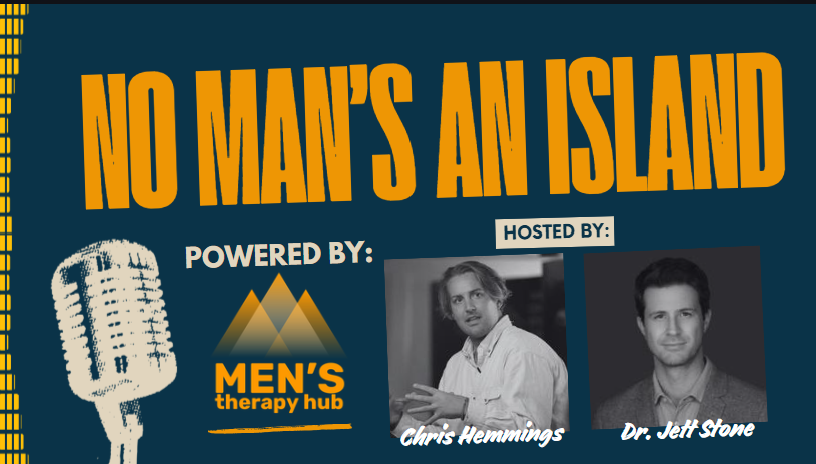
In the final episode of Season One of No Man’s an Island, Chris Hemmings and Dr Jett Stone explore the rise of optimisation culture and ask whether many men are chasing performance at the expense of purpose, connection and enjoyment. Inspired by a viral clip from Steven Bartlett discussing the impact of a few drinks with friends, the conversation expands into a wider discussion about masculinity, anxiety, body image, workaholism, social media and the pressure to constantly improve.
Alongside the discussion, Chris and Jett reflect on the journey of Men’s Therapy Hub so far and share exciting news about the future of the platform, including a major website redevelopment and the upcoming launch of Men’s Therapy Hub in the United States.
What we cover
- Steven Bartlett’s viral comments about alcohol and optimisation
- The growth of wellness culture and biohacking
- When self-improvement becomes unhealthy
- Perfectionism, burnout and workaholism
- Why many men struggle to feel good enough
- The rise of looksmaxxing and body image concerns
- Male anxiety and the pressure to perform
- Capitalism, productivity and modern masculinity
- Existential questions about ageing, mortality and meaning
- Why community and enjoyment matter for wellbeing
- The future of Men’s Therapy Hub
- Plans for the US launch and new website
Listen and watch
YouTube: [Embed video]
Apple Podcasts: [Insert Apple Podcasts link]
Spotify: [Insert Spotify link]
Takeaways for men
- Self-improvement is valuable, but it should serve your life rather than become your life.
- Optimisation without purpose can become another form of anxiety.
- Many men are taught to solve emotional discomfort through performance and achievement.
- Success metrics rarely tell us whether we are actually fulfilled.
- Community, friendship and enjoyment remain essential parts of wellbeing.
- Taking a step back is not always failure.
- Sometimes the most meaningful question is not “How can I improve?” but “What am I doing this for?”
- A well-lived life cannot be reduced to numbers on a screen.
Quotes to share
“What is the point of being alive if you can’t have fun at the same time?”
“Are you optimising because you love life, or because you’re terrified of death?”
“We’ve become the project.”
“The pursuit was no longer about quick wins. It became about living a meaningful life.”
“Sometimes the most important question is: what is this for?”
“Self-improvement without meaning becomes another trap.”
Resources and links
Men’s Therapy Hub
Men’s Therapy Hub
https://menstherapyhub.co.uk
Find a male therapist
https://menstherapyhub.co.uk/therapist/
Related resources
Chris Hemmings
https://chrishemmings.co.uk
Dr. Jett Stone
Further reading
Explore Men’s Therapy Hub articles on:
- Perfectionism in men
- Burnout and workplace stress
- Male anxiety
- Identity and self-worth
- Social media and men’s mental health
Episode credits
Hosts: Chris Hemmings and Dr Jett Stone
Powered by: Men’s Therapy Hub
Podcast: No Man’s an Island
Produced by: Men’s Therapy Hub
Transcript
The full transcript of this episode is available below.
Chris (00:00)
Welcome to No Man’s An Island, a podcast powered by Men’s Therapy Hub, which is a directory of male therapists for male clients. And I’m not sure quite whether I’m excited or a little bit sad to say that this is going to be the final episode of the series or the season if you’re in the US. so Jet is here today. Hey Jet.
Jett Stone (00:18)
How’s it going, Chris? Glad to be here on on the final episode of of season one.
Chris (00:24)
Yeah. And I wasn’t sure whether we were gonna do it in seasons or we were just gonna kind of let it rip for the the whole way through. But I’m gonna get to this later in the in the in the episode. I wanna talk about like the journey of Men’s Therapy Hub so far because it’s been a wild eighteen months or so for me from first having the realization and this recognition that crap, now I’ve actually got to do something with this idea. lots has happened and we have some stuff to announce.
That we are excited about. so there’s the little cliffhanger for you to to keep listening. But before we get to that, there’s been a a a topic that has been circulating a lot on the internet for the past probably two, three weeks. Many of you will have seen it already because it’s everywhere. And it’s the guy, Stephen Bartlett, who is the diary of a CEO podcast host. And in this clip, he’s talking about how he went out with his friends for a couple of beers.
And it basically ruined the next few days. So I’m gonna leave a space here because I need to check the legality of it. If it’s legal, I’m gonna play you the clip. If it’s not legal, I’m just gonna carry on talking. so that’ll be it’s gonna sound a bit weird either way. so here’s hopefully the clip.
Okay. So so in it, and Je, you hadn’t actually come across this. I think maybe it swamps like UK social media because Stephen Butler isn’t really a big figure in the US.
Jett Stone (01:44)
No, he’s
he’s big worldwide. I I had not seen the clip, but w after we talked about it, miraculously the algorithm on Instagram showed me the clip. So that’s really messed up. Yeah, how however that works, right? so long story short, I saw the clip and happy to talk about it and with you. you want me to launch in or you wanna you wanna start?
Chris (01:54)
conspiracy theory. Yeah.
I guess I have a question for you with it. Because I I I am torn here because over the past ten, twenty years, health, general health and wellbeing has become this like behemoth of an industry. And actually, there’s a really funny way of looking at this. If you look at I don’t know if you had the same in the US. In the UK we had these Panini football stickers.
Right. And if you look at the football stickers of like footballers f from the nineteen eighties and and nine and early nineties, these guys who are like thirty-two, thirty-three years old as professional footballers back then, they look like they’re nearly fifty. Right. And you look at someone like Cristiano Ronaldo now, who is nearly fifty, and he looks like he’s Yeah. And he looks like he’s twenty five. Right. And so like this this wellness culture and this wellness industry, it’s not
Jett Stone (02:43)
Yeah.
Well he’s forty, four young forties, but yeah, okay. Yeah? Yep.
Chris (02:58)
inherently a negative thing because people are generally healthier like you know people are not dying as much of cancers and and whatnot so that that’s that’s the the positives of it the negatives of it though and I guess watching this clip my first thought was actually from like an existential perspective of like what the hell is the point of being alive and working your ass off and
Exercising and r making a business and doing all of this stuff that is like generally difficult and hard work if you can’t have fun at the same time. And I just wanna put my arm around Stephen Butler and say, dude, it’s okay to let loose once in a while. I remember my auntie teaching me when I was very young. She’s like, Have you heard this phrase, everything in moderation? And I was Yeah, yeah. And she’s What do you Because we had a conversation about it. She’s Well, do you know what I prefer? Everything in moderation except moderation.
Jett Stone (03:32)
Mm-hmm.
Mm-hmm.
Chris (03:54)
I was like, right, because sometimes we have to let loose. And and of course, having two glasses of wine doesn’t ruin three days of your life. Sure, you might feel the effects of it the next day or so, but so what? Come on, man. So I I’m just curious about a bit of this like optimization, because we’re kind of post wellness now, and now it’s like hyper optimization. It’s like this is a long question, Jet. So yeah. it it’s like, okay, so creatine is good for us.
Jett Stone (04:06)
Mm-hmm.
Mm-hmm.
Chris (04:21)
And you could take three grams of creatine a day. but I’m gonna take 20 grams of creatine a day. Or like, I’m gonna measure my protein in every meal that I eat. Like, okay. And it’s like, do you know this Brian Johnson guy? I’m on a rant now. You know, this Brian Johnson guy who’s trying live forever. Like, I don’t wish ill on people, but I really hope he doesn’t live to 150. Like, because that’s not a way to live. Everything is like hyper performance and maximization. And and and where’s the fun? Where’s the enjoyment? Where’s the excitement in life?
Jett Stone (04:25)
Mm-hmm.
yeah.
Mm-hmm.
Chris (04:52)
So from from your perspective, a and this comes up with clients all the time, it’s like they’re trying to be the best, the best, the best constantly. How do you relate to this kind of optimization, this hyper performance culture that we’re in?
Jett Stone (05:06)
Yeah, I see a lot of strivers in my practice who probably would listen to Steven Bartlett. And a lot of these podcasts are popular sp among men that do focus on optimization and and measurement. And it becomes like the self as the project, you know, and like sleep sleep scores, body mass index, VO two max, grip strength.
Chris (05:24)
Mm, I like that.
Jett Stone (05:31)
You know, there’s all these markers that we have of performance, essentially. And I think it caters to men and sort of the masculinity of like virtuous masculinity of like discipline and you know sticking to it and like it it seems virtuous, but I think it also
Creates pathology in some cases, like real illness, like perfectionism and burnout. And so to me, whenever I see someone like Brian Johnson who spends like two or three million dollars a year trying to use his body as an experiment to see how long he wants to live forever. Right. And so he’s I mean, he’s got stacks of peptides, I’m sure. He’s got the sleep routine, he carries an umbrella so the sun doesn’t, you know, he’s not exposed.
Chris (05:58)
Mm-hmm.
Jett Stone (06:20)
To the sun. And to me, I always think in my head, and th I think of this, you know, when a guys come into therapy, you know, trying to optimize and it’s like, are you is this optimizing about like loving life so much, or is it a terror of death? And I think it’s a g uh-huh, uh-huh.
Chris (06:37)
That’s the thing for me, exactly. It’s
that point, right? Because I don’t see joy in a lot of these guys. I I’ve I’ve told this story before, I think, about the the stagdo and the guys in Ibiza and they’re all standing around, like pretending to not have fun. And it’s like, are you actually enjoying yourself or are you just so terrified of what happens if you enjoy yourself too much? You know? And it’s like, smoke the damn cigarette, man. Like have the beer. It’s okay. Like it’s it’s it’s not gonna kill you.
Jett Stone (07:06)
Yes.
Chris (07:06)
I
it might do, but sure you might die at eighty rather than ninety, but you had didn’t you have a good time doing it, you know?
Jett Stone (07:11)
Mm-hmm.
Yeah, it’s where optimization like kills what your aunt was talking about, moderation or balance is is another way of of putting it. And so I I think we’ve lost a sense of like where that balance is. Like where’s the threshold at which optimization backfires on you? Where not having that drink, you know, time and time again starts to kill off your sense of community and social life. I don’t think like
There’s no metric that can measure that. Like there’s no threshold point which you can see where it’s like, me being so hyper-vigilant about my alcohol intake has made it such that I don’t even ever go out. You know, and I I I I know there are people who have struggled with alcoholism, and I’m very aware of that in my practice because I do work with substance use disorders. But I also have to recognize like encouraging someone to go out to get a drink.
is could be therapeutic in a way that staying home is not. And I think a lot of what we’re talking about here came online at post-COVID, where we all became comfortable in our own worlds and isolation. Well we’ll just zoom in to the meeting. Like I I’ve we learned to be alone and maybe it feels good. Feels like it’s like solitude, but really we’ve isolated ourselves and this is at around the same time when social media obviously blew up in comparison.
And all these biometrics, you know, and I think it just totally changed our culture. I think we’re in in a meaning crisis, if I have to really pinpoint what a lot of this is. Like so much of Yeah, like so much of I was just talking about like a post-COVID, like civic community, religion, marriage, birth rate, like there’s so much in the in decline in or have eroded it in some way that it feels like
Chris (08:49)
Ooh. Say more about that.
Jett Stone (09:05)
Okay, like the project again becomes ourselves. Like we focus on performance and productivity. And I just think that it’s it feels like it’s purposeful, but really it it it’s more hedonistic. Like we’re chasing the good feeling. We’re trying to avoid the pain. And I don’t know if it’s really a well lived life that we’re pursuing.
Because we’re so focused on the metrics, we’ve lost track of purpose and what matters and what we’re doing this all for. Kinda like w how you started this podcast. Like, if you’re gonna live till a hundred and fifty, okay, fine. Let’s say you live till a hundred and fifty. What are you gonna be doing in those a hundred and f or those extra seventy years that you have above the average human? Right? Like how Yeah, yeah, yeah, exactly. Is it are you gonna do it just looking at your aura ring measurements? Like are you gonna
Chris (09:53)
Чи трайне стайв?
Jett Stone (10:00)
Just should be checking your sleep score obsessively. Like, how do you want to live those extra years that you supposedly want to have? And I think we’ve lost track of the meaning. Like, and when you can’t answer the question, what it like, what am I for? What do I stand for? What am I doing all of this for? Then you it’s very easy to just turn to performance measures almost as a defense against knowing what you’re doing this for. And they’re so available.
Chris (10:27)
Mmm,
I like that. Because it’s it’s interesting for me this because as training as an integrative therapist, we did we covered multi multimodality, and I just remember the existentialist set sessions. I remember learning about existentialism and just being like, yeah, this makes total sense to me. Like the the very essence of a set of existentialism, and I’m sure I’ll get corrected here by someone who knows a lot more, but to me, what it was was
Jett Stone (10:51)
Mm-hmm.
Chris (10:54)
Ask yourself, would you want to live forever? No. Well, why not? Why would you not want to live forever? Well, because every you would have done everything. Everything would be monotonous and dry and boring. Right. So the fact that we have a limited time on this planet is what makes life valuable, right? It life is precious because of that. And in that, what do we do with that time that makes it worthwhile to be alive? And like you say, if if all we’re chasing
Jett Stone (11:14)
Yes.
Chris (11:23)
Is metrics and scores and plots on a graph, to me at least, and and do you know what, Jet? Maybe I need to get somebody on who is a I don’t know if they call themselves life maxers. They probably do. these days, everything is maxing with a double X. Maybe I need to get one of these people on and actually like hear from them and and and ask, like, what is it that you’re chasing? Because because is it j is is is it fulfilling?
Jett Stone (11:37)
Mm-hmm.
Chris (11:52)
Is it joyful? Like maybe you do get like a little dopamine kick when your liver age is 35 and you’re 50. I don’t know. Like I would hate to know what my liver age is, but I don’t care. Like it doesn’t matter. Like it’s working right it’s working right now, and that’s all that that’s all I need to know. But like I I I, for example, I guess like my approach with drinking, I Christmas, sorry, no, New Year 2021.
Jett Stone (11:53)
Mm-hmm.
Yes.
Chris (12:19)
When we couldn’t really go home and see family, we had friend mess, me and a few friends. And I’ve never drank so much in my life. And and since then I now have a two-drink maximum. And I still feel it the days after. So I guess I’m still a little bit of a hypocrite here because I don’t want to have the hangover. But it it’s I mean, that was like 30 drinks, and that ruined two days of my life. You know, not two glasses of wine. And I just think we can get so
hyper focused on everything that we kind of my dad always used to s say the phrase, you can’t see the woods for the trees, you know. And it’s like you can’t Yeah, yeah, you you can’t you can’t see what’s right in front of you, which is actually like excitement and enjoyment. And I t to to me that’s the essence of existence. And I’m repeating myself now because it’s so important to me that like I would not feel like I’m utilizing the gift of life if I’m not out there enjoying the
Jett Stone (12:54)
Yeah. Or forest to the trees, however you
Yeah.
Chris (13:16)
Of like all the sights and sounds and flavours that that are that are to offer in the world, you know?
Jett Stone (13:20)
Mm-hmm.
Sometimes I ask my the clients I see who are struggling or trying to reckon with their alcohol use, let’s say, right? Maybe it’s not clearly a a disorder and it’s not clearly not a problem. Like and I’ve tried to do this with my own relationship to alcohol, is like when I’m going out and possibly drinking, or when I’m contemplating it, I’m like, what is this for? You know, so it’s so you take away the automaticity of it.
Chris (13:29)
Mm.
Jett Stone (13:49)
And you have to put some space between the the like wanting to drink and what you’re drink and what the drinking is for. So if it’s for community, if it’s for conviviality, if it’s for like you know easing tension, just know what it it is. And I think some people who get blocked out drunk or just over drink, just obviously they’re r run avoiding something or running away from something or numbing something.
in a lot of cases, but oftentimes they just sort of lose track of like what they’re using it for. Like and it goes back to meaning and purpose. Like a a a good an example that I often think of is like I’ve been on a I I do stationary bike as my exercise. And I’ve done it for like the last ten ten years, right? High interval training, some endurance, all that. And when I first started I I had a terrible back injury ’cause I was just going hard. I was just going
like fast. I had the competitive part of me and th and there’s a masculinity tie in here as well. Like I was looking at other people in, you know, the my Peloton or my cohort that I was racing against and you know, I it was very competitive and I injured myself doing it. And that was my focus, the quick win. I wanted to win the race that I was in for twenty, thirty minutes. Right? And I I and I got injured. and then I came back to the bike like
mature mature adult would and thought about posture and thought about like well what is like you know power what are power zones? How do I how do I do this in a much more measured, balanced way? And and why am I doing this? And I and I’m imagining myself like, I want to be able to to like pick up my grandkids and be a grandfather that my dad can’t can’t be in in his age, right? I wanna I wanna be able to like support
Chris (15:09)
Ha ha ha.
Jett Stone (15:35)
my kids and dance at the way, you know, that’s just that was just a motivator for me as a as a parent. And it just changed my relationship to the bike, meaning that the pursuit was no longer about quick wins or, you know, voiding loss and was much like more nourishing. That’s just an example of from of of my own life. You know, it’s not spectacular in any way, but I think we can all add that in in small ways. Like what am I doing this for? And it
Chris (15:53)
Mm.
Well and
and and and what and what I hear there is what you’re doing this for is you are setting future jets up for the thrill of being able to play with his grandkids. You know, not just I wanna live forever.
Jett Stone (16:12)
Mm-hmm.
Yes, but to be honest, it’s a little bit of both. It’s me wanting to love life and experience it, but I’m also fucking t pretty terrified of aging. You know what I mean? So it’s like I can’t say it’s cleanly a valued base pursuit, but I think it leans much more in that line than it ever has. Right? That’s the most honest answer I can give.
Chris (16:28)
Okay.
Yeah. Yeah, and I I I
appreciate that because I guess I’m I’m actually not fearful of aging, but then I don’t have kids. So maybe there’s a difference once you have children. And we’ve we’ve spoken about you partly in the difference between us in that way. But there’s a couple of things, or there’s one thing in particular actually that you’ve mentioned there about the masculinity side of it. Because I’ve been thinking a lot about this guy, Clavicular, who is the luxe maxing Yeah, I know. I know again because
Jett Stone (17:00)
Mm-hmm. We we all have, okay? We’ve all been having him flooding our feeds.
Chris (17:08)
It’s quite sad actually, because when you actually hear him being interviewed by actual journalists who know a s how to ask actual questions, he storms out, he gets defensive, he gets aggressive. but one of the saddest things, I think, and and and it touches quite a lot upon something I’ve been thinking about for a long time in this space. Even when I used to go into schools, I used to talk to the lads about this. So when when clavicular is asked, like, who he’s doing this for, it’s like,
Jett Stone (17:19)
Mm-hmm.
Chris (17:36)
Are you doing this so you can get laid more often? And actually, his answer is no. He doesn’t have very much sex. And so you think, like, what like so who are you trying to beautify yourself for? And actually, what it is is this mogging thing, which, if you don’t know, mogging is like, so if Jet stood next to me, Jet would Jet could be like, well,
I have I have a a more chiseled jawline and a lower body fat percentage. So therefore technically I’m more attractive. Of course, of course, that’s just like random metrics that people use and whatever, right? But that’s what mo that’s what mogging would be. So actually he’s doing it to feel superior to other guys. And this is often what you see with like gym talk and these gym bod culture guys, is they’re not doing it for women. They’re doing it as a means of gaining the approval of other men.
Jett Stone (18:10)
Mm-hmm.
Uh-huh.
Mm-hmm.
Chris (18:30)
And I find that part of it really fascinating. Because these are guys who will protest that they are 100% alpha hetero dudes. And yet a lot of their energy is being focused on how can I impress the dudes around me. And I still am really confused by that. Because when I when I were a lad, when I was when I was young, all I was trying to do.
Jett Stone (18:46)
Yes.
Chris (18:56)
Not entirely, but quite a lot of my behaviour was how could I look good in front of people who might want to have sex with me? But this culture we live in now where b boys and girls, young women and young men are kind of frightened of each other, it’s not even about that anymore. It’s about impressing and actually I’ve I’ve I’ve heard some stuff about the femosphere, which maybe we’ll get into one day, which is interesting because it turns out women are equally shitty to each other and women are also shitty about men. Kelsey Breeze, right?
Jett Stone (19:03)
Mm-hmm.
Yeah.
Chris (19:25)
And they’re also doing it to impress each other and to not impress men. And I’m so confused by it. And I’m so confused by it that I don’t have a question here. I’ve just I’ve just like, what is going on?
Jett Stone (19:31)
Mm-hmm.
No, no. I yeah,
I think there there is an interesting gender tie-in. And I always think about it is like you describe it as trying to impress other men. Another angle on that is trying to avoid being dominated by other men. Maybe it’s more of like an evolution maybe it’s more of an evolutionary bent that I’m putting on it, but it’s it’s it’s less focused on trying to attract women.
Chris (19:52)
Yes.
Jett Stone (20:01)
or trying to or being afraid of women. And it i it is, in my view, like a lot more about protecting yourself from being dominated by other men, physically, intellectually, looks-wise. And so it’s just interesting. Like a lot of this optimizing in the men I see in my practice, but also just generally, like clivic cliff here. Like there’s a an anxiety in there about all of this. Even in the Stephen Bartlett clip.
that can get masked by, again, like being disciplined as a virtuous stoic might, you know? And what lives beneath is anxiety. And and I, you know, I’ve interviewed Krista Fisher out of she’s a Movember researcher, and that episode hasn’t gone out yet. Maybe season two, plug. and you know, she’s written and studied a lot about male anxiety as being unique from male type depression, which we’ve talked a lot about.
Chris (20:36)
Mm-hmm. Mm-hmm.
Season two.
Jett Stone (20:58)
depression and suicidality gets a lot of play when it comes to the men masculinity space, but anxiety is unique because it’s fear based. And what ends up happening it becomes embodied, meaning that men f have anxiety just like anyone else, but it becomes somatic, right? Stomach issues. yes, it becomes stored in in in exactly trapped. And we turn it into, we men oftentimes turn our anxiety into s problems that we have to solve.
Chris (21:16)
Well becomes trapped in there.
Jett Stone (21:27)
Like it feels like we’re out of control and we have stress and it feels generally shitty. And so then we try to master these problems. And maybe in this case of optimization, we’re trying to master ourselves because we have something underneath anxiety, if it’s about death, death anxiety, or if it’s about you know, grief or hopelessness about my ability to, you know, be viable on the dating market.
We then turn it on ourselves and try to master and control. And I think that a lot of it underneath is anxiety and it’s this becoming your you know
becoming as beautiful as I possibly can be, or chiseled as I c as I can, or maximize my sleep in the case of Barlett.
Chris (22:08)
Yeah.
Yeah. But you know what? Max
maximize your sleep. But then why do you need to brag about it? Because it’s that it’s that point for me. It’s it’s okay, okay, you’re super healthy, but you seem to be protesting a bit too much about it, you know? And it’s that point because, you know, the for ever since like the eighties, and you only have to watch like American Psycho, do you know, like the rise of the the the metrosexual, right? Like ever since we’ve been able to
Jett Stone (22:17)
Mm-hmm. Yes.
Chris (22:37)
We’ve been trying to beautify ourselves as a species. You know, I mean, don’t even get me started on the amount of anxiety with kind of women’s beautification and this, you know, you see around the kind of MAGA lot now, there is this like MAGA look with all of the ridiculous levels of sorry, I’m that’s not compassionate of me, with all of the high levels of of plastic surgery and facelifts and fillers and everything. So it’s not again, it’s not just men doing this.
But what what I find interesting with with the male side of it is that I I did research sorry, no, I spoke to a researcher many years ago called Rob W Dr. Rob Wilson, who was the first to come up with this term. he coined the term bigorexia, which was basically muscle dysmorphia, which is that quite a large percentage, I can’t remember now, but it’s like something like 10% ish of the men you see in the gym regularly, they have a diagnosable body dysmorphic disorder.
Jett Stone (23:14)
Mm-hmm.
Chris (23:30)
But because they are like this, like huge, hench, ripped, we just go, well, that’s fine. That’s that’s not that’s not problematic. But of course it is. It’s just as problematic as anorexia and just as debilitating because these guys aren’t living a a normal social life. They’re not out seeing people, they’re in the gym seven, you know, nine times a week, desperately trying to improve how their body looks.
Jett Stone (23:33)
Uh-huh.
And ingesting some shady products and stacks along the way.
Chris (23:58)
Well, quite. Yeah.
Damaging their physiology, you know, long long term. All for these gains. And
Jett Stone (24:04)
Yeah.
Chris (24:11)
I’ve lost I’ve lost my train of thought here because I I I’m I’m so it it it makes me so sad to think that we still okay I’m no I’m now I’ve remembered why I remembered why but it it makes me so sad because we are still we’re still encouraging it and and these guys are encouraging it but what it is for me is is just another example of it’s like for for decades now men who are experiencing this anxiety that you’re talking about
Jett Stone (24:17)
Mm-hmm.
Chris (24:39)
They’ve just overworked and overworked and overworked and overworked. But then that is in this capitalistic culture that is congratulated. It’s like, wow, you work fifteen hours a day. You’re you’re amazing. Like, wow, you work fifteen hours a day. You need to not do that for very long or you’re gonna burn out, you know? And it’s just this normalization of the overwork and overwork, which is kind of it’s it’s so normalized that we don’t consider it to be a problem for men.
Jett Stone (25:03)
Mm-hmm.
Chris (25:09)
In the same way that we don’t consider this like hypermuscular look, guys smashing their own cheeks. And I mean, many of us don’t consider that to be normal, but there is a subset that are normalizing that. And and I think it is just about a an overarching anxiety. And it comes back to that existential question of what what does life actually mean to these guys? What do they get out of it?
Jett Stone (25:28)
Mm-hmm.
Yes. I I mean there’s so much more to bring into this conversation like around capitalism, you know, and as someone who works with a lot of guys in the US on Wall Street, it’s not just normalized, it’s institutionalized to th the workaholism and
money maxing. I don’t know if I made that up or not, but you get you get the you get the point. Exactly. At some point that’s gonna age out. I I know. That’s right. so yeah, that the companies profit off of that anxiety. You could be getting a little bit better sleep. You could be more ripped. You could be slightly more beautiful, right? It’s
Chris (25:52)
Just add maxing to anything now, yeah. It’s fine.
Therapy maxing. Yeah.
And if you do, this is the lifestyle you could have. It’s that carrot that’s dangled, right? You know, you could have the beautiful woman, you could have the nice car, you could have the holidays in Dubai for some reason. I don’t know why people go there, but yeah.
Jett Stone (26:20)
Yes.
That’s right.
Well, that and and it’s not just like you get a catalog in a mail in the mail, you know, once every month with products. No, no. After this episode, you know, we’ll open up our phone. I’ll try not to, but I’ll open up my phone and like I’m going to be hit with the message, you could be better in some way. Or you’re not good enough. Whether that’s through a product or whether that’s through comparison. there’s another psychologist who’s doing this, or there’s another th you know
So it’s we’re inundated with and you’re right, it’s sad. And I was talking about anxiety, but at the bottom of it, at the base of it, oftentimes like you’re we’re running away from the shame of not being enough, not being good enough, not achieving our potential. So it’s it is it is sad, yeah.
Chris (27:14)
Yeah. I and many of us
many of us have grown up in environments and I I actually don’t include myself in this, as I’ve spoken about before, with my emotional privilege, but I working with many clients, you realise how many people grew up in an environment where their achievements were never enough for their parents. They they, you know, okay, you got nine out of ten on a test. Well you should have got ten, you know, you get an A minus. Well, next time you get an A plus. You know, I I made it onto the soccer team.
Can’t believe I just said soccer. Damn you, Jet. I made it on I made it onto the football team. I’m trying to embrace our US audience because it’s growing. Yeah. I made it onto the hockey team. There you go. I made it onto the hockey team. okay, well, are you the captain of the team? Like it’s just, it was just never enough, never enough, never enough. And so actually, what I’m hearing you say, and this is interesting for me because I hadn’t considered it this way as well, is that the marketing industry is very aware of that.
Jett Stone (27:46)
I’m infiltrating you with my Americanness.
Chris (28:09)
And is very very good at manipulating us into believing that if if only you have X, then why? If only you have this car, then your life will be great. If only you get that promotion, then and and I’ve worked with so many guys who I have like actively courage them. Like, what would it be like to actually take a step down within your business? Because you your kids have your kids are your kids are old, you’ve they’ve they’ve graduated university college.
Jett Stone (28:19)
Mm-hmm.
Chris (28:38)
You don’t need the money that you don’t need all the money you’re earning. What would it be like to take a step down? well, I could do that job standing on my head. Exactly. Wouldn’t that be nice to give yourself some space? And it’s like they hadn’t considered you know, doing doing a four day week. You know, make a a fake client j just as an example. Like you are a heart surgeon and you’ve been working five days a week for 30 years. Could you do four days? Cause they’re not gonna sack you for doing four, because they need you.
Jett Stone (29:07)
Mm-hmm.
Chris (29:08)
What it’s like I they hadn’t considered that that’s an option because that’s not progress.
Jett Stone (29:13)
Yes, let me let me say something about that because it’s so tricky because that’s a something I come up again against clinically, and of course to some degree my own life. And it’s lifestyle creep, meaning that they’ve spent and built a life for five days of work. They hadn’t the their mortgage and their private school education of their kids wasn’t built for four days a week because no one else in their, you know, neighborhood is doing
Chris (29:28)
Yeah.
Those four
days. Yeah.
Jett Stone (29:39)
is doing that. Like
you’re a product of your culture and the community that you live in. You know, you may not be hanging out with those people, but you sure can see the size of their house and the car that they’re driving, you know, or or what their, you know, spouses are doing, you know, like and and so it’s like it we run into I run into that all the time. And I don’t have a great answer, honestly, about what to do about it, other than that scaling down feels like failure and feels like, I’m gonna get run over by
Chris (29:52)
Yes. Yes.
Jett Stone (30:09)
you know, my competitor or or my peer, the person next to me, and then you’re just back in it, you know, and and so this there’s no easy answer, I guess, is where I’m getting to. It’s
Chris (30:21)
No, and I’ve I’ve I’ve just started reading a book by a guy called Jason Hinkle. and it’s let me just I I’ve actually forgotten the name of it now. It’s not in front of me. Degrowth, it’s called. it’s yeah, it the the book is I can edit this part. Hang on. Yeah, so I’ve actually just been started reading a book by a guy called Jason Hinkle, in the US. And the book is called Less Is More, How Degrowth Will Save the World. and I actually would really like to get him on.
Jett Stone (30:31)
Interesting.
Chris (30:46)
at some point because it’s really great the book to talk about this exact thing because he’s a socio I think he’s an anthropologist, sociologist. And I would like to ask him whether or not he’s ever considered the link here between capitalism, growth, patriarchy, and and I think ever since the Louisa Monk episode, Dr. Louisa Monk now I should say. She’s she passed her PhD. I think I’ve been really actually become a little more more comfortable calling it like capitalist patriarchy.
Jett Stone (31:09)
nice.
Chris (31:16)
I think that that I’m much more comfortable with. And it is just constantly about growth more, growth, more, growth, more. And I think, you know, I’ve I’ve said this to my I’m gonna I’m gonna finish on this point. Like I’ve said this to many kids in schools when I’ve done classes over the years. And you know, the Andrew Tate rhetoric is escaping the matrix, right? And this is a this is a guy who owns like 30 sports cars and profits off the back of women. And it’s like, what matrix have you escaped?
You know, and I’m like, the people who I know who’ve escaped the Matrix more than anybody are my friends Nana and Sam, who live on a van in a Welsh farm, and she does macrame and he like renovates camper vans, and they their outgoings are like twelve pence a a a a month and they live mostly off grid and so and it’s like that’s escaping the matrix. And they and they want for very little, you know? Like and and I think.
Jett Stone (32:07)
Yeah, yeah.
Chris (32:14)
That’s incredible. I I couldn’t quite live like that, but I still idolize that they can, you know? That’s escaping the matrix, not desperately trying to earn millions and millions off crypto and NFTs and all of that sort of thing. So like I don’t know. It it it’s something that I need to think more about very clearly as I’m trying to articulate thoughts here. I hear that I don’t have rounded opinions on this. And I’m okay to say that because it’s it’s it’s it’s true. So I think I would like to to
set the intention to get a guest on or maybe multiple guests on in the next season to talk more about this because this whole maxing culture is is is it’s like capitalism maxing. You know, we’re we’re doing we’re doing something that’s been happening for generations, but now we’re able to do it at at warp speed because of what’s available to us. And and and it scares me actually.
Jett Stone (32:50)
Yes.
Mm-hmm.
Yeah, and it and it and it
You it’s it’s dangerous too. I think the clavicular has like said publicly that he’s sterile now, right? That he even he did want to have children, I don’t know if he could I don’t want to spread rumors, but look that up for yourself. You know, it it’s there’s no easy answer to this maxing optimizing and this culture of you could be better. You could live longer, you live forever, maybe. And I think for someone like you and me, actually, who have moved
from their native countries to a country at least temporarily that gives you some perspective on it. So if I I’m in fr France temporarily, and I am able to look at American culture in a way that I could not when I was in the fishbowl itself. And similarly to you in Denmark
Chris (33:57)
Mm.
Jett Stone (34:00)
I’m not gonna give your exact address, but looking at you know a place like Manchester, which is maybe like it’s it’s degrees of capitalism, I get it. But living in France and being able to see sort of the cafe culture and the communities and and how people interact and like it gives me a sense of okay, I see how degrowing or degrowth or scaling down is possible. I’ve I have a
a sample of it here, now being here a year, right? I’ve acclimated to European life in a way that I would have never done just visiting, even for a week or two. And so I’m not to say that I’ve like, you know, self-actualized in any in any type of way, but I definitely have ch I definitely have changed my perspective. I’m like, my gosh, like when you’re in it, when you’re in the matrix of of capitalism in the US, on the East Coast where I you know, where I’ve l or exactly
Chris (34:31)
Mm-hmm.
Mm.
Working on it.
London as I was, yeah.
Jett Stone (34:57)
It’s like you you can’t get a breath of fresh air to be able to like just reflect on on it. So I guess this is my way of saying like give yourself an extended break. And not necessarily like a vacation, like some type of break. Get out and look in for a minute. And I guess that helps you that can help lead towards a different outlook on the optimization culture.
Chris (35:16)
Yeah.
Yeah.
And and what would happen in the space that is created where you’re not trying to improve yourself all the time. You know, maybe you’ll have a good night’s sleep finally. Who knows? You know? Okay, more to talk about on that for sure. let’s get on to the exciting slash potentially terrifying next steps. So what I do want to say first is this is episode thirty-seven, I think. so a pretty good run from November
Last year to now. so thank you, Jet, for supporting me with this. And thank you for all of you who’ve listened. I know some of you who’ve listened from the start. I have a couple of friends who’ve listened all the way through, and we have a couple of listeners who I never heard of before until they got in touch with me, who’ve sent very, very sweet and thankful messages actually about the way that we are approaching conversations around men. and one message in particular.
and you know who you are, who actually said that the work that we’re doing here gave him the vocabulary to be able to have difficult conversations with his partner and people around him. So like great, that’s amazing. That’s what we’re here for. we are gonna come back in the autumn slash fall for our US and and international listeners.
Jett Stone (36:21)
Yeah.
Chris (36:29)
We’ve picked up listeners from all over the world, J. I haven’t even told you. We have we have like South American listeners now. We have some in we have a lot in New Zealand and Australia, which is really nice. so actually what we’re doing is and and don’t point out the hypocrisy here, please. we are reinvesting in men’s therapy hub. and yeah, we’re well, yeah, and and website maxing and yeah, business maxing and
Jett Stone (36:38)
Great.
Podcast maxing.
Chris (36:56)
Yeah, yeah. So we’re all hypocrites. That’s okay. and what I will say is for those of you who are on the website, the therapists, thank you for investing your time and energy and your five pounds a month for the past twelve months or so, not quite yet. that’s it it’s been beautiful to to have you on on board with this. we’re taking almost every penny you’ve spent so far and we’re b building a new website because turns out I designed our old website.
And apparently, I’ve designed a website that would have been great for about 2008. which I’m not a web designer jet, as we are becoming increasingly aware of in our conversations with our new web agency. yeah. And I guess even more exciting than that, when we come back in September, October time, we’re not sure when yet, we will be launching in the US. And Jet as the US director of men’s therapy hub.
Jett Stone (37:42)
Yep.
Chris (37:47)
is gonna he’s he says he’s gonna f he’s gonna get more therapists from the US on than the UK, which I said I should bloody hope so given the size of the US. so some healthy competition between us. but actually I’m excited because
There seems to be a big movement in the US, at the moment, similarly in the UK. So yeah. I’m excited about that.
Jett Stone (38:09)
Yes, I am nervous about it, right? As I should be, and also excited. I don’t know what sometimes I don’t know what is the nervousness and what is the excitement. and the US market is different for therapists. It’s much more of a wilderness when it comes to h health insurance, out of pocket, self-pay, out of network, all these terms, you know, in addition to
Therapists itself and all the different degrees you can have to be a therapist. So a therapist isn’t a protected term in the US. Like so wading through that complexity is one of the biggest challenges of launching men’s therapy hub in in the US. I think we’re gonna do it. You know, we have some good designers, and helping therapists.
Chris (38:49)
Mm.
Jett Stone (38:56)
Skeptical men come see our site, feel a sense of confidence that they can find a male therapist if that’s what they want, and f understand the system in the US and get a good match. That I feel like is possible. I’m feeling so much more hopeful now that we’re in deep with designing this new website. And I think it’s so important.
There is a labor market demand for therapists in general, for male therapists, for therapists of color. I think men’s therapy hub is you know, I I’m proud because it’s it’s a mission that I’m on with you. it’s not a short term, you know, win sat type of satisfaction. It’s it’s a long term yeah, yeah, it’s windy. It’s and I don’t know where this will go, but I think it has a potential to be really
Chris (39:39)
Apparently not.
Jett Stone (39:47)
successful success, meaning people come to our site as therapists and get referrals and potential clients come and find therapists. And then there is the hub aspect of men’s therapy hub, which is it’s a directory of male therapists for male clients, but it’s ideally there’s a bigger vision there that it’s a community where we’re talking about doing men’s mental health more broadly through this podcast, but doing trainings
inspiring maybe the next generation of men young men to become therapists and
Chris (40:17)
Well, and and current therapists
to understand the nuances of working with the male mind more because I’m still learning about that. You know, you’re still learning about that. lots of us are still you know, it’s the the Zack Seidler quote that he laughs constantly when he calls himself a specialist for forty nine percent of the population. But that is the reality, is that men’s minds are different in the way that we’ve been socialized and so
Jett Stone (40:22)
Yes. Yep.
Mm-hmm.
Mm-hmm.
Chris (40:42)
We need a different approach, and I think I said that exact quote on our first ever episode, and I will continue to repeat it, you know?
Jett Stone (40:47)
Yep.
So we we hope you come here not just to find therapists but to learn as a clinician how to be better and upskill yourself working with men and it’s gonna be a one-stop shop. It’s gonna eventually we’re gonna start selling, you know, dog food and we’re gonna start selling tap peptides and
Chris (40:57)
Find all the answers. If o if only
Yeah.
Peptides. Yeah, yeah, yeah. Of course. Yeah. Therapy peptides. Yeah.
So you can therapy max, precisely, Jet. Precisely. and so to everyone who’s listening and to everyone who has listened, whether you’re a new listener, an old listener, what I what I’m gonna ask is, we create this podcast for for free, right? This is this is an addition to I say it’s for free. What I say to the therapists who sign up is that their money funds this podcast.
Jett Stone (41:13)
That’s right.
Chris (41:32)
So they’re five pounds a month, which I’m starting to realize was is very little compared to our competitors. 10% goes to charity, this podcast, and then the rest of it is being reinvested. Okay. What I can ask you as a listener is, and I’ve asked this multiple times, but I guess I’m asking like really heartfelt this time. Please like, please subscribe, please rate us five stars, please share this.
And that last one is really important because we’re about to go on hiatus for a few months. And what I would love it is if you could if you had one person in your life that you would just send one episode of this podcast to and say, Hey, do you know what? I often laugh and and at myself when I was in schools, and I used to describe myself to the lads in the schools as their least bad option, you know?
So maybe we’re the least bad option that there is out there in terms of talking about men’s mental health. If if if if if if if we are the least bad or anything above that, please share us with people because we rely on word of mouth. We rely on our our name getting out there and our episodes getting out there. And I would love to to continue to see our audience develop even while we’re not releasing episodes because
We’ve put a lot of effort into this and we’ve had some brilliant, beautiful conversations with people that I’m really proud of, actually. and if you do, then encourage people to start from the beginning. And if you haven’t gone back to the start, then do. Because the first episode was me interviewing Jet. And then a few episodes later, Jet interviews me, and there was a few in between. So there’s there’s there’s a lot of good stuff that we’ve done so far that I’m really proud of, and I’m really excited to to kick off season two.
Probably with some really interesting guests from the US to celebrate the US launch. and then to get back into it. and and to continue to try to have compassionate, nuanced conversations, which is our MO, and we will not stray from that. It’s as simple as.
Jett Stone (43:27)
Well thank thank you, Chris, for bringing me on this journey to sound cliche, but it it has been and it’s been so much fun to not just help build out men’s mental men’s therapy hub but and this podcast, but just our friendship too. Like I think it’s so cool that we’re from different sides of the pond and you know, we’re we’re communicating almost on a daily basis around all things, men’s mental health and be and beyond. So
Chris (43:31)
Yes.
Yeah. Lovely, isn’t it?
Jett Stone (43:51)
I I really I
really cherish the relationship we built as as well. So thank you for for bringing me on board at all this.
Chris (43:56)
Likewise, I I I I could
have done it without you, but I would definitely have burnt out. So so I’m really glad that I decided to to dare to reach out to you in the first place. So pat pats on the bats for us. I think it’s okay to do that. and and yeah, we’ll see you all in the autumn slash fall when hopefully we have a new website and a US launch to brag about.
Jett Stone (44:01)
No.
Yes, and
look out for a t shirt that that says least bad option in a men’s mental health. And then on the front it’s gonna say
Chris (44:22)
Yeah, exactly. That’s our that’s our marketing. Commence therapy hub. The least
bad option for your mental health. Yeah. Great. All right. Thanks, Jet. See you soon. Bye bye.
Jett Stone (44:29)
All right.