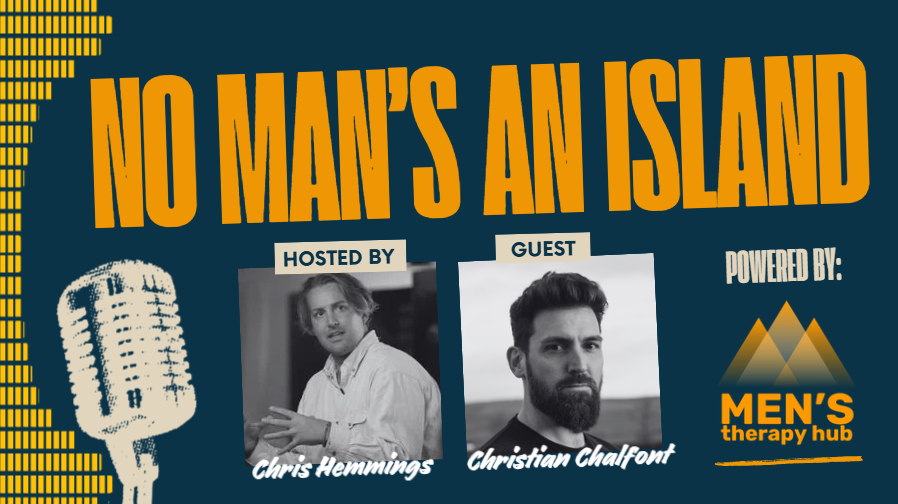
No Man’s an Island episode 30
In this episode of No Man’s An Island, Chris Hemmings is joined by Christian Chalfont, a counsellor and hypnotherapist whose work is increasingly centred on men’s mental health, identity and pressure. Christian previously founded Men’s Retreats UK, creating male-only talks, workshops and retreats designed to help men reconnect with community. Alongside his therapy work, he now runs Core 5 Coaching, delivering talks, trainings and workshops for managers, high-performing teams and men navigating work, identity and performance. We talk about the moment Christian first encountered a more grounded, nurturing masculinity and how that reshaped the way he relates to men, touch and emotional safety. We get into why men do talk, but often do not feel received, how shame keeps high-achieving men locked into overwork, and what it looks like to help a man move from intellectualising into feeling. We also explore anger as secondary emotion, the fear many men have of opening the floodgates, and why presence, silence and attuned listening can be more powerful than advice. Christian finishes with the one change he would make with unlimited resources: overhauling sex and relationship education so boys grow up with healthier models of intimacy, consent, communication and connection.
What we cover
- Christian’s route into counselling and why training can be therapeutic in itself
- Coming out young, masculinity and the hunger for belonging in male spaces
- Touch between men – safety, shame and non-sexual connection
- Why men do talk but often do not feel listened to or held
- Helping men move from analysis into body awareness and emotion
- High-achieving men, overwork as coping and redefining success
- Anger, suppressed pain and what happens when emotion erupts
- The case for better sex and relationship education in schools
Listen and watch
YouTube: (embed here)
Apple Podcasts: (link here)
Spotify: (link here)
Takeaways for men
- If you feel numb, cut off or “fine” while describing something awful, that can be protection, not strength
- You do not need to have the perfect words to start therapy, you just need enough safety to begin
- Ranting without interruption is not weakness, it is often the first step back to self-respect
- Overwork can be a coping strategy, not a personality trait
- Success that costs your relationships is not success, it is survival dressed up as achievement
- Anger is often secondary emotion, look for what is underneath before it spills into damage
- Community matters, many men do not need saving, they need connection
Quotes to share
- “The bigger problem is not that men don’t talk, it’s that we don’t know how to listen.”
- “Men think opening the valve will unleash a tsunami, the fear is that it won’t stop.”
- “You don’t need therapy, you need a friend.”
- “These aren’t soft skills, they’re the fundamental skills of being human.”
- “Redefine success so it includes connection, not just status.”
Resources and links
Men’s Therapy Hub – Find a male therapist
No Man’s An Island – Podcast hub:
Christian Chalfont
Core 5 Coaching
Related Men’s Therapy Hub resources:
- Men and Loneliness in Later Life – Finding Connection at Every Age
- Workplace Mental Health – Coping with Stress, Pressure and Burnout on the Job
Episode credits
Host: Chris Hemmings
Guest: Christian Chalfont
Powered by: Men’s Therapy Hub
Music: Raindear
TRANSCRIPT:
Chris (00:01)
Welcome to No Man’s An Island, a podcast powered by Men’s Therapy Hub, a directory of male therapists for male clients. On this episode, I’m joined by Christian Schalfont. Christian is a counselor and hypnotherapist whose work is increasingly centered on men’s issues. He previously built Men’s Retreats UK to create male-only talks and workshops and retreats focused on helping men reconnect with community. Alongside his therapy work, he now runs Core 5 Coaching, delivering talks, trainings, and workshops for managers.
high performing teams and men navigating work, identity and pressure. Hey Christian, how you doing?
Christian Chalfont (00:36)
Hey Chris.
I’m good man, good to be here.
Chris (00:40)
Yeah, it’s good to have you on. are therapist number three, I think now from Men’s Therapy Hub who has come on. So that’s nice. We’re going to have have ticked you all off at some point. So you’ve listened to some episodes before. You know the drill. The first question, what got you into this space? So what got you into being a therapist and what particularly into working with men and doing men’s retreats and having a focus on men’s mental health and wellbeing?
Christian Chalfont (01:04)
Yeah, sure. So I’m 43 years old now and about six years ago, I was really questioning who I was, just my purpose, my identity, what value I had just in the world to my friends, my family, the people that I loved. And I was in quite a difficult place and I needed to take eight months out of work. I was really lucky to be supported by my partner and it allowed a lot of time for me to be really reflective, really build out my self-awareness and just to reach out to friends and family and people who I respected and loved.
and just get a take on why people were friends with me. You know, why we were in relationship with each other, why they spent time with me, because I just didn’t trust my own judgment at the time. I had to get some feedback from other people. And during that whole time, I just had some really beautiful feedback and I trusted these people. And I tentatively started looking into counseling after a friend of mine had recommended it for about two years, because he retrained himself as a counselor. And I said to him for,
two years, look, I don’t think I could do it. I care too deeply, I feel things too deeply. I’m not sure I’d be able to be bounded with clients, but I tentatively started looking into it and I absolutely loved it. And the whole journey of actually becoming a therapist was very therapeutic in itself because you have to do a deep dive into yourself. You have to look at all your identity, all your traumas, all your successes, what’s conscious, what’s subconscious, your relationships, how you were brought up, just.
Chris (02:22)
Yes you do.
Christian Chalfont (02:31)
you shine a light into every facet of your being. And it was one of the best things that I ever did. And it’s also one of most challenging because the more self aware you become, the more you have context and understanding as to people, society, culture, religion, but it doesn’t necessarily change anything. Like you’ve changed, you’ve become more self aware, but the systems or the environments that you exist in haven’t changed. And that is a very difficult thing to start to learn how to navigate.
and I wanted to start to share that with other men. So I never really felt safe or really comfortable, probably comfortable is a better word with other men. I never felt like I belonged or that I had something to offer. So I had to really start connecting with my own masculinity and defining what masculinity meant for me. Whereas in the spaces that I’ve run and quite a lot of men I speak to, they talk about integrating the feminine and allowing the feminine side to come out. Mine was the exact opposite.
I had to connect with my masculinity and allow that to cultivate.
Chris (03:33)
I want to put pin in that because obviously I want to hear more about that. But I’m also interested, and I think we haven’t talked about this yet on this podcast. So maybe this is a good opportunity. What route did you take in to becoming a counselor?
Christian Chalfont (03:45)
Sure, so I went down the college route, I’m based in Manchester, and I went through a Stockport College. And when you go through the college route, you do a level two, a level three, and then the level four is the industry standard. And then I did a competency exam with the BACP, and then that was my routine. And that took about three to four years to complete all of that.
Chris (04:07)
because there are multiple different routes and like my route was doing a foundation course and then I went through the PG dip, the postgraduate diploma and I didn’t do the masters year because the thought of writing a research paper scared the hell out of me. Okay, that’s just something I haven’t asked before so that there are multiple different routes in. Okay, so let’s go back to what you just said which is for a lot of men, I would guess, you’re saying that for them to develop into…
successful counselors and therapists, there would be a need for them to engage with what, I hate that the terminology is masculine and feminine, I wish we had different words for it, what would be considered to be the feminine, but for you actually, it was to engage with the masculine. It’s interesting looking at you because deep voice, beard, low lumberjack shirt, you look particularly masculine, you look ⁓ like an ⁓ AI version of masculinity, right?
Christian Chalfont (04:45)
Yeah.
Chris (05:03)
But there is a part of you that was not connected to that, so can you tell us a bit more about
Christian Chalfont (05:08)
Yeah, sure. ⁓ So I grew up in a household with my grandparents and my mum. My mum was quite young when she had me. So my grandparents used to take care of me when my mum went out to work and she saved up enough money that eventually we got our own house. And we moved out of my grandparents place when I was around the age of 10. So my grandma was pretty much like a second mother to me and she was very much the matriarch of the family. She really held us all together and she…
just created a really beautiful, loving, caring, nurturing environment. My granddad was out at work, my real dad wasn’t really around, and then my stepdad came on the scene when I was around 13. So I had a lot of female influence in my life for those really formative years. And my granddad was there around to some degree, but I don’t really remember him too much because he was quite young when he passed away. And then my stepdad, he was working away quite a lot. So just this very female…
heavy influence and then just going through high school most of my friends were female so I didn’t really start forming relationships with guys my own age until my mid to late teens really.
Chris (06:17)
What was that like to suddenly start to engage with male spaces?
Christian Chalfont (06:22)
Yeah, well, I came out at the age of 12. So I was like being bullied at school for being gay and fitting in there. So I have.
Chris (06:31)
Sorry,
you just dropped out. you start that answer again? So from where you said you came out.
Christian Chalfont (06:35)
Sure. So, yeah.
So I came out about the age of 12. So most of my friends at school were female and I didn’t really kind of connect or get on with other guys at school. It was only once I left sixth form and then started being out in the world, having a job that I started cultivating relationships with other guys my own age. And it was kind of, was great but it was also a little bit nerve wracking.
to be in these spaces, they knew I was out to everybody at that time, but really not really feeling still a sense of belonging, not really knowing who I was, what was acceptable, what wasn’t acceptable, little jokes that would be made, always in banter. So I still felt real acceptance from these new guys, but also a difference being in the way as well. And it took me quite a long time to form my identity and get a sense of who I was.
what I liked, what I didn’t like, but also having an opinion and having a voice on things. And again, that was all kind of down to being bullied at school and being told I was just stupid.
Chris (07:42)
And what about that relationship to your masculinity? What was that sense of your connection to your manhood or your lack of connection to it and how did that start to form?
Christian Chalfont (07:55)
Yeah, well, I moved to Australia back in 2009 and 10 and I studied out there to become a personal trainer and sports therapist. And it was the first real time that I was introduced to men who were in kind of quote unquote caring roles. So what I mean by that is half of the faculty were male, half of them were female. But these were guys who were massage therapists. They were doing like traditional Chinese medicine. They were doing PT, sports therapy.
But all of a sudden you had these men, like you said, who presented very, very masculine, very strong, very rugged, deep voices, but they were calm, they were collected, they were emotionally intelligent. There was a lot of physical touch that went on in that college because of the nature of the work that we were doing. So when I say physical touch, when you’re studying like a massage therapy course, you’re learning about all the anatomy and physiology. So we’d have to do practice sessions. So we’d literally be stripping down to our underwear. Somebody would jump on a bed.
you’d have 20 people stood around you and the teacher would be massaging a different part of the body, doing Q and A on anatomy and physiology. And it’s quite a confronting situation to be in, to be in your underwear in front of a group of people who are all fully clothed and people are just pointing to different aspects of your body. Like, yeah, that nipple sits higher than that nipple. yeah, his bum cheeks are a bit saggy or his legs a bit twisted. know, so somebody’s really being critically analytical of your body, but they’re doing it in a very…
Chris (09:07)
I’m Zed.
Christian Chalfont (09:22)
conscientious, empathetic and respectful way. And one thing that one of the guys used to do there, one of the tutors, a really amazing tutor called Will. I remember he’d basically put his hand on you. So if you’re lying face down and he was doing like a back massage, he’d place his hand on the base of your back and he’d very gently just rock side to side whilst he was talking to the students and saying, look, this is what we’re to do on. This is what we’re going to focus on this part of the body. And he’d be rocking you like a baby the entire time.
and he’d be listening through his hand for you to relax in your body and relax in your muscles. And if that took 25 minutes out of a half hour session for you to relax, he’d keep rocking you for 25 minutes. And then in the last five minutes, then he’d massage you. So that level of connection and safety through physical touch between two men in a group setting was phenomenal. And it’s the first time that I’d ever come into contact like that. And I think touch between men is a huge subject that I love to explore.
Chris (10:03)
Hmm.
Christian Chalfont (10:21)
either with clients one-to-one, in group settings or on retreats as to what is a man’s level of comfort with another man through touch. So going back to your original question, this was like an introduction to masculinity that I had never seen before. And each of the men on that course who were tutors or faculty members, they communicated ⁓ verbally, emotionally, physically in such a grounded but very masculine way. And it was just something I’d never seen before and it absolutely blew my mind.
Chris (10:50)
Right, and that was what I was going to suggest was the masculinity that perhaps you’d been surrounded by when you were growing up was a version of it that didn’t really feel comfortable for you to engage with. And then you see this beautiful, ⁓ what would you call it? Some would call that the kind of the sacred masculine, right? This sense of groundedness, calm, composure, still strong, still in control of themselves, and yet not.
overimposing either.
Christian Chalfont (11:21)
Yeah, I’d call it nurturing. It was just a very, very nurturing form of masculinity because it felt like it was cultivating something. It felt safe. It felt like you were given permission to step into a space and meet somebody else where they were at. And it was something that really recognized where you were at.
Chris (11:24)
Beautiful.
From there, when did the idea start in your head to develop men’s retreats? Because that’s a big step, right? To go from, okay, I’m finally starting to engage with these men around me and recognizing there can be a different way to, I am now going to facilitate hundreds and hundreds of men to engage with this idea in a real way over the course of days at a time.
Christian Chalfont (12:07)
Yeah, yeah. So I’ve kind of swapped and changed careers about every four years going through most of my adult life from like 15, 16 up until my mid thirties, which is when I retrained to become a counselor. But back through the years I was a PT, I wanted to do retreats then. Obviously that was very much focused on physical health and wellbeing. But all the PT clients that I used to have to come to me would always be sharing something of their mental and emotional health and wellbeing as well.
So skip forward to when I’m doing my counseling training, that’s when I really started getting into the possibility of running men’s retreats. And I was working with two different charities at the time, one on a counseling placement to do my clinical hours, and the second one with a peer-to-peer support group service for men. So I was running weekly men’s circles and men’s groups where we were just offering a safe space for men to talk. And I just got such a…
first-hand view as to all the issues that men were struggling with and some of these men on a spectrum of one to ten something which isn’t very traumatic and something which is extremely traumatic they’d be presenting in different ways in these social groups or in this peer support group I should say and it gave me an insight into what it’s like to be in a community of men held in a safe container which is directed in a way which is for the benefit of everyone
So recognizing everybody in the circles in a slightly different space or place with their own process. But there’s a way of bringing us all together with a form of community and togetherness. And how do we meet each other where we’re at? And a big part that I see, and I think it’s pretty true across society of the whole male process is, you know, if somebody comes to you with a problem, you want to offer a solution, problem solve it, offer logic and reason.
or you diminish it with banter because you don’t know how to handle it. So there’s these very clear ways that men have of responding to other men when they’re struggling. And what I found with the peer support groups is it was enough just to meet somebody with presence and with silence. And that was enough. And when you actually start to realize that it’s like people don’t necessarily need a solution or to be rescued or to be saved. They just need to be met with humanity.
dignity and respect and holding somebody in presence and silence and intentionality gives that.
Chris (14:36)
There’s a great story that Stephen Hall told on his episode where a user of a service of predictions was going to take his own life. And only at the end of their work together did he explain that the reason why he didn’t was because Stephen walked in, looked him in the eye, said his name, shook his hand and said, come in. Just that moment of, hey, I’m here. Yeah, of humanity and feeling like you are a part of the whole, which is quite difficult for a lot of men.
Christian Chalfont (14:54)
Yeah.
humanity.
Yeah, massively. Steven’s a great guy. He’s a great therapist as well. But yeah, it’s just meeting people and treating them as human beings. And I think there’s so many of the systems that exist within society where, and again, this is just part of the systems that exist, where we’re trying to get people through as fast as possible and people don’t feel seen. They just feel like a ticket in a line.
Chris (15:24)
There’s a question that’s burning in my mind and it gives me a little bit of anxiety to ask it. You came out as gay at 12. You’re talking there about male touch and the lack of it. Was there a challenge for you because male touch, you know, the episode with Sarah DiMuccio, she spoke about particularly in America in high school, men would hug each other and there would be the no homo. Like, you know, ⁓ this isn’t me being gay.
So like, was there an extra challenge for you in the male touch or did it become more natural? Was it more natural for you? But you know, because you came out very early, so you were openly gay. And so like, how did male touch develop for you in a non-sexual setting?
Christian Chalfont (16:10)
Yeah, sure. Wow. What you thinking of that?
I really was craving to be accepted by men and in spaces with other boys, like peers my own age is what I mean. And I just never felt like I really had that. And looking at the other boys my age who were into like football or rugby or hockey, you know, did they have that level of camaraderie or brotherhood or banter or acceptance? And all of it would include an element of touch or kind of, what’s the word, rough housing to a certain degree. Yeah, that’s it, jockeying and jostling. That’s exactly it.
Chris (16:40)
Yeah, so jockeying and jostling, yeah.
Christian Chalfont (16:45)
And I remember just being so starved for that. I was desperate for it. I really, really wanted it, but I’d never really got access to it until my late teens. And even then, because I never was into team sports, that was probably a big part of it. But also there is that level of what touch do people want to give to a gay guy? Because it’s like, well, people think I’m gay or is he thinking I’m coming onto him or is it this, is it that, is it the other? it’s like…
No, it’s none of those things. So I’m a very tactile person anyway. Like touch is one of my love languages. It’s right up there. know, I really love communicating through touch and letting people know that they’re acceptable, that they’re loved, that they’re okay. And I always hug and kiss my family and my friends and tell them that I love them whenever I see them. So that’s a very natural quality that exists in me. And I have to self-manage not to touch people.
Chris (17:22)
Likewise.
Christian Chalfont (17:43)
So it’s interesting seeing that evolution of myself throughout the whole arc of my life as to when I’ve started to feel more comfortable with people or simply.
seeing people feel more comfortable with me probably is more accurate. And I think that’s what it really is that then gives me permission to be more authentically who I am. So kind of bringing this into the work that I’ve done over the past five years, when guys would come to Men’s Retreats UK, which was what the business was called, they’d send an inquiry first. And it was really interesting seeing the inquiries that we got coming in.
So I’d have men coming in from the queer community sending me a message, I’ve never been on a retreat, I don’t feel safe in spaces with other men, I’ve got this particular trauma, but I’d really like to come to your space. Is it safe for me to come? What’s your policy on homophobia, bigotry or bullying? And I just shared with them and said, yeah, we have a zero policy on bullying or bigotry or any kind of racism or homophobia.
I said, we’re a multidisciplinary team. We’ve got facilitators who are black, white, gay, straight, national, immigrant, Muslim, Jewish. I said, this isn’t about one type of masculinity. This is about all men and all men are welcome into this space because that’s what community is. But what I wasn’t prepared for was the amount of straight men that contacted me saying pretty much exactly the same thing. I’d love to come to this space.
Chris (19:05)
Hmm.
Christian Chalfont (19:16)
but I was bullied by my father, I was sexually abused as a child, I was ⁓ jumped on a night out, I was jumped in a toilet. All these instances of other men who identified as straight, who didn’t feel safe with other men, instances of workplace bullying or being forced out of a company, so many stories were so prevalent and I was like, holy cow, it’s not just.
gay people that feel this level of isolation or segregation in society from other men, it’s a huge portion of all men that feel this just based on their own lived experiences and I was really shocked by that.
Chris (19:55)
And as you were saying that, I was thinking to myself, that sounds like a really shit retreat if it’s going to be pro bigotry, pro racism, pro homophobe. And then I think, damn, those retreats definitely do exist somewhere. Yeah. Okay. Let’s not think about that right now. So the first one that you did, the first retreat that you ran, tell us about that experience of having been…
Christian Chalfont (20:00)
Hahaha
Yeah. Yeah.
Chris (20:24)
somebody who has experienced the compassion and the openness and has been on the receiving end, you know, I think here of the amount of male spaces that I’ve started. And then I have my men’s groups where the guys are like, hey, you’re not the facilitator here, Chris. ⁓ Like, ⁓ my God, how did you take on that facilitator role? And what was that like? tell us about those first few retreats and like what sticks with you from them?
Christian Chalfont (20:52)
Yeah, sure. So I was really fortunate ⁓ to meet a gentleman with the charity mentel.org.uk and I became very fast friends with him and he was a CEO at the time. And he started introducing me to some other men’s spaces and men’s retreats as well. So I got to see firsthand how other people run their retreats, met a great gentleman there called Anga Kara who’s a phenomenal facilitator of men’s spaces. He invited me to his retreat. I attended.
then him and his team of facilitators invited me back to co-facilitate with them because he said, you were a participant, but the way that you helped this guy, the way that you had a conversation with this guy, he said, we’d love you to come back and co-facilitate with us. So I did that. Yeah, definitely an active participant. So I went back to his and helped co-facilitate a handful of his retreats. Then with some of the other guys that I met on there, that’s how I put my team together. And then my first two retreats that I ran were,
Chris (21:33)
So you were an active participant. Yeah.
Christian Chalfont (21:50)
followed like a flow and a structure, an element of psychotherapy, of coaching practices and somatic practices, getting guys into the body through breath work, meditation, cold water therapy, ⁓ and different light self-reflection exercises. But those first two retreats that we ran were just phenomenal, because as facilitators, in the therapeutic space is very much a divide as to whether or not a therapist should do self-disclosure or where they shouldn’t.
And people either fall into yes, you should or no, you shouldn’t. And it’s a very clear divide. I’m very much of the opinion that I am for self-disclosure if it’s in service of the client, if it’s with situational awareness and if it’s done in an appropriate way. So in the retreat spaces, those first couple that we did, we always shared from a place of this is a lived experience for us. This is not an intellectual concept. You know, we’re going to share some of our life stories, some of our traumas, our successes.
our insecurities and where we’re still figuring shit out. You we don’t pretend to be these gurus who have all the answers. We’re human just like you, but we’re willing to create a space where we can be human together and talk about being real. And what does it look like to be real? And the whole bag of life.
Chris (23:04)
What was the thing that surprised you most in those early retreats?
Christian Chalfont (23:09)
just how much men leaned into it. Like honestly, all the participants just leaned right in. And I think it was just completely down to the team that I’d, team of guys that had come together as to what we did with vulnerability of just being real with guys, talking about ourselves and seeing how instantaneously that gave other men permission to do exactly the same.
Instantaneously. Yeah, it absolutely is. You know, as soon as you give men that space, they will step into it. It’s a complete fallacy that men don’t talk. It’s absolute bullshit.
Chris (23:39)
That permission piece is so important.
Yeah, and it’s that question that I’ve asked before, know, when there’s like many to talk more, it’s like, yeah, when, how, where, about what and to who. So if you create that space and you give them the tools and you start off by being vulnerable yourself, that breaks not all of the ice, but quite a lot of it.
Christian Chalfont (24:09)
Yeah, I’d say the bigger problem is not that men don’t talk, that we don’t know how to listen. We don’t know how to receive men and we don’t know how to give men the space. And it kind of comes full circle back to what I was saying before of for many men, we feel we have to offer advice or a solution or banter if we don’t know how to hold somebody in their pain or their grief or their sadness or uncertainty even. But I think that’s true for a lot of women as well. I think women don’t know how to handle
men who feel uncertain, ⁓ who lack knowledge or awareness or don’t know what’s going on in life and they don’t have the answers. And I think women don’t know what to do with that. And I think that’s very much a societal problem. You there’s all these social constructs of what does it mean to be a man, a woman, a husband, a wife, an immigrant, a national, black, white, gay, straight. There’s all these different blueprints that were sold. And it’s like, where can we just be ourselves? The fullest expression of ourselves.
Chris (25:09)
Yeah, and for men actually it feels as if society doesn’t want us to be the full expression of ourselves quite often. Yeah. So with that in mind then, this is not a podcast about, sorry, this is not a podcast for men specifically. So I’ve seen the statistics about 15, 20 % of our listeners are female, but the rest are male. And in your retreat spaces or even in your therapy practice now and your coaching work, when you receive a ma-
Christian Chalfont (25:14)
Yeah. Yeah.
Chris (25:38)
and he is guarded or skeptical or tense and he is coming with a desire to perhaps suffer and move away from those things. What have you found that works in order? Like you’ve talked there about getting into the body. So there’s somatic work. What are the stories? How do you develop a relationship? Like what is it that you think can be at least achy? There isn’t…
the single one, but in your work that works at least to start the process of the softening into the vulnerability.
Christian Chalfont (26:14)
Yeah, it’s that real rapport building. It’s that relationality that exists between two human beings. We expect somebody to come into therapy or to engage with a process with a stranger where they’re expected to open up and talk about the deepest, most challenging, confronting things.
how many of us comfortable with that? You know, we’re not comfortable with sitting with discomfort or uncertainty. So what are the things, ask it of yourself. And I’d advise the listeners to this podcast, ask yourself the question, what allows you to feel safe with somebody? You know, what allows you to open up to someone?
And for me, it’s somebody listening. It’s not interrupting. It’s not having to have an answer or a solution. It’s just being able to listen for the purpose of listening, to understand. Not to have a response, not to know an answer, not even to do anything beyond, just wanting to listen to understand someone.
Chris (27:18)
There’s a couple of things this reminds me of ⁓ in one of my men’s groups and ⁓ Rich, I know he listens to some of it, not every episode, but he brought this idea of, he brought this idea of if you are bringing something to the circle, do you want empathy and compassion? Do you want advice or do you just want a rant while we sit and listen to you? And actually, do you know what?
I didn’t think that the ranting while people sit and listen would be such a popular choice as it is, but it is really popular. And then that reminds me of the first six weeks of my therapy training when we’re doing our practice one-on-one, the practicum, we always have stupid names in therapy, the practical work. So you’d sit with your colleague and they would tell you 10 minutes about their life and their difficulties. For the first six weeks, we weren’t even allowed to move.
Never mind speak. We had to stay completely still. And for the first four weeks it was just, I have so much to say. It was such a practice to go, hey, calm, calm, calm. This is not about my need to say something, which those that know me well will know that is a real practice for me. But it goes back to that listening piece. And actually you build such a rapport with somebody if you can just make them feel seen and understand.
Christian Chalfont (28:15)
Yeah.
Chris (28:42)
And when I do empathy work in businesses, it is, can you take what somebody has said for three minutes and can you create one sentence which makes them feel like they have understood what you have, that they can feel understood in what they have just said. And if you can do that, wow, you’re actually listening.
Christian Chalfont (29:01)
Yeah. And it absolutely boggles my mind that as a society, as a species, we’ve had to create something called counseling or coaching or mentoring just to be human with each other. Just to provide a space to be seen and to be heard authentically.
Chris (29:21)
And I guess that is where back in day, would have been the elders of the community would have created that space, but instead now we stick elders in homes away from us all because they’re a burden and a drain rather than a resource.
Christian Chalfont (29:34)
100%.
100 % that whole thing of eldership in society just communication across the generations What does it mean for older individuals to teach younger individuals and to have those channels of communication open through the ages? It’s massively missing. You know, you look at the continent and places like Germany or Poland or Greece or Italy you look at the family structures, you know, they don’t in some of those countries care homes don’t exist for the elderly because multiple generations live inside
one family home and it’s that level of constantly being in relationship with different family members throughout lifetimes.
Or you just muted.
Chris (30:15)
Sorry, I was coughing. How do you relate to that experience? Because I’ve spoken about this in a previous episode where my supervisor kind of had to coach me into being accepting that part of my role, you know, I’m not even 40 yet, but part of my role, even with clients that are older than me, is being this compassionate dad. To being this elder that many of us didn’t have.
who is going to meet us with kindness and compassion, but also with a bit of fortitude and encouragement and that sense of, yes, I hear you, I see the problem, let’s figure it out together. How did you step into that? Not just as a therapist, but also as a facilitator, because these men, if they’re coming to your retreat or they’re coming into your counseling room.
They are coming there because they are seeking something from you.
Christian Chalfont (31:16)
Yeah, yeah, and for many men, they don’t even know what it is. You know, they don’t realize that they’re looking for a father figure or a brother or a friend in some way. And there’s been so many situations where I’ve started with a new client. We’ve just had the first session and partway through the first session, I’m thinking, you don’t need therapy. You need a fucking friend.
And just the devastation of that realization. It’s like you just need a friend or some access to friendship and community. And it’s devastating to see that. So it’s really interesting that the whole subject of transference and why people choose us as therapists, because we represent something for them that’s either missing or was distorted or they have a…
traumatic experience with somebody that looks like us. So it’s interesting seeing what category that kind of falls into and then what happens in the therapeutic relationship and the therapeutic alliance between the client and the practitioner and how that will come into the process. And it’s amazing. I absolutely find it fascinating when a client will point it out. So I can think of one client in particular was working with me for about two years and about 18 months in this client said, I never realised that I’ve been looking at you.
as this man in my life who was abusive and did all these terrible things but you look like this person but you’ve never doubted anything that I’ve said you’ve never made me feel less than and you’ve never cancelled an appointment on me said those three things gave me such safety and within the first kind of couple of sessions this client had
very openly shared some of the traumas that she had been through. But it took about 18 months for her to share another trauma that she’d never mentioned previously. And when she shared it, I was really taken aback. And I said, what allowed you to share that after I was working 18 months together? She said, you’ve never let me down.
she had I realised finally that here’s a man who’s not letting me down and that I can trust. And it took 18 months of that work to be able to show that level of safety for her to feel safe in her nervous system, to allow that to come up and to start being explored. And it was such a fucking privilege. Such a privilege.
Chris (33:37)
Hmm.
Yeah, I can’t help that, but now think that was an 18 month journey with that female client. I wonder if you’ve had the same experience with me and I’m leading you here because I’m certain that you will have, you know, I think one of the things I have to say most often early with my male clients is you can’t win at therapy. You’re trying to go too fast. We’re trying to go into deep psychological change and you’re expecting it in six to eight weeks.
Christian Chalfont (34:20)
Yeah, what I say to guys is stop fucking intellectualizing it. And they’re just like, what do you mean? was like, stop trying to apply reason and logic and problem solving to this and rationale 100%. I was like, we’re gonna start going into your nervous system, into your emotions. And I said, think about, there’s a woman called Dr. Julie who does great like little snippets of ⁓ just bite-sized bits of psychotherapy.
Chris (34:31)
Rationale, yeah.
Christian Chalfont (34:47)
And she uses this analogy of this like massive helium balloon that she holds under a bathtub of water. And she said, that’s what a lot of people do with their emotions or their traumas. They’ve got this trauma that they’re trying to suppress or depress or hold down, and they’re not allowing it to come out. But if we simply open the valve on the balloon and we let some of the pressure out, that’s like an analogy of our emotions being processed or expressed in some way. And therefore the balloon gets smaller and it takes less energy to hold it beneath the water and it can dissipate naturally.
how it’s meant to. So starting this conversation with those male clients saying all of your emotions are part of a feedback system. They’re trying to communicate something to you. Just like if you break your arm and you’re in pain, your arm is saying, hey dude, look at this, a bone sticking out of your skin. Do something about it. No, no, it’s fine. It’s just a flesh wound. It’s fine. It’ll heal by itself. And it’s that kind of mentality. It’s like,
Chris (35:37)
No, no, no, no, no, it’s fine. If I just ignore it, it’ll go away.
Christian Chalfont (35:45)
If we can have a reframe around what our emotions are trying to tell us, then we can start understanding what’s really going on. You know, why are you feeling angry? Why are you feeling sad? Why are you feeling frustrated? Is it because somebody’s not listening to you? Is it because you’ve been disrespected? Is it because somebody’s overstepped a boundary? And it’s going into this real…
awareness development and understanding and self-reflection as to everything you’re thinking and feeling experiencing is there for a reason. What’s it trying to tell you? And as soon as you start leaning into that, life becomes so much easier to navigate.
Chris (36:22)
And how do you do that then? I’m going to count this towards my CPD, right? How do you do that? Like with a guy on a retreat or with your coaching clients or in particular with your therapy clients I’m interested in. When you’ve got a guy and I work only with men, so obviously the percentage of these men that I work with is quite high, who is just no. Who not literally saying no, although sometimes literally saying no. No, I cannot, I will not, I shall not.
go deep into my emotional self because, and they have a multitude of reasons why, underneath it all, realistically, it’s the fear of what will happen if they do. So how do you approach that? How do you approach the kind of the Alexothymic men who are just so cut off from themselves that they don’t want to? Because we all have these clients who come in and after like session four, they’re like, I’m engaging with this now and I’m already changing things. And you’re like, okay, well, great for you.
There’s a big queue of guys behind you who are really unable to do that.
Christian Chalfont (37:24)
Yeah, yeah, so the way that I do it is if somebody’s just told me something deeply traumatic or deeply confronting, I’m looking at the guy and thinking, how is he presenting? So he’s presenting it in a very factual bullet point, this is what happened and doesn’t seem fazed by it in the least. And inside me,
my alarm bells ringing, I feel a tightness in my chest, I might feel a closing on my throat. And I say, just pause there. I said, what’s going on inside your body right now as you tell me that? nothing. I said, just pause for minute. And I said, just take a breath. And I want you to feel into your body and turn your awareness inwards, what’s going on inside your body right now.
And I think and then some people they won’t access it, but some people will start to feel something and I’d say, okay, just pause for a minute then I said, let me tell you what happened inside my body when you did that. When you just said what you said, I said, my throat closed up, my heart started racing on my skin. What is crawl off my body? Because what you’ve just described was fucking horrendous. That was abuse of the highest form and that should never have happened to a child. And I’m wondering.
why you’re not feeling something as you’re telling me that not rightly or wrongly. I said, but that shows me that you’ve had to shut down to protect yourself. And for us to start working with this and start processing it, I’m giving you the permission to feel if you need to scream, if you need to shout, if you need to tell me to fuck off, if you need to cry, said short of hitting me, we can allow I’m here for it. You know, we need, we can do it. If we need to go for a walk outdoors and you need to scream at the Hills, let’s do it.
Chris (38:45)
Yeah.
I’m here for it. Yeah. Yeah.
Christian Chalfont (39:09)
I said, I’m here for it. I said, because that’s okay, but you’ve been taught not to express any of this and not to connect with it. And that’s why you’re depressed. That’s why you’ve got ME or this is why you break out in hives or this is why your throat closes up and you’ve got asthma. You know, not to diagnose because I’m not a doctor, but I think it’s Gabor Mate that says ⁓ something along the lines of the emotion that isn’t expressed in tears will make organs weep.
So when we’re not expressing something outwardly, we’re internalizing it and it’s corrupting our system and our health physically. That’s just a fact that is going to happen. introducing men to their nervous systems, what’s going on there? What are the feelings? What are the emotions? What are the sensations? So generally I start going into the sensations first and then saying, okay, what does that sensation tell us? What does that feel like? So then it’s going into the physicality of it and then we can move into the emotion of it.
Chris (39:38)
Hmm.
I like that a lot. ⁓ It kind of marries up in some what-so approach that I take, is ⁓ I’ve just heard you tell a really harrowing story and yet I can’t feel anything from your body at all. I can’t feel a response. If I was being scared, I use this example of like, if you were to walk around the corner here and I was to jump out and go, boo, like what would happen?
You would jump, you would, like, I would be able to see that your body was having a reaction and yet you’re telling me this horrific thing that happened to you and it’s just stone. And they, it’s very, it’s so interesting because most guys have never considered that that is what’s happening because it has become so normalized for them. To respond from a place of being completely dissociated from your emotional self and from your physical body a lot of the time.
It’s terrifying. think we underestimate how scary it is for a man to tiptoe back into that space and to say, yeah, actually that was horrendous. And during that moment I was screaming, crying or whatever it was that was happening. if I was allowed to, that’s how I would have responded, maybe.
Christian Chalfont (41:24)
Yeah.
Yeah. And it is. It’s absolutely overwhelming. I know for many men, it’s the idea that there is this entire tsunami inside of them of emotion that exists. And if they dare to open up the valve on that and let it come out, is it just going to break the wall and just ruin everything? Is it just going to be the tsunami that wrecks their entire world? And that’s the fear.
It’s like, I can’t look at that. I can’t go there. I can’t give it an expression because what happens if I can’t stop it? What happens if it overtakes me? What happens if it ruins my relationship or my life or my work? And it’s it’s providing a space where we can start to feel into that and start to give it away to be expressed. And for some, it needs to break. You know, that damn wall needs to come fucking crashing down because
In my experience, it either goes one of two ways. People either stay on that course and it completely breaks them, absolutely breaks them and they just become a shadow of themselves or it comes fucking ripping out of them in some way. You know, I can think of a number of stories where it’s come ripping out of somebody where somebody’s cut them up in a car park. Like say Sainsbury’s just waiting for somebody to pull out of the space. This guy’s gone to pull in this
third guy has just come along and just sweats right into the space. The client had a lot of past trauma. It had got brought up with the current situation in work. But this completely triggered him, got out of his car, punched in this guy’s driver’s side window and dragged him out of a car just for taking his car back in space. And it was nothing in relation to the guy that had taken the space, but it was everything to do with how he had suppressed all of his emotions and traumas.
and not seeing sort of help for that. So I’ve had it with myself as well. I’m somebody that can take quite a lot of stress, but I’ll get to a breaking point. So for me, my emotions start ripping out of me. I might just like laugh hysterically or I might feel like I could cry at any moment or I might have a hair trigger on my anger and just be very reactive. So that’s how things will start ripping out of me if I’m not doing self care or going to therapy.
Chris (43:21)
Wow.
Christian Chalfont (43:47)
or talking to people.
Chris (43:49)
And then as men, the anger part I’m always really interested in. Anger has been the go-to emotion for men for generations. And now culturally, men are being told our anger is not acceptable, actually. You know, I’m a very big guy, as I’ve mentioned before, and I know that when I get angry around people, I can see that they are really triggered, challenged by…
Christian Chalfont (44:01)
Yeah.
Chris (44:19)
by the way my anger presents. And so that’s where, yeah, this guy probably needed a space for that anger to come out previously that wasn’t literally in some other guy’s face that didn’t deserve it.
Christian Chalfont (44:34)
Yeah, absolutely. And there’s so many different forms of anger. know, anger is a very natural and healthy emotion to have, but how is it being expressed? Is it being expressed in microaggressions? Is it being expressed in physical violence? Or is it being expressed with maturity and clear articulation? Even if it’s emotionally charged and somebody’s swearing and gesticulating, it doesn’t mean that somebody’s going to act violently or…
or take advantage of somebody in some way. So it’s recognizing again across society, male, female, young, old, different cultures, religions, where has it been acceptable or not acceptable to express anger and what have been the forms of those expressions and being able to self-evaluate and be self-reflective as to this is okay, this is not okay. This is healthy, this is not healthy. And recognizing there’s two sides to it. There’s the person that’s
in anger and expressing it and the person who’s witnessing it and receiving it and recognizing just like any communication, there’s something that both people have responsibility for.
Chris (45:44)
And this example that you’re talking about is also an example of what’s known as secondary anger, right? So if I punched you in the face, you’d get angry at me and that would be primary anger and that would be understandable. But secondary anger is the expression of unprocessed primary emotions. So this guy who has been forced his whole life to suppress all of that pain and trauma that he felt, suddenly it’s near the surface. Like you called it a hair trigger.
brings it to the surface and the secondary anger is much more explosive because it is the, it’s the helium balloon that you’re trying to hold down bursting and water and everything goes everywhere. And I think that is part of the issue is that this suppression mechanism for men is creating a lot of the violence and the anger down the line. But then it’s not met with compassion and understanding.
I mean, you will have met your client with compassion and understanding, but law enforcement would not have met him with compassion and understanding. He is now a violent criminal, potentially, you know?
Christian Chalfont (46:49)
Yeah.
Yeah. And absolutely, absolutely that. And as you said that what’s kind of come into my mind then I’ve just been reminded of, you know, we look for signals that men are struggling, don’t we? Like we say, ⁓ men just reach out, just talk, you know, as if it’s that simple, but we don’t recognize the warning signs, you know, so when men become dissociative, when they become distant or when they become more reactive or when they start shutting down or
What are those telltale signs of emotions, actions, behaviors that are actually clear signals, but we don’t know the signals to men being in crisis and needing help?
Chris (47:31)
We could have a long conversation about this, but we’re we’re already nearly 50 minutes in. ⁓ Cause I do want to ask you about your coaching work now. And also doing my research on you beforehand on your website, the people that you specifically say you want to work with are what might be described as a high achieving or elite individuals, entrepreneurs, athletes, CEO, C’s people in C-suite.
What do you see in terms of those sorts of individuals and those sorts of mind? First of all, that made you want to work with them. And I’m going to try and suggest that it isn’t just the cynical that they have more money and can pay more. But we’re all driven to work with certain types of clients. Like I’m driven to work with the people who have had a bad experience of therapy before or are terrified of coming to therapy. That’s what I say. Like specifically, if you’re male and that’s you, I want to work with you. For you, it’s this cohort.
So why these guys, and what is it that you see as the similarity with these like high achieving men that you see as are repeating patterns within them?
Christian Chalfont (48:40)
Yeah, for sure. So we look at coping mechanisms or maladaptive behaviors like porn addiction, gambling, overeating, shopping behaviors. But so rarely do we actually acknowledge men who overwork, or men who are like athletes. And some men have thrown themselves into work or into this idea of seeking success or wealth or financial freedom.
And actually it’s been a coping mechanism for a lot of guys or for others. It’s simply been that was their blueprint and they grew up into a family that valued wealth, money, status, power. ⁓ And that’s a blueprint they inherited, but they get to the midpoint in life and they’re asking the question, is this it? You know, why do I feel like I’m about to have a heart attack? Why do my kids not talk to me? Why is my relationship on the rocks? You know, they’ve
Chris (49:30)
Right.
Christian Chalfont (49:37)
thrown themselves into a work or a career or a pathway that is supposed to lead to success and they’ve got the wife, they’ve got the kids, they’ve got the house, the car, the signals of money but deep inside they are absolutely fucking dying. You know there’s such a disconnect between this external idea of success and actually what does success look and feel like on the inside?
Because when guys reach this point of supposed financial freedom or status or power, they get there and they feel nothing. They feel absolutely nothing that they can buy a Ferrari or have a mansion or buy a Patek Philippe watch, know, all these things that they thought would be great. They might buy the thing or have the thing and think, oh, this is awesome. And then they’ve got it for like a day, a week, a month. And they’re like, so what? It’s just…
this thing that exists or that I can show to people, but so what? And it’s actually this deeper realization that we are striving constantly for belonging and connection. But as men, we may never have realized that because that was never afforded to us or taught to us in childhood, in education or in our family, culture, religion, whatever it was.
It was just never something that was openly talked about. You know, we always ask kids, what do want to be when you grow up? I think it’s, is it Bob Marley that said, I want to be happy. And the teachers like, he didn’t understand the question. He’s like, no, you didn’t. And it’s, I think that’s such a beautiful wake up call. You know, we ask kids, what do we want to be when they grow up? But we don’t teach them emotional regulation. We don’t teach them how to sit with uncertainty or challenge or failure.
Chris (51:14)
Yeah.
Yeah.
Christian Chalfont (51:32)
We teach them to strive for all these things that are external to themselves and not actually who you as individuals. What’s important? How you love someone. How do you care for somebody? How do you help somebody when they’re struggling? How do you speak up when you need help and support yourself? You know, we, we define these things as fucking soft skills. These are the most fundamental skills of existence. Yeah.
Chris (51:58)
Dif- as hell.
Christian Chalfont (52:02)
And it absolutely boggles my mind, absolutely boggles my mind that we describe these things as soft skills. These are the most fundamental building blocks of human behaviour and human interaction and belonging.
Chris (52:15)
Yeah, that’s a military term that has caught on, the soft skill idea. I think one of the most interesting things for me in the course of the years I’ve been doing this work with clients is with high achieving clients, and I’ve had worked with a few.
It’s almost like I feel like I’m slowly undermining capitalism because with them it’s like, have you considered that you don’t need that next promotion? Have you considered that you already have enough money? Have you considered that you have worked X amount of years to a point where you’ve got like, have you considered that actually you could take, you could take a step down on the hierarchy and you could.
do your five days a week work standing on your fucking head and still have enough money or as a doctor, you can work four days a week and they’re still gonna want you. And it’s like this concept didn’t exist in their minds because it’s all about I must have more and work harder and do better and earn more rather than saying at what point do you have enough?
And at what point have you earned the right to slack off at three and go and pick your daughter up from school every day? Because you work for yourself and you’re already earning six figure plus salary. Dude, go pick your daughter up. It’s cool. Like I’m not going to tell anyone. Do know what I mean? Like kind of having a joke with them about it, but it doesn’t exist in that world.
Christian Chalfont (53:35)
Yeah.
Yeah. It’s just not something that’s ever been on their radar. It was never communicated to them that they have free will and choice to define what success is for themselves. They’ve been born into a family or they exist within a industry like, I don’t know, the financial industry or the legal sector, where it’s this echo chamber of this is how we do things.
Chris (53:53)
Do you have… on.
Christian Chalfont (54:19)
And this is how you are expected to do something. And this is a pathway to success. And this is the expectation. And we expect you to do more than what’s expected of you. So inside these echo chambers, they’ve existed for five, 10, 20, 50 years and institutionalized. That’s what it is, isn’t it? Like we’ve just existed in this echo chamber where we’ve never been able to think of doing something differently or giving ourselves permission.
to redefine what we want our life to look like. You know, it’s this script that we follow of you work all your life, you retire at 60 or 70, then you can be happy.
Who wants that? Like who wants that?
Chris (55:03)
Well, not our generation or the ones to come because you’re definitely not retiring at 60 or 70 or maybe even 80. Jokes aside, with these guys, how much is shame a part of the dynamic of them not willing to give up the status? You know, that there would be a shame in, oh, you only work four days. Ooh. Or you’ve taken a demotion. Ooh.
Christian Chalfont (55:07)
No.
Yeah.
Chris (55:31)
You know, like the shame that comes with that because it does go against everything that is kind of innate within the masculine, if you want to call it.
Christian Chalfont (55:38)
Yeah,
yeah, 100 % embarrassment, shame and guilt are huge things like huge, huge, huge repeatable issues that I see across so many clients that I work with. And exactly like you said, just the idea of going against the grain of doing something different of stepping away from a career and, you know, going from being a lawyer to being a breathwork instructor, for example, and people are like, are you crazy? Like, are you having a mental breakdown? You know, you’re having a midlife crisis. And it’s like, no, I actually
realize that don’t need any of those things anymore. I don’t need the power, the status, the wealth, or I’m able to live a certain financial lifestyle that allows me freedom, choice and happiness on a day-to-day basis. So shame is huge. Shame is absolutely massive. And again, those internal narratives that they’ve inherited as to this is what we do in this family. This is our religion. This is our culture. And some of them are so pervasive and so systemic that it’s so…
It’s unfathomable or you can’t conceive of going against that because to do so means that you’re going to be ostracized in some way.
Chris (56:46)
How do you work with that then? Because this is where in my work I feel like the coaching aspect comes in. Whereas because they’ve agreed that I’m a therapist and a coach, I feel like I can speak to them slightly differently than just a straight therapist. I can do the like, you know, the kind of peering around the curtain and being like, dude, can you hear what you just said? can you, like, go on.
Christian Chalfont (57:06)
Yeah.
Sometimes as well, like you just saying that, can you hear what you just said? Like I’ll say that to clients, I say, can you just repeat what you just said? It’s like, oh, I don’t know what I said. It’s like, I’m just gonna repeat it back to you. And they’ll be like, I didn’t say that. I was like, you 100 % did. It’s like, you don’t even know the language that you’re using and the language that you’re identifying with as being who you are. And that’s wild. And for some people coming into this for the first time, it is wild, but for people like you and I who are in this industry or this profession, I should say.
Chris (57:20)
You did, yeah.
Christian Chalfont (57:39)
We see it. see how unconscious or subconscious these narratives go and how people are completely shaped by them.
Chris (57:48)
And when you do bring those forward, this is where I think, and I’ve spoken with many guests and also not guests about this, this is where moving away from a traditional therapeutic approach, which yes, if you have a rich emotionality and a depth of understanding, then you are more likely to be able to get to the point of the, you know, people talk about the benefit of getting to the understanding yourself.
But I think with a lot of guys, we could sit for 10 years and they’d never get to the point of understanding that me as the professional who has seen 15, 20 blokes already do this, sometimes they’re sitting there like, have no idea what it is that we’re trying to get towards. And that’s where I can just go, all right, so I’m just gonna lift you up off this square and I’m gonna plonk you on this one and say, I think this is what’s going on. I think you’re doing this, I think you’re denying this, I think that X, Y and Z.
And not that is definitely what’s happening, but does that at least sound like something that might be what’s happening with you? And it’s okay that you couldn’t see that, because this shit is hard. This is really hard, you know? And that’s not traditional therapy, but who gives a shit about that anymore?
Christian Chalfont (59:05)
Exactly, exactly that is why I’ve developed my practice to include coaching as well and why you’ve had an evolution and rebranding and repositioning of the business because certainly in this country in the UK, coaching is seen as way more accessible than therapy or counseling or psychology. You know, if you look at places like America and Canada, it’s all just a part of the brick in the road to success here in the UK for me and my perception of it, it’s all built on embarrassment, shame and guilt.
And that’s why guys don’t want to access therapy because there’s something deeply shaming and embarrassing about it, which for me isn’t the case. But being able to provide an avenue of accessibility into coaching and allowing psychology, psychotherapy and behaviorism to inform the work gives way more scope for guys being able to access and feel.
permission to do the work and start going into it.
Chris (1:00:01)
because we have been socialized to be process driven. So it makes sense then for a guy to sit here and say, all right, we’ve just talked about all of that. Well, what do I do with that information? Because I don’t have the ability to understand what to do with it. To which I go, well, I have some ideas. you like to hear them? Here’s what has worked for me and for other men. And maybe we can come up with a hybrid of something else, but actually to say, how do we take the information that we’ve got from your past?
and we’ve changed the relationship, we’re trying to change the relationship to it, but we also need to put in plans to move forward that don’t just repeat those patterns of the past, which we aren’t able to know unless we have done the psychotherapeutic work alongside it.
Christian Chalfont (1:00:43)
Yeah,
100%. And you asked me the question before why I work with, you know, founders or entrepreneurs or high net worth individuals. A big part of it is the transitions that they go through. And what I mean by that is when you’ve scaled a business, you sold a business and you exit a business, you go through very distinct transition points. So all of a sudden, if you’ve sold your business for 50 million and you can retire at the age of 35 or 40, what do you do?
Chris (1:01:12)
Now what?
Yeah.
Christian Chalfont (1:01:13)
Dude,
dude, what do you do now? You can do absolutely anything and that is crushing. You know, some people think, my God, like rich boy syndrome or X, Y, and Z, but it’s like, if all you’ve done is work your absolute bollocks off, firefighting every single day to make a business grow and scale and sell, and your relationship has suffered with your wife, your kids, your partner, whoever, and all of a sudden you’re at absolute breaking point.
at the point that you’re selling a business or you’re scaling a business. And I heard a story, I think it was last week, ⁓ of a gentleman who had made it, I think, sold his business in excess of like, I think, seven, eight figures, something, something like that, a crazy amount of money, and ended up killing himself within a year. You know, absolutely devastating because he realized he didn’t have any friendships. He didn’t have family. He didn’t have any sense of community or belonging.
Chris (1:02:03)
Yeah.
Christian Chalfont (1:02:12)
It just had crazy amounts of money.
Chris (1:02:15)
Which is why from my perspective, not that Men’s Therapy Hub is ever going to make me tens of millions of pounds, if only. Actually, do know what? No. ⁓
if I had that amount of money, to, it will always be to run alongside my therapy practice because my therapy practice means that, you know, I’m not so bothered about my pension right now because I will just be able to be a therapist until I can’t be one anymore, you know? And that to me is a fantastic thing to keep alongside it because it will always give me purpose and meaning because I love being a therapist and I love…
Christian Chalfont (1:02:27)
Yeah.
Chris (1:02:56)
working with my clients, most of them, most of the time, right? I know we’re not supposed to have favorite kids, but we definitely have favorite therapy clients. But they won’t know who they are. And that idea of success is an idea that is constantly popping up on this podcast, which is how do we redefine what that is? And I kind of want to end on this point before I ask you the last question to like really think about what does success mean to me?
Christian Chalfont (1:03:02)
you
Chris (1:03:24)
And why am I, or am I just trying to reproduce an idea of success that wasn’t mine? And how I speak to the young lads in schools, I say, when you were born, you were automatically opted in to this system. You were automatically opted in to an idea that you didn’t agree with. So now, as a sentient adult with free will, we can have a conversation about whether or not they have entirely free will.
At least the perception, if we will. You do have the choice to opt out, but it will be one of the most difficult things you ever do because everybody around you will be going, what the fuck are you doing? Why are you opting out from this fantastic job? You know, I remember my dad, I’m on a rant now, with my dad, I used to work for Coca-Cola on a graduate scheme back in the day. And I left and he said, but you’re leaving a job for life. And I said, yes, I agree with you.
Christian Chalfont (1:03:55)
Yeah.
Chris (1:04:22)
but for different reasons. You’re saying don’t leave a job for life. I’m saying a job for life sounds fucking awful. So even then I was like, what does this mean to me? Because I could have stayed there and been earning shit loads of money right now, but it wasn’t who I was, know? Really tough decisions to make to move out of that.
Christian Chalfont (1:04:41)
Yeah, 100%. And, you know, I got there in my mid thirties, you know, really thinking about who am I? What is my purpose? What impact do I want to have in the world? And success for me is actually being able to spend time with people that I love, you know, being able to have loving, authentic, deep relationships with family, friends, partner, and to be making a difference in the world where other men feel that they have access to love, happiness.
and connection.
Chris (1:05:12)
Yeah. And for me, it’s the fact that it’s three o’clock now in Denmark and I’m going to go to my friend’s house and we’re going to make pizzas together for the rest of the afternoon. So that’s, that’s, that’s my happiness. And I’m not embarrassed that I’m skiving off on my Friday. okay. The last question I’m going to give you unlimited funds, the keys to the vault. What are you going to do? What, what change are you going to make? That’s going to have the biggest impact in the place that you want it to have impact.
Christian Chalfont (1:05:21)
Yeah, nice dude.
Hahaha
Chris (1:05:39)
You knew this was coming, come on.
Christian Chalfont (1:05:41)
For me, you know what I do? I would completely overhaul sex education in schools. Like I know that might be completely different to what we’ve been talking about, but in relation to identity, belonging and connection, I think as a society, we don’t talk about sex enough in a healthy way. And what you said before about eldership and this idea of talking across generations to young people, I think we need to be having more real, open, honest conversations about
Chris (1:05:52)
Absolutely, yeah.
Christian Chalfont (1:06:11)
sex, intimacy and relationships and teaching children at a young age what does all of that look like.
Chris (1:06:18)
I’ve said this before, my wife is a clinical psychologist and I’ve seen her go into educational settings and not just her, many do, and they’re not like, here’s a uterus, here’s a fallopian tube, here’s some sperm. It’s like, how do we have pleasure together? How do we actually relate to each other? How do we have, not just here’s what consensus is, but here’s how to have a good conversation with your partner about what you would like from a sexual relationship.
Christian Chalfont (1:06:31)
Yeah. Yeah.
Yeah.
And not to go, not to open up another kind of words here, but coming back to this, I, yeah, a hundred percent, but just this idea of touch between men as well. You know, what is non-sexualized touch? What is nurturing touch? And I see a lot of clients and I think this is true across society where men feel that the only touch that is available to them is sexual. And actually what does non-sexualized touch look like, which is just nurturing, loving, caring, safe.
Chris (1:06:45)
All of the podcasts.
And for the vast majority of people, because the vast majority of people identify as straight, that is solely from a woman. one woman, maybe two if their mom’s still alive and they have a good relationship with them, and that’s it. yeah, okay. Well, I like that. And I’m really an advocate for developing and expanding ⁓ sexual and relationship education in schools. So I love that a lot.
Christian Chalfont (1:07:15)
Yeah.
100 %
Chris (1:07:33)
Christian, thank you so much for your time. Perhaps I’ll get you on in the future and we can do a whole episode about MailTouch. I would really like that. ⁓ Yeah, so people want to find you, where do they go?
Christian Chalfont (1:07:39)
Yeah, I’d love that.
They can find me at christianchauffont.co.uk or at core5coaching.com.
Chris (1:07:50)
or on Men’s Therapy Hub, of course, which is the important one that you forgot. Thank you for your time, Christian. Really appreciate it. And I’ll speak to you again soon. Bye bye. So just stay there a second.
Christian Chalfont (1:07:52)
Indeed. Indeed.
Thank you, dude.