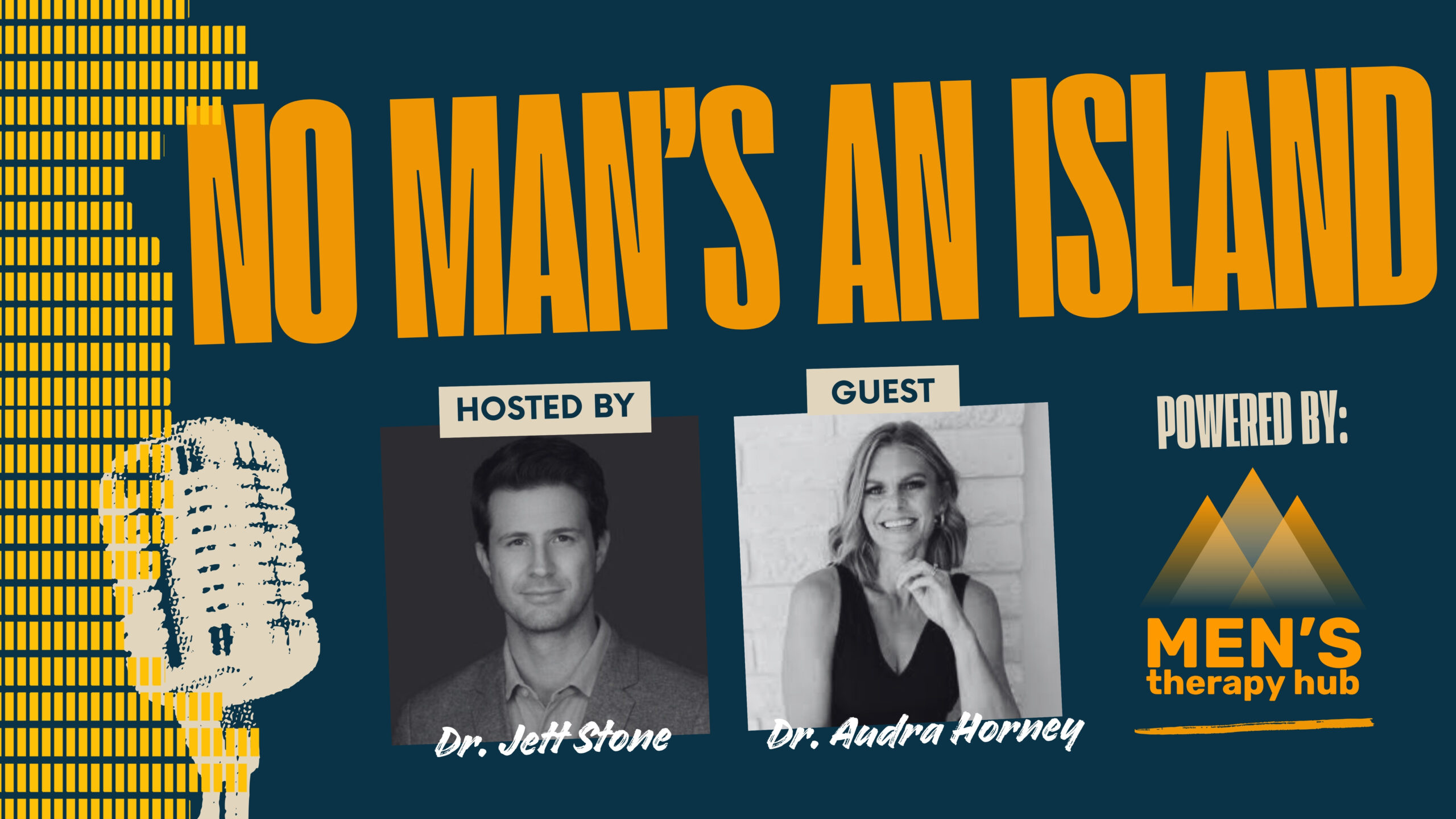
In this episode of No Man’s An Island (powered by Men’s Therapy Hub), Dr Jett Stone speaks with Dr Audra Horney, a licensed psychologist and founder of Modern Therapy Arizona who has become one of the most visible voices in men’s mental health online. Audra’s work focuses on something many therapists are beginning to recognise – that traditional therapy models do not always reach men effectively. Through her clinical work and social media presence, she has built a practice designed specifically to meet men where they are and help them engage with therapy in ways that feel authentic and useful.
Audra’s route into this work was not planned. With an undergraduate background in psychology and women’s studies, she initially approached therapy through a social justice and multicultural framework. But once she began working clinically, she noticed that many of the men she saw were struggling with therapy environments that did not feel built for them. That realisation led her to specialise in men’s mental health and rethink how therapy can work better for male clients.
One of the ways Audra communicates these ideas is through social media, where her posts about the “rules she breaks” as a therapist for men have resonated widely. These include things like swearing in session, being more direct with clients and avoiding the stereotypical soft therapist voice. For Audra, these choices are not about rejecting professionalism but about authenticity. She believes that therapy works best when the therapist shows up as a real human being rather than performing a professional persona.
Much of the conversation focuses on how men approach therapy differently and why many hesitate before seeking support. Audra challenges the common belief that men are resistant to therapy. Instead, she argues that many men simply do not see therapy as something designed for them. When therapy feels relevant and accessible, she finds that men are often eager to engage.
Another important topic in the episode is emotion and vulnerability. Audra pushes back against the idea that crying is the ultimate sign of emotional depth in therapy. In her experience, many men feel emotions deeply without necessarily expressing them through tears. Rather than focusing on whether a client cries, she encourages attention to where emotions show up in the body, such as tension in the shoulders, heaviness in the chest or a knot in the stomach.
Jett and Audra also explore how emotional communication can create tension in relationships. Many men are told they need to be more emotionally expressive but are rarely given clear guidance on what that actually means. Therapy can provide a space to practice those conversations and build the language needed to express emotions more clearly.
The conversation also touches on the role of social media in building trust with potential clients. By sharing educational content online, Audra allows men to develop a sense of who she is before ever contacting her. This often means that when a client finally reaches out, they already feel comfortable enough to speak openly about difficult experiences.
Towards the end of the episode, the discussion turns to the biggest barrier men still face when seeking help – access to therapy. Even when men overcome the emotional challenge of asking for support, the cost and availability of therapy often stop them from moving forward. For Audra, improving access to affordable mental health care is one of the most important steps for advancing men’s mental health.
What we cover
- How Audra’s background in psychology and women’s studies led her into men’s mental health work
- Why many men feel therapy is not designed for them
- The “rules” Audra breaks when working with male clients
- Why authenticity matters more than performing a therapist persona
- How men express emotions differently and why tears are not the only sign of vulnerability
- The communication challenges many men face in relationships
- How social media can build trust between therapists and potential clients
- Why access and affordability remain major barriers to therapy
Listen and watch
YouTube – (embed here)
Apple Podcasts – (link here)
Spotify – (link here)
Takeaways for men
- Therapy does not require you to show emotion in a specific way
- Feeling emotions in your body can be just as important as talking about them
- Being direct and honest in therapy often helps build stronger trust
- Many men struggle with therapy because it has not been designed with them in mind
- Accessing help can be difficult, but the desire for support is often stronger than people assume
Quotes to share
“I think men are very justified in being hesitant to pursue therapy.” – Dr Audra Horney
“How can we call someone resistant to something that doesn’t seem like it’s for them in the first place?” – Dr Audra Horney
“Therapists should show up as human beings in the room.” – Dr Audra Horney
“The hardest barrier for many men is believing that therapy could actually help them.” – Dr Audra Horney
Resources and links
Modern Therapy Arizona
https://www.moderntherapyaz.com/
Men’s Therapy Hub – Find a male therapist
https://menstherapyhub.co.uk/therapist/
Related Men’s Therapy Hub resources
How to get a man to share his feelings – https://menstherapyhub.co.uk/how-to-get-a-man-to-share-his-feelings/
Men and Financial Stress – When Money Worries Become Mental Strain
Episode credits
Host – Dr Jett Stone
Guest – Dr Audra Horney
Podcast – No Man’s An Island
Produced by – Men’s Therapy Hub
TRANSCRIPT:
Jett Stone (00:00)
welcome to No Man’s in Ireland, a podcast powered by Men’s Therapy Hub, a directory of male therapists for male clients. I’m Dr. Jet Stone, and my guest today is Audra Horny, a licensed psychologist, founder of Modern Therapy Arizona, and one of the more visible voices in men’s mental health right now. Audra has built something unusual. She’s a woman who’s made men’s mental health a major focus, and she’s done it in a way that actually reaches men.
If you’ve been on TikTok or Instagram and you’re interested in this space, you’ve probably seen her engaging content about men and psychotherapy with titles like rules I break as a therapist for men. But what I find most interesting about Audra is that she’s direct, she’s authentic and men seem to respond to that because she’s figured out something a lot of us therapists maybe haven’t. That the traditional therapy is set up is not always built in ways that actually work for guys out there. So thanks so much for coming on Audra.
HODRA
Dr. Audra Horney (00:57)
Thank
you. Thank you for having me.
Jett Stone (00:59)
My pleasure. So let’s walk through a little bit your origin story. I know that you studied psychology and I think I saw women’s studies at Wisconsin Madison. So I’m a big 10 guy at University of Michigan. ⁓ Can you walk me through ⁓ how a woman studies major ends up dedicating her career to being a therapist for men? What pulls you in that direction?
Dr. Audra Horney (01:08)
Mm-hmm. Mm-hmm. Nice.
Such
a good question. And I hope we haven’t scared off the entire audience already by putting that out there. ⁓ So it’s true. ⁓ During my undergraduate university years, I was a psychology and women’s studies double major. And believe it or not, my work today
my specialization in men’s mental health, the therapy practice I’ve built specifically marketed to men seeking therapy and my online content around men’s mental health is all rooted in my 21 year old identity as a feminist. And from, you know, that’s now 21 years ago, over time, what has that what that has evolved into is
my values today stand in a place of believing we all deserve access to inclusive mental health care. And through my training as a master’s level clinician and then in my doctoral program, becoming a licensed psychologist, my work was always really focused on social justice and a multi-cultural approach to my work as a therapist.
I’m sure that you know that means a lot of self-reflection and personal work and awareness of my own biases, my own identities, and then being sure that I am taking those same multicultural identities of my clients into account in the work that we’re doing, recognizing that we are all individuals and we all then have some sort of cultural background to us, ⁓ regardless of how many privileged or marginalized identities we may hold.
And so I did not pursue men’s mental health. I did not go to graduate school to become a therapist for men. This work really found me and it found me after I was outside of my academic training. It found me once I was really pounding the pavement as a therapist doing full-time clinical work. ⁓ Again, with the same values informing me of believing that.
Every client who walks into a therapist’s office, every person who is considering therapy deserves to be seen as an individual, deserves to receive support, therapy, treatment, interventions that are catered to their unique lived experiences. And the work that I was doing with men early in my training, honestly, was just the work that I felt like I enjoyed the most and that I was best at. And as I continue to lean into that, I…
quickly learned that, quickly realized that the training I received, although I took many multicultural classes and had a social justice multicultural lens to the work I was doing, I hadn’t been informed about what that meant to be working with men. And I think generally we may assume that men are like the majority population or so many things, even research historically has maybe been done, medical research even on men.
But I believe over time, therapy has become a more feminized resource. And the majority of therapists are women and the majority of people who seek out therapy are women. And because of that, I think there’s unfortunately been a gap in the ways in which therapy can be more specifically catered to men, helpful for men, meeting men where they’re at. And…
That has been now my mission. It’s where I’ve lead in and that’s the work that I’m, ⁓ you know, passionately hoping to ⁓ continue for as long as I can and to make changes, not just for the men that I work with, but more broadly in the field as well.
Jett Stone (05:19)
I love that origin story because it speaks to me who trained somewhere else in the country differently than you did. But there is this gap in the training that when you’re actually working in practice with men of all varieties, it’s like you realize you have to do start doing some things differently to make this work and to build these therapeutic relationships. We’re going to talk about that a little bit later. I’m actually curious, looking back at your 21 year old
Dr. Audra Horney (05:39)
Mm-hmm.
Jett Stone (05:48)
feminist self, what’s something that she would have been surprised about? You know, decades later version of you. Like what is something that you’ve learned, another way of asking this, like what have you learned now as more of a seasoned psychologist that would have surprised your 21 year old self?
Dr. Audra Horney (06:05)
Mm-hmm.
I think I would have been surprised, specifically if I’m thinking about working with men in therapy, is I would have been surprised at how eager men are for support that meets them where they’re at, for therapy, for mental health support for them. I think there is…
misconception that men are resistant to therapy. I think men are very justified in being hesitant to pursue therapy. I also think that we’ve maybe created a system where it doesn’t always seem like therapy is for men. So how can we call someone resistant to something that doesn’t seem like it’s for them in the first place? ⁓ And so what I’ve been pleasantly surprised by is how eager and willing and motivated men are once they realize this resource is not just available to them, but
for them, created with them in mind.
Jett Stone (07:08)
Yes. And that’s what I think you speak to on your social media channels that spoke to me and probably a lot of other therapists out there as well. Have you received any pushback, any feedback from other therapists about kind of like making this declaration like a therapist for men? ⁓ It’s so welcoming for a guy. Like I’m taking off my clinical hat on and just putting on my put on my ⁓
therapy client have like that. That’s a welcoming, that’s a welcome sign that there’s not very many of those welcome signs out there, at least not yet. I think that’s it’s growing. ⁓ So my question there for you is like, what is it like to be a therapist in this space? does the, what’s the feedback like positive, negative, neutral?
Dr. Audra Horney (07:40)
Yeah.
Mm-hmm.
⁓ I would say overwhelmingly positive and neutral. ⁓ As you were asking that question, was internally reflecting on the fact that I don’t get, I haven’t received pushback from other therapists. And I’m kind of smirking to myself because I think I present in a pretty confident, no bullshit sort of way. so I…
I don’t waver in my commitment to this. I really stand behind what I say and I think I have a very sound argument. ⁓ And so I’m a type one enneagram too. So I’m just like, I know I’m doing this right. Like I know what I’m standing for and I’m gonna do this as well as I can. So I don’t know if I leave too much room, right? Like I’m always self critiquing and I’m always working on like what are my blind spots and how can I grow and what is missing here and how can I.
deliver this message not just to men, but to therapists in a way that can be palatable. So don’t know if I leave much room for ⁓ pushback, but I would say, overwhelmingly, it’s just been positive. I will not lie that therapists are surprised when they first meet me and they ask, know, ⁓ who do you work with? What’s your specialization? And I say, I’m a therapist for men. ⁓ There’s often a pleasantly surprised reaction that they have, like,
wow, really? That’s really neat. That’s great. Like, it’s a quick pivot to that’s great, but the initial reaction is oftentimes surprise. And I think that speaks to how rare it is. It’s, you know, I’ve seen more and more therapists ⁓ becoming more public, more female therapists that that is like, it’s more rare for a female therapist to identify as a therapist for men. And so I think that that unfortunately is even surprising to therapists.
Jett Stone (09:47)
Yes.
I think sometimes it would be surprising, is why I asked about it. And again, it’s such a welcoming sign to see that. I want to dive right into some of the content that you’ve created, because like I said, it spoke to me and it speaks to others, that there’s a list of Instagram rules. And for those who follow you, they’ll know what I’m talking about.
Dr. Audra Horney (09:59)
Yeah.
Mm-hmm.
Mm-hmm.
Jett Stone (10:22)
where you talk about like just breaking traditional therapy norms. You curse first, you don’t use soft calming voice. You ask why, you tell clients ⁓ where to sit. I wanna, I can just list the other ones off too, but like what’s the thinking behind those? Like how’d you land on them? And maybe, cause there’s a bunch of them there. I’ll let you, ⁓ let’s focus on the soft calming voice because it’s, women often.
Dr. Audra Horney (10:26)
Yeah. Yeah.
Yeah, that’s funny. That’s
the one that was ⁓ this, I posted this both on Instagram and TikTok and in both platforms. the, that seemed to people like nails on the chalkboard, like how triggering it was. Cause in my post, I sort of mimic the like, I’m so glad you’re here. I’m so proud of you. Please open up. You’re safe here. Like.
And the reaction people had to me even acting out that soft voice was, ⁓ it was triggering to say the least. And so to me, like really what it comes down to is like that whole post to me could be summarized as therapist, be a human and treat your clients like a human. Why are we going to show up and act any differently than we would?
talking to someone else in our life that we want to build trust with and that we want to connect with. Granted, as a therapist, we walk in and I have my professional hat on and my ethical hat on and I’m utilizing evidence-based interventions. I’m doing my job and doing it well, but I am in the business of people. I’m in the business of relationships. And so if I’m showing up, hoping that my clients, really what I do is work with my male clients to help them get to a place of authenticity.
What’s behind the mask? How can you live a life that feels true to you? And if we’re working towards authenticity, but I’m showing up as some therapist, stuffy, robotic version of myself, how is that, how are we fostering authenticity in a relationship if one person in that relationship isn’t being real? so unless, to me, those rules,
aren’t necessarily the rules all therapists have to follow. These are the ones I break because these are the ones that are true to me. It is true to me. I don’t swear in session with my clients just because I think my clients need that. I swear in session with my clients because I swear in my life. I don’t use that soft voice in session with my clients because that’s not how I talk. And so ultimately for me, it’s about finding a way for me to show up authentically, professionally and authentically.
to model and invite and give permission for my clients to do the same.
Jett Stone (13:15)
And I think it in some ways models the relational styles of how many men were raised into that, you know, a lot of times cursing and shooting the shit, talking about sports is a, a way in to deeper vulnerability. And there’s just something about that post. It reminds me of, you know, I hear a lot of women talk about the ick factor in dating. and
Dr. Audra Horney (13:24)
Yes.
Mm-hmm.
Yeah.
Yeah, yeah.
Jett Stone (13:44)
That is it. Actually, there is an ick in there. And I wonder with therapists, it’s, you know, the soft voice and whatever. You don’t want to like shame people for how they talk. You’re just being authentic. But I think sometimes I found it actually defensive in therapists that if you haven’t dealt with your own anxiety, you sort of go into like warmth and terminal niceness and like soft mode. And I
Dr. Audra Horney (14:00)
Mm-hmm.
Mm-hmm.
Jett Stone (14:13)
I’m just putting that out there that in some ways doing the work yourself, ourselves, as therapists and getting confident enough in the room to work with men who might present with more intensity, let’s say, or in different relational styles, I think is part of the work of being a therapist for men. It’s that self work.
Dr. Audra Horney (14:23)
Yeah.
Mm-hmm.
I agree.
I agree. I think it is so important that I’m showing up, not just myself, but confidently myself. ⁓ Not arrogant, not cocky, not trying to prove anything. But I want to make sure that when my clients walk in, they feel comfortable. And I think part of that is feeling like I’m myself with them. ⁓
You know, I’ll have clients now who have found me through social media. And the last thing I want is for you to get a sense of my personality or sense of humor or my style and then walk into my office and feel like I’ve bait and switched you. And now I’ve got this quote unquote therapist persona and we’re going to interact differently there. ⁓ I want you to feel like I am being genuine with you.
And I also want you to feel like I am confident in the room with your emotions, whether that be sadness or depression or crying or anger or irritability or aggression. I want you to be able to come in messy. I want you to be able to show up honest. And especially, think, for men working with a woman, I need to make sure that I am OK with that, that I’ve done that work, that I’m working with clients that are
a good fit for me so that when they come in, they can trust like Audra’s got me. Because so many men don’t feel like they can lean on anyone else. They can’t rely on anyone else. They are a burden if they do lean on anyone else. And I wanna make sure that at least in those 50 minutes in session with me, they can trust I’ve got them.
Jett Stone (16:15)
You know, that coming in messy part, I think is important. In my experience working with a lot of men in therapy is that they come in feeling really disorganized, especially if they have like perfectionistic qualities, like they want to get it right. They want to, they’re not going to speak or they don’t even feel worthy of being in therapy unless they can really nail down exactly why they’re here and what they need. And I wonder, what do you, like for me, it’s a lot about like,
Dr. Audra Horney (16:19)
Yeah.
Yeah. ⁓
Mm-hmm.
Jett Stone (16:45)
front-loading clarity up front in therapy like early on explaining the process like you’re supposed to come here like and not know what the fuck is happening or necessarily you don’t have to come in with like you know the exact agenda of what needs to happen that’s my way of normalizing that like yeah you don’t you can get you know you could not have words for what you want to say i’m wondering if that’s your tact as well or the what other ways do you work with men who feel like
Dr. Audra Horney (16:49)
Yeah. Yep.
right?
Mm-hmm.
Yeah.
Jett Stone (17:12)
Oh my gosh, I don’t even know where to begin in the therapy process. Yeah.
Dr. Audra Horney (17:13)
What do I even do here? Yeah,
I completely resonate with what you’re sharing. I do so much of that front loading. And I really see it as my job to educate men on the process. Because not only is therapy foreign to a lot of men, but these sort of emotionally intimate relationships and this sort of one-on-one intensity in a relationship is new for a lot of men as well. And so I want to err on the side of assuming
the majority of my clients have never been in therapy before. And so I want to give you as much information and want to make sure you know that there are no dumb questions here. If you’re not sure what to do, that’s my bad that I didn’t explain that well enough. And I want to make it clear sort of like what we’re doing here, why we’re doing it and like, let me take the lead. You know, I do a lot of that scaffolding early and whether it be the initial consult call before we’ve even agreed to work together, like really being clear about
all the steps we’re going to go through and why. And then through our work together, I see that education around the therapy process, around mental health and diagnoses and coping strategies. I do so much education in a non-shaming way and a just empowering way. I want you to have as much information at your disposal as possible because I want you to be empowered, but I don’t expect you to have that information now. ⁓ And in addition to that, this is
been part of the reason I’ve been so committed to the content that I create on social media is because that does that front loading for me.
The men that I’m working with now are finding me through social media, or maybe they’re finding me elsewhere. Maybe they receive a referral. But then they’re able to see, not just my website, but they’re able to see a lot of content, which is a lot of talking head content on social media, where I’m very clearly laying out what I stand for, what therapy is like with me, how to do an intro call.
what to expect in your intake session, what therapy can be like, what sort of treatment models exist. Like I’m doing so much education there. And so many of my clients now are coming in, they’re oftentimes following me on social media for quite a while, building trust, seeing like, is she consistent? Can I actually?
can I actually be supported and helped by this person? So by the time they’re coming into my office, they’ve got some therapy know-how and some education there already. And they’re able to come in with at least a general idea of what to expect because they’ve been able to receive that information anonymously, confidentially on their own terms prior to even starting the therapy process.
Jett Stone (20:06)
That’s so interesting. I had not yet thought of the way that social media presence for therapists in your case, like already builds preloads of transference, right? Into the, you don’t even know about.
Dr. Audra Horney (20:18)
Yeah, well,
no, I mean, it is, you we gotta be careful, because there is that like parasocial relationship that occurs. Like my followers are able to build a relationship with me before I even know who they are. And I think that is something for therapists, you know, I wasn’t trained on how to navigate that as a therapist. So this is new and a lot of therapists might, some therapists decide not to see clients who follow them on social media for that reason. But in my opinion, working with men,
Jett Stone (20:30)
fast.
Dr. Audra Horney (20:47)
This is such an asset to the work we can do that men are able to build trust and rapport with me. Like I said, I’m showing up on social media. Really honestly, I’m showing up the way that I do in my office, build a relationship with me, build trust with me. And then by the time we have then our initial consult call, which is what I do with all potential new clients is we have 20 to 30 minute free phone call just to see, is this a good fit? Can I actually help you? Or is there someone else who might be better fit? And
during that initial phone call now, I mean, I’ve now experienced being a therapist before and after showing up on social media as a therapist. And now in that initial consult call, I have men disclosing things to me that they otherwise weren’t disclosing until maybe the fifth, sixth, 10th session in therapy, because they feel like Audra gets it. I know what she stands for. I can actually tell her what’s going on. I don’t have to wait. I don’t have to go through those first…
you know, one to 10 sessions of therapy to build trust and to see, can I actually put myself out there? And so I see that such a huge asset that we can jumpstart that rapport and trust process so that therapy can be even more efficient with the clients who begin to work with me because they’re coming in arguably the way that a lot of women enter therapy, feeling like, okay, I can trust this, this is a therapist, let’s hit the ground running.
But for a lot of men, understandably, they want to take more time to slowly build that trust and to gauge, can I actually put myself out there? Can I actually tell my therapist these things that I said I was never going to tell anyone? And I will even have clients who have that rapport and really hit the ground running. And then a few sessions in will say, you know what?
I came in here ready to do the work, but there were two or three things I was never gonna tell you, but I think I wanna tell you now. Like there’s such a leg up in this process because they have decided to step into my office already feeling like they can trust what I stand for before I’m then with them one-on-one proving to them what I stand for.
Jett Stone (22:59)
Well said, and I think that they’re now sitting across from you, speaking to you, there isn’t a mismatch between your online presence and your, at least your video presence, which is helpful. It’s not over curated or over edited. There’s an authenticity there, which I think helps you. And then it facilitates the therapeutic process in a way that is so interesting.
Dr. Audra Horney (23:11)
Well that’s good to hear.
Yeah.
And that’s, yeah.
Well, that’s my hope. That’s why I don’t, and this may not resonate for those who aren’t like in the social media space, but I don’t batch my content, which means I don’t record things weeks or days even ahead of time and schedule it to be posted. I do it very off the cuff, spur of the moment. I don’t script my content. I just record something long form and I edit it down to clean it up. But it is…
it is very authentic. is very genuine that I’m speaking to these topics because I wanted to read that way and because men can smell bullshit. I think a lot of people can, but like, especially men who are deciding whether or not to trust a woman, they can smell that authenticity or they can smell that fakeness. They’re trying to sniff that out. And so I want to make sure that I’m not just…
performing authenticity, but that I’m actually showing up and whether you’re finding me on social media, on my website, on a podcast, that there’s consistency there. Because otherwise, trust is broken before that guy even has a chance to walk into my office.
Jett Stone (24:35)
Let’s continue on the authenticity track and talk about vulnerability because one of the other things that you’ve talked about on your ⁓ social media channels and I’m not on TikTok but I am on Instagram. I know that you have a lot more followers on TikTok. One of these days I’ll get on there. ⁓
Dr. Audra Horney (24:40)
Mm-hmm.
All the guys are over there. There’s
like this degree of like anonymity over there ⁓ where men are able to, you should top over just to see my comment sections because men are able to engage with my content over there in a way that I think is a lot safer than on Instagram.
Jett Stone (24:55)
Interesting.
Hmm.
Okay. I will. I want to talk about emotion, emotions in men and maybe a good segue in. And one of the things I loved is that you said something along the lines of, ⁓ I don’t care if you cried, but did you feel, and I write about, male psychology. And one of the things I’m sort of been brainstorming is, ⁓ an essay on like male tears and
Dr. Audra Horney (25:12)
Mm-hmm. Yeah.
Jett Stone (25:35)
and our relationship with crying. And I’m just curious, ⁓ like there’s so much there because I think the assumption for many men, actually myself included that tears, this biological signal of oftentimes sadness, sometimes joy, it’s like a sure sign of authentic or true vulnerability, right? And if you’re not tearing up and you’re not actually feeling in the right way,
Dr. Audra Horney (25:36)
Mm-hmm. Yeah.
Mm-hmm.
Jett Stone (26:05)
winning therapy, right? If you’re
Dr. Audra Horney (26:06)
Right, right.
Jett Stone (26:07)
if you’re not crying and I just want to let you expand on that because you said on one of your posts, I don’t care if you cry, but did you feel what do you what have you learned about tears and men?
Dr. Audra Horney (26:17)
Yeah.
I mean, I’ve learned that they’re maybe not gonna tell us as much as we think they could. And honestly, I see that on both ends of the spectrum. I see men who are feeling deeply and doing this really groundbreaking work and making so much change for themselves and not shedding a tear through that process.
And I also see men who have relatively easy access to tears and may not be digging into all the different parts of themselves and what they are feeling in as dynamic of a way as someone who’s not crying at all. And so, you know, granted, do I have tissue boxes on both ends of my couch? Yes. And do plenty of men at times cry in my office and during sessions? Of course.
But that’s not the goal unless I’m working with a client who’s saying, I want to cry and I can’t cry and I want to figure out why not and see what’s blocking me and see if I can get past that. But if that’s not the identified goal, there are so many other ways that we feel and express ourselves because ultimately what tears are is an expression of
a feeling or an experience. And can it be tied to how you are actually feeling and an indicator of what you’re feeling? Yes, but not always. And so, yeah, I want men to know that that’s not the MO. Like, that’s not my goal of therapy. I hope it’s not most therapists’ goals in therapy. And honestly, it’s something that I can personally relate to because I…
I think I have a more, quote unquote, like masculine expression of emotion myself. Like I’m a fairly guarded person. I don’t cry often. I don’t cry publicly. don’t, I rarely cry in my own therapy. And I also know that I experience deep emotions and I’m very sensitive and I can feel vulnerable and in pain without
Jett Stone (28:25)
you
Dr. Audra Horney (28:48)
those tears tied to it. And so who am I to, you know, just even as a woman, who am I to judge a man for how he’s showing his emotions? Again, are you feeling it? What are you feeling? Where do you feel it? For a lot of men, there’s, you know, a ⁓ tension in your neck or shoulders, or there’s a pit in your stomach, or there’s like a heaviness in your chest. Well, let’s focus on that. If that’s where you’re feeling this emotion, let’s
Let’s explore that further. Let’s not assume that you crying is the ultimate goal.
Jett Stone (29:25)
Let’s copy it and paste that and put that out there because I think for so many men, I’m just thinking of specific people that I’ve worked with where it’s like, that’s an added layer of shame to whatever else they’re coming presenting with, especially having worked with military veterans who’ve seen and witnessed so many horrific things. It’s like, why haven’t I cried? I must be a monster. There was like a stuck.
Dr. Audra Horney (29:39)
Yeah. my gosh. Yeah.
Yeah.
Jett Stone (29:54)
belief inside there. So I hope those words that you just spoke ⁓ can be heard by someone who’s feeling like they’re maybe not a monster, but maybe like robotic, right? And a lot of men who I see are ⁓ given that label of being emotionless or expressionless or robotic or like, you know, in heterosexual relationships, you do see a lot of like, need more expression.
Dr. Audra Horney (29:55)
Yeah.
Right.
Mm-hmm.
Jett Stone (30:19)
I need more of a range of facial expression and emotion that I’m doing, if you can see me on camera. What do you, like, how do you work with men who are in relationships where they need to start being more expressive? Like, where do you start when someone does have more of, like, a ⁓ less expressive, you know, exterior or something, right, affect? Where do you go with that?
Dr. Audra Horney (30:24)
Yep.
affect.
Well, I mean, there’s a few things that quickly come to mind. ⁓ One, when that’s rooted in the relationship, whether it be, you know, they’re referred to me from couples therapy or their partner, maybe their female partner is saying, like, I just need more from you. Like, I wish you were more emotionally vulnerable with me. Like, you’re you’re a robot. I need more. Right. I think that it is important to explore.
with my client, I think that it’s important to maybe zoom out a little bit. And I always wonder, is your partner wanting more emotional support? Do they want more room? Do they want you to be present for their emotions and connected with that? Or do they actually want more emotions from you? Because I think a lot of times partners in a relationship will say, I need more from you. And what they’re really saying is, I need more emotional support from you. Which in my experience, a lot of men are like, okay, what the fuck does that mean?
Give me some direction, give me something tangible there. How do I emotionally support you? But I think a lot of men here, like you want me to be more emotionally vulnerable, you want me to open up, you want me to cry, I guess. And then unfortunately sometimes do that and have negatively reinforcing experiences in the relationship. And sometimes female partners don’t know how to support.
Jett Stone (31:58)
Mm-hmm.
Dr. Audra Horney (32:09)
their male partners through that sort of vulnerability. So I think it is very important to not jump to any conclusions about what does it mean when your partner says you’re a robot? Like what are they actually asking for? So I just wanna put that out there, because I think that is a miscommunication I see in relationships often.
Jett Stone (32:21)
Mm-hmm.
Yeah, it is an important distinction. ⁓
It’s something that I do see a lot in my work. And one of the things that I have come to do more as a therapist for men myself is provide, I sometimes think of it as like a, okay, we know what happened, take one with that situation where it didn’t land. Like, let’s say this person is trying to be more emotionally supportive for their ⁓ partner who’s going through like a fertility process. ⁓
Dr. Audra Horney (32:38)
Mm-hmm.
Right.
Jett Stone (33:04)
Let’s kind of like roleplay it out a little bit if they’re comfortable with it, you know, because a lot of men are coming like they’ve never had a chance to talk through another way of being with someone else. If not in therapy, then where? Like,
Dr. Audra Horney (33:07)
Mm-hmm.
Mm-mm.
Right, and
that’s the struggle that so many men are up against is that they may be in their 20s, 30s, 40s, 50s and now in a relationship where they’re being asked to be more emotionally vulnerable or emotionally supportive, but we have not socialized these men from the age of two, like we do little girls, to be emotionally attentive in these ways, to have these skills, to have this language. And I think that’s such a…
valuable component of therapy is being able to practice that. I think it’s ⁓ a value add for men who work with a female therapist, if that’s what they’re seeking, to be able to navigate that sort of communication with a woman and to practice what that’s like, and then to receive feedback from me as a woman, you know, for me to be able to say, I know what you meant by that, and I’ll be honest that here’s how I took it or here’s how I’m wondering if she’ll take it.
Jett Stone (34:07)
yeah.
Dr. Audra Horney (34:16)
⁓ you know, let’s, if we give it another go and you focus more on the emotion and less on the behavior, right? Like to be able to practice that is so valuable and to be able to do that in therapy in a really supportive, safe way. Like it may feel uncomfortable. It may feel embarrassing to normalize that, but to be able to say like, okay, but here’s, here’s like the, we get to experiment in here a little bit and we get to practice this so that once you go back to your relationship, you’ve,
Jett Stone (34:16)
Mm-hmm.
Yes.
Dr. Audra Horney (34:46)
you’ve already put in some reps like we do anything else, right? You’ve already gone through these motions and practice it and gain some muscle memory so that when you’re, you know, prime time that those skills feel a little bit more accessible.
Jett Stone (35:03)
Yes. And I think it also depends on how you work as a therapist, but working with men, like that’s very, that’s very valuable, which makes me think of this tension that I always carry with me between the being and doing. And that a lot of men, like, if you look at the research, we’ll say, you know, I want a sort of an action oriented, you know, solution focused therapy. as therapists, we know that like, you know, life doesn’t exist with this. This is what you need to do for this.
Dr. Audra Horney (35:18)
Mm-hmm.
Yeah.
Yep.
Jett Stone (35:33)
We’re not trained with the right answer for everything. Obviously, now we’re not advice givers. I think what you’re saying there in this role playing ⁓ example I asked of you is that there is a mix between being and doing, feeling somatically and then giving them some type of experiment out in the real world. I think you’ve mentioned that. Can you say more about how you
Dr. Audra Horney (35:33)
huh. No.
Mm-hmm.
Yes.
Jett Stone (36:01)
handle the tension between the being of therapy, presence, and stillness, and feeling deeply, and the sort of getting out there and actually enacting.
Dr. Audra Horney (36:04)
Mm-hmm.
Yeah, I’m a firm believer that in every single session I have with a client, I should be providing both hope and solutions to some extent. And solutions don’t necessarily mean a tangible skill. It may be ⁓ helping explain a symptom and linking that to a diagnosis. It may be helping them build some insights in their relationships and give them an idea of how they.
want to navigate that relationship moving forward. It may be some coping skill that is very tangible that they’re going to practice. But in addition to that, that like the hope or the insight or the validation piece of therapy is just as important. And what I often do with my clients is help explain how validation, especially empathy support is a solution. And it is unfortunately an intervention or a solution that few men have.
received as much as I believe they deserve to have received that just like space to be and to breathe and to be able to quote unquote sit with something and feel safe naming how they feel or just feeling how they feel and not having the pressure to jump to a solution and run from it. ⁓ I think is something that I know it’s something that I work to help educate my clients on the value of
insight, the value of understanding and owning their own story without any immediate intention to change it or to do anything with it, but to be able to sit with themselves without that constant pressure and urgency to change.
Jett Stone (37:54)
And so I’ll share a very quick story. was on a bus and I was related to what you just said. I was on a bus listening to two guys in front of me talk about their therapy experiences. So you can imagine like how like this is like the best time ever for eavesdropping. Yeah. I’m my notepad out. was, you know, taking notes. ⁓ And each of them were talking about like, I wish my therapist would, this is a direct quote.
Dr. Audra Horney (38:10)
riveting, yeah.
Jett Stone (38:22)
step up to the plate and just say the thing that they’re thinking. Right. They even use that metaphor. and you know, it’s not to say that you should just be like, you know, word of vomit as a therapist, but there is something that I have noticed about shooting your shot as a therapist that really helps build rapport with men and that it’s, I don’t know how it necessarily relates to being and doing thing we’re talking about, but it is like doing as a therapist is that like can be, ⁓
Dr. Audra Horney (38:25)
Yeah. Yep.
Yeah.
Jett Stone (38:51)
great for the Alliance. And so I guess that’s my pitch for you to add that one into your rules.
Dr. Audra Horney (38:57)
Yeah, no, I totally
agree. I think too often I hear therapists fall back on this line of therapists don’t give advice and kind of come back to that in ad nauseum. And if I were outside of the therapy world and just a client, I’d hear that and think, well, then what the hell are you doing? Like if you’re not, right? And as a therapist, we know it means like, I’m not gonna tell you how to live your life.
I’m not going, I don’t have the answers. So I’m not gonna give you the quote unquote answers. I’m not gonna say, you know, that’s right or that’s wrong or do that or don’t do that. I’m not, I’m not the, I don’t know all and I’m not in charge. And I think when therapists too often reiterate this line of we don’t give advice, therapists don’t give advice, we miss the part that you just hit on, which is, well, I’m gonna be honest with you though. And I’m gonna, you know, I’ll tell clients like, I’m not telling you,
whether to do this or not do this, but I will tell you I’m worried that xyz. Or I’m wondering if you’ve thought about this potential outcome. Or I’ll tell them like, hey, I know you’re saying that you’re fine. You’re not anxious or you’re not depressed or like it’ll pass. It’s just the situation. But I need you to know that everything you’re describing.
checks the boxes for more chronic major depression or this actually what you’re describing as post-traumatic stress disorder. To me, that feedback, that’s the piece that I think is so critical is, okay, yeah, I don’t give advice to my clients in the sense that I don’t tell you how to live your life, but I believe that a big part of my job is offering you feedback and making sure you know that this is my feedback. I’m not like,
all powerful, all knowing, but I know a lot about psychology and men’s mental health, and then you know a lot about yourself, and together, we’re gonna offer feedback and collaborate to help you find your way through this, and a big part of that for me is being involved in this process. I’m not just nodding and smiling and affirming. I’m challenging. I don’t think I’m doing my job if I’m not challenging you as a client. I don’t think…
That’s not the kind of therapist I am at least. Like therapy, I’ll joke with my clients sometimes, you know, when they’re saying it’s a hard session or they were exhausted, they had a therapy hangover. And I’m like, dude, like you could have chosen an easier therapist. Like I, you know what I stand for and I’m not doing my job if I’m not challenging you. If this isn’t a little hard, then we’re probably not moving the needle. And that’s my responsibility. I’m here to play ball, right?
Jett Stone (41:47)
Yeah.
Dr. Audra Horney (41:47)
And so,
like, I’m going to show up every single time because, you know, I’m asking the same of you and that to me, like, that’s ethical, that’s professional, that’s me doing my job.
Jett Stone (42:01)
Yes. And even the metaphorical aspect of it, I think is important because you may not have the exact emotion words, but the metaphor gets at the heart oftentimes of, of, ⁓ what men are feeling. And what’s great about this, you know, is about this challenging thing that we’re talking about here is that it’s not necessarily, you know, saying like, you’re wrong. It’s actually putting out something for a client that they can take.
can reject. It gives you so much information about how much, you know, their style, their moves when, you know, they get uncomfortable and ⁓ they can also edit it. I always say that, although you can edit this if you want, but I think XYZ, right? Or it makes, you know, it makes it collaborative.
Dr. Audra Horney (42:37)
Right.
Mm-hmm.
Yeah,
exactly like collaboration is so key. And I’ve, I’ve been known to say with my clients, like, you can tell me to fuck off about this, but and then I’ll tell and then I’ll tell them. And so it’s like full permission, right to say, Audra, where the hell did that come from? ⁓ Sometimes, honestly, my challenging, sometimes the most powerful challenge I offer a client is me saying, I’m really worried about you.
Jett Stone (42:58)
That’s said. That’s better said.
Mm-hmm.
Dr. Audra Horney (43:15)
to slow down, to let them know like, hey, I’m not just like co-signing on all of this. And I’ve felt snagged on some of the things you’ve said. And to me, that’s a challenge, right? To me, that is confrontational. And in my opinion, like in my work with the clients who want to work with me, like that’s what moves the needle is them feeling like I’m invested, I’m paying attention, I give a shit.
And that helps them lean in more. And it allows us to then work together to collaborate to figure out how we can get them closer to where they’re trying to be.
Jett Stone (43:56)
Yes. And I think ⁓ sometimes I do training with other therapists about working with men. And one of the things I emphasize is about language. And obviously it has to be, we’ve talked so much about like organic, it has to feel like it’s actually the way that you would speak. But there is something about like, how do you think about therapists who don’t necessarily have access to that language of like, that, know, saying,
Dr. Audra Horney (44:09)
Yeah, gotta be authentic, yeah.
Jett Stone (44:23)
You know, you could tell me to fuck off, but it just doesn’t roll off the tongue. Right. Like, is it possible that there are some therapists who just might not be equipped to work with these more like traditionally masculine clients because of that? Or I mean, I’m just curious how you think about that.
Dr. Audra Horney (44:24)
Yeah.
I think that when therapists are being honest with themselves, when therapists are doing their best work, it is with the clients that we are the best fit for, that we feel like we can be our full, true, honest, genuine therapist selves, read as authentic.
that’s our best work. And so I know I’m not the best fit for everyone. I know that there are plenty of men who wouldn’t be a good fit for me. And I know there are female clients that aren’t going to want to work with me. I don’t assume my style is for everyone. And as I mentioned before, this is the work that I’ve leaned into because it’s what I felt like.
I is what I know I enjoy the most and it is what I believe I am best at like I’m good at this because it feels so true and so I’m not trying to do anything that doesn’t feel true and if the things that I practice or the rules that I break aren’t the ones that feel honest for you to break then that’s okay. I would say that maybe you’ll have you know
a higher attrition rate for some of these clients or maybe these clients won’t find their way into your office. And I think that’s okay. I think as therapists, I think we should be really focused on who we serve and who we don’t. I think it is a mistake for therapists to be too… ⁓
too open and too generalized in the clients that they serve. I think that is us biting off more than we can chew. ⁓ I don’t think that you have to curse like a sailor to resonate with your male clients, ⁓ but I do believe that authenticity goes a long way. And so whatever that honesty looks like for you, ⁓ those are the clients that are gonna connect with you. And…
If that’s not traditionally masculine men, that’s OK. Who are you serving instead? But for those therapists who do resonate with what I’m saying and feel like, my gosh, I had so many comments from therapists on that post of the rules I break as a therapist for men, from therapists saying, my gosh, it’s such a relief to see this. I thought I was the only one. I feel better. I got in trouble in grad school because I did some of these things. And so that’s a big reason why I show up online too, to normalize this and say, hey, I’m doing.
What I believe is like really solid ethical work. I’m seeing great outcomes. Like my clients are happy. Like I have, you know, a lot of success in this work. If this is what you want to do too, therapists, there’s space here for you. And there’s so many clients who want to be able to find you, ⁓ who would feel really supported in that approach.
Jett Stone (47:38)
I, is there anything from your own, as we wrap up here, from your own therapy experiences as a client or patient, however you want to, you know, whatever language you want to use on that, that you’ve brought into your work as a therapist for men that, like you’ve learned from your own therapy experiences on the other side of the couch.
Dr. Audra Horney (47:46)
Mm-hmm.
Yeah.
I mean, I have such, I have a track record of seeing a therapist for, I’m a terrible client. I think a lot of therapists are terrible clients ⁓ because for a lot of reasons, we’re tricky. ⁓ And I had a track record of seeing a therapist a few times and then deciding like, that’s not a good fit, ghosting them, I’m fine. I say a lot of things that my male clients do, like I can handle it on my own.
Jett Stone (48:26)
Mm-hmm.
Dr. Audra Horney (48:29)
There’s a reason why I’m drawn to this work with men. I can relate in a lot of different ways. And the most successful therapy I’ve had is when I was really upfront with my therapist about, I have a track record of ghosting my therapist. I want to be real here, but it’s hard for me to do that. I mask even when I don’t realize I’m masking. I want you to challenge me. I want feedback. I don’t want somebody to just…
support me here, like I want you to challenge me. And when I found a therapist who was willing to do that, but I stuck around because it felt productive. so I, I want to, you know, I, I clearly I offer to my clients a lot of what I’m looking for. I create space. I’ve learned I I’m creating space for clients that, that I wish I had more of or that I seek myself.
in therapy. And so some of that is about, you know, challenging my clients, being very real with my clients, utilizing self-disclosure with my clients. I think a lot of therapists are trained to be super cautious and like understandably, we want to be so thoughtful about how we bring ourselves into the room. But I know for a fact that if I’m not self-disclosing anything with my clients, they’re not building a deep relationship with me. They’re not sticking around. ⁓ I need to be human in the room too. And so
Jett Stone (49:34)
Hmm.
Dr. Audra Horney (49:56)
These are things that I have learned in therapy largely based on what I felt like I needed. And again, that speaks again to like the authenticity with which I’m bringing myself to this work. Like I’m in it with them. I’m not sitting high up in some ivory tower saying, here’s what I know, here’s what you have to do. Here’s what some woman is telling some man. Like I’m not a man, but I have a lot of experiences. I can resonate in a lot of ways. I’m in this with you. I’ve been in the work.
as well and I’m bringing those lift experiences into the room. I’m just sitting on the other side of the couch today.
Jett Stone (50:34)
That, ⁓ I think that’s also something that for those of you who are listening who are considering like going into therapy again or trying it again, it’s like come in with that type of mindset of say the thing. And the same thing, the same way we’re encouraging therapists to say the thing. It’s like come in and say what hasn’t worked and what you’re looking for. that like you’re a person that really can handle feedback and you want to hear it. So that’s the…
Dr. Audra Horney (50:44)
Yeah.
Yes.
And ask the
therapist if they can do that. Like a good therapist is going to tell you if they can or if they can’t. And if they can’t, they are gonna help you find someone who can, but call them to task. Say, hey therapist, like here’s what I need. Can you do that? Will you do that? And hold them accountable.
Jett Stone (51:13)
Mm-hmm. Yes.
Yeah, and that speaks to the match, which is one of the answers that you’ve given here, it doesn’t matter so much. Before I let you go, we ask all of our guests this question. One of these days we’re gonna compile all these and it’s gonna be like a, I don’t know, a book of some sort. But if I gave you the keys to the vault and you could do anything to advance the cause of men’s mental health, what would that be? What would it be?
Dr. Audra Horney (51:34)
You
I’ll speak from a therapist who has a practice in the US. And so I’m not totally sure on how the logistics of this work in the UK, which is I know where a lot of your audience comes from. But ⁓ what I see, the barrier that I come up against now, like I’m reaching those men who are uncertain about therapy. I’m offering some education, normalizing their experiences and making them curious about therapy.
desire, maybe even like searching for therapy and then the barrier of access and cost comes in so quickly that it shuts down any possibility for them to actually pursue that and explore that in a meaningful way. And so it seems like a bit of an obvious answer, but to be able to eliminate those barriers of accessibility and cost so
Unfortunately, therapy is cost prohibitive to so many and ⁓ access to great therapists even is limited based on where you are located or the language you speak or if you’re a man looking for a specific kind of therapist because we need more therapists for men to be here in this space and vocal about what they do. And so that is what frustrates me most now is I feel like I engage daily constantly with men who are like,
Okay, I actually want to do this. Like, all right, Dr. Audra, like you convinced me, like I’ll try out therapy. And then they look into what their insurance covers or they see who they have local in their area or they see what the cost may be and very quickly say, well, fuck that, nevermind. And like to me, that is just such, that’s like just such a tragedy right there that we’re like, we’re so close and then an access kills it.
Jett Stone (53:34)
Mm-hmm.
Dr. Audra Horney (53:38)
And I just, wish that weren’t a barrier because the emotional, like the vulnerability barrier is the hardest one. Like that is to me, the biggest hurdle to actually cross is the like believing therapy could be safe for you, believing it could help and believing you’re worth it. And that like, you deserve this. Gosh, if we pass all of those and then we don’t have access to someone, therapists are full or therapists are too expensive, then the system is failing us.
Jett Stone (54:08)
Yes, the system, especially in the US. ⁓ know, Chris, my co-host could speak more to this, but there’s more access in the UK. So we’re really screwing it up here over in the United States of America. You’ve been an awesome guest. Thanks so much for taking time out. And it’s been just a pleasure. Of course.
Dr. Audra Horney (54:23)
Yes, we are.
Absolutely.
Thanks for having me.