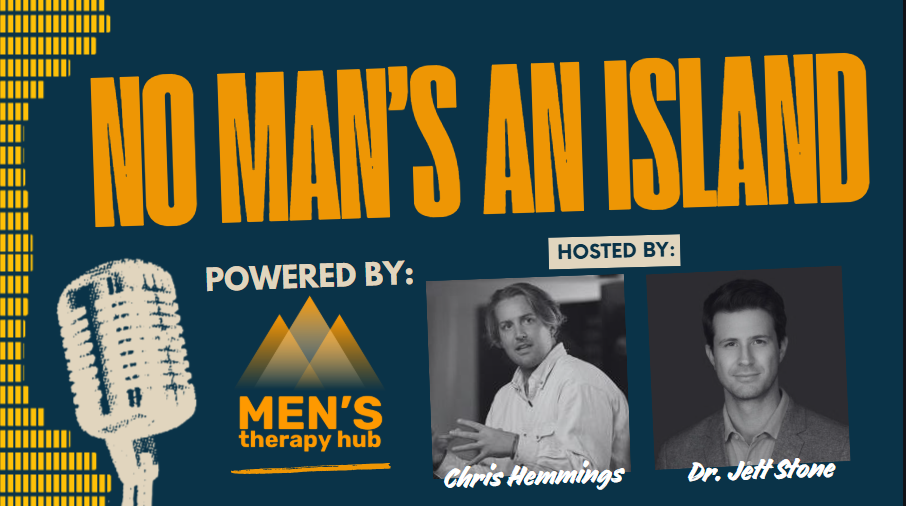
Episode 24 with Chris Hemmings and Dr Jett Stone
In this episode of No Man’s an Island, Chris Hemmings and Dr Jett Stone reflect on the growing influence of the Manosphere following the recent documentary by Louis Theroux. Rather than focusing only on the personalities featured in the film, the conversation explores the deeper cultural and psychological forces shaping the appeal of these online spaces.
For Chris, one of the most striking themes was the sense that many of the influencers portrayed in the documentary appear to be wounded men projecting their own insecurities outward. Social media platforms have created an environment where those wounds can be broadcast to millions, often in the form of provocative content that rewards outrage and controversy.
Jett agrees that the ideology itself is only part of the story. As therapists, he argues, it is more important to look at the underlying needs that drive young men toward these spaces in the first place. Boys and young men are searching for belonging, meaning and competence, and the Manosphere offers simple answers to complex emotional struggles.
The discussion also highlights how the online attention economy intensifies these dynamics. Algorithms reward the most extreme and emotionally charged content, creating echo chambers where young viewers are repeatedly exposed to the same messages about wealth, status and dominance.
Chris describes this dynamic as a digital version of schoolyard hierarchies. Just as teenagers once looked up to the older boys who seemed confident, successful and admired, young men online now encounter influencers presenting a hyper stylised version of success. The difference today is scale. Instead of a handful of older students in a playground, these figures reach millions of young viewers every day.
At the heart of the conversation is the distinction between belonging and fitting in. Drawing on research from Brené Brown and sociological work on masculinity, Jett explains that fitting in requires performing a version of yourself that you believe others will accept. Belonging, by contrast, allows a person to remain authentic without needing to conform. Many young men searching for belonging online instead end up trapped in cycles of performance and comparison.
Another major theme of the episode is misogyny and how it appears throughout Manosphere content. Both Chris and Jett argue that misogyny often grows from unresolved insecurity and resentment rather than confidence or strength. When young men feel excluded or powerless, blaming women can become a way of avoiding deeper emotional pain.
Chris also reflects on how these narratives are influencing behaviour in schools, where teachers are increasingly reporting misogynistic language and attitudes among younger boys. While these trends are worrying, both hosts emphasise that boys themselves should not be blamed. Children absorb the messages and cultural signals that surround them.
Towards the end of the episode, the conversation shifts toward solutions. Both Chris and Jett believe the most effective response lies in creating stronger communities and opportunities for young men to develop purpose and connection in the real world. That might include mentorship, youth programmes, community spaces or national service initiatives that give young people meaningful roles.
Chris also argues that the earlier these interventions happen, the better. By the time boys reach their late teens, many of the narratives about masculinity and success have already taken root. Helping boys build healthy identities earlier in life may be one of the most powerful ways to counter the pull of online echo chambers.
Ultimately, the episode asks a simple but important question. If the Manosphere is filling a gap for young men, what responsibility do communities, schools and institutions have to fill that gap in healthier ways?
What we cover
- The influence of the Manosphere and the Louis Theroux documentary
- Why wounded male identities can fuel online influencer culture
- The role of algorithms and the attention economy in spreading extreme content
- The psychological difference between belonging and fitting in
- Why young men are drawn to narratives about wealth and status
- The rise of misogynistic attitudes among some boys and teenagers
- The importance of mentorship and male role models
- Why purpose and community are essential for young men
Listen and watch
🎧 Listen to all episodes here: No Man’s an Island
🎥 YouTube: Watch on YouTube
🎧 Apple Podcasts: Listen on Apple Podcasts
🎧 Spotify: Listen on Spotify
Takeaways for men
Belonging is different from fitting in. Real belonging allows you to remain authentic rather than performing an identity for approval.
Social media rewards outrage and certainty, which is why extreme voices often travel further than thoughtful ones.
Young men searching for meaning are vulnerable to simple answers that promise status and success.
Healthy masculinity requires community, purpose and the freedom to fail and learn.
The responsibility for change does not sit with boys alone. Culture, institutions and adults all play a role.
Quotes to share
“We’re dealing with wounded men who now have platforms to project those wounds out into the world.” – Chris Hemmings
“These ideologies are symptoms of deeper unmet needs for belonging and purpose.” – Dr Jett Stone
“Fitting in requires a mask. Belonging allows you to be who you really are.” – Dr Jett Stone
“If young men feel they have no place in society, they will look for answers wherever they can find them.” – Chris Hemmings
Resources and links
Chris Hemmings
https://chrishemmings.co.uk
Dr Jett Stone
https://jettstonephd.com
Men’s Therapy Hub – Find a Male Therapist
https://menstherapyhub.co.uk/therapist/
Episode credits
Host: Chris Hemmings
Host: Dr Jett Stone
Produced by: Men’s Therapy Hub
Music: Raindear
TRANSCRIPT:
Chris (00:00)
Welcome to No Man’s an Island, podcast powered by Men’s Therapy Hub, a directory of male therapists for male clients. On this episode, Jett and I are going to be talking about the Manosphere because both of us this week have watched the documentary by Louis Theroux on Netflix. So I messaged Jett and said, hey, have you watched this? And he said, yeah. And he said, you should watch it too. And I reluctantly did because it felt a little bit like homework rather than pleasure.
And it wasn’t really a pleasure to watch it, but it was extremely interesting. And so, yeah, here we are. We’re going to just spend a bit of time talking about what came up for us as we watched it and what we think can be done, I guess, maybe in the long run. So, Jet, do want to start off with your initial thoughts? And I can gather mine because I wrote some notes while I was watching. So there’s a lot to get into.
Jett Stone (00:46)
Yeah, I wish I had written some notes when I was watching. Look, there was moments when you’re watching that and as a 41-year-old man, just putting the context out there, it’s very cringy. It’s almost painful to watch. then you’re watching some of these scenes of misogyny and ridiculousness and anti-Semitism.
Bigotry and you’re thinking to yourself. my gosh, it’s just so painful and the lingo but at the same time like I don’t I didn’t want to get too caught up in debunking every single Toxic ideology that was put forth in that documentary. I didn’t want to Get too deep into that because as we know, chatted a little bit about before we went live here is that these are symptoms of much bigger issues and I think it
behooves us as people in this space, as maybe we call ourselves elders in this space, as therapists, to think about what is going on more at the root of it. Because the only way you change it is if you think about the root, the context of it, the structures that make these characters in this documentary possible. And so usually I like to take a few, I like to have some sleep.
after I watch a documentary, like multiple nights of sleep before I come with any take. And so this is a bit of a hot take day for me. So it’s going to be new. I don’t love this, but I do. I think it’s a good exercise to just put forth what we think. So there’s so much there. What was your overarching take?
Chris (02:06)
Yeah.
It was interesting to watch this because for many years working in this space, I was aware of Jordan Peterson, Ruche V, the Pick Up Artist, like these kind of originators of what is now deemed to be the Manosphere. And back then I hadn’t done the psychological training that I’d done. Watching this, what was very clear to me was that we’re dealing here with wounded men. These are wounded men with an opportunity to…
to pump out continuous media streams. I mean, the HS Tiki Toki guy literally says in the challenging conversation with Louis 3, if you haven’t seen the documentary yet, I guess there’s gonna be spoilers. There’s gonna be spoilers, yeah. He literally says to camera with pride, I don’t edit anything that I say. It is just a constant stream of thought, right? And what we’re doing now.
Jett Stone (02:54)
Spoiler alert.
Chris (03:06)
is we have created platforms and situations for these wounded men to project their wounds out into the world. And so my grand narrative here about this is that what we are seeing is the mass dissemination of schoolyard bullying, which is when I was at school, there were always these lads who were two, three years older than us who would
You’d see them hooking up with the hot girls from the sixth form and you know, they would have like I remember this one guy had like a BMW M3 and as a 14 13 year old you would look up to these guys as if they were heroes and they’ve done nothing to earn that other than be older and richer and perhaps good-looking and as a 17 year old there’s no they haven’t earned that like in any way So what’s happening now is we’re living in a cultural time
Jett Stone (03:54)
Mm-hmm.
Chris (04:01)
where there’s a lot of men through no fault of their own that are experiencing arrested development, which means still living at home with parents, they’re struggling to get good paying jobs, they’re not able to get these mark, these traditional markers of esteem as easily as they once could. And then there are a few guys, just like there always are, there are a few guys who make it big. There are guys who are like one of the characters who was the son of an oil magnate.
or sorry, a steel magnate, not an oil magnate, right? Some of them who just started streaming very early and tapped into that zeitgeist and did well from it. And then what they’re doing is they’re saying to everybody else, well, I am superior because of that and you all must be like me. But the problem is, is these guys, as I said, are projecting high levels of insecurity and encouraging…
men who are feeling that level of insecurity. So of course, as a teenager, like it’s an appealing message. Because what do you want as a teenager more than anything? You want to be rich, you want to hook up with girls, and you want to have a nice car and a big house because at the time you think that that is the zenith, that is the peak of manhood. And unfortunately, because of the algorithm, the echo chamber happens and our content doesn’t reach
Jett Stone (05:05)
Mm-hmm.
Chris (05:21)
14-15 year olds most of our content is reaching 35 to 50 year olds
Jett Stone (05:26)
That’s right. And to add in there, this attention company, this attention economy that we’re all swimming in is different now because they leave school and they’re still in it. You know, over the weekends, their phone brings them to it. You’re talking about a story when you’re in high school, a similar version, right? In my experience in the US, in the Midwest, like we got, we had refuge ideally from the bullies, from the schoolyard.
Chris (05:41)
Yes.
Jett Stone (05:53)
bullies from the people who you know, stand at attention to and idealize, put on a pedestal, we’d come home and maybe we’d get some type of reality check. But because so much time is being spent and there’s numbers out there that are just shocking how much time are spent with inside what we’re calling the Manosphere, which is a very, you know, that’s a very wide net to cast. There’s so much that’s going on inside this online communities is that there’s like
little reprieve when you’re spending six hours a day, seven hours a day on it. You’re just getting funneled with these messages. And so there’s little reprieve from it. But I do, I think your take is, I agree with it. And for me as a therapist, I’m thinking of like, okay, these ideologies come and go, technology comes and goes. Like don’t know what’s gonna happen in the next iteration of, you know.
social media what that would look like but what i do know is the basic underlying longings and yearnings of young men and boys and humans but you know we’re taking a closer look at young men and boys are going to be the same and we have to look at what are those unmet yearnings for let’s say belonging orientation where you are in the world like where you’re headed meaning
Competence is a big one. You know you look at this documentary you say okay I can be competent if I make a shit ton of money and I have girls and I have all the accruements of fame and wealth And that is the way to do it right and they’re looking for shortcuts right these if you you watch documentary you’ll see like man like this is a like there’s a 13 year old who’s making more money than his parents like there’s like
You know, it is like a Ponzi scheme. What’s that? Right. But I’m just, they’re making, they’re selling it. The salesmanship is such that it makes it seem like this is, you can get all the things that I got, you know, as the, the alpha, if you just do these following things. And so, we are in a time where these belong, these yearnings are being met.
Chris (07:36)
No evidence for that though, by the way. There’s no evidence for that.
Jett Stone (08:02)
in these very superficial, like quick dopamine type of ways.
Chris (08:07)
Yeah.
The irony of that for me is that these guys are professing to have escaped the Andrew Tate rhetoric that they use in the film is the matrix, right? And the matrix would be working hard for the man, right? And all these guys are doing is replicating one-to-one what has been happening in kind of capitalism for a long time, which is the people at the top who are rich for…
Jett Stone (08:17)
Mm-hmm.
Chris (08:33)
various reasons look, privilege, some grafting and genuinely have earned it themselves, but then when they’ve done that they look down and say well if I can do it so can you. If only you work hard, if only you put in the time, if only, if if only, if only, and then you’ll be happy.
Jett Stone (08:50)
Mm-hmm so generous right so generous to offer these skills to these I’m being sarcastic here Like so generous of them to offer these skills and pass it down To the younger generation right it has the guise of being Magnanimous and generous
Chris (08:56)
Yeah.
Yes.
Right.
And yet what they’re doing is they’re saying, pay me $50 a month and I will show you how to get rich. And all that’s doing is making them richer so they can prove that it works and sell more of their content. And it is the pyramid scheme. It is the Ponzi scheme. The guy at the top is selling coaching to the guy on the second tier.
Jett Stone (09:13)
Right.
Chris (09:30)
who was then selling coaching to the guy on the third tier, who was then selling coaching. And at some point there’s most of the guys at the bottom. You know that kid who moved to Miami and he’s homeless, right? He was living homeless for a while because he’s so desperate to make it and he refuses to work within a system. And it’s like, yeah, do you know what? I will agree as somebody who’s been self-employed slash freelance for most of his adult life, that working for bosses is crap most of the time.
Jett Stone (09:38)
Mm-hmm.
Very sad.
Chris (09:58)
I didn’t like working for other people. But the solution is not to disavow everything around you. it was so interesting that there’s two men in it that they happen to bump into one of the guys who is the Steel Magnet guy. And they’re like huge fans of his. And you can see that these guys are incredibly insecure. They were…
Jett Stone (10:12)
Mm-hmm.
Chris (10:22)
the way that they were stood, the way that they were talking, the way that they were even talking about their own lives, they weren’t proud of who they were. The thing that they were proud of is that they weren’t giving up. And I’m like, do you know what? Respect to them for that. But what are the chances that you’re gonna end up like him? It’s so minimal. And yet what they’re saying is if I don’t do it, then I’m a failure. And that’s the saddest bit for me is if I, and I’ve heard lads in school say this to me, like one lad put his hand up once and say,
Jett Stone (10:35)
Mm-hmm.
Yes.
Chris (10:50)
I made 7,000 pounds on investing recently. So why should I listen to you? And I was like, you don’t have to listen to me. But what happens one day if the markets crash, right? And you lose all your money. Does that mean that you’re a failure? Because that’s the challenge here, I think for lot of men is what if you don’t make it big? What if you don’t become a millionaire? Like the vast majority of us aren’t going to. What happens then? What do you do then?
Jett Stone (11:16)
Mm-hmm.
Chris (11:19)
Are you a failure? Because I don’t think you are, but you might think you are, and then you’re trapped in that narrative.
Jett Stone (11:26)
And it’s no surprise that even those who have made it big have had numerous legal issues that are just bearing down on them. The car crashes, the Tate brothers. Like, they have these very… They have stories that include legal problems that at any moment could tear down the entire castle that they’ve built.
And when you press on that, and when Louis Thoreau pressed on that in the documentary about, I think it was HS’s car accident, you could see, ⁓ my gosh, when you touch on the shame, that’s when you go big. So when you touch on the one down part of the person, they go one up. And the irony of it is that part of the Manusphere culture is, we can…
Chris (11:55)
Yes.
The defensiveness. Yeah. Yeah.
Jett Stone (12:12)
You know, be free willing and talk about anything. We’re unfiltered, right? We’re not like sort of the left, let’s say, who are so censored and so over policed and protected. We can talk about anything. And you’re like, all right, well, let’s talk about this very real legal case that’s happening. And then you can see the rage build up in HS towards documentarian, which is the irony of it. It’s they’re saying that they’re unfiltered.
Chris (12:19)
Yeah.
Jett Stone (12:38)
almost as a defensive function against vulnerability. I can talk about anything unless you talk about the very thing, right, of how small I feel and how fragile I actually am.
Chris (12:41)
And yeah. Yeah.
Right, and that’s it. It’s this sense of everything in their life was incredibly controlled. And so the guy who does the Fresh and Fit podcast, when the conversation is happening with his girlfriend and suddenly she starts to express something that he deems to be unacceptable to express, he shuts down the conversation. very smart of him, he gives her the dog and says, take the dog out, right? And then he also bans…
Louis, the, the, reception, his receptionist from speaking to Louis Theroux, uh, his, his booker, sorry. And it’s all very controlled. And then what you’re talking about there is as soon as somebody with the skills of Louis Theroux, and I will say this, it was, it was a slight shame for me that Louis Theroux clearly hadn’t done more research into male socialization and masculinity, but he’s just very skilled at the way he makes a documentary and he’s very good at just poking.
and then standing back and then just going, that seems to have challenged you. Why is that? You know, he doesn’t keep pushing on it, like aggressively. And as soon as the mask goes anywhere near slipping from these guys, they fight back. And what they do is they automatically then come over the top, you know, and belittle everybody else because to them, the only thing that is acceptable is that they are superior.
Jett Stone (14:03)
Mm-hmm.
That’s right.
Chris (14:11)
And so I have an anecdote here, which I actually have told to a few of my clients, which was… And the reason I say this is because one thing that was noticeable throughout this whole documentary was these guys weren’t smiling. These guys weren’t having fun. These guys were showing zero emotion, right? And so a few years ago, I went to a B-Thur on a stag do, and I’ll be taking no further questions about that, I went to…
Jett Stone (14:35)
Could you translate that to a US audience?
Chris (14:38)
I went to Ibiza, which would be the equivalent of your like, yes, it would be like your spring break, you know, going to Miami or whatever, right? It’s like party central. And we went there on a bachelor party, a stag do, right? And we were at a beach club during the middle of the day. And for those of us of a certain vintage, there was a guy called Pete Tong who just came on and started DJing. And it wasn’t…
Jett Stone (14:40)
⁓ a beezer. A beezer. Okay, fine. Okay.
Sure. ⁓ huh, okay.
Mm-hmm, got it.
Chris (15:06)
planned, like we didn’t know it was gonna happen. So me and my friends were just like, fuck yeah, okay, we just get this like random Pete Tong DJ gig in middle of the day. So we’re all dancing, right? And there’s us and a load of women are dancing. And because of who I am and how I operate, I’m very often in research mode. I’m looking around the edge of the dance floor, right? What was happening on the edge of the dance floor yet? Can you guess?
Jett Stone (15:29)
Mm-hmm.
There were some very like still faced, sunglass wearing, hard asses.
Chris (15:39)
Yes.
Yes. There was a load of men stood there pretending to not have fun. Right? So I go over to a couple of these guys and I’m like dancing over like, hey man, how you doing? Like, yeah, yeah, fine. Like, okay. Are you having a good time? Yeah. And I’m like, okay. Go over to the next guy. you’re having, and it’s just like, they were specifically trying to make it seem like they weren’t having fun because that would also risk the mask slipping.
And so these guys, and that’s what a lot of these men we were seeing, it’s this, they were very stiff, right? They were all very tense on edge. And they’re all standing there and they don’t want to show that they’re enjoying their life. And it’s like, you have all of this and you’re still not actually showing people that you’re enjoying it. You’re showing them the trappings of the success, but you’re not driving around listening to music, singing in your expensive car, right? You’re not dancing in your amazing house.
Jett Stone (16:14)
You’re right. You’re right.
Mm-hmm.
Chris (16:36)
You’re sitting there very stiff, very rigid and refusing to show the world anything other than neutral. And I think that’s so sad.
Jett Stone (16:44)
It’s a,
it is sad. It’s a good, it’s an astute point because when we, when, when you talk about masculinity rigidified, right? When, when it becomes stiff, it’s not just psychological. It becomes in the posture that you take to the world. And it’s, it just goes to show like masculinity gone awry. The most rigid, rigid form, rigid, rigid forms of it are.
Like they don’t make for a good life actually, right? That beneath that veneer of keeping it together, it doesn’t build genuine relationships, right? There’s a big cost. There’s a big cost to it. it’s really hard to see when you see that guy. I think Justin was his name. He was the success coach, right? He was the one who was in like a three-piece suit and the steel guy.
Chris (17:35)
Yeah, he’s the oil, sorry, he’s the steel guy.
Jett Stone (17:39)
It was even more disappointing to watch him because you know some of these guys are in their early 20s And I’m not you know making excuses like For any of them, but this guy seems like he’s closer to his 40s. He’s got he’s got two daughters They ask how many kids do you have and he kind of does the cool thing? I don’t know. I’m you know like and then Louis Thoreau push it right It’s just it feels even That rigid form of masculinity feels even more like upsetting
Chris (17:59)
Yeah, it’s at two. Yeah.
Jett Stone (18:09)
to me because he should know better at this point. And I think he knows what he’s peddling. And it’s, quite sad. I actually think if we could turn like shift this conversation to the, to the wounds that you talked about, like the traumas, the, and one of the things I don’t want to forget is that part of this documentary, he had pointed out or at least tried to in so much as you can in an hour and a half of a documentary, the,
Chris (18:10)
Hmm.
Jett Stone (18:36)
just the backgrounds, the childhood, the upbringings of these influencers and how many of them were raised in single parent families. And I just want to say as a disclaimer, I don’t appreciate that aspect of this vacuum. It makes it seem like fatherlessness is kind of like the driving cause of why these guys have turned out the way that they have and why they do what they do. And
Chris (18:46)
Mm.
Jett Stone (19:01)
I just want to put that out there that I think it’s more about father figures more broadly and male figures. Good guys, good elder male elders in their life. To me, that’s the way that I’m, I always frame it. That’s not about literal fathers. Although that’s helpful. It’s much more about having elder male figures. They can help talk about these things that we’re talking about. What is success? Right.
Chris (19:10)
Mm.
Jett Stone (19:28)
What do you do to build a life worth living? So I just want to put that out there because there is a wounded aspect of it. A lot of these influences grew up with very violent fathers or absent fathers. And I just wonder.
Chris (19:40)
Yeah. Of
violent mothers, one of them too. Like it’s just violence per se, in which they probably felt, and I hate this word, but they probably felt emasculated. And so now they perhaps doth protest too much. You know? And it makes me think about the episode that I recorded with Armour, the East London rapper that we had on. And he talked about just how many of the young lads that were in the street culture, he never used the term gang, so I’m reluctant to use it.
Jett Stone (19:44)
Right. Yes.
Mm-hmm. Mm-hmm.
Chris (20:08)
in the street culture and the environment that he was in. How many of them actually did have absent fathers?
Less than that though, was that what comes with that is a search for affinity, right? And where do you find affinity as a young lad? Again, it’s the same as me looking up to the guy three years above me in school. I think he’s cool, he’s got what I want, so I’m gonna try and be like him. I’m gonna try and walk like him. I’m gonna use the language that he does. If he’s at a party and he’s taking drugs, well then that must be cool, so I should do it too, right?
Same with drinking alcohol, same with smoking cigarettes, same with being misogynistic, same with being anti-semitic, same with being racist and all of these things that were in it. A lot of these men, because it was very telling with the fresh and fit guy, his girlfriend said, this is his on-camera persona. When he’s off-camera, he’s very different. And it’s like, of course he is. He can’t be like this all the time. So he knows that this is a way to tap into the insecurities of young men.
Because think how, remember how defensive the H.S. Tiki-Toki got when it was like your main audience is like 14, 15 year old boys? No, it’s not, no, it’s not, no, it’s not like, well, of course it is. That is the main audience for this kind of material because a lot of guys, I would hope, once they get past kind of 25, 30, would start to come out of it. But…
Jett Stone (21:19)
Mm-hmm.
Chris (21:34)
Sina said something, my wife said something really smart, she watched it with me, which is when you’re looking at these guys, right? What you’re seeing is a lot of guys who all they want is belonging. You mentioned it before. All they want is belonging. All they want to do is try and fit in and they’re doing it via any means necessary. And what they’re doing is they’re meeting each other eye to eye with, I’m anxious.
Jett Stone (21:50)
Hmm.
Mm-hmm.
Chris (22:00)
I’m nervous, I’m unsure of myself, I’m going to pretend that I’m not, you can do that too. Because that’s the quote, easier solution. When actually we know as therapists that that is not the easier solution. That is the much more difficult, but to do that work to break free of that, and I used to say this in schools, is the single most difficult thing you’ll ever do in your life is start to live a life that is congruent to live a life that is in line with how you actually think and feel and believe not.
Jett Stone (22:09)
Yes.
Chris (22:27)
what is expected of you.
Jett Stone (22:29)
Yes, and in the interview that I did with Brendan Kwiatkowski, the sociologist, who’s really masculine, he was talking about belonging and fitting in and how Brene Brown’s definition of it is that they’re opposites, you know, and that in the attempt to quench the thirst of belonging, they end up fitting in, meaning this gets to the point
Chris (22:51)
Yes.
Jett Stone (22:54)
You’re talking about a congruence and no one’s pointing that out to them that fitting in takes a lot out of you. It’s very inauthentic. You’re having to put a false self out there and try to jam it into something. And belonging is much different. It’s your nervous system is at rest. You’re at peace. And that’s what these kids are striving for. And so were we all.
Chris (23:18)
Mm.
Jett Stone (23:19)
at that age. That’s why it’s like the consumers, it’s very hard to point a finger. ⁓ absolutely. Just in a more, you know, just in a different way, in different communities.
Chris (23:22)
and still are sometimes. It never goes away.
But just to kind of speak to that, like even here now, because there’s a clip going around of Louis Theroux speaking to guy called Ramesh Ranganathan, a British comedian, and he’s saying that Andrew Tate refused to engage with him, and Andrew Tate was showing him his Google search graph, basically, and saying, I’m more relevant than you, right? I have launched Men’s Therapy Hub. Every day I check how many impressions have we got.
Jett Stone (23:45)
Yeah, I saw that too.
Mm-hmm.
Chris (23:55)
Like how many downloads of this podcast are there? And on days where like yesterday we had like 16 downloads of the podcast so far today there’s been zero and I still have to fight that like why am I checking? Sure, but like why but why am I checking? Right? Why am I checking? What does it mean to me? Does it matter actually? Or am I doing this with you because I like this? Right? Do you know but
Jett Stone (24:06)
It’s still the morning, okay, Chris? And your time, Right, yep, metrics.
Chris (24:22)
Which the answer to that is yes, I’m doing this because I enjoy it and I enjoy making content as a former radio journalist. It’s nice to flex those skills. But it’s also we are still all part of this comparison culture. And again, these guys, I hate to say it, they are fantastic at harnessing that. It’s the only fans models that they spend time with. It’s the Fresh and Fit podcast where they get like five women in.
And these women are allowing themselves to be ridiculed and rinsed in the old Mancunian the terminology. He fucking rinsed you. Like he’s rinsing them, he’s ridiculing them and they’re happy to do it because it’s going to increase their visibility. And so they are also part of this ecosystem. And they are also, by the way, part of their own ecosystem of women. Because here’s a bit that was really interesting to me was
Jett Stone (25:00)
Mm-hmm.
Yes.
Chris (25:16)
On the Fresh and Fit podcast, one of these women was saying that she wants a guy who’s over six foot, who owns more than 300K, like all of these, and he, I don’t know where his calculator comes from, but it showed that 0.02 % of men. And actually he is making a good point there, just in a brutally misogynistic and cruel way, which is a lot of women have been miss-sold what a man can and should be. And so they kind of fuel each other’s fires.
Jett Stone (25:42)
Yes.
Chris (25:42)
And
Sina again made this point, is, because I was like, they’re doing this to try to boost, like, this is not good for women. And Sina was like, yeah, but all of these people are trying to get the attention of young men. All of these, like the guy who is showing off his lifestyle and the women who are the models and OnlyFans models, they’re all chasing the same book from the same guy. And so these young guys are getting it from both sides now.
Jett Stone (25:54)
Mm-hmm.
Chris (26:07)
They’ve got these women convincing them that the only sort of man that they want is rich. And then these rich guys saying, I’m the guy that gets all the women. it’s a lot.
Jett Stone (26:07)
Mm-hmm.
Yes, it’s
a fight for attention.
When we think about fixes, even saying that sounds ridiculous because it’s like, you know, we’re not going to bring a hammer and nail to this and, you know, patch this thing up. But these big tech companies that build the infrastructure and the algorithms like have to have some type of responsibility. You know, I’m, I don’t know enough to say exactly what to do, but there has to be something because
Chris (26:28)
Good luck with that. ⁓
Jett Stone (26:50)
They are billions and billions of dollars are put into, you know, funneling this content out. And my algorithm is so like addicting, right? It feeds me exactly what I’m interested in. It knows exactly what’s going on. And all of us are subject to it. You’re not wrong, actually. And, but you’re right, but you were talking about the metrics.
Chris (27:08)
So it’s just hockey and therapy the whole time.
Jett Stone (27:14)
too. And that is something that is also like very addicting. And you know, the old, it doesn’t matter how old you are, it’s going to capture your attention. And so I guess in a way I’m trying to understand and sympathize with the young men out there who are watching these guys. And you’re right, there’s some truth to what that there, there’s some
Chris (27:19)
Mm-hmm.
Jett Stone (27:41)
kernels of truth there. Like even, you know, there’s a, there’s a prevailing theme throughout that has a kernel’s truth to it. And it’s that these young men who are wounded, who are arrested development, as you say, like they all are being fed this idea. You, you were born as a male with no value. Whereas girls were born inherently with value because of
Chris (28:06)
Yes.
Jett Stone (28:10)
their bodies and the way that they look. And there’s some truth to that in the sense that, you know, this is talked about a lot in male psychology, but masculinity, being a man is hard earned and easily lost. It’s precarious. And that like, as a young man, you constantly have to go out there and pound the pavement in order to be lovable, in order to be worthy. And there is, that’s…
Chris (28:25)
Yes.
Jett Stone (28:36)
Socialization that’s psychological right? That’s not some objective truth Right there could be there’s many parents out there who raised their sons to feel like they’re worthy For being alive, but I think they’re taking that psychological truth of How so many boys are socialized and they’re using it? To monetize their Enterprises and whatever the hell they’re doing saying
Chris (28:58)
Mm.
Jett Stone (29:02)
You’re not born with worth. You have to earn it. You have to work hard. That guy, whatever, Justin was like, if I lose everything, I’m going to be back to like, know, hang and steal. Right? So he’s carrying this mentality of like, I may lose everything. I may lose my sense of self, my worth, but like a man should, I’m going to rebuild it. And you’re nothing unless you can erect your own empire.
Chris (29:27)
Yeah.
Jett Stone (29:28)
And I don’t know, that was interesting to me because it touched upon something real, but it’s being used as a bludgeon in some ways to say, like, you can be rich and, you know, drive a Lamborghini like me. It’s…
That was an interesting element of this. I wonder what you think about that.
Chris (29:47)
Yeah, I’ve thought a lot about this based on some personal experience of mine where I lost a lot of the esteem of my colleagues a few years ago. It was actually five years ago this week, interestingly. And I was training to be a therapist at the time. And so of course I was seeing it all through a very interesting lens. And what I recognized was I, and I took this message into schools because a lot of the challenge from young lads is just like, I just want to be rich.
I’m going to be rich one day, so it doesn’t matter. I don’t need any of this. don’t need… I’m going to get a hot wife because I’m going to be rich.” And it’s like, okay, they don’t care about the research about like… And actually there’s an episode coming up with Christian Schalfont who works with High Value Men. And literally the clip in the opener is these guys get everything that they want in terms of their financial success and then they realize that it’s empty and hollow and it doesn’t bring…
You know, how many wealthy old men are with wives who despise them and they’re not close with them or their kids and they haven’t spent any time with them. Anyway, I digress. So how I used to describe it was, I was sitting on this lovely rug, right? And this rug had all of my medals and trophies from when I was a decent sportsman, which is a long time ago now. All of my, look how many Twitter followers I have. Look at these documentaries that I’ve made.
Look at these gongs and ribbons and fancy things and the fact that I am making a success in the journalism. I have a book out, like wow. And you know, all of these are building my esteem, right? My self-esteem boosting, which was great, but the one problem with that is that all of that can be taken away in a moment. And if you haven’t developed a sense of self-worth underneath it,
you will fall into a pit of despair. And I did, I fell into a pit of despair. And that despair was, I didn’t believe that I was worthy of love and care and attention unless I’d earned it, right? Of course I had, and I’ve spoken about this before, I had the emotional privilege of a lot of my friends actually telling me very quickly, no, that’s not true. We’re here for you no matter what. You know, I think about my friend Lauren and she was like,
Jett Stone (31:42)
Mm-hmm.
Chris (31:56)
when I was really, really low, she was like, if I don’t hear from you every day, I’m gonna call around to find you. And one day she did. And it’s like, okay, my friends showed me that I’m worthy of that, even though right now I’m useless to them, right? But a lot of these guys don’t believe that. also, so what happens to fresh and fit if the internet goes down? What if the internet stops existing, right? Does he have inherent self-worth?
Jett Stone (32:08)
Yes.
Chris (32:25)
that he is still valuable, that he is still worthy of love and care. And does he even believe now that he’s worthy of love and care or just that he has to earn it? Because actually what those two lads said, very specifically, is that we have nothing. When we’re born as men, we have nothing. We have to earn it all. And it’s kind of like self-fulfilling victimhood. It is this self-fulfilling notion of, I’m not monetarily valuable, then I am of no value.
Jett Stone (32:42)
Mm-hmm.
Chris (32:55)
And what my therapist said to me at the time was, when you were born, did your parents say to you, how many Twitter followers does this baby have? Is this baby smart? Is this baby attractive? Has this baby shag loads of birds? Like has this, do know what I mean? No, they don’t. They say, this baby has worth merely for the fact that it’s human. And the biggest challenge for us as humans is to remember that that doesn’t go away.
Jett Stone (33:21)
Yes, the difference between inside out versus outside in esteem. Like inside out comes from within, right? No matter what happens in the external world, you can lose all your ex followers or you lose all of the, you know, lose all the fame, but you still see yourself as a worthy individual, someone who’s capable and deserving of love.
Chris (33:26)
Explain.
Hmm.
Jett Stone (33:47)
That’s inside out self-esteem. Outside in self-esteem is when your sense of self-worth is hitched to how many followers you have and how much money you make and how much attention you’re garnering in the attention economy. Your metrics. And we can all fall into that trap. we’re not, you know, I’m not talking here from a pedestal either. Like I can feel myself getting
Chris (33:49)
Yes.
Yes. Yes.
Jett Stone (34:14)
pulled into that, which is why I have such an ambivalent relationship to social media, because it’s so alluring. It gives me what I want. learn, legitimately, learn so much from people on it. At the same time, it also burns me out at the end of the day. But to go back, it’s like, OK, this fresh and fit guy, what is his name? Myron.
Chris (34:23)
Mm.
Myron, yeah.
Jett Stone (34:39)
What happens if the internet goes down? Which kind of sounds funny because as if there’s like some guy with a plug who could like trip over it and you know, in the server room and the next thing you know, you know, we don’t got internet. But let’s say, yeah, let’s say there is something that happens. Developing that inside out self-esteem is so difficult. It’s not like this easy project where you go to a therapy session, a therapist says something, then you walk out and suddenly you’re…
It’s very hard when you weren’t raised in an environment to be made to feel like you’re worthy of love. And a lot of it does come down to, you know, parenting, of course, we could always talk about that, but we could talk forever about parenting and attachment, but also the company that you keep. I don’t even, that’s maybe a bad word, the friendships that you keep. You you talked about it. You had, was it Catherine or sorry, Kathleen that you mentioned, who was like, I’m going to call you and find you. So I’m sorry, Lauren, okay.
Chris (35:28)
Lauren. Yeah. Yeah.
Jett Stone (35:30)
calling me
that name up. So you need friends like Lauren who will track you down. And that’s another form of attachment to Billbitt.
Chris (35:38)
I ⁓ was
just having a walk without my phone, but she found me, you know?
Jett Stone (35:43)
Yes. Well, you make
a point because all the moments where I’ve disconnected from technology are the moments where I’ve needed it the most. So, yes, it’s very hard to do. That’s maybe a whole nother podcast, but…
Yeah, I wonder when I watch that documentary, like, what is the 10 years later documentary gonna be? know, Louis Thoreau, he’ll be a little grayer and he’ll have the same kind of, you know, documentary style, but it’s gonna be a follow-up. Where are they now? I mean, look at child stars. Where are they now? It’s always, it’s never a, I mean, sometimes it’s a good story about where child actors end up, but oftentimes it is kind of sad.
Chris (36:01)
about those same guys. Yeah.
Yeah, it’s interesting.
Yeah.
Yeah. I think it would be remiss of us not to touch on the misogyny within it. ⁓ Because this was the part of it to me which was like the yeah, duh part, right? Which is the problem here for me is a lot of the grievances of these men, a lot of the challenges these men talk about, there is some truth within them, right?
Jett Stone (36:28)
Mm-hmm.
Chris (36:50)
Of course there was like the blatant misinformation, like the guy who was saying that sperm DNA can stay in a woman for years after, like just absurd that people would even believe that. I don’t think that they do believe it, but it just creates conversation. throughout this, there was a load of men who, and I wrote down every single one of them at some point said, I love women.
Jett Stone (37:15)
Mm-hmm.
Chris (37:15)
Right? And they also said, I love Jews. But they would also say, fuck the Jews at the same time. So it’s interesting. But then what they would say was, I love women and I love them so much. I know what’s best for them and I will speak for them and I will choose what’s best for us as a couple. And I will choose how I want things to be. You know, he even said at some point, like, if I wanna, and I’m paraphrasing here.
Jett Stone (37:22)
Mm-hmm.
Chris (37:42)
If I want to have sex, we’ll do it. And then when he was called on that, he was like, I mean, I don’t mean that literally. It’s just that she needs to know when I want it. like, all very, very, yeah, be assertive, which is fine. Again, like there’s nothing wrong with being assertive, but there is something wrong with being coercive, right? The interesting thing about it for me was, so two things. First of all, the H.S. Tiki-Toki, the only person that he was frightened of in the entire film was his mom.
Jett Stone (37:51)
Be assertive. ⁓
Chris (38:11)
His mom ruled over him. You could see that, right? He didn’t want to upset her. He did do at times, but he didn’t want to. But then it was this, love women, but the only way that they could have women in their life is if these women were, it was made very clear. Like H.S. Taki Tiki Taki introduced his girlfriend as, here’s my dishwasher. Which is like, ha ha ha ha. Like that’s the oldest misogyny joke, right?
That is the oldest joke for like a patriarchal man to make.
And it just was really interesting because that is blatant, but it’s also sometimes subtle. This message, it percolates through everything that they’re doing. And it’s this, and I think the one place where I would have liked, I almost would like a documentary mirror of that, where Louis Theroux goes into schools and meets kids and meets the women who are, the female teachers who are experiencing it on the ground.
Jett Stone (39:07)
Mm-hmm.
Chris (39:09)
who meets the young boys who are, know, imbibing all of this information. Because there’s a really famous clip where a influencer, and I can’t remember his name now, is on the street. I think it might be Sneako. And these boys come up to him going, yeah, fuck women, fuck women, yeah, women are fucking slags and whatever. And he goes, my God, what have I done? He’s like, no, no, no, no, no, that’s not what I think. And it’s like, no, but that is what you’ve said repeatedly.
Maybe not directly, but that is the message that is trickling through. So I think it missed a trick by not showing the impact of this because the impact is very real.
The impact is happening right now. And it is happening in schools where we’ve got Dr. Sophie King Hill on next week’s podcast. And even though she is absolutely vehemently like, don’t blame boys, don’t blame boys, this is not boys’ fault. She’s also saying teachers being pinned up against walls and corridors by groups of boys because they now feel emboldened to do that in part because of this. That to me is what’s so interesting because…
Jett Stone (40:10)
Yeah.
Chris (40:14)
Matt Pinkett talked about it as well in his episode. Unfortunately, misogyny is on the rise again. I remember being at school, I remember being at school and there were two girls schools down the road. We were friends with them. Of course there was like low level banter misogyny, which wasn’t okay, but to the level that it’s happening now, it has been re-emboldened and these guys are doing it and they don’t care. That’s what’s so sad about it. They don’t care. It was always my issue with Jordan Peterson is,
Jett Stone (40:20)
Yeah, Gen Z.
Chris (40:44)
The incel culture really picked up on Jordan Peterson. And when Jordan Peterson was challenged on that, he said, that’s not my fault. That’s up to them to make that. It’s like, if a guy listens to this podcast and comes out thinking that antisemitism is okay, then you and I need to rethink our messaging. I take responsibility for that. But these guys are just like, it’s not my problem, not my responsibility. But then whose is it?
Jett Stone (41:00)
That’s right.
I worry myself having two daughters, you know, about the effect of misogyny just downstream in their lives. Part of the reason I do the work that I do, you know, thinking, writing, working with lot of men in therapy is because I’m thinking about the future and Gen Z is our future and I think that they hold
much more parochial, patriarchal type of views about the world. And that showed up in this documentary. It’s like, if that’s what’s being peddled out there, it’s terrible. And I think, you know, they try to qualify it, as you say. I love women. That’s a dangerous start to anything. Right? Not all. Right? Not all. It’s a way, it’s kind of a saying, okay, well,
Chris (41:46)
Yeah, I’m not racist, but…
Jett Stone (41:53)
I prefaced it with that, so everything else that I say is now safe. And it’s just gross. I’m looking to hear from the women who watch it. think that’s also would be really interesting to hear their viewpoints on it. And maybe we could do an interview further down the line on what people think about, what women think about this documentary. But it’s just like, it doesn’t bode well.
the future and it means that we as elder men who are in this space is like we’re not we’re not doing enough or we haven’t done enough something is broken and again i’m coming back to like so what do we do you know we can build the things to to put other messages out there that can counter the misogynistic messages but like what do you think like what’s you know what’s
the action that we can take that can have the biggest impact to change this course of misogyny on the rise. Like, do you have a sense of that or are you still like…
Chris (42:50)
Unfortunately to me the answer is always the same and it is actually in your interview that I just edited with Dr. Audra Horny, which is coming out in a few weeks. You said we should make a list of all of the, if you had the keys to the vault answers. Because the lion’s share of them have been working with young people, giving them purpose, giving them community, reopening community centers.
Jett Stone (43:04)
Yeah.
Yeah.
Chris (43:14)
reopening youth clubs, going into schools and giving these boys opportunities to talk about the realities of what they’re experiencing. Because again, I have this kind of mantra, like if you get these boys one-on-one, they don’t think like this. It is a herd mentality, right? It is this, I believe that everybody else believes this, so therefore I’m going to pretend like I believe it. And over time, that becomes your reality, right? The split.
becomes real. You know, we split in terms of, there’s a part of me that believes this and there’s a part of me that doesn’t, but I have to show the world a part of me that believes it. But then the part of me that is showing the world that I believe it, that becomes my reality because I do it all the time and I lose sense of who I really am. And so how do we create spaces where people can be who they really are? And that doesn’t happen online.
Jett Stone (44:08)
Yeah.
Chris (44:08)
So
actually it is why actually I am reluctantly in favor of a ban on social media for under 16s. Like I am reluctantly in favor of it because you learn how to be in the world, you learn how to socialize, you learn how to talk with girls even though it was the most terrifying thing in the world to me. I still tried it at times, right? Failed miserably until like my early 20s really, right? But tried.
Jett Stone (44:19)
Mm-hmm.
Chris (44:37)
and failed and learned how to fail and learned that failure was okay and learned that rejection didn’t mean it was the end of the world. But now young men are so frightened of all of that that they would rather present a false narrative of themselves. You know, they would rather actually have all the trappings that would bring women and girls into their life depending on their age, but then actually not do anything with that information because they’re too scared to do it.
And so how can we create spaces for young boys to fail, make mistakes, be vulnerable, be a mess, you know? Scott Galloway’s like, you know, go back to the pub and drink a few beers and make some bad decisions. I don’t agree with a lot, with some of what Scott says, but I agree with that. Like, it’s a big loss to culture.
Jett Stone (45:20)
Yeah,
I agree with some of it. you know, V, if you had the keys to the vault, what would you do? You know, a lot of them do carry that theme of like going, reaching that younger generation. I think that I’m a big proponent of national service. ⁓ Well, I did AmeriCorps, right? When I was feeling lost when I was a younger person, I did a
Chris (45:38)
Okay, interesting.
Jett Stone (45:46)
a national service program called AmeriCorps, which is basically you get, you tell this organization, federal government organization, the skills that you have. I was a talented writer, or least I thought I was. I was an English major. I read it and thought, you know, and so was like, okay, how can I use this specific skill in the service of something bigger? So I became a grant writer for poverty organizations for a year. I worked for a nonprofit and basically wrote grants.
helping people build food banks and things like that. And so that gave me a great source of meaning. Like I was doing something, I was a little too sedentary, honestly. I kind of wanted to be a little more out there in the world. But regardless, we need a draft. And before that gets clipped in a bad way, I don’t mean a military draft. Although I think the military is a great option for so many young men. For some, exactly.
Chris (46:34)
For some. Yes.
Yes.
Jett Stone (46:36)
But we need
a draft for something that’s bigger, for many more social service type programs. It’s almost like a we want you, you know that Uncle Sam icon, but it needs to be updated and diversified to say, we need you building solar panels. We need you, you know, fighting authoritarianism. We need you standing up for something. We need you to, you know, go out there and help, you know,
Chris (46:45)
Mm.
Jett Stone (47:03)
teach young men how to work with cars and how to build. There’s so many things that our country needs, our world needs, being very US-centric here, but you get what I’m saying. that if we can… The narcissism is just… We should enlist only Americans, none of you Europeans. But I do think that when you give a young man a cause,
Chris (47:13)
Mm.
Shocking, shocking for an American.
Jett Stone (47:29)
you are indirectly addressing misogyny and antisemitism. Lonely, broke, young men fall back on misogyny and antisemitism always gets thrown in there. Disgusting, but it does. It’s almost like the last remaining thing that you can get away with when it comes to the isms. And that’s a sign that something’s broken. And so I think if you give people
that maybe we don’t have the same energy that we did in World War II when there was this, when there’s like a Hitler out there and it’s so completely obvious that Poland isn’t yet being taken over. Yes, there’s a lot of war happening out there, but there isn’t this sort of collective agreement that we need to band together and do something like there was during that time. And I just think young men need that, need to…
to find that and however that happens, it happens. And that is going to address these things we’re talking about, like misogyny.
Chris (48:25)
I think
that’s interesting. guess my pushback on that would be that by the time we get to an age where that would happen, say 18, 21, even 16, the horse has bolted by that point, right? The gate has been left wide open. And that’s where I would think this needs to happen, something at a much earlier age. Yeah, even younger than that, because I’ve used the statistic before.
Jett Stone (48:47)
okay, even younger than that, huh.
Chris (48:53)
There are more 12 year old boys in the UK at the moment that have a smartphone that live at home with their dad. The access to mass media, I was walking down the street here the other day and I saw an eight year old girl with a phone in her back pocket and it was just, what is, That is, I mean, I’m guessing that she was eight. I didn’t ask, but she looked about eight.
Jett Stone (49:09)
Mm-hmm.
She wouldn’t have had an ID anyway.
Chris (49:15)
Right, and yet she does have a smartphone. And she had a nicer smartphone than me, I might add, right? And yeah, we’ve still got an iPhone 14, it’s still going strong. Yeah, yeah, it’s still going strong. See, a bit of one-upsmanship there, Jett, we can’t get away from it. yeah, oh, well, that means you’re more successful than me, clearly. But to me, it’s about getting them early.
Jett Stone (49:17)
Right?
What are you working with?
Ah, okay, I’m 15, so.
Yeah, 15 pro, 15 pro. One day, one day Chris.
Chris (49:42)
And at the moment we’re losing them too early. We’re losing them to this narrative too early because the opportunity to pick up the phone and hear these guys that we’re talking about to bring it back is just too easy now. It’s too simple. And the social media companies don’t give a shit what you’re watching as long as you’re watching, as long as you’re staying on their platform, as long as you’re watching something.
Jett Stone (50:07)
Mm-hmm.
Chris (50:08)
and hateful narrative. I mean, these guys literally said it, right? The guy at the end just said that if he had made content that was good-natured, I’m paraphrasing, he wouldn’t be as successful as he is. He wouldn’t have gone viral. So he knows that you have to scream, fuck the Jews, even if he doesn’t mean it, because it will get more clicks and likes.
You know, the content where they’re beating up strangers on the street and that’s being celebrated. Like, you and I could go and do that, Jett. I would probably lose that fight, to be fair. But like, I made the joke in an episode that’s coming up that people on this podcast are coming on making nuanced points. And sometimes part of me wishes someone would come on here and just be fucking outrageous so I could clip it up and get some traction. But I don’t actually want that, right?
But that is what would make this more successful. If me and you were sitting here saying, men’s therapy hub, and don’t clip this, men’s therapy hub, like women, female therapists are shit. The therapy world has been hijacked by feminazis and all that’s like, we would be quote more successful, but we don’t believe that. And we don’t believe, like I say in the trailer, we don’t believe we have all the answers and you should be wary of anybody that says they do. And these guys are coming out here with the bravado of.
Jett Stone (51:16)
That’s right.
Chris (51:31)
I’ve got all the answers, so follow me, lads.” And they’re like the Pied Piper, right? They’re dragging the kids away, right? Because they didn’t get what they wanted when they were kids, and now they can have what they want because they’ve fluked the system. They’re one of the tiny percentages that have fluked it. Yeah.
Jett Stone (51:36)
Yeah, it’s very grandiose.
Look,
feels, you know, when it feels very good to be in a state of grandiosity and saying provocative, controversial things, right? There’s an energy high you get from doing that. And it’s just like, and that energy high is fueled by the interactions online and the number of streams and the number of likes and the number of shares and the metrics. And so, yeah.
Chris (52:15)
Which to bring it back again to the start is no different than the guy at the house party when you’re a kid who is drinking and doing drugs and he’s the most vulgar and outrageous and he hooks up with some hot girl and he gets all of the privileges of esteem because of that. It’s no different. And all these guys are doing, yes, it’s replicating.
Jett Stone (52:34)
Yeah, he’s won the masculinity contest.
Chris (52:39)
high school bullying and cafeteria bullying as I’ve seen in all of these US high school dramas, right? It’s just that and that’s what we’re dealing with. And that’s why to me focusing on the kids, the 13, 14, 15 year old who are most at risk of being pulled in by that, that’s the solution here.
Jett Stone (52:46)
Mm-hmm.
Mm-hmm. Okay, I can buy that it needs to happen younger. It just makes it more difficult. Yeah, it does. Yep.
Chris (53:02)
It does, it does. But that’s why empath exists. That’s why we go into schools. That’s why
there’s amazing organizations in the UK like progressive masculinity, which we’re to get mycon from at some point soon. There’s brilliant guys doing brilliant work in this space and they need funding and we need to do this more because these are and these organizations are not going insane. Boys, you’re all bad. These are these are going insane. Boys, what’s going on with you? Let’s talk.
Jett Stone (53:16)
That’s true.
Yep. I mean, empath and also, and obviously Richard Reeves has talked a lot about this, just the male teachers too, play an important role in being that male elder that I’m talking about because they’re not just teachers. They often tend to be more likely to coaches as well. Um, and just a 12 year old boy as I was, I was much more likely at that stage of my life to listen to someone who was, you know, on the field with a whistle or on the ice, you know, with, with a whiteboard.
Chris (53:40)
Yeah, yeah.
Yes.
Jett Stone (53:53)
making plays, you know, you, they have more power. I don’t want to more pressure on the teachers out there because it’s about parents as well. It’s about, you know, yeah, but so, well, it’s the ego system.
Chris (54:02)
Everyone, yeah. It’s the entire ecosystem. And
we have to start to be bold to have difficult conversations. again, it’s come up multiple times. It’s the sex and relationships education. It’s all of that that just isn’t happening right now. And it’s all left to parents. And one of the things I used to say to parents in one of my seminars was, unfortunately for you, the rest of society will spend more time with your children from about the age of five onwards.
because they’re at school all day. it’s, yeah, it’s true though, Jett, it’s true. Like your kids spend more time with the children of other parents who might not be doing the same job as you, who might have different views than you. And, you know, I’ll finish on this, right? Which was, there’s a study from years ago which shows that by the age of three, boys are more drawn to masculine toys than girls, right?
Jett Stone (54:32)
It’s tough to hear, man. You’re also speaking to me. Another parent.
Mm-hmm.
Chris (54:58)
But
of course, by three years old, your children have already soaked up all of the messaging from society around them, right? And then I went to do a documentary about male nursery teachers. And one of the anecdotes this guy tells in it is, yeah, there’s like 4 % in the UK. It’s appalling, right? And one of these teachers said, brilliant guy. Actually, do you know what? I should get him on the podcast. Awesome. I’ve got his contact details still. He’s like, he was.
a young black guy being a nursery teacher, which was just unheard of, And he said on one of his first days he came in and he’s one of the young lads, it was the start of the year and he was playing with some dolls and his dad came to collect him. And the moment that he walked in, his dad walked over to him, took the doll out of his hand and said, that’s not for you to play with. Put him in front of the trucks and said, these are for you to play with. And then what happened was,
That boy then started policing the behaviour of the other boys to say, those are girls toys, we shouldn’t be playing with those. And that’s how it starts. So it also comes from the parents, it comes from the whole of culture, which is why, as Sophie Kinghill will say in the next episode, we have to stop blaming boys, it’s not the boys fault. They are just expressing the culture that is around them.
Jett Stone (56:16)
Yeah, they’re sponges.
Chris (56:18)
Yeah. So there’s some compassion to end with.
Jett Stone (56:21)
Well, was lovely talking to you, Chris. We could do this forever. And I’ll see you again soon.
Chris (56:22)
As always. Yeah.
Yes, we’ll come up with another subject, I’m sure, but this is the first time we’ve done Zeitgeist-y podcasts. So, ⁓ interesting. Maybe we’ll get five more downloads as a result. Who knows? All right. Nice one, Jett. Speak soon.
Jett Stone (56:32)
Mm-hmm. Yeah.
See you next time.