Fearing I had lost my inner Warrior
A few years ago, I feared I had lost my inner Warrior. Or worse: that I had never had one in the first place. For a while there, I was pretty freaked out.
The issue arose while I was undergoing therapy myself, as most therapists do. Our exploration had moved to questions of maleness, masculinity and what “being a man” meant to me.
The Jungian Archetypes – King, Warrior, Magician, Lover
My therapist put me onto a book, King Warrior Magician Lover, written in 1990 by Jungian analyst Robert Moore and the artist, mythologist and counsellor Douglas Gillette. The authors identify four core archetypes (inherited psychic blueprints or “energies” which, according to Jungian theory, exist within each of us) as being essential pillars of the “mature masculine” (as opposed to the “immature masculine” or “boy psychology” that underpins macho culture and the patriarchy).
To flourish fully and authentically as adult men, Moore and Gillette contend, each of us needs a strong inner connection with the four archetypal energies of King, Warrior, Magician and Lover.
I love a good model of the psyche, and this one, with its elegant interlocking diagrams, network of bipolar Shadows and precursor “boy” archetypes, was catnip to my inner nerd. I traced the positive aspects of each archetype within myself, trying to connect at deeper, subtler levels through meditation and self-reflection. I loved how the archetypes overlapped and interlaced, each one containing a germ of the others, so that a healthy connection with all four is necessary for a man to develop fully.
And that, it seemed, was my problem.
Where was my Warrior?
Looking within, I had little difficulty recognising aspects of the King, Magician and Lover, which made it easy to deepen that resonance further.
But of the Warrior, I could make out little. If anything, I felt in thrall to his passive shadow archetype, the masochist/coward. Throughout life, I had tended to shy away from my own aggressive tendencies, casting myself as the “easy-going” one, the gentle one… a bit of a sweetie. I was the mature, centred, philosophical one who had no need of a Warrior’s primal, aggressive drives.
But I also knew that this strategy of “yielding” had held me back from defending myself on occasion, acting as a welcome sign for anyone tempted to overstep my boundaries. It had won me “friends” but had also cost me respect – including, at times, my own. It made me prone to resentment, negativity and occasional bouts of rage.
And now, the apparent absence of an inner Warrior seemed to undermine my entire “mature masculine” identity, invalidating my affinity with the other three archetypes.
On that basis, was I even a man at all?
Calling in help – therapy and the search for my inner Warrior
I went back to my therapist and shared how I was feeling.
This was hypno-psychotherapy, so he put me in a light trance and invited me to visualise my Warrior, in whatever form my unconscious chose to reveal him.
It proved surprisingly easy.
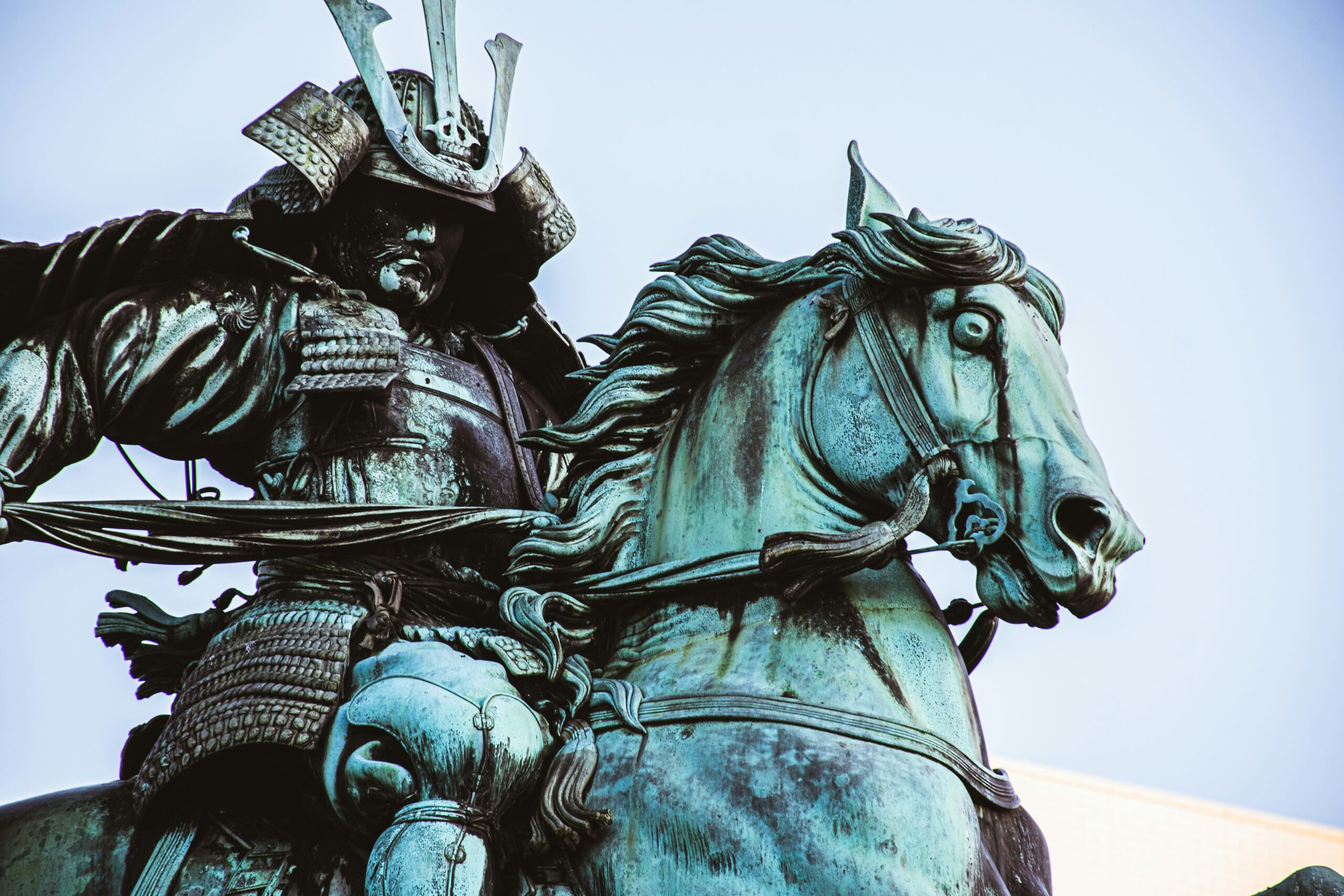
There he was. My Warrior. A bareheaded, lean-looking Asian man, considerably younger than my own forty-odd years, dressed in the kind of garb I associated (no doubt wrongly) with a ronin. A long-handled sword was sheathed at his waist.
He was staring at me, fresh-faced and impassive, from the other side of a low, fierce bonfire, which seemed expressly lit to keep me at a distance. The outline of his features twisted and flickered in the heated air.
“Can you sense what he might be feeling?” asked my therapist.
Despite the blank expression, I could.
It was disappointment. Deep disappointment. And of course, I felt it too.
Not much else happened then and there. I came out of hypnosis and we moved on to other things. But the look in that young man’s face stayed with me.
He was there all right, so why could I not connect with him?
Reading the Warrior again – and seeing something new
That evening, I revisited Moore and Gillette’s chapter on the Warrior. It was as if I had never read it before. My unconscious clearly had been hard at work since our earlier hypnotic encounter, and now a host of new themes stood out, all of which had been lost on me first time around, so intent had I been on rejecting and envying the archetype’s purely martial aspects.
I now perceived a more fleshed-out, multi-faceted version of the Warrior, vibrantly alive within me. Not just that, but he had achieved a particular fullness of expression in a way I had not clocked.
The process of therapy itself.
On reflection, it was obvious why.
The four archetypes at work in therapy
All four archetypes are essential to successful therapy, especially therapy for men and anyone grappling with questions of masculinity.
The King integrates, sustains and harmonises the forgotten parts of our psyche, helping us become whole.
The Magician brings transformative insight, ingenuity and creative detachment.
The Lover provides a vivid life-affirming sense of connectedness to all things, an acute alertness to inner and outer experience.
But the Warrior?
The Warrior does the work
The Warrior does the work.
I thought of what I had already achieved in therapy. We had gone deep. I had come face-to-face with feelings, memories and beliefs that I had never before had courage to confront, which had lurked in the shadows, assuming monstrous proportions. With support from my therapist, I had ventured deep inside the cave and, over multiple sessions, hacked away decades’ worth of conditioning, introjected beliefs and habits of thought. I had dragged the causes of suffering into the light, connected with inner resources I did not know I had, and given voice to parts of myself that I had exiled or suppressed. I had come closer to my truth and cleared the way for new, more authentic growth.
In all of this, the inner Warrior leads the charge.
He is not the Hero, his counterpart archetype in Boy Psychology, sublime in his exuberance but blind to his own limitations.
The Warrior is as measured and controlled as he is decisive and relentless.
He is committed to the task, however long and arduous.
He masters his inner realm to tame the outer.
He protects the boundaries of the kingdom.
He serves something greater: the integrity of the whole.
He does what needs to be done, and no more.
Deployed in his fullness, the Warrior is the bringer of peace.
The healing edge – invoking the Warrior when we start therapy
To embark on therapy is to invoke him.
Every time we choose to turn towards our pain rather than away from it, every time we set a boundary, speak a difficult truth or sit with a feeling we would rather avoid, we are activating the Warrior energy within us.
Therapy for men is often framed as “opening up” or “talking about your feelings,” which it is. Yet beneath that, therapy is also a disciplined, courageous Warrior’s path. It asks us to show up, session after session, to face what we fear, to do the inner work that brings outer change.
The Warrior is there, even when we cannot see him.
The work of therapy is how we learn to stand beside him.
Jim Cogan is an Oxford-based person-centered therapist & hypnotherapist.