Grief, Masculinity & Building Men’s Therapy Hub with Chris Hemmings
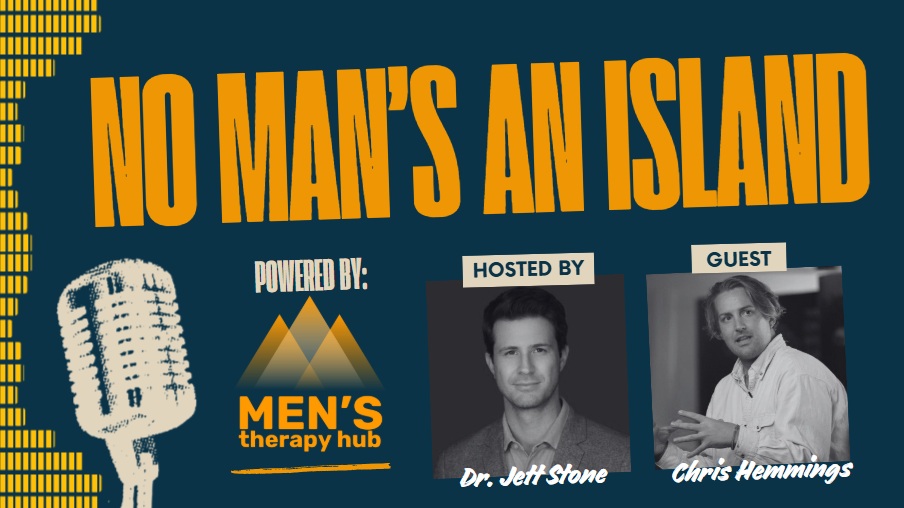
Welcome to episode six of No Man’s an Island, powered by Men’s Therapy Hub. In this special conversation, co-host Jett Stone interviews Chris Hemmings, founder of Men’s Therapy Hub, therapist, coach and founder of M-Path. Chris shares his personal journey from journalist to therapist, charting the grief, breakdown and awakening that led him to devote his life to men’s mental health.
They explore how generational trauma, bullying and “banter culture” shape emotional repression in men, and how empathy can be taught and modelled without shame. Chris reflects on building Men’s Therapy Hub as a space for men to find help and for male therapists to connect. It’s a raw, honest and hopeful conversation about grief, masculinity and the courage it takes to change.
If you’ve ever wondered why men struggle to talk, or how therapy can become a space that feels purposeful and masculine, this episode will speak to you.
What we cover
- Chris’s journey from BBC journalist to psychotherapist working with men and boys
- How grief, addiction and friendship became turning points in his healing
- The influence of fatherhood and generational trauma on men’s emotional lives
- Banter, bullying and the hidden costs of “lad” culture
- How empathy can be taught to boys and men through compassion not shame
- Why vulnerability still feels risky and how to meet resistance with empathy
- The creation of Men’s Therapy Hub and why representation matters
- Addressing critics and building inclusive, purpose-driven male spaces
Listen and watch
🎧 Listen to all episodes here: No Man’s an Island
🎧 YouTube: Watch on YouTube
🎧 Apple Podcasts: Listen on Apple Podcasts
🎧 Spotify: Listen on Spotify
Takeaways for men
- Grief and denial often mask deeper emotional pain – facing them begins healing
- Addiction and avoidance are coping strategies that can be replaced with connection
- Empathy is a skill that can be learned through practice and presence
- Male-only spaces can help men feel safe enough to start talking
- Therapy doesn’t make you weak – it helps you reclaim your emotional self
Quotes to share
“Empathy isn’t soft – it’s strength in action.”
“If we don’t meet boys with compassion, they’ll keep hiding behind jokes.”
“We are a minority on both sides of the therapy room.”
“Men’s Therapy Hub exists so men know this space is for them.”
“Unsure about therapy? We get it. We were too.”
Resources and links
Men’s Therapy Hub – Find a male therapist or join the directory
M-Path – Workshops on masculinity and empathy
Episode credits
Host: Jett Stone
Guest: Chris Hemmings, founder of Men’s Therapy Hub
Production: Men’s Therapy Hub
TRANSCRIPT:
Jett Stone (00:00)
Welcome to no man’s an Island, podcast powered by men’s therapy hub, a directory of male therapists for male clients. I am Jett Stone. I’m a cohost of this podcast. And in today’s episode is a bit different because my guest is Chris Hemings, the founder of men’s therapy hub and the creator of this very podcast. Chris is a psychotherapist, a coach and author, and he works exclusively with men and boys, helping them develop spaces to
engage with their emotional wellbeing. He founded men’s therapy hub, which just launched earlier this week. And before that he built empath, which is an organization that’s still running today and doing workshops on masculinity, empathy, and men’s mental health around the world. Before becoming a therapist, Chris spent a decade as a journalist making documentaries for the BBC, writing about men and masculinity for the guardian and independent telegraph. So he’s seen.
this issue from both sides as someone documenting the problem and now as someone trying to fix it from the inside. Chris, welcome to your own podcast, my friend.
Chris (01:08)
Thanks, Jack. This is weird.
Jett Stone (01:10)
Yes, I figured it would be. ⁓ So let’s start with the question that you have asked of all your guests so far, which is how did you get into this space of men’s mental health? And we’ll go from there.
Chris (01:23)
Yeah, my story of this begins in 2013 with the death of my father. And at the time, as you spoke about that, I was actually in the very early stages of being a BBC journalist. I’d quit my corporate job and I was trying to move into the journalism space and I started getting some bit part freelance work at the BBC. And my dad’s death hit me.
incredibly hard in the months we knew he was going to die. It was cancer that came back with vengeance. And in the months before he was going to die, I have to admit, I was just in complete and utter denial, ⁓ as was he, I might add. ⁓ And after his death, and I’ve said this many times before, I took as much cocaine as I could to try to numb the pain. I was going out every single night. was…
Jett Stone (02:13)
Mm-hmm.
Chris (02:17)
drinking and taking cocaine because, and this is not a sales pitch for that, but alcohol and cocaine together are an incredible emotional suppressant. I’ve done the research, it works short term. It does not work long term. So about three months later, I’m very fortunate to have a group of guys around me who we were in the burgeoning phases of being emotionally literate back then. And two separate friends privately took me to one side and said, dude, this has to stop.
You have to stop doing this. have to come to terms with what’s going on. So, yeah, big up Sean and Rob for that. And the moment that I stopped, I had a monumental emotional breakdown to the point where I couldn’t sleep. I’m just screaming, crying. And I lived with Rob at this point and I remember waking up one Saturday morning and I remember it vividly because
it was the Lions were playing. The Lions are, the British and Irish Lions are a rugby team that travel. You will not know about rugby. Yeah, the British and Irish Lions are a rugby team who traveled the Southern hemisphere once every two years, four years. I don’t know enough about them. But anyway, he’s a big rugby fan. So he’s sitting watching the Lions and I just say to him like, dude, I need to say some stuff and I don’t know how I’m gonna do this.
Jett Stone (03:23)
Okay, yes, thanks for clarifying.
Chris (03:46)
but I know that I have stuff that I need to say that I haven’t said. And so probably for about two hours, I paced back and forth drinking tea and smoking cigarettes and just talking at him while he watched rugby and was as empathetic as he could be. And once the dust settled from that, I had this moment of like, well, okay, I’m a journalist, first of all. So I’m meant to be intelligent. I’m privately educated.
Jett Stone (04:01)
Mm-hmm.
Chris (04:15)
relatively privileged in many ways. And I’ve spoken previously ⁓ about the emotional privilege that I grew up with. And I thought to myself, well, hang on a second. If someone who has all of the possibilities in life that I had and still have, and I could end up in that place, basically what the fuck? What chance do other people have who don’t have the opportunities that I have?
So of course, as a journalist, start to tell my own story. then as I do, start to also research what’s going on. And this was probably, so this was, yeah, this was early 2014.
Jett Stone (04:54)
And you were how old at
that time, just for reference point.
Chris (04:57)
Good question. 2013, so like 27, 28. So I start to research men and men’s mental health. And 2014, I find out this statistic that…
Jett Stone (04:59)
roughly.
Chris (05:18)
Because the way I prefer to say this statistic is not that the biggest killer of men under the age of 45 is suicide, that the most likely way that I will die today is by choosing not to live. And that blew my tiny mind. I almost didn’t know what to do with it, but something just changed in me. And so I wrote for The Independent, because I was still freelancing at the time. I’d started writing for The Independent and I wrote an article.
Jett Stone (05:27)
Mm-hmm.
Chris (05:48)
that was why do my male tears make so many people uncomfortable? Because I’d had this experience with my ex, where actually it wasn’t even about my dad, but it was about watching the film Marley and Me, where the Labrador dies. And I’d had a Labrador growing up and I hadn’t grieved her properly. So my ex comes into the room and I’m just a wreck, like the dog has died. Like, and I’d never watched the film before. And I could see her discomfort with me, not knowing what to do with me. And…
⁓ From there it snowballed and I found out more and I spoke about it more and I wrote about it more and ⁓ I started making documentaries. wrote my book, Be a Man, which changed my life, not financially, but in many other ways. First time authorship, not lucrative as I’m sure you can attest to, Jet. And yeah, just this…
Jett Stone (06:42)
Yes, yes.
Chris (06:48)
this growing sense in me that like, ⁓ this is what I’m here for. So then I, you know, I wrote this book, people started getting in touch with me asking, do you do talks? And you know, obviously because I’m male, I was like, sure, will you pay me? Yeah, great. And then I go into these schools and I go into these businesses and then one of these schools goes, hey, do you do workshops? And because I’m male, I’m like, yeah, sure, of course I do. And so I developed this empathy workshop because to me that was what I…
Jett Stone (07:04)
You
Chris (07:18)
recognized was missing was this deeply beautiful empathetic part of myself had been shut off because I had been playing the role of the rugby lad, the lad, the British noughties lad culture as it was, ⁓ and had bought into this concept and I had cut myself off from my empathy ⁓ because I was not that person. That was not how Mother Hemings raised me.
Jett Stone (07:34)
Mm-hmm, mm-hmm.
Chris (07:48)
⁓ And I started to understand all of these things about like my dad, who was this like amazing father, hands-on, but emotionally very ⁓ cold in his, he was joyful and silly, but in anything other than that, he was cold. And I wrote in my book about him being like a transition man, because like I then started to look at his dad through a different lens and be like, wow, the fact that my dad can be like this.
his testament to his will because my granddad was made of stone. I remember this line that I wrote in my book that he was stoic in the face of gardening. And it’s like the one thing that he said that he liked doing, but even when he’s out there, he’s like, no, I’m fine. No, I’m fine. No, I’m fine. It’s like, wow. So looking at this like generational trauma, like that’s how I realize it now. seeing all of this and then, I’ll skip a bit because
Jett Stone (08:21)
Mm-hmm.
Chris (08:45)
I started to focus on it heavily. I launched empath. It was just me to begin with going into schools and businesses and doing talks around men, masculinity, what it means to be male, what we’re missing, like treating men with kindness and also calling men into difficult work too. I always talked about issues that affect men and that men affect, right? And doing both of those things simultaneously. Go on.
Jett Stone (09:08)
Mm-hmm.
Actually, let
me pause you because before we go into that empath, I’m gonna ask you about empath. But I wanna ask you about intergenerational trauma. I’m just gonna think it’s a good pause point. What do you imagine that your grandfather would think about his grandkid being you, being a therapist? What do you imagine he would say about that?
Chris (09:36)
you
Do you know what he would first be shocked by is my bleached hair and my multiple earrings and my tattoos and my extremely alternative lifestyle, let’s call it, right?
Jett Stone (09:49)
Sure. ⁓
Yes, and what
kind of chair are you sitting in? He’d want to know too. what did I… Yes.
Chris (09:58)
Yeah, like what’s this weird gamer chair that my friend has already told me I should
change when I’m doing the podcast because it’s not attractive and I’m like, but I don’t care because it’s comfortable.
Jett Stone (10:04)
Well, I like it. That’s right.
Chris (10:10)
He wore a suit every day. Every day, he wore a tie every day. Sunday, tie. Saturday, tie. Wednesday night, he’d go around there. Maybe he’d take his tie off. We still have his shirt and his blazer on. ⁓ So it’s such a great question, Jett, because I think he wouldn’t understand what it even means to be a therapist. don’t think he would, the concept would be lost on him. I don’t think my dad would entirely either.
He would be eager to try to understand because my dad was interested in me in that way, right? Which is part of my emotional privilege. ⁓ I think my granddad would be just confused and I think he would just change the subject. I think he would just be like, that’s nice. Did you watch the cricket? Because that’s what he was into, right? He would just divert because I think about him and I think about…
Jett Stone (10:44)
Yes, yes.
Yes.
Chris (11:07)
whatever must have happened to him to make him that way. And I look back now with incredible levels of compassion because that poor guy, he probably allowed himself 2 % joy because he was so cut off from anything other than showing neutrality.
Jett Stone (11:33)
Thank you for saying that because it’s probably true of so many of our forefathers or fathers, fathers, fathers, fathers, right? It’s like we are a reflection of all that came before us. And this podcast, this conversation, your story of going from, you know, rugby lad to talking to men about their feelings and, you know, and helping them.
with their emotional wellbeing would be so confusing that they wouldn’t even have a language to talk about it. That’s where we, many of us have come from as men today in this modern world. Yes, that’s a point. Yeah, me too.
Chris (12:12)
But you know what, Jet, it still confuses me.
I spoke with ⁓ the first guy on the pod, the first, sorry, the first person to sign up to men’s therapy up yesterday, Stephen Hall. So I spoke to him for the podcast ⁓ and I talked about like, how dare me and you become therapists? Like who do we think we are that we become therapists? know, this kind of imposter of like, my boys and they know me from a very different time. Like it must confuse the hell out of them.
Jett Stone (12:35)
Mm-hmm.
Chris (12:50)
to think like Hemings is a therapist, like what, that guy?
Jett Stone (12:55)
I feel you on that, man. I do. And my, and my buddies from high school and college, they’re to, a very similar way. Yeah. Let me, let me ask though, how would you, the, the rugby lad, let’s say, you know, 23, 24 years old, if someone were to have come to you and said, you’re going to be a psychotherapist in, you know, whatever it is, five, 10 years, 10 years.
Chris (13:01)
Yeah. Yeah.
Yeah. 10 years.
Jett Stone (13:25)
What do think you would have told that person?
Chris (13:28)
Honestly, I know that the answer that would make most sense would be fuck off, what a load of shit. But honestly, when you had me one on one, I was not that person. That whole persona was just that. It was a facade, it was a deflection tactic. was, okay, this is how I need to be to be accepted in this environment.
because I was sport, sporty guy through and through. even studied sports at university, right? It was ridiculous that you can even do that. ⁓ Great, it was the easiest thing I ever did. And I honestly think that if you told me that something in me would have gone, well, yeah, because do you know what my mom told me? Like about two, three years ago, which based, given everything that I’ve spoken about and that she has seen me publicly do, I said to her like, why is it taking you this long to tell me that? She said,
She once had to tell my dad, like I have two older brothers, and she had to tell my dad, Chris isn’t like those two. He is soft and he is kind and you have to not treat him the same, which I think my dad took as a bit of a challenge to do it more so. ⁓ But my mom saw that in me and I knew about that in me. I was the one that when we used to smoke cigarettes before school at the park.
Jett Stone (14:29)
Mm-hmm.
Right.
Chris (14:51)
The girls would line up to give me a hug because I was big and soft. And all the guys would be like, why are they giving it to you? And I’m like, because I’m not a threat to them. that, you know, I’m yes, I’m the big soft squishy guy, like quite literally in places. And that’s always been who I was, but about 14, 15, I just got caught up in this. Well, that’s not how I get laid, right? That’s not how I get esteem, the markers of esteem as a man.
Jett Stone (15:00)
Yeah, you’re more approachable.
Chris (15:20)
That’s not how I get ahead. ⁓ And so I started to buy into this narrative of the kind of macho mentality, which is why my therapist told me years later, you were a bully at school. And I was like, no, no, no. And then he was like, yeah, you were, you were just also bullied. And I was like, ⁓ whoa.
Jett Stone (15:43)
How were you bullied?
Chris (15:47)
Every guy who is in the setting that I was in It’s kill or be killed. It’s It’s the constant one-upsmanship. It’s the constant gamesmanship It’s it’s well if I don’t step over you somebody’s gonna step over me if I don’t show you that I am Brave and I can take the joke and also dish it back then I’m gonna be the butt of the joke always and I remember
I’ve thought about this stuff way too much. I remember a time we were in our, I went to a posh school, so we had a common room for that when we were in sixth form, right? When we were in, like when we were 17, 18, playing table tennis. And one of these guys was like, Hemings, you’re so fat that I can see your ass from the front. And so I was like, okay, what can I do? And I goes, everyone’s laughing at me. So I ran and sat on his face. And it’s funny, but it’s also…
Jett Stone (16:42)
Mm-hmm.
Chris (16:44)
like it is such a window into that mentality. You I had two older brothers, so I was really good at this because I’d already had all of the barbs. I’d had all of the, you know, the banter and yeah, yeah, And I’d seen how they dealt with it. And also I knew that they would stick up for me and like if it really came to it. And so like I was borderline too confident. You know, I was sometimes called arrogant, but I was super, I am a super confident person. But I think about the guys who don’t have that confidence.
Jett Stone (16:52)
Yeah, before at all.
Yeah.
Chris (17:12)
And how many clients I see now who are dealing in their mid twenties with the fallout of the bullying that they received when they were a child.
Fucking hell. And if I could wave a magic wand, that would be the thing that I change. I spoke to, Luke Ambler spoke about this beautifully. He’s like, banter between friends is not problematic in itself. As long as you can also understand the impact of it. And you can also be accountable when someone says, do you know that name that we call each other or that you call me? I actually don’t like that, so please stop and not use that as a moment to go, ha ha ha.
Jett Stone (17:25)
Yes.
Chris (17:53)
So I’m going to call it you more.
Jett Stone (17:55)
Yes.
Chris (17:57)
That is the thing. So yeah, I was a bully and I was bullied. And so was everybody else around me. And that was this mentality that I got caught up in that disconnected me from my empathy. And it cost me daily.
Jett Stone (18:02)
Yes.
Yes.
You know, that bullying, when you look back, you squint back in time and look at it, it’s very painful to see, especially being a therapist and having the opportunity to learn about men and their inner lives and boyhood at the level that we do. It becomes more more painful and it becomes ⁓ clearer and clearer that some of what was just, you know, boys having fun and
You know, banter and one-upsmanship, some of that buried inside that fun and laughter was grief, sadness, and shame unnamed. And, you know, one of the things that I think about as a therapist is that you got to get to that point of getting to like what really lies beneath. You know, all of it, but at the same time, there’s a conflict here. It’s that it was great fun.
at times, it brought brotherhood, brought memories, it brought closeness, and it really fucked you up in so many ways too. was both of those things at the same time. And so the ambivalence around it, I think is important to explore and reconcile because I’m imagining you got a lot out of being a rugby lad as well. Like, am I wrong in saying that?
Chris (19:41)
People love,
no, people love humor. And apparently I am able to be funny. I’m not like standup comedian funny, but conversationally, apparently I’m quite witty and sharp. And that’s because I am the youngest of two brothers. So again, I had to be, right? It’s like deep end training. ⁓ And they’re both like incredibly, way smarter than me. So I had to try and keep up. So like I am that. And I like that I am.
Jett Stone (19:56)
Yeah.
Chris (20:10)
But, and because I want to ask you a question here, which is how many clients do you have, male clients do you have, where you have to do the Gestalt approach. And for those that don’t know, Gestalt is like reading the body a lot and recognizing what’s going on in the body of when you talk about something painful, do you know that you laugh at the end? Do you know how much you use laughter as a coping strategy, basically?
How many of your male clients do you have to do that
Jett Stone (20:42)
Yeah, if you weren’t laughing, what would you be feeling? Right? Or if you weren’t, ⁓ you know, making great jokes, like what would we have to talk about?
Chris (20:45)
Well, exactly.
And I was brilliant at that.
Jett Stone (20:56)
And the jokes are good, by the way. I tell
them, I was like, that is legitimately funny, but I’m not your buddy and I want to know what you would tell me if you could and you can.
Chris (21:08)
Yeah, and I’ve said before to clients like, hey, I’m not supposed to laugh. Like I was trained not to laugh. Like stop being funny. But actually in all seriousness, we were just talking about something painful and then you tell a joke. And that is so common for us as guys. I was brilliant at that. And now…
Jett Stone (21:25)
Yes.
Chris (21:34)
as somebody who is exponentially more emotionally intelligent than I was from 0.1%. So it wasn’t difficult. It was a low bar. I can also tell when I have the urge to do it and I go, wow, it’s still in me.
Jett Stone (21:49)
Yep. Just to go back, you these skills of banter and one one up some in ship can be delivered healthily. Right. And in a way that isn’t problematic. then it goes into that space, right? It can go dark pretty quickly. And it’s it’s a private experience for a lot of boys. The feeling that I don’t like this, you know, and and
Chris (22:10)
Yeah.
Yeah,
Jett Stone (22:20)
You know that.
Chris (22:20)
and I have this concept that I’m kind of working on right now, as I often do, which is, I don’t know if you are aware of the kind of archetype of the fool. So the fool in medieval courts, not in America, because you’re only about 50 years old as a country, but in Europe, okay.
Jett Stone (22:34)
Mm-hmm.
I’ve read Shakespeare, man. Come on. I have a…
I was an English major for better and worse.
Chris (22:46)
yeah, I forgot that you’re well read and learned.
Yeah. But for those that don’t know, and I didn’t know this until really recently, because I’m not an English scholar, the archetype of the fool, the fool in the medieval court was the only person who was allowed to speak truth to power. The fool could mock the king and the fool could say what nobody else was saying, because anybody else says it, they would lose their head.
Jett Stone (23:05)
Mm-hmm.
Chris (23:16)
But the whole point of the fool was that the fool allowed the king to be seen as human and therefore actually more powerful. And that’s the genius of it. in the therapeutic space, when we are being incredibly serious, something I think is important is to point out that someone can tell a story about their life and then they can laugh. And I say like, what is that laughter about? then,
maybe they’re not sure. I say, it because actually when you hear that back, there is, it’s absurd that that happened to you. And it’s like, wow, yeah, it is. And so the archetype of the fool, think is great because what it can do is it stops in male groups. It stops there being like absolute power, you know, that everybody is open to being mocked and laughed at equally. And, and
Jett Stone (24:05)
Mm-hmm. Mm-hmm.
Chris (24:15)
I actually believe that this is part of, know, the whole Jimmy Kimmel thing in the US with Trump is like, he doesn’t want, he is not actually comfortable in himself because he can’t be laughed at. Like you have to be able to not take yourself so serious. Like overly sincere people is also a cover, I think.
Jett Stone (24:35)
Yes.
Well, that’s also the, you’re talking about the beauty of ⁓ boyhood relational styles and male friendships is that, you know, across the hierarchy, we do learn to have to hold each other accountable up the chain and down the chain. And the fool is a great example of that. And it’s why we need the satirists to hold power, to hold truth to power in ways that are really accessible for people. And I think it has deep connections to boyhood.
Chris (24:51)
down. Yeah.
Yes. Yes.
But that boy relational hierarchy, some research that I found that showed that one of the ways that boys and girls socially are different is if somebody does something that is against the code or ethics of the group. In boy code, you can stay in the group.
and you will be roundly criticized and mocked for it until you have served your time. And then they’ll move on to the next guy when he’s done something. And that can be a day, a week, a month, a year, five years. In girl code, you will be ostracized from the group. And my wife and I have had the most beautiful discussion about which one is worse. And I didn’t come to…
I actually didn’t come to it. I was trying to argue that it was worse what girls do. And then she was trying to argue it was worse what boys do. And actually we didn’t agree. And it was like a great conversation because they’re both equally cruel in their own way. But for lads, it’s like you can stay around, but you are gonna be reminded of that indiscretion repeatedly. And that’s painful.
Jett Stone (26:09)
Mm-hmm.
Yeah.
It is, and it’s a hostile environment, you know, in an implicit way because it’s, you have to, as a boy, have a good weapon at your disposal. You better have an arrow, some type of arrow in your quiver, whether it’s your strength, physical strength, maybe your humor, your ability to drink a lot, your quick-wittedness, your looks, your, you know, there’s something it’s, and I don’t know if you saw this in the work you did with Empath, which I do want to ask you about like,
there’s a sense that if I don’t bring something to the table in this hostile environment of boyhood, I’m either going to get beat up, I’m going to get run over, I’m going to be kicked out of the crew. I won’t be seen as a warrior, I won’t be seen as a trustworthy, viable teammate. And you worked with a lot of young men and boys in your previous…
job at empath and I’ve been wanting to ask you this like how do you teach empathy ⁓ to boys and men whether it’s in a therapeutic space or just like kind of in a group setting like how go into like how do you define empathy and how do you teach it in a way that doesn’t just sound like be more like women right
Chris (27:43)
Mm.
Yeah,
we worked really hard to make sure that was never the message. And it was, well, first of all, the reason that I called it path, hyphen path cheesy play on words is because of the experience and the understanding. And there’s also research that backs up the boys have less. ⁓ It’s not the boys have less empathy. It’s the boys don’t show as much empathy. So to me, it’s like, and actually it has proven that empathy can be taught. It is a skill.
So first thing is to define it, which is very simply for kids, the ability to understand how other people feel. Now, if you think about that, this is where we fall down massively as a society. In my opinion, is that we are telling boys, you need to understand how it feels to be female, to be black, to be disabled, to be queer, to be at all of these places on the intersection. And yet,
these same boys have been told from moment one of their life, but you’re not allowed to feel. So that’s basically like, you need to understand, you need to understand Spanish, right? But you’re not allowed to ever learn it or speak it. You just have to understand it. And to me, there was this moment of like, what’s happening here is grossly unfair.
We are culturally, you know, the bell hooks, we’re culturally like cutting boys off from their emotional self, like an act of violence against boys. And then many years later complaining that our husbands and our partners and our brothers and our sons are emotionally illiterate. Like, yeah, welcome to the landscape we’ve created for ourselves. And I, by the way, this is not patriarchy that has created that. This is the whole of society.
Jett Stone (29:39)
Mm-hmm.
Chris (29:47)
which I guess some people would argue is patriarchy. but like, you know, research showing that at four years old, mothers police the emotional responses of their boys more than they do girls. And so this is not to blame any gender or anybody individually. This is a ⁓ cross-cultural problem that we are then complaining to boys and then making them feel shame. So my whole thing was we have to…
Jett Stone (29:48)
Yeah, some would call that pH record, but whatever. Continue, yeah.
Chris (30:15)
I had to stand on stage first and explain to them like, I’m learning this. I didn’t know how to do this. I had to meet them in their reality, show them empathy and explain to them that me doing this is showing them empathy to say, I understand some of your experience because, you know, I would talk about some of these boyhood, the banter and the things that we’re experiencing. And I would say like, I can see that some of you are squirming in your chairs right now because this is landing in you and saying that’s also an-
empathy, I’m seeing that you’re uncomfortable, right? And then I would show empathy to the teachers and I would show it in the room. But then we would do exercises where the best ones always were anonymous sharing exercises. And then, okay, so I’d read out some anonymous sharing. So how do you think it feels for this person in this room who isn’t able to share this painful thing about themselves? Or I would read out some of these things and then people would laugh.
And I would, okay, so can we talk about what just happened there? It’s the therapeutic technique of like, what, like bring it into the, into the room. You know, what just happened in the room is I’ve read out something that’s challenging for somebody that they don’t want to share. Some of you have laughed. Can you understand why then we are continuing this? And yet all of you who have laughed have also shared difficult things. So we’re laughing at people who are struggling, even though we’re struggling ourselves. So can we talk about why that is and what it is that’s going on?
Jett Stone (31:31)
Mm-hmm.
Chris (31:41)
And then we would talk about the kind of constructs and where the lack of empathy comes from and to say like, know, I’m here to specifically remove the blame and shame. Cause one of the biggest frustrations I ever had was a teacher at school once at the end of an assembly, put her hand up and said, if we’re telling 14 year old boys, if we’re saying that 14 year old boys ⁓ aren’t to blame for this, then how do we hold them accountable for it? And I’m like, accountable for what?
they are children and if they are behaving in these ways, we as the adults around them need to take responsibility for that. What culture are we raising boys in that they behave in these ways? It’s victim, you know, victim blaming basically was my take. So to take that on me as the adult in the room to probably the first time ever that someone has gone, guys, I see you and I see the pain and struggle and I know this banter shit because I did it.
Jett Stone (32:25)
Yes. ⁓
Chris (32:39)
And I was really fucking good at it. And that’s not a thing that I’m proud of, but also, and then here’s how it hurt me down the line to model it in the room.
Jett Stone (32:50)
And you may have been the one of the only men in a lot of these boys and young men’s life who showed it to them. And part of it is like, there aren’t that many male models who are displaying empathy to young boys. it’s like, you, if you can’t see it, it’s hard to be it. And it’s a muscle that you’re describing. You are building in what psychology is sometimes called like a mentalization, which is basically the ability to.
anticipate and see, predict and understand the emotions and feelings and inner life of someone else and yourself. And I think in as girls, like the conversations and the communication styles they have naturally build that skill. What did you do today? How did you feel there was it’s more emotions talk. Sometimes it’s like rapport talk. ⁓ It’s been called and boys grow up with this report talk, which is this is what I did, like kind of in a factual way. You don’t ever build that muscle of
like anticipating and kind of guessing and reading between the lines and reading facial expressions and talking through what might be happening behind the scenes. And so what you’re doing there is showing them that that is a way of relating. That is how you show up in this world as a three-dimensional full like human, like you have this, you have it within you. There isn’t this sense of like major deficit. If there’s a deficit, it’s the deficit in the expression of it.
And the using of it, it’s tapping in. You know, there’s this, for many reasons, it just gets shut down. And so it seems like you spent a lot of time showing boys that actually you have this skill within you. And here’s how you do it through the modeling of it. And I think this message is great, not just for therapists and those who run men’s group, but for dads out there, for parents as well. Right.
It’s saying this is how I can show up in the world and show my son or anyone for that matter what it looks like to care about the lives of other people and do the empathic work.
Chris (35:00)
And what I never underestimated, because I said this to the boys, was I do not underestimate how difficult this will be. In fact, for many of you, it will be the most difficult thing you’ll ever do in your life, is to change the way that you operate in this way, in this sense. So even with dads with young boys, we’re asking dads there to unlearn a lesson of a lifetime, because the biggest challenge for young boys and for men is…
It is a risk to dare to be vulnerable and you are putting yourself on in the firing line because we are used to vulnerability being laughed at. And it’s, really difficult. You know, I vividly remember one of the most transformational experiences I ever had in a school was during the sharing part.
⁓ One of the boys wrote some Andrew Tate rhetoric, which was really prominent at the time, right? Rather than share, like, like everybody else had in the room, and this was a room just full of boys.
And the teacher in the room was about to stand up and I saw what was going to happen. And I was like, sit down. I was like, okay, to the person who wrote this.
I understand why you wrote this because this experience for you was so deeply challenging that you decided that it was easier for you to write this. Now, I’m not gonna ask you who you are, cause this was anonymous, but you know who you are. And I want you to think today.
Why was I not able to do this? And try to be kind to yourself and ask yourself, all of my classmates were able to do this. So actually I’m trying to portray strength. Is it possibly that I protest too much basically? So I met him with a hundred percent compassion and I went back because empath with some schools was multiple strands. That was the empathy workshop.
Jett Stone (37:23)
Mm-hmm.
Chris (37:28)
I then went back for the mental health workshop and at the end of one of these, the mental health workshop, this lad stays behind and he’s like quivering a little bit. And I’m like, you know, sometimes lads stay behind and like they break down crying and he was just like, I wrote that thing. He said, do you remember that piece of paper from last time? And I was like, I remember. And he was like, it was me that wrote it. And he just said, like, he started crying and he was like, thank you for what you said and how you said it because…
from that moment on, I’ve stopped pretending and I’ve started to allow myself to be myself. And I’m like, I’m getting emotional thinking about that. And me and him are standing there, both of us welling up together. And I’m like, if I wouldn’t get arrested for hugging you, I would hug you right now, right? Like, thank you for being so courageous to come and tell me that. Like, that’s one of the coolest things I’ve ever experienced in my whole life and probably ever will, right? And…
It was just because like ordinarily he would have been met with fire and fury. He would have been met with, did this? Come and see me. You didn’t take this, but this is Andrew Tate stuff. We’ve talked about this blah, blah, And I’m just like, no, of course it’s easier for me. I’m not a teacher. I don’t deal with these kids every day, right? But like, let’s talk about the reason why you did this and let’s meet you with compassion. And like when you do that, but when you do that, it’s hard to be…
Jett Stone (38:38)
Mm-hmm.
Yes, right.
It’s a beautiful example of it.
Chris (38:56)
angry back or furious back, you know? Yeah.
Jett Stone (38:59)
Yes,
yes. Even in just sharing that here, that moment of like empathy and action is really what that is. It was a moment where you really turned that kid and changed his life. Like even just rehashing it here, what is it, like what comes up? What do you feel?
Chris (39:21)
I am
feeling the, I’m like 50 % on the way to tears because it reminds me of, it’s multiple things. It reminds me of why I did that work for so long. And I said to him like, this gives me fuel to keep going. So thank you. And it also reminds me of why I launched Men’s Therapy Hub because there’s already one guy who has messaged me to say he found a therapist through Men’s Therapy Hub and he’s like,
multiple sessions in and he’s seeing change. And I’m like, then this whole thing was worthwhile. Like it’s helped someone. And Luke and I had a beautiful conversation about success. And that’s why we do this work because at my core, I don’t want people to experience what I experienced. I’m driven by that. And it’s why I became a therapist because my friend Annie, who I talk about a lot, she said, put your money where your fucking mouth is.
Jett Stone (39:56)
Yes.
Yeah.
Chris (40:22)
And because she’s a therapist, she was like, you have to be a therapist. And I was like, I can’t be a therapist. But I say to clients regularly, like, you don’t understand how much of a privilege it is for me to sit here and be in this in you. think, you know, when they’re really struggling with being a burden, right? And I do the classic question of like, do you think that…
Jett Stone (40:30)
Yeah.
Chris (40:49)
Like you’re a burden on me. Do you, do you feel like this is difficult for me to sit with? And they go like, well, you know, sometimes I do. I have to say to them, like, I understand that compulsion, but it’s a privilege that I get to do this. And it’s, and it’s deeply beautiful to sit here. And then I also like soften it with, you’re paying me. So, you know, that helps too. But, but this is, this is a choice for me to be here. And it’s one of the biggest privileges of my life to see personal growth on that scale with clients.
Jett Stone (40:53)
Mm-hmm.
Ha ha ha.
Yeah, and that point is important to circle is that a lot of men who show up to therapy feel like, my gosh, like I don’t, like I shouldn’t have to need this. There’s so much of a burden attached to the emotional work and that if I show up in a different way to whomever, whether it’s a romantic partner, it’s friends, then I’m gonna be a drag. I’m gonna pull down the moment and
That is a story that we tell ourselves. And I love that one of the interventions that you use is it’s again, mentalized, it’s building mentalizing, um, which is the ability to say, what do think I feel? You know, and, and, and that’s a wonderful intervention because then you get to hear them say, you, you’re going to think of my burden and you get to break that myth a little bit and say, no, actually it’s pride.
And those, those are micro moments, but they build up and they build up. And I, like you, when I heard that story, um, you know, 50, you know, 50 % of the way to tears because it feels like, man, I wish there was someone who could have phrased it like that to me. When I was that age, I grew up in the eighties and nineties, you know, not to say that that’s like, you know, the same as like the fifties or forties, but there was this like hard-ass culture where you didn’t talk to boys that way. You were still.
in a way, even when we were kids, like we were being trained to be warriors, at least where I grew up in some way, that we were being trained for a job and, you know, most of us didn’t go into the military. But we were being trained to, you know, be warriors. And there’s not, you know, there’s some wisdom to that, you know, there is, but at the same time, I think it shuts down.
kills off in the bell hooks way half or more of our full humanity and I like you would secretly you know go out with buddies and come back home and you know write songs and music and talk on the phone to to people and like I was able to relate to that but I couldn’t show it you know I I couldn’t show that that was something that mattered to me
Chris (43:19)
Yeah.
Jett Stone (43:46)
And what you’re talking about here is giving permission as an elder, as a male elder in this world, giving young men and boys and sometimes our peers permission. And I think in our friendships now as guys approaching middle age, maybe not so I’m a little older than you. ⁓ yeah, yeah, yeah. ⁓ it’s like, one of my takeaways is let’s give our buddies, whoever they are, whether it’s your
Sean and Rob, let’s give them permission to unfold that other part of themselves. And maybe I’ll put that out as a challenge to anyone who’s listening. Give yourself permission to do that. let me, sorry, if you want to respond to that, I do have another men’s therapy question. Sure.
Chris (44:34)
Yeah, only very quickly that
one of the things that I have thought a lot about is when we are inviting men to do this work, ⁓ I had to reckon with this within my own friendship group and that’s where the thought came from, is that for a long time I was an outlier. I was constantly saying, can we stop using homophobic, racist, misogynistic terms? Can we be kind to each other?
like stop using that sort of language. I was the one that it felt like to the point where my mates would be like, not now, man. And I’m like, yes, now. Somebody has just used a homophobic slur. And at the time I was still dealing with my own sexuality and I wasn’t out properly at that point. Yes, now. I am saying stop using that term right now. And.
Jett Stone (45:23)
Mm-hmm.
Chris (45:34)
The guys that I work with often will say like, now I don’t feel like I have somebody to meet me in this space. And I’m like, yeah, I understand that. So yeah, the unfolding is beautiful, but also some of us unfold and forever keep unfolding and others will unfold a little bit and that’s enough for them. And I think it’s also not to expect that everybody will be able to do.
continual deep work on themselves or want to. You and I are, you and I are, know, hook it to my veins, right? The emotional work. I actually said, I actually said to you, Jett, that on my, on the podcast with you, that I’m taking a break from my therapist. I’ve now started back up again, cause I was like, no, there’s a thing. There’s a thing. Yeah. So yeah. It’s, it’s thank you to the Sean’s and Rob’s of the world.
Jett Stone (46:14)
you
Yep.
Chris (46:31)
and to all my other friends who’ve been wonderful with me through so much pain and challenge, and they’ve been there for me no matter what. But also I can’t just expect them to be as interested in this as I am. And everybody has their own limits with it and capacity for emotional development. ⁓ And we have to be patient with people because they’ll do it at their own time.
Jett Stone (46:43)
Yes.
Yeah.
That’s right, and there’s many ways to ⁓ skin the cat. It’s not the greatest metaphor for this, maybe. It’s too brutal of a metaphor. ⁓ But there’s psychotherapy, and that’s our domain, right? But then there’s creative arts. There’s somatic therapies. There’s yoga. There’s many ways to do this. ⁓
Chris (46:59)
Mm.
I what mean.
Mm-hmm.
Jett Stone (47:20)
And there’s many ways to express yourself. So I think that point is taken, but from a relational level, which is what I think men in my practice, I try to grow them into to become more relationship oriented beings. know, the younger men that I see sometimes have been so caught up in a solitary life on the computer, oftentimes with video games and their experience of the world is, you know, so much in solitude and…
So building out to that how to be a ⁓ good boyfriend to somebody, right, is not something that could come second nature.
Chris (47:56)
Yeah. Do you give,
do you give guidelines? I know we don’t ever tell our clients what they should do, but do you ever think like, well, this guy doesn’t actually have the, he’s never gonna get to the point that is the, you need to have that difficult conversation or you need to go outside and look at a tree or like, do you give pointers like that?
Jett Stone (48:17)
Mm-hmm.
Depends. I’m not against skills at all. I think the CBTs are third wave behavioral CBT, all that mumbo jumbo look it up. It’s just it’s a different type of therapy that’s a little bit more skill based. I think it’s really important. ⁓ I sort of assess it on person to person. There are some people who yeah, would really benefit from like role playing what it’s like to bring up a tough conversation that can really really helpful. ⁓
I’ll point out that like, look, the way that you said that, especially in couples therapy, there’s, let’s say it’s a heterosexual couple, you know, the way that you said that, like kind of felt cold to me. I’ll own my own experience of it. So they can understand. And again, in this mentalizing way, like, oh, someone is called and it’s not really calling out. It’s doing it with compassion as much as I can that like,
You’re kind of like a robot here a little bit. Like, let’s talk about how you can show up for her or if it’s individual, individual session, we’ll even roleplay it ourselves. Like, be curious, like ask, reflect back what you just heard. You know, your, let’s say your girlfriend say in your own word, that’s powerful. All those things, all the skills I’ll call them. Like we don’t necessarily learn them. ⁓
And so that’s something that I definitely would bring in. I would be more directive in that moment in therapy for sure.
Let me ask you, because I want to bring Men’s Therapy Hub into the conversation too, in the time that we have left. Was there any moment for you, and you talked about all these kind of headline moments, where we’re talking about empath and the conversations you had with people and your own struggle with addiction and friends and sexuality, but was there a moment recently, I will say probably on the
last year or so when you decided that now is the time for men’s therapy hub, right? Like it takes a lot of effort to do what you’ve done. Like give me an answer to the, like at what point would you say, screw it, I’m doing it now. Like we’re doing, like we’re doing this.
Chris (50:45)
Yeah, we talked in our, in the first episode where I interviewed you, where I was like, I read what you’d written and we reached out, well, I reached out to you and we had that conversation where, let’s do something together at some point. And the mad thing is that Jett and I still haven’t actually met in person. He is still just a 2D guy on the screen. ⁓ There are plans in place, but we had that conversation and I…
Jett Stone (51:06)
There are.
Chris (51:12)
at the end of it said, I’d love to work with you. I’d love to figure out a way and talked about this ⁓ men’s therapy network maybe. And I honestly wasn’t inspired by that. So that just kind of sat in the back of my head of like, something because we’re a minority in this profession and whatnot. Around that time I was getting married. I moved to Copenhagen and I am now here and in…
May 24, I arrived in Copenhagen. Sorry, no, I’d moved house and I arrived in my new house and I remember sitting in my house and I tried to do a Zen of like, all right, I am going to not do anything other than be a therapist for ages because I’m tired of the modern parlance’s side hustles, right? I am exhausted. ⁓
My friend Espen, is walking ADHD is 100 % convinced that I have ADHD and I am probably in denial. I definitely don’t have the D, it’s not disordered, but I definitely have traits of. Because in November, 2024, from somewhere, from the ether, from the universe came the idea of…
Why is there not a therapy directory for men? And then I thought, well, shit, that’s a great business idea. And then I went, fuck. Okay, well, I guess I have to do it and I have to see if it can work. And because of how my mind works, and this is where my friend Espen will say, yeah, because you have ADHD.
Jett Stone (53:09)
Thanks
Chris (53:11)
I was like, I have to do this now because otherwise it is going to be a worm that eats at my brain. And I’m going to think somebody else will do it, which, by the way, they kind of have, there’s an organization launch called men’s counseling service. And I would actually love to get in touch with the people who run it, but it doesn’t say anywhere who runs it. And, but they are a therapy service for men, but they are mixed gender therapist, which I think also is a good idea. I it has its place.
Jett Stone (53:12)
you
Chris (53:41)
there’s an organization called lads.app and they are all sorts of different coaches and not just therapists and it’s also mixed gender. But there isn’t a men for men space. Well, there is now. So I thought, there’s queer therapy, there’s the black and Asian therapy network. There’s all of these brilliant spaces that are targeted at minority groups. So.
Jett Stone (53:50)
Right. Right.
Chris (54:08)
Well, for the first time in my life as a privately educated middle-class white man, I’m queer, but I felt like a minority. So it’s advocacy. It’s why we’re giving 10 % away. It’s why, you know, it’s five pounds a month to join. It’s like, I don’t need to be rich. I live in now the safest country on earth. A lot of my money goes to taxes, but I’m pretty good here. Like I’m set for life. ⁓ So this is…
Jett Stone (54:27)
Hmm, didn’t know that.
Chris (54:37)
one of those moments where I was just like, well, I have to do this. I felt like I had no choice. It was the same as when I met my wife. I was like, I have no choice but to be with you. Like you have a choice, but I don’t. am just, I’m like, I’m in, sold, done. Like with men’s therapy, I was like, I wish it wasn’t such a good idea. And you know what the best ⁓ compliments I’ve had for two guys, one was Stephen Hall when I first met him and was another guy was like, I’m jealous because I wish I’d thought of that.
Jett Stone (54:56)
Yes.
Chris (55:06)
And I love that compliment, because I’m like, thank you for being honest about that. I love that.
Jett Stone (55:12)
Yes. Well, I’m…
In a similar way, I wouldn’t say that I’m jealous that I hadn’t thought of it. I did think of it, but it takes someone like you, which I don’t necessarily have the same type of fire in my belly. I have a fire in my belly, but you have a certain type of fire in your belly where it’s like, no, no, no, this has to get done. And that’s why it’s so cool to work with you because you have that drive and that passion that just, that just hits you.
And so that’s just my saying, like, it’s been so fun to work with you because there’s nothing like working with someone who just has their heart and soul in this work. And I get the sense ⁓ it’s going to take you places. But I want to ask you this question and then maybe we’ll start to wrap this interview. But look, we’re likely and have already faced some critics.
with men’s therapy hub who say this, who could say this is an exclusionary space, even though given all you’ve said about all these other spaces that have been built for other demographics and other people, and that it further isolates men from already a female dominated field, right? So like reinforcing the very gender segregation that we’re trying to dismantle here, right? By creating this men’s therapy hub.
What are your feelings towards that sentiment?
Chris (56:52)
I get it. I get that there is distrust of male-only spaces. ⁓ Our forefathers haven’t really helped us out in that regard. ⁓ They were excluding for, ⁓ actually I can use the word accurately here, patriarchal reasons. ⁓ To me, one of the beauties of men’s therapy hub,
is that if you don’t like what we’re doing and you disagree with what we’re doing, you can just close the tab on your browser and you will never have to hear from us again. We’re gone. You can block us on all of your socials and you don’t have to ever consider that men’s therapy hub exists. Then it’s not for you and I wish you luck. What this is for and the reason that I did, I decided to give away money to charities.
Honestly is twofold partly because they’d help us with the publicity. Let’s be honest, but also mainly because I have been deeply inspired by I mean Luke Ambler I didn’t quite say it to him when he was on the call because I don’t think people like to hear it is a hero of mine
He experienced suicide in his family and then looked around at the men in his life and was like, where do we go from here? How do we change things? And he created a male only talking group and is now 6,500 guys every week turn up to a Andes Man Club in the UK. And it’s growing and getting bigger, right? I know in the US there’s like MKP who is gonna, Mankind Projects who are gonna be one of the…
Jett Stone (58:25)
Wow.
Chris (58:34)
organizations that we sponsor there. And the beauty of, for me, of Men’s Therapy Hub is we are never saying that men should only have male therapists. We are not saying that ⁓ male therapists are even better for all men. I’m specifically saying that there are some incredible female therapists out there. What Men’s Therapy Hub is saying is we are a minority on both sides of the sofa. That’s the
Retrace I came up with right the line that in the UK 20 % of psychotherapists are male and fewer than a third of clients are male
Jett Stone (59:06)
Mm-hmm.
Chris (59:14)
So we know that men are not coming into a space that jet both you and I are in agreement can be incredibly transformational because we’ve seen it. Not saying that therapy is gonna work for every guy either just to be clear. But what we are saying is here are a load of men who have done the work on themselves, who have been where you’ve been, who know what it’s like to be terrified to do this work.
and we want to work with you, a man. If you don’t want to work with a male therapist, go and find a female therapist. They’re not hard to find. All of the directories are 80 % female therapists. The reason that men’s therapy up exists is specifically so. A guy who isn’t sure about therapy can at least be understanding of the knowledge that, or in the knowledge that this guy
wants to work with him because he’s male. Just like Andy’s Man Club, they want more men to go along. James’s Place, one of the most heartbreaking things I’ve heard so far on this podcast was when Eleanor Donoghue, the CEO of James’s Place, she said that the biggest hurdle they have to overcome is when men walk in and say, I shouldn’t be here. There are people who are more worthy of this support than me.
And this is the guy who is in suicidal crisis and they have to go like, I’m sure they don’t say my dude, like my dude, like this space is specifically for you. So that’s why I tell my clients, I work specifically with men. This is for you. This is a space I’ve created that hopefully will be for you. If it’s not for you, cool, go and find somebody else. That’s part of the game.
but men’s therapy hub is that it’s twofold. It’s to try and get more men into therapy as clients, but it’s also to try to let men see that there is a community of male therapists out there that is building. And I hope that it works. I don’t even know what works looks like, but I hope that in five years men’s therapy hub is still going. If it’s not, then I have built myself
the most shit hot therapy website. That will be men’s therapy hub and it will be me and probably Will who are on it. And like, cool, okay. Either way, I’m gonna be doing this and I’ve wanted to do this. I’ve always wanted to have my own radio show and for reasons that if, go and listen to the Mankind Project podcast if you really wanna find out more as to why not. This is the closest I’m gonna get. I love doing this. I love talking about this. I love that I get to do this with you.
Jett Stone (1:01:44)
Yes.
Chris (1:02:02)
I love that I get to meet you and I love that I get to have these conversations and Men’s Therapy Hub is going to open doors for me to have conversations with people because they go, it’s not just some dude with a podcast. It’s a podcast that’s attached to a website of therapists that’s doing something. All right, like awesome. I’m so excited about the prospects of it. I’m also completely exhausted. Yesterday I fell asleep at 6 p.m. because I was so tired. But I…
Jett Stone (1:02:24)
Mm-hmm.
Chris (1:02:30)
I’m gonna keep going because it’s worth it in the end. And it will be worth it in the end.
Jett Stone (1:02:36)
Well, I think you’re doing a wonderful job and it’s a very inspiring to hear that’s inspiring endeavor to be a part of. So thank you for that. And I love the underlying message of men’s therapy hub, is you are worthy of this space, right? On each side of the sofa, whether as an aspiring therapist or whether as someone who’s looking in to being a client.
patient therapy.
Chris (1:03:07)
I have an idea for
a marketing, which I don’t know how it’s going to happen yet, but it’s going to say, unsure about therapy, question mark. We get it. We were too. Men’s therapy hub, male therapists for men.
Jett Stone (1:03:19)
Mm-hmm. Yeah.
I sure can relate to that.
Chris (1:03:24)
Right, because I was too. I was like, what am I going into? What is this space? I have to talk to some stranger about my feelings. I don’t even know what my feelings are. know?
Jett Stone (1:03:37)
I know, man. I was there. Let me end with the question that you’ve ended with all your guests on, and that is, if I gave you the keys to the vault and you could do anything to advance a cause, men’s mental health or otherwise, what would it be?
Chris (1:04:00)
Do know, I started asking this question before I’d even considered the answer myself. ⁓ And I’ve been thinking long and hard about it. And to me, there was an obvious problem that we have culturally. And the problem is, just as an example, in the UK right now, there are more boys with a smartphone than there are live at home dads.
So more boys have access to the internet through a smartphone than they do their dad actually lives at home with them. They have either a dad who’s estranged or they don’t know him or their parents are divorced and he lives apart.
To me, the biggest problem that the UK has faced in recent history was austerity. So in 2010, the Conservative government won and they just cut funding to everything. And the thing that they cut, which broke my heart because I’d been involved in this work was youth centres. I had done sport outreach as a 16, 17, 18 year old.
And like when I was home from university during the summer and stuff, and they were some of the best times of my life, like having fun with kids. And it would just be like, we’re in a park and ⁓ posters would go up and it would be like, there’ll be a free football session or a free cricket session or a free sports session, like athletic session. And me and my brother did it together and it was just beautiful, brilliant. But the youth centers that would have counselors in them, that would have
Jett Stone (1:05:25)
Mm-hmm.
Chris (1:05:36)
awesome dudes in them who are pedagogically trained, who are not sir, they’re not teachers. They are Steve, they are Terry, they are John, right? And they are there and they are mentors to young boys. And mentorship to say,
Jett Stone (1:05:42)
Mm-hmm.
Chris (1:06:05)
Go and do some counseling training. Go and spend time with boys. Go into schools and have a mentor for boys in schools. And also for girls, I might add two. Maybe the girls would like a counselor because that would sound cooler for them. But for the boys, a mentor. Don’t tell the boys there’s a therapist or a counselor in. Like there’s a mentor, you got a mentor, right? These guys who have done appropriate therapeutic or counseling training, they’ve done the pedagogical training, they have done the work.
to go and meet these boys because there are so many lost boys out there who don’t have guidance. And it ain’t cool to listen to your teachers. I’m sorry teachers, I know that you know that. Terry at the Youth Center, like, yeah, yeah, he’s been in prison. Like he’s a cool guy. Like he’s someone I can relate to, like, know? Guys who’ve been through it and know it. And to have that in every community.
And for those guys in every community, not to send me into Brixton in South London, right? But to send somebody from Brixton to work in Brixton, you know? ⁓
Jett Stone (1:07:11)
Right.
part of the, a member of the community.
Chris (1:07:15)
Yes, yes, who can be a guide and a mentor because so many boys are missing that. I was so fortunate yet to have the dad that I had and to have two older brothers who are still our mentors and guides to me. I’m so privileged in that way and so many boys out there aren’t. So if I had unlimited funds, I would pay for every community to have a guy from that community.
who wants to go and help the boys and meet them in their reality and work with them and guide them out of the behaviors that we’ve been talking about and we’ll talk about forever if we don’t do that work.
Jett Stone (1:07:55)
It’s a great idea. It’s placing male elders into the community where they’re needed most and giving them a model. And you said that you were lucky to have one. I was lucky to have one in my dad and some coaches and that there is a real need for that.
Chris (1:08:00)
Yes.
Yes.
Jett Stone (1:08:23)
So someone take that idea and run, I guess, and maybe give Chris a little credit when it’s successful. ⁓ Look, man, this was such a pleasure. This was fun. ⁓ You know, we would have done this anyway. The only difference is I just hit record. Maybe I’ll let you do more of the talking this time, because you were the guest. But I’m excited to go on this path with you to launching Men’s Therapy Hub and making it a thing. And it’s great talking to you.
Chris (1:08:51)
There’s a guy ⁓
called James Routledge who has started a newsletter called Jack in the UK. And when I met him, he was like, are you another founder working on your own? And I was like, actually, no, because I have jet. And I have jet to be like, is this a good idea? What am I talking about? What do you think of this? ⁓ And to co-host this podcast, which means that once you’re up and running properly,
Jett Stone (1:09:07)
Mm-hmm.
Chris (1:09:19)
I don’t have to do an episode every week. I do have to edit every week. And this is going to be really weird to edit my own interview. Not done that before. I’m not sure it’s ethically sound as a journalist. ⁓ But to have ⁓ a companion on this journey and to have someone to support me and also to take this global, to take this elsewhere out of the UK, I will never not be grateful for you taking the chance with your time and your energy because you’ve
Jett Stone (1:09:26)
Mm-hmm.
Chris (1:09:48)
You already do a lot of work and this is adding to your plate and I’m so grateful that you chose to join me on this.
Jett Stone (1:09:55)
Yeah, sometimes it’s hard to say no to something that’s deeply aligned to the things you care about.
Chris (1:10:02)
Yeah,
I feel you.
Jett Stone (1:10:04)
What’s the best way to get in touch with you, Chris?
Chris (1:10:08)
Well, don’t get in touch with me. Go on menstherapyhub.co.uk in the UK. Menstherapyhub.com is launching in the US. And have a look at all of the men on there. And if I’m the man you want to work with, then get in touch with me. If you do really want to get in touch with me, you can go to chrishemmings.co.uk and you’ll find more about me. But please, please follow us on Instagram at menstherapyhub. Follow our LinkedIn page, menstherapyhub.
⁓ share our content, share that the directory exists because any men out there, whether you’re a therapist, a client, or just an advocate or a supporter, an ally of this, we need support to help this get to the people that need it most. So, ⁓ please share this podcast. ⁓ listen to our other ones, like it and subscribe it and do all of that because every little bit that you can do to help us is going to help us reach the men that need the help. So thank you.
Jett Stone (1:11:07)
That’s great. Thank you, Chris Hemmings. And we will, you’ll see both of us back on this podcast soon. Bye everyone.