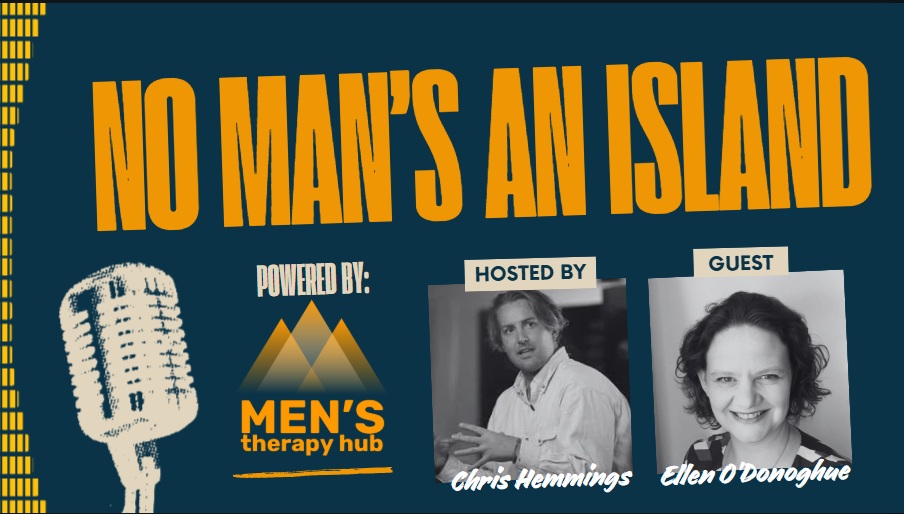
How We Get Them Through with Ellen O’Donoghue
Men’s Therapy Hub launch week continues with another episode of No Man’s an Island. This is a vital conversation about suicide prevention that meets men where they are. Chris Hemmings speaks with Ellen O’Donoghue, Chief Executive of James’s Place and co‑chair of the National Suicide Prevention Alliance. Ellen draws on years of public health leadership at Movember and Public Health England to unpack what brings men into suicidal crisis, why many do not see themselves as having a mental health problem, and how a focused, rapid clinical intervention can dismantle crisis and restore hope. We explore James’s Place’s model – swift access within two working days, structured therapy delivered by trained clinicians, practical signposting for issues like debt and relationships, and welcoming spaces designed for men. Ellen also looks ahead – the need for early intervention, stable funding, smarter collaboration and campaigns that go to where men are. If you work with men, love a man or are a man navigating tough ground, this episode offers clarity, practicality and a path out of the darkest moments.
What we cover
- Why suicidal crisis often stems from life problems men cannot solve – not a diagnosis
- James’s Place’s model – urgent access, structured therapy, safe spaces
- The IMV lens – who a man is, what is happening now, proximity to means
- “Go to where men are” – designing services and messaging that land
- Collaboration, funding and scaling crisis services across the UK
- Early years and early intervention as long‑term prevention
Listen and watch
- Listen to all episodes here: No Man’s an Island
- Watch on YouTube – https://www.youtube.com/watch?v=fMk4GXWtTTM&t=1619s
- Listen on Apple Podcasts – https://podcasts.apple.com/us/podcast/no-mans-an-island/id1849171262
- Listen on Spotify – https://open.spotify.com/show/5QgINHeUZKorBCE4LBoBXF?si=eae037416d464a10
Takeaways for men
- If you are in crisis you deserve help – you are exactly who services like James’s Place are for
- Name it – asking directly about suicide can open the door to safety
- Crisis can pass – with structured support you can move beyond the worst moments
- Practical problems need practical help – therapy plus signposting works
- You do not have to find help alone – let services come to where you are
Quotes to share
- “The man we see often does not think he has a mental health problem – he has a life problem he cannot solve.” – Ellen O’Donoghue
- “With the right structured support men get better and get better quickly.” – Ellen O’Donoghue
- “It should not be a person’s job to find help – it is our job to get help to them.” – Ellen O’Donoghue
- “You cannot solve the problem you cannot talk about – name suicide when you see it.” – Ellen O’Donoghue
Resources and links
- Men’s Therapy Hub UK – therapist directory and podcast hub
- James’s Place – men’s suicide crisis therapy
Episode credits
Hosted by Chris Hemmings with Ellen O’Donoghue. Produced by Men’s Therapy Hub. Recorded 2025.
TRANSCRIPT:
Chris (00:00)
Welcome to No Man is an Island, a podcast powered by Men’s Therapy Hub, a directory of male therapists for male clients. I’m Chris Hemings and today I’m going to be speaking to Ellen O’Donoghue. She is the chief executive officer of James’s Place. That’s a UK based suicide prevention charity which offers clinical intervention to men in suicidal crisis. Ellen is also serving as the co-chair of the National Suicide Prevention Alliance. Now,
Ellen is here. She has a deep and varied background in public health, mental health promotion and behaviour change. And I’m definitely going to ask you about some of that today. We need some expertise. Now before joining James’s place, she led global health promotion programmes for men at the Movember Foundation and directed strategy and planning for behaviour change campaigns at Public Health England. So somebody who knows how to engage people in campaigns. And that is going to be
a lot of what we talk about today, I hope. But first, Ellen, welcome. And I want to ask, how did you start to become so deeply involved in work around men’s mental health?
Ellen (01:06)
Hi Chris, it’s lovely to be here. Thank you so much for inviting me. So as you mentioned in your very kind introduction, I’ve worked in a variety of roles, always around health and public health ⁓ and social change and mental health has always been a key part of that. And for me, I think it’s one of the most interesting areas where really what we’re trying to do is align people’s lives, their day-to-day experiences, what they want, what they need.
with what services they need to have access to. And I think mental health is absolutely at the heart of that. And suicide prevention is a really key area where really what we’re looking at is what somebody’s life is actually like and what kind of support they might need in the context of that. So when I first heard about James’s Place, I thought the work that they were doing was really profoundly interesting and quite exciting, I think, as an idea to bring.
a service intervention directly to where men ⁓ needed it most and certainly when I joined six years ago that was a big part of the motivation for that.
Chris (02:14)
What’s been the biggest surprise for you working in this huge area and from a personal perspective, my journey into men’s work began, well, with the death of my father in 2012 and subsequent ⁓ drug abuse, but then coming out of that and learning for the first time 13 years ago now, the suicide statistics and just how much they affected me. I know everyone knows those suicide statistics now, but back then,
I mean, even six years ago, we were only really starting to have this conversation in depth. So what’s been the biggest shock or surprise for you in this, in this role?
Ellen (02:51)
I feel like we could discuss this question alone for the full hour, so I’ll try and keep myself short. I think the thing that really struck me when I first started working ⁓ specifically in suicide prevention and particularly at James’s place was the universality of the experience that I think before I joined, I imagined that we would be supported by people who had very precise and very specific experience of ⁓ either being suicidal or being bereaved by suicide.
And in fact, what I see is a much, much broader coalition that we have people fundraising for us, supporting us, working with us collaboratively as stakeholders who understand what it is to experience significant distress. You could say it’s part of the human condition. And I think what has been wonderful about James’s place is seeing that breadth, that real willingness across communities, individuals, people.
to help others when they’ve reached the point that they don’t feel like they can ⁓ carry on. And I think for me, that’s been something that has been both surprising and incredibly motivating. I think we’ve been really fortunate to benefit so much from support right across ⁓ the country. And that understanding that people have of what it would be like to be a man who needs the support of a service like James’s Place has been really…
profound and really quite moving as well. think the thing that surprised me most though before I joined James’s Place or that I really needed to, I think, understand, which is also one of the key things that we want other people to understand at James’s Place, is that people who are experiencing a suicidal crisis won’t necessarily and often aren’t experiencing a mental health or kind of psychiatric condition.
that the things that drive people’s crisis are really rooted in everyday life events. And I think that’s something that’s so important that the men who come to us at James’s place won’t see themselves as having a mental health problem. They’ll see themselves as having a problem in their lives that they can’t solve. And that might be around relationship breakdown, family problems, financial issues, debt, job loss, redundancy, all these very recognisable things that can build to the point where somebody can’t see a way out. And I think that’s one of the key
kind of shifts that we would like people to understand is that suicide prevention takes place outside the context of mental health and mental illness and is something that’s really a universal thing for us all.
Chris (05:29)
Is that a deep seated reluctance perhaps on the part of men to acknowledge that ⁓ relationship breakdown, which I know is one of the biggest indicators ⁓ of predicators sorry of, of suicide or suicidal ideation ⁓ that perhaps there is an unwillingness to accept and acknowledge that depression, not clinical depression, but depression that comes
from a ⁓ relationship breakdown or a job loss is related to their mental health in some way, or are you saying actually they are two separate things altogether?
Ellen (06:12)
think every person is different and so we will see men at James’s place who are experiencing really recognisable symptoms of depression and anxiety. We will also see men who have a well managed mental health condition but fundamentally what we’re seeing in suicidal crisis is somebody for whom the problem in their life has become the overwhelming issue and I think it’s about helping people to understand how they’ve come to be in that place, how they can get through it and really how they can stop it from happening again.
And I think there’s something really vital that we recognise that the problems that men are facing are not simple, they’re not easy to solve. We’re not saying it’s a of a simple problem to get out of debt to find a job, for example. But what we are saying is that with the right structured support, we can help a man get to a point where he’s not seeing suicide as the only way out of that problem. And I think that’s exactly what we do at James’s place.
Chris (07:08)
Is that the major driving factor is that men don’t see an alternative to escape from the pain that they’re experiencing other than taking the ultimate decision to end their life? Is it that we at the moment still, societally, culturally, we don’t offer men enough alternatives?
Ellen (07:30)
I think that’s a really good way of putting it. think that the men that we see want a way out of the difficulties they’re facing. And I think it’s worth reflecting on our founder’s ⁓ son’s story, James. And James did the things that you would want someone to do. He sought help. He went to a walk-in centre where he told them he was suicidal. He went on to A &E where again he said he was suicidal. So he was looking for a way out of the situation he found himself in.
Tragically, he didn’t find that help and ⁓ he died a few days later. And I think what we’re doing at James’s place is very much based around James’s experience and the experience of many, many men like him, that without that kind of immediate support at a time of really acute crisis, men are incredibly vulnerable to losing their lives by suicide. But with the right kind of supports, for example,
the work that we do at James’s place, they can and do get better and get better really quickly. So I think it’s about making sure that that help is there at the point of crisis so a man can access immediate urgent support, but really then helps him to go on and live his life.
Chris (08:48)
I think I saw a social media post from James Place today. And if I was more organized, I would have the exact statistic in front of me. I think it said, you’ve now helped more than 4,000 men ⁓ out of a suicidal crisis. That’s phenomenal. And it goes without saying each one of those men is a father, brother, friend, husband. That’s just magnificent. The work that you do, what would it be like?
for an individual who walks through your doors and says, need help. am considering ending my own life. How do you approach that? Because I know as a therapist, it’s very interesting. When we were doing our therapy training, we were told one of the kind of, it’s almost counterintuitive with suicide.
that when someone talks to you about suicidal ideation, you lean into that conversation. You talk to them specifically about how are they considering doing it? When are they gonna consider doing it? Have they thought about it? Really kind of confront them with their own belief structure around themselves. you know, as a therapist, I’m expecting those conversations because someone has already had a conversation with me beforehand. They’re coming into this work and they’ve already written. You’re getting people who are…
at the real point of crisis. How do you triage them the moment they come in?
Ellen (10:19)
I mean, I think there are a lot of really important points that you’ve raised there. I think it’s absolutely fundamental to our intervention that whilst we’re a therapy based ⁓ intervention, we don’t have the time to work with men to build up what would be a kind of almost traditional psychotherapeutic relationship that we need from the very first session for a man to be able to talk about some of the most difficult things that he’s facing and experiencing.
And so our model, which was developed by our clinical lead, Jane Boland, has always been about trying to get to a man to that point as quickly as possible. So to break down as many barriers as possible, to make it possible for a man to speak really, really quickly about honestly incredibly difficult things sometimes. So we’ve identified some key elements of what we would see as the James’s Place model. We use a set of cards, for example, called Lay Your Cards on the Table, which help a man
articulate the things he might be feeling, thinking ⁓ and doing. We also make sure that we offer our service in really calm, welcoming, safe spaces. It’s a physical environment where we’d expect a man to feel really welcome and that he’s somewhere he’s going to be looked after. We also only work with trained professional therapists. So all of our therapists will have a track record in delivering counselling and therapy, but who will then
be trained in our specific intervention. And so they will work with that man over a period of about four to five weeks, ⁓ usually six to eight sessions, in a very structured way to work through how a man’s come to find himself in crisis, how we can get through it and how we can really prevent it from happening again. And I do think there is something really important about our intervention that it’s not about…
I suppose diagnosing somebody, stepping back and telling somebody what’s happening to them, it’s about helping a man come to that realisation himself. And I think that’s one of the reasons that the intervention is so impactful, but also that it can really sustain across a long period, because a man has worked with his therapist, James’s Place therapist, to understand really what’s happening to him. And I think that’s so fundamental to everything we do as well.
Chris (12:42)
That intrigues me because one of the challenges I think in kind of traditional therapeutic approaches and maybe trying to move away from a bit of the stuffiness of old school therapy, let’s say, would be to be completely non-directive, right? We don’t tell clients, I mean, we specifically can’t diagnose because we’re not psychiatrists, but we are not there to tell our clients specifically what’s wrong with them. We help
to guide them there. Some clients might need a little bit more nudging and poking than others. But what you’re saying is you actually have to figure out a way to get a man who quite possibly has never spoken to anybody before ever about the realities of the depth of their emotional pain. And you don’t have 40, 50, 60 sessions as I might do with some clients. You’ve got eight because you’re a charity and you’re
Ellen (13:30)
you
Chris (13:40)
resources are limited, I presume in that way, which is partly why men’s therapy hub is donating to you to try to help in the future. And that model, I know you’re not a clinician yourself, but I know that you will be very up to speed with that model. What is it about that model that you know, or has been reported to you that actually is effective at meeting a man and getting the, hey, okay, you’re here now.
We have to do this. How do you get that? Because that’s probably one of the biggest challenges many of our listeners will face either as therapist or client in the future.
Ellen (14:22)
I think a really important thing to recognise about our work is that we are only working with a man to kind of dismantle his suicidal crisis. So we work through, as I say, about six to eight sessions because that’s typically what we find is enough to get to a point where a man can kind of go forwards with his life. And I think that all of the kind of factors I mentioned earlier about
kind of the elements of the model are designed precisely to do that. And I think that the final piece of the picture is about urgency. So we commit to seeing men within two working days of referral. We don’t have a waiting list. So if a man is referred to us on a Monday morning, we’ll review his referral pretty much straight away and really aim to have him in for a welcome assessment the next day. So we’re working very, very quickly. And that’s because the men that we’re seeing
are in really very immediate risk. They might have an active plan to end their lives. They might have recently made an attempt. They might be finding that their ⁓ day-to-day lives are becoming increasingly disrupted by ⁓ suicidal thoughts and plans and impulses. So I think what we’re looking at are men in a very precarious, very risky place who need that kind of urgent help. And so…
what we’re doing at James’s place is not trying to necessarily solve the long-term underlying problems, ⁓ but to get a man to a point where he’s not in suicidal crisis anymore. And so all of our resources are focused specifically on that. And then it comes through partnerships with some of the organizations that you will be working with as well to look at how can we help signpost a man.
on to further support. So for example, if somebody’s dealing with problems around debt, we would seek at James’s place to get him to a point where he wasn’t in suicidal crisis anymore. But we might then refer him on to an organisation that can help him with debt counselling, for example. We might look at other partnerships with organisations who can support in a variety of ways and to make sure that people are getting the kind of practical help that they need. But fundamentally, the one thing that we do is help
a man to not be in suicidal crisis anymore and that’s what everything that we do is focused on. But as you say, we’re a charity, everything we do is funded by people’s incredibly generous donations, people go to amazing efforts to support us, which I think lifts all of us every time. And we’re not funded by statutory funding and we do that consciously so that we can add something additional.
to what’s already available to people who need support.
Chris (17:21)
You say people who need support there and men’s therapy hub is for men by men. ⁓ James’s place is for men, not necessarily by men. One of the challenges and just as an example in the domestic violence and domestic abuse space, there have been specific spaces for women and maybe some people who don’t have the best intentions at heart will say, where are the spaces for men? Which obviously the answer to that is obviously well,
you need to start them. ⁓ In this space, do you ever get put first of all, do you ever get pushback for being male specific and male centered? Because, of course, 70 ish percent of suicides are male. That doesn’t mean that other genders don’t also end their life. Do you ever get that pushback?
Ellen (18:11)
Well, as you reference, the numbers of deaths by suicide in men are particularly shocking. And that really is what drives the focus for James’s place. So we work with men because they’re three times more likely than women to die by suicide. And it’s the leading cause of death for men under 35. So it’s a really pressing ⁓ and I think compelling reason to provide a service specifically for men.
And I think, I don’t think we do get a lot of pushback. I think people understand that we are a charity. We’re one thing. We’re part of really a network of wider provision. It’s one of the reasons that I’m so pleased to be able to play a part with the National Suicide Prevention Alliance as well, because we are not going to solve every problem that every person has. We have to work collaboratively and be part of a network that gets people.
the support that they need when they need it. What we do at James’s Place is help men who are in suicidal crisis, men who are in immediate risk and who need urgent help. There are other absolutely fantastic charities who help people at different stages of ⁓ their journey, who might do ⁓ brilliant upstream prevention work, who might be able to support women, who might support people who need a different kind of ⁓ treatment or service. I don’t think, ⁓ I don’t think
it’s something that we would ever shy away from, the focus that we have. And I think there’s also something really important that the men that we see will very often start their treatment with us by saying something like, I shouldn’t be here, there are other people who need this more than me. And I think particularly being aware that we’re a charity, they may feel that there are other more deserving.
recipients of that kind of help and we can say to them you are precisely the person that this is here for we have created this for you and for people like you and that’s why you’re here and I think that is such an important statement to be able to make to a man in crisis that there is no place that he should better be and there is no more deserving recipient of the service than him and I think that’s something that we try and emphasize at every stage.
Chris (20:09)
and that’s why you’re here.
Does that speak to a conversation around male privilege, for example, ⁓ which seems to be a topic that comes up quite a lot ⁓ when you’re working in men’s mental health spaces? Because as you say, lot of men will say, you know, I always remember my mom saying, there’s kids starving in Africa, so you don’t have it so bad. And I actually make that joke with clients sometimes. like, you don’t get to be sad about.
the grief that you’re going through because there’s kids starving in Africa. And it’s like, yes, there are. And you’re also going through grief and pain. And that’s the one of the big barriers, I think, for men to engage with their own self is first of all, they feel like a burden. Secondly, they feel as you beautifully put there, the sad reality is so many men think, well, I shouldn’t be using up resource because other people have it worse. And I wonder if that’s something
maybe I get your opinion on this, intrinsic in the male condition of the provider protector, the protector, well, I don’t need to be protected because I’m the protector. So somebody else could be using this service better than I could or something like that.
Ellen (21:41)
think they’re all really interesting and really important points and at James’s place we evaluate our work really rigorously and have rights since the very beginning and one of the things that we look at are those kind of psychological factors that might drive a crisis and we know that feeling like a burden, ⁓ feeling ⁓ humiliated, feeling lonely, they’re all factors that can be ⁓ really, I think, really very difficult for people and I think, yes.
Clearly those factors can be made worse by things happening in people’s specific lives but also ⁓ in society more widely. I also think that as a society we don’t always cope with distress very well. I think that we often measure people in quite medical terms whereas when we’re thinking about something like suicidal crisis it’s really distress that we need to be looking at. We’re seeing people with very very high
levels of distress, you need urgent and immediate help and the things that can be driving those distress, that those levels of distress can be very kind of varied, that suicide is incredibly complex and driven by ⁓ a real variety of factors. I do think that, you know, it’s really important as well to recognise that this isn’t something that happens in a vacuum, know, men from the most deprived areas.
are 10 times more likely to die by suicide than men from the least deprived areas. There are ways of coping and dealing with problems that simply aren’t available to everybody. And I think we absolutely need to recognise that people’s lives are very complex, they can be made much more difficult by socioeconomic pressures, and also by the expectations that people have for themselves and see
see as others having for them too and I think they’re all things that our therapists would be trying to unpick with a man ⁓ and help him to understand to get to a point that he can kind of carry on.
Chris (23:45)
And that is the challenge, is helping men to see that there is life beyond the crisis.
That is a huge challenge because we are also in a male loneliness crisis epidemic, call it what you will. We are ⁓ still in a cultural situation where, well, the interesting thing about male loneliness is most men aren’t physically isolated, they’re emotionally isolated. So the isolation comes from not feeling seen, not feeling heard. ⁓ And that’s where I know, and this is where I’d like to expand out.
to kind of tap into your deeper knowledge base. The work you do at James’s place is vital and brilliant. And I’m so impressed with the work that has been done and I’ve watched it grow over the years and the way it’s been brilliant. You also worked with Movember, you worked with Public Health England, you work in so many areas. And one of the biggest challenges that I think all of us face, and sadly I’ve seen even this week two different
organisations aimed at helping men specifically have closed. And how do we better engage men in the parts of their life that have been up until very recently, uncontactable, like unengageable? How do we actually, you know, in the work that you’ve done with Public Health England, in the work you do with James’s Place, when you were at Movember,
How do you create campaigns that make men go, ⁓ that’s about me? Because mostly with psychological stuff, we haven’t considered it’s about us.
Ellen (25:30)
I mean, that’s always the big challenge, isn’t it? Is how ⁓ do you reach people in such a way that engages them? But I also think there’s a fundamental point to make about not leaving it to the person in need ⁓ to reach out, to make sure that actually we’re providing a set of services, information, knowledge that people…
have easy access to when they need it most. think there’s something really important to me that it shouldn’t be somebody’s responsibility to find help. It’s our responsibility as a society to get that help to them as well. Movember got a lovely phrase about going to where men are. And for me, that’s not just a kind of a physical ⁓ manifestation. I think that’s psychological as well. And I think I remember, you Movember did some really, powerful work around suicide prevention where one of the
things that they found was that many men who’d been suicidal felt that they had sought help, but they hadn’t been heard, that they had tried to indicate their distress, but it wasn’t understood. And I don’t think that’s necessarily, you know, that’s not necessarily a kind of a blame or a fault. It’s that the way that people are expressing distress is not the way that people recognise or hear it. And I think there’s such a lot of work to do to look at that across the board. So if men across the board,
Chris (26:34)
Right.
Ellen (26:56)
but particularly to start thinking about kind of intersectionality and the other reasons that a man might have not to trust a service like ours. So one of the things that we do in our centres is think all the time about who needs to know about James’s place, how do we make sure that they do know and how do we make sure that their kind of knowledge is something that is then returned, that we make sure that when somebody does.
seek help from us that we support them in the way that they expect to be helped. And I think one of the things certainly that was really clear from all of the work that I used to do in public health is that whenever you’re engaging with someone, whether you’re communicating with someone, it’s not in a vacuum. It’s not the first time that they’ve had contact with services. It’s probably about the millionth time that they’ve had some kind of engagement with services in the state. And their previous…
experiences will have a strong influence on how they hear and understand what you’re trying to tell them. And I think there is something, there can be sometimes a mismatch between what the kind of service or the organisation wants to say and the context in which that’s heard. So I think one of things that we do at James’s place, for example, is we speak to men who’ve used our service, speak to men who might be in…
who might be in need of our services to make sure all the time that what we’re offering is really effective. you know, I mentioned earlier our academic evaluation, but we also speak to men who’ve used our service. What was it like for them? What did they think about us before they heard about us, before they knew us? And I think there’s something really key as a sort of fundamental principle that services need to deliver on that kind of…
that kind of trust really that if somebody seeks help we have to make sure that help is available for them.
Chris (28:47)
tailored for them.
Ellen (28:49)
Yeah, yeah, absolutely.
Chris (28:52)
Because to me this is where I kind of want to ask a cheeky question that I know the answer to, which were if you were to launch Jane’s place, which would also be valuable, I would presume that the messaging, the interventions, the decor, everything about the places would be different than they are now because they’re designed for men.
Ellen (29:01)
Mm.
Get my-
Yeah, quite possibly. I think we have designed James’s Place for Men from the very beginning. So everything from the, you know, from the surroundings, from the way that we communicate with people has all been done with reaching men in mind. And I think some of the most impactful interventions ⁓ have looked very different for other groups. So, you know, I would always point to mother and baby units, for example, as a profoundly important suicide prevention.
intervention which is you looking at women in that perinatal period and how you make sure that they get the support they need without being separated from their babies for example. for me what we want is specific interventions targeting people, ⁓ tailored for people, designed around their lives and their needs but also evaluated to make sure that they’re as impactful as they need to be when they’re working at such high levels of risk. But you’re absolutely right that what
you know, what one person needs might be very different to another, what one community needs might be very different to another. And we’ve been, we’re now working towards opening our fourth centre. And I think we have learnt something, we’ve learnt quite a lot along the way about what is unique and specific to the work we do at James’s place and what might change each time. And fundamentally, I think what we found is that the core intervention, the intervention that Jane developed, you
those years ago, it remains the same. That a man who comes to us in Newcastle will experience the same intervention as a man who comes to us in London, say, or in Birmingham, which would be our next centre. But the way he reaches us might be quite different. The partnerships that we have locally might be different. The way that we interact even with local NHS services might be different.
I think it’s all about understanding what does need to change and actually what is absolutely central to the intervention itself.
Chris (31:22)
I asked that question because I know that there is a movement or a change now within psychotherapeutic world, counseling world, ⁓ slow change of, well, here’s the irony of it. Almost all of psychotherapeutic interventions are based on the fact that our socialization affects us as we grow and develop. ⁓ And yet it seems that within the therapeutic world, there’s still a reluctance to accept that gender.
And you can, we could have a long conversation about whether gender is innate or whether it’s a construct or either way we know that male-bodied people and female-bodied people are socialized differently in our world still. And yet we don’t seem to be fully willing to accept and acknowledge that that impacts the way that we as men communicate, the way that we…
For example, if I work in person with clients, I don’t sit face to face. I sit at a 45 degree angle to reduce the stress of feeling like I’m imposing on them. Like taking their socialization into account is important. And yet sometimes I feel like there is a reluctance to do that. The beauty, I guess, of having a male space that is for men as James’s place is, is that you can disregard and you can just say, we know this works.
This is what we’re doing. Sod off if you don’t like it. And I’m sure you wouldn’t say that. I would say that on your behalf because you’re much more polite than me. But there’s an importance there to acknowledge the reality of the situation that we find ourselves in. I hear myself quoting my granddad. My granddad took me out golfing when I was a kid and I tried to cheat and kick the ball out the roof. And he said, hey, said, son, you have to play it as it lies.
It’s a metaphor for life. And I was like, I didn’t understand that at the time, but we have to play it as it lies. And as it lies is men are socialized differently. And I think it’s beautiful that you’re here saying, we understand that knowledge that I’m, it would be remiss to do it any other way.
Ellen (33:33)
I think that probably the most important thing about our intervention is the recognition that a man’s crisis is coming out of his life, it’s coming out of his experience. And it’s really important for us as a charity, as a service, to make sure that we’re providing a service that is best focused on helping him to kind of go on and live that life. I also think that there is…
there are clearly some groups of people, some experiences that make a suicidal crisis particularly likely and particularly high, particularly hard to address and deal with. Like one the things that we’re really concerned about at the moment, which I think there’s some really kind of striking studies being done on at the moment is about neurodivergence, for example, so that we’re seeing high numbers of men who are neurodivergent coming to us at James’s place and…
To some extent we’re seeing people whose crisis could have been addressed much, much further upstream, that people are reaching a point of crisis because they can’t get the help and support they need earlier on and in different ways. And so for us, understanding where someone’s crisis from is rooted in who they are, what their experience has been, what their experience of life and other services has been.
but also what’s happening to them in that moment. And a lot of our work is built around some of the fantastic work that Rory O’Connor and his team have done ⁓ in Glasgow around the kind of IMV model, the integrated motivational volitional model. And that really, if you were kind of translating it into very overly simplistic terms, is looking almost at kind of three buckets. So who somebody is, where they kind of come from, you know, what…
what their kind of psychological makeup is, what their background is, the kind of things that have happened in their lives, what’s happening to them at the moment, the kind of stresses they might be experiencing, and also their kind of ability, their proximity to the means to hurt themselves. And I think that’s a really important thing to recognise as well, that some of the things that you’re talking about in relation to kind of gender and kind of identities that people experience.
will be sitting in that first category and that can interact then very badly when something happens in somebody’s life that brings them to a point of immediate risk and crisis.
Chris (36:04)
So I’m gonna give you the keys to the vault, right? And with all of your knowledge and experience that you have, I’m gonna say you as somebody who is very wired in to suicide prevention more generally and specifically for men, because that’s obviously what this podcast is mainly focused on, I give you the keys to the vault. You can do anything to reduce the number of male suicides.
Where would you stop?
Ellen (36:37)
I think this is probably a slightly techy answer, but I think I would start by recognising that there are multiple points that we need to be able to intervene at. So I think there will always be a need, much as we would like there not to be, for crisis services like ours. So absolutely, let’s make sure, let’s fund it consistently, structure it appropriately so that anybody
⁓ who’s in suicidal crisis gets access quickly, urgently to appropriate tailored crisis intervention support. And so for men, that would be James’s place. We would want to make sure that that was a really consistent coverage. At the moment, we can help men in the Northeast, Northwest and London. And it’s a source of real frustration to me that men outside those areas can’t get the help that we provide because we know it’s effective. We know they need it.
we know it’s not available elsewhere. So I think that’s really driven quite a bit of our really strong efforts to replicate and extend the intervention as widely as we can. So I think there’s something about crisis support. I think then it’s also about looking at the other points at which somebody can help. think it was very striking to me. When I ⁓ joined James’s Place, I had been doing quite a bit of work on youth violence.
And at the time I was also doing a kind voluntary position with the mayor of London on child obesity. So I was reading about child obesity, was reading about youth violence and I was reading about suicide prevention. And what’s really striking is that when you look at the kind of early indicators, the kind of nought to five years, the early years stuff, it’s all very similar things. I think the experiences that people have, the kind of context in which they grow up that make them vulnerable to…
know, child obesity are also there in relation to some of the other outcomes, including things like suicide. So we really, really need to get proper early intervention work ⁓ up and running so that people are getting the support they need at the earliest possible place. And I think, you know, initiatives like, you know, Sure Start, for example, were really profound and important in doing that kind of thing. I think there’s then something about being ready to intervene.
when difficulties are emerging. And I think it’s no secret or no surprise to anyone to say that things like long waiting lists for ⁓ mental health services, for support, for counselling can be really damaging. So we’re seeing people who could be helped quite simply, quite early on with some quite kind of short-term support who aren’t getting that support they need. And so they’re…
problems are intensifying and becoming much harder to solve. So think getting that early intervention kind of much more quickly and much more consistently to people is really key. And then I think there’s something about the whole system working together so that we do something very specific at James’s place. But I would also want to see, you know, we work best when our local partners are also supported and thriving. So this whole network of coming together around CSI prevention.
bit of stigma reduction as well, I think is really key. I do think that suicide is still very stigmatized. It’s very difficult for people to talk about being suicidal. It can also be very difficult for people who’ve been bereaved by suicide to get the help that they need. So I think it’s that wider societal thing. And so those four key elements working together so that you make it easier to get help early, you make it easier for people who are needing to talk about suicide to do so.
but you also make it much, much more consistent that when you do hit the point of crisis, the help is there.
Chris (40:31)
And you mentioned that the importance of collaboration with community partners across the board.
In your time working in this space, ⁓ have you seen a change? Because many years ago in my life as a journalist, I wrote on International Women’s Day an article about how the women’s movement is a marvel and the women’s movement for decades was fantastic at working together for the greater good. And I think I have my own experiences of men
saying, no, I don’t collaborate. And yet they’re presenting work that they didn’t invent themselves. So they’re already collaborating with the people who invented bystander intervention, for example. And yet, no, I don’t, I wonder if the men’s movement has been slow to pick up on cross collaboration.
Ellen (41:32)
I can understand where you’re coming from, but I think honestly my experience hasn’t been that. Actually I’ve found real appetite for collaboration, certainly in the suicide prevention sector. I think, excuse me, I think there’s, it’s often a stick that’s used to beat the charity sector with, that it’s not collaborative enough and that it needs to work together more. Actually I’ve seen amazing collaboration, looking at for example the way that we’ve been
brought into existing networks. When we opened our new Castle Centre there were a number of charities already working in the North East who bent over backwards to help us to establish ourselves, to work together. And I think it really is about that kind no wrong door approach. So making sure that if somebody reaches out to us and we’re not the right service for them that we then help them to get to the service that is right and is going to help them. So I think there is a lot of collaboration, but I also think
that because there are such difficulties at the moment in accessing sustainable funding in our sector, it kind of creates barriers to collaboration. So the single thing that would improve collaboration most, honestly, would be to make it easier and simpler to access appropriate long-term funding. Because, know, honestly, in the sector, I think there is a really common vision and goal, which is to make sure that, you know, nobody
faces a suicidal crisis alone, whoever they are and whatever they need. But I think the kind of structural difficulties in getting help to people can make that more difficult than it needs to be.
Chris (43:16)
And that is often the frustration.
know, I know traditionally, ⁓ organizations that are male focused, male centric, have struggled to attract funding. I would say here, push, the irony of that is that men at large, we don’t do enough to promote each other. We don’t do enough to help as a, as a, as a gender to help our fellow man.
And we could probably go back to the provider protector stuff. I was talking about earlier But what you’re saying is actually You and many others are hamstrung by what the lack of a guarantee of your funding in five years time Is that what you’re saying?
Ellen (44:06)
think it’s certainly a barrier and I think we, at James’s place, we’ve been really fortunate to be supported amazingly by lots and lots of different people but across the sector we are seeing real difficulties in brilliant services, keeping their doors open because the funding isn’t there for them to do that. So I think that really collaboration is best done when we can kind of focus on
what we all are trying to achieve together, which is a really universal thing. It of goes back almost to the point I was making at the beginning of this discussion about the kind of universality of suicide prevention. People understand why this is necessary. And there are some absolutely wonderful initiatives that have come from a place of great loss. You we were founded in memory of a 21 year old young man who died by suicide. And I think…
his parents were so motivated to try to stop that from happening to any other family, to any other young man like James. And I think that story is seen right across our sector of people doing extraordinary and very brave things, I think, to try to help other people in the face of their own kind catastrophic loss. And so the point I’m making is simply that I think the collaboration or the urge for collaboration is absolutely there.
But it’s a very difficult economic climate, it’s a very difficult climate for charities across the board. And I think we really need, as a sector, sometimes to say that and acknowledge that, because there are a million things that I would love to do. You were talking about a version of James’s Place for Women. I think we are always looking at innovation. How do we get our service to as many people as possible, as quickly as possible? But really, it’s then about how do you make that possible?
financially and structurally as well.
Chris (46:02)
And I asked Mark Brooks this question just last week, because he’s somebody who has been heavily involved in men’s work for two decades now. You’ve been heavily involved in suicide prevention and specifically with men for many years now. Have you seen, I’m going to actually scratch that. Have you, have you, have you, how do you look upon
the recent changes where in the last two years, suddenly there has been an explosion in the conversation around men’s issues and men’s mental health and male suicide and male violence and homelessness and all of this stuff that many of us like yourselves and me have been banging on for years about and felt like people weren’t paying attention. Do you get the sense now that people are?
starting to pay serious attention to men in a way that perhaps they haven’t before.
Ellen (47:06)
think that’s a really interesting question and I think I, I mean obviously I’d be looking at those kind of issues always through the lens of suicide prevention and I think what I have seen and what I absolutely do recognise is that you can’t solve the problem that you can’t talk about and I think making…
these discussions mainstream, being able to talk about mental health, being able to talk about suicide and suicide prevention is really fundamental. And I think it’s something that we all say, you know, that when somebody is suicidal, it can be a real reluctance to ask them that direct question. And we would always obviously really ⁓ urge people to name it, to say, you know, are you feeling suicidal? Are you thinking about ending your life? And I think that probably goes to the wider
⁓ the much wider kind of mental health, wellbeing and wider mental health kind of discussions as well. That the more we can talk about these things, the better able we are to deal with them. And I certainly think that ⁓ it’s a very positive thing if we’re seeing a generation of ⁓ younger people who are more comfortable talking about their mental health, their wellbeing. ⁓
But I also think that we have to recognise that the context that people are growing up in is really difficult at the moment. We’re seeing very difficult economics of kind of circumstances and we’re seeing some quite concerning things about the optimism that young people have for their futures. So I really would like to celebrate the positive things that we’re seeing, but also recognise the very difficult climate that young people are growing up in now, I think.
Chris (48:53)
Thank you ⁓ for that. I’m gonna give you the chance now to do your sales pitch to any listeners for potential people who are in suicidal crisis for people who might know somebody who is and for anybody who has a spare few quid to throw at you How do they find you and what is what is the processes for getting for getting in touch with you?
Ellen (49:21)
Thank you so much for that chance to let people know about what we do. think what’s great to some extent about James’s Place is it’s the same message for people who need us and people who want to support us, which is that James’s Place is here, it’s free to use, it’s quick to access. We offer ⁓ life-saving therapy for men in suicidal crisis in our centres in Newcastle, London and Liverpool. We’ll be opening a centre in Birmingham next year.
And the men who come to us will receive really important structured therapy delivered by our trained professional therapists in a really warm and welcoming environment. It’s a free service for men to use and we commit to seeing people really quickly within two working days. And we’ve been able to help over 4,000 men so far and we are really keen just to get
the message out there that James’s Place is available for people when they need it. We take referrals from other organisations like the NHS and other charities, but men can also self-refer as well. people can find out more on our website if they search James’s Place and they can make a referral directly on our website too. And fundamentally what we’re doing is working with a group of men who will really struggle to get the help they need.
outside of James’s place and it is so important that that help is there when they need it most to get them to a point where they can get through their suicidal crisis and go on to live their lives.
Chris (50:56)
Thank you, Ellen. Thank you so much for giving us your time today and for all the work you’re doing. let’s hope that that big pot of money comes your way and keeps coming your way because the work you’re doing at James’s Place is essential, it’s vital and most importantly, it’s quite literally life saving. So thank you.
Ellen (51:13)
Chris, thank you so much. It’s been an absolute pleasure to talk to you.