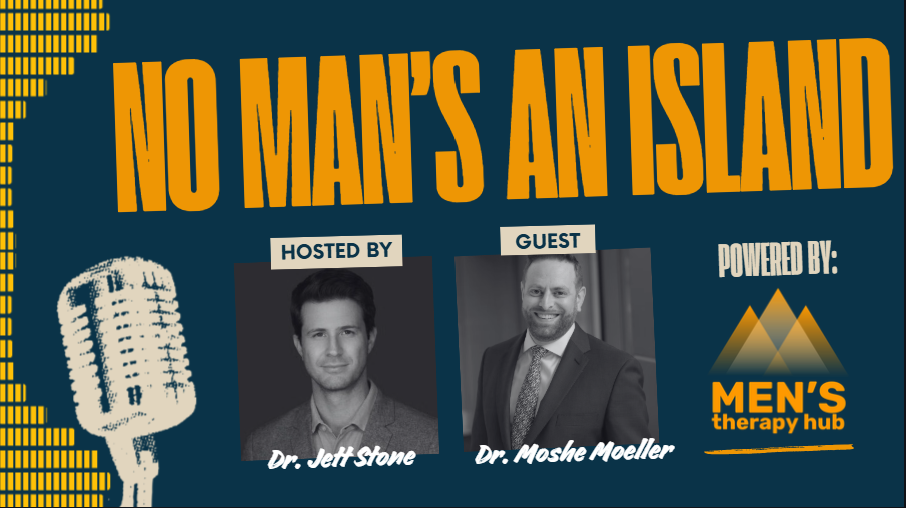
The Fight for Dads with Dr Moshe Moeller
In this episode of No Man’s an Island, Dr Jett Stone speaks with Dr Moshe Moeller a clinical psychologist, assistant professor at Albert Einstein College of Medicine and associate director of the Hero Dads programme at Montefiore Medical Center in the South Bronx.
Moshe’s journey into fatherhood research did not begin in a psychology lab. It began in rabbinical study.
Raised in an Orthodox Jewish community, Moshe spent years in yeshiva before transitioning into psychology. What started as a personal search for meaning and healing evolved into a professional mission to understand fatherhood, attachment and the structural barriers facing disadvantaged dads.
This conversation moves from faith and masculinity to class, the legal system and intergenerational trauma. It is both deeply personal and systemically grounded.
What we cover
- Growing up in an insular Orthodox Jewish community
- Moving from rabbinical study into psychology
- Studying fatherhood when almost no one else was
- Rough and tumble play and what fathers uniquely offer children
- Masculinity in Orthodox Jewish culture
- Patriarchy, shifting gender roles and religious identity
- Narcissism and pressure within traditional male roles
- Class as the defining variable in men’s outcomes
- The South Bronx, poverty and non-custodial fathers
- Structural bias in the family court system
- Insecure attachment and why many dads feel guarded
- How Hero Dads creates secure attachment for men
- What real change for fathers would look like
LISTEN & WATCH
🎥 Watch on YouTube: No Man’s an Island – Episode 23
🎧 Listen on Apple Podcasts
🎧 Listen on Spotify
From yeshiva to psychology
Moshe describes growing up in a more insular Orthodox Jewish world, where gender roles were clearer and often more rigid. His early education centred on Talmudic study and religious scholarship.
His move into psychology followed a period of unexplained physical illness. Through therapy and learning about the mind body connection, he discovered how emotional strain can manifest physically. That experience opened a door.
“When I decided I wanted to study psychology, it was because of the help that I got,” he explains. “There was something profound about realising how much our emotional world shapes us.”
When he began doctoral training, he had a young son. A developmental psychology assignment on fatherhood changed everything.
“Fatherhood? That’s a topic? I can study fatherhood?” he recalls thinking. “I didn’t even realise that was a thing in psychology.”
It became his life’s work.
What fathers uniquely bring
Moshe’s early research focused on rough and tumble play. The cultural stereotype suggests that physical, high energy play makes children more aggressive. Research shows the opposite.
When fathers engage in structured rough and tumble play with boundaries and attunement, children learn emotional regulation, risk calibration and self-control.
“If you create an environment with good limits and rules, it actually helps children contain their aggression and express it in healthy ways,” Moshe explains.
This kind of play is more commonly initiated by fathers. It is not exclusive to men, but it is often something fathers bring in distinctive ways.
Masculinity in Orthodox Jewish culture
The conversation moves into masculinity within Orthodox Jewish communities.
Traditionally, men are expected to be scholars, spiritual leaders and providers. There is a strong emphasis on study, religious responsibility and financial provision. Gender roles have historically been clearer, with women carrying more domestic labour.
That balance is shifting.
Moshe’s research interviewing Orthodox fathers found movement toward more egalitarian divisions of labour. Yet tension remains. Many men are navigating the pull between religious expectations, financial pressure and emerging norms around emotional presence and co-parenting.
There can also be rigid interpretations of responsibility. Moshe gives examples of how religious obligations may sometimes be used to avoid relational work at home. Clinically, he challenges that directly.
“You cannot sacrifice a relationship for a religious responsibility,” he says.
For Moshe, faith and emotional health do not sit in opposition. They must be integrated.
Class as the defining factor
When the conversation turns to Moshe’s clinical work in the South Bronx, class becomes central.
“Class is absolutely the most important variable,” he says.
The fathers in the Hero Dads programme are often non-custodial, low income and navigating complex legal systems. Many grew up without stable father figures themselves. Poverty, unstable housing, legal involvement and child support enforcement create immense barriers.
The family court system can exacerbate those challenges. Wage garnishment, licence suspension and accumulated arrears can trap fathers in cycles of debt and disconnection from their children.
Before any higher level psychological work can begin, basic survival stress must be acknowledged.
“You cannot get to higher functioning ideas of masculinity when you are struggling with the most basic needs,” Moshe notes.
Attachment and secure space for men
Many of the fathers Moshe works with have insecure attachment histories. Early caregivers were inconsistent or overwhelmed. As adults, these men often appear guarded, defensive or emotionally closed.
In reality, they have learned that vulnerability is dangerous.
The Hero Dads programme is intentionally designed to counter that. The physical set-up avoids interrogation style environments. Clinicians sit beside fathers rather than across from them. The tone is collaborative, not evaluative.
“We are not another agency scrutinising them,” Moshe explains. “We are here for them.”
Over time, that consistency creates a new attachment experience.
“These men come in guarded. And then you see the guard come down. You see them cry. You see them share things they have never told anyone.”
The work is not about instantly fixing structural injustice. It is about creating a secure relational base from which change becomes possible.
What real change would require
When asked what he would build with unlimited resources, Moshe does not hesitate.
He envisions a comprehensive centre for fathers. Not just therapy, but legal support, employment assistance, policy advocacy and financial education under one roof.
A one stop shop.
Because sending fathers across fragmented systems often means they disengage entirely.
The ultimate goal is not just supporting men, but breaking intergenerational cycles for children.
“If we help the fathers, we help the kids. That’s the next generation.”
Quotes to share
“You cannot sacrifice a relationship for a religious responsibility.” – Dr Moshe Moeller
“Class is absolutely the most important variable.” – Dr Moshe Moeller
“These men have never been validated in their entire lives.” – Dr Moshe Moeller
“When they come into the group, you see the guard come down.” – Dr Moshe Moeller
Takeaways for men
Your past attachment does not define your future
Attachment is malleable. With consistent, safe relationships, you can build new patterns.
Strength includes vulnerability
Guardedness may have protected you once. It does not have to define you forever.
Provision is not your only value
Fatherhood is not limited to financial contribution. Emotional presence matters deeply.
Integration is possible
Faith, culture and psychological growth do not have to compete. They can coexist when approached thoughtfully.
Resources and links
Hero Dads – Montefiore Medical Center
Men’s Therapy Hub – Find a male therapist
No Man’s an Island – Listen to previous episodes
Episode credits
Host: Dr Jett Stone
Guest: Dr Moshe Moeller
Produced by: Men’s Therapy Hub
Music: Raindear
TRANSCRIPT:
Jett (00:00)
Welcome to No Man’s in Island, a podcast powered by Men’s Therapy Hub. I’m Dr. Jeff Stone, and today I’m talking with Dr. Moshe Moller, clinical psychologist, assistant professor at Albert Einstein College of Medicine, and associate director of the Hero Dads Program at Montefiore Medical Center. So Moshe and I were two of the only men in our clinical psychology doctoral training program a long time ago. And while most students were pursuing traditional research topics, a lot of
psychotherapy research, he was studying fatherhood. He was passionate about exploring something, what I think a few others in our space were doing at the time. He was a young dad himself then, and I became one towards the end of our training as well. And I credit Moshe with inspiring my own work in this space. And honestly, I wish I had picked his brain a bit more back then, but here we are. Since graduation, he’s expanded both his research and clinical work to serve culturally diverse
and socioeconomically disadvantaged dads in New York City. And coming from an Orthodox Jewish background himself, he understands fatherhood in marginalized communities in many ways researchers and clinicians do not. And I’m looking forward to exploring all of that today. So welcome Moshe.
Moshe Moeller, PhD (01:18)
Thanks, thanks for having me. This is so exciting. I’m honored that I was some of your inspiration to go down this path because as you said, there aren’t enough people working in this field and studying and focusing on this population. So.
Jett (01:26)
Yes.
Yep.
Moshe Moeller, PhD (01:40)
I love this podcast. I love some of your previous guests that you’ve had. So I’m really excited to be here.
Jett (01:50)
Well, thank you. ⁓ So I want to get into your origin story. We always ask guests that first question. So how did you get into the fatherhood space after starting out in, I believe it was rabbinical school, am I correct? Okay, so just walk me through that and take your time with it.
Moshe Moeller, PhD (02:00)
Yeah.
Yeah, yeah, yes, that’s true.
Yeah, so as I said, I’m Orthodox Jewish and so I grew up in a more of an insular community. My first foray into the non-Jewish community, let’s say, was my undergrad ⁓ at ⁓ Queens College. And that was a really great eye-opening experience for me, really trying to… ⁓
understand more of what’s out there and to integrate myself a lot more into mainstream society and studying psychology and that was a really great experience and helped me a lot when I moved up into grad school and that’s where we met.
Jett (02:59)
Mm-hmm.
Moshe Moeller, PhD (02:59)
Before I started Queens College, yeah, I was I studied after high school a few years in Rabbinical school or they call it yeshiva some people confuse yeshiva with yeshiva university but it’s it’s a little different and Then I was in Israel studying in a big school there for two years as well And then I came back to the US
Jett (03:11)
Mm-hmm.
Moshe Moeller, PhD (03:29)
⁓ studying a little bit more, ⁓ know, rabbinical or tummotic studies while going to Queens College at the same time. And I sort of ended my tummotic slash rabbinical studies when I started my grad program with you at Adelphi in 2013. So my foray into the PhD program, I didn’t know enough about ⁓
Jett (03:48)
Hmm.
Moshe Moeller, PhD (03:59)
research in general. I’ve had some experience and I didn’t have a great idea of what I wanted to research, what I was really interested in. And it was, I think our first semester, we had Dr. Laura Bermariu, if you remember, and we had to write a paper on
development because she taught us developmental psychology and so something related to developmental psychology and she gave us several ⁓ ideas and one of the ideas that she had was fatherhood and child development and as you said Jett we we just had our first child our son I think it was
Jett (04:28)
Hmm.
Him!
Moshe Moeller, PhD (04:50)
He wasn’t a year yet, I believe, when we started the program. He may have turned a year old in that semester. And I said, fatherhood? That’s a topic? I can study fatherhood? I thought, wow, that’s amazing. I didn’t realize that was like a topic in psychology. And then that’s where it really started. And it just grew from there. Because I was so…
Involved in my it with my son and I was I was such a proud dad and I loved it so much It really it really It was a real identity of mine so it really spoke to me that I said, let’s
If this is an interest to me and I also thought like, I want to be the best dad that I could be. Why don’t I study fatherhood so I can know what it’s it’ll be a, you know, it’s good for my research and it’s also good for my personal life. So let’s do that. And so I started with rough and tumble play, which was my first, I think that was my first. ⁓
Jett (05:56)
Hmm.
Moshe Moeller, PhD (06:02)
project in that semester and how that
can help influence the development of children because people may think, if you’re gonna rough them around and play with them and wrestle and like be very wild with them, that’s gonna make them wild. RAND research really shows the opposite. It doesn’t actually, if you’re able to create an environment of rough and tumble play with good boundaries and limits and rules, that helps children contain
Jett (06:22)
Mm-hmm.
Moshe Moeller, PhD (06:35)
their emotions, contain their aggression, and be able to express them in healthy ways with those boundaries. And so it actually is a really good thing and that’s something that fathers do a lot more than mothers. You know, there’s a lot of questions of what are the benefits, what things can fathers bring that moms don’t bring? And I’m not saying that they can’t bring similar things, but generally dads bring more of this rough-and-tumble exploratory
Jett (07:04)
Yes.
Moshe Moeller, PhD (07:05)
let’s get wild to the family.
Jett (07:12)
That to me is music to my ears because I think like most dads myself, I want to know that when I’m tossing my daughters up in the air that they’re gaining something. They’re learning about boundaries and physical space and the limits of their own bodies and sort tiptoeing around danger and coming back and there’s a lot there.
Moshe Moeller, PhD (07:31)
Right, right,
it allows them to take risks, a little bit more risks, it pushes, right, exactly.
Jett (07:35)
Yep, safe risks.
I want to rewind a little bit because you went from, ⁓ Talmudic studies into psychology. And was that something that is that a natural transition or it. Okay.
Moshe Moeller, PhD (07:41)
storm.
So not necessarily.
So I’ll tell you how that happened. when I was, this is my story into psychology, right? So I did not know anything about psychology really for the most part until I was 21 or so, 20, 21 at the time when I was studying, it was in New Jersey. I developed…
certain physical illnesses over the course of the year there and I didn’t know what it was. The doctors didn’t know what it was. The first time I had I thought I had strep and I would get strep a lot and then would go away after two, three days. So I stayed, I was home for two, three days and I said, oh, it’s probably going away. So I went back to school, but it didn’t go away.
Jett (08:23)
Hmm.
Moshe Moeller, PhD (08:45)
And so I went back home for three weeks. And so I don’t know what was wrong. And then every so often I would get this sick again. I would get sick again. And it wasn’t mono. It wasn’t like, and I would get really, I would get really like fatigued and this feeling of malaise. And sometimes it would have like, my throat would hurt. Sometimes I would be achy or things, I would be, it was so ⁓ frustrating for me because I couldn’t
really explain what I was feeling and no one really knew what was going on. ⁓ actually the head of the school, we call him the Rashi Shiva or the headmaster, you could say, ⁓ his wife ⁓ told me to read a book called Healing Back Pain by Dr. John Sarno. ⁓
Jett (09:29)
Mm-hmm.
I’ve heard of it, yeah.
Moshe Moeller, PhD (09:39)
which
is the mind-body connection and how people can experience physical illnesses because of repressed, unresolved emotional needs or psychological ⁓ challenges.
And so that really opened up my mind to be like, ⁓ wow, that’s crazy to think that. But it was so true. knew at that I would. And I remember always. And it’s spelled out in the book, like I would have really great. I would have really great like periods of time. And I would I would I’m a doer. Right. And so I would I would coordinate a lot of things. And I was also.
Jett (10:02)
Yeah.
Ahem.
Moshe Moeller, PhD (10:29)
Supposed to be you know studying so would study and I would go places and do things and It was there were so much cortisol that was going on in my system that in an adrenaline so during those times of Performance I was great, but then once it ended that’s when my body was like okay great. Let’s shut down now like Really shut down and that’s when all then I started feeling all of those symptoms, and that was the pattern
I finally figured that out and doctors didn’t know what to do. One thought I found strep in my blood so let’s give them like this medication or whatever but so sort of what I really figured out and it wasn’t a lot at that time. So I spoken about was chronic fatigue syndrome. It’s really what it was.
I believe. I was never technically diagnosed with it, but like I really think that’s what I was experiencing. And so, but then I went to, finally at the end of the third year, I started seeing a psychologist for the first time ever. And that was my start into, you know, the field of psychology. And he got me started, I remember when I went to Israel later that year and he told me to start like exercising.
You know to work out so I started going to a gym there And and then he said also, you know what? Maybe we should start an antidepressant SSRI because there are some good side effects that can happen from those and I don’t know if he wanted to say because he wanted didn’t want to tell me that I was like anxious or didn’t want to tell me that whatever was or just but I did we started on like Prozac then and I I
I started feeling so much better between the also the freedom of being in Israel like not having a lot of restrictions ⁓ and being and like working out feeling feeling really good about myself that really ⁓ Made me feel so much better. And then after ⁓ after a year or so
Jett (12:26)
Yeah.
Moshe Moeller, PhD (12:46)
I was able to go off the Prozac, actually, and it sort of stayed like the healthy, that consistent, you know, feeling good for a long time, until internship year. ⁓
Jett (13:00)
I love these
backstories. Before you dive into internship here, you initially started by talking about coming from an insular community and then integrating yourself, to use your words. like you integrated yourself into the college that you went to, but also into sort of the wider community. And I’m just curious what it was like for your family, particularly the men in your family to see you go and become a feelings doctor.
Moshe Moeller, PhD (13:05)
Yeah.
Yeah.
Jett (13:30)
What was that like? that part of the integration process or is that something that seemed natural coming from the more insular community you came from?
Moshe Moeller, PhD (13:30)
Right. yeah.
So, so it was,
⁓ so for me, well the reason so, so then I’m gonna just preface it a little bit with something. When I was in Israel and exploring and trying to thinking and figuring out what I want to do with my life, that’s when I decided that I wanted to go into psychology because of the help that I got and this profound awareness that and this
this also a more of an innate drive towards the helping
people professions and stuff like that. And I didn’t know really what I wanted to do. And so this was something that really spoke to me. And so when I decided that, I mean, my father was very supportive at the time. He, my father is a son of a Holocaust survivor. My mother’s also. And
⁓
He had a very different childhood than I had. His father spoke German for the most part and did not know really how to communicate in general. It’s definitely not feelings, but just communication itself was very difficult. I remember when I was trying to speak to my grandfather, it was very hard to understand. so my father was able to somehow come out of that with a very different perspective. And so my father was very emotionally attuned.
And then I had an interesting relationship with my brothers growing up because my older two brothers would fight all the time. I was the younger one. I would watch all of it. I was a more sensitive kid and so I would experience all of that. ⁓ So ⁓ my brothers…
I think before I started even psychology, my brothers have seen that, saw therapists in the past or psychiatrists and things. So, so they were, ⁓ it wasn’t, it wasn’t a crazy surprise to them. Soon more normalized.
Jett (15:51)
It was more normalized to you.
Moshe Moeller, PhD (15:55)
Yeah, yeah. mean, but then when I, so my wife’s family, my father-in-law was very supportive, something that he, he’s also emotionally in tune. Some of my brothers-in-law, or at least one, I remember one of them not believing in therapy. There are a lot of people in the Orthodox Jewish community that, well, it’s a big stigma. I mean, it’s been much, much, for the past 10 years, you know, since I started, it’s been significantly decreased, the stigma.
Jett (16:24)
Why do you
think that is?
Moshe Moeller, PhD (16:25)
significantly
because People are talking more about it. It’s becoming you know, the rabbis are normalizing it the rabbis are saying that it’s important because the things a lot of Yeah, yeah, yeah, yeah and so rabbis are right referring people to therapists Which right wasn’t always the case many times the faith-based, you know
Jett (16:30)
Mm-hmm.
like as a separate profession from them.
Yeah.
Moshe Moeller, PhD (16:50)
institutions or religions, right, like you would go to the priest or the rabbi or someone to get your moral support or to get your advice or direction for what you needed and ⁓ they have since realized that they’re not trained adequately to deal with a lot of these things. And so it’s becoming less stigmatized but not totally because
they’re still… ⁓
negative connotations attached to that. But that’s one of the things, so also, I didn’t tell you this, but I’m also one of the founders of AOJP, which is the Association of Orthodox Jewish Psychologists, which is a pretty big organization now. We have 350 people on our WhatsApp chat, but we have about over 200 paid members also. And so one of the goals is also to educate the Orthodox community with psychology and to also
break down more of that stigma that’s attached to it. So that’s a separate thing. I know we’re going off.
Jett (17:55)
I missed that very
important part of your bio. Actually, I didn’t know that. Now I’m regretting it. OK, I’ll go back and edit it. No, but it is. It’s because it is a men’s therapy hub adjacent movement. It’s to bring therapy to the people and to destigmatize it, to normalize it, and to make sure that people know that therapy is for them too. Can I just say a little bit?
Moshe Moeller, PhD (18:02)
No, it’s fine. No, No, no, it’s really fine. ⁓
Right.
Yeah. So, but I
think men in the Orthodox Jewish community, they are still less likely to seek services than the women in the community. that is still, so together when you have like that religious aspect and the men, so you do have that. Yeah.
Jett (18:31)
and
Double whammy. Yeah.
Can I just say, and I want to get more into orthodox, but I think it’s very interesting, is that so much of your background was seeking to understand.
yourself, perhaps your family, Holocaust survivors, and there’s a ⁓ phrase like me search, all research is me search. Right. And so yours is such a great example of that. And I think we’re all guilty of not all, but in so many of us that, you know, start on the academic world. Right. It’s like you’re starting and trying to figure out who you are. And it’s no surprise you had a young kid when you first started studying fatherhood. And it just it was that developmental paper that, you know, ⁓ sparked it.
Moshe Moeller, PhD (19:01)
Right. Right.
Yeah.
Right.
Jett (19:25)
for you. And so I wanted to ask that because I think there are people listening who are wondering if they’re meant to try to go if they’re meant for to become a therapist, right? Because I think so many of our backgrounds as men start off like, that’s not for me. Or like this this path can’t. It’s like I don’t see anyone else around doing it. That’s my story. I never I don’t know any other therapists who I grew up with, especially not male therapists. So it’s a story like yours.
Moshe Moeller, PhD (19:40)
Great.
Jett (19:53)
that says, come from an insular community and you found your way into New York City, largest, one of the biggest cosmopolitan cities in the world. And that’s when I met you as you were doing your Mii search, right? Maybe I didn’t know at the time, but we were two guys. Did we? Okay, okay. Well, you have better memory than me.
Moshe Moeller, PhD (20:09)
Right? No, we did. We talked about it. You used the term. Yeah. I remember a lot. Good things.
Good things.
Jett (20:20)
Yes. Well, let’s remember some more. Okay. We were the only two guys in our therapy training cohort, right? I think there were three at first and maybe there’s, you know, there’s some drop off and I’m just curious looking back now, well over a decade, like what was your experience like? Because I shared this before this podcast and elsewhere. That’s like, was, ⁓ isolating and not in a way that I want people to feel bad for me. just felt like, ⁓ the mal experience was
Moshe Moeller, PhD (20:23)
Okay.
Right. Yeah. All right.
Jett (20:49)
unattended to masculinity and men. was sort of, was grim out there. There was a lot of deficit of what we’re lacking, the problems that… ⁓
men have and it just didn’t feel as if there was a practical way to understand masculinity and apply it to clinical populations, right? That’s just a briefer on my own experience and I’m curious if you felt the same way, if your experience of being one of the few men in not just in our training program but in also clinical placements, like right, we’ve been in hospitals all over the city and community clinics, yes, the only one and what was that like for you?
Moshe Moeller, PhD (21:19)
Yeah. Only one. Yeah.
Yeah, a few things. So not just that we were the only men, we were also white men. ⁓ we also have to, even though, you know, this was my ⁓ first ⁓ educational experience on who I was as a, that I was a white man, because when we had our diversity class or so,
Jett (21:29)
Mm-hmm.
Mm-hmm.
Moshe Moeller, PhD (21:51)
I was talking, we talked about who’s the other, the otherness, and I was saying, you know, anyone different than, you know, my insular community is other. And at some point I was also saying that, oh, I think, you know, was talking about socioeconomic status and stuff, and I didn’t consider myself white. And they’re like, what do mean? Of course you’re white. Like you are white, even though you’re Jewish, Orthodox Jewish, you know, but you’re white still. And…
Jett (22:16)
Yeah.
Moshe Moeller, PhD (22:19)
And so that was my… So even though I can think whatever I want, whoever my other is, and whether if I have privilege or I don’t have privilege, but I can see that I have to understand that this is how other people see me. And that I need to be aware of that and very attuned and sensitive to that. So that’s one of the things I really learned. That I did feel very isolated also.
Um, it was, it felt isolated, yes, in, in, our, in our cohort and definitely in the placements. Like my internship year, it was just me and six other women. Uh, so the, the, there was not a lot of emphasis on
Jett (23:08)
Mm-hmm.
Moshe Moeller, PhD (23:16)
masculinity and men’s health and how do we work with that? I also wonder because we were in a psychoanalytic program a lot of a lot of the there was a lot of talk or psychoanalysts who who slept with their patients and a lot of the men who who used their power in negative ways and I do wonder and we talked about men you know in that way a lot of times men are spoken about in ways
of
using their power for, you know, for the wrong reasons. So which is true, I don’t want to deny that, right? But then sometimes you then need to be sensitive to how you then…
bring up the healthy parts of masculinity and things like that. I remember very specifically, you probably remember this was, I forgot her name, but I think she taught us cognitive psychology. Remember these? That’s how…
Jett (24:17)
Yeah.
No call-outs.
No, no calls, but I do, okay.
Moshe Moeller, PhD (24:29)
⁓
And I created a great paper. I remember it was about…
the cognitive understanding of being a father and the more that you can ⁓ see yourself as being a father and the more that other people, especially the moms, they can view you as an important father figure and important in the child’s life, the more the father is involved, the more that they are going to be interacting with their kid. there’s a big piece there. And she kept on…
pushing me, but what about dads? What about families that are not traditional?
right, that maybe two dads or two moms or whatever. And I’m like, yes, that’s all really great. I mean, just we’re talking about, I was focused and I remember I prefaced it with saying, I’m focusing right now on more of the traditional types of families that we are. I’m not saying that it’s not, know, the others aren’t important, but right now for my research, like this is specifically what I’m focusing on, on like the 90 or so percent of families out there. But she kept on pushing me on those others.
and it was and which which I understand of course is also very there it’s also very important and I respect and appreciate those family compositions and what they can also bring to the table but but that just shows that the traditional male row was no you can’t or you shouldn’t just focus on that you are that should that’s
Jett (26:01)
Mm-hmm. Right. Nudged away from
it almost. Yes. Okay.
Moshe Moeller, PhD (26:07)
Yeah, that’s
like, that was done already. Like you feel like, it’s almost like, yeah, men, white men, they were studied already. Like you don’t need to deal with them.
Jett (26:16)
rights. Like there was all the research that has already been done and we need to sort of like move on from that. I have a related question that and maybe this is just a false stereotype but educate me here that Orthodox Jewish communities tend to be more patriarchal meaning that my guess is that you were hanging around a lot of other men studying and that it was gendered, bifurcated.
Moshe Moeller, PhD (26:22)
Right.
That’s true.
Yes, grew up like yes like schools were injured schools. Yeah.
Jett (26:44)
And so what was that
like for you going from a place where the spaces you were in were very male dominated, right? Into a place like in the clinical place where you were the one of six ⁓ individual studying, one of six males studying in an internship program. I’m just curious like what that experience was for you because out integration.
Moshe Moeller, PhD (26:53)
Great.
Right. So for me, right.
Right. and you know, I grew up with sisters, also, I two sisters and two brothers, and I gravitated more towards my sisters because my brothers, as I said, they were always fighting and stuff, it wasn’t my thing. it was…
for sure a learning experience and figuring out how to, you know, how to navigate that. ⁓ But we had a great cohort, great, great cohort. And so super like supportive and loving. we were like, I’m so grateful for our cohort that we had. Like we had, I don’t know, I know we’ve heard not such great things about other cohorts, but we were very fortunate. ⁓ In Queens College, I didn’t,
Jett (27:38)
Yes.
Moshe Moeller, PhD (27:57)
I didn’t have ⁓ that much need to be, ⁓ to interact so much with females. if I, of course I have female professors, my lab I had several females and that was fine. It was, was, and at the time I think, I think I was dating, at the time I think I dated my wife and.
like my second semester, third semester of college. But there were some things that were.
embarrassing for me or shocking for me or not understanding. Like there’s several things that were, this is such, I feel stupid now thinking about it, but like in my sociology class they went around like asking, how many, what do you think the average like family composition size is? Like how many kids? People are going around like two, one, three, I’m like eight.
Jett (28:50)
Mm-hmm.
Moshe Moeller, PhD (28:55)
And everyone’s like, what? what? And because in my head, I’m thinking about the ultra-orthodox, like Hasidic, right? so I guess out of, in like maybe in the Jewish world, like in the Orthodox Jewish world, eight maybe would be because they have many, many kids. But now it’s really, the Jewish world just makes up only a 0.02 or so population, right? It’s a very, very, very small number. So, but that was just to show you how
Jett (29:12)
Mm-hmm.
Mm-hmm.
Moshe Moeller, PhD (29:25)
I was another I remember the same class. I know wow this is I’m like going back so long I remember bringing Water but I put it in a seltzer bottle because I didn’t have another water to bottle to fill up and in the middle of class I like opened it just to take a drink and I Made this loud popping sound
Jett (29:29)
Mm-hmm.
Moshe Moeller, PhD (29:48)
and people freaked out, shot up to the ceiling. This was my first semester in Queens College. I was so embarrassed. I did not know what do with myself because I felt like such an outsider and I like I had to be so careful like what I do or what I say. ⁓
Jett (30:11)
Those are such good illustrations
of ⁓ just the vast cultural difference. And it’s not like you grew up too far away either, right? And it was just kind of around the corner. This is a good time to talk about and maybe educate some of our listeners who might not know, like more about Orthodox Jewish masculinity. Like in Orthodox Jewish communities, what does healthy masculinity look like? What is unhealthy?
Moshe Moeller, PhD (30:19)
Right, right, right, right, right,
Jett (30:38)
masculinity look like? What do we misunderstand as more secular therapists? What are we undervaluing? Like, what can we learn here?
Moshe Moeller, PhD (30:38)
Right.
So,
yeah, so.
Let me try to figure out what healthy masculinity is in the Orthodox community in this conversation. going to talk about masculinity in the Orthodox world. There’s a very strong emphasis on studying, on learning, on becoming more knowledgeable, on scholarly understanding and insight and dialogue.
Jett (30:55)
Yeah, this is the place.
Moshe Moeller, PhD (31:20)
That’s a very important part of for a boy and a man growing up. There’s, as you said, it’s a patriarchal religion. ⁓ Men are seen, they have more of a responsibility to do a lot of different ⁓ commandments or rituals, you know, different things to keep them and women don’t have the same ⁓ amount of… ⁓
Jett (31:41)
Mm-hmm.
Moshe Moeller, PhD (31:50)
duties that they need to fulfill. ⁓
the way that they, the only way to talk about masculinity is to also talk about women, because it’s a balance. so roles, gender roles, traditionally, men were the breadwinners and women were ones to stay at home, domestic, childcare, things like that. And the roles were seen as,
Jett (32:15)
Mm-hmm.
Moshe Moeller, PhD (32:24)
you know, important for their specific roles. And that’s evolved over time. know, it’s part of part a lot of my research was regarding that and how that’s how that’s, you know, developed. But but healthy masculinity, ⁓ I think part of it should be very similar to what it is in the, you know, in
in every culture where it’s ⁓ understanding who they are, they can’t, their strengths, ⁓ understanding how to ⁓ speak to women in healthy, ⁓ you know, proper ways, ⁓ learning how to navigate their emotional states in healthy ways. ⁓ There is a lot of emphasis
for boys, especially like on sports. Actually depends which circles, you know, the more ultra-orthodox, they don’t focus on that so much. But like I grew up, recess or, you know, during summers, like sports all day, that’s what it was supposed to be. Even if you don’t like sports, you still do it. Like I wasn’t that, that interested, but ⁓ I still played a bunch of different sports. So my son plays a lot of sports, you know, still adults play, you know.
Jett (33:37)
Mm-hmm.
Moshe Moeller, PhD (33:50)
flag football every Saturday night or Sunday. They have softball leagues, know, throughout the, you know, kids and adults. ⁓ But then, so I just want to focus a little bit on masculinity. So then there’s also this idea of running a household.
Jett (34:14)
Okay.
Moshe Moeller, PhD (34:14)
finances, being being being you know in control but being responsible for that and supporting being to be able to provide. Really to show like to run it’s like running the household even if a woman may make more money the man is still seen as the one to run the household. ⁓
Jett (34:35)
make the decisions
you mean and like.
Moshe Moeller, PhD (34:37)
yeah,
more decisions, yeah, like, yeah, or he would ask like rabbi questions and things like that. That’s in a normative type of home, like that’s what you would generally see. There is also, unfortunately, I was talking to some people about this, in the Orthodox Jewish world for some reason, there’s a lot of narcissism.
in the men’s group. It’s something that I’ve been seeing more and more. ⁓ Well, there’s some negative connotations. Every religion, every group has some negative parts to it. ⁓ Sometimes
Jett (35:07)
How do you understand that?
Moshe Moeller, PhD (35:30)
They may think that they’re better than others, that they don’t have to listen to certain rules or something, that they can get around certain things. There’s also this idea of men need to make as much money as possible.
because living in the Orthodox Jewish world community, it’s very expensive. You have to pay private.
education for all your kids, probably, you know, sheave education. You know, you have, you know, kosher food and then have, and then there’s, you know, in the, you live, you have to live in a Jewish community and those, as soon as the community becomes Jewish or starting to become Jewish, all the prices go up because of the demand. And so you have to make a lot of money in order to really survive. And so people are always looking
Jett (36:09)
you
Moshe Moeller, PhD (36:38)
to how can you make the most money? And then there’s, ⁓ so unfortunately there’s like a big focus on that, and not necessarily a focus on what you want to do with your life, ⁓ occupationally, because I think there’s a lot more focus on spiritually and religiously what your focus should be, but to make money you just have to make a living, just have to make money.
Jett (37:00)
Mm-hmm.
How do you balance that though?
if you’re seeing a, you know, let’s say an Orthodox couple or even an individual that, you you’ve been exposed to other cultures, you’re working in New York City and much more progressive views of gender and family life. Like, how do you reconcile all that clinically with, how do you deal with attention?
Moshe Moeller, PhD (37:24)
Right.
Right?
With my, the ones that I work with,
the ones, right. So the ones that I work with, you know, that I have access to. So I can challenge them on that depending on where they are. I’m very comfortable with doing that. I, you know, it also depends on how set in their ways they are as well. Like how old they are can also what generation they’re from. ⁓
Jett (37:42)
Mm-hmm.
Moshe Moeller, PhD (38:01)
It’s a case by case basis as always, you we always say that.
Jett (38:04)
Okay, good.
For younger Orthodox men, when you push back on what’s called some of the more rigid masculine norms, like what happens? Are they open? Do you feel like there’s a new generation of Orthodox Jewish men who are more open? You sort of alluded to that earlier, to a more equitable family dynamic. I’m just kidding.
Moshe Moeller, PhD (38:09)
Yeah.
Yeah, right.
Yeah, so right.
So my research with dad, so I interviewed 30 dads, and so qualitative study. So it was a lot of time and effort. And this is before AI. This is before like translations. I mean, I think they had some that were very expensive, but now you could put it in and do it like like a few minutes, right? But this was hours and hours of transcribing, which was good because I really heard the voices and heard these ideas over and over. ⁓
there is a shift towards a more egalitarian. ⁓
division of labor, division of finances, division of responsibilities in the Orthodox community. However, there’s still a lot of the domestic work does still fall on the mom, even if both are working. It’s the same way in the greater population, the mainstream population. Research shows that it’s the same, even though it’s going towards that, but still women.
are doing more. ⁓ We call them the double shift, right? So, but men are really trying to navigate this ⁓ new found, you know, role for them to be more of the nurturing, to be sensitive, be able to care in ways that men in the past have not for their children.
And they’re still trying to balance these other responsibilities that they still have, which is like going to synagogue three times a day if they do, or over the weekend, supposed to be studying, supposed to be learning, supposed to be teaching their kids, these things that I sometimes think…
I’ve told, I’ve spoken to my wife a lot about these things, but I think sometimes men use these religious ⁓ obligations as excuses sometimes to get ⁓ out of their domestic responsibilities. Like they say, I have to go to synagogue today or shul.
Jett (40:45)
Mm-hmm.
Moshe Moeller, PhD (40:46)
and so for an hour or two and then they don’t have to be home dealing with the kids or do bedtime or whatever, I have to go learn with this person or you have to, whatever, ⁓ then they don’t have, they can get out of it. I see this sometimes on Shabbos day, Saturday, people come to synagogue not for the praying part, they come afterwards just for like the drinking part and the eating part and they sort of get out of their responsibilities in some way.
Jett (41:14)
What happens if you
push on that defense? You’re talking about using sort of religion as a defense against having to deal with whatever you might feel if you’ve stepped into more care work, let’s say. So like, what happens if you press on that, you know, as a ⁓ therapist?
Moshe Moeller, PhD (41:28)
Right, so I sometimes say,
I do, I sometimes would say, when I have couples like this, I say, do you need to go, like what is more important right now? When I have a couple or family, like I would say, right now, what is more important? And it is a value thing, and I tell them I’m not the rabbi or anything, but there’s something that I know I myself, like when I had my second kid.
⁓ This was, and I was in school then, right? We were in our second year. I said, I can’t go anymore in the morning to synagogue because then my wife’s gonna have two kids here and dealing with them and she has to go to work. Like, that’s not fair. Like, how, that’s not, I couldn’t, I couldn’t, I couldn’t do that to her. Like, it was not in, so I said, you know, God understands that like, you know,
This is what’s most important right now. And that’s something actually my father’s helped teach me that it’s like what, like there are certain things that are more important in certain situations. It’s not all, all or nothing. It’s not always one thing. It’s each situation, you have to see what is, what is the right, the correct decision. Like if you, if, your wife is gonna struggle.
Jett (42:28)
Hmm.
you
Moshe Moeller, PhD (42:50)
You you need, you’re there. That’s your number one priority. Like, you need to do that. Like, the relationship is super, super important. You can’t sacrifice relationship for a religious belief or a responsibility.
Jett (43:07)
Well, that’s powerful right there. I want to circle that. I think it’s important to even hear from you that you can’t sacrifice a relationship for a religious responsibility. That is, I don’t know who might hear that and resonate with, but it’s important.
Moshe Moeller, PhD (43:17)
Yeah.
It’s like the same thing, like another example.
Another example, it’s like, if, if, know, there’s.
I don’t how much you know about the rules of, you know, spiritual purity of like when a woman had menstruating and then afterwards she has to go to the ritual bath, the whole thing. It’s a whole process, Nida and things like that. And so like they’re supposed to be like that, you know, when after they’re purified, you know, you’re supposed to have sex that evening. And…
Jett (43:38)
I’ve heard of it.
Moshe Moeller, PhD (43:54)
some people can use that as ⁓ either a manipulation or just a thing of, know, just, you know, that’s the rule. We have to have sex, even if the woman has vaginismus, you know, they’re going through something, they’re not attracted to their husband, they don’t wanna have sex, they’re having postpartum issues, whatever, whole bunch of things. ⁓ And so that’s another example of you need to see what is happening right here.
right? Your wife is struggling. You have to put this idea that you think is more important aside. That’s not right now. That’s not the most important thing. I mean, even if they ask rabbis, they would tell them that. But some people, know, the men don’t always realize that or care or whatever, you know, they may use it, you know, as ways to, ⁓ you know, get what they want or do what they want.
Jett (44:37)
Mm-hmm.
Yes, I
do like the way that you’re reconciling.
Moshe Moeller, PhD (44:56)
which also talks about the narcissism piece. I’m not saying
it’s narcissistic personality disorder, but there’s this narcissism piece that men have. There’s like this underlying piece. I ⁓ haven’t studied it like research wise, but it’s a very interesting thing. I’ve talked to others who have seen it also. Yeah.
Jett (45:09)
Mm-hmm.
Yeah,
you’re picking up on the narcissism there when it’s like, as a therapist to manage anyone in this community, guess, you’re helping them reconcile their religious beliefs, God, with their values and basically who they want to be, that they don’t have to live separate, that there’s a way to bring them together. And I think it’s really an important part about working with this population.
dealing with it, you know, working with families who are in these patriarchal cultures, it can be very rigid. In some ways it feels like, you know,
what the clinical populations that you see ⁓ in the more insular community are just like kind of slower in coming to this more equitable family arrangement that so many dads are leaning into. It’s just taking some time, you think? mean, it’s, Yeah.
Moshe Moeller, PhD (46:11)
Yeah, it’s always like that in the… Right, right. It takes more time. Yeah, I think so. I think it takes more time and I think…
We’re getting there. There’s some people that still would grow up and coming into the relationship like, well, my dad did this, so this is how we’re gonna do it. Like lot of times people think like, well, no, my mom cooked and cleaned and everything and did the laundry. So I’m not gonna do that. That’s what you’re gonna do. But your mom didn’t work 40 hour a week. So they don’t take that.
Jett (46:31)
Mm-hmm.
And that’s where the challenging part comes
in.
Moshe Moeller, PhD (46:49)
Right, they don’t take that into consideration.
Jett (46:53)
Yes. Let me shift you a little bit here because we only have so much time. I’m interested in, so sorry, if there anything else in that that you want to add. ⁓ So I would be remiss if I didn’t bring up the issue of class as well when we think about all the different dynamics that go into ⁓ the mal experience because working class men have worse outcomes just across the board in terms of whether it’s ⁓ higher addictions, ⁓
Moshe Moeller, PhD (46:56)
Yeah.
I don’t know, this is all good.
Jett (47:23)
death by suicide rates, economic precarity is like a real issue that’s driving a lot of the ⁓ problems that men and boys face. Like elite men, by and large, I think that they’re doing better at least, ⁓ or okay. And so you’ve worked with probably hundreds of fathers through your hero dads program. And so when you’re sitting with these dads, like…
What are, let’s say, we missing about how class shapes the experience of fatherhood, masculinity?
Moshe Moeller, PhD (47:58)
class is absolutely, I think that’s the most important variable when we’re thinking about, I think really any situation, class is what.
is going to determine like those different factors. It’s not even so much race or ethnicity, but it’s class. And I remember Dr. Kirkland Vaughn, remember? He would always very much bring that up, like class is like the big thing. ⁓ So right, the dads I work with are from low income, impoverished, right?
underprivileged communities. I work in the South Bronx. South Bronx is the poorest part of New York City, one of the poorest parts in the country. They have super high rates of single parent homes, you know, and so these dads are coming from homes. This is an intergenerational
⁓ struggle because a lot of these dads did not have dads growing up or didn’t have positive role models growing up, positive male role models growing up. And this is very common in a lower class ⁓ society. know, teenage pregnancies are more common in these.
in these populations, unfortunately. And so therefore that’s when, you know, if a boy is becoming a father when they’re 15, 16, you know, it’s much less likely for them to stay together than if they’re starting their life with their partner when they’re 30, when they have lot of things the more, you know, more figured out and then they could have multiple kids with multiple women. And so they don’t even know how to, where to put their energies.
many times are not living with them. A lot of the dads that we work with, we focus on non-custodial dads. So they’re not living with their kids. And a lot of them don’t even have the abilities to see their kids because moms, call it mother, you know, gatekeeping, right? Where moms decide when they can see their kids or not, or they have custody battles, they have orders of protection against them. And these dads, especially low-income dads,
Jett (50:09)
Mm-hmm.
Moshe Moeller, PhD (50:30)
face the most, I think, most prejudice in the illegal system where they have to pay child support and if they don’t pay child support, right, it goes to arrears, then they start getting all of their privileges taken away from them.
whether they’re on welfare or, you know, they start, then they lose their driver’s license at some point. They ⁓ garnish all their, you know, if they have any wages that are on the books, they’re all, you know, they’re taken, you know, large percentage. A lot of it is given to, back to OCSS, which is the Office of Child Support Services.
Jett (51:02)
Hmm.
Moshe Moeller, PhD (51:11)
The moms don’t even get all the money that they provide a lot. A big percentage goes to this government body.
Which is very unfortunate. So instead of just paying the mom a check you have to pay it through this or this agency and then some of that money goes to the family ⁓ and So there’s so many so so then the legal system is very much I think another person recently spoke about this that they’re they’re definitely ⁓ biased Against dads in the system. They are much more likely to give over custody rights or side with moms
This has been a thing for many, many years that’s been, you know, used to be when they created all of these rules was because dads were the primary breadwinners, moms stayed home. So it would make sense that the kids would stay with moms so they can take care of them. Dad who’s working, they can give them money. But when you don’t have dads working, right, then dads can never see their kids because if they don’t, not gonna pay child support, then they’re not gonna be able to see they may be incarcerated or, I mean, I could go on and on.
trauma in this field. There’s more substance use. There’s crime. There’s so many barriers and so many struggles, intergenerational complications that go into working with dads from lower class families. You can’t even get to the things that we were talking about before, like the more higher functioning
Jett (52:26)
Yeah.
Moshe Moeller, PhD (52:48)
ideas of fatherhood or masculinity because you’re dealing with, but like think of like the hierarchy of needs, right? You’re dealing with like that lowest level of like just basic necessities.
Jett (52:57)
Yes.
It is a struggle to survive and make it all work. And you’re meeting these men at this place in their life where they need the most basic needs. That must be challenging for you to show up and do that, right? Like these structural deficiencies, prejudices that you’re talking about, or the system isn’t working. ⁓ How do you deal with systemic
issues like this as a psychologist who, right? Like we were not policy makers. Some of us are, guess, but most of us aren’t. We’re not in that part of change. We’re in the part of change that’s more individual oriented, working groups as well. What are you talking about in those settings like to help these men cope with these immense structural barriers?
Moshe Moeller, PhD (53:58)
So for us, because we know, like there’s so much cynicism, there’s so much bitterness for these men, like we’re not talking these men out of their feelings. Like we need, there’s so much validation that’s needed because these men have never gotten validated in their entire lives. No one has ever listened to them.
to the real stories. People were just told them what to do and how to do it and when to do it. They come to our program, they come to Hero Dads and we are a very different experience for them. not, we set up the whole.
the the model, the physical setting to be very different from what it might look like, like a probation office or an ACS office, or child support services, ⁓ or child protective services, or any other.
Agency where they are being interrogated or they are being scrutinized they’re being blamed or being accused of something they come to us and We are here for them. We want to hear from you and what can we do for you? To be successful when we sit down with them for their interview clinical interview. We make sure we’re sitting next to them not
and cross from them or like ⁓ next to a table, like someone will be sitting right here and I’m sitting here and we’re talking, we can look away, but it’s not an interrogation, it’s a conversation and it takes them time to get used to it because it’s very unique experience. We talk a lot about attachment and secure attachment, all these men have insecure attachment styles for the most part and so we try
Jett (55:26)
you
Explain
Moshe Moeller, PhD (55:54)
to create. ⁓ Yeah, so attachment is a huge
Jett (55:54)
that to people who might not know what ⁓ insecure and doesn’t mean.
Moshe Moeller, PhD (55:59)
part of my work because I also work a lot with couples and EFT, which is emotionally focused couples therapy, focuses a lot on the theory of attachment. Attachment is, we can also call it a bond or relationship bond between two people, but when
the earliest attachment bond we refer to is the bond between the
parental caregiver and a baby. And the more that the parent is attuned with the child’s needs, the more they can respond when the child calls, the more consistent they are. they create this bond that’s a security so that the child knows that they can rely on the parent. If they get hurt or something, they can go to the parent. We call a secure baby.
and they can feel safe. But a lot of times it doesn’t happen with children, with babies or toddlers, especially in lower income families where there’s so much stress and chaos going on. Moms or dads, whoever it is, the caregiver can’t be so attuned and always consistent with their kid. so unfortunately they can develop insecure attachment. And so…
The reason why this is so important is because the way that we experience our early child, our first caregiver in childhood, is the way that we see our relationships throughout the rest of our lives. We use that lens. And so as adults, in order to make good connections, those with secure attachments are easier to create those bonds because they’re more trusting, they feel more safe, but those with insecure attachments
styles, they can be very anxious about around others, they’re not sure, they can’t trust others so much, there’s jealousy, there’s so many things that are going on and so…
a lot of our dads do experience that, especially, you know, coming from these different other agencies. And so they can be very guarded, very closed off. They don’t want to show anything because that’s vulnerability. And when you show vulnerability, then someone can get you, someone can use that against you as a weakness. And so what we do in our program is we really try to… ⁓
Jett (58:29)
Yes.
Moshe Moeller, PhD (58:35)
create a secure attachment with the program. the idea is attachment is malleable, you can change. And so the more consistent we are with them, the more validating we are with them, they feel like we show up, we’re there for them. That creates that secure attachment, which is what we try to do. And then you see in the program, the guard comes down and you see the softer parts of them. And you see these people from the South Bronx, East New York,
Jett (58:58)
Yeah.
Moshe Moeller, PhD (59:05)
these tough places where they have to put on that shell in order to survive on the streets. When they come into the group you see them, they’re crying, they are relating to, they are sharing their real struggles and their softer emotions that they never are able to share any other place. And that’s what happens in our program.
Jett (59:29)
beautiful and I think it goes to show that you know you hear you say you hear the call to open up to men talk more right and you have to create the right conditions for ⁓ men who have gone through so much as ones you’re working with to do you have to create the conditions for them to be able to do that is what I’m trying to say and secure attachment actually is the first order of business in order to be able to
start to bring out and tease out these feelings that they’ve had, that maybe they never had language for. Yes.
Moshe Moeller, PhD (1:00:01)
Yeah, yeah, because they have to feel safe. Right,
you have to feel safe.
Jett (1:00:09)
That must be rewarding work to do, to be able to see that evolution, go from so restrained and to see these guys take off the mask and begin to open up and talk about what it’s like to be in the judicial system or to talk about, know, getting, know, having to shorten the stick with the legal system. And ⁓
Moshe Moeller, PhD (1:00:32)
Right.
And so we don’t, so we’re not necessarily gonna be there to fix their problems. Like we can’t just fix the judicial system, but we are there to help them along the way and that we’re there to support and validate them so they know they’re not alone and that it’s not necessarily so helpless and just… ⁓
they can’t do anything about it. We try to give them some hope. There are some things we can do which we do help, but that’s not the main focus. The main focus is really the holding space for them and allowing them to have these negative feelings and that it’s okay to have them.
Jett (1:01:07)
Yes.
Mm-hmm.
Yeah, it’s incredibly ⁓ meaningful for these guys who have had no other… You might be the first male in their entire life who has offered up that space. mean, that’s revelatory. Yeah. Yeah.
Moshe Moeller, PhD (1:01:38)
100 % they say that they say it
they say it explicitly. They’re like, oh, I was never able to share any of this I don’t know why I’m saying this I never told anyone this like like oh my gosh, like I can’t believe I’m sharing this if anyone else like I you know, I told myself I was never gonna tell anyone
Jett (1:01:54)
Yes.
Yeah. Well, I could talk to you forever about that type of work. I’m going to wind it down. And it’s a related question because, you know, the Hero Dads program needs resources to do the work that they do. Let’s just say that I gave you unlimited resources and total freedom. What is the one thing that you would build or change to advance men’s mental health or healthy fatherhood?
Moshe Moeller, PhD (1:02:10)
Right?
Right.
You know, it’s a similar question to, mean, well, I wanna just add because when I do make these, when I talk about my dreams, they might come true. because when I went on internship, know, this was, you know, I was…
Jett (1:02:42)
Why is that?
Moshe Moeller, PhD (1:02:52)
you know when you have to apply and everything, you have to have a story or you have to have what your hook is and something unique and fatherhood was my uniqueness. And I was worried, some people are like, is that really a thing? Do people even know what that is? Like, what do you mean? Fatherhood psychology? And I said, no, I’m gonna go with it.
And ⁓ each, during these, during my interviews, they would ask like, what’s your dream? Or like, what would you want to be doing in five years or something like that? And I said, I hope I can be, you know, it’s a dream. I don’t know if it’s gonna be possible, but I would wish like I could maybe start my own father program or be part of some type of father program or initiative. Like I didn’t even know that these programs really existed. ⁓ And I said,
That was it. And then, two years after internship, we applied for this grant and we started Hero Dads. And so sometimes dreams come true. And I did not think that I was able to do this, like two years out of school.
Jett (1:03:48)
That’s awesome.
Moshe Moeller, PhD (1:03:53)
I thought it was going to be up to be in the field and then like, you know, grow some, you know, connections and this and that or whatever. But it was so, ⁓ yeah, anyways. So if I could do anything, I mean.
Jett (1:04:04)
It’s really cool.
unlimited resources.
Moshe Moeller, PhD (1:04:09)
Unlimited resources. like it’s like an amusement park. It’s like an amusement park for men’s health and like men’s like like like father so like Like if I had unlimited resources, well, we could pay lots of really really good clinicians, right? We can hire lawyers Right. We can hire policy, you know makers or whatever. We can have a whole team that is gonna help re
Jett (1:04:15)
I’m sorry. ⁓
Okay.
Moshe Moeller, PhD (1:04:39)
reorganize and redefine what fatherhood is. I would refer to right now New York City. And really change the landscape and start
start in a new direction and giving hope for a lot of these families. Because at the end of the day also, it’s not just about the fathers, it’s about the kids who are struggling because their parents are either aren’t together or whatever, they don’t have enough money. Like we want the kids for the next generation to be successful. And so we want it to be like a place for the kids to be able to come, the fathers to have unlimited, you the fathers can’t, you know, they’ll be placed.
Jett (1:05:21)
Mm-hmm.
Moshe Moeller, PhD (1:05:26)
and really great jobs. They’ll know how to use their finances in a healthy way. I think that’s like to have ⁓ a an unbelievable huge facility that we can just we can do it all.
Jett (1:05:47)
I like that angle. I was not expecting the lawyer bit, but it is practical. It’s practical because.
Moshe Moeller, PhD (1:05:52)
Yeah, I’ve tried. I’ve tried to get like,
I’ve tried to get, cause there’s one father program, so I forget where they’re connected with a, you know, like we have externship, psychology externship. So sometimes law, like law schools have those types of things so they can work like 20 hours a week.
in an agency, like ⁓ a nonprofit or something to do some of that work for them. So I would want that, but I was never able to get there. We have a ⁓ partner ⁓ with an agency, but it’s not the same to have on-site, because then lawyers can answer the questions, they can be there for the dads, for all their different legal issues. ⁓ So if a team of them, and they can represent them, like a whole bunch of things.
just like all the whatever resource they need to be in house as opposed to like a one-stop shop as opposed to sending them to different places because they may not go there, they may not find it, they may not have a good relationship, they may have bad experience, and then they have to go back, they don’t want to go back. just you need to break down those, minimize those barriers, minimize those hurdles.
Jett (1:07:07)
Well, I hope your one-stop shop dream comes true in our lifetime. Well, I hope it does. And it was a pleasure talking to you. It’s so cool to get to ask you some of these questions that I have not asked you before and do it in a more public way. So thank you so much, Oje. It was so fun to talk to you.
Moshe Moeller, PhD (1:07:12)
Yeah, maybe. You never know.
Yeah.
Yes.
my pleasure. This is great. Thank you.