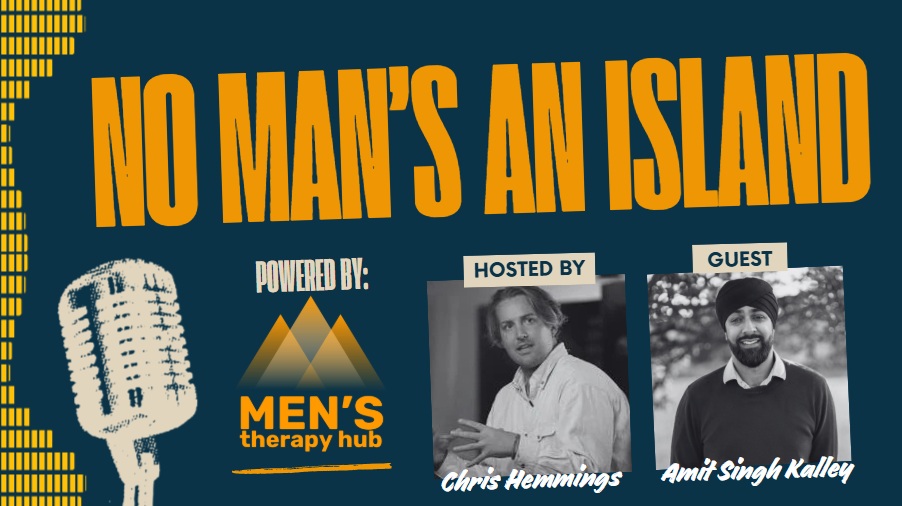
Parenting, Porn and the Manosphere with Amit Singh Kalley
In this episode of No Man’s an Island, Chris Hemmings speaks with Amit Singh Kalley – former deputy headteacher and founder of For Working Parents, an organisation supporting families, schools and workplaces to understand the digital world.
Amit shares his personal story of loss, ADHD and cultural silence, and how those experiences led him to help parents and teachers navigate the online lives of young people. Together, he and Chris explore the influence of pornography, the rise of the “manosphere”, and how boys are being shaped by what they see online. They also discuss fatherhood, trust and how to create safe, open conversations about technology at home.
What we cover
- The widening gap between children’s online lives and parental understanding
- How social media and gaming affect boys’ emotional development
- The link between porn, masculinity and identity
- What the “manosphere” reveals about male loneliness and confusion
- How fathers can build safety and trust around technology
Listen and watch
🎧 Listen to all episodes here: No Man’s an Island
🎧 YouTube: Watch on YouTube
🎧 Apple Podcasts: Listen on Apple Podcasts
🎧 Spotify: Listen on Spotify
Takeaways for men
- The internet isn’t going away – parents must guide, not just guard.
- Boys need conversation, not condemnation.
- Modelling healthy screen habits matters more than enforcing rules.
- Critical thinking is the strongest form of online safety.
- Connection always beats control.
Quotes to share
“Let’s stop talking about boys as the problem and start talking with them about the problem.” – Amit Singh Kalley
“The day you hand your child a smartphone, you’re handing them the entire world – and the world isn’t always kind.” – Amit Singh Kalley
“Porn is shaping boys’ understanding of sex before they’ve even had a relationship.” – Amit Singh Kalley
“Children get their bloody childhood back.” – Amit Singh Kalley
Resources and links
- For Working Parents – Amit’s organisation helping families navigate the digital world
- Men’s Therapy Hub – Find a male therapist
- Episode 16 – Boys in Schools – Bias, Mental Health and Misogyny with Matt Pinkett
- Episode 15 – Engaging Black Men – Race, Identity and Belonging with Dr Stephen Smith
Episode credits
Host: Chris Hemmings
Guest: Amit Singh Kalley
Produced by: Men’s Therapy Hub
Music: Raindear
TRANSCRIPT:
Chris (00:00)
Welcome to No Man’s an Island, podcast powered by Men’s Therapy, which is a directory of male therapists for male clients. On this episode, I’m joined by Amit Singh Kali, founder of For Working Parents. Amit is a former deputy head teacher and now delivers talks, training, and coaching for parents, schools, and organizations on the digital world, from social media and gaming to screen time, online language, and harms. He’s also the host of the What Do Parents Know podcast, which I’m told will be launching a new season soon. Hey, Amit.
Amit Singh Kalley (00:28)
Hi Chris, thanks so much for having me.
Chris (00:31)
That’s quite all right. Thanks for coming on. First question we ask every guest is always the same, which is how did you end up in this space? So for you, guess, you were a head teacher and you decided that noble as that was, you could do more good elsewhere. So what made that change happen?
Amit Singh Kalley (00:48)
As lovely as that sounds, I have to correct you, I was a deputy headteacher before I decided to pack it in, but I was on a journey to becoming a headteacher. It’s interesting, I think for me there were a variety of factors that led to me kind of leaving traditional work in that sense and leaving education. I left in April 2022. We were just coming out of COVID at that time. The world was sort of beginning to work from home. There was that flexibility that I didn’t feel that I had.
Another factor of course is that I have ADHD and I basically quit without a plan. So it wasn’t literally an overnight decision, but I remember I just said to my wife, you know what? I’m done. Typed an email, handed it with my notice and hit the send button. Just did it. And I just thought, gosh, that was in January. The notice period was until the end of March. And I thought, what the hell am I going to do after
after that and it took me a while to figure exactly what I was going to do out. But then I sort of, you know, always was very passionate about the kind of social media online harms world. I’d seen so much of it in education, so much harm caused to young people and just saw the gap between young people and parents getting wider and wider in terms of what young people actually do online versus what their parents think they do online and then not knowing how to support them. And then I sort of started doing what I do. I retrained as a coach.
So I support parents in sort of managing screen time, building healthier relationships at home with their children around screens, and then do a lot of speaking in organizations and schools all around that kind of digital piece. And also do a lot of storytelling. So I share my story, which I’m sure you’ll ask a bit about anyway, in the workspace as well, because there’s not many people that look like me, I think, sharing their story. And I think that’s important for.
for representation and for the idea of creating truly compassionate and empathetic workplaces, you’ve got to have a variety of stories told from a variety of lenses. So that’s a kind of whistle stop tour of where I was and where I’m at now.
Chris (02:36)
Well, tell us a little about that background and that story then for those who can’t see you because they’re watching on the podcast. are Sikh, you are wearing a turban and yes, you are not the quote, usual look for somebody working in a corporate space, I guess.
Amit Singh Kalley (02:52)
there’s plenty of people that look like me that actually work in the corporate space, of course, but I think there’s not many people that look like me that share vulnerability in the corporate space. I think when we get really powerful storytellers, we get people that are, you know, the standard kind of corporate look. So it might be a sort of white middle class male sharing their story. There’s a lot more diversity now. There’s some great storytellers out there that are female, that are people of color, that are people from all over the world. It’s brilliant. But for me,
I just thought that I’ve been through what I’ve been through in life and my story is no better or no worse than anybody else’s. But I just thought that I’ve got this passion for speaking. I’ve got this passion for being up and sharing that story. And I’ve got this addiction almost to people coming up to me afterwards saying that really resonated or that really changed my kind of day. I just thought, even if one person out of a room of 100 says that to me, it just fuels me to think, actually, you what? This work does matter.
because there’s one person in that organization now that feels perhaps a bit more comfortable maybe sharing their own story. So that’s why I kind of do, I felt that people need to see a variety of people. So as you say, I’m a turban wearing Sikh man who’s got his story and my story, I’ll summarize an hour storytelling session for you in just a few minutes. ⁓
Chris (04:09)
Thank you.
Amit Singh Kalley (04:09)
My story is I’m a child of immigrants. So my parents are both from Tanzania. They’re born in Tanzania and East Africa of Indian origin, so Punjabi origin from India. Both came there in their own ways to the UK in the 70s. Mum was in Coventry, dad was in East London. So I’m born in East London. So born and raised East London boy. Pretty standard immigrant upbringing, working class environment. Money wasn’t exactly flying around.
I start my storytelling pieces is in 2016 when my mom was diagnosed with cancer. My mom was diagnosed with ovarian cancer, stage three ovarian cancer at the beginning of 2016. I don’t know if I can go into lots of detail depending on how much of it you want to hear, but there is one bit of that story that really sort of always sticks so vividly in my mind. And it was the day we found out.
And actually in the buildup she’d been having lots of checks and lots of tests and you know, because we didn’t look for the symptoms at the time. We didn’t know anything about ovarian cancer. In our culture, we didn’t talk about things like ovaries and breasts and know, testicles and those kinds of things. We just, there were certain things in our community we just don’t talk about and anything related to the male or female anatomy, we just don’t discuss.
I was a head of sixth form at the time at a school in Northwest London, and I lived at home in Essex, and I remember driving around the North Circular at end of the day, and I called my mum, and I said, I was very anxious, I said, so what did they say? And she said to me, I’ll tell you when you get home.
That kind of language to anybody listening is very trivial. But when you love somebody and you know somebody and you know the way they normally talk, language matters, words matter. And I knew when she said that to me that it was not gonna be good news. And so I had about 40 minutes left of my journey and I remember sitting in the car thinking, right, you know, I’m…
I’m a man, I’m a grown adult, I’ve got to be manly about this. I went into all these kind of masculine stereotypes that I now look back on with regret actually. But at the time, that’s all I knew how to respond, because that’s all I saw around me in my community. So it was, I’m a man, we’re going to deal with this, no matter what happens, we’re going to deal with it. And I’ve got to be strong, I can’t show all this emotion. So spent all that journey preparing. And I remember getting home, we live in the bungalow. And I remember walking into the dining room.
and opposite the dining table, my mum and dad were both standing there and I sort of, know, prepped, ready, deep breaths, everything. And I said to my mum, so what did they say? And I remember her looking at me and she said, I’ve got cancer. And all that prep that I had done in the car went out the window because I just burst out into these almost uncontrollable tears. I didn’t know how to process that news. You know, I was an only child, it was only the three of us in the house.
I had only recently sort of met my now wife. So much was changing in my life and I was just, yeah, blubbering like a baby. And I remember she came around the table and I’m sort of six foot and she was about five one, five two. And she came around the table and she put her arms around me. And she said to me, don’t worry, I’m still gonna be here for you. And the reason why those words still ring so vividly in my head was because this is a human being who is.
Chris (06:52)
So.
Amit Singh Kalley (07:02)
potentially staring their own mortality in the face here. You’ve been given a devastating diagnosis. And her only priority, her only thinking at that moment in time, it wasn’t herself, it was me. It was the fact that she knew I still needed her. I wasn’t ready for her. At that stage, I think 2016, so I was 27 years old, I was not ready for her to go anywhere. years, couple of years of chemo, all the standard kind of
things, you know, she lost her hair, she lost her, she lost weight and you know, she was treated brilliantly at St. Bart’s and by the end of 2017, it was quite clear that it was quite clear to me that she was, you know, this isn’t this isn’t working, you know, she’s had almost two years of treatment and it’s maybe prolonged, she had some major surgery as well. It maybe has prolonged her life, but it’s it’s clearly not working anymore. She was very weak, very frail and I was
I was due to get married in August of 2018. So she needed to, for me and for her, in our culture, any culture, but it’s amplified, I think, for us, because we lived it. She wanted to see her only son get married. It was a big deal for her. So she was involved in the kind of planning of the wedding. She helped choose decorations and color schemes and all of this. She wanted to see her son get married.
Chris (07:55)
Thank
Amit Singh Kalley (08:14)
Because our weddings are big, they’re lavish, they cost tens and tens of thousands of pounds and there’s hundreds of people that are invited. ⁓ yeah, for sure, we have week long celebrations and yeah, yeah, absolutely. But we had the added complication in our situation is that my wife is from Tanzania. So although my family background is Tanzania and I’ve been going back to Tanzania many, times because I’ve got family there, my wife herself was from Tanzania and her parents
Chris (08:20)
Is it multiple days as well?
Amit Singh Kalley (08:38)
And so that Christmas of 2017 when my mom was very unwell, my in-laws actually happened to be in the UK, they were visiting. And we thought and we discussed as a family that look, whatever happens in August,
we’d booked things here in the UK and forget about that for a minute, you my mom might not make it to August. Can we have some sort of small civil wedding where at least we can get her in and she can see that her son, you know, has gotten married and has made it exactly, has made it, has done it. And she’d obviously met my wife on number of occasions and, you know, she, you know, it does carry a bit of weight. She gave it the seal of approval and, you know, that meant a lot to me, of course.
Chris (09:03)
Made it.
Amit Singh Kalley (09:15)
And so we had decided then we contacted the local town hall and we booked a room at the town hall for the 6th of January 2018. It was a Saturday and they gave us a room of 40 people. And I remember we sort of joked as a family and we said, 40 people, that’s not even our immediate family. know, we’re going to start, you know, we’re going to start turning people away, but you know, so we booked it the 6th of January for 40 people at Redbridge town hall. That was where we were going to get married. And then whatever happened after that.
Chris (09:32)
Yeah.
Amit Singh Kalley (09:41)
we would sort out on a sort of as we go depending on how long my mum was around. And I remember on Friday morning, my mum’s sister had been staying with us for some months actually because my dad and me, we were pretty useless. We were so emotionally drained and not very helpful. So my mum’s sister was really on it with medication, really on it with doctors and nurses and consultants and really looked after my mum. And my mum, she needed her sister, her big sister. My mum was the youngest of five. She needed her big sister there.
And I remember on the Friday morning, this is the 5th of January now, so we’re due to get married on the 6th. 5th of January, it must have been about nine o’clock in the morning, my mum’s sister, my aunt, came to wake us up and said, look, you need to get up, you need to come into the room. I remember going into my mum, your freshened up got ready, went into my mum’s room and she was very poorly. It was quite obvious to see how poorly she was. And my dad was on one side,
I was on the other side and my mum’s was there. My mum’s mum was there as well actually, my grandmother, a frail old woman, had also been there. And then about 10, I think it was about 10.15, I can’t remember the time off the top of my head now, my mum died. So she died on the Friday morning, which was the day before I was supposed to get married. So as I’m sure you can imagine, it was a devastating.
Chris (10:55)
Yeah.
Amit Singh Kalley (10:55)
thing to have to go through. The journey itself was devastating, that two year period of will she survive, won’t she survive was devastating enough. Mix in trying to plan a big wedding and then cross countries. was, yeah, so obviously the town hall were very understanding and I can’t remember but they didn’t take any money from us or whatever but dealing with that was really difficult. So that was the day before my wedding. It was the fifth of January due to get married on the sixth. My 30th birthday was on the ninth.
of January. So it was a pretty rough time ⁓ for us but we did end up getting married in the August.
Chris (11:22)
man. Yeah.
that is a devastating thing to happen to anybody, there’s no good time to lose a parent the day before your wedding is I couldn’t think of a more shitty time. What you’re doing here and you mentioned this earlier is you’re being vulnerable, you’re being open, you’re being honest. And that’s something that
you say isn’t a part of your culture, what is it that gives you the courage to do that right now on this podcast episode and previously, of course, to actually say, well, I’m going to be honest about the challenges and I’m going to be open about
Amit Singh Kalley (12:00)
That’s a really good question. I don’t know what makes me any different to anybody else in my culture. There are people in my culture by the way now who are speaking out more about things that they are passionate about that we need to talk about in our community. But we grew up in an era and an environment where men didn’t talk, men went to work, you know, provided, and women did the parenting, and women did the kind of going to school parents’ evenings and looking after the house and all of that.
We still have that legacy in my generation where my generation still find it very difficult to talk about how they’re actually feeling. I think there’s that stigma around men are not supposed to show that they are struggling mentally, emotionally, physically, financially, whatever it might be because there’s that fear of being judged and sometimes minority communities can be incredibly judgmental. There’s that fear of being seen as weak to your family.
And there’s that stigma of, I’ve got children, I’ve got a wife, who’s going to look after them if I’m out of action? As though your wife isn’t capable enough of looking after herself and the children. in this day and age, equal partners, equal earnings, sometimes women are earning a lot more than men, but there is still that stigma that so many men carry. And so I don’t know what’s made me feel comfortable and confident and the need to speak about it, but I’m just so passionate about it. I’m just so passionate about sharing
my story because there’s the grief element that we don’t do very well in our community and talking about grief and of course who wants to talk about death? know most people don’t want to talk about death. It’s a horrible thing that most of us, we don’t want to think about do we? But when it happens in your home you’re confronted with it and you know I think about it a lot now because I was confronted with it.
So for my community, I just feel that if somebody isn’t talking about the challenges that we face, what are those people that are in the community who are dealing with this in silence gonna do? They turn in our community to things like drink and God forbid drugs and other things to try and deal with the real struggles that they’re going through internally. those, when they turn to drink and drugs and other things, those challenges then become external because everybody can now see that there is a bit of a spiral here.
what I and other people in my community who are advocates for various things are trying to do is show that actually just because we’re Sikh, we’re not immune to any of the problems that are in the world. We are all vulnerable, you, me, everybody, no matter what our color, what our upbringing, what our religion, where we’re from, none of it matters. We’re vulnerable to everything that we are exposed to. And so if everybody else can talk about it, why the hell can’t we? Why are we so tied down to this
No, we’re men, we are not supposed to talk about it. We save the crying and the depression for women. We just go to work and get on with it. It’s a nonsense for me. It doesn’t sit right with me. So me going out as far and wide as possible as I can to share my story is part of me is it’s therapeutic because I talk about it a lot and I still get emotional sometimes at different parts of the story depending on how long I’ve got. But part of it is also to raise that awareness because there might be somebody that looks like me
in an audience who wants to share how they’re feeling but just has never been able to and is now hearing somebody that looks like them sharing their story and might feel that they want to get help or they want to share their story and for me that’s so important it drives me, it fuels me.
Chris (15:08)
Yeah, it’s that you can’t be what you can’t see mantra, which is why men’s therapy hub exists because men don’t realize that there are a bucket load of men who are therapists who want to work with them. But I want to go back to something that you said a bit earlier, which was that in minority communities, there’s a lot of judgment. And are we talking here about judgment of being different or judgment of struggling? And like, how does that judgment play out still in you? Because I presume
You have internalised that judgement as we have all internalised the structures and socialisation that surround us.
Amit Singh Kalley (15:44)
think it’s a bit of both of those things. there is, including within family, by the way, there’s judgment of, he’s not earning very much money at the moment, or, she’s not looking after her kids very well at the moment, or whatever it might be. There’s just comments that are passed. And because sometimes communities can be quite close-knit, you tend to know a lot about each other, and you sort of find out through the grapevine about each other’s business and what’s going on. And so some people just fear that actually,
Rather than have people gossip about me or talk about me, I’d rather just not share anything about me at all. I’d rather just keep it to myself because why do I want to give somebody else the energy to talk about my struggles when that’s probably going to make me feel a lot worse? So I think rather than, I think what some people say is rather than expose myself to those comments and those judgments, which might make me even more vulnerable, I’d rather internalize my struggles, not realizing that’s probably going to make me more vulnerable.
But because I’ve seen other people do that, because I’ve seen my father, my grandfather, my uncles, my whatever, do those, behave in that way, it’s normalized. When you’re children, you’re so impressionable, right? You you grow up in the environment you’re in and you pick up all the things that you see around you. And if all you ever see are women that are, know, parenting and working on running the house and you see men who are either out enjoying themselves or out working really hard and earning the money, you’re of course gonna think that’s what…
normal society looks like. And then suddenly you go to school, university, and wherever, and you’re exposed to all sorts of different people from all walks of life, and you think, geez, I’ve lived a pretty sheltered life here. And there are other ways to deal with challenges, and there are other ways to deal with problems that we might be facing. And bottling it up and being this masculine man, alpha male, isn’t necessarily always going to be the healthiest way to do that.
Chris (17:28)
You’ve then taken all of these life lessons and you worked up through the school system to be deputy head. Thank you for correcting me earlier. I actually got that right in the intro. you went to deputy head and then you quit and you decided to do something else. So what was it that led you to decide to move into the space of talking about social media?
Amit Singh Kalley (17:37)
You did, you did.
Chris (17:53)
Like has there been any personal experience or like was it from your time at school? Like what led you down that path?
Amit Singh Kalley (18:00)
No, thank God I went to school during a time where there were no smartphones or social media or anything like that. So I was, you know, very protected from all of that. I think working in education gave me an insight into what children are really going through. And I say this, you know, I think it’s the hardest era to be a child right now. And therefore I think it’s the hardest era to be a parent right now because the gap between children and parents is just so huge. What children actually do online and are exposed to online is very different.
to what many parents think their children do online and think their children are exposed to online. And many parents just don’t know. And when I worked in education, I worked a lot in safeguarding and I was dealing with on a daily basis, harms and dangers and issues that were happening online, whether it was sharing of nude images or sexualized behavior or getting involved in drugs and gangs all through online recruitment. All of it stemmed to this massive online.
kind of issue and that wasn’t necessarily why I quit the deputy headship. Because like I say, I was very career driven and I was pretty young when I became an assistant head and a deputy head and I was ready for a headship and was looking for a headship. But I just felt that was too much had happened in my life in too short space of time. So this is now in 2022. So I’ve lost my mom in 2018, I’ve got married in 2018. We had our daughter in 2020, went through all those challenges up till 2021. We were expecting our second.
There was just so much going on. gosh, financial, a ridiculous thing to do, know, financially, just a ridiculous thing to do. But we had some savings that we’d saved up and you we just felt they would get us by for a little while whilst I figured out what I wanted to do. And then this ADHD thing was sort of eating me up because I’d worked with so many young people who were ADHD and I kept seeing myself in them. You know, I had this bitten lanyard that, you know,
Chris (19:20)
The bold time for a career change.
Amit Singh Kalley (19:44)
was chewing my way through. used to walk out of meetings. I used to sit on my hands during boring insets. just had to, I just couldn’t process things. And I told, started telling people at work, I think I’ve got ADHD, you know, and they don’t be ridiculous. I’d be laughed at the building. You know, you’re just trying to justify your bad behavior. And okay, fine. You know, kept thinking in my head, you know, I’m sure. And I guess the impulsive nature of quitting my job, you know, that I don’t think many neurotypical people would do that without a plan. You know, I just didn’t have a plan.
And then whilst I was thinking about building a business and getting passionate about coaching and speaking and the whole social media world and storytelling, I decided to go for that ADHD diagnosis. And I know there’s many people out there listening who might think they’re ADHD and don’t want the diagnosis, and that’s absolutely fine. I respect everybody’s decision. But for me, I felt like I needed it. I needed to know. Because if I was ADHD, I wanted to go back to a lot of people and sort of say, look, when you laughed me out the building and you told me I was just badly behaved or I was rude or I was disrespectful.
this is who I actually am and these are the struggles that I was going through. And I remember part of process, had to, it’s quite an intrusive process from the psychiatrist and they went through, they need to speak to people from your childhood. And obviously my mum’s not around and my dad, felt just wouldn’t know enough because, you know, like I said, stereotypical old school kind of, you know, Punjabi Sikh Indian dad just wasn’t around enough. Luckily I had all my school reports. For whatever reason, I kept all my school reports in this lovely little folder.
from reception all the way up to year 13. And I said to the psychiatrist, would these do it? said, they’d be brilliant. He said, yeah, great. Bring them in, let’s have a look. And then I remember reading through them and gosh, if you read that about a child now, you’d know immediately. But I remember reading words like infuriating, always distracting others, finishes his work and then distracts others. So was quite academic, always out of his seat, spends more time in the corridor than he does in the classroom, rude, disrespectful. And I just thought, wow.
you know, if only we knew then what we know now, somebody might have said, actually, you know, there’s something different about this young lad and we might need to look into it. And so handed these reports over, went through the whole process and of course ticked every single box for ADHD. I was actually diagnosed with ADHD, OCD and anxiety disorder because, you know, since losing my mum, the anxiety sort of was pretty bad. That was back in 2024.
We’re now recording this in January of 2026 and I only started my medication about three weeks ago. So again, there’ll be views on, people have their own views about medication. For me, running your own business and not being accountable to anybody with ADHD is an awful, awful thing. It’s crippled me. Where my business should be versus where it is actually are two different things. I know where my business should be.
I also know where it is and I genuinely believe that because of the ADHD and because of my inability to focus, sit down and get tasks done and really drive things forward, I’ve struggled. But I’m hopeful with the medication, it’s a bit early to tell yet, but I’m hopeful because I’ve spoken to lots of people who are on medication and who are very successful business people. And that’s not to say, by the way, that people with ADHD who are unmedicated can’t be successful. can. Just for me, it wasn’t working.
And so I’m fingers crossed and hopeful that the medication will work for me and will allow me to really focus on the things that are important to building this business that I know can have such a positive impact on young people and on adults.
Chris (22:55)
Well, tell us a bit about that business then. How did it start and what is it that you are developing into in terms of a speaker and a business? what would you say are your key themes?
Amit Singh Kalley (23:06)
Well, it started when I left my job and realized that I now need to get clients. At that time, I didn’t know what I wanted clients for because I retrained to be a coach. So maybe I thought I’m going to do some leadership kind of coaching, exec coaching. How do I get clients? How does anybody know who I am? So I thought, OK, let’s open up that LinkedIn account that I first opened back in 2012 and had like 300 connections and never used. Let’s start learning how to use LinkedIn. Let’s start learning a bit more about social media and
And the irony is not lost on me, by the way, that all my work is on social media when I advocate against it for young people. I get that. But hopefully my work is an adult for adults. So I just started posting. I just started posting some stuff initially about leadership, because that’s what I thought I wanted to do, then sort of moved into the parenting space. I just thought, there’s a lot of people supporting parents out there, but a lot of them are women. And I thought, how interesting would it be to have a male person talking about parenting and then an ethnic minority male person talking about.
parenting and so I started doing a bit of that and started working with a few people on a coaching basis, did a bit of school consultancy to just in a couple of local schools and just to get some money in. But then really sort of started getting more and more passionate about social media and online harms because I’d seen so much of it in my time in education and just was more exposed to all the struggles. Did start doing some research on it and goodness me, it just showed me how toxic and awful
the online experience can be for young people. So I sort of pivoted and started doing a lot of work on that and worked on my storytelling and started asking corporates, do you want somebody who looks like me to come and tell their story or better still, do you want somebody that looks like me to come and work with your parent network group and talk about social media harm so they can be more educated, more up skilled, more informed, so they can be better at home and therefore be better at work.
and just started doing a bit more of that, started working with a few corporates, started working with a few already fully functioning and successful businesses as sort of like an associate just to earn some money through their networks. Started working with a few schools because teachers need this support, parents need this support, kids do too. And yeah, it’s just sort of evolved from there, but I think the presence on social media has helped. I’m not some big influencer or anything, but just the people that do.
I think follow me and are connected with me. It’s that message I think they like. It’s that kind of educational piece that lots of parents who think, I didn’t know that about roadblocks or I didn’t know that about Snapchat, but now I do. I’ll go back and have some conversations about it or you’ve told your story, gosh, I went through something similar. I wish somebody like you would come to my workplace. And so it’s just helped build things up and it’s just sort of an evolving business.
Chris (25:42)
And you talked about the irony of being kind of
making parents aware of the potential pitfalls of social media whilst being on social media. And one of the questions I wanted to ask you is, in your experience as a teacher and as a deputy and as a parent also of a child who is not yet, but at some day is going to be online, are there such things as, quote, healthy digital habits?
Amit Singh Kalley (26:04)
Yeah, there are, of course there are. You can have screens and devices where there are limits, where there are spaces where there are no screens. And I work with lots of parents to help build that. But the fact is that social media and games and all of those things are designed to be addictive. The scrolling, the homepage, the shorts.
the games and the way they’re put together, all of that is designed to be addictive. I I as an adult am definitely addicted to my phone and I do my best to role model in front of my three children now. Actually, my daughter’s been joined by two boys over the last few years. So, we’ve got a big old busy family and a busy life. They’re all very young at the moment, but you can be healthy. You can definitely create homes where screens are part of that home, but there are expectations and I work with families to create what I call a digital charter.
which is where all the family come together, kids and parents, to create a set of expectations around everybody’s screen use within the home and where we can and where we can’t and what we can do and what we can’t do. All of that exists, but it doesn’t change the fact that for me, a lot of these platforms, a lot of these programs, a lot of these games and all of that are by nature of their design, designed to be addictive and children are their biggest customers, children are their biggest users.
Children make them the most money and children are the ones that make the biggest mistakes on those platforms because we have some terrible adults in society who want to exploit our children and exploit vulnerable children and social media companies have proved time and time again that they can’t or some will say they won’t keep our children safe on their platforms because we still get in fact we’re probably getting more you know online grooming cases we’re getting more recruitment into gangs and violence and all of that exists online you’ve just got to walk into any school.
any school, an inner city school, and just see for yourself. And there are so many great schools out there, so many great inner city schools with great leadership doing great things. But one of the things that they are struggling with the most is pushing back against this infiltration of their children’s minds by screens and by what’s on those devices.
Chris (28:05)
We are obviously a podcast that is focusing on men and boys. That’s never to say that there aren’t big issues for women and girls too in terms of online stuff. From your time working in schools and from the work that you’re doing now, what are the biggest challenges that young boys are facing or that parents of young boys are facing in terms of what they are viewing and engaging with on social media?
Amit Singh Kalley (28:28)
think as you were speaking, two things immediately came to my mind. One is pornography and the other is the kind of manosphere as it’s called. I think the issue around pornography is that, I mean the Children’s Commissioner released a report a couple of years ago which she updated recently to show that the average age of porn consumption now is 13 and 10 % of nine-year-olds have seen porn. And you know, these aren’t necessarily kids that are typing into Google going looking for porn. They’re seeing it on the number one source of pornography and that same report by the way was Twitter.
and number two I think was Facebook and Instagram and Snapchat. Porn websites were something like five or six on the list. And so if you’re seeing pornography from a young age, you’re already now in your mind when your brain is still developing, starting to think about what relationships look like. And I’m not sitting here saying porn is good or bad, because all of us have been through childhood. We’ve all been exposed to sexual behaviors and sexual videos and photos and whatever it might be in our time, right?
But think the biggest issue is that a lot of boys are watching porn at a much younger age and some of them are watching porn that potentially is violent and promotes this idea of dominance, male dominance over females. There’s a lot of things that we’re choking and those kinds of behaviors. But I think the biggest issue is a lot of dads are struggling to deal with their own pornography habits because porn is so easily accessible. And the likelihood is that a lot of dads are watching
pornography and so it becomes this really difficult conversation to have between a father and a son about porn because They’re both watching porn likely both likely watching porn in their own environments Dad probably doesn’t know what type of porn son is watching son definitely doesn’t want to ask dad what type of porn he’s watching and so it just creates this kind of I’m gonna get my sex ed from
from the internet, I’m going to get my sex ed from porn, I’m going to share that porn with my friends and my friends are now going to get their sex ed from me or from the porn that I’ve watched. And so all of that is going around and I think the issue of pornography needs tackling and the government is trying, not doing very well at it because kids are still watching porn using VPNs and things like that. But I think a lot of boys are getting their kind of sex and relationship education from porn and I think that’s a problem if nobody else is having those talks with them.
And the second thing, like I said, is that manosphere. think young boys are being exposed a lot to masculine influences and who are trying to define what it means to be a man. And we see some of this crazy stuff out there about you’ve got to be powerful. You’ve got to talk to women in this way. In order to get girls, you’ve got to behave like this. You’ve got to look like this. If you’re not in the gym five times a week or whatever it is, you’re not a real man. I think a lot of boys are vulnerable to that kind of language. A lot of boys are vulnerable to that kind of feeling.
And I remember after Adolescence came out last year, which was obviously a massive hit and really brought this issue to the forefront, I released this periodic table of emojis that I created which had loads of emojis on it that young people might be using to mean something other than what you think they mean. And that went, it just went viral. Off the back of Adolescence, I was riding off the coattails, it just went globally viral. it was in schools from Latin America, Asia were requesting it, and it was in media all over the place.
And it was just that idea of raising awareness about what our young people really are exposed to and how they are communicating in ways that is very secretive because they don’t want parents or adults in their lives to know about it. And I think for young boys, and there’s a lot of people, by the way, doing great stuff in the manosphere, working with schools, young and old. And I think it’s a really important topic because boys feel, and men to an extent, think, that, know, feminism perhaps has gone too far and women are very…
critical of men and men get very defensive about that and you know there’s an example that I saw online where you know a man a woman had slapped a man’s bum and you know it was sort of laughed at because it was okay but the man asked you know what if I’d slapped your bum you know what if I’d done that to you and I think some people resonate with that and you know I’m not saying are both of those things wrong of course and I’m not for one second saying that women haven’t been through all sorts of awful things a hell of a lot worse
than what men have been through in time and still go through. But the question you asked was specifically about men and boys. And I think some men respond to that in a negative way to say, actually, where’s the equality? Why are you treating us in this way? And then we’ve got this, then they fall into that manosphere where these influencers who sit in front of a Lamborghini or in their private jet because you’ve paid 2000 pound for their coaching program that tells you how to be a real man and get real women.
They then thrive and then more and more men get sucked into that. It’s just a real vicious cycle that we’re in where I think boys and men who potentially are lonely, maybe vulnerable, maybe struggling in relationships, maybe finding their way, maybe find they don’t have a way in society and then they turn to these online influencers and they speak to them because they speak their language and they speak about their struggles and you resonate with that and you start believing and buying into all of what they say and then you do spend £2,000 on their coaching program and make them very rich.
It may not necessarily change your life for the better. So I think that they’re the two big things that men and boys are dealing with.
Chris (33:13)
And when those boys that you have worked with and you talked about inner city schools and I guess we’re also talking about here is often emotionally vulnerable boys. They are more likely to be sucked in for understandable reasons. I spoke to Matt Pinkett on episode 16 of the podcast and Matt does really great work tackling misogyny in schools and I asked him outright, do you think that misogyny is actually increasing in schools? And he said, sadly, he thinks that it is.
at least the overt misogyny, is that something that you have also seen? That boys are becoming more, like almost re-emboldened in a type of misogyny that, at least through our kind of millennial generation, had slowly been not entirely stamped out, but was beginning to disappear.
Amit Singh Kalley (33:55)
Yeah, and firstly shout out to Matt Pinkett. I think he’s amazing. He was a guest on my podcast as well and he’s doing some fantastic work in this space. It’s so needed. And I would agree with him because my work is mainly with teachers and it’s not necessarily dedicated to the Manosphere as such, although I do touch upon it. And I sadly, when I speak to female teachers and some of them tell me what they are facing when it comes to boys. mean, sexism is one thing. Sexism has existed.
forever, right? And we keep doing great work on trying to stamp it out and we’re really struggling with it. But some of the things they say they are facing in terms of the way boys talk to them, the ways boys treat them, the way, I mean, I had one teacher just last week, I was in a school and she said that actually she was walking in the corridor and four boys sort of cornered her and got her pinned up against the wall and were sort of, you what are you gonna do about it now, miss? Maybe she told them off earlier, what are you gonna do about it now, miss? And they were using their size
to intimidate her, but she felt incredibly vulnerable, not only because they were four people who were pinning her against the wall, not holding her, but just sort of crowded around her, but she also felt because of the language that they were using that there was a sexualized element to this. They were trying to make her feel as though they could do what they wanted to her and there wasn’t anything she could do about it. And this is in a school. This is not in the after school or down the road. This is in a school corridor, she said this happened to her.
So sadly, I do speak to a lot of teachers who just find that the way they’re being treated and the way they’re being spoken to by boys is not very good and they’re saying it’s getting worse. So I would agree with Matt and say the same thing that sadly, despite all the great work that people like him and others are doing, it is getting worse because Matt is one person or somebody else is one person. They’re all individual people fighting against an influencer with half a million, a million
five million followers and an algorithm that pushes their stuff out there. Even when the boys aren’t looking for it, it’s being fed onto their home screens and they get sucked into that. Who am I, a random bloke coming into your school telling you don’t treat women badly or talk nicely to women when actually matey boy at home with a million followers tells me exactly how I can get girls and exactly how I need to treat girls. It’s an unfair battle. We can’t win the battle against the algorithm.
Chris (35:42)
and an algorithm.
Hmm.
Amit Singh Kalley (36:10)
So the only way to tackle that is that the algorithm needs to get sorted out. Social media companies just sort that out. They can’t do it. So we go down the route of a ban of social media. But of course, there’s issues with that because kids will find ways to get around it. It’s an awful time to be a young person at the moment growing up in this horrendous social media world where you’re fed things that you’re not looking for, but suddenly you get sucked into.
Chris (36:33)
And it just makes me so sad because those boys are being brainwashed, those boys are being coerced into behaving in a way that they are led to believe is going to benefit them long term. And yet we can sit here as adults and I look back on my time as a kind of rugby lad to think, well, I was at least some part like that because society had emboldened me to be that way. And in the long run,
It didn’t get me anywhere near where I wanted to be in terms of who I am as a person. And it certainly didn’t help me get laid or any of that stuff, right? And yet what we do then is we then demonize those boys. We then say that they are the problem. And know, Adolescence was not a documentary. was fiction and it was great that it brought the conversation to the surface, but also what it did, it brought with it…
a huge amount of added demonization and stigma against boys. And I think, I really want to ask you, what can we do culturally here? What can we do as a society to say, there are things that boys are doing. And yet, alongside that, it is not the boys’ fault that they are behaving that way. And I’ve told the story before in this podcast of a…
a teacher putting their hand up and saying, you know, are we at risk of saying that 14, of letting these boys off the hook and saying that these 14 year old boys aren’t responsible for? And I’m like, they’re 14. If they are behaving in these ways, they are a product of the culture that is around them. And again, I just go back, it makes me so sad for these boys. So what can we do, Amit? Like what can we do, first of all, to re-engage these boys and say like, hey guys, like,
Snap out of it, come over here and rejoin society. Because right now there is an increasing gap and polarization between a certain subset of boys, not all boys I might add, who are being sucked down that rabbit.
Amit Singh Kalley (38:30)
think you’ve made a cracking point there about the demonization of boys and that is pushing boys further and further away. And that was the bit that I was alluding to earlier where men think that they are being targeted and being victimized for having certain views. And everybody’s entitled to their view and their opinion as long as that opinion isn’t harmful, I guess, or promoting harm. And I think the way I see it is the most important thing is to…
We need to stop making the conversation about boys and we need to involve boys in the conversation. That’s the key thing for me. We can’t keep talking about boys and saying boys are terrible and men are terrible and you’re all, you know, that group of boys and men are, you know, sexist and homophobic and whatever it might be. We need to stop talking about them and we need to start talking to them and letting them talk with us.
So let’s stop making the conversation about boys and start involving boys in the conversation. Let’s hear what they say. And rather than when they do speak, which is the natural response sometimes from teachers and from parents, if a boy says something that’s offensive or the parent or the teacher might say, how dare you? That’s a terrible thing to I don’t ever want to hear that said again. That is sexist. And the boy thinks, yeah, whatever. Here we go. It’s another, I’m just being shouted down for voicing my opinion. Well, actually what we want to encourage is critical thinking.
You know, we want to get these kids thinking, okay, so you’ve made a comment that maybe is a sexist comment. Why do you think that? Where did you hear that comment? What makes you share that view or what makes you repeat that view? Do you agree completely with it or let’s break it down a bit? Or what if that was said about your mother or your sister or a woman that you love? So really get them thinking critically rather than just saying, you know, because my work is all about, you know, from the social media world, it’s all about
breaking that wall between parents and their children which currently exist. All we do when we shout boys down for being sexist or whatever it might be is we put that wall back up again and they’re not gonna say to you, okay, miss or sir said I’m sexist, therefore I better stop saying what I’m saying. Of course not. They’re gonna carry on listening to their influencers who by the way already tell them that your teachers and your parents and people in your lives will say that you are sexist. So they know it’s coming and they tell them how to respond to it.
What we’ve got to do is bring these boys into the conversation and say, look, what has society done to you that’s made you feel this way? And how can we make sure that as you get older, you’re a fully integrated member of society, even if you still hold some of these views as you get older, how can we make sure that you’re able to actually function and integrate in society and be happy in life and find a partner if that’s what you want to do and have children if that’s what you want to do?
you know, be successful, all those things. But it’s about making sure that they’re involved in that conversation rather than everybody, you know, talking about boys. And that’s why, you know, those people like Matt and everyone go into schools and talk directly to the boys. That’s why the work that I do is, you know, working with the children and with the parents. you know, it’s that voice of the young people is really, really important, I think.
Chris (41:22)
Let’s say somebody is listening to this who is a father of a son and his son has been called in by the school because he has been engaging in some misogynistic, probably like what they were determined to be banter or maybe some homophobic comments or stuff like that.
And this to me is like the killer question. So I would love to know your answer to this. When you’re working with parents one-on-one or when you’re doing talks in schools or when you’re in businesses talking to parents, and I’m obviously extremely interested in fatherhood, what do you say to those men in terms of how they do exactly this, which is how do they actually effectively engage their son? How do they talk not about the behavior, but to the son?
about what’s going on and not make him again feel, you know, not just go in and give him the third degree and you know, you’re grounded and you can’t go online for, punishment like that doesn’t really work. What does work in terms of changing behavior?
Amit Singh Kalley (42:24)
they have to go hand in hand? mean I am am still an advocate for for parenting and so sometimes sanctions and consequences and punishments are necessary because you you’re the adult and you’ve got a parent but I think sanctions alone are never going to work. They’ve got to come with those conversations. One of the challenges that I’m finding as well is that it’s not always online that a lot of these boys are getting their information from. They’re actually getting it from their dads.
who themselves might be getting it from online. So I think we’ve got to look at ourselves first, look in the mirror ourselves and you know, I go back to the kind of porn story, but also the kind of what we’re consuming online. You know, are we falling into the trap of, you know, all the work that society has done in trying to create a level playing field? Are we now falling into that trap of thinking a bit sort of misogynistically or, you know, in a sexist way? So that would be number one. And secondly, you know, if your kid is called in or if you are called in,
It’s how am going to have the conversation with my son that encourages him to think critically, which does have the fact that actually you got suspended, therefore you’re grounded for a certain period of time or whatever, know, but we need to talk about what it is that you saw online, what you’re seeing online. And there’s one thing that I do and I say to parents, every single day you need to ask your children these four questions. And I know it’s a bit much, but the classic question of how was school today is such a redundant, useless question. I remember when I used to get asked that question, was a shock of the shoulders and
whatever, it was fine today. it’s the same, I sometimes ask my daughter, how was school today? She’s five, by the way, it was fine. Where do you go from there? Like, by the way, how was, what did your teacher say? What was in, they’ve answered your question. Now, if your children are online, we’ve got to be asking them four questions every single day. And I say, number one is how was your online world today? Number two, did you see anything online today that made you feel uncomfortable? Number three, did anybody send you anything online today that you didn’t like?
And number four, did you send anything to anybody online today that you might regret? Now why do I think people should ask these questions? Because what you want to do with your children is create a safe space. And you want that safe space to be you. Because often I find that parents are usually the last people to find out when something has gone wrong online and when it’s already escalated to a really high level. So you want to create that safe space. And you also want to create that space that’s non-judgmental. So that question, that fourth question about did you send anything to anybody online that you regret?
That’s the idea of taking a bit of your child taking a bit of responsibility, but also creating a space where they can talk to you and you might be angry and you might want to talk through what they might have sent, but you’re not going to judge them for it. You recognize that they are in a world that is causing real harm to them. And on day one, you’re to get a of the shoulders. On day 10, day 100, you might get a shrug to all of those questions. But can you imagine on that one day, and I’ve seen it with parents that I’ve coached, can you imagine on that one day when your kid comes home and says, actually, dad, you know what?
I did see something online today that I didn’t like. And now you’ve got this beautiful opportunity to have a real conversation. And it might be something terrible that he shows you. It might be a violent video, a pornographic video. It might be something so horrible that you can’t comprehend it. But he’s showing it to you. And he’s coming to you to show it to you. And that’s somewhere you weren’t at maybe six weeks ago, six months ago. So I think it’s investing that time in having those conversations regularly. That critical thinking.
isn’t just a school responsibility, it’s something you need to encourage at home. It’s taking an interest in your child’s online world. It’s putting in parameters like not letting your child be in their room with their device with the door closed because a closed door isn’t for privacy. A closed door is a signal and it should be a signal to you as a parent, as a dad, that if my son is in his room with his door closed, he’s obviously looking at things that he doesn’t want me to necessarily see. we need to try and…
break that down a bit to say actually, you know, any laptops, computers, they’re going to be used in shared spaces, maybe the lounge or wherever. And mobile phones as part of our digital charter that we’ve created as a family, mobile phones, maybe all of ours, including me as a dad, they’re going to charge after 9pm, they’re going to be charging downstairs in the kitchen overnight. So none of us can access our phones. So you’re putting in the guardrail. So you are, you’re parenting, you’re putting in the parameters to reduce harm.
But alongside that has got to be the conversation, it’s got to be the regular check-ins, it’s got to be that building of the safe, non-judgmental space so that they feel comfortable and confident enough to come to you when something goes wrong.
Chris (46:28)
flip side of that then what do you think parents get wrong mostly with this?
Amit Singh Kalley (46:32)
It’s either not taking an interest in their children’s online world or not being willing to learn about all the dangers that exist in the online world because parents are busy. know, parents are busy working, they’re busy earning money, they’re busy doing lots of other things. They don’t recognize, I think, that that day they hand that mobile phone over to their children, they almost sort of metaphorically just say good luck. They need to recognize, and I say this carefully, but I believe this, the online world.
is more dangerous than the physical world. And I genuinely believe that. And so if we start seeing it that way, parents might start thinking, gosh, actually, you know what? There are so many harms on Snapchat. There are so many harms even on roadblocks for the younger kids. There are so many harms on TikTok. There are so many harms on platforms I don’t know about. I have another periodic table of apps that might be dangerous for children. And I always show that in my talks. And there’s about 60 apps on there. And I always say to parents, how many do you recognize?
you’d be surprised at how many parents are in single figures. They recognize the TikToks, they recognize the Snapchats, but they don’t know about Kik. They don’t know about some of the dating apps. They don’t know about some of the character.ai or replica AI apps. And you think, why don’t you know? You know, as your child is using these apps, your child is exposed to everything on those apps. Why don’t you know about it? Why are we not keeping up with the ever changing? It’s very hard to keep up, I accept.
Why are we not keeping up with those changes? Why are we not sharing the research we’ve done with our children? Look son, I saw this about AI online. It’s really great, but look at this danger that I saw. Can we talk about it? Having those open conversations and ultimately holding your child’s hand like you would when they cross the road when they’re young, holding their hand and walking that digital path with them because it’s not designed for them. They can’t be kept safe on it. And you want to do whatever you can to ensure
they’re kept as safe as possible if they are in that world.
Chris (48:17)
And you are now a father of two sons as well as your daughter. They are still many years away from having that device in their hand. I’ve asked this question quite a few times of guests recently, but do you have hope that by the time they get there that things will have changed? Do you have hope? mean, of course, I hope you won’t be a hypocrite and you’ll have these difficult conversations with them when they get there, but hey, we’re all hypocrites, right?
do you have genuine hope for the future? Because…
I struggle to see how this online ecosystem is going to improve when the people who are running it see the zeros in their bank account and they see that it is quote, working for them. you you said at the very start, why would they change it?
Amit Singh Kalley (48:59)
you
Look, I’ve been through a lot in life. So I tried to be an optimist and I tried to see the best in the life that I have and the world that we live in. I do see hope. I think the tide is turning not just here in the UK, the tide is turning around the world. Australia has taken massive, massively bold action in banning social media. Obviously, we’re waiting to see if it’s been successful or not.
but at least they’re taking the action to do it. Europe is talking about it. Countries in Asia are talking about it. The tide is turning. I’m very much in favor of the social media ban, yes. I don’t think it’s going to solve every problem. Education is always key, but I am in favor of, and the way I phrase it is it’s not banning children from accessing social media. It’s banning social media companies from accessing our children because they can’t keep our children safe. I know young people aren’t going to see it that way, but for me it’s important to phrase it.
Chris (49:32)
Would you do it?
Amit Singh Kalley (49:52)
in a way that actually we’re not punishing children here, we’re getting at the social media companies. And I’m hopeful that with that pressure will come some genuine regulation of the industry that has spiralled out of control. And me myself, try to, like I say, I am addicted to my own phone, I try to model that good behavior, because part of my work is modeling, we have to model good behavior. We are a screen free home, so obviously, I don’t count TV in that, so we do have a TV in.
Our kids can watch things like YouTube when we’re in the room on TV, but none of our kids have devices. There’s no iPads or anything like that in the house. And they won’t be for a very, very long time. And they won’t be mobile phones for a very, long time. But we’re going to talk to our children about why, all the way. mean, my daughter’s five. She’s already asked about when she can get her first phone. Maybe her friends. Yeah, absolutely. She’s asked. Maybe a couple of friends in school have one or she obviously spends time.
Chris (50:35)
Really?
Amit Singh Kalley (50:41)
you know, she sometimes spends the night with some of our family members and she loves going there and phones are very much part of that world. I can’t control what happens in somebody else’s home. And we’re very clear, we don’t lie to her, we’re very clear at the moment that it’s not on the horizon for many, years and here are the reasons why. We make everything age appropriate. I’m hopeful, but you know, we all have hope in life and you know, one of the hard lessons of life is that you always get let down, don’t you? And we have to teach that.
We have to teach ourselves. I know, I just said to you I’m an optimist, I? But we always get, people let you down. That is just life, right? And I’m hoping that these, governments, whoever, whatever kind of the government is, whoever the government is, I’m hoping the governments won’t let us down. I’m hoping the social media companies in the future won’t let us down. But let’s see, let’s see.
Chris (51:05)
That’s the spirit. Yeah, exactly.
Okay, and I’m going to ask you the question that we ask every guest at the end, which is I’m going to give you unlimited funds, the keys to the vault. You have as much money as you want to spend and you can make one change in one area that’s going to have the biggest impact. What would you do?
Amit Singh Kalley (51:37)
Wow.
Chris (51:37)
And we can edit out the pause no matter how long it is. So you can take your time.
Amit Singh Kalley (51:40)
Yeah, sure. Yeah, that’s great. That’s great. Yeah.
Okay, yeah, would, and this is gonna be controversial because I know, if I could, and you didn’t give me any parameters, you didn’t say there’s any rules here, so if I could, I would close down all social media and AI platforms that are not designed for any positive purpose. I know that’s a very vague answer because gosh, you know.
Everyone who designs an AI will say it’s for the positive reason, but I would.
Chris (52:07)
So you’d buy
X off Elon Musk and close it down.
Amit Singh Kalley (52:10)
X is a cesspit of just horrible stuff. Yes, there’s great stuff. Exactly. I yes, there’s some great stuff on there. I used to have a Twitter account. I still have my X account because I do like looking at it sometimes. But when I go on it, I realize why I don’t use it very often because it is just a cesspit of hate and anger and division. But yeah, I don’t know how I would do it. You didn’t tell me I had to know how.
Chris (52:14)
It was bad enough before he took it out.
Amit Singh Kalley (52:32)
So don’t know how I would do it, but I’d somehow buy all of the social media companies and AI companies and close down all of their ability to access young people. adults, by the way, there are many adults that shouldn’t be on social media, but that’s a separate debate. I would somehow do that. I don’t know how I would do it, but you didn’t tell me I had to have rules. You’ve given me all the money. I’m closing down social media and AI programs for all children.
Chris (52:33)
You
Okay, and the lasting impact of that for you would be what?
Amit Singh Kalley (52:56)
children get their bloody childhood back.
Chris (52:59)
and actually start to go out and engage with each other in the real world.
Amit Singh Kalley (53:03)
and enjoy what it means to be a child that is not stuck in their room, that is not being fed horrible things by an algorithm, that isn’t designed to keep them safe, that are not fed stuff about beauty, about masculinity, about all the horrors that are out there. People say that I’m draconian by getting rid of social media. It’s here to stay. Children, tech is the future. Yeah, of course tech’s the future. But being fed horrible stuff on an algorithm isn’t setting them up for a future in tech. We can still set children up for a future in tech.
without them being poisoned by all the horrible things that are on social media.
Chris (53:34)
Well, yeah, mean, kids working in the cotton mills was also normalised in the 1800s. So, you know, things can change and they do. it’s weird for me because I’m quite free in terms of how I think we should allow society to be. I also think that I agree very much with what you’ve said here, that social media is not good for young minds in particular. It’s not good for many of us a lot of the time.
but for young malleable minds, I agree. So great work that you do. Thank you for sharing your story. That was a part of it that I wasn’t expecting actually. So that was an added bonus to this. If people wanna work with you, if they wanna find out more, where do they go?
Amit Singh Kalley (54:12)
Sure, thank you. My website is www.forworkingparents.com. The company is called For Working Parents. You can find me on Instagram and TikTok at For Working Parents. And you can find me on LinkedIn at Amit Singh Kali.
Chris (54:26)
Awesome. Thank you for sharing your valuable time with us and I will look forward to speaking to you soon.
Amit Singh Kalley (54:31)
Thank you Chris, really appreciate your time mate, thank you.