Education, Work and Purpose with Nick Isles
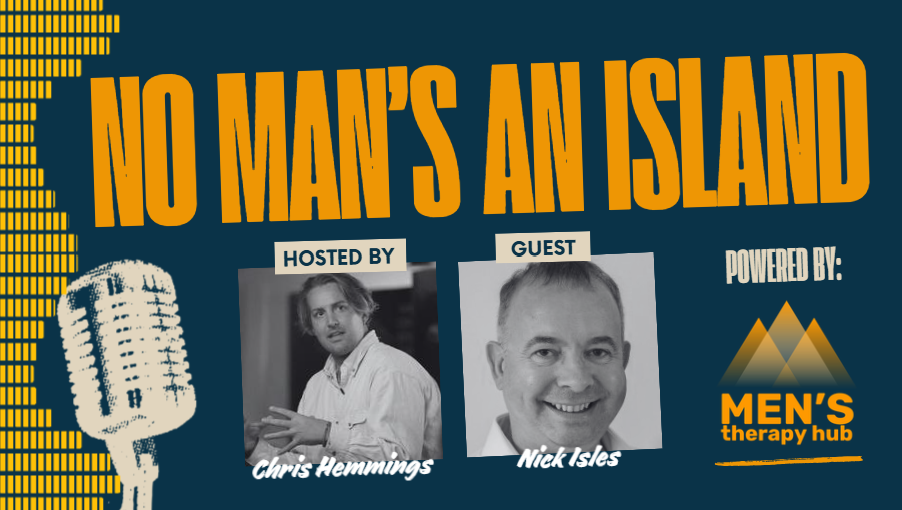
In this episode of No Man’s an Island, Chris Hemmings speaks with Nick Isles, Director of the Centre for Policy Research on Men and Boys. Nick’s work focuses on building a robust evidence base around the challenges facing boys and men in the UK and translating that evidence into practical policy solutions.
Their conversation moves from education reform to economic growth, from worklessness to workplace culture, and from political polarisation to the future of masculinity. At its core is a simple but urgent question: what happens to boys and men when the systems designed to prepare them for adult life stop working?
Nick argues that we have reached a tipping point. For too long, conversations about men and boys have been politically uneasy. Now, with rising worklessness, widening educational gaps and increasing despair among young men, the data can no longer be ignored.
Rather than framing men as either perpetrators or problems, Nick makes the case for a non-zero-sum approach. We can improve outcomes for women and girls while also addressing the specific structural challenges affecting boys and men. It is not a competition. It is a matter of pragmatism and evidence.
Listen and watch
🎥 Watch on YouTube: No Man’s an Island – Episode 21
🎧 Listen on Apple Podcasts
🎧 Listen on Spotify
What we cover
- Why the Centre for Policy Research on Men and Boys was founded
- The idea of expanding the “permission space” to talk about boys and men
- Why the NEET crisis is a national emergency
- The long-standing attainment gap between boys and girls
- Developmental differences and early literacy intervention
- Academic versus vocational pathways and why both matter
- The psychological impact of labelling boys as failures
- Work, identity and the link between unemployment and male suicide
- Responsible capitalism and workplace culture
- Why young men are drifting towards populist politics
- How education reform could reshape the future
Education and the early gap
Nick is clear that reform must begin early. By the age of eleven, many boys are already disengaged from school. Developmentally, boys often start formal education behind girls in literacy and emotional regulation. Without targeted early intervention, they never catch up.
“There’s something going wrong in the way that we structure our education systems that disadvantages boys,” Nick explains.
International research shows that in the lowest-performing groups across OECD countries, boys are roughly a year behind girls academically. This gap compounds over time. Streaming lower performers together can reinforce a sense of failure, turning schools from places of discovery into places of labelling.
Nick calls for genuine curriculum reform, including earlier access to vocational pathways and broader recognition of different forms of intelligence. Academic excellence should not be the only valued route. Technical, creative and caring professions must carry equal dignity.
Work, identity and despair
The conversation turns to work. In the UK, around two thirds of unemployed young people not in education, employment or training are male. For Nick, this is not just an economic problem but a psychological one.
“It’s catastrophic. It’s unaffordable,” he says of the scale of youth worklessness.
Men, culturally and evolutionarily, still tend to define themselves strongly through work. When opportunity disappears, so does identity. Chris reflects on the stark correlation between male unemployment and suicide during the 2008 financial crisis.
Nick agrees that deprivation and poverty drive despair. But he also argues for broadening the male identity beyond provider status. Fatherhood, care and contribution outside traditional paid work must be valued too. That requires both cultural and structural change.
Rethinking capitalism and workplace culture
Nick’s background in responsible capitalism brings the discussion into corporate life. What traits are rewarded? What leadership styles endure?
He argues that sustainable organisations balance individual recognition with collective purpose. Toxic, hyper-competitive cultures may produce short-term gains, but long-term success requires shared values and psychological safety.
Recognition matters. Belonging matters. Feeling seen matters.
When diversity, equity and inclusion initiatives exclude men from the conversation, particularly young men, resentment can grow. Inclusion must include everyone. Representation cuts both ways.
Political polarisation and young men
Chris raises the growing gender split in voting behaviour among young people. Nick notes that many young men feel ignored by mainstream institutions.
A recent survey found that a significant proportion of young men feel that no one cares about them. When people feel unseen, they look elsewhere for recognition.
“I think the interesting thing is that it’s so gendered,” Nick observes of the political divide.
Populist movements often offer simple narratives and promises to restore a familiar script of masculinity. The challenge for policymakers is to offer credible, evidence-based alternatives that expand opportunity rather than rewind history.
Hope and the long view
Despite the scale of the issues, Nick remains optimistic. He sees potential in younger generations, in technological innovation and in policy reform that is grounded in evidence rather than ideology.
When asked what he would do with unlimited funding, his answer is immediate: invest in education from the earliest years.
“I would start by privileging the start of that education system to make sure that every child, when they started formal school, was on a level playing field.”
The outcome, he believes, would be a more fulfilled society. One where children leave education with real choice, real skills and real opportunity. One where work is meaningful, where contribution is valued and where fewer boys grow up feeling surplus to requirements.
Quotes to share
“We can hold two thoughts at the same time. It isn’t cognitive dissonance to think we need to serve all people.” – Nick Isles
“It’s catastrophic. It’s unaffordable.” – Nick Isles on youth worklessness
“There’s something going wrong in the way that we structure our education systems that disadvantages boys.” – Nick Isles
“Deprivation and poverty drive despair.” – Nick Isles
“We need to broaden our definition of what good work is.” – Nick Isles
Practical advice for men
Expand your idea of value
Your worth is not limited to one narrow career path. Skills come in many forms, from technical ability to care work to creative thinking.
Stay adaptable
Transitions are inevitable. Developing the habit of learning keeps you resilient when industries and economies shift.
Build collective strength
Success is rarely solo. Strong teams, communities and families provide stability when individual performance fluctuates.
Engage politically with curiosity
If you feel ignored, seek evidence before anger. Ask who is offering real solutions and who is simply offering recognition without substance.
Resources and links
Centre for Policy Research on Men and Boys
Men’s Therapy Hub – Find a Male Therapist
No Man’s an Island – Listen to all episodes
Episode credits
Host: Chris Hemmings
Guest: Nick Isles
Produced by: Men’s Therapy Hub
Music: Raindear
TRANSCRIPT:
Chris (00:00)
Welcome to No Man’s An Island, a podcast powered by Men’s Therapy Hub, which is directory of male therapists for male clients. On this episode, I’m joined by Nick Iles. He’s the director of the Center for Policy Research on Men and Boys, which is a UK organization focused on building the evidence base around the challenges facing boys and men and what policy can do to address them. Nick’s work looks at how issues like health, education, work, family life, criminal justice, shape men’s outcomes, and the knock-on effects for everyone else. Alongside that work,
He’s also an advocate for responsible capitalism and is the former chair of the High Pay Centre with a focus on business ethics and the future of work, much of which, I would argue, has some serious crossovers with men and masculinity. Hey Nick.
Nick (00:43)
Hi, nice to be here.
Chris (00:45)
Thank you very much for coming on. So if you haven’t listened to the podcast before, which why would you? We always start with the same question, which is I’m always interested in how people ended up in this space. What was your journey to end up being the director of this new research center in the UK for men and boys?
Nick (01:02)
Well, like many things in life, was accidental. ⁓ Partly accidental, but partly entirely my own fault. ⁓ I’m a former colleague and friend of Richard Reeves, who wrote a very good book called Of Boys and Men. In fact, it was really a seminal book, and he set up the American Institute for Boys and Men. And ⁓ I, like many people, were growing increasingly concerned about some of the sort of ⁓ symptoms, if you like.
of the distress and trouble that many young men and boys are in. So ⁓ I thought that we could do with an institute like that here, an institute that was, or a think tank that was ⁓ non-aligned, was very much non-zero sum. We’re absolutely as much for doing all the things we need to do for women and girls as we are for looking at the evidence around what’s happening with men and boys. ⁓ And so ⁓ I said I’d help set one up.
And it then became evident that someone needed to lead it through its formative phase at least and that’s why I’m in the hot seat as director. We launched last May and Wes Streeting, the Health Social Care Secretary, came along and ⁓ gave us the keynote speech and we’ve been ⁓ working very hard since then to ⁓ act as a, not just the original research which we are now engaging in.
to do a lot more of that this year, but also act as a platform to amplify the best thinking, the best ideas and the best research that lots of great people are doing all around the UK. So classic think tank, we sit between academe and policymakers and our job is to try and come up with the refinements of policy and better ideas so that more men and boys are not in trouble.
Chris (02:55)
This concept of a think tank, I was a journalist for 10 years, so I have spoken with many people within think tanks. I think it can be a bit of a kind of dark area for some people that they don’t know. They think of like maybe Tufton Street and all of that. For this, what was it like setting up something that is still perhaps a little politically uneasy for some people? You you did get a government minister to come along and…
There was a health strategy for MenLaunch recently which we’ll get into, but this is still an area that isn’t particularly popular.
Nick (03:30)
Well, I think the way we describe it is that part of the reason to set ourselves up is to expand that permission space to talk about men and boys. You’re absolutely right, Chris. There is ⁓ still some nervousness around the idea that men and boys can be anything other than trouble ⁓ rather than being in trouble. And I think that permission space over the last year has expanded considerably. So we haven’t found the sort of ⁓
negativity that there may have been perhaps even two or three years ago from some elements in society against the idea that we should be thinking about how we improve the lives and life chances of men and boys. think that there’s been a sort of tipping point, overused term I know, but I think there’s been a bit of a tipping point around this. That’s not to say there aren’t still in some quarters nervousness about this world.
because we’re so used to being binary. We’re so used to the idea, well, if this group’s winning, who’s losing? So if you start talking about, you know, we need to do something about men and boys, there is an assumption in many people’s heads that, well, that means you’ve got to lessen the activity around women and girls. And what we say is, look, we can hold two thoughts at the same time. It isn’t cognitive dissonance to think we need to serve all people, and both genders deserve attention.
in different ways at different times for different things. So that’s really our sort of starting point. And I think the other difference with us is that we are non-aligned. So a lot of think tanks are indeed centre left, centre right, associated with particular political parties or points of view. We’re not, you know, we will talk to anyone and everyone because what we’re trying to do
is present really strong robust evidence of what needs to be done and what seems to be happening. So that’s I think a difference. So we’re much closer to organisations in terms of intent at least like the Institute of Fiscal Studies or the National Institute of Economic and Social Research who are bodies really trying to add to the public conversation with very good from a very good evidence base rather than a ⁓ particular political slant they want to bring to that evidence.
Chris (05:56)
guess that is possible now because over the past two years, the Democrats in America and the Labour Party in the UK have realised that they’ve really missed a trick with this and have been behind because for many years as a journalist, when I was speaking to politicians, I, as somebody who is a little ⁓ lefty liberal, was speaking mostly to Conservative party MPs who are more on the right wing.
Is that only possible because there has been a shift?
Nick (06:27)
⁓ undoubtedly. I mean, I think the Trump election in 24 was the moment when centre-left politicians, mean, obviously the Democrats in the US, realised they’d missed a trick. That by ignoring this constituency, all they’d is enabled that constituency to be welcomed with open arms by the populist right. And all they had to do really was to say, look, we see you, we hear you, we’re going to do something about it, we’re going to turn the clock back. ⁓
you know, what you need to do is be like your fathers and grandfathers. And of course that’s hopeless in the sense that ⁓ we have seen this amazing ⁓ revolution really in the role of women and girls, quite rightly. That the data is unarguable, women and girls have advanced in so many areas as they needed to, which is great and we’re fully supportive of that, which means we need to write this new script for men and boys and it can’t be going back to the old script.
So think centre-left parties have woken up to that. Certainly I think the government here, the very fact that they’re holding a summit on men and boys soon, that the Prime Minister ⁓ in his remarks on ⁓ International Men’s Day last year talked about the subject and said to the men and boys of this country, we see you, we hear you, we believe in you, we’re on your side, is an important moment in the UK along with the launch of the men’s…
health strategy which is acting as a sort of like an icebreaker across government in saying to different areas of government, look we need to take and have a more gender sensitive lens to whole areas of policy ⁓ because if we don’t we won’t be as effective as we want to be when we talk about growth, we talk about ⁓ inequality, when we talk about jobs and life chances. It’s just being pragmatic and sensible.
And of course in the US, the Democrats, there’s a huge amount of activity now going on in different Democrat states, but also in Republican states like Utah, where they are, in a sense, institutionalizing the idea that there needs to be proper attention given to policies that affect men and boys. So you’re absolutely right, Chris, that was the moment, the Trump election, that’s broken that particular barrier down. And you’re also right in saying up to that point, it really was…
more centre-right parties and politicians, many of them very thoughtfully thinking about what does this mean and what should we be doing? This wasn’t a sort of, you know, all of it was a populist right sort of thing. It was actually, well, we’re concerned, we’re seeing this in our constituency meetings, you know, we’re having people coming up in real distress. They were seeing suicide figures going north and three and four suicides are men.
the figures for suicide in the North East to double that in the South East, for example. So it’s very heavily linked to ⁓ life, to opportunity, to ⁓ some structural changes that need to be made. ⁓ And all the things that actually ⁓ people from all parties have been talking about, ⁓ the real world ⁓ consequences of those structural changes have ⁓ affected genders slightly differently. And they have ⁓
certainly affected men and boys very badly in those areas that have experienced high levels of worklessness, lack of opportunity and a really broken education system without any question that needs urgent attention.
Chris (10:02)
During those years, there were voices, even within the political ⁓ sphere in the UK, I think of like Philip Davies, the MP for example, who I would suggest weren’t particularly helpful because it was very them and us. And what I’ve always tried to do with my work is to talk about the issues that affect men and that men affect. And it’s by doing the and the issues that men affect that you can bring the other side, because it does feel like the other side, in and say, we’re not ignoring the fact that
violence is mainly a men’s issue. I often use this example, it’s to say men are mostly perpetrators, but are also mostly victims too. And if we can address all of that, men are less likely to be violent towards others, which to me, psychologically and physiologically makes sense. For you, how has it been to ⁓ start to bring those conversations up and…
And hold that, like you say, this Richard Reeves line of holding both thoughts in your head at the same time. we can, so, I mean, multiple thoughts. We can talk about men as perpetrators and men as victims and also recognize the Venn diagram overlap of that. Because I think that’s where we’ve fallen down for a long time.
Nick (11:17)
Yeah, no, you’re absolutely, again, Chris, you’re spot on. If you actually look at the data, the ONS data on violence, domestic violence, and indeed in the violence against women and girls, there’s a very good addendum on men and boys. Violence against men is included in the strategy around violence against women and girls. ⁓ Essentially, you’ve got an issue which is to do with what are the structural drivers of violence?
And then what do you do about it? And if you take a deficit approach, i.e. it’s about toxic masculinity and all men are incipient animals about to attack women and other men, you don’t really get to a better understanding because it goes back to sort of Christian ideas of original sin, you know, we’re all born as sinners, which is a very strong tradition in the Catholic faith, for example.
that actually what you want is a positive approach to this. And there are lots and lots of, you know, good men out there. And it isn’t the case that men as a group are violent and dangerous. Some men are. So let’s understand who those men are, why they are like that. And let’s try, yeah, and let’s try and break the cycle. So let’s be strategic about this and let’s be evidence led.
Chris (12:37)
The why, yes.
Nick (12:45)
and understand those structural reasons. So wherever you look, the evidence will show that poverty breeds violence in societies. What do we do to reduce poverty? That’s a really important part of any strategy to deal with violence against women and girls. There is a very strong correlation at least between those two things. ⁓
Start with the presumption that men want to be good rather than men want to be bad. Deal fairly and quickly with perpetrators of violence so that you’re protecting people who have been ⁓ abused in any way. Encourage men themselves who have been victims of domestic abuse to come forward. Most don’t because of the way that society envisages men and I know many men who have been the victims of
domestic abuse and you never know it until they quietly sell you that that’s the case. So I think our job really is to put the numbers around this to drive the data and the evidence on what the structural issues are in order for us to have better approaches to dealing with it. you know often you will find that abusers have been abused. How do you break those cycles? What are the sorts of interventions you need?
Fatherlessness is not a great thing for many boys who are growing up in fatherless households. A great job though that usually the single mums are doing. ⁓ You want those positive role models for young men early in their lives and through their lives to help them show them what being a good man is all about. And that isn’t about being violent.
Chris (14:35)
Where do you see the biggest impact could happen right now? Because I mean, I could list off reams of statistics here. And as you said, we do now in the, I say we, I don’t live there anymore, I live in Denmark. So like you in the UK now have a health strategy for men, which is amazing.
to me there’s the kind of needs that not in employment, education or training and the long lasting knock on effects, because we’re talking about poverty here and this is a good starting point to get into a conversation around capitalism later. Where does that lie on the kind of pantheon of issues for men or is there something actually that would be further down the chain even that would be better to.
Nick (15:21)
Well I suppose the two things I’d say to that question, which is fundamental and the NEET issue is absolutely at the heart of, know, this needs to be resolved. The government’s got a, Alan Milburn is doing a task force on this to look at what else should happen, but I think that’s a national emergency. We’ve got a million young people 16 to 24 who are NEET, are on some form of benefit package. This is catastrophic. It’s unaffordable.
Chris (15:48)
Do we know what percentage
of those are men?
Nick (15:50)
Yeah, it’s ⁓ two thirds, I think, ⁓ of the unemployed needs are men. So these who want to work but have given up ⁓ in one form or another and they’ve gone straight into having a benefits package. So a lot of them are men and boys. ⁓ And there’s a slightly different ⁓ mix for women and girls. It’s not that they also want to get jobs, but they have a different set of drivers.
to men and boys often ⁓ around caring and things like that which don’t affect men and boys in the same way. You arguably they should but they don’t. ⁓ It’s different conversation, yeah. So I think certainly any activity that can be directed at breaking that cycle with needs has got to be done, has got to be a priority and I think it is for the government. I don’t think it isn’t.
Chris (16:31)
It’s a different conversation.
Nick (16:50)
The is cash and resources because we’re not growing as an economy. We’re already at record levels of tax and that’s a problem. from that point of view, yes, absolute priority. But I think goes beyond that, goes back into our education system and how it’s failing boys. So by 11, know, loads and loads of young men are already switched off from school.
We have too narrow a curriculum. We’re keeping ⁓ arguably young people in school for too long. We don’t have enough connection between employers and the school system. And by focusing on the academic route at the expense of the technical route at school level, what we’ve ended up doing is kicking people into the vocational sectors too late when they should be having that choice earlier.
⁓ very early, mean 13, 14 at least. I mean we see it and one of the things we’re planning to do is launch a commission into boys education ⁓ in a couple of months time where we want to look at ⁓ what’s going on in our education system but drawing on the best ⁓ evidence we can find internationally so we’re currently in the middle of a research program.
Chris (17:51)
How early do you think?
Nick (18:17)
looking at other countries’ education systems to see which ones, if any, are good at reducing the gap in attainment and achievement between boys and girls. There’s been a lag between boys and girls’ attainment since 1911. This is not a new problem. There’s something going wrong in the way that we structure our education systems that disadvantages boys. I don’t think it advantages girls. I just think girls are better at coping with it. So the other thing
is that because boys on average going to school at four or five are often six months to a year behind girls developmentally and their literacy skills are lower in many cases, they never really catch up. So actually intervening at that point to improve boys literacy and girls, I mean both genders, but it’s more of a boy problem than a girl problem because of the developmental issues which we’re understanding better and better.
⁓ Richard Reeves has called for red-shirting boys, for example, holding them back a year. ⁓ Other people say, well, you don’t need to do that. It’s about the institutions, the schools and the intervention you put in. But early intervention to bring boys up to at least the level of girls and then creating more choice so that you’ve got more access to vocational subjects. Because what’s also very clear is that boys seem to need to understand the why.
Well, why do I need to learn this? And I’ll give you an anecdotal story from my experience with my stepson. And he’s now works for the fire service in the UK. He’s an emergency call handler and he did an apprenticeship and he was at school and had to do French. And he came home moaning about having to do French. What’s the point of doing French?
Chris (19:49)
Right.
Nick (20:13)
So I waxed lyrical about the marvels of France, French culture, French wine, French food, the French language and all the rest of it. He said, yeah, but you know, I’ve got Google Translate if I go to France and I’m not planning to go anytime soon. And I thought, well, what he wanted to do was stuff connected to his passion, which was the fire service. He wanted routes that were more vocational for him. And here he was stuck biding his time in the school system and he’s bright boy.
He’s very bright boy, so it’s not, you know, it’s not on the same. He’s typical of all young men, but they’re clearly school is failing young men in epic levels. And in the international research we’ve done, interestingly, across the whole of the OECD, in the bottom 10%, boys are in all subject areas and all categories are a year behind girls. So when you’re looking at the
⁓ bottom tier, the people most likely to be neat. For example, ⁓ you’re finding that they’re a year behind girls developmentally and educationally. So they’ve literally been left to ⁓ fend for themselves in many cases through these school systems. And that’s true in the UK. ⁓ streaming kids, it’s really bad for the low performers. You group them all together.
they all fail together, they all see themselves as failures. The system that’s supposed to help children ⁓ find out and discover their passions instead labels them as failures and puts them into the dustbin. And that’s not the fault of the teachers and it’s not the fault of the schools, it’s the way that we see education as uniquely academic in the UK, that the academic route has been privileged ⁓ over the technical routes. ⁓
consistently over the last hundred years or so and it’s been eroded as an option and for many boys it is ⁓ what they want to do. They want to understand what they’re doing is going to lead to something. ⁓ There’s some interesting experience been going on particularly with Andy Burnham in Manchester with what he describes as the MBAC, the Manchester Baccalaureate, where he’s expanded into ⁓ creative subjects and vocational subjects, the core curriculum.
Chris (22:10)
Hmm.
Nick (22:37)
And that seems to be developing some pretty good data, pretty good outcomes. I mean, it’s early days, I think. But I think it’s on the right lines. getting education system right so that young boys and young girls can see, you know, well, if you’re academically able, you can do this. If you’re vocationally able, you can do that. And let’s not forget, you know, some 30, 40 years ago, the Harvard academic Howard Gardner identified seven
different types of intelligence that we all hold as human beings in different quotients, not just the narrow IQ types of intelligence that we tend to focus on when we’re teaching young people. And we’ve got to explore all of those and we’re not and we haven’t and we’ve narrowed it down too much.
Chris (23:27)
Yeah, in a sense, we glorify the high IQ, high intelligence, the suit and the tie and the riches. And yet I remember in the little town in East Manchester, I grew up in, being told even at primary school, you know, work hard and you won’t have to become a plumber or an electrician or whatever. And then in my local town, the guy with the second biggest house after Lord Tom Pendry was the local plumber because he was the only plumber in the area and he was coining it. ⁓
Nick (23:35)
Yeah.
Yeah.
Yeah. Yeah.
Chris (23:57)
And so I think what you’re talking about here, or it feels as if the kind of psychological impact, and I like to think about it this way, we’re talking about boys who are being piped through a system that doesn’t work for them. And then what we’re doing is we’re shaming and blaming them for coming out the other side with completely demoralized self-esteem or a complete lack of self-worth.
Nick (24:18)
correct.
Yeah, that’s completely right, yeah.
Chris (24:26)
And then we’re wondering why they don’t have the drive to go into a workplace.
Nick (24:32)
Yeah, yeah. Well, yes, and I think that lie. ⁓ So just to sort of there was a fundamental ⁓ category error made in around the year 2000 by the Blair Brown government, which was to set up a target for 50 % of young people in the UK to go to university. was well ⁓ thought out in the sense that here we were.
Chris (24:33)
but they’ve been sold to a lie, almost.
Nick (25:00)
in a changing economy, we used to call the knowledge economy, that we were going to need the service economy, the tension economy, you know, all of these terms, meaning basically, what we needed was higher, larger numbers of people with higher levels of cognitive skill. So, hey, presto, let’s have a target to get 50 % into university. And what we did in doing that was to say to, and this is the Michael Sandel, the Harvard Philosopher’s Point,
Chris (25:04)
That’s the service economy.
Nick (25:31)
was we said to the other half, well, you’re not really worth anything. That’s not valuable. The only thing that’s valuable is going to university. So ⁓ of course, university attendance started to rise and rise and rise. And everybody who couldn’t go to university was basically told they were sort of surplus to requirements almost. were on the scrap heap, you’re going to be second class citizens. And there was some logic behind that, that drive.
I think the current government have corrected that laterally by saying what we need is around two thirds, they’ve set a target of people to have higher levels of skill. But that skill could be vocational skill as well as academic or cognitive skills. And we need to go back to valuing all forms of work because the plumber who comes and saves your house from being ruined by a leak, you love.
You love that man at that moment. It’s usually a man. It’s not always. Sometimes a woman, but you really love them and they’re your best friend. And they’ve got high levels of skill you don’t have and you need. And that’s as valuable an attribute to have as being able to write brilliantly or speak well or chair a meeting or be the CEO of a company. These things we need to get back to valuing. And they are intrinsic things that lots of young men and boys want to do. Not exclusively, nor is it the case that we shouldn’t
have women and girls doing these jobs because those campaigns to get young women and girls into STEM have started to bear fruit and be successful. So we need to broaden our definition of what good work is. And I wrote a book about good work, so it’s something close to my heart. ⁓ And it is about, you know, lording people with those intelligences that can do that. I can’t, you know, put a ring vein in. I can’t plum.
I’m cack-handed, I’m useless. I’m sobbingly grateful when I see, you know, like a proper bloke comes through the door and I’m like, you know, thank you so much, you know, help me. But of course, you you’re supposed to be able to do these things. And I think famously, one of my partners would tell the tale of how a set of shelves I put up fell down not once, but seven times. That shows how useless I am at those sorts of things.
Chris (27:31)
Me too, Yeah. Help me, help me.
Nick (27:55)
Valuing all types of labour is really important to get back to and that comes through broadening our education system so we have a proper technical as well as academic route for people to choose and go between. Why do you have to do one or the other? You know shouldn’t have to.
Chris (28:15)
And on top of that, because I know Richard Reeves talks about the HEAL subjects, it’s health, education, arts, literature, is that right? Or administration literature. Yeah.
Nick (28:20)
Yes, yeah, yeah. That’s right. Administration literacy, yeah, yeah. And
in fact, in his interview with Gloria Steinem, she loved that term. We’re gonna be mounting a campaign called This Boy Cares. And this is all about ⁓ aiming, I’ve obviously got a double meaning, but it is about saying we need a campaign to get boys into those industries and sectors where there’s plenty of work, ⁓ as well as…
Chris (28:35)
Nice.
Nick (28:47)
giving them opportunities to go into engineering construction and plumbing and being an electrician where there’s even more work. And also, let’s work out how we encourage those young men and young women who want to become plumbers and electricians to build their own businesses because that’s an opportunity for them when they go into those sorts of industries and those sectors. We don’t do anywhere near enough support at school in preparing people for life at work.
Chris (28:53)
Where there’s even more work.
Nick (29:16)
and that’s part of the ⁓ curriculum reforms I want to see, that we really do help young people earlier to understand how to become a citizen, how to become a functioning adult, which we don’t. ⁓ So I think there’s a whole range of things that starts with education but doesn’t finish there. It’s also about getting habits established in most people that you can learn.
And at the moment we have far too many young people coming out who believe they can’t. ⁓ But of course they can. Of course they can. So how do we stop that? Because it’s happening and it’s leading to a crisis. And the other side of the coin of course is employment opportunity. And this is really where it becomes the sort of ⁓ sharp end of the government’s growth strategy is where is that growth going to happen?
because people want jobs and they want opportunity where they live in their communities. They don’t all want to have to, you know, up sticks and move to London or the South East, you know. And that’s been a challenge for the last 40 years. know, globalisation has led to disaggregation ⁓ and that has led to ⁓ blind spots, if you like, of ⁓ deindustrialisation, but really deemployment.
We’ve taken opportunity out of areas through these processes. ⁓ We’ve let market marketisation rip and actually we haven’t been sophisticated as other countries arguably have been better at in ⁓ managing that transition and managing that process.
Chris (30:59)
like the Scandinavian countries, for example.
Nick (31:02)
Exactly, but they have a different social contract as you will know because you’re living in Denmark. They pay more tax. They have a belief in investment. You pay a lot of tax, they have a belief in public services and the public state. And we have this tension in the UK between those ideas around individualism and choice and freedom and the role of the state.
Chris (31:05)
Yep. Yep.
pay a lot of tax.
We could have a long conversation about kind of neoliberal policies from the mid to late 80s. But what we are talking about here, and part of your work is about the kind of future of responsible capitalism, is how to create a system where work is available for people. One of the most stark statistics I ever saw was during the financial crash of 07, 08.
the rate of male suicide spiked almost identically to the rate of male unemployment. And of course, an area such as the northeast of England was where it was highest.
that contract for men of work is how you prove your worth, what happens or what is happening right now when that becomes increasingly difficult to attain because, okay, there are jobs available now, but particularly in countries like the UK and the US, a lot of those jobs don’t pay. mean, speaking to some of my clients, I realized like starting salaries now, they haven’t changed since I entered the workforce that I’m nearly 40.
Nick (32:42)
Well, again, there’s so much to unpack in that it ⁓ is undoubtedly the case that deprivation, poverty, unemployment drives despair and drives up suicide. And that particularly affects men who ⁓ on the whole believe that their role is to ⁓ be some sort of provider as well as some sort of protector. And if you can’t provide for your family, that’s devastating.
It’s devastating for men. So part of the ⁓ picture again goes back to education, which is how do you understand yourself as a man and the different roles you have? How do we ⁓ encourage ⁓ men to be ⁓ understand the role of being a father, for example, and the importance of that to you as a man and how you see yourself as man being a good father? ⁓
so the caring side of masculinity, which is there is just as much quantity as there is with women. How that’s got quite so gendered, I don’t know. We’ve got a fantastic board member called Anna Machen, who’s done a wonderful book called The Life of Dad. And she’s an evolutionary anthropologist. so her sort of research and the research of others has conclusively proved that we’ve evolved to be caring as men. ⁓
So seeing ourselves in that way is quite an important part of the education process. ⁓ But men need work. Men define themselves by how they act upon the world through work in a way that women do, but not in the same degree. ⁓ Women ride the two horses of motherhood and being a worker in various quantities from the individuals, you know, ⁓ will vary from person to person. My wife is very…
driven by her work and what she achieves at work and she’s also a fantastic mum. need dads to be able to do the same thing and actually value that side of what they do as much as they do at the moment, see themselves as providers and workers. ⁓ But it’s absolutely self-evident that that is something that’s part of the male psyche, both culturally and in an evolutionary sense. And so if you haven’t got work, the
key question is how do we create more opportunities to work and that’s partly creating those opportunities so there is more of it work around but it’s also about working with men to see that their opportunities aren’t just in a few sectors but can be in all sectors. Just as we’ve said to women and girls you can do anything we need to say to men and boys you can do anything you want you can achieve what you want ⁓ and help that process of broadening
their identity as men so that they don’t feel in such despair when transitions, as happens to everybody in life, turn out badly at some points and well at others. But work is absolutely integral. mean, we’ve got to start creating and finding the means to create work in those areas of highest deprivation where we’ve had, in many cases, generations of worklessness.
Chris (35:58)
Do we also need on the flip side of that to promote a version of manhood within business or within the workplace that isn’t constantly striving for more and stepping over each other and in essence, kind of what would be branded now as kind of late stage capitalism where we are just exhausting resources, but we’re also exhausting our own resources to try, okay.
Do you really need that promotion? Do you really need that extra 10 grand a year? Or do you have enough as you are right now because we’re also creating ⁓ impossible standards for ourselves?
Nick (36:39)
Yes, I mean, I think, I it’s that’s that again, that’s that’s a really good point and there’s lots in it. So on the one hand, what the ideal, I suppose, set of opportunities people want is to is to really understand that their unique contribution is valued. But in order in most places to do that, you need to work collectively. And
to get joy out of that collective effort. So these things are in sort of creative tension in most workplaces. And when they don’t work is when you prioritize one over the other. And how you do that is through really great leadership. And there’s no one way to lead. You might need to have many different styles of leadership in your locker.
in order to get that collective endeavour ⁓ right, creating the opportunities for the individuals to feel that they are being recognised as well. And recognition is really important for people. This is why pay is such a ⁓ touchy subject and why transparency is both a good and a bad thing at times, because people benchmark themselves against peers. So if you’ve got some drive and ambition, you’re going to
inevitably want to see yourself progressing, but that can’t be at the cost of the collective effort. So being able to corral and a great example, I think, is the work that Gary Southgate did in the England team, the way he brought those, you know, youthful millionaires together with their vast egos and created that team that did so well, where they put the team first. You see it most obviously in places like ⁓
really successful rugby teams. Because it’s such a brutal sport, you cannot ⁓ do well in rugby by being an individual, but you’re needed as an individual to make the teamwork. So that tension between the collective and the individual and what they need is about how you build successful organisations and actually successful societies. So I don’t think you can, there is one simple
I suppose what I’m saying to you is I don’t think there’s one simple model here. But those two sets of drivers are going to be intentioned and you’ve got to work your way through how you manage that. Yeah, another way, sorry, I was just saying another way of looking at it is that in work you can analyze people as two types, journey and destination. So if you’re running a sales operation, you want destination people.
because they’re the people that don’t care what happens to them as they’re getting to the destination, but it’s the destination that matters. So this is why performance-related pay in the public sector often doesn’t work very well. Simply because it’s aimed for destination people, but you’ve got journey people. And by that, what I mean is people who are good at the day-to-day. They want their work to reflect their own personal values, and they want that work to be…
fulfilling in and of itself when they go to work. Whereas destination people, if I’m making sense, are the people who will put up with all sorts of stuff. Give an example, very few people will be successful working in call centres. But the people who are successful, the people who will know at the end of the day, there’s a pot of gold and that motivates them. So they will put up with all the go away and unpleasantness on phone for a nine hour shift or whatever they’re doing because they’re going to get
Chris (40:09)
Yeah, yeah.
Nick (40:31)
So that reward has to be quite big and obviously in most enterprises you can’t work like that, but you can in some. ⁓ Finance, know, critically you talked about the crash. Well, what was the crash driven by? I would argue it was driven by a whole collection of destination people ⁓ going, doing what they would expect them to do, which is take risks and gamble. The trouble is it was not with their money, it was with our money. So we paid the price, you know.
Chris (40:58)
Yeah.
And that has me thinking about, I wonder what traits within corporate environments are being rewarded that perhaps shouldn’t be. And on the flip side of that, what traits aren’t being rewarded or even sometimes being punished that perhaps we should be lauding.
Nick (41:20)
Yeah, I mean, think if you look at successful businesses, they come in all shapes and sizes and there’s lots of different cultures, but sustainable ⁓ organizations are ones that do build a we culture, that do have cultures that are rooted in values and principles that people who work for them believe in. ⁓ Those cultures which are all ⁓ overly ⁓ gung-ho,
and my way or the highway, the typical sort of bullying boss type, know, like the CEOs that demanded everyone come back to work five days a week after the pandemic because productivity was down. actually the research showed that’s nonsense, but hey, what do we need to research because this is who I am and I’m, know, those sorts of people aren’t ultimately going to run successful businesses for long. They will maybe have some short term success, but.
These aren’t the cultures. But yet, you know, we have an affinity for toxic leadership. Time and time again, look at the Trump effect in America. We sit here on our side of the Atlantic thinking, surely you can’t believe this guy. And yet lots and lots of people do. So those charismatic leaders who impose a sort of, ⁓ you know, competitive culture, they will have some success for some time.
the long term success comes out of doing the hard yards and drawing on people’s collective will and ⁓ belief in what you’re doing is a good thing.
Chris (42:59)
which is what the whole concept of DEI, diversity, equity and inclusion has been, which is bringing people, marginalized communities, ⁓ creating a wider voice base. And I actually spoke to Sarah DiMuccio, who’s an expert on this in episode 19, which is a great episode and you should definitely go and listen to it. And I wonder what your thought on that has been because actually what there hasn’t been…
for many years or at all really, and maybe it’s just starting, is including men in the inclusion work. And so the variety of different male voice types who, you know, I didn’t work particularly well in business because I struggled with authority, which is why I work for myself. But how can a variety of voices be brought in? And that includes, you know, men are not a homogenous mass either.
Nick (43:33)
Yeah.
No, absolutely right. I think, the DEI, the evidence is pretty clear. Diversity builds brands, builds business, creates for more successful companies and you get better ideas, obviously, because you’ve got a pluralism of perspective and view. What’s happened with many initiatives is that it’s been excluding of others and particularly
some men and boys have found themselves feeling on the outside looking in at initiatives designed to be inclusive. So, you know, when that happens, you defeat the objective that you’re setting yourself and you’re saying to all of a particular gender, well, you’re all privileged and we’ve got to do something about that. So we’re going to focus on these other folk. So they haven’t been brought.
along with it. Now I was talking anecdotally to a young man who works for one of the big four accountancy agencies and he was describing how he feels he’s sort of a baddie within his organisation simply for being a man because all the initiatives are about how women are going to be promoted and ensure that they’re treated fairly and so on. And the whole rhetoric
of DI in that organisation was ⁓ one gender. Now one understands why that would be the case given the historic position that those organisations typically were coming from but the outcome has been that this young man and he was fairly typical I think of many of his fellows felt ⁓ undervalued ⁓ as being a problem that not for him, that he had enough anyway.
whether he had or hadn’t. With no regard to his personal journey to get there, how much work he’d had to put in, what he had to offer, he felt undervalued as a consequence of the way that the language was being used and the choice of imagery. You go into some schools and it’s all about, literally there’s no boys, it’s all girls achieving things. ⁓
they’re working on engineering benches or they’re in the lab, know, those sorts of images, which is great. But as a young man or young boy, you go into that and you think, where is me? know, representation does matter, inclusion does matter and it cuts in ways. So I think what we’re facing now is how do we include the voices of the many different voices of men and boys in these types of approaches so that you have a genuinely inclusive and diverse ⁓ range of views.
And the best organizations are trying to do that and do do that. ⁓ But many organizations, I think, ⁓ left out that voice, the voice, different voices of men, driving for ⁓ quite rightly a better culture and more success through having diversity initiatives. ⁓ And it became very, ⁓ particularly in the US, think, rather destructive.
and drove a sort of political wedge. And we are seeing that here. I if you look at the recent polls on things like voting intentions among 16 year olds, there is a diversion between the genders with a relatively small number of boys tending to go towards reform, for example, and a similar number of girls saying, they want to vote green. So, you know, these things have real world impacts in the way that people.
to then see the world as either for them or against them. And we’ve got too many young men and boys at the moment who see the world against them and that they don’t care. Another survey I think Equimundo did recently before Christmas showed that I think was 64%, 63%, 64 % of young men feel that no one cares about them. No one. Now these are pretty stark bits of data that seem to suggest there’s a lot of despair going out there with this particular, with many of these
one gender and therefore we need to do something about that.
Chris (48:14)
And I think I’d just like to play ignorant for a moment and ask because there may be people listening to this who are reform leaning, who think, what is the problem with boys supporting reform? And maybe we have some people who are anti-green who say, well, why is it a problem? Or maybe it’s a bigger problem that girls are voting green. Like, what is the issue with the polarization?
Nick (48:40)
Well I don’t think necessarily there’s an issue with pluralisation. I think it’s interesting that you’ve got a split in the genders, that we haven’t got equal numbers of boys and equal numbers of girls going one way or the other. That there’s this separation between the genders in terms of where they’re tending to go when they’re not saying we want to vote for the mainstream parties. So this pluralisation of politics is arguably a good thing. I’m not saying I’m neutral around whether it’s good or bad. I think the interesting thing is that it’s so gendered.
or seems to be so gendered. But both groups are saying in their own way they feel let down by the mainstream political processes and the mainstream institutions and they want change. Boys saying we like the change that reform is offering and girls saying we like the change that the Green Party is offering. That’s fairly unique. That hasn’t sort of happened to this degree amongst this younger generation before.
the last five or six years. What you’ve tended to find is younger people en masse, both boys and girls, voting to the left, older people tending to vote to the right, broadly speaking. This division between quite large numbers of young men and large numbers of young women in these opposite directions is sort of a mirror of what’s happening in other aspects of society.
where there’s this sort of quite different view on who’s going to be best representing my interests, given that I’m pretty fed up with what’s happened and been happening in society at large and in politics.
Chris (50:23)
know, some people would call them far right. I would hesitate to describe them that way. But what is it then that is more enticing for men and younger men in particular, two parties such as the current Republicans in the US or, I mean, in South Korea, the split towards like right and left is bigger than anywhere in the world. Like, what is it that’s drawing men right?
Nick (50:50)
I think it’s two things really. One, first of all, they’re being noticed by the right and they have been noticed. Their issues, their grievances, if you like, ⁓ have been stoked by the right from ⁓ a complaint into a grievance and they’ve been very successful at doing that. And secondly, they’re offering promises to turn the clock back so that ⁓ the role models perhaps that many of these young men had from their fathers and grandfathers
they can be similar men to them. And I think that’s a big allure for many young men and older men who are turning to those parties for solutions to the problems they feel they have. Problems, as I say, that have become grievances in many cases. Now, you know, one would take a ⁓ view on what’s the evidence saying as to which party is going to resolve issues.
better than another, that is the sort core political choice you’re going to make. There’s a mixture there of your values as well that come into that and how you see the world and what’s important to you. But in broad terms, these parties have been offering, or seeming to offer, men solutions to things that have really upset them.
Chris (52:10)
It sounds challenging, it sounds like a big…
I don’t even know how to put it into words what it is that we’re facing in terms of that. Do you have hope still that socially we can rediscover some cohesion?
Nick (52:30)
Yes, I do. I have huge hope. I’m a positive person. The glass is always half full. And I think there’s lots and lots of green shoots all over the place. think Gen Z and the, what is it, Gen Alpha, it? They’re wonderful young people. They’re just wonderful. And you talk to them and ⁓ you get full of their enthusiasm for life and their ideas. I think we’re going through a moment in history.
where there’s a major adjustment going on, not just sort of geopolitically, but also, I think, in the economic terms. ⁓ And I think that much of what the current government’s doing in terms of its strategies towards investment and its policies towards releasing a lot more ⁓ money that’s essentially trapped in our system in one way or another, like through pension funds, is going to ⁓ pay dividends and that we will see some increasing growth going on.
There’s other things that we need to do, but the enthusiasm and the dynamism is still there. The hope is still there and I think we’re going to have a resurgence over the next decade or so. And I’m also ⁓ not a technophobe. I wouldn’t say I was a technophile, but I do think AI is going to be on balance, a good thing, and will create lots of opportunities and jobs.
but we need to do smart things about some of the institutional mechanisms like our education system. We can fine-tune some of that. I think we’re going to have a very good future.
Chris (54:10)
Okay, with all of that in mind, the last question we ask is, I’m gonna give you unlimited funds, I’m gonna give you the keys to the vault, and you can change one thing and it is gonna have the biggest impact. What are you gonna do, how are you gonna do it, and what impact is it gonna have?
Nick (54:30)
So I would spend that money ⁓ in our education system. ⁓ I would start by ⁓ privileging ⁓ the start of that education system to make sure that every child, when they started formal school, was on a level playing field. So that intervention with those children who were behind, who need most support, that they get that support. And then I would expand ⁓ education spending.
so that we could offer genuine choice through the education system so that no child is left behind and they come out at the end of that period, whenever they leave formal schooling ⁓ and go to learning in different environments, in workplaces etc. ⁓ So that we have out of the investment that we make collectively as a society in our future which is our children.
a real return on that investment which we’re not getting at the moment so that’s where I would prioritise if I had a big chunk of cash that I could spend.
Chris (55:33)
And what would be the outcome of that?
Nick (55:36)
I think the outcome would be a more fulfilled and happier society with fulfilled citizens able to contribute as adults through having the work that they deserved and that they wanted to get and therefore we would be able to invest more in the sorts of things that matter to people most which is the experiences they enjoy with their families ⁓ and the experiences they enjoy through creative and cultural output.
Chris (56:06)
Beautiful. All right, well, thank you, Nick. Thank you for the work that you’ve been doing so far and continue to do. It’s a real privilege to chat with you.
Nick (56:09)
pleasure.
Thank you for having me.