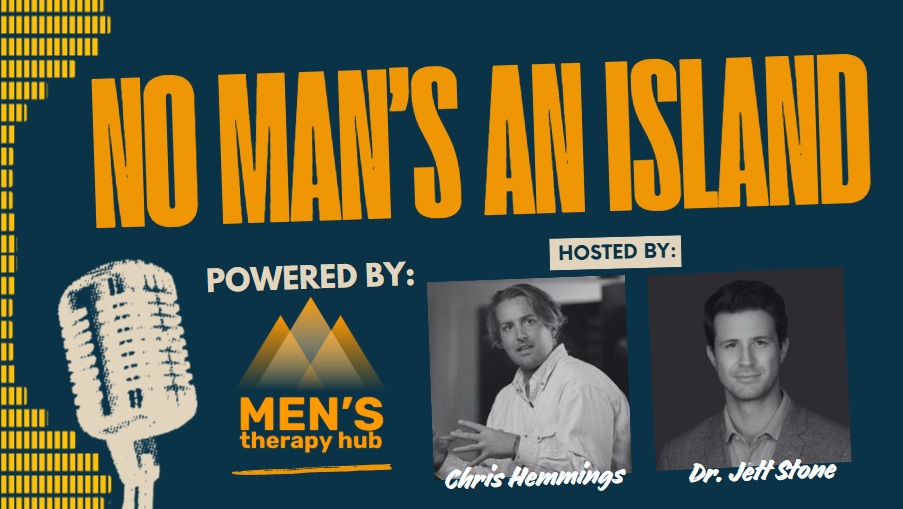
In this deeply reflective episode of No Man’s an Island, Chris Hemmings and Dr Jett Stone sit down to explore one of the most painful experiences many men face: relationship breakdown and the subsequent impact on identity, self-worth and emotional wellbeing.
Inspired by research discussed in Episode 13 with Professor Ben Hine and rooted in their own personal and clinical reflections, Chris and Jett unpack why separations and losses hit men so hard, how male socialisation shapes emotional responses, and what it takes to rebuild a life after love ends.
This conversation is not a “how-to” guide. It’s a compassionate space where two therapists speak candidly about fear, loneliness, attachment, self-esteem, and the courage to keep going – even when everything feels like it’s been lost.
What we cover
- The statistics showing how relationship breakdown affects men’s mental health
- Why men are socialised to equate love, identity and self-worth with performance, status and provision
- How loss activates shame, loneliness and existential fear
- The role of attachment and “self-objects” in romantic relationships
- Why men often fare worse than women after separation
- The dangers of collapsing male identity into one relationship or role
- The difference between self-esteem and self-worth
- The importance of social networks, friendships and multi-dimensional identity
- How fathers can maximize presence even in post-separation arrangements
- Therapeutic insights on sitting with pain rather than avoiding it
Listen and watch
🎧 Listen to all episodes here: No Man’s an Island
🎧 Watch on YouTube: No Man’s an Island – Episode 19
🎧 Listen on Apple Podcasts
🎧 Listen on Spotify
Takeaways for men
- Love and loss come together: deep connection brings vulnerability — and that’s part of the deal.
- Loss hits identity: when relational roles collapse, so can self-esteem, especially if you’ve tied too much of your worth to one person or role.
- Loneliness matters: men are more likely to lack broad social support networks, increasing the emotional toll after separation.
- Attachment shapes response: losing someone who helped regulate your emotions can feel like losing yourself.
- Presence beats performance: it’s not just what you provide, it’s how you’re present with yourself and others that sustains you.
Key concepts explained
Self-object: A term from psychodynamic theory meaning a person who helps maintain your psychological cohesion — so losing a partner who has served that role can feel like losing part of yourself.
Self-esteem vs Self-worth:
- Self-esteem is how you feel about yourself based on external feedback and performance.
- Self-worth is the deeper recognition that your value isn’t defined by roles, outcomes or relationships.
Existential load: The psychological weight many men carry that links self-identity to what they build, provide, protect and achieve.
Quotes to share
“Love and loss come in a package.” – Dr Jett Stone
“You don’t get love without the underbelly of loss.” – Dr Jett Stone
“Men can put all their chips on one relational table, and if that falls, they fall hard.” – Chris Hemmings
“Self-worth is greater than what others think of us.” – Chris Hemmings
“It’s okay to be scared, lonely or a complete mess. And it’s okay to stand up again.” – Chris Hemmings
Practical advice for men
1. Broaden your relational portfolio
Don’t invest all your emotional resources into one person or role. Cultivate friendships, hobbies, passions and community ties.
2. Sit with the pain before reframing it
Therapeutically, facing fear with support is more healing than avoidance or quick fixes.
3. Strengthen self-worth, not just self-esteem
Work toward valuing yourself independently of performance or external validation.
4. Maintain presence with your children
If you’re a father facing separation, focus on quality presence during your time with your kids.
5. Build and nurture social support
Reach out to friends, brothers, fathers and peers. Male friendships are buffers against loneliness.
Resources and links
- Men’s Therapy Hub – Find a Male Therapist
- Episode 13 – Evidence, Empathy and the Gender Divide with Professor Ben Hine
- Episode 12 – Loneliness, Legacy and Letting Yourself Be Seen:
Episode credits
Hosts: Chris Hemmings & Dr Jett Stone
Produced by: Men’s Therapy Hub
Music: Raindear
TRANSCRIPT:
Chris (00:00)
Welcome to No Man’s Island, a podcast powered by Men’s Therapy, which is a directory of male therapists for male clients. Jett and I have been chatting about doing an episode each month or so where we discuss an issue in more detail. Could be something that’s come up from a guest in a previous episode or just something we’re interested in diving into. Now, I spoke to Professor Ben Hine in episode 13. He’s somebody who specializes in family breakdown and what’s known as parental alienation post-separation.
It’s actually a great episode and I can highly recommend going listening to it if you haven’t already, perhaps even before you start this one. Struggling after relationship breakdown is something I already knew was a big issue for men, but I hadn’t really properly looked into it. So after the episode with Ben, I did and wow.
Ben told us that research showed men are about nine times more likely to experience suicidal ideation after relationship breakdown. And there’s a lot of research to back that up. For those that don’t know, the three stages of suicide are suicidal thoughts, suicidal ideation, where you actually consider how you might end your life, and then suicide completion, which is self-explanatory. You might think it’s a bigger issue for older men.
but actually separated men under the age of 35 are much more likely to end their life compared to married men. And then came the kicker for me from Ben in that episode. The research he carried out found that 42 % of fathers involved in relationship breakdown had some suicidal ideation. And as I pointed out, those were first of all, the men that were still alive. And as Ben pointed out, those were self-selecting because they were men already involved in support services.
So I spoke to Jet about this as an issue. And of course, as therapists specializing in working with men, it’s an issue that we both see. And I also thought, well, I’m recently married, been married a couple of years, and I know Jet’s married and Jet also has kids. So he has more skin in the game and maybe I shouldn’t say that, but it feels at least that way. So Jet, to begin with, as I said before we came on, I just want to kind of throw you the ball here and say like,
What does this mean to you, first of all? I’d like to talk about our own personal experiences to begin with before we get into the kind of wider conversation.
Jett (02:18)
I think it’s something that comes up so frequently in therapy. You can’t avoid it, right? This isn’t something that, you know, maybe some therapists see and some don’t. think even regardless of gender, there is partner loss, family loss. And we could sort of expand what loss means. Does it mean loss of the romantic relationship itself? Does it mean death?
Does it mean loss of a fantasy you had about the person that’s now met with the reality of who a person is? So it’s such an expansive way of looking at it. I think the more existential terror is that is the the death of a loved one. And there are so many factors that go into that. There are so many there.
The roots come from so many different places. We could look at attachment, which maybe we can talk about in a minute. We could talk about trauma. You know, those are two big factors that can play into your experience or of loss or your anticipation of it. And so with men, you know, you’re looking at how we’re socialized. so we’re going to experience that in a different way based on our socialization.
You know, the thought of loss can activate aloneness, alienation, shame. And then what do men do with that typically? What’s part of our socialization? Well, we can go into controlling mode, grandiosity, or we could preemptively withdraw from it, from a partner or from kids that you might have fears about losing. so, you know,
Chris (03:49)
Thank
Jett (03:57)
I’m going to go even farther and say, can just pull back even more and not even look at this psychologically, but look at it sociology. Like we’re living in a time where, at least in heterosexual relationships, fewer women are dependent on men to provide for them, at least financially. And so there’s a lot of guys that at least I see in my practice where there’s just a general confusion, kind of like a fog where they feel in relationships. Like we’re being asked to bring more to the table as emotionally dynamic.
beans. so romantic partners play a bigger role maybe they did in previous generations. We’ll talk more about that. Because, you know, it’s a different time. And so I think there’s the larger social economic picture too that plays into all this. So I’ll pause there because it’s just I’ve covered way too much territory.
Chris (04:41)
Well, yeah, and that’s kind of
the point of this is the things that were on my mind really were the shame and the social isolation and those are things that I want to get into but you’ve touched upon there part of the reason why I wanted to do this and I Do this fully with my wife’s permission by the way to talk about this I spoke to her about it this morning just to check She doesn’t listen anyway, so it’s not a problem
My wife and I got married two years ago, two and a half years ago. And she passed her driving test six months ago. So for the first time in her life, she gets the keys to the car and she goes out and she’s driving to work. And I remember this feeling as she leaves the house of being stood there and having dread, actual dread of what happens if.
what happens if she crashes, what happens if anything. And then suddenly I’m realizing that I’m facing kind of a beast almost of a potential crisis should it happened. And I start to realize that this is what it’s like when you are deeply connected to somebody. And you mentioned there the existential dread, it’s the fear of the lost, because let’s talk about that first.
You are also a father. If anything will happen to your wife, you would be left with the two kids on your own. That would be a big challenge, of course. But how much do you think that is the biggest fear that men in relationships have?
Jett (06:09)
I don’t know if it’s the biggest fear. I know it is a fear and one that I like you and I appreciate you sharing that have also felt and feel. You’re right, I have more skin in the game quite literally. I have two daughters and you know, it’s…
The way that I think about that is, and I’m just thinking of putting my therapist hat on as I listen to you, and I think even just thinking about myself being my own therapist, it’s like, man, that is the dark side of love. And so I’m flipping it, meaning that you don’t get love. You don’t have the privilege of love, I’ll call it, without the underbelly of loss.
Chris (06:43)
Yeah.
Jett (06:48)
They come in a package. And so for some men, think about, I’ll even say that, like, man, you love this person. You know, they’re talking about the loss and all the fears and I frame it that way for them. It’s like, yeah, this is the sacrifice you make to say yes to that, to the vulnerability of that. And so it’s actually helpful because not to just, you know, detract from or deflect from
the fears and walking them down that dark path, which I do. I said, I want to go to that place. initially I might flip it and say, yeah, this is the byproduct of loving someone deeply. And it’s actually soothing in some ways to hear that reframe on it. But it doesn’t mean that I won’t go down that dark path. And that’s been helpful to me when I think about just the health and well-being.
of my family that love is worth it to me. And so that’s the way that I would frame it. I don’t know if I fully answered your question, but maybe ask it again and I’ll give you a more direct answer.
Chris (07:57)
Well, it’s
a beautiful answer and it is kind of existentialism in a sense, right? It’s the, tis better to have loved and lost, yadda yadda. And I do agree with that and I do understand that. It doesn’t take away from the reality of the lived experience day to day that many men have of what if I lose everything that I have built? And…
Those statistics, they’re going to speak for themselves in a sense. And I wonder what it is from your perspective, what have you seen in the work that you’ve done? And also from your own personal experience, what is it do you think about male socialization that means that when a relationship does break down, that men fare so much worse statistically?
Jett (08:31)
Mm-hmm.
Yep. Yep. I mean, there’s just so much there to try to unpack. It’s like, what are we placing on our relationships? They’re also sometimes an extension of our self that, you know, I’ll maybe get a little bit academic when I think about it. But there’s a term called self-object. It sounds kind of
Strange right? It’s this guy his name’s Heinz Kohut. I think in the 50s and 60s. He created a whole brand of therapy i’m not gonna go into that but a self-object is someone who is performing like pretty essential psychological functions that maintain your own yourself cohesion your self-esteem as a guy So a lot You know when you go into therapy think about well, is this is your partner?
Are you experiencing them as a separate individual or just an extension of yourself? Like who’s soothing you who’s mirroring you who’s I? Who can idealize and so the terror of loss from that standpoint can just be looked at Is it about her or him if it’s a romantic relationship? Is or it’s about losing the sense of self that only is kept together in your partner’s presence. It’s like it’s why some
Guys will get really, really frantic when their relationships end. It’s like they’re not always, always mourning the person. Sometimes they are if it’s a healthy, loving relationship. But if there’s a narcissism to it, then they’re experiencing, oh my gosh, like, who am I? I’m going to break apart without this person who’s regulating me, even at the nervous system level. So that’s kind of one more psychoanalytic, actually, way of looking at it.
But that’s personality. But then there’s also trauma, too. Like, what have you experienced in your earlier relationships? What wounds do you have from previous relationships? Caregiver? That would tell you that loss is inevitable. It’s like what scripts are running within you that we have to unpack and give some airtime to? And…
A lot of times, you know, people have been broken earlier in their life. And so they project that fear onto their partners or their kids. And so if you’ve been abandoned and you’re walking into a new relationship, that is vulnerable thing to do. And so you start to place some of these intolerable fears and say, okay, well, what if it happens?
to them. so there’s trauma in there. And that’s a whole other episode, right, like ⁓ that we could go into. But and within that, I’m bringing a lot of stuff here from the psychology world, but there’s like, you know, anxious attachment to which I’m not going to just dive into that. But it’s it’s related to all this, because that’s the template of how we experience relationships through attachment. We call it internal working models.
Chris (11:24)
You
You always do, Jack.
Jett (11:43)
about the reliability of connection. So all of this, these are just different ways of like looking at this big issue of like, what happens if I lose it all? And I’ll say one more thing and then I’ll shut up is that for men, I think that we are socialized, finally to get to your point, that there is like an existential, I’ve called it the existential load. I wrote about this actually once.
in psychology today and basically it’s that like what
I am a reflection of what I can build and provide and that I earn therefore I am. And so in the sense it’s like what I build in this family, I’m driving this bus. A lot of men take on this load in their families, no matter how big they are. Like I have to drive the bus. I was talking to guy recently, know, men are much more likely to focus on saving and investing, right? Looking at this sort of
Homeland security in the general sense of, know, I’m responsible for, you know, keeping this together, even if I have a partner who makes more money than me. Like this isn’t so much about money. It’s about like, stasis. Thank you for that language. And so if that starts to fall apart, like, holy shit, I’m a failure. I am a failure as a human, but I’m a failure as a man. I’m not performing. Performing is the key word there. My sacred.
Chris (12:53)
Stasis.
Yes.
Jett (13:09)
duty to keep shit in order, to drive this bus, to keep us secure. And so then you devolve into shame, right, of being defective and a failure and a bad provider and…
Chris (13:22)
And they kind of encapsulated at the end there this failure potentially of the provider protector. if a relationship breaks down, you no longer have somebody to provide and protect. And interestingly, I didn’t say stasis, I said status. But you heard stasis, but stasis was a great word too. But in essence, it is the stasis of the status, right? And the status, I think, is a huge thing because
Jett (13:37)
okay.
Perfect.
Chris (13:49)
There has been in the past 20, 30 years this huge movement for women of like the strong independent woman, like the single woman who doesn’t need a man. And I know that there has been the kind of red pill narrative around that, but these men, unfortunately, they don’t really project.
groundedness and stability in it it seems to be coming from a place of anxiety and fear And perhaps it is too from the other side a little bit But when I speak to young boys in schools when I used to and I used to ask them like what they’ll dream life looked like it was always We talked about the markers of esteem and it was always big why a big wife big house nice car hot wife right and it was
Often in that order because you know first you get the power then you get the money then you get the women right that was you know that’s the Scarface line that I used to make the joke about and this was true working with adult men as well. It was the get the house get the car get the wife right and it’s like once you’ve got these markers of esteem in place then I wonder if there’s also a kind of external thing here that to have somebody who vouches for you have a woman who vouches for you
in some way as a man, particularly these days perhaps with the rhetoric around men, gives you like a badge of acceptance that you could walk around the world with and say, well, I’m spoken for. Like at least one woman has said, I am a viable man. And you have that stripped away from you maybe when a relationship breaks down and suddenly you’re left with a sense of incompleteness perhaps.
Jett (15:10)
Mm-hmm.
Mm-hmm.
And that’s a very good plain language version of what I was trying to say with a self-object before is that sometimes a partner is a extension of your masculine identity as opposed to their own separate being with thoughts fears, you know beliefs their own terrors, right and so what you’re you’re saying and I agree is that actually that that
Chris (15:41)
Mmm.
Jett (15:53)
A loss of that sort would mean a failure also of a masculine achievement, right? The marker of status, or status, as I would say, as an American. Real men, cultural, the vast cultural differences between us, real men keep our, real men keep their women in a heterosexual dynamic. And look, there’s, I,
Chris (16:02)
that’s why you didn’t understand status rather than stasis. again. Yes.
Jett (16:21)
I think adding to that is that men are more likely now to have like a pretty impoverished social emotional support networks. And so a lot of that is lumped onto their romantic partner. And so what ends up happening is that they, the romantic partner becomes all things. They become a one-stop shop for intimacy, emotion regulation, sense of self identity.
And so then what’s up happening is that too much is placed. And so what happens at the fear of loss? Well, if I lose that, then I lose so much because so much is resting on this one person.
That’s why male friendships, male spaces are so important.
Chris (17:03)
which again is something that we spoke about in episode 12, which was about the male loneliness. And that is kind of the elephant in the room here, which is the research shows that one of the main reasons is because women have a much broader, grander safety net post-separation, post-divorce, to fall into the arms, quite literally to fall into the arms of a rich social network that they have been better at maintaining.
And again, we’re generalizing, hashtag not all women, hashtag not all men, right? And of course, there are men out there who are fantastic at developing rich social networks, but the statistics don’t lie about this, that men experience loneliness at a much greater rate. So therefore, it would make sense that post-separation, men are much more likely to fall into a deeper sense of loneliness because perhaps, as you’ve articulated there,
Jett (17:34)
Yep.
Chris (18:00)
they’ve invested their, they’ve put all of their chips on the wife table, right? And they’ve gone all in on that. And if that breaks down, there are no chips elsewhere. And how much is this, in a sense, like a kind of warning to us as men to not do that and to try to keep those friendships going? Even.
Jett (18:18)
Mm-hmm.
Chris (18:23)
Regardless of how fucking annoying your mates are sometimes, if there’s someone who might be there for you in a crisis, give them a call once in a while because you never know when you might need them.
Jett (18:35)
yeah. I mean, that’s at the very least. Don’t keep your male friendships on a shelf to collect dust. Grow them, water them, or water them and grow them. I don’t know. I think I don’t have the male loneliness data at hand, but I think that I’ve been thinking a lot just by myself about like,
alienation and loneliness and I Ben Hind and talked about alienation, but they’re separate like loneliness is the desire for relationships and Meeting the reality that they’re not there in the way that you want them to be the same depth whereas alienation is like a separation between two things that ought to be together like
You know, men are alienated from their maybe the roles of being a provider. There’s wage stagnation. There aren’t jobs in the same industries like there were, right? Were alienated from just a natural human yearning to be connected to other men. Like, so those two things that ought to be are not together. They’re alienated. They’re separated. And I think there’s a lot of men who out there who actually feel to use the word alien.
like in their home or their home country or walking the streets. It’s like, this is where I’m supposed to belong, but I don’t. Is that because of discrimination? Is that because of just social economic changes? Like my life doesn’t look like my dad’s life, right? And so I think that is a big part of it too. Is it objectively the world around us has changed, right?
Like we’re alienated from the job availabilities that we have, the friendships, the, our role in a romantic relationship is, you know, the breadwinner, the, you know, people will listen to me when I speak or when I need time alone, I get that time alone without asking, like all those things. But those, you know, some of this we have to accept, like what I just said, but other, other, some other of it is like other aspects of it is beyond our control. So there’s a separation. And I think that that brings about the sense of like.
⁓ deep loneliness too. Do get where I’m going with that? I’m just kind of like workshopping that out there. I don’t know if I really nailed it, but.
Chris (20:49)
Yeah, yeah. ⁓
And this is where I kind of want to ask you.
That alienation, what Ben Hine talked about was parental alienation is where post-separation, one parent, and actually it’s not gendered, and you would think that it is, but one parent will actively alienate the other parent from the children by obfuscating, lying, manipulating them to hate the other parent so that the kids don’t want to see them. of course that…
Jett (21:19)
Yes.
Chris (21:21)
as he talked about, deeply affects the kids attachment system. But from your perspective, can you understand as a parent, the pain that a lot of men must feel because it is usually the men that leave the family home. And whether it’s active alienation or not, you are still being ostracized from the family unit, the day-to-day family unit.
What impact would that have on a man? And like, can you imagine what impact that would have on you if suddenly that was taken from you?
Jett (21:50)
And that’s it, is that you have to step in to their shoes as men who are alienated in that way. would be devastating. Yes. I’ve imagined it, and I do with my clients who are facing that. And you know, we’ve talked about a lot here already. I think one of the things that men need
This is my opinion is just yeah, that’s devastating. It feels unfair or it is objectively unfair and likely.
Let’s silence ring out a little bit, like just sitting with that, that there’s someone else sees it fully, how awful that is, without trying to fix it. Like just letting them have that moment, that’s part of it.
Chris (22:41)
or you’re not a couples counselor,
so you can’t really fix it. That’s not your job as the therapist to go in and try and fix them. It’s to be with them in that reality.
Jett (22:48)
No.
That’s right. I don’t want to lose sight of that either as an aeroless therapist. It might seem like totally obvious, but that isn’t if you’re not, you know, if you haven’t experienced if you haven’t been in therapy or you’re going through this, like who’s going to give you that? Who’s going to offer you that space and not sugarcoat things? Right. You might talk to someone else like, but you’re such a good guy. You know, you’ll find you’ll pick up, you know, you’ll you’ll happy talk. All right. The happy talk.
Chris (23:12)
plenty more fish in the sea.
Jett (23:16)
isn’t helpful. And so you kind of have to sit with them in the muck before you even think about entering reframing mode, which I’ve talked about before, problem solving, which is all, which all can be valuable therapy, but there’s a time and a place for it. And so, we have to, as therapists, we’ve, I think we really have to stretch ourselves and not just listen, but listen in a way where like you were in that man, you were inhabiting that man’s inner
and seeing how crushing it is and maybe giving him language for it like that new language to help organize the experience.
Chris (23:53)
And if you have been in a quote happy relationship, if such a thing exists, you know, a well functioning relationship, let’s call it, where tactility, for example, has been a big part of it. And like, you you have two daughters, I can only imagine that you are like a walking oxytocin bomb every day. Like to have that taken so that maybe you only see your kids weekends, you know, maybe you never get to hug that.
person again, whether it be a wife or a partner, depending on your sexuality, but you’ve had somebody there to co-regulate with, as you mentioned before. There’s also the somatic withdrawal in a sense that you don’t get that hug from your daughter every day. You don’t get that hug from your partner every day. You don’t get that moment of connection every day. Suddenly you’re in a flat on your own five days a week.
And then when your kids do come, they’re a bit weirded out because it’s not their usual space. And like, why are you here daddy? This is strange. And you know, suddenly everything is different. And there’s not just the status, the impact of stasis. I like that. I’m going to use that. There’s also, and of course the kind of cognitive challenges that come with it, the finances and all of that too. There is this kind of somatic bodily change that you are extricated from this environment.
suddenly and put into a new environment where you don’t get all of those creature comforts, those home comforts that you’ve been so used to.
Jett (25:25)
Absolutely. I mean, it’s no, no, no. I mean, I have thought about it. So you’re not taking me to a place, which says something, you’re not taking to a place I haven’t been, at least in my imagination. And, you know, there’s a time to meet the reality of it. But as I suggested before, but then it’s like, it’s part of the trauma of it all. I don’t necessarily mean that in a PTSD way. I just mean that in a general
Chris (25:28)
I’m not trying to scare you here, Jack, by the way.
Jett (25:53)
you know, trauma, small t trauma, maybe, although it can be a big t trauma, is that it’s the fantasy of what this relationship would be, has now been totally upended into something different. It’s really hard to reconcile what we had hoped versus what we are experiencing. And that that’s part of our work as therapists too, is like reconciling those two. How do you do that?
It’s not so easy. You have to give it space and time.
You know, there are moments for reframe, but I think in the early stages of that, it’s like,
How can you then focus on presence? Like what are your values as a dad, whether you’re a resident dad or not? Like what are your values? Well, a lot of times when I ask dads that question, in this case, we’re talking about fathers, it’s presence. They really care about presence. When we think about values, being present emotionally, physically.
obviously, in their kids lives. And so it’s like, okay, how can we maximize that in the reality of you being, you know, having 5050 separation or 2223 arrangement in a divorce or something like that? Like two days, two days, three days. And it’s like, okay, well, I’ve seen divorced dads thrive in the sense that, okay, now the time that I do have with my kid has to be very, very, like,
focused with love and care and interest and listening and exactly active. So you take for granted, I might take for granted, I probably do take for granted that I’m a resident father. That’s a privilege, That is. And that if it were something else, I might have to focus on like, how can I maximize duck? I don’t want to blink in the time that I do have with my kid.
Chris (27:27)
active.
The very fact, as you said, that this is something that you have contemplated shows just how fearful that can be for guys to step into. And I wonder what your advice is to the men that you see or what you kind of work towards with those men. Because they do have to try to fill a space that was once filled with a person or one person and one or two small people.
that isn’t there anymore. And that, I go back to the fear of losing my wife on the road. What would happen if she just didn’t come home? What would I do? I’d be in this house and it would be empty and she would never come back. And like, what? It’s almost, I can’t really fathom what that would feel like because I mean, I’ve experienced heartbreak before. Like my previous relationship breakdown.
have experienced a deep, deep heartbreak, but this? almost don’t want to think about it, but I can’t not think about it.
Jett (28:46)
Mm-hmm.
Yes. And the more you avoid it, the more it comes back with a vengeance. So I don’t know if this is advice, but it’s have someone you trust. It’s not, you know, the person that you feel you’re losing. Walk you down that dark alley. And so sometimes it’s scary for me, even as a therapist, to walk someone down that like, OK, this is conquering your mind. Let’s go there. I’ll go there with you. OK.
Chris (29:02)
Yeah.
Jett (29:16)
Tell me how she’s going to die. Okay, I won’t sugarcoat it with, you know, not be there anymore, right? In the ways that we do to make just the terror of death seem nicer. In plain language, I’ll just go with them, like, okay, then what would be the first thing you do when you wake up?
Would you, was that a survivable event? that like, I’ll do this with myself too. in a way it’s harder though. You want to be able to do it with someone else and I’ll just let them go there. I’ll let them, I’ll walk down that to that dark place with them and it doesn’t solve it, but you’re seen in the most terrible state that you can imagine being in. Do you see what I’m saying? It’s like, that is an intervention too. We forget about it. It’s like,
um go to that place it’s exposure it’s Imaginal exposure as we call it in the psychology world like Well, guess what I I make this I use this metaphor if you walk into a department store and walk out humming a song Right and you just can’t get it out of your head. It’s It’s just taking over. Well It isn’t to say oh stop thinking about it. I can’t believe i’m just gonna push it away. Like let me just
Chris (30:05)
Surprise surprise, the therapist is suggesting that you have to sit with your emotion and your pain.
song gone.
Jett (30:27)
Sing
another song. It’s actually to sing it. To sing it like with a little bit more gusto maybe, I don’t know. So that’s a nice pleasant example that I’m using for something that’s quite dark. And look, I have kids, I’ve thought about this. This is my biggest fear, right? As it relates to the health and well-being of my kids, of course, every day. It creeps in somewhere somehow.
So much so that I use the word it, because it’s hard to even talk about it. And so I think I go back to the very first thing I said, yeah, I love these kids and this is.
The baggage.
Chris (31:04)
Yeah, and like you spoke about so beautifully at the start, it’s part of the deal. If you want this love, if you want this family life, it comes with risk. And I wonder if that’s part of the challenge for single men even still now and separated men is, you know, dusting yourself down and climbing back into the ring and saying, well, actually we go again.
Jett (31:04)
love.
Yes.
Chris (31:27)
Because one of the things I’ve said to my wife is, she hates this, she’s much more avoidant than me. So I’ve said to her, if anything ever happens to me, you have to keep going, you have to go again, you have to believe that this exists because we have experienced it together. Spot the romantic in the relationship. But I wonder if that’s such a big thing for guys because as we talked about before, that loss of the status.
and the kind of, the big fall, why would I bother risking that again? Why would I bother trying to find that again when all it’s going to do is hurt me?
Jett (31:52)
Mm-hmm.
Chris (32:04)
I know there’s not a question there, that’s just more of a statement.
Jett (32:05)
No, no, I’m just sort of,
yeah, I’m reflecting on it because I think.
You know, what you want to tell her is a reflection of what you want to hear, from her, perhaps. Because I’ve told versions of that to my wife, too. It’s like, go on. You know, I give her a you know, tep talk in the case of the worst. But secretly, not so secretly, that’s also like what I want her to tell me.
So, but I will say that all of what we’re talking about can lead men to do
Chris (32:30)
Yeah, okay.
Jett (32:37)
controlling behaviors, grandiose behaviors, withdraw behaviors. And so the fears that we hold can manifest in really destructive ways, relationship-wise. Well, I mean, what do we do with shame as guys? We quickly transform it because it’s intolerable. We go big, right? We become more stern and more resolute and more assertive, but really it’s aggressive and intimidating.
Chris (32:49)
Tell me more about that.
Jett (33:04)
Um, or we go into narcissistic, something more narcissistic and we talk about, you know, like, um, we save things passive aggressively about how we’re, you know, we could pull chicks or, you know, get, find another woman or find another partner, you know, and how exactly, right. Re rewrite history. And to me, those are all destructive.
Chris (33:22)
or win in every fight we ever have.
Jett (33:32)
And we have to be aware of it and catch ourselves in those moments. Because real confidence is maybe what this all comes down to. Is living with that fear. It’s not going go away. That’s my sense. I’m not like, we’re not going to eliminate our fears that we’ve talked about today. But real healthy self-confidence doesn’t mean not having fears. No, no. It’s having the fear and, as we say in the psychological world, like holding that dialectic, and
being the partner present, loving, caring, thoughtful partner. So it’s, it’s not elimination. This isn’t a complete like, let’s eradicate this fear somehow. Get it out of my mind. No, it’s going to show up. I promise you it’s going to show up if you’re in the love game, if you’re truly loving, healthy self-confidence is having it and still being the person, the guy that you want to show up in the world as.
Chris (34:26)
which
is understandable for those still in the relationship. Once the relationship has ended based on everything that we’ve said, I guess what we’re actually talking about here is a massive knock to self-esteem. And therefore, if we don’t have the foundations of self-worth, which I think maybe we should do an entire episode on, because I think for me, understanding the difference between self-esteem and self-worth was revolutionary in my own life. If we don’t have the…
Jett (34:51)
Could you say that? Just
if you can remember it offhand, I would love to hear how you would distinguish it.
Chris (34:56)
So self-esteem is what we think and feel and believe about ourselves. And usually that’s based on ⁓ external factors. So it’s how we perceive others to perceive us, right? Or how we perceive others perceive us. And self-worth is the recognition that I’m greater than all of those things. So I don’t need the external validation continually to know that I’m a good person, that I’m okay, actually. And…
When you’ve been knocked off your perch, as I have been, and you have been dragged through the mud, and you have all of that esteem taken away, to build up a sense of self-worth and say like, okay, but none of that actually changes who I am as a person. okay. and for those on the podcast right now, I have my finger pointing, I’m in aggressive mode right now. Like, that’s fucking hard.
That’s probably the hardest thing I’ve ever done in my life is to develop that sense of worth. So if you have put all of your markers of esteem on this relationship and your esteem is taken away from you because a relationship ends and probably somebody is saying nasty things about you too, which doesn’t help, then you can fall into this pit of despair. I talk about having the rug whipped from underneath you.
and you fall down into a pit of despair. And so if you don’t have that self-worth to hold you up, then you do automatically then lose a shit ton of self-confidence. And actually one of the biggest ways that men will try to mask that would be through drug and alcohol. Through escapist methods which men are much more likely to use and the most likely ones would be drugs and alcohol. You know, I’ve had clients say to me like, no, I’m in a super happy, comfortable relationship. Okay, well, you know.
we play out what would happen if it ends. well, I’d definitely go back to using drugs. And it’s like, well, what? Okay. Doesn’t sound so happy and healthy if that’s, it sounds like all of your eggs are in that basket. You all that chips are on one hand on the table. So to lose that confidence for men, you know, I’ve got it written down here. Like one of my clients said recently, I have a book of, of smart things me and my clients say in sessions, which is a separate book to.
Jett (36:57)
Yeah.
Mm-hmm.
Chris (37:11)
My
client notes, and he said that for him, the thing that he needs to show all the time is competent, capable, confident. Those are the three C’s. I must be competent, capable, confident. And to have a relationship taken away in some way affects all three of those, but particularly the confidence. And to recover from that, to recover from that loss of confidence as a man, to try, and this is not to say that developing self-esteem is bad.
to regain some of that self-esteem is really tricky when you have put most of it in the hands of a partner.
Jett (37:48)
Yes. Yeah. Another case to be made that we have to expand our portfolio of relationships as like that we are relational creatures and we’re not on an island to use the name of the podcast. But yeah, that distinction between self-esteem and self-worth is ⁓ helpful.
It’s a good way of putting it.
Chris (38:14)
because it’s saying, yes, I’m in a relationship with this amazing person. And yes, I do take a lot of joy and comfort and confidence from, you know, I’ve got my best mate who bigs me up all the time, right? That’s just partly why I’m with her because she talks me up some of the time. And yes, that would be hard if it went away.
It would be the most difficult thing I will have ever experienced and bear in mind my dad died when I was 25, right? So it would be the most difficult thing I ever experienced. And yet, part of me has to recognize that I am greater than that in a sense, that I still can be whole, that I still can be me. It’s gonna take some time to get back because grief is grief and we have to allow the grief in.
Jett (38:53)
Okay.
Chris (39:05)
but that it doesn’t say anything actually about me as an individual necessarily.
Jett (39:10)
Yes,
yeah, I mean, it really has me thinking because…
What I’ve found is the more chips you put onto your romantic partner is your end all be all right. The more likely it’s going to be totally a sense of destruction, the anticipation of my total life destruction if that were all to end. But it’s also like. Yes, relationships to humans like I’m going to center that. That’s that’s important, but it’s just also having multiple parts of yourself that are in relationships with.
other things out there in the world too. Hobbies, passions, interests, causes.
passion projects, being multi-dimensional, having, I think the term is self-complexity, right? Like that you’re not just, ⁓ Actually Richard Reeves talks about it in his book about men and self-complexity is that women tend to be more likely to have more understandings of who they are. I’m a mom, I’m a professional, I’m a collector of, know, some…
Chris (39:55)
I like that. I’ve never heard that before.
Jett (40:12)
like a collector of something. I ⁓ read fantasy novels or romantic novels. And so men, I think, might have less identities that they take on. So just take a look at yourself. I really don’t want to butcher that definition. But my main point here is that you want to have relationships to multiple things. I do feel like that’s a buffer against trauma and tragedy.
Chris (40:15)
Collector of whatever it is people collect.
Jett (40:38)
is feeling like, okay, I am a multi-dimensional person with so many different, like fallbacks that will help keep me up as I’m collapsed.
Chris (40:49)
I think the cliche for men often has been, or the stereotype has been that men are quite simple creatures, right? And then I think, okay, we’re talking here about one of the biggest predictors of suicide in men being relationship breakdown. And one of the other biggest predictors, because during the financial crash of 07, 08 in the UK, the rate of male suicide spiked almost identically to the rate of male unemployment. So it’s like our identities wrapped up in…
Jett (40:54)
Yeah, true.
Chris (41:17)
Provider protector like I am the provider of my phone for my family. I have a job therefore I am or I love and I protect my family Therefore I am and if we take away one off god forbid both of those things What are we left with? And maybe we’re left with a not so complex being so maybe sometimes you know, like some stereotypes There is some accuracy in them. And so maybe this is what this podcast I mean, yeah
no man’s an island. You’re literally making me want to call my friends now and have this conversation to say like, you’re all married. Like, what the hell do we do if that ever falls down? Like, can we make sure we’re all there for each other? Because I know that we will be, but just like, can we just like solidify that? Like, please sign here to say that you’ll be there if anything happens. Because, you know, right. Because actually, because I have two older brothers, right? And I actually know that if anything happened to me,
Jett (42:05)
Turn it into a contract. Send a contract out of it.
Chris (42:13)
like seriously financially, I know that they would support me and vice versa. With my friends, I know that they’d be there for me, but that is something that we’ve cultivated over probably the last 10 years. Because 10 years ago, we wouldn’t have been able to have the conversations we have now. it’s what I used to say to the kids in the schools, which was like, you have to start practicing this now. If you start trying to practice this when you’re 40 or 50, it’s still better to start, but it’s going to be way harder to start.
when you’re 40 or 50 than you are when you’re 14, 15.
Jett (42:44)
Yes, yes.
Yeah, and indirectly, you know, making yourself dynamic and three dimensional, multi dimensional, whatever word you want to use. I think is means that, you know, having these conversations with friends or, you know, in your case, talking to your brother and my case, talking to my sister. It’s a very hard thing to talk about, to bring up, because it would seem like quite a
a bummer, right, to have to talk about loss, you know, in the few moments you have to converse with someone in, you your family. It’s, time is becoming, you know, there’s less of it. And so that the time you do want to spend, want to spend it talking about tragedy and loss too. Right, right. But I think it’s worth it.
Chris (43:26)
things that matter. Yeah.
What’s the one thing that you would want to leave listeners with from this? This is the first time we’ve done an episode like this, where we sit and say like, here’s a topic and maybe in the future we can be a bit more refined with it and we can work on it. We’re all practicing, we’re all learning. For those that are still listening at this point, what would you want to leave them with?
Jett (43:38)
Yeah.
Hmm. I’m going to say something that like, isn’t that profound. and maybe doesn’t totally track with everything that we’ve talked about, but it’s maybe an add-on that I think about it maybe in my own life is like having some creative outlet as a buffer to loss, which is why art therapy can be so great, you know, of a medium, but
You know, I’ve always played music my whole life and it’s another form of emotion regulation for me. And so if you’re a dad out there or if you’re like, it’s never too late to start to express yourself in other ways outside of just talking. You know, we do talk therapy, but there’s so many ways to be expressive. that having that is a, like I have a relationship with music. Like it’s my, I always know it’s going to be there.
some way shape or form and I’m not doing it in an ambitious way. I’m doing it in a playful way and in a way of like it helps me be present and grounded and so I’m just putting that out there as like I don’t know it means buying an easel in watercolors or what it means just tinkering playing with your creativity whether it’s art or music or whatever I want to add that because I do feel like it’s often gets
buried in there. And I have buried it because it’s the last thing that I’m saying in podcast. But that’s what I would say. How about you?
Chris (45:16)
You know, I do this all the time. I ask you a question and then I think, shit, I have to answer it myself. So I’m gonna, people who know me who listen to this won’t be surprised when I say I’m gonna talk myself up a little bit here. I lost a friend called Charlie about, what was it, eight years ago now? And his brother, his little brother, his little brother, he’s like six foot four, but anyway, his little brother was…
Jett (45:21)
You
Chris (45:45)
devastated, really struggling. And I had this conversation with him and I forgot I had this conversation with him. And then he called me about a year or so later and he said to me, you said something when I was grieving that revolutionized the way that I thought about this. And I think this would be what I would say to men who are grieving, whether it be a death from a partner or even just a relationship breakdown.
And what he said was, that I said, it’s okay to be scared. It’s okay to feel lonely. It’s okay to be like, objectively miserable. It’s okay to be a complete fucking mess. And it’s okay to stand back up once all of that’s over. And I thought to myself, wow, what a…
Smart thing I said that I don’t remember saying and then I incorporated that into the work that I do and I remember Doing one of these fireside chats with a business once and I started crying when I said this because I felt it so deeply because at the time I was going through something and I was speaking it to myself and It’s that reminder that yeah relationship breakdown is going to be hard, but the world is a better place with you in it So keep going I keep fighting
keep standing up, even if you fall down, like when a kid is learning to walk, it keeps standing up even though it keeps falling down. And you have to keep going because I say this to my clients all the time. I like, I wish I could do this for you, but I can’t. You have to do this yourself. And yeah, so you’ve done a preemptive thing and yeah, put all of the preemptive things in place, but you could have all of, you could have the perfect system in place to catch you. And it’s still going to hurt like shit when it happens.
and all that you have is yourself to keep, to say, I’m allowed to be a mess and I’m also allowed to stand up and keep going.
Jett (47:43)
Thanks.
so wonderful. It’s such a powerful thing to hear when you’re in really low spot. And not to add another one onto that, but it got me thinking of what a supervisor once told me about talking to clients who are going through hell and who might be hopeless. It’s saying to them, it’s okay.
if you don’t have hope. I’ll hold it for you.
Chris (48:11)
Mmm. And I’ll give it you back when you’re ready. Yeah.
Jett (48:12)
And I don’t know. Yeah, yeah, yes,
yes. I mean, I personalized that too, right? In the same way that you did, but it just reminded me of it. Cause that’s kind of like what you’re telling them. Like, it’s okay, it’s okay. Keep going. Like, and you’re instilling, like you’re showing them that you have the resilience even when they might not have it. And that’s okay.
Chris (48:35)
Yeah, to model it, in a sense. And to model it and say, you know, it’s something that I’m not going to understand your experience. And this is as friends, like we can’t go in and say like, I know what you’re going through. Even if you’ve been through your own divorce, you don’t know what somebody else is going through. You have an idea, but you can stand beside them and say, and I will be with you even in the darkest moments. So you’re not alone. And that’s the challenge really is how to not feel alone.
in that pain because I think that’s probably the scariest and most painful thing of all.
Jett (49:11)
Yes.
Chris (49:12)
Let’s end on that cheery note. Thanks, Jet. I’ve enjoyed that. I would like to do more of these. And for those of you that are listening towards the end, I actually would be interested in feedback. Would you as a listener be interested in more of these sorts of episodes where Jet and I discuss issues? Or do you just want to hear from our guests because they’re more interesting than us? I would be interested to hear that. So thank you, Jet. And I was.
Jett (49:38)
Thank you. This is awesome.
Chris (49:39)
Yeah, I really enjoyed that. I’ll speak to you again soon.