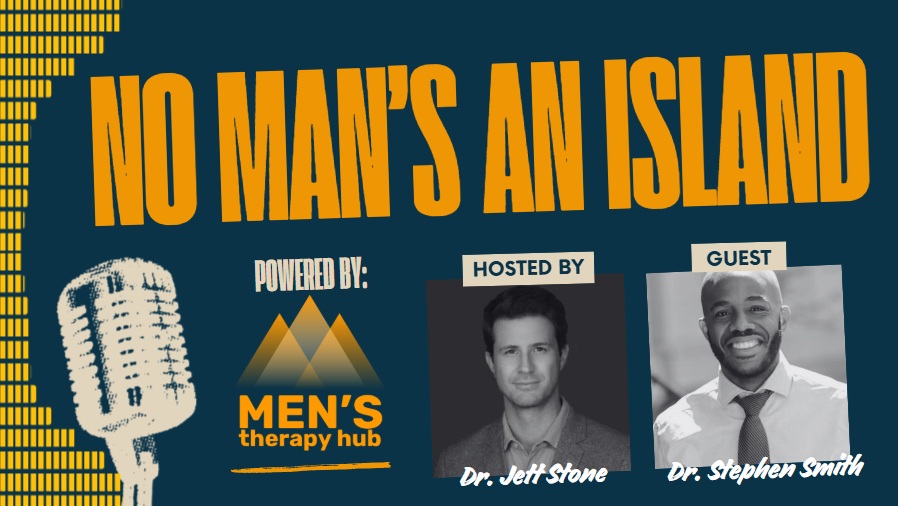
Race, Identity & Belonging with Dr Stephen Smith
In this episode of No Man’s an Island, Dr Jett Stone speaks with Dr Stephen Smith, a New York–based clinical psychologist, workplace consultant and adjunct professor whose work bridges identity, culture and belonging in therapy.
Stephen shares his personal and professional journey – from studying theatre to working in the legal system and eventually earning a doctorate in psychology. His path was shaped by one pivotal experience: meeting a Black professor who encouraged him to pursue psychology when he couldn’t yet see himself in the field. That moment of representation became the foundation of his work today.
Together, Jett and Stephen explore what it means to create therapy spaces where Black men feel they belong. They discuss how race, masculinity and culture intersect in the therapy room, why language matters, and how slowing down the therapeutic process helps build trust.
Stephen’s reflective approach invites listeners to rethink what therapy can look like when it meets men where they are – curious, human and unhurried.
What we cover
- How representation inspired Stephen’s path into psychology
- Why Black men often feel unseen or misunderstood in therapy
- The role of curiosity and authenticity in building trust
- How therapy culture can unintentionally alienate men of colour
- Why therapists must bring their humanity – not just technique – into the room
- The importance of language and cultural nuance in therapy
- What white therapists can do to work more effectively with Black clients
- The tension between identity, professionalism and belonging
- How slowing down creates deeper emotional connection
Listen and watch
🎧 Listen to all episodes here: No Man’s an Island
🎧 Watch on YouTube
🎧 Listen on Apple Podcasts
🎧 Listen on Spotify
Takeaways for men
- Representation matters – seeing someone who looks like you in the room can change everything.
- Slowing down helps trust develop naturally.
- You don’t have to abandon what’s kept you safe to start healing.
- Language is connection – it shows respect, understanding and care.
- Therapy isn’t about performing emotion; it’s about being real.
Quotes to share
“I hadn’t really seen too many Black psychologists, particularly male professors. So when I met one, it changed everything.” – Dr Stephen Smith
“When you’re with Black men, don’t rush to strip away the things that have helped them survive. Hold space for it.” – Dr Stephen Smith
“Men need to know they can bring their full selves into therapy – language, culture and all.” – Dr Stephen Smith
“Therapists are so afraid to talk about race, but for many Black clients, that’s already part of the story.” – Dr Stephen Smith
“I’m not here to push someone into transformation. I’m here to meet them where they are and hold what they bring.” – Dr Stephen Smith
Resources and links
- Dr Stephen Smith – Psychology Today
- Workhaven Consulting
- Men’s Therapy Hub – Find a Male Therapist
- Episode 15 – Build Safety, Show Up and Give a Damn with Dr Brendan K Hartman
Episode credits
Host: Dr Jett Stone
Guest: Dr Stephen Smith
Produced by: Men’s Therapy Hub
Music: Raindear
TRANSCRIPT:
Jett Stone (00:00)
Welcome to No Man’s in Island, a podcast powered by Men’s Therapy Hub, which is a directory of male therapists for male clients. And I’m Dr. Jet Stone, and my guest today is Dr. Stephen Smith. He’s a clinical psychologist, workplace consultant, and an adjunct professor based in New York City. I first met Steve when I was a clinical psychology intern at the Manhattan VA. And he came in to run a workshop.
Steve (00:01)
you
Jett Stone (00:27)
on cognitive behavioral therapy for psychosis. Maybe we’ll get to that today, I don’t know. And it stuck with me immediately. The way he approached some of the most challenging clinical cases with creativity and real thoughtfulness, it made an impression on all of us in the room. And I remember thinking, this guy is really talented and I wanna be able to run a workshop like that someday. Don’t know if I have, but years later, we ended up working together for an organization called Workhaven, where we help organizations.
Steve (00:47)
You
Jett Stone (00:56)
navigate complex workplace dynamics. And we still work together today. In his teaching consulting and psychotherapy practice, Steve has developed an expertise working with men of color. And I’m excited to talk about how we as therapists can more effectively work with culturally diverse men. And what Steve has learned about making therapy a space where black men in particular can feel like they belong. I’m really excited to have you here. So welcome.
Steve (01:22)
⁓
Thanks for having me. It’s a pleasure to be here.
Jett Stone (01:26)
So walk me through your trajectory to becoming a psychologist. I’m curious, like, what led you to pursue a doctorate? How’d you end up doing this work? I’m not going to let you leave out the theater background part of it. So there you go.
Steve (01:39)
Wow,
you remember that. ⁓ That’s a great question. think every time I think about like the origin story, I just kind of surprised at how little interest I had in like actual psychology. I was interested in race. I was always been just kind of fascinated with race and how we’re socialized into understanding our skin, our identity. ⁓
The only kind of field that satiated that interest was psychology. So I just naturally gravitated towards that. ⁓ And after I graduated with a bachelor’s in psychology, I worked at a law firm, a public defender’s office actually. And then I started to see the kind of more clearly the intersection of like these social justice issues ⁓ and mental health.
I wasn’t really kind of determined to pursue it. It was just fascinating to me. and then someone recommended a, master’s program in forensic psychology. So said, not? You know, ⁓ I figured I was early in my career. So I did that. Still not interested in kind of pursuing it ⁓ to a kind of.
higher level. ⁓ But I took a class with a professor that looked like me. ⁓ Never forget him. I’m still in contact with him to this day. ⁓ Black professor. And he taught a class on ⁓ confessions. ⁓ And I loved it. The mental health piece, the kind of, you know, the legal piece, the
Jett Stone (03:13)
Mm-hmm.
Steve (03:34)
⁓ identity piece that just kind of intricately gets woven into the fabric of our legal system. And I wrote a paper and he liked it. And again, I was like, great, glad you like it. And he pulled me to the side and said, I think you need to keep going with this.
pursue your doctorate. And I was like, yeah, I’m not gonna do that. ⁓ Close that door. And then he just kept kind of staying in my ear encouraging me. And I think more than him. ⁓
wanting me to pursue the doctorate was that he was in his position, someone that shared the same identity in that position. I hadn’t really seen up to that point too many black psychologists, professors, particularly male professors. So.
Jett Stone (04:26)
Mm-hmm.
Steve (04:32)
After some convincing, just, he, he told me to apply and I applied to a few schools, happened to, I applied to the school that he was teaching and then I got in there and then it’s been kind of off and running. But the story, I say that story because it actually, every time I share it, I talk to someone that’s like, yeah, I had a similar story. I didn’t really want to or know anything about this profession and somebody, particularly somebody that looked like me, told me about it.
wanted me to do it, believed in me, wanted me to contribute more, wanted to see more people of color.
⁓ in that profession. So it’s, it’s, it’s been incredible ever since I try to do the same kind of pay it back. ⁓ You know, whenever I see folks that are interested in pursuing psychology, I never say no, I never say, you know, ⁓ well, maybe it’s always like, absolutely, you can absolutely do it. We need you to do it actually. ⁓
Jett Stone (05:31)
Yes.
Steve (05:33)
And I think it’s kind of really timely for this conversation because we realized that although there are some folks that are doing this work, we still need more. We still need more doing it.
Jett Stone (05:47)
Yep.
We’re going to get more into that, but just I hope there is somebody out there listening who is interested in pursuing psychology or psychotherapy that hears what you just said. Because I don’t know if they have that professor that you had and that sometimes to change the course of your life, it takes one person who shows an interest.
Steve (05:53)
Mm-hmm.
Mm-hmm.
Jett Stone (06:14)
in you and it happens at the human level, sometimes one to one. You saw yourself in that professor and it’s like we can’t be what we can’t see, which is why I hope that there’s someone out there or more than one out there who can hear that and see that if they’re watching. And you you were like, you were like, I don’t really know what I want to do, but the criminal justice system, the intersection of the criminal justice system.
Steve (06:16)
Mm-hmm.
Yes.
Great.
Jett Stone (06:41)
and mental health ⁓ is something that, I mean, it’s complicated. The legal system is so rigid and mental health is so nuanced, right? And you were interested in race and skin and how that shapes how we see the world and how we treat each other. And you found it because you took a forensic psychology class, right? ⁓ Were it not for that and meeting this professor, you know, we wouldn’t be talking today.
Steve (06:50)
Mm-hmm. Mm-hmm.
Yeah.
Yeah. Yeah.
Jett Stone (07:12)
Yes.
I’m curious. Well, first, how you also told me a story about the theater background. And I’m actually curious, like it may not fit at all into it, but it does. Like you’re multifaceted, right? Like you’re interested in many things. I know that about you. So just what happened there? think it’ll be entered because I think a lot of people are coming from other fields that might be interested in psychology and mental health and it doesn’t disqualify them to have had other interests. So.
Steve (07:28)
Hahaha
Yeah.
Yeah,
that’s a great question. I’m still interested in.
theater and I feel like like one day I’ll get back to it. But you know, I can’t I can’t sit here and claim that I have an extensive background ⁓ or that I had a shot at something like a true shot. It was really more I did ⁓ some theater in high school. I loved it. It actually I think was one of the few moments I could point to that allowed me to come out of my skin a little bit and just kind of be a little bit more free in the world. ⁓ You know, in my
school that at that time theater was a predominantly like white thing right like it was an elective so folks got to choose that but you never really saw. I went to school in Florida in West Palm Beach Florida but it was pretty you wouldn’t see too many black and brown people doing theater at that time ⁓ even though I went to a school that was had a good kind of ratio in terms of demographics and then I took a class and the class led to just kind of taking off
Jett Stone (08:22)
Mm-hmm.
Where’d you go to school? for… Ah, that’s right, that’s right.
Steve (08:46)
some more outside, not outside, but extra shows there. And I just really, I just remember being there and I was like, wow, again, another space that I would not think to inhabit, right? ⁓
that felt good and allowed me to really play into some of the things that I end up hiding. Like I was singing in theater, right? I was like, know, dancing and just there was a side of me that, we’ll get to this I hope, like ⁓ I’m not really socialized into showing. ⁓
Jett Stone (09:22)
Mm-hmm.
Steve (09:28)
So I was really grateful for that. And it was, again, it was just on the side as an interest. ⁓ I did, when I started the Forensic Psychology Master’s program, I did get back to it and joined ⁓ doing a little bit more theater. And again, same thing, was, these are the things that kind of allowed me to kind of push outside my comfort, outside of this image that I usually have to uphold. ⁓
occupying a space that I usually don’t see ⁓ with other people that look like me. And you know, it’s these small things that you might not think about in the moment, but they really add up to kind of point you in a direction. And for me, I was just lucky that I…
was able to harness that experience, experience in grad school. The right doors opened and really kind of shaped who I am today. It’s just like, I do know that it’s possible to be someone different than how society sees you. So.
Jett Stone (10:31)
Yes, and
I’m glad I asked that question because theater gave you permission to feel, and I can relate to that so much just as learning music, right? If we can’t do it among our guy friends or within our family or within our community, then it’s like it gave you a space to safely show the emotions that you may have otherwise clamped down on, right? It’s a, ⁓ you know.
Steve (10:39)
Absolutely, absolutely.
Absolutely.
Yes. Yes.
Jett Stone (10:59)
It’s a good excuse for to be able to bring out a fuller range of feelings, a venue. So we’re going to talk more about ⁓ masculinity ⁓ and race, but I wanted to just give you a stat and just let’s just think about it together. That, you know, the representation barrier and how you felt represented and seeing that, you know.
Steve (11:07)
Yes, absolutely.
Mm-hmm.
Jett Stone (11:27)
Professor and saw yourself in him. The numbers are stark. So the APA data, American Psychological Association, I think only about four to 5 % of the psychology workforce is black. That may have been 2023. Someone please fact check that. And then 45 % of the psychology workforce is black, but black men make up less than half of 1%. And given that reality, when a young black man walks into a therapy room,
Steve (11:33)
Thank
Mm-hmm
Jett Stone (11:56)
the space itself, I’m imagining would feel foreign or not for him. I mean, it’s that way for men, but more so for black men. So my question for you is beyond just the lack of representation, like what are we doing structurally or clinically that reinforces that feeling of exclusion? Like what can we do?
Steve (12:01)
Mm-hmm. Mm-hmm.
Yeah, I mean, there are a ton of things just kind of built in the fabric of our field that really dissuade.
⁓ marginalized, minoritized communities from joining, ⁓ Barriers in terms of expenses, know, therapy is expensive. Even if you have insurance, therapy is really expensive. ⁓ Therapy is inconvenient at times. Obviously, advent of telehealth and teletherapy virtual appointments has been incredibly helpful to a lot of people. But it often doesn’t account for folks that have a lifestyle that’s different
than the mainstream. And you know it there is a lot of people come to therapy because they want ⁓ to be heard but they want to be understood and if you’re not seeing the therapist that look like you it automatically gives you an impression of what the possibilities could be and for some it’s hard to imagine connecting with someone that looks differently. ⁓
And so I think our workforce is our workforce is predominantly white.
female centric, right? I know a lot of men that have stayed away from actually seeking therapy services. Now, interestingly enough, I think the landscape has shifted, particularly from men, particularly, I think particularly for men of color, in that there are so many other spaces now that they’ve decided to enter, right? So therapy now for a lot of black men happens at the barbershop, right? Or they’ll listen to a podcast to kind of get their cup filled.
Jett Stone (14:00)
Mm-hmm.
Steve (14:06)
or a lot of programs that are incorporating ⁓ sports and having conversations. It’s not therapy, but it kind of is a substitute. So not only have we not necessarily been as welcoming to people of color ⁓ in our field, in the therapy space, but now other spaces are kind of feeling that need that I think it’s great.
You know, I think it’s great that there’s more conversations, there are more resources, there are more spaces, but it’s not always therapy, you know? And we’re not doing a job recruiting, where our workforce hasn’t diversified to bring more people into our offices.
I don’t know what the solution is gonna be because I think more of these ⁓ peripheral soft spaces are gonna be created, ⁓ which again, fill the need, fill the gap, but ⁓ don’t quite do it in terms of the deep journey that one can go on when they actually start therapy. So it’s interesting, I think.
Jett Stone (15:13)
Yes.
Yes. ⁓ I like the way that you phrase it. Those like soft spaces. There’s therapy adjacent, right? And that there’s whether it’s a barbershop, I’m imagining like technology too is a big part of it. And we need more of those. I’m sure you’d agree with me. These third spaces that aren’t work or home, right? We need more of those. But therapy is different. It’s a different experience. And I’m curious like how you welcome, let’s say,
Steve (15:30)
Mm-hmm, technically, Mm-hmm, mm-hmm.
Mm-hmm. Yeah.
Jett Stone (15:48)
a black man who’s never been in therapy before, into your practice, walks in through the door. I mean, I my first time, tense, know, like, know, this is not like an alien experience. I’m wondering, like, how you welcome him to this deep space in a way that creates buy-in. Like, I’m not saying that you have specific tools. I’m just curious, like, what are some of the things you think about when you welcome someone
Steve (15:58)
Yeah.
Yeah.
Jett Stone (16:17)
who might feel like therapy is alien, in this case a black man. Like, how do you, what’s your mindset?
Steve (16:24)
Yeah. And I’ll respond to this and hopefully not make this a therapy, my own therapy session. Cause that it was, that’s exactly my journey. ⁓ you know, when I started seeing a therapist, it’s, it’s, it’s interesting because I wish I could say there’s something that I point to doing every single time. I think for me, it’s a lot of undoing.
Jett Stone (16:31)
Hahaha
Steve (16:53)
and that happens right undoing meaning i have to think of them differently i have to address speak i have to allow for things to come into the room differently than how it was trained ⁓ people come to my office black men in particular come to my office ⁓
partly because of their own interests, but partly because, you know, someone in their family or partner has suggested to them over and over that they need to see a therapist. So there’s always this kind of like, there’s some buy-in, but there’s, ⁓ it feels kind of, there’s an extra force happening in the room.
I tell folks all the time when you’re with men in particular, men and black men in particular is you don’t want to force them to give up the things that they need that they’ve been using, right? So you have to be incredibly ⁓ curious. You have to be in, you have to create so much space for them to just be and come into it. ⁓ You know, I have, I have clients, for instance, who
Jett Stone (18:00)
Mm-hmm.
Steve (18:07)
will come in, will say just a little bit about themselves, talk about experience, but talk a little bit about how they’re feeling, just a little bit about kind of what’s going on inside their head. And I was trained to just be like, we gotta shortcut that and bring their attention back to them. We have to like really show them that this is happening and then kind of cut that out because it ends up working against them the less they focus on themselves.
Jett Stone (18:30)
Mm-hmm.
Steve (18:35)
I’ve always taken the perspective with men and again men of color. It’s like, no.
they’re coming in this needing to have these responses, needing to kind of see the world a certain way and navigate the world a certain way. I think our job is to contain everything that they’ve had, that they’ve had to do to kind of survive. So I’m not as.
kind of pushy. I’m not as as directive. I mean I’m not directive in therapy at all but I think I take ⁓ an absolutely just listening stance. Also I do bring in a lot of like banter. I think it’s it’s really important for I’ve had black men say I need to know something about you before we go on this journey right. I need to see myself in you or I need to see like the human
Jett Stone (19:20)
Mm-hmm.
Steve (19:33)
in you, I need to see a smile, I need to see that if I say a word that you’re going to understand and I don’t have to feel like I need to explain myself. And again, traditional therapy, you’re kind of rigid, you don’t bring that in. But I think with our folks, you have to bring that in because I think it’s incredibly important, not just for their comfort, but for the buy-in to say like, okay, part of being me is part of this journey is me being me completely. Now,
Jett Stone (20:00)
Yeah.
Steve (20:01)
So you listen, you’re incredibly curious, you allow space for the things, their personality and for you to kind of let your guard down and connect. I think too, what I often hear from black men is that, know, I tried but then it just didn’t work. So.
I kind of like throw my hands up. And some of that is what we’ve learned in society. It’s like, know, things are stacked against certain communities of color. ⁓ You can only get so far or there’s limitations to what you can do, ⁓ but you have to pick yourself up by your bootstraps, right? You have to kind of like, you know, that’s kind of embedded in our Western culture. ⁓
And again, I think a lot of our folks internalize that, believe that it’s their responsibility. They have to take control of things. They ⁓ can’t really show emotions. If they show emotions, they have to clean it up really quickly, be strong. ⁓ And again, I hear that. I don’t push against it. I allow for that to happen. ⁓
And then I hold those small spaces when they show that there’s conflict between this value system that they have to uphold and what’s actually the pain inside. those small moments, if you could just really just give space for that, it’s incredible. It’s the small moments that really matter where there’s pain despite what they have to do, right? Where there’s conflict despite like knowing that things might not go their way. I think the… ⁓
Jett Stone (21:43)
Yes.
Steve (21:51)
I’m very intentional of holding those spaces, identifying those spaces, and saying, hey, I see that happening for you. So those are kind of the three things that I keep in mind. It’s obviously, incredibly curious and listening, allowing some of the ⁓ facade of the relationship to kind of. ⁓
Jett Stone (22:13)
Mm-hmm.
Steve (22:16)
disintegrate so we could be humans together. And then really taking advantage of those small spaces where there’s some pain, some complex feelings. And I’m not looking for these transformative moments. There’s obviously great if we get to that. ⁓ But I think those things help people feel like, OK, I’m here.
someone could hold some of my pain and I could go back to the world to kind of do what I need to do.
Jett Stone (22:46)
Mm-hmm.
I love that you’re, and I’ve just learned here too, I reminded myself as a therapist, like you are so unrushed. know? That’s why I love talking to you, because I feel like my nervous system gets regulated in just these conversations. And I wonder, like that element of like letting it unfold and like, you know, striking when the iron’s hot, when you feel like there’s that opening, you know, that like, you’re not on any, there’s no time clock.
Steve (22:57)
Right. So unrushed.
Yeah. Yeah.
Jett Stone (23:17)
taken down for you to get to that big Hollywood moment of emotion or where they feel like this, the conflict between the way that they’re acting and the facade versus who they really are. Like you’re not pushing that, but you let it unfold. like, I’m just curious if that style, that therapy style and what I even feel just talking to you in this podcast is something that you had to learn or is it something
Steve (23:20)
Right, right.
Mm-hmm.
Mmm.
Jett Stone (23:46)
that you feel like you just kind of came to therapy with and maybe with self-selecting.
Steve (23:52)
Yeah, it’s such a good question because I draw from like my professional and personal here, right? Like professionally, I had to learn it. ⁓ There is what you’re taught is to like really stop something that’s working against.
that’s in the best interest of the client, right? So you’re challenging, you’re ⁓ reflecting and helping people kind of draw new conclusions. ⁓
And again, I just associate that with just kind of our Western value system of really being centered on this individual, the individuals responsible for their actions. And I think that when you have that agenda, pushes you in a way to kind of like force issues, to kind of force people and not recognize when you’re misaligned with your client. I had a lot of undoing. I had a lot of slowing down. I’ve had so many moments of people kind of like blocking at my
⁓ my confrontations
Jett Stone (25:03)
What do mean by that? Like what
kind of people would balk at your conversations?
Steve (25:05)
Just like,
you know, I’ve had, I have a client in particular, that the more I pushed to like say like, I’m noticing, I see this, what do you think about this? The more he would just like disappear, right? And just like subtly say less.
Right. Um, and again, I think our old way would say, look, well, we need to know what he’s doing, why that’s happening. And it really was, I was losing my, my, my client in the process of me pushing this agenda to rush to kind of confront. Um, and I just, I just, it didn’t feel good for me. You know, you’re invested at that point. You don’t want to, no one ever wants to lose, uh, a client, especially because of something that you’re doing. If you’re realizing it in one.
Jett Stone (25:44)
Mm-hmm.
Steve (26:00)
⁓ So I kind of just the next few sessions said I’m gonna just not say anything confront. Yeah, you just learned, right? And it just a series of those things happen where you have to kind of like undo these practices of that we’ve been kind of ⁓ taught to do. I will say on a personal level, my own therapy. I mean, yeah.
Jett Stone (26:08)
You learned.
Yep. I was going to ask you about that. let’s, I’d
actually be curious how that, your own personal therapy has influenced the way that you work as well.
Steve (26:35)
Yeah, yeah. So I was very intentional about having a Black therapist. And I thought, OK, this is going to be great. I’m going to be open. going to just kind of finally practice what I’m preaching. And I started this therapist, which I have to this day, my same therapist, when I was in grad school. So we’re talking 10 years now, 10, 15 years.
Jett Stone (26:41)
Mm-hmm.
awesome.
Mm-hmm.
Steve (27:05)
Surprisingly, like I went to therapy and I hated it. Right? I hated it. And I hated it not because of what the therapist was doing, but because of like, felt like I felt like I needed more. I needed to push more. And I dropped out of therapy. I took a break. ⁓ And then
Jett Stone (27:09)
Mm-hmm. Say more, please.
Steve (27:27)
because my therapist was so unrushed. He was so unrushed. And then I came back to him and it was such an interesting thing coming back because I knew that I had to take my time. ⁓
It took time for me to open up. took time for me to actually make any change. It took time for me to see the value of looking at myself and figuring out my emotions. At that point, I had no clue. And I’m in grad school learning about this stuff, but I had no clue what it meant to get in touch with an emotion. That’s not because…
of, you know, a lack of training. was growing up, that’s just not what we did, right? There was, what would being in touch with your emotions do for you? That’s kind of what I was always taught. ⁓ So it took so much of me to kind of like get familiar, get comfortable in the chair, go back and forth, and he never rushed. He never, he just kind of sat there. He would float things out and never rushed. ⁓
And then after a few breakthrough moments, I was just like, okay, I’m allowed to go at my own pace here. My therapist is walking with me. ⁓ So those two things, think really, I try to mirror a lot of that. It’s just like, I want to make sure that.
My clients don’t feel rushed and I’m very aware that I’m working against a way that men have been socialized that into not talking about things, not feeling things, not understanding the relief and the tension that comes with getting in touch with the emotions, not.
⁓ knowing about the freedom that happens on the end, on the other side of that. Men just have not had that opportunity to, that privilege to know those things. So it’s not for me to push, it’s for me to help them come into if they want to.
Jett Stone (29:31)
Mm-hmm.
Well, I’m of you back in Florida, right, as a boy. you know, I imagine you keep in touch with at least some of your guy friends from back in Florida. What do they think about this slower version of you? mean, maybe you’re not necessarily, you’re not a therapist self with them, but what do they think about you being a therapist, right? Like going this route, what do they think about?
Steve (29:52)
Ha ha.
Mm-hmm.
Yeah.
Jett Stone (30:17)
Think of you’re a high school crew, right? Like what do they think about when they think about Steve as a therapist?
Steve (30:19)
Yeah, yeah.
Yeah, great question. Great question because like those my boys, my best friends are my high school friends, right? Like, yeah, you got it right. Absolutely right. ⁓ And this comes up all the time when I go home, you know, there’s the, you know, the banter, like, they know that I, you know, at my PhD. So they, there’s a lot of assumptions about, you’re to analyze us.
Jett Stone (30:32)
Okay, good. got it right then.
huh.
Steve (30:55)
⁓
or that I’m very academic. ⁓ But I do think they are still very… ⁓
I think they see me as being a lot more emotionally different than them, right? ⁓ We speak on topics. My perspectives are different. ⁓ You know, we speak on a ton of things that relate to masculinity. And they see my perspective on…
Jett Stone (31:32)
Like what? Like what about when you think of like topics that relate
to masculinity?
Steve (31:35)
We talk about gender a lot. ⁓ Gender is a big conversation topic in Florida, especially with sports and gender identity and the kind of spectrum of gender identity. And I’m always very honest with them of being like, you know, I think that we need to be more open and accepting. And, you know, for some of them, it’s a conversation that turns into conflict because they’re not there. ⁓
they’re not accepting as accepting as maybe I am of certain types of ideas around gender. And, you know, I think they attribute that to me just kind of in the field that I’m in, I see people, I don’t, you know, I make it a habit of being very open that I work with everybody.
Jett Stone (32:26)
Mm-hmm.
Steve (32:27)
So these are conversations that we’re having where you can tell that although we are all boys and we have ⁓ a lot of commonalities in our identity, I think they see the therapists in me as being, I would say even more feminized than they are, right? In terms of embracing things, embracing perspectives, embracing narratives that they probably are still kind of a little bit in conflict with. It’s,
Jett Stone (32:44)
Mm-hmm.
That’s so interesting because therapy
is coded as feminine, right? We’re talking about our feelings and listening in a way that we wouldn’t as high school boys. Back to this permission to feel, it’s in a way, it’s like when you come return, you maybe it’s a holiday season, you’re return, I’m not exactly sure what you’re doing, but you go back to Florida and it’s like, you know, Dr. Smith comes in in some ways that
Steve (33:01)
Yeah.
Jett Stone (33:25)
Persona or whatever they project upon you. Maybe it gives them permission to feel I don’t know if you find I find this a little bit that like people in quieter spaces Will just bring thing. Yeah, we’ll bring things up that like when we were just knucklehead 11 12th graders like that would have never come up It’s not that I’m doing therapy with them, but it’s like you can tell that they want to be able to talk to someone who can contain Whatever they couldn’t where they weren’t permit socially permitted
Steve (33:34)
in quieter spaces. Yes.
Yeah.
Yeah.
Yes. Yeah. Yeah, absolutely.
Yes.
Jett Stone (33:54)
to talk
about as teen boys. And I think as a black man, it probably comes with extra just pressure too, right? Because there aren’t enough black psychologists and therapists out there. And so it’s maybe even more so what I’m talking about. I’m you’re feeling it more so as like, have to be a stand in for this feeling side as opposed to the male thinking side, right?
Steve (34:06)
Mm-hmm.
Yeah.
Yeah, yeah.
Jett Stone (34:24)
And I
don’t know, I’m just imagining that there is like a pressure that comes with it.
Steve (34:30)
It’s interesting. I think there is a pressure. think, you know, I have conversations with my friends all the time. And there is a maturity, that just comes with age in terms of like…
it’s okay to be upset. It’s okay to cry when somebody, something bad happens. And I think I’m glad that we’ve kind of shed that a little bit and allowed some space for that. ⁓ folks come to me, like my boys, when we’re all together, we’re not kind of talking about these soft spaces, but definitely one on one, they’re going through things. They wanna talk it through. ⁓
they are asking specifically like, am I sounding right now? Am I like wrong here? ⁓ Or like, I can’t believe like my parents, my mom like is just like responding to me this way. ⁓ And so yes, like I try not to put on the therapy hat, but you can’t help it, right? You can’t help it. Like, be like, yo, just what are you really feeling dude?
Jett Stone (35:40)
Sometimes, yeah.
Steve (35:45)
Just talk to me. Or like, you like, you need the validation, you need the space to be, but like, you’re caring a lot. ⁓ So I think a lot of Black men do now feel comfortable talking. ⁓ They do want to take up space a little bit.
but they take up space with it. And it does put pressure on, you know, folks in this profession to kind of meet that call. ⁓
I also unload, I can’t say that I’m fully the therapist with my boys. I would say more so like I have an ear for certain things that they say and I give some kind of feedback, but then I equally unload on what I’m going through, equally talk about the things that I struggle with. I want to say two things too. Like there’s this interesting…
like duality that I think black men live in, right? It’s especially the modern men, modern black men. It’s like, again, they do talk. They do talk about it. They do complain. They do vent. They are pushing back. They’re also more involved. They’re actually more stripped of some of the gender roles that they’ve been kind of bounded to over the years. ⁓
Jett Stone (36:58)
Mm-hmm.
Steve (37:18)
think you’ve written on this a lot in terms of men are more involved, fathers, they’re more kind of present fathers than they were before. I would say that goes in a lot of different ways. They’re having more conversations about things that are bothering them out loud rather than keeping it private. So my boys, they talk all the time about things that they would not talk about years ago. ⁓
Jett Stone (37:44)
Mm-hmm.
Steve (37:45)
But again, the duality is they’re still living a very masculinized culture. They still feel the expectation to be a certain way to kind of cover up. So it’s helping them be okay to complain and feel at the same time. So it’s a kind of like download and like be hurt, right? ⁓ That’s the balance that I often find when talking with, whether it’s my clients or my friends.
Jett Stone (38:04)
Mm-hmm.
Steve (38:15)
and just like helping them just to kind of like.
do the thing that they’re allowed to do now in our world today, ⁓ which is talk about problems. But then really push them to be like, yo, I know I could see it on you that you want to cry. You don’t have to, but I could totally see that. could see that this really, really hurts you. And know that they have to clean it back up.
Jett Stone (38:24)
Yes.
It’s it.
Steve (38:50)
to go back to their spaces, to their families, to their jobs. So it’s interesting. We’re moving the needle, because now they’re talking. We’re talking. ⁓
Jett Stone (39:02)
Mm-hmm.
Steve (39:07)
and hopefully get to a space where it’s it’s really accepted to really feel.
Jett Stone (39:12)
Yeah, you seem to be able to balance the dual role of friend and being a therapist outside of that. And I think just even just some of the language there that I was picking up on can be liberating for a friend to hear. Like it’s giving permission to say, hey, feel. And I think that’s actually also something I’m interested in as a therapist and just in general is language and masculinity and race and how that shows up.
Steve (39:16)
Mm-hmm.
Yeah. ⁓
Jett Stone (39:40)
outside the therapy room, in the therapy room, and that you said something, you’re like, what are you really feeling, dude? Like, know, the shift in tone, ⁓ you know, how you say it depends on the context of where you are, if you’re with this group of friends or that group of friends, or if you’re saying it as a therapist. But language feels like it’s incredibly important. And black culture has a whole history of language that…
Steve (39:45)
Mm-hmm.
Yes.
Jett Stone (40:07)
⁓ And little nuances to words that you use with this friend group and not that friend or this person professionals, right? and I think that sometimes that does get gets missed in the representation conversation is that we need therapists who can authentically say whatever version of what’s up, how you feeling dude? Like whatever that is, bro. I don’t care what it is. Whatever version of it. We need someone who can say that genuinely.
Steve (40:25)
Mm-hmm.
Yeah.
Mm.
Jett Stone (40:35)
In your case, talking about your own therapist and how like initially, you know, representation mattered. Then you had this kind of break. needed more. need someone to do more. And then you came back around. You switch it. So I don’t know if there’s anything on language. Like when you think about therapy and just the consequence of race, masculinity, and just our use of language, I don’t know if there’s anything come up because I think about it a lot.
It’s an important, just something so important. This is a talk therapy after all.
Steve (41:04)
Yeah,
yeah, yeah, yeah. I mean, the language is such, I would say the words you say, the way that you say it is, I think it matters more than anything else, right? Because it subtly communicates ⁓ a level of respect, a level of comfort.
⁓ You know, I’m thinking of a few clients that I can’t imagine them saying the things that they say the way they say them with a white therapist. I would bet anything that they wouldn’t say it that way. ⁓ But the way that they say it, the laugh, the way that we…
Jett Stone (41:41)
Mm-hmm.
Steve (41:53)
gesture towards each other and respond to each other. all of that, man. I have clients, I have clients that the first thing they say is like, yo, what’s good? What’s good with you? And I remember the first time that happening and I’m like, I need to…
Jett Stone (42:07)
Yep.
Steve (42:13)
I need to analyze this. Like, why are they so comfortable? Do they need to make me a friend in order to go deep? And I’m like, why am I thinking so deep about this? Just kind of the kind of that way that we’re taught to think about ⁓ this kind of standard way of thinking about clients and their behaviors. And I was like,
Jett Stone (42:13)
You
Yes.
Steve (42:36)
I think I took a few sessions to try that out and be like, I’m curious, you kind of, the way you greet, you come into session. And I’m like, it was so off putting to the client and it was, was inauthentic to me. And then I just backed up and I was just like, why am I, why don’t I embrace that? That’s how I would talk to people. It doesn’t matter if they’re professional or personal or just a casual encounter. Like that’s exactly how I would talk to people.
And so that’s the… Yeah. Like there’s nothing wrong with that. Yeah, I imagine so, right? And I think for men that those things, when you’re saying like, I don’t have to censor myself in that way, I think it’s incredibly powerful. mean, I have so many clients that are just like, they come in and they need to come in that way. And I’m good with it. Yeah.
Jett Stone (43:05)
I just want say, if you’re a therapy trainee, circle that right there, what Steve just said, because I’ve had my own version of that. Yeah.
Yep. It’s
so important. I’m curious when you you are, you know, you, you’ve done supervision, teaching, consulting, and then with other therapists, like when you see non black clinicians working with, let’s say black male clients, just for the sake of this podcast and our conversation, like what’s the most common missed opportunities, like, where maybe you see like good intentions of like a therapist, a white therapist like myself.
Steve (43:50)
Mm.
Jett Stone (44:01)
like falling short of being more therapeutically effective, right? I’m just curious if there’s anything that comes up, like what we might miss. I don’t want to speak in broad strokes like you can represent all black mouth therapists, but I am just curious if in your own supervision and thinking about therapy, if there’s anything that you can think of.
Steve (44:02)
Mm-mm.
Okay.
Mm-mm.
The thing that I often, with supervisees, I don’t hear is that they don’t talk about race. And you don’t need to bring it in like it’s a thing, but there’s no curiosity about it. And why is that important? Because a lot of clients
Jett Stone (44:40)
Mm-hmm.
Steve (44:51)
they see things through racial lenses, right? So if someone’s telling you something about something that happened at work and they don’t mention like some curiosity or some thoughts about like, know, I do think that it’s racial what’s happening to me at work. If your client’s not mentioning it, you should ask them. You should like, I’m wondering if you have any thoughts about like this relating to your race. Like…
Jett Stone (45:17)
Mm-hmm.
Steve (45:17)
I think therapists are so afraid to bring that in and it sucks because for a lot of black and brown people, they are already considering that as a part of the equation, but they’re not going to tell you, right? Because they don’t think that you could hold it. ⁓ They don’t know how you’re going to respond to it. They don’t know if you’re going to discredit it ⁓ or fumble it. But it’s so interesting. We’re so afraid to just like.
Like bring it in to see like is this is this something you’ve been thinking about? Right? Is this something that that like has this happened before? I guarantee you, you know, a good percentage of your clients, if you are seeing a black and brown person, I guarantee you they’ve had ⁓ situations where they’ve looked at it through a racial lens. If you’re not asking them specifically about that, you’re missing a good part of the story.
Jett Stone (45:49)
Yes.
Yes.
Steve (46:15)
I hear it all the time like did you ask him if it was do they feel like discriminated against who they felt like they were being treated differently for some reason for some reason I like no I didn’t they didn’t say anything so I didn’t ask him
I have this, have, and I’m sorry to sidetrack. I keep, I heard this thing once, like if you have a black friend and they’ve never talked shit about race, that’s not really your friend. Because black people talk about race all the time. Talk about their experiences with race. That’s a huge part of their narrative. one thing I would say is try not to miss that opportunity to be curious about that. And don’t wait for them to bring it up.
Jett Stone (46:31)
Please.
Mm-hmm.
That seems like, I think the fear, and I’m actually speaking about that as a white guy who is a therapist, who’s worked with black ⁓ male clients and have been afraid to ask that question. Although through my own supervision, like, you know, I’ve become much more comfortable doing that. I’m very curious about it. And just the way that you phrased it, like, it’s not that hard, right? It’s just simple curiosity. What’s it like being the only
Steve (47:12)
Yeah.
Alright.
Yeah.
Jett Stone (47:28)
black guy in your doctoral program. What’s it like to, ⁓ you know, when you talk about mental health and like the legal system where it’s like the legal system, masculine lies, masculinizes if that’s a word, black man, right? Like, I don’t know, I just, there’s ways of plain language asking that. And what you’re, what you’ve signaled to me here is that not only is that not off putting, but it is actually like liberating in some way. It’s like, takes tension out of.
Steve (47:29)
Right? Right?
huh, ⁓ huh, huh.
Yes. Yes. Yes.
Jett Stone (47:57)
the room,
Steve (47:58)
Yes.
Jett Stone (47:59)
which is the good time to ask for you when you walk into corporate spaces, let’s say, because we’ve done, you know, we’ve talked about consulting work in our work haven, or even just coming on this podcast, right, like, which is another space, like, what ⁓ do you feel like you have to be an ambassador for black male? Like, what pressures do you bring into the room with even here as white podcast hosts? Like, what do you do? You bring pressures that you have to be this great, great ambassador.
Steve (48:05)
Mm.
Mm.
Yeah.
Jett Stone (48:27)
Like
I don’t know I mean or are you past that because you’ve been your own there before so long and because You’ve done this work for quite some time now. I’m just curious
Steve (48:36)
Yeah,
I wish I could say I was past it. I wish I could say like I’m at the point where, ⁓ you know, I worry about kind of my own interests, but absolutely. I always feel like my identity, I have to represent my identity well.
I’m in a lot of spaces where, you know, one of, you know, or a handful of people ⁓ of color. Yeah, it’s that pressure for me doesn’t go away.
There are a lot of times too where I lean into it. Like I want folks to see me, see my race as being central to my identity. It’s for me to speak on behalf of my experiences. But in that, yeah, you end up carrying the weight of having to speak for ⁓ your culture, your identity. ⁓ Yeah, I wish I could save. ⁓
Jett Stone (49:21)
Mm-hmm.
Steve (49:36)
that I don’t carry that consciousness. It’s a double consciousness that WDB Du Bois talked about. Like you are conscious of your black skin and how other people see your black skin. And it just, you it just doesn’t go, you learn to kind of wear it, you know, wear that consciousness in certain situations. It changes, yeah.
Jett Stone (49:58)
It like it changes with time, right? it
morphs. When you talk to ⁓ like older black psychologists, right? Like do they talk about it in just different ways than you do? it’s…
Steve (50:13)
think they talk about that journey of really feeling the pressure to explain the Black experience, being kind of, having interest in Black issues. And some go on to shed that kind of, that need, and others just, their identity, right? Everything, they’re central.
part of their identities, their Afro-centric self, right? ⁓ So I wish I could say there’s a natural evolution, but people just kind of take it and live with it in whichever way is comfortable. I think for me, like I’ve learned that, and…
Jett Stone (50:39)
Mm-hmm.
Steve (50:55)
Society has shifted a little bit, but I’ve learned that like I need to be the unequivocal black man. ⁓ There’s a lot of things that ⁓ need our voices needed in a lot of spaces. So I take that pressure on, know, I take that responsibility on. ⁓ Do I sometimes feel I’m… ⁓
Jett Stone (51:13)
Yes.
Steve (51:20)
pigeonholes or kind of reduced to these identities, sure. But I think a lot of what I do feel is like,
Jett Stone (51:24)
Mm-hmm.
Steve (51:31)
we, we, we, we, we, need us, like you need us, you need us to kind of speak up and say things and, know.
Jett Stone (51:36)
Yes, yes, it’s like this,
you know, we could do a whole another episode on CBT for psychosis, right? Psychodynamic work, which I would actually like to do. So I’ll maybe book you and, you know, give you some space between this time. But I think it is so important. And even wanting you to come on here, it’s like I want to what you’re talking about, the experience of the black male experience as a therapist is so important.
Steve (51:46)
Yeah Yes
Jett Stone (52:05)
I mean, it’s interesting too, but just so important for people to hear that, oh, I’d be remiss if I didn’t have Steve on here to talk about it on Men’s Therapy Hub. it’s, there’s so much in this conversation that I just want to keep and hold onto. And I hope, I hope other people do as well. So thank you for the effort and taking the time to talk about it. I do want to know a bit about like what you see in the corporate spaces. Cause there are probably some listeners who are like, you know, I,
Steve (52:13)
No.
Mmm.
Jett Stone (52:36)
I work at Google or just in general, just trends that you see. You’ve worked with nonprofits. You’ve worked with banks. know this because I hear a lot about it. What are just some outside of the racial dynamics? Maybe we’ll come back. I don’t know. But what are some dynamics that you see just in the workplace and when it comes to men and gender and things that show up, whether it’s
Steve (53:01)
Mm.
Jett Stone (53:05)
You hear about it in therapy or you hear about it in the consulting work that you do. Any like things that you notice trends that come up around masculinity of men in the workplace?
Steve (53:09)
Hmm.
It’s
Interesting. The corporate world is interesting. have clients that are at different levels in the corporate world. So folks that are really high up and folks that are kind of more middle managers. ⁓ The male, the need to be like assertive, the need to know, the need to project this image is still there. Still there. ⁓ Their sense of self is so tied to their ability to perform well. ⁓
And it’s interesting, have two clients and I’m thinking about some consulting cases where for some, do feel like they’re being kind of pushed to the side a bit ⁓ for lack of better phrasing. ⁓ They feel like…
Jett Stone (54:09)
Mm-hmm. Yep.
Steve (54:15)
that that old traditional narrative of male leadership is kind of going away ⁓ and they feel kind of under attack. Other people, women, are being promoted more, ⁓ types of individuals are being promoted. Like there is like this kind of like
the competitiveness that once propelled them now feels to be like really stressing them out and constraining them. And so that’s interesting. think too, you know, in corporate America, they do a terrible job with race and DEI. ⁓
Jett Stone (54:55)
Mm-hmm.
Steve (54:56)
in creating spaces. And although they have more of these kind of affinity groups or these small initiatives, they’re not welcoming particularly for men. These are still very rigid, stale kind of meeting spaces where you have some ability to talk about identity as it relates to kind of larger politics, but it’s never really personal. So the men that I know hold a lot in these corporate jobs.
They have a lot of spaces they’re feeling either under attack, devalued. They still feel the pressure to be kind of this rigid, hyper performing man. And they’re struggling. They are struggling because corporate America ⁓ really, really puts them in a box that has not served them well. And now society has shifted and they’re not getting the benefits that they once got from being able to perform in this box.
Jett Stone (55:36)
Mm-hmm.
Yeah, I
Steve (55:56)
So
it’s interesting. Yeah, sidelining, yeah, yeah, yeah.
Jett Stone (55:56)
see that sideline, that feeling of sidelining, of being sidelined. Yeah. When you coach, what do you, like, there’s a part of it that is just factually true, right? That some of these men are sidelined ⁓ for good reason or bad reason. It doesn’t almost doesn’t matter. Like, it does. How do you coach them?
Steve (56:17)
Thank
Jett Stone (56:21)
If you’re listening to a guy who feels like, you know, what worked for me in, you know, 2015 no longer works for me in 2025, like, what framework do you give them to think about it? Like, you don’t want to be too heavy handed and teach you about feminism, the change of the workplace and what this all means. you don’t want to say suck it up either. Right. So it’s kind of like, it can be a tough balance.
Steve (56:32)
Hmm.
Mm.
Mm-hmm.
Yeah, it’s a tough balance, right? And you know, you don’t want to go in there and invalidate that, right? And obviously, that’s not what we do. ⁓ I think I’ve always kind of tried to hone in on like…
Where is this coming from for you? ⁓ And my North Star is always to help people feel empowered. And empowerment can come in a ton of different ways, whether it’s like I speak up in a meeting or maybe I start a different job search. I start this job search that I’ve been thinking about or that I’m able to make a decision, take it back to my family to kind of… ⁓
chew up a little bit. So I think, I think for a lot of the guys in these situations, the framework I always give is like, you’re bringing up a lot, your body’s responding, your stress is up, the competitive edge that you feel like you once had is no longer there. These forces are working against you. How do you make it?
How do you show up every day? how is that? What drives you to show up every day despite some of the things that you’re feeling and experiencing? when you, for me at least, when I approach it that way, again, not going against the grain, not trying to tell them that the perspective is wrong, that women aren’t taking your jobs, ⁓ it really opens them up to see like I’m responding to this situation of feeling devalued inside. ⁓
and then thinking really clearly about like, huh, where is this coming from for you? Because this is usually isn’t a new feeling that you responded to. It’s the situation is different. The environment is different. The players are different, but it’s usually not a new feeling. And this feeling is such. ⁓
⁓ It contradicts the sense of self. It’s so jarring to who they think they are. Like really allowing them to be okay, to feel devalued, which is weird to say, but allowing them to feel devalued, because that’s where everything else comes in. You don’t want to go in there and say like you shouldn’t feel devalued. You’re great. You know, you’re working really hard. You’re doing, it’s really like you’re feeling devalued. You’re feeling demoralized. Like, is it okay for me to sit with you?
Jett Stone (59:04)
Mm-hmm.
Steve (59:16)
and talk about this and leave that space for it. And then you start to think about like, okay.
I see these moments of being devalued, but I see that you’re also taking the choice to kind of talk about it. You’re taking the choice to do something about it. And then we get back to thinking about, how can we help you feel empowered with this feeling that you’re having? Right? And it’s a weird thing to do, like my North Star, again, it’s always like, create the space. Don’t try to fight against them.
allow them to be them and then help them feel empowered with the experience that they’re having.
Jett Stone (59:56)
V
and that’s such a different way of interacting, especially in the corporate world, right? Like where it’s just like boom, boom, boom, boom, boom, boom. Don’t think, dude, just like, know, you should know what to do, right? Like it’s just fast pace. It’s no one really cares. Like, yeah.
Steve (1:00:02)
Yes. Yeah. Yeah.
And they ask for that, right? They’re asking for
like, need you to tell me what to do. how can I, how can I, I have this presentation. I’m really anxious. Give me some skills. ⁓
Jett Stone (1:00:13)
Yes.
Yep. And I know that
there’s probably someone listening like that, you know, well, I need like an action plan. I need a set of skills and you know, you know me, I do like those as well. And what I appreciate is that you can’t really come up with a good intervention until you’ve metabolized something like feeling devalued in full and no one gives you any time to do it. You’re to go home and you’re a parent, you no one’s going to, you you might not have a spouse who’s just willing to hear you out on the devaluing feeling.
Steve (1:00:26)
next.
Yeah, right.
easy.
Jett Stone (1:00:49)
So
what you’re doing is you’re opening up this space. It’s not nothing for all the guys out there. This is actually very important. It’s nothing. No, this is, this is the foundation. And so it’s like, okay, you may in reality be devalued, but when you take a psychological mindset, even more what we call like psychodynamic mindset around this, it’s like saying, okay, well, there’s probably some history of devaluation there is what you’re saying, Steve. It’s like, let’s not…
Steve (1:00:53)
Right, it’s not nothing. Yes, yes.
Mm-hmm.
Mm-hmm.
Jett Stone (1:01:17)
get too hung up on reality for a minute. Let’s talk about this feeling and where it comes from, where it stems from. And then once we’ve done that, you can probably almost create your own intervention for yourself. I mean, I could give you skills too, right? Which is, I think, can be an important thing, but oftentimes they access their own wisdom through that. Gosh, you know, we could talk about this forever. I’m going to end with a question. We’ve reached an hour.
Steve (1:01:19)
Right. Right.
Yes, exactly. Right.
Right. Exactly.
Mmm.
Jett Stone (1:01:47)
So
it’s the magic wand question, and it’s a tough one. ⁓ But if you had unlimited resources and total freedom, what is the one thing you would build or change to advance the cause of men’s mental health and to break that silence?
Steve (1:02:08)
Man, such a great question. ⁓ And I’ll just really quickly say, like, I really appreciate you highlighting ⁓ men’s mental health ⁓ and doing it in such a thoughtful way. ⁓ Because again, there are so many spaces, some of it is missing this. So I appreciate it. If I had a magic wand, ⁓
Jett Stone (1:02:31)
Appreciate that.
Steve (1:02:41)
You know, my mind goes to these social conditions, right? The way that people think. I honestly would give folks more access to like activities, like things that they could play.
learn from each other. And I would love, my vision has always been like create programs where in these activities that kids have, whether it’s sports or chess or music, like there is embedded in it conversations and reflections on like, how did this feel on self, right? Like if we could train like coaches, ⁓ instructors, know,
Jett Stone (1:03:25)
Yep.
Steve (1:03:35)
people that are in charge of kids spaces to like really know how to help people have fun, kids have fun and enjoy themselves and then reflect on their experience. I that’d be great. I always like growing up the people that made the most impact or those that checked in with me, you know? And so if there is a way to train,
train people to, hey, just check in, just ask this one question, just check in, leave that space. Yeah, and it just just routinize it, know, that, and again, maybe that’s, that’s, that’s a waste of money for some, because there’s no kind of concrete ⁓ output. But I do think ⁓ the long term impact might might be there.
Jett Stone (1:04:12)
It’s a very good idea.
You
Well,
it’s a really good idea because I’m just thinking like training the coaches how to check in. It seems like a simple thing. well, just ask. Well, now it’s like, how do you ask? Like, how do you how can you tell someone’s in distress? How can you tell like someone might feel out of place or like, you know, like that if you give those tools to a coach or a music teacher that after a lesson or after a practice, my gosh, I would have loved if
Steve (1:04:38)
Yeah.
All
Jett Stone (1:04:59)
you know, a coach came into the locker room instead of like, you know, barking orders about, hard just saying, saying what a, what a shitty game I played. ⁓ if, they were like, ⁓ you, know, you were minus three to like, that, sucks. what, what does it feel like? No one has ever, no, no male elders ever growing up said, said that to me. Right. Yeah. They do.
Steve (1:05:03)
right?
Yeah. Yo.
⁓ no. And those things carry. Those things carry. A coach
that barks at you carries. Like if left just out there, it carries. It goes on to the next experience. Yeah, yeah. Yeah.
Jett Stone (1:05:34)
Yes.
Well, I’ll start that initiative next. All There’s nothing we can do all this time. Well, it’s been an honor to have you on here. I, people are going to wonder where to find you. You’re not like super active on social media. It’s probably healthy. Where can people who are listening find you? You don’t have to give that out. Yeah. Okay.
Steve (1:05:40)
Yeah, let’s do it.
Yeah. Man, I mean, the only place to find me really is just email. Unfortunately, I can share my email. No, I don’t mind.
yeah, I’m not. this is psychology today is a good place. I’m also in. Yeah. Yeah.
Jett Stone (1:06:07)
On Psychology Today, they could find you. ⁓ Stephen ⁓ Smith, PhD, you could find him.
Steve (1:06:14)
Also using Alma, which is another kind of therapy portal. you’re looking for a provider, I’m on there. ⁓ And then through Workhaven, ⁓ consulting, so a few spaces.
Jett Stone (1:06:26)
That’s right. Yeah, if you go to Workhaven’s site, you can see his bio there. ⁓
Thank you so much. It was awesome having you on.
Steve (1:06:35)
Thank you man, pleasure.
This has been great. You’re doing awesome, man. I love it man. Jed, thank you. All right, take care man.
Jett Stone (1:06:43)
Yeah, I’ll see you soon.