Why men drop out and what makes them stay with Dr Zac Seidler
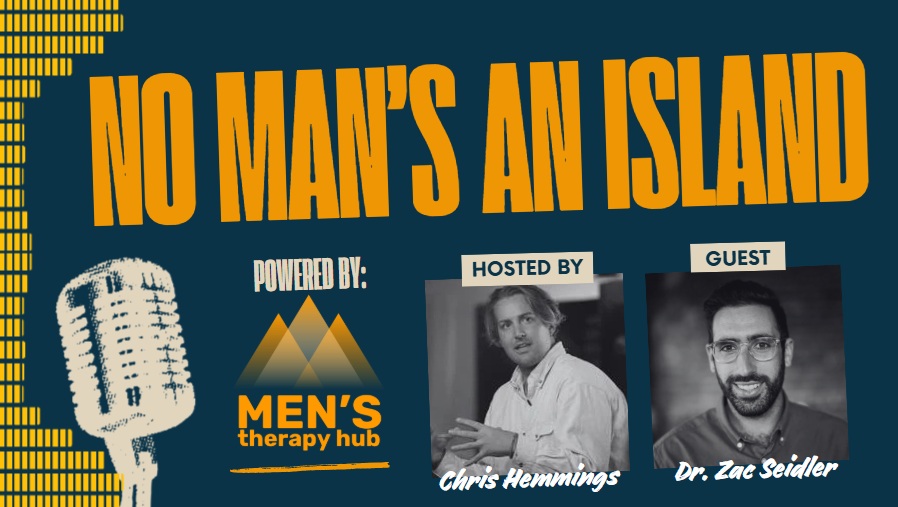
In this powerful episode of No Man’s an Island, Chris Hemmings speaks with Dr Zac Seidler, a clinical psychologist, researcher and the Global Director of Men’s Health Research at Movember. Zac is also an Associate Professor at the University of Melbourne, where he leads the Young Men’s Mental Health Lab – a space dedicated to understanding how socialisation, culture and identity shape men’s experiences of distress and recovery.
Zac shares his journey from the Man Island study – the inspiration for this very podcast’s name – to creating Men in Mind, the world’s first evidence-based training designed to help therapists better engage men in therapy. Together, Chris and Zac explore what keeps men from seeking or staying in therapy, why belonging is such a powerful protective factor, and how redefining strength can lead to real connection.
The conversation covers everything from growing up in a macho culture in Australia, to the ways therapy must adapt to meet men where they are. Zac also reflects on the challenges of working within systems that can feel polarised and political, and how meaningful progress in men’s mental health depends on empathy, evidence and collaboration rather than anger or ideology.
What we cover
- How Zac’s Man Island research inspired a new approach to men’s mental health
- The fear of alienation and why belonging matters more than vulnerability
- The Men in Mind training and how it’s changing therapy for men
- Why men often drop out of therapy and how to keep them engaged
- The role of shame, language and trust in helping men open up
- How rigid gender expectations still shape men’s sense of self
- What it means to “call men in” rather than call them out
- Why adapting therapy for men benefits everyone
- The balance between compassion, accountability and progress in gender work
Listen and watch
🎧 Listen to all episodes here: No Man’s an Island
🎧 Watch on YouTube
🎧 Listen on Apple Podcasts
🎧 Listen on Spotify
Takeaways for men
- The fear of exclusion is often stronger than the fear of emotion.
- Connection and belonging are the most powerful tools for change.
- Therapy works best when it adapts to men’s lived experience.
- It’s not weakness to seek help – it’s a form of courage.
- Honest, human connection is how we start to rebuild trust.
Quotes to share
“The reason we do not challenge the status quo is because the fear of alienation and ostracism is the greatest thing that men face.” – Dr Zac Seidler
“Belonging, if we’re honest, is the greatest safeguard against suicide.” – Dr Zac Seidler
“We need to stop making men change for therapy. We need to change therapy for men.” – Dr Zac Seidler
“If you want to help men, meet them where they are and hold them there.” – Dr Zac Seidler
Resources and links
- Dr Zac Seidler – Official Website
- Movember – Men’s Health Research
- Men’s Therapy Hub – Find a Male Therapist
- Episode 13 – Evidence, Empathy and the Gender Divide with Professor Ben Hine
Episode credits
Host: Chris Hemmings
Guest: Dr Zac Seidler
Produced by: Men’s Therapy Hub
Music: Raindear
TRANSCRIPT:
Chris (00:00)
Welcome to No Man’s An Island, a podcast powered by Men’s Therapy Hub. I’m Chris Hemings and on this episode, I’m going to be speaking to Dr. Zach Seidler. Zach is a clinical psychologist and it certainly isn’t a stretch to say that he’s one of the world’s leading voices in men’s mental health. He’s the global director of men’s health research at Movember and he’s associate professor at the University of Melbourne where he leads the young men’s mental health lab.
His research is pretty wide ranging with a major focus on how masculinity shapes men’s distress to reducing male suicide and domestic violence worldwide. He has published more than a hundred peer reviewed papers, which is crazy, and helped create Men in Mind, the first online training program designed to help therapists better understand and respond to men’s distress and suicidality, which I have done. And I have to be honest, I was skeptical about it, but it was pretty damn good.
Hey Zach.
Zac (00:52)
Hey Chris, I’m glad it hit the spot. I wanted some negative reviews live. That would have been fun.
Chris (00:59)
I don’t have many to be honest because I’m going to get to this. There is a question I want to ask you later on, so no spoilers. But the first question that we ask everybody who comes on this podcast is, how did you end up in this space?
Zac (01:01)
Aww.
Yeah, wow. Well, the very name of this podcast has real symbolism for me. My PhD was actually called the Man Island study, Chris. So ⁓ very early on ⁓ in my studies, I decided to kind of brand my work. And I think that that speaks to, ⁓ you know, my proclivities to
kind of do something that’s actually going to resonate in community. didn’t ever want to be an academic sitting in an ivory tower talking down to people. And so Man Island, ⁓ you know, really was born out of that desire to offer men a safe haven, something ⁓ to, you know, kind of look toward as ⁓ an information hub, really. was just, I was a…
a guy on my own doing my PhD and I remember getting all of these emails because I set up a website and whatever and I kept getting these emails saying Dear Man Island team and I was like wow I’ve really fooled everybody. So that was really a means to actually recruit for my qualitative study on ⁓ how men with depression experience therapy which was my entry point in many ways into this space. My ads were like have you had a shit time in therapy come and talk to me about it.
And, you know, it’s funny, so many people are like, men don’t want to talk about what’s happened to them, blah, blah. But it became abundantly clear that if you offer them a means to complain, you’re going to get a lot of very, very good, good, good advice. And that was really the foundations of of men in mind as well, which was a rebranding because, ⁓ you know, Man Island had a number of different connotations depending on where in Urban Dictionary you look. decided to maybe
Chris (02:45)
Absolutely. Yeah.
Zac (03:03)
be a bit safer. But the reason I got into the field, Chris, was I’ve been reflecting on this more and more. I think I just I had passion and drive around masculinity and manhood. It was always very interesting to me. I’ve got two older brothers. ⁓ And I also I think that I saw a whopping gap throughout my studies. I was at university for a decade. ⁓ And, you know, there are very few men in my psych course.
There was very little discussion around how to connect with and engage with men. And so it just felt like a no brainer. I think I’ve always, I’ve always kind of, you know, found a way into places and spaces ⁓ where I think that there are like systemic failures or I think that there are, ⁓ you know, things that are being overlooked or misunderstood. And so it was really very interesting to me to kind of ⁓ grapple with that.
And then as with everyone, Chris, you know, if you’re, if you’re a man working in this field, you’ve got lived experience one way or another, ⁓ whether it’s the driving force or it’s, you know, just, ⁓ a backstory. And, know, I’ve, I’ve had a number of different things happen in my own life when it comes to men’s mental health, with my own family members, my dad specifically, and an ongoing, yeah, just.
kind of grappling with how this stuff shows up in my own life. And I was never really seeking answers, I don’t think, but I was hoping that I was gonna be able to provide a better understanding for others going through this in future.
Chris (04:53)
It’s rare that I meet a fellow youngest of three brothers. ⁓ I wonder what the experience was like for you being the youngest and what impact that might have had on your perception of this concept of masculinity, which is also something I want to ask you about.
Zac (05:10)
Yeah, it’s funny because my brothers, they’re both very similar to me and very different. And so I think, as I said, trying to find my way at the dinner table, I have a younger sister who was five years younger than me and she’s a funny case study in and of herself with three older brothers. But I do think that ⁓ separating myself from them, ⁓ you know, I was much smaller. I wasn’t as bookish as either of them, which is funny.
given where I’ve ended up and where they’ve ended up. ⁓ And I think that, you know, it was a very physical household. you know, they were pretty, pretty brutal at times. ⁓ But we also learned a lot around words and storytelling and ⁓ anecdotes and trying to, as I said, find your voice, I think, in many ways. And so I think I learned a lot, you know, my oldest brother.
had some mental health difficulties of his own, ⁓ is extremely creative. He’s an author and a copywriter. And so, you know, he taught me about music and fashion and various things like that. And then my second brother, who’s a lawyer, ⁓ is extremely athletic. So, you know, I went for runs with him and to gym with him. And I think I’m kind of the middle ground between both of them. And that’s again, this…
exploration of myself being like, what do I like here? What do I like there? And kind of finding my own niche. But to be honest with you, I was very lucky to have them, ⁓ be third, to be able to watch and learn, hopefully not make the same fuck ups that they did. And I had far more grace, I think, from my parents in that way, ⁓ because I just wasn’t.
seemingly as, you know, as problematic potentially. And so I just, we have like the best relationship now. I see them all the time. We have, you know, I’ve got two nieces ⁓ and it’s a really, really rich ⁓ interaction where we can jostle over ideas.
Chris (07:25)
You grew up in Australia. ⁓ I’ve had a six-month stint in Australia where I played cricket in Perth and ⁓ given the date, we won’t talk about the cricket just yet. ⁓ Maybe we’ll come back to it at the end of January.
Zac (07:34)
You and every Brit.
haha
Chris (07:43)
I got a sense of macho culture within an Australian sports team that really wasn’t so dissimilar to a British sports team. For those who haven’t had the fortune of visiting Australia, what would you say would be the big challenges that you faced when you were growing up in an environment within Australian manhood?
And one of the things that I’ve spoken about for years is whilst the symptoms of the problems around the world may differ, the core of the problems remain the same. So what would you say that they are as you experienced them and as you still experience them today?
Zac (08:32)
yeah, I definitely still experience them. I think, I think Chris, that it’s, it’s interesting, you know, my member works in 20 countries. I get to spend a lot of time in the UK and, and U S and Canada. ⁓ and the, the similarities are far greater than the differences there. There is no doubt about that. I, I see and feel.
almost pretty much the same things in each of the countries that I come to. I would say that England is the closest to Australia, for sure. ⁓ That said, you my entire apartment block here, I’m the only Australian. Me and my wife in this block, just have, there’s only Brits. So I’m very comfortable ⁓ understanding British manhood as well. ⁓ But I think that the thing growing up, you know, I did a bit of
drama and music over here. was a drummer. loved the arts, but then I was also an athlete, you know, trying to play football, ⁓ not too well and running and swimming or whatever. so I coached ⁓ soccer, the real football, the real football. No, Aussie rules is not for me. I’m not into getting king hit for fun. ⁓ the world game. But I found
Chris (09:38)
soccer or Aussie rules.
Okay. Yeah. Okay.
Zac (09:55)
I found that that code switching, found that that chameleon-esque desire to kind of have multiple versions of myself was very interesting now in hindsight. I look back and I realized the mask that I was wearing and kind of continued to wear around many men. especially when it came to sport, the banter and the putting people down. ⁓
you know, which is where most of the humor kind of came from and the connection came from. Once that was gone, when high school ended, there was such ⁓ a vacuum of actual meaningful, you know, connection between the guys such that I’ve seen so many of those friendships just fall away because they weren’t actually built on anything. There was no real foundation. In Australia, we’ve got this term, the larrikin. And so there’s like a number of different
versions of Australian manhood. The larrikin is kind of the guy who’s just constantly making jokes and never being honest or transparent about what he’s thinking or feeling. And I think that I realized that I didn’t want to be that. But I’m still in a state now, I think, Chris, where you’re always trying to undo the things that you learned for the first 10, 15 years of your life. And
Chris (11:21)
Working
on it.
Zac (11:22)
Yeah, exactly. It’s an ongoing process. ⁓ you know, with impending fatherhood for me, Chris, I’m really thinking through what was handed to me and what I have purposefully chosen and trying to understand when it comes to manhood that, yes, society has scripts and ideas around, you know, notions of
protective provider traditions, ideas around being stoic and self-reliant, those types of concepts which are just, you know, really baked into our social fabric. But I think for a long time, I was just passively consuming those things and believing that they were fact. you know, much like the algorithms now, what I try to do with young people is tell them that they have choice, that the information that is washing over them
you know, is, should be consumed in a critical manner. ⁓ And I think that that’s what it means to be a modern man is realizing where your values are and understanding what you are being told and whether or not that complies with who you want to be rather than this osmosis, this passive consumption of things that I think is really dangerous and has gotten me into hot water before.
where I’ve ended up being a shithead to my friends because I thought that that was the way to do it, that was the way to connect, that was the way to be funny. And then they’ve ended up being hurt. And that’s completely at odds with how I wanted to, you know, cherish them and love them. So that is an ongoing process. I think lots of people in Britain, think look at Australia is very easygoing, everyone’s fine. But the…
The of manhood in Australia is extremely strict. It’s really, really rigid and can get us into some tough spaces, I think.
Chris (13:24)
talking about there, it sounds like, is presenting men kind of what we, not we, I certainly didn’t, but culturally what women chose to present themselves with 40, 50 years ago, which was to say we don’t have to be defined by these old rigid ideals of what a woman should look like and be. And what you’re saying is, well, actually, if we can expand male horizons, the tagline for my other business, Empath, is engaging men in cultural change.
And part of that is to say that the change is happening, like it or lump it. And I think sometimes we can get caught up in the negative messaging, such as in the UK now, 16 to 25 year old women earn more than men and to say, well, that’s a problem for men, rather than saying that’s an opportunity for men. Because to go with that, recent research from the US is showing that 83 % of men
still think it’s essential for them to be a provider. Now, does that mean a sole provider? But also I would question then a provider of what? Because a provider of safety and sanctuary, then sure, but a provider of all of the cash. My first ever girlfriend that I lived with, she was a doctor, I was a journalist, no prizes for guessing who earned more money. I had to go through a process of being like, she’s gonna pay for two thirds of the rent.
Ooh, that like sat weird in me for a time. And I worked on it, of course, because then I realized, great, I’m going to live in a better apartment because she’s smarter than me. But it plays on a part of us that is, and I wonder what you think, is it innate? Is it nature? Is it nurture? And how do we start to encourage young men out of the rigidity that…
Zac (15:01)
You
Chris (15:18)
has been the way it has been for so long.
Zac (15:21)
For sure. So I think that the rigidity is the key thing here. Lots of people talk about traditional masculinity and these ideas being fundamentally dangerous. I don’t believe that to be the case, Chris, as you suggest, it’s the notion of expansive, flexible manhood that we are seeking here, which is that I’m not trying to throw out the baby with the bathwater. think that stoicism, self-reliance, protected provider traditions in the right
context at the right time are very useful. If you are in a situation like I am in where my wife is studying, she’s finishing her Masters of Psychology, she’s finishing today actually, which is very exciting. We are making an active decision about our future together and that requires in the short term financial support on my end. That doesn’t mean that that’s forever and that doesn’t mean that that is a gendered role.
Chris (16:03)
on us.
Zac (16:18)
per se. It’s just that that’s the situation that I find myself in and the only way to kind of work through that is for transparent open communication. And so I think that when it comes to the rigidity of these ideals, they are rigid because they are not looked at. They are not challenged. They are not discussed. They are just internalized as beliefs. And so
Lots of these guys have witnessed their father and their grandfather doing certain thing. And so they don’t understand that maybe there is another way of being. And that is not to say that either is better. The way of being that works for you and your partner, if we’re talking about, you know, gender roles in partnerships, if we are talking about, ⁓ you know, the way in which to be a good mate, there are so many different relationships that take place that require pivoting, that require
you shifting and changing the version of yourself that you’re presenting. And so when it comes to this notion of nature and nurture Chris, like I wouldn’t be a psychologist if I believe this stuff was baked in. think fundamentally, like sure we can, you every podcast, everyone’s going on fucking like evolutionary psychology, like we’re all cavemen. And I just think even if even if this stuff is
written throughout our DNA. There’s enough examples of people doing it differently that I don’t buy that. That even if it’s in there, you can shift, you can change, you can challenge it. And as I said, you’re not a failure if your wife is making more than you because we know that domestic violence goes up when the woman becomes a greater breadwinner because the man feels challenged rather than seeing it as an opportunity to do something he loves.
to spend more time caregiving for his children. Like the door is open to you, mate. Like I don’t understand why we make more pain and suffering for ourselves when the world is trying to help us. That’s what I find really interesting.
Chris (18:27)
Well what do you put it down to? You say you don’t understand it, but you are a psychologist so you must have some theory on it.
Zac (18:33)
I think that it is, the pressure is so real around the idea of success and failure. And we have been sold a very narrow prescription of what masculine success looks like. It’s extremely hard to achieve. makes you con yes, increasingly hard in financial uncertain financially uncertain times. And you always almost feel like shit like
Chris (18:51)
increasingly hard.
Zac (19:01)
It is a depressive cycle in the same way that many women feel, you know, beauty standards are unattainable and, and, you know, so stressful. ⁓ I think that when it comes to finances specifically for many guys and, increasingly as well, body image is a huge thing for lots of guys. That’s why we’re seeing this spike in use of testosterone and steroids and stuff like that. Mewing looks maxing God. The list goes on of the things I witnessed online, but
I really do think that there is a great opportunity for us to realise that if we start to create new norms, especially amongst our friends or our colleagues, like having these discussions in the way that women have discussions about masculinity far more than men do. You don’t go to a pub and hear men talking about what it means to be a man, but you will go to a bar and hear women talking about what it means to be a man, which is a very interesting nuance.
And that comes from notions of disempowerment and fear and violence, et cetera. But guys have so much capacity, so much capacity for growth, for connection, for understanding themselves. And so it frustrates me when they take the commandments that have been handed down by God knows who, like these puppeteers of masculinity that have been telling them what this thing should look like.
and they have blindly been following. So my aim really is to take off that eye mask and to go, hey guys, look around, look what is possible and let’s talk about it.
Chris (20:43)
Are we at a risk here, and just to be clear, I join you in the frustration. Are we at a risk of if a man is listening to this and hears you and then me agreeing, as you say, it’s frustrating that men, including me, and I’m sure you at some point have bought into these ideals, of not taking into account the level of fear and the level of shame that they would risk.
if they were to be, because what I explain to my clients, very often one of the things that happens is a client will start to put boundaries in place for the first time. He’ll say to his mates, I don’t want to behave this way. I don’t want do that. Can we stop using homophobic language? Can we stop being racist? Can we stop being misogynistic? Whatever it might be. Can we stop using that nickname for me that actually I hate is a classic one, right? But then what they become for a time at least is an outlier in their friend group. They become…
Zac (21:31)
Mm-hmm.
Chris (21:39)
point of curiosity. I think I’ve said this once before already which is given it’s 10 episodes in that’s not a good sign. ⁓ Which is my friends were making a homophobic slur and I just come out as bisexual in my late 20s and I was like can we not do that? My friends are like, ugh, not now Hemings. And I’m like, yes now. Like can we stop doing it because actually that’s hurtful for me. Now luckily I have wonderful friends and in the end they came around. But even in that moment I had that
notion of like, this is really uncomfortable for me that I have to like keep explaining myself and for a guy who wants to maybe start being a bit emotionally open, he doesn’t have the guys around him who can do that with him and it can be isolating, which is such a challenge to overcome.
Zac (22:31)
Yeah, so if we’re talking about my theories here, Chris, my main belief is that, because I felt it myself and I’ve seen it enough, is that the reason that we do not challenge the status quo is because the fear of alienation and ostracism is the greatest thing that men face. The idea of being in the out group, it’s why
guys join gangs even though they know that violence is not a good idea because they’re lonely and then they’ve suddenly got a father figure who’s saying come and join us we’re going to have fun together. Like it is it’s a sense of belonging and belonging if we’re honest is the greatest safeguard against suicide. And so when lots of these guys who are feeling alone and adrift have now got a group a community around them.
They’re not gonna fuck that up. They’re not gonna go, hey, can you stop calling me gay? Can you stop saying this? Can you stop saying that? Because being cut off from that lifeline is so profound a risk for them that it’s much easier seemingly to put your head down and just get on with it. And so I completely agree. And so what I was kind of suggesting before Chris wasn’t a huge blowing up of the.
of the system that you find yourself in. You know, in the same vein that calling men out for misogynistic jokes, for instance, ⁓ has been shown pretty consistently to be a very bad mechanism of behavior change. Calling people out, shaming and distancing them, unless you have a really rich, you know, relationship with your friends, ⁓ where you say, hey man, can we just like not do that?
It’s I’m not feeling good about when you’re saying this about me. That’s a very different situation from, you know, in the round, they’re making broad brushstroke sexist comments. And so what we see, you know, is this notion of trying to call people in, trying to get them on board your way of seeing the world and thinking. lots of these guys need to do that work. First, they need to understand what to say. They need to understand.
how to walk that path, which they haven’t done before. And when you’re not surrounded by a group who is necessarily wanting to do that, it’s gonna be very hard for you to do this on your own. Lots of guys use Reddit, they use online forums to kind of flex and stress some of their ideas, their notions of how they think that the world should work. But it’s a very isolating and risky thing to do.
What I hope is that something that we can stress Chris that I talk about a lot is this notion of like pluralistic ignorance or the perception gap as we call it. It’s ⁓ academic term in some ways, but it’s this idea that your beliefs around what it means to be a man, around what type of guy you should be, whether it be, you know, I think that, ⁓ you know, men should always be the breadwinner. Lots of guys don’t actually believe that.
in themselves around their view of the world. But when you ask them, what do you think culture thinks? What do you think society thinks about that? They say, oh, everyone, everyone out there thinks that I must be the breadwinner. And so it’s this disconnect, this disconnect between how you feel and how you think society feels. But if I go to each man, 10 guys in a locker room and ask them separately away from one another what their actual views are on things like gender equality, you’re going to find
Chris (26:08)
Hmm.
Zac (26:26)
some pretty progressive ideas. It’s just that this notion of what they think they have to live up to, that’s what really stresses them out. And so it’s this drive towards being something that others want you to be. That’s, that’s, that dance is so taxing, you know?
Chris (26:48)
Yeah. And it takes a lot of courage to break out of that mold. it’s one of the regular listeners to this podcast will know that I absolutely love a cheesy segue. So you were talking there about, uh, call, you know, calling men in rather than out. And what we’re trying to do a men’s therapy hub is to call men into therapy, but there is, um, you know, there are kind of the apocryphal tales of the group of 10 mates.
And when one of them finally admits that they’re in therapy, it turns out four of them are in therapy at the same time and two have already been, right? So we are trying to encourage and you are actively doing a huge job globally to encourage more men to engage with their mental wellbeing. Some of the most common research that I cite is your research that showed that 44 % of men drop out of therapy early. That they…
Zac (27:20)
Exactly.
Chris (27:43)
come to therapy, mean, the statistics on the number of men that come to therapy is terribly low and that’s something that can be improved. When they do come, you just talked about that, with the guys, with their group of mates, they don’t have the tools, they don’t have the language, they don’t have the skills to listen, they don’t have the courage to not get defensive, right? That’s a huge thing. What your research showed,
was, and I do want to get into this, was that the main reason that they dropped out was because they didn’t feel like they connected with their therapist. But I wonder if what is keeping men away initially is that fear of, don’t even know what I’ll do when I get there.
Zac (28:32)
That is 100 % the case. We’ve done studies showing the barriers into therapy in the first case. think, Chris, what we’ve always tried to do is focus on reach and retention. And so we’re trying to actually separate those because I think when I joined the sector over a decade ago, everyone was obsessed with getting more men in the door. That reach.
that reach question, that’s what Movember had done for a very long time. That’s what really the entire literature base was like, men don’t seek help, so get them in. And so I did enough of those studies as well to try and understand the structural and attitudinal barriers. And really the main barriers were I have to be very sick and crazy to go. I don’t know what, how am I gonna spend an hour? What am I gonna?
Say am I going to be lying on a couch? They the health literacy of lots of these guys if they have never been in therapy, you know The amount of clients that have come to me and the only reason they’re there is because they watch the sopranos Like that that was it. They were like if tony soprano can do it I can i’m like one fucking cultural moment and that’s all we needed like we it says a lot around the way in which we’re talking about men and therapy and
Chris (29:44)
Yeah.
Zac (29:57)
this idea of like what it looks like, what it sounds like. And that’s why I created a YouTube series called What Is Therapy? Which is like a five part series which literally breaks down how it goes, what it looks like, how to feel about it, what to say. But once they come in, as you noted there, it’s that connection piece. And that comes down to that interaction between client and clinician, whereby lots of these guys have been socialized.
to keep their internal world secret. Not even that, they’ve often atrophied over time because they haven’t had access to this thing and so the volume has massively been turned down that they can’t even hear it. Like I had a client once, I was talking to him about introspection. I was like, you know, do you ever introspect? Do you ever have that internal voice when you come home from a date who’s like, oh, you really fucked that up. That wasn’t very good. You know, you shouldn’t have said that.
And he goes, what do you mean? I’m like, you know, the internal running dialogue. And he goes, I don’t know what that means. And I was like, what? And so I started to realize I had a lot of young men who had literally turned off their internal voice because it was too overwhelming or frightening for them. And they were drinking and gambling their way through it. know, so this is where I need to push the clinician to come to the table.
Chris (31:07)
Wow.
Zac (31:27)
for too long it had been, guys, learn how to speak, learn how to open up, learn how to express what’s going on and all will be well. And our data consistently shows that they just leave because you cannot have that expectation of someone who doesn’t have the skillset to do so or doesn’t feel safe to do so. It’s like trauma-informed work. These guys have been beaten up consistently probably for expressing things. You think you’re just gonna like, you know.
roll out the red carpet and all will be well. We need to understand the culture that they exist in. And not all men are the same. Lots of men have had really supportive parents or mates and have that ability and access to vocalize what’s happening for them. But clinicians need to come to the table and realize that we need to adapt our practice if we are going to fundamentally connect and keep those men there and get them better faster.
Chris (32:24)
And that was almost word for word what made me reach out to Jet Stone, who was the co-host of the podcast, because he wrote a piece in Psychology Today a few years back that said, we need to stop making men change for therapy. We need to change therapy for men. Now, I’ve spoken to a lot of male therapists in the last 12 months, probably still not as many as you. And the biggest frustration for me is not a single one has told me…
that there was specific training on their therapy course about working with men. And I was one of three men who graduated on my therapy course out of a cohort of 24, I think. I was a massive minority in that room and we talked about every minority except for the elephants in the room, right? The loud…
Zac (33:12)
The lions.
Chris (33:16)
the loud Mancunian guy at the back who kept speaking about men and kept asking like, and kept saying, but I don’t feel like this intervention would make sense to a lot of men. This doesn’t feel appropriate. Like, do you think that we need as a profession to start to actively engage with the realization that men have been socialized differently? So men will need a different approach.
Zac (33:18)
Heh.
Yep. I think that that’s where all of my work has come from. You know, I was only gaining so much traction by going to men and saying, this is what you should do. This is how you should speak in therapy. I’m like, this is like whack-a-mole. You’re gonna have to go to every man and find a way to train him. And it’s like, that’s not how this works. And so it’s much easier to create an adaptive system.
Chris (34:00)
Every guy.
Zac (34:10)
In the same way as you said that we’re dealing with every minority. We’re trying to understand what, you know, ethnic and racialized groups experience. We’re trying to understand what sexual minority and gender minority groups are dealing with on a day-to-day basis. And why not try to seek to understand masculine socialization? The interesting thing, that I witnessed very early on, which is now massively subsided, which says a lot, is that when I went to start to create this training,
I got a lot of psychologists saying to me, we don’t really need this. I, you know, I see men like 50%, I see 50%, it’s funny, lots of people call me a specialist. I’m like, I deal with half of the population. I don’t know if it’s a specialty, it’s a bit crazy, but ⁓ they’re like, we understand it. Like it’s, this is general knowledge. This is general knowledge. And so when I went to create this thing,
Chris (34:49)
Bye.
Zac (35:07)
I really wanted to make sure that I wasn’t teaching clinicians to suck eggs. I wanted to make it very specific and clear from a therapeutic standpoint, how you can fuck this up if you do not attune to the things that are coming in to the room. And what we found in our randomized control trial of many mind is that, you know, we were like, we’re going gold standard here. The only way to kind of get this over the line is to do the most rigorous and robust.
trial that we can of this training and what we found was very interesting is that there was a gendered effect such that guys, male clinicians specifically, pre-training had so much confidence in their ability and understanding around engaging with men. Women were like down on the floor. They’re like, ⁓ I’m trying to work it out. I feel uncomfortable. It’s really difficult. I don’t know what type of banter, how to use it. After the fact,
Men’s scores dropped. They were just like, holy shit, I had no idea what was going on. I just thought I’m a man. And so I know how to do this. And women’s scores went through the roof. And so we’re at a point now where we realize firstly, given, know, 81, 82 % in Australia of psychologists are women. Lots of people are like, my God, we need to make sure that we have more men because women can’t treat men. Absolute bullshit.
That is not the case. I do not believe that men are any better at treating men than women are. It’s just there’s no evidence. There’s actually anti-evidence. So I really think that what we need is more choice, which is that if, you know, my other study, Chris, around gender preferences showed that if a man has a preference, so 60 % of the guys, of 2000 guys or something, did not have a preference for the type of clinician, the gender of the clinician that they saw.
which is completely at odds. Everyone now is talking about men only want to see men, not the case. 60 % didn’t care. They want a good clinician. 21 % wanted to see a woman. And that was typically younger guys who have this desire for like a maternal, you know, character. And they also, they also are just much more comfortable speaking with women because that’s all they’ve ever done really. And then 19%, which is actually the later thirties, early forties, men started to want to see a guy.
and lots of them couldn’t do so because there aren’t many men out there.
Chris (37:36)
Which is why
what you hear is men saying, well, men must want a male therapist because all the male therapists I know are working with men. And it’s like, yes, but that’s because there are so few male therapists that the men who specifically want one make up like 95 % of the available slots. Right.
Zac (37:49)
Exactly.
So it’s all gone, exactly. And
so if you have a preference, what we found is if you have a preference and you do not get that preference met, your outcomes and your likelihood of dropout is far greater. So your outcomes drop and your chances of dropout are higher. So you want to be able to meet their preferences, but to do so, you need to be able to create training that engages all clinicians of all backgrounds.
And so that’s what Men in Mind came from. And it’s really a 101, Chris, you’ll know there’s a lot more depth that is required. There’s a lot more, you know, specific groups that we need to talk to, whether it’s veterans or in Australia, our indigenous populations or gay and bisexual men. there’s so much stuff that we can go into, but we needed a 101. No one was doing this stuff. And now we’re in, you know, eight universities across Australia and that’s going to expand massively.
Chris (38:51)
That is about saying, which is exactly what we say with Men’s Therapy Hub, which men’s therapy is male therapists for men. But the only reason we do that is because there aren’t enough male therapists. And this is about trying to say to men, hey, there are a load of men out there who are male, who specifically want to work with you because you are male. And maybe that might take down one of the hurdles. That means they’re not coming in. It’s not about saying that…
women aren’t great therapists because there are, and also there’s plenty of women who are shit therapists, just like there’s plenty of men who are shit therapists. We’re all, it’s about finding the right therapist for you. But what you’ve done is you’ve created this men in mind. And I said before, I did it, and I was skeptical. I think I was skeptical because I’ve been looking at and studying and writing about as a journalist men for 10 years. So, you know, I kind of did the like, well, what can I learn from this?
And, you know, shut up Chris, would like, stop being privately educated for a moment. And what was great about it was, I did learn some stuff, but I think the thing that I appreciated most about it was I started to watch it from the perspective of somebody who hadn’t spent 10 years doing this. And I had kept going like, ah shit, that’s good. Ah shit, that’s such a good idea. And I think the thing that I use most is this idea of the rucksack.
And what I say to my clients is, so in this training, Zach talks about the masculinity rucksack and it is this bag that we carry around with us for so long. And so much in that rucksack, we don’t even know why we’re carrying it and we don’t even know that it’s in there. So to come to therapy and what you talked about, it’s great imagery and I love using imagery with my clients. Taking the rucksack off and then taking the bricks out and going like, the fuck’s that? hey, can I hold that? As a therapist, hey, can I hold that for you for a second?
Okay, like do you want that back? No, actually I don’t. okay. So where did you come up with? Because you were obviously you’ve done research for a long time, but where did you come up with all these notions from? it from peers? Was it just from your own experience? it ⁓ gut instincts, some of it? Like where did you come up with the ideas for the training?
Zac (41:12)
Hmm.
Yeah, so the end of my PhD, I wrote, you know, a really long PDF of just like everything that I had read or seen. ⁓ And I had I did a scoping review actually of all of the ⁓ all of the suggestions for how to engage men in therapy. It was very funny. None of them were evidence based. was just a lot of old mates in in the US being like
I’ve been working for 40 years, let me tell you what’s going on. And so I kind of brought it all together and then started to see where’s the overlap here? What’s, what’s showing up? What are the things that are consistent across 50 papers? Everyone is saying the same thing. Um, the backpack thing, it’s funny because at the start of the podcast, I kind of explained the same thing, which is like, what have you been handed? Do you need this? Is this useful to you? But I I’m obsessed with imagery and metaphors. There’s a whole, you know,
module and metaphors in men in mind. It’s really a very important part of therapy with guys I’ve always found. And so that, was kind of a mix between, of course, of course. And they, know, and this is the thing, it’s like plenty of sports I’ve never played before nor have interest in, but just like get around it. You don’t need to, you can find a way to bring them in. And so I always found this idea of
Chris (42:16)
I use a lot of sports metaphors.
Zac (42:36)
building and growth is such a central facet to lots of people’s idea of their manhood. And so I started to think about the idea of what it takes to build something. How do you do that purposefully? And so Bricks was the first starting point, which is funny because the rucksack actually came second as a means to understand the weight that people were carrying around with them. But the way in which the metaphor kind of works is that the
you’re carrying around this backpack full of bricks. And once you come into therapy, the aim is that you, over time, you feel safe to open the zipper, pull out the bricks and show me what they were. I’m gonna ask you where you got them, firstly, which I think is really important. Like who gave that to you? And can you actually remember your dad telling you to shut up and stop crying? Can you remember this idea of like,
what it means to become a father and that you have to fit this role. Who gave you these ideas? And as I’m holding them, as you say, Chris, I ask, do you want them back? And if you don’t, what can we build with them over here? What can we build with them purposefully over here to create together, to co-create this purposeful idea of your future manhood that you are trying to inhabit now as the house that you are going to live in?
Chris (44:05)
One of the issues, I think, with therapy in general as an umbrella term is that you can go into a therapeutic website and you could say, I mean, if you go on mine, it says that I work with transactional analysis, transaxonal analysis, Gestalt therapy, CBT, person-centered, humanistic, right? And it’s like, fucking hell. And on some websites, on Men’s Therapy Hub, you can only choose five specialisms or specialities if you’re in the US.
Zac (44:25)
Tick, tick, Yeah.
Nice.
Chris (44:35)
but on some you
can choose, I work with 50 of them. Are we still at a risk ⁓ as a profession of being a little bit holier than thou? You know, a little bit like, well, we are smart, we are intelligent. And if you don’t know what these things are, you need to go and learn. Because I don’t think guys really know. Maybe CBT is probably the most well-known.
Zac (45:01)
yeah, they don’t really know and they don’t really fucking care, nor should they. Like this is where ⁓ you should have a very plain English summary of who you are because they want to know who you are. They want to understand that you are a human, not a robot. You know, there’s so many great ⁓ TV shows about therapy now that are coming out and Jonah Hill’s one with Stutz, which was, you know, really interesting. He was like,
Chris (45:05)
Right. Right.
Zac (45:31)
I’ve got friends who can like, you know, offer me Socratic questions. I’m paying you as a therapist. Can you, can you offer me some advice? Can you like give me something? And that’s the thing that so many, you know, my whole, my whole degree, they were like, don’t tell anyone what to do. And when I started in practice, guys were like, can you tell, can you give me something? Like, what am I, what about, what do I do next? So that as, as an idea, I think is so important. And so
I would describe CBT in some ways in a very broad base or act to my clients. I would never put it on any website. I have no desire to really talk about these notions, but the idea that I’m gonna challenge the way that you think and try and offer you some behavioral tools, sure, that makes sense to someone. And so I think that we need to move away from jargon. Guys consistently tell us they do not want it, they do not like it.
They want to be spoken to as equals. They want to be collaborated with. They want this reciprocal notion of learning and adaptation to take place with their clinician. so I really think that we should get out of. work with this. It’s like clinicians are all seemingly generalist because they all just want more business. Everyone’s just like, I could treat anyone. I can do anything. I really think that we should hone in on who we’re good at working with.
and we should be doing that ⁓ and we should be expressing to them what resonates with them, the way in which you work that is really going to say, in your everyday life, this is what I’m gonna offer you.
Chris (47:10)
And the power in those early sessions of, and I specialize and I say it, one of the first things I say, I specialize in working with men who haven’t been to therapy before and are terrified of coming, right? And it’s like, first of all, well done for even making it to the consultation session. Like, wow, like you have been on a trip to get here, but that power to say this fucking hard, right?
This is so incredibly difficult what you’re doing. And I know, cause I’ve done it myself. Like I was there once and that is so far away from what we were trained to do. to work with a man, this is where I think the training just doesn’t understand the male mind really. Because I think of part of my job is, I mean, I’m trained as a coach too, but like I think of the best sports coaches that I have.
Zac (47:47)
yeah.
Chris (48:06)
They would say, you just did this, how could you do it better? Sometimes, like the real pedagogical approach, but sometimes they’d be saying, Hemings, stand the fuck up and keep running you lazy shit. And sometimes I’d be like, my God, okay, that is what I needed right now. And of course I don’t say that to my clients, but.
Zac (48:22)
Yep. That, I do, I
do. That’s most of my therapy.
Chris (48:26)
But you know what I mean? It’s it is it is the challenging. It’s the encouraging It is what my supervisor calls the compassionate dad, which is which is like hey, I know you can do better than
Zac (48:28)
Yeah.
yeah.
Look at where men gravitate towards. Guys will go to every coach, every leadership coach they can find before they come to therapy. They are seeking the exact same thing, but they gravitate towards a certain type of language, this motivational, growth oriented, goal oriented work. That’s what I try and offer them is this action focused, know, this idea of what you are capable of. You asked me at the start, Chris, what got me into.
becoming a therapist and doing this work. And I think since I remember being 11 or 12 and always being the one in my friend group trying to push my mates to like, not be better, but just like try new things, like give this a go. Like I was always kind of the motivational coach for my friend group. And I think I do that still to this day with my clients. That said, that is simply not the approach that is going to work for everybody.
And that is fine. If you are a guy where this is going to work for you, it’s going to work really fucking well. And so for those 10 % of guys, I am your perfect clinician and you should come and see me for the others. You shouldn’t. And lucky there are thousands of other people you should go and see. So that idea of, ⁓ really providing and creating an environment firstly, that is focused on safety. This is a, this is a very, a feeling of unsafe, you know,
description of emotionality given their socialization. So I try to tell them, yeah, this is hard, but you like hard. I know you like a challenge and I’m gonna hold you here. I’m gonna hold you. You’ve got an hour to yourself and we’re gonna fucking push. We’re gonna give this a red hot go and you are going to learn and you are going to struggle a bit, but boy, boy, we’re gonna come out better and stronger. And so it’s like offering them something to work towards. I think that’s really.
Meaningful and I say always from an expectation standpoint You need to make clear that this is not a linear trajectory You’re gonna come you’re gonna have two sessions. It’s gonna suck Maybe you’ll go home you feel a bit worse third session You’re gonna feel great and then you’re gonna say I don’t need to go see him again And I say that’s when I want to see you That’s the time when you start to feel good that is when therapy is at its best because I don’t need to get you out of bed I don’t need to get you eating and sleeping
We can do the real work, but you discussed that those first sessions and the importance of it. My entire career has been focused on that short window of opportunity. Guys are so skeptical coming in. They are uncertain of their place there. We need to make them know that they belong. And that doesn’t mean hitting them over the head with jargon around what you do and how you do it.
It means going, hey man, I just want to hear about you. What, what do you like? What do you not like? You know, talk to them about football. Like I had so many sessions with this young guy. He grunted at me for like three sessions. And then we started talking about surfing by chance and I saw his eyes light up and then he goes, ⁓ this guy is a human being. He’s not here to just mine my internal experience. Be human, sit and wait and hold them there.
in not doing this tick box assessment, but just waiting to see what comes out. And then, you know, it overflows then from sessions three, four, five, you start to get real depth once they trust you and respect you.
Chris (52:19)
Yes, that is why. And I wanted to talk to you about this because when I first started out in therapy, sorry, when I first started out as a therapist, my inclination was men would probably drop out around session two or three. And what I did was I stole the personal trainer model, which is I tell my clients, if you want to work with me, you will pay for four sessions upfront. And what that means is
you are making a psychological determination that you are going to stick this out because I’m going to tell you this is going to get harder before it gets easier. And if you’ve already paid, you’re more likely to come. If you haven’t paid, it’s easy for you to not bother and not come back. And actually what I hear very often is about session three or four, I wouldn’t be here if I hadn’t already paid. So they’re smiling and they’re going, kind of fuck you. And I’m like, yeah, good, right? Good. That’s why I do that because
It’s the retention, right? If you can just keep them there for long enough, the work will start to take hold. But there are so many levels of distrust in it. And that’s where to go back to the 44 % who do drop out early, it’s about not feeling an affinity basically with the therapist, not feeling seen and heard. I wanna talk to you, because you say the research doesn’t back it up. If I don’t feel seen and understood by someone,
Does it not make sense that I would be more likely to be seen and understood by somebody who looks like me and sounds like me and has had similar socialization than me? Because to me, that was the one bit of the research that didn’t quite make sense to me because if we think of the affinity bias, that is about understanding somebody more because they are like us. And if they’re dropping out because they don’t feel understood, maybe it’s because, and that’s where I kind of dot, dot, dot, I don’t.
Zac (54:17)
Yeah, No, that’s, it’s a really good thought. I think that the bias that lots of men who have had a very similar experience have is that they think that their experience, I think that my experience is the experience. And so you actually end up kind of locking in the client such that they might actually have quite a bit of diversity and difference to you, even though you look the same and have had a similar
upbringing, et cetera. And so there is some benefit, I believe, in having someone who has a bit more objectivity, who can see these things. And if we can train those people better, then they can have that ability to look to the side at what’s happening for this man, understand kind of where it comes from, but not be tied to their own bias, their own experience, which can limit them and their ability to support.
I do think that there is great capacity for more men. Like there are very few, the guys who get into therapy now, I think it’s shifting, but the guys who become therapists are not your everyday guys who have worked in construction and, you know, been in the army and various other things. So I think some of us are kind of cosplaying at being some of those guys to be able to connect with your everyday working class, you know.
man and it would be great if we had way more representation from that portion of our demographic. ⁓ But I think across the board really, we just want, we want more choice. And then the evidence that comes out in the next decade is going to be really telling there Chris, where we’re, because we have far more splay around the number of clinicians with totally different backgrounds, we’re really going to understand how that matching works.
We used a very blunt tool in our research. And so I think that we’re going to have to do a lot more to understand how that idea of that bias kind of shows up.
Chris (56:23)
this space. Okay, I’ll check back in in 10 years. ⁓ I could talk to you about men in therapy all day, but I do also want to talk about the behemoth that is Movember and ⁓ it’s the first of December and you’re still sporting your mo. ⁓ I will never grow… Okay, okay, you’re doing December-ed. ⁓ I will never grow a mustache because my dad had one and I tried once and I look too much like him and he’s dead and it freaks me out. So I’m out. ⁓
Zac (56:38)
I’m growing out the beard now. Coming back.
Yeah.
Chris (56:52)
But I think it’s really cool. Movember is a juggernaut. It has gone from a couple of guys growing mustaches to this huge… What is it like for you as an individual human to start with this PhD and this interest in men and suddenly, I mean, you are strangely powerful in the world.
Your voice is, you you were on a stage with Prince Harry recently. You said to me like, I’ll get back to you in a few weeks. I’m just going away. And then I see on your Instagram that you’re with Prince Harry and I’m like, yeah, just on a casual away trip, are you?
Zac (57:28)
It’s not an everyday occurrence, but yeah.
Chris (57:30)
Sure,
is it weird for you to be suddenly so in demand but also suddenly so listened to? How do you stay grounded through that?
Zac (57:33)
yeah.
Firstly, Chris, think you’re blowing me up in ways that may not be true. But yes, I appreciate that I have far more influence than I would have previously. And I take that as a massive honor and privilege. ⁓ I never wanted to create science without having an audience. I saw no reason to do things that were just gonna collect dust. And so when I…
joined Movember, honestly, it felt like coming home because I’d sat on my own, honestly. There was very few people doing this stuff at the university. I was at, I didn’t really have anyone to talk to about my stuff. I was the guy putting up his hand in every lecture being like, what about the boys? And they were like, shut the fuck up. And so to be able to walk into an organization that firstly was extremely moldable and flexible to these new ideas that I was bringing, they wrapped their arms around me. They gave me a lot of opportunity to kind of
have that voice, be that voice. And secondly, to translate, to go from that PDF at the back of my PhD that sits there for everyone. Everyone’s got one of those in the back drawer, hopefully, and to create something, to fund the videos and the platform and all of that. I will be forever grateful for that ability, for my vision to be held and to be expanded on and now spread across the globe. And so
I’m very, very lucky that, you I think that there is a lot of luck around timing around ⁓ being able to walk into that space and hopefully offer a new perspective that that was lacking. ⁓ But I stand on the shoulder of giants. have incredible colleagues. My whole team is the best. They push me, they question me, they teach me each and every day. And the sector is incredible. You the UK sector.
in particular, every time I come to the UK, I to work with like James’s place, the best organisation who’s constantly on the front lines trying to work with men in suicidal distress and others. I’m just, I was in the right place at the right time and I’m just trying to do my best to make sure that I’m going to give voice to some of these things which really have not been looked at and to make sure that men get a better opportunity when they come into the health system.
Chris (1:00:12)
We talked about things that aren’t looked at. And I want to caveat this because I do want to acknowledge, like, Movember has changed the game in terms of men’s health. You you’re currently changing the game with men’s mental health. I get the sense, and this is not just an issue for Movember, this is an issue for global organizations, that sometimes organizations like Movember have to play the game. And one of the areas, and I know this isn’t the first time you’ll be challenged on this.
One of the areas where I think that we still culturally are falling down is we’re not actively acknowledging kind of male victimization, male victims of abuse, but also I talk regularly about male violence. Like men are biggest perpetrators and biggest victims, right? And I spoke to Jett about this. And so this is Jett’s wisdom, not mine. So I’m not going to take credit for this, but to discount male victimization.
it kind of reinforces the power structure of the patriarchy or this idea of the patriarchy because that concept needs men to be invulnerable, not weak. And to say that men can’t be victims, we’re saying that men can’t be vulnerable. And therefore if we say that they can be victims, we’re saying that they can be vulnerable, but male vulnerability is not something that is incumbent within the patriarchy. so it…
It’s super confusing, right? So basically by not talking about male victimization, we’re kind of working against the system that a lot of people are trying to dismantle. As yet, Movember hasn’t stepped into the space of engaging with male victims and you’re not the only ones. Is it hard as an organization like Movember to step into a space that is still culturally unpopular?
Zac (1:02:08)
No, it’s not. I’m very happy to walk into those spaces at the right time with the right partners. I will say when it comes to the UK bill specifically, gotten a lot of hate from a number of people who I don’t think ⁓ are really, really coming at this from the right perspective. we worked and now this is not me, know, the belief that I am.
the puppeteer here, I have only so much influence in the organization. I’m three tiers down from our, our CEO, you know? Yeah. But when it came to the, the, the bill around male victims, ⁓ we specifically went to the sector partners who are leading that advocacy and we asked them, how would you like us to show up? So this is where the behind the scenes stuff takes place. And they said, can we please have some soft and silent advocacy from you?
Chris (1:02:38)
I’m not suggesting that it was your decision, yeah.
Zac (1:03:01)
We do not want you to join this because the idea of being a juggernaut and taking it away from these on the ground, male victim survivors was not what these three leading organizations wanted us to do. And so that is the role that we played. So no matter how loud people are screaming from the rooftops, we are going to do what is most advantageous to get that bill over the line. we work obviously with 10 Downing Street. We’re doing, you know, incredible stuff, getting the mail.
health strategy over the line and that was not one that we were going to be overly vocal about. That was not a political decision. I have a PhD student, I’ve published over 10 papers specifically on male child sexual abuse. ⁓ This is not something I am shying away from. Every time I do domestic and family violence work, I will talk about male victim survivors. I will talk about the fact that if we do not get rid of male to male violence more broadly, not only amongst boys, but amongst adult men.
we are going to struggle to get rid of not only patriarchy, but violence full stop. You think that if we just get rid of it in our houses amongst heterosexual couples and then men in bars are still beating each other up, it’s not gonna work. We need to understand the cultural nuance there. So I think that there are very problematic bad actors in this space ⁓ who are…
fairly traumatized, which I completely understand. I think that this is a very difficult space to walk in. But my issue is that lots of these people who are trying to create a voice for male victim survivors do so by trying to minimize the voice of female victim survivors. That is not something I’m willing to get on board with. That’s where the notion of men’s rights advocacy kind of comes from. I believe that two truths can be held at the same time. We must understand, especially when it comes to boys.
how we are going to, because the perpetration cycle is really problematic, let alone anything else. We need to get that going. We need to be able to hold them up, look at their experiences and support them with services. That is not what Movember does. We do not do frontline services, despite what many people want us to do. And we also understand and support women and girls.
Chris (1:05:00)
Yes.
Zac (1:05:20)
both of those things can happen at the same time. And yet I’m not here to shy away from that. And I hope we’re gonna be more vocal about that in future.
Chris (1:05:27)
That’s awesome. And I do actually have a lot of compassion for the space generally that Movember takes up and also myself weirdly these days and other people too, because there is a, I hate to use the terminology of gender war, but at times it feels like that. feels like, know, Zach is on TV talking about, ⁓ talking about.
Zac (1:05:46)
Hmm.
Chris (1:05:56)
men’s mental health. And then somebody is like, why are we not talking about breast cancer? Why are we not talking? And it is this constant us versus them. And again, I’m asking what is it like for you to navigate this space? Because you must have mud flung at you at times from both sides. Because I remember when I first started in the space and I went to do my first talk in the school, most of the lads hated me and most of the women hated me because
Zac (1:06:03)
Yeah. Yeah.
yeah. Yeah.
Chris (1:06:26)
I was trying to be compassionate towards men but encouraged men to change their behaviour. So there’s probably like five girls and five boys who were like, this guy’s cool and the rest of them fucking hated me.
Zac (1:06:35)
Yeah,
100%. I that’s my sweet spot, Chris. I think that ⁓ what what I’ve learned over time is what I need to do to play the game. How am I going to get my message across, depending on the room that I’m in? I’m going to Melbourne in two days time. I’m going to be in a room with a hundred of the leading MPs and sector players around domestic and family violence. If I want.
If I want to make meaningful change around men’s mental health, around male victim survivors, I’m going to have to find a way to thread that needle to be heard. There are a number of players in the UK market who are destroying me because I’m playing ball with government here. They don’t realize that if I don’t play ball, I don’t have a seat at the table. And then I cannot make meaningful change. You have to understand that you can throw mud on fucking Instagram.
for as long as you want. But when it comes down to the rooms of power, when it comes down to meaningful change, you have to make some shifts. You need to be able to find that room to get in there and have a conversation that is actually going to benefit the men and boys that we are serving. And that means not blowing it up. yeah, yeah.
Chris (1:07:51)
But isn’t that frustrating? But isn’t that frustrating? It’s that
every time I do a talk and there’s women in the room, I’m fucking caveating all the time, Zach. And I don’t want to do that. And so what you’re saying is you would like to be having a different conversation, but you have to have the conversation. It’s my granddad’s golfing metaphor of play it as it lies, right? You have to play the ball as it lies. And right now as it lies, if you were…
Zac (1:07:58)
caveats.
Yeah, I know.
Chris (1:08:18)
just being vocal about male victim survivors, as you call them, a better term than just male victims, thank you, we’re always learning, then what happens is you will be shouted down. So you, as you see it, you have to be a bit more cautious and careful with your language because of the position that you’re in.
Zac (1:08:31)
Shout out.
This is, and this is now, this is the thing. Five years ago, I would have never been invited on a prime minister’s expert advisory. There was never a man, let alone a men’s health expert on a five, six person panel. I was now invited. If I’m to go, nah, I’m gonna shout this down. I’m not doing any cavity, I’m not addressing, that’s progress. We’re at a point now where progress is being made. And in five years time,
The person who comes after me is going to be able to speak in a very different manner. I am trying to open doors and trying to find a way to do something that is difficult and that needs to be palatable within an ideological, you know, mainstream. But I’m OK. I’m OK to do a bit of caveating. I don’t do it all the time in the same vein. And when I go to a boys school, you don’t need to do it in the same way. Sometimes it’s just having having a really strong
understanding of what matters to me, what my outcome of interest is, and the way in which I get there in the same way that like when you’re doing a campaign for guys around violence, you don’t need to make it about violence. You can get there in many different ways. And so I am happy to shape shift. I am happy to be the person as long as I am able to say what I actually think, the way in which I do that.
to make sure that it actually translates and gets through to them. I want to be in those rooms because I think it’s really meaningful progress. And ideologically, I understand the shit that women and girls have had to go through for a very long time. So for me to put a couple minutes upfront, you know, I’ve spoken with Richard Reeves about this at length, I’m all right with that. Like, that’s not the end of the world for me.
Chris (1:10:32)
Yeah, I got tired of it. And then I, and then I offended audiences. And my colleague, Will was like, Chris, sometimes you’ve got to do it. And he’s a smart man as well. And he’s right. Sometimes you’ve got to do it. And it’s about reading the room. So I, I, admire your honesty, Zach. And I was a little nervous asking you that question because I know that it is a touchy subject. And in essence, that’s kind of the point is
If we don’t talk about it, things won’t change. But I do really respect that your position is, it’s not concrete, We are, men, there’s just been the first ⁓ audience at the prime minister’s house for International Men’s Day ever, right? And Mark Brooks et al have been shouting about this for years. Like, you know, I did a talk on that day, I saw him, he was…
as Larry on that day, right? But it’s still, we’re not so many years away from people saying, why do we even need International Men’s Day? You know, so I get it, I really do. And I’m glad to hear that it is something that you want to speak more about. And I hope that over time, it will become a topic that people are more receptive to because that’s what it needs. I’m going to let, come on.
Zac (1:11:30)
Hehehe.
It will, but slowly,
slowly, slowly, Chris, and realizing when you’re shouting, when you’re shouting in a certain way and people aren’t listening, adapt. That’s all I’ve ever said to various people who have been doing this for a very long time, who then get very frustrated when someone like me or Richard or Scott, anyone who comes forward and takes up space, like we need to understand that the mode of communication is often more important than the message.
Chris (1:12:20)
And I’m gonna, I’ve got a final question to ask you, because I’m gonna let you go. But I had a therapy session recently ahead of this talk I was giving. my keynote speech, I was talking about some personal experiences to begin with, but it was about this idea of shame and the many, ways in which men are shamed culturally. I’m not gonna talk about that. But my therapist said to me, he’s brilliant. He was like, about halfway through.
I just lost you. I was really with you and he was like emotional with me and then he lost me and he’s like what happened is that well I got angry and he’s like right. He’s like anger is a disconnecting emotion. Anger does not bring people into the conversation with you. Particularly, I don’t know if you work in feet or centimeters, six foot three, 115 kilo man who is very loud and confident.
He said, your anger on that stage, you will lose people. He said, even though you have every right to be angry, your job as a communicator is not to be angry. And I was just like, I cried because I was like, but I’m so fucking angry on behalf of myself and my experiences, but also on behalf of so many men who feel overlooked. And he’s like, yeah, he’s a man too. He’s like, yeah, get it.
can’t be the way you communicate it. And it’s really frustrating, because I would love to stand on a stage and just shout and say, what the fuck are you doing? Constantly telling men they’re toxic and then complaining that they’re not engaging with the solutions. But that’s not going to
Zac (1:14:01)
I completely agree. I feel that often, but I’ve been through the ringer enough, Chris, to know I will adapt based on the reception and I take motivation from the way in which people are engaging with the message. And when you start to see and get wins from certain people in influence, when you start to get the media understanding your message,
as you titrate it, you constantly start shifting it. You need to find a way. And I’ve done this, you know, of of making sure that I have an outlet for my anger, that I have discussions with my wife when I’m really pissed off about something. And and there’s there’s a need to express that it should not be it should not be buried. But again, it comes down to. Where am I trying to go right now and who am I trying to help?
And sometimes anger will help you if you can channel it in the right direction. But I think that we need to mature as a sector towards working together, to not shitting on each other, to supporting one another towards our goals. ⁓ And I understand the power that Movember has. I’m doing my utmost to try and open the tent and bring in as many people as we possibly can. And I will continue to do that. But I will not, I will not.
bury my own values, which are, I will not lift up men and boys to take away from someone else. That is not what we’re here for. We are here to walk and chew gum at the same time till all boats are rising. And I believe that that’s possible.
Chris (1:15:44)
Beautiful. All right, so the last question, and I really appreciate you coming on. And it’s a bit of a weird question to ask you because you are the global health director, men’s health director.
I think the biggest donator to men’s health in the whole world. But the question is, I’m gonna give you the keys to the vault. You have unlimited resources, right? And you can’t just give them to your favorite sports team or something. You can choose to do with that money one thing that is going to revolutionize the world in the way that you in your field is gonna see the biggest impact. What do you do?
Zac (1:16:27)
Well, we are about nine days away from the social media ban in Australia, which is a very interesting situation that’s about to unfold. What I would do is turn off parts of the internet that are fundamentally disconnecting and harming lots of guys and spend the money on community building. I would create spaces and places where men can hang out with one another with really positive, healthy…
male mentors. I would make those places alluring and cool and somewhere that young guys especially want to be. I would try to fund things that I know work. I would make sure that they’re evaluated and I would get guys with each other in real life connecting over what matters. That is front of mind for me. That’s what we’re consistently trying to do at my member.
I can’t fight with Elon Musk and Sam Altman, but ⁓ if you gave me billions of dollars, I might be able to get into that room. Right now, we need to find out what works. We need to get guys the tools to look after themselves and those around them. And that is the challenge of our time.
Chris (1:17:43)
Amazing and very similar to mine, which is youth sensors and people who are properly trained in them to create community, people from the community. So I love that. Thank you, Zach. It’s a bit of a weird question for you because if people want to find you, they can just Google your name. But maybe rather than finding you specifically, or you can, where would you, for anybody listening right now, where would you advise them to go?
Zac (1:17:52)
Yep.
Yeah, well, definitely. I’ve got, I’ve got a website, Zachsilo.com come to my, my LinkedIn and my, my Twitter. try my best to share ideas that are, that are forthcoming from, from me. I’m not really actually now that I think about it, ⁓ but blue sky maybe in due course, but ⁓ definitely heading heading to movember.com. We’re expanding more and more with, with more programs and assets and just reach out, ask questions. I’m always here.
Chris (1:18:17)
You’re still on Switzer?
Zac (1:18:36)
to respond and help out. So yeah, it’s always a privilege to be able to be in this field and support.
Chris (1:18:45)
Thank you, Zach. I didn’t say this at the start of the interview because I don’t think it lands very well sometimes, but you genuinely have been an inspiration for Men’s Therapy Hub, reading your research and hearing you speak so openly and forcefully about male experiences in therapy ⁓ helped to impact my approach with Men’s Therapy Hub. So thank you. ⁓ At some point, I would like it to come to Australia, so maybe I’ll send you an email, but for now.
It’s been a real privilege and thank you for the work that you do and I’ll speak to you soon.
Zac (1:19:18)
Thanks so much, Chris.