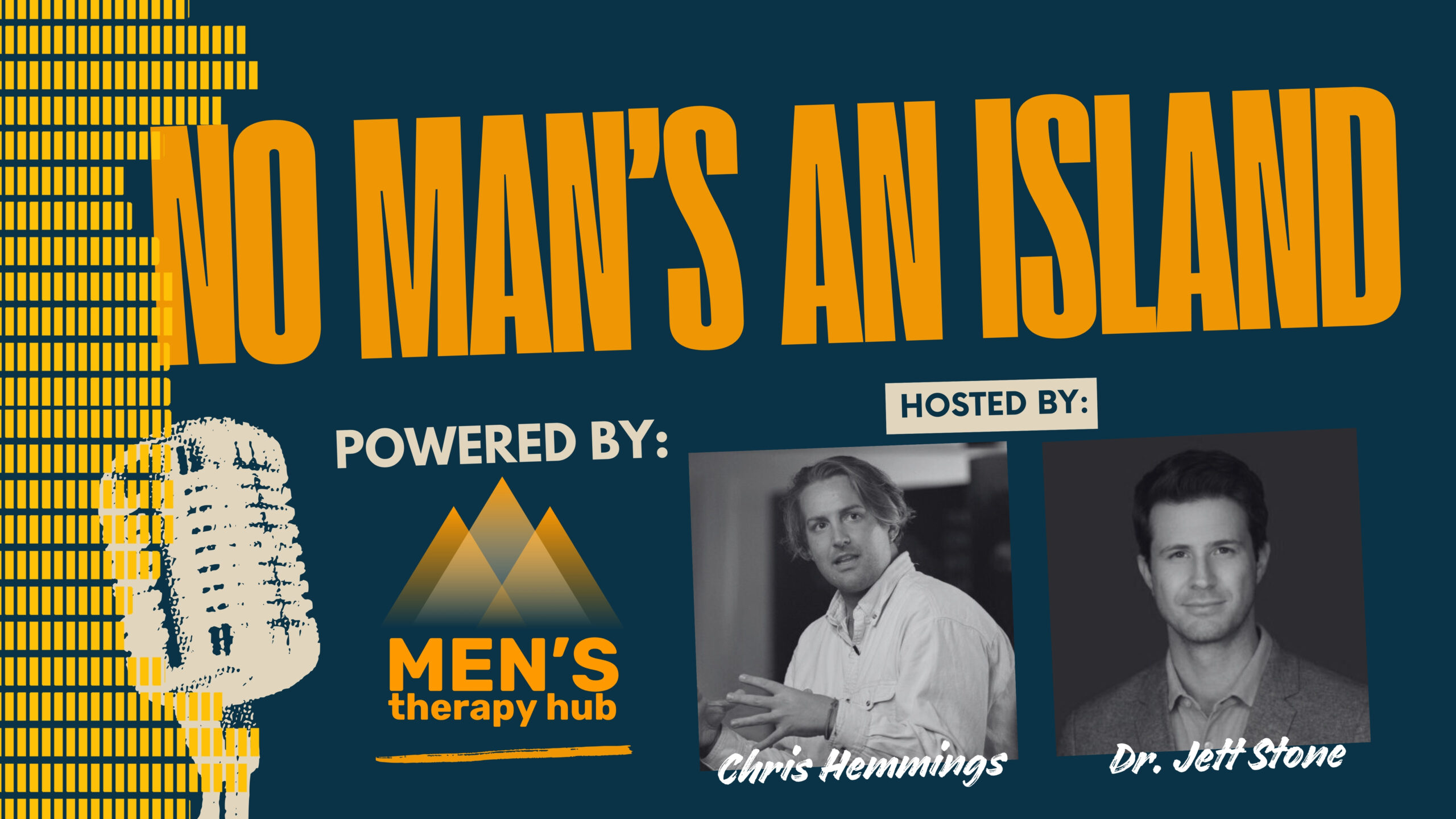
Loneliness, Legacy and Letting Yourself Be Seen with Chris Hemmings and Dr Jett Stone
In this special holiday episode of No Man’s an Island, Chris Hemmings and Dr Jett Stone take a moment to reflect on the first year of the podcast and dig into a topic that’s especially relevant at this time of year: male loneliness.
Rather than a “best of” episode, this conversation is relational, intimate and grounded in real experience. Chris and Jett talk about the men who came before them, the weight of tradition and emotional suppression, and how the festive season can amplify a sense of disconnection for many men.
They explore how family expectations, intergenerational messages about masculinity and technology can both mask and deepen loneliness, and why reaching out – even when it feels hard – is a profound act of courage.
What we cover
- Reflecting on the journey of the first 11 episodes and why asking new questions matters
- The influence of fathers and grandfathers on how men show up emotionally
- What it means to be seen as a man and why that can feel threatening
- How Christmas and festive expectations can amplify feelings of loneliness
- Why having company doesn’t always prevent loneliness
- The role of technology in deepening isolation
- Practical ways to prepare for and navigate difficult holiday moments
- Normalising male loneliness and encouraging connection
Listen and watch
🎧 Listen to all episodes here: No Man’s an Island
🎧 Watch on YouTube: No Man’s an Island – Episode 12
🎧 Listen on Apple Podcasts
🎧 Listen on Spotify
Takeaways for men
- Loneliness isn’t a personal failing – it’s a human experience many men share, especially at the holidays.
- Being seen requires courage because it feels risky in a culture conditioned to emotional suppression.
- Family gatherings can trigger old patterns but also present opportunities for presence and self-understanding.
- Planning ahead for challenging emotional moments gives you agency rather than avoidance.
- Connection doesn’t have to mean perfection – it can be as simple as being genuinely present.
Quotes to share
“We are trying to make what was hidden or subconscious visible… to illuminate it for people to see.” – Dr Jett Stone
“There is a massive increase in the experience or feeling of loneliness at this time of year.” – Chris Hemmings
“Loneliness is a disconnect between the relationships you want to have and the ones you actually have.” – Dr Jett Stone
“I don’t need you to understand, I just need you to accept.” – Chris Hemmings
“There’s a good chance that guys in your friendship group are experiencing something similar.” – Chris Hemmings
Resources and links
- Men’s Therapy Hub – Directory of Male Therapists
- Samaritans (UK) – Support for loneliness and emotional distress at any time of year
- Episode 5 – Dr Luke Sullivan on Loneliness and Connection
Episode credits
Host: Chris Hemmings & Dr Jett Stone
Produced by: Men’s Therapy Hub
Music: Raindear
TRANSCRIPT:
Chris (00:02)
Welcome to No Man’s An Island, a podcast powered by Men’s Therapy Hub, which is a platform. no, start that again.
Welcome to No Man’s an Island, a podcast powered by Men’s Therapy Hub, which is a directory of male therapists for male clients. And this is episode 12, which is pretty good to say. We’ve made it through 12 episodes and we’re doing something a little bit different today because Jett’s here. Hey Jett. I’m all right. Thank you. Yeah. I’m keen to in some way reflect on where we’ve come from so far, but just before we had this conversation recorded, Jett was like, we can’t really do a best of.
Jett Stone (00:25)
How you doing?
Chris (00:39)
of the podcast given that we’ve only got 11 episodes before now, which is fair enough. Yeah, yeah, which is fair enough. There is a topic that Jet and I wanna talk about today, which is male loneliness. And particularly because at this time of year, there is a massive increase in the experience or feelings of loneliness. So we’ll put a pin in that for a moment. But I do wanna reflect on the fact that we have so far done 11 episodes. Jet has recorded two.
Jett Stone (00:42)
Very premature.
Chris (01:08)
and I’ve done the rest and I’m pretty proud of the work we’ve done so far and the guests that we’ve had on. And I did ask Jett before just to have a little think about what his favorite moment so far from the podcast has been. So Jett, would you like to enlighten us?
Jett Stone (01:24)
Yes, I’m, I’m still new to the podcast game. And so I’m, you know, still building up interviews. But one of the things that stood out to me was when I interviewed you, Chris, and we got to talk about many things, but when I’d asked you about what your ancestors, your father, your grandfather would have thought about you starting a podcast called men’s therapy hub and bringing it to the
Chris (01:53)
Well, hang on,
the podcast is called No Man’s an Island, Jett. Yeah.
Jett Stone (01:55)
You’re right. Well, starting men’s therapy.
Yeah. The no man’s island is powered by men’s therapy hub. Right. We’re keeping this in. Okay, Chris, we’re keeping this in. It’s still, still getting my, ⁓ sea legs here. ⁓ so I asked you a question about what your father and grandfather might think about this endeavor, no man’s in island. And, you know, the time that you took to think about it and your response just really made me reflect on.
Chris (02:00)
Yeah, yeah, yeah.
Jett Stone (02:24)
the intergenerational transmission of masculinity and trauma and how we think about what the role of being a man is, that it starts from long ago. And sometimes, you know, asking a question and reflecting like, how might someone from a previous generation look at what you’re trying to do here now, explicitly talk about what it means to be a man, like enter into that conversation. It was just…
Chris (02:48)
Mm.
Jett Stone (02:52)
powerful because it’s, it says a lot, it said a lot about who you were. And it just reminded me that we are just a reflection of the men and the fathers who came before us and that we’re trying to do something different here with No Man’s in Ireland. We’re trying to make what was, you know, hidden or subconscious, and we’re trying to bring it to light and illuminate it for people to see and give them permission to say, Hmm, what would my father think about me? You know,
being a therapist or wanting to become a therapist or being a guest on No Man’s Island. And it takes it from just the individual to where am I coming from? Like what’s, what’s my family lineage and what are the messages that I inhaled about masculinity? And it’s something that I, you know, I certainly had not done as a young man, not until I started doing therapy and even more so now guest hosting this podcast with you.
Chris (03:51)
And I want to respond to that, but what I also want to say is this is what I love about this format. I’ve done so many radio TV podcast interviews and every now and then you get a question that you haven’t had before, but also one that you hadn’t even considered the answer of before. And it reminds me when, when my book came out many years ago, I was interviewed by one of the
radio host called James O’Brien and I worked as his producer sometimes and he asked me, know, he threw me a few fastballs, right? Very easy, you know, simple answer questions. And then suddenly he asked me, could you have written this book if your dad was still alive? And I remember looking at him and mouthing like, fuck you to him, right?
Jett Stone (04:46)
You
Chris (04:47)
and smiling and being like, you, I thought you fucking bastard, that is a brilliant question. And your question was similar. And actually, because it’s edited, you won’t know that the pause between question and answer was actually a lot longer than it would have been in the podcast, right? Because that sort of question, you can’t prepare for that sort of question. And it was so beautiful because what it made me think was,
Jett Stone (05:03)
Mm-hmm.
Chris (05:16)
I’d often thought about what my dad might think of the work that I’d done, but I never considered my relationship with my granddad and just how completely and utterly alien this whole thought process and genre would be to somebody whose life was completely, know, directly opposed to this space that we’re creating.
Jett Stone (05:45)
Mm-hmm.
Chris (05:46)
And so now what I want to do, Jack, is I want to ask you the same question. What would yours think?
Jett Stone (05:50)
You
Eternal or maternal.
Chris (05:55)
Whichever is the most difficult to answer.
Jett Stone (05:58)
Whichever is the most difficult answer. I’m have to go with the grandfather that I knew least, which would be my dad’s grandfather. Sorry, which would be my dad’s father. And World War II veteran. ⁓ You know, I didn’t get to know him well, but the culture of my dad’s family was just don’t talk about things.
keep things neat and clean and proper like so many of you out there listening. ⁓ That he, if he knew that I was starting, know, helping start this podcast, he would probably be ashamed actually, if I have to take a guess. Not to throw him under the bus. ⁓ He was a great man who did great things, but I just have to be honest and it sucks to put feelings into him that I just don’t know how he’d feel.
Chris (06:42)
Wow.
Jett Stone (06:54)
But I don’t think that he would be proud. I think he would be very, very cautious and afraid to ⁓ hear what might come out, because he would have to look at it himself. But I do know that just knowing my own father and how he was raised, that shame makes you want to run. And when you start talking about who you are as a man, ⁓ you know, there could be a threat there. Now, let’s put into context.
talking about a Jewish man, right? And the cultural implications of that and the dangers of being outed and the dangers of being seen in public for who you are came with huge consequences for Jews and still do. Yes, yes, growing up in a time of rampant anti-Semitism that built into the culture of Judaism is like ⁓ fear about being labeled and branded.
Chris (07:41)
You mean growing up at a time of rampant anti-Semitism.
Jett Stone (07:53)
sometimes quite literally in the case of the Holocaust. there’s so many stories there that that shame that I talk about comes in a context. It’s not shame in like, that you’re doing you’re being vulnerable and that’s not good, just generally speaking. No, it comes from the standpoint of like that threatens survival. And that’s there’s an evolutionary element to shame as well. And so that would be my guess. And then maybe over the course of time.
he could warm up to the idea, you one of my grandchildren is doing something that’s vulnerable and that’s okay. But initially, that’s my guess.
Chris (08:33)
Mm.
Sometimes when you record something you wish you’d done it the other way around because this actually would have been a perfect segue into the loneliness conversation that we were gonna have because actually what we’re talking about here is men for a variety of different reasons choosing, and I’m doing bunny rabbit air quotes right now for those who are just listening, choosing to not be seen. ⁓ But that choice is being made against a backdrop of.
the threat to self if I am seen. And that threat is so real for so many men, know, by the sounds of it for your granddad, for multifaceted reasons, he didn’t wanna be seen for who he really was. But there are still a lot of men out there right now who don’t want to show themselves for a variety of reasons, because what I talk about often is there is so much at stake. So when I people, clients all the time, like,
What is at stake for you if you have this conversation, if you show yourself with the vulnerability? And sometimes, you know, the answer can be everything. It feels like everything. So yeah, I think it’s pretty remarkable actually that so many men of our generation are able to be this way when we remember men who from our direct lineage who were so opposed.
to this kind of approach to life. So yeah, when you look back and think about him now, and like, I wonder because I look back at my granddad now and I think about him with pity actually. I pity him and I pity his lack of life, if I wanna put it that way.
Jett Stone (10:17)
Mm-hmm.
It’s a good question and because this is a grandfather I did not know so well, it’s easy for me to project upon him or what I would imagine he would feel. ⁓ maybe that’s why I chose that grandfather versus a grandfather that I might have known on my mother’s side a little bit more. ⁓
So in a way, even talking about it, I’m glad I did, by the way, I feel like, oh my gosh, did I blow up his spot? Did I put a spotlight on him in a way that isn’t fair, maybe. But I don’t know if I even answered the question that you asked. I got lost there. What did you ask?
Chris (11:04)
Way to obfuscate, Jack. Good work.
I asked whether or not you look back in the same way I do at my granddad with pity about the lack of life that he led.
Jett Stone (11:15)
⁓ OK, yes. ⁓
Less with pity, because… ⁓
I think he missed out on a lot, but I think he…
He gained so much too. You know, I guess he had a good life. Both my grandparents did and that ⁓ there was suffering, but I don’t feel a sense of pity. think he carried on.
You know.
with a message to my dad who was then passed on to me. He did the work of working hard enough that I could then one day have the tools and the know-how to help you build something like No Man’s in Ireland. So in a way, it’s like, don’t know. was just, that was what it was in history. There was no other way to do it except bottle it up. So it’s hard for me to feel that pity.
Chris (12:23)
Yeah. And I think, but that’s where the pity comes in for me is that
I pity the fact that there wasn’t an alternative. And what we’re doing here is trying to show men that there is an alternative and actually there’s richer fulfillment if you do. Yeah. Okay. So sadly, sadly no awesome segue. But we will come back to that. I want to talk about an experience that I had last night, actually, a very good friend of mine.
Jett Stone (12:39)
Yes, yes, I can see that.
Chris (12:52)
came over and she has been listening to the podcast. She is one of our listeners in Denmark, which is nice. Confirmed listener, yeah, one of the few. No, we have about 70 or so now who are followers and weekly listeners. That’s pretty good. ⁓ She had listened to… So the episode you were just talking about, that was where you interviewed me, that was episode six. The episode that she was talking about was episode seven.
Jett Stone (13:00)
Confirmed listener. Good.
Chris (13:22)
where I interviewed George from the Tin Men. So the Tin Men is a kind of one-man band, George, who doesn’t use his full name because he doesn’t want to have the personal retribution against him. But basically what he does is like unapologetic advocacy for men and it’s very data evidence stats driven. And what my friend said to me was that she’d listened to that and there were so many times in it where she felt triggered.
She didn’t use that word, but basically she was really uncomfortable with what was being said. But then what she said was, well, she kept pausing it and asking herself, why am I so uncomfortable with this? Because he hasn’t said anything that isn’t true. He hasn’t said anything particularly controversial. All he’s doing, and this is what I congratulated him on actually, was the yes and approach.
All he’s doing is pointing at the male side of the statistics that we’re not talking about culturally. He’s not saying that we shouldn’t also look at the other side, which is most often the female challenges. So, you know, 60 % ish of domestic abuse victims are female. The man is 40 a male and we don’t talk about those just as an example. And that’s one of his big subject areas. And I thought it was beautiful because that is exactly what
I hoped for with this podcast. This is not a podcast specifically for men. It is a podcast about the male experience. But at no point do I ever want anybody on this podcast to come on and say that we shouldn’t also be looking at women and girls issues. It’s just that we’re not going to be doing that here. Right? We’re going to be doing, yes, there are huge problems that women and girls face.
And we support efforts to improve the lot for women and girls. And let’s look at some stuff that’s happening with men. And I had this moment of like, yes, okay, it’s working. Also, big up my Linda, awesome human. Like well done her for being cool enough to sit with that discomfort. That’s why we’re good friends. And what I’m hoping is that that is an experience that we can have with more people listening.
Jett Stone (15:39)
Mm-hmm.
Chris (15:45)
that we want to challenge people’s preconceptions of what it means to be male, but also what it means to advocate for men. Because for a long time, I think, people advocating for men have been the kind of what would have been labeled the men’s rights activists who would have been anti-feminism.
Jett Stone (16:02)
Mm-hmm. Mm-hmm.
Yes.
Which, which your friend’s name actually you didn’t say her name. Okay. You’re Linda. Um, it’s like, Oh, Melinda. Okay. Um, what Melinda, my Linda was feeling like was an understandable, like almost leftover feeling of creepiness or disgust, right. At the sense of, my God, are we centering?
Chris (16:14)
My Linda. Yeah. No, not My Linda, as in My Linda. Yeah. Yeah.
Jett Stone (16:40)
Disgusting male behavior in some way like or like can this be fit into the narrative of what the tin man is saying it’s like there’s almost this like ⁓ Tenseness and ⁓ like is this Going to go into a sort of a creepy man argument about why it’s okay or why we should you know Put aside women’s issues so that then focus on men like there is this natural understandable inclination to say ⁓ a woman again going to be crowded out by men
And it’s a very real concern because it’s happened so much in history. So there’s this sort of impulse of like, oh gosh, is this like another creepy situation? Am I going to have to? It’s like you’re waiting for it, but it doesn’t come. Right. It’s almost because there’s a conditioning there that I’m talking about. And so this it’s reflective of the stage that we’re in, in the conversation around the mal experience is getting it going. And when it’s in good faith.
when you’re really trying hard to get it right, the numbers, right? The data, what you’re saying. It’s like people who are listening, not even just my Linda, there are feminist men out there who probably still have that same like, it’s like, yes, anticipatory, I’ll call it maybe like, ⁓ and that’s okay. And what I love about that is like, when that happens before calling out, just call in to yourself and say, well, why do I feel this way?
Chris (17:56)
discomfort. Hmm. I like that.
Jett Stone (18:11)
And maybe you do have a good argument for why it elicits an ick. But maybe it’s left over, is what I’m saying, too, from something unrelated even.
Chris (18:12)
Hmm.
Well, she did add… Yeah.
And what she did say was, to help me to understand it more, she said that ⁓ if you think about the vast majority of the challenges that women have faced culturally, they have been caused by men. And I said, yes, I actually begrudgingly agree with that, right? ⁓ And she said, so I think one of the challenges is that women have… ⁓
used up a lot of their empathy for men, right? And so then when someone like me is coming along and saying, well, I’m going to continue to have empathy for men.
Jett Stone (18:55)
Yes, exhausted, yeah.
Chris (19:06)
they don’t have much empathy for that, right? Because they’ve lost, again, understandably so, but that’s where I’m saying, okay, fair enough. So we’ll take on that now and you focus on your stuff, but also can we, and I said it in the last episode with George Bell, can we stop throwing tomatoes at each other? Can we actually?
Jett Stone (19:08)
Yep. Yes.
Yep, yep.
Chris (19:37)
be mutually supportive because that is where all the ships will rise together. And if we keep telling each other that a win for one side is a loss for the other, then we’re all gonna lose. And that’s the saddest part of this for me. And so her approach was so beautiful and it gives me so much courage to keep going with this podcast because it means we’re something right.
Jett Stone (19:53)
Mm-hmm.
Yes.
Chris (20:07)
If we can challenge somebody in a way that they don’t feel threatened by the challenge too much, that we lose them.
Jett Stone (20:15)
And in doing so, reconditioning this idea that talking about the male experiences doesn’t have to come with HIC. We’re still in the developmental phase of this broader conversation about men, masculinity, and the male experience where one could say is it we as men haven’t yet earned
the ⁓ we haven’t earned yet to for someone not to feel that anticipatory ick. We’re not yet there, we will, but we just have to take it and understand it and we’re doing this we’re taking this upon ourselves and that’s the idea here is like we’re not giving this work for for someone else for a woman or anyone else to do it’s it’s the work for us to do.
Chris (21:01)
And if we’re going to tell them, or you’re not allowed to feel that way, then we can’t expect people to not say the same back to us. Yeah.
Jett Stone (21:07)
No, we have to expect it. We’re walking into this
territory. Like, expect it, of course. Makes total sense.
Chris (21:13)
Yeah, yeah. So that’s been my favorite moment so far is somebody talking to me about the podcast. Yeah. So I want to go back then to, you know, this time of year and Jett and I laughed because, you know, Jett’s Jewish and I’m a heavily lapsed Christian. I basically gave up Christianity as a kid when I was realized that I was part of a church that a king had formed so he could divorce his wife. And I was just like, mom, really? Okay, I’m out.
Jett Stone (21:17)
Thank you for sharing that. Yeah.
Chris (21:42)
non-denominational festive season, right, is a very challenging time for a lot of people. There is an expectation of jolliness. There is an expectation of like familial festivity, of coming together and being with loved ones. And actually,
Jett Stone (21:45)
Yes, let’s call it that.
Chris (22:09)
evidence and research is suggesting, I saw some research before that said in the 60s, about one to 2 % of people spent Christmas alone. Now it’s more like eight, 9%. And that about one in three men at some point during the non-denominational festive period will feel lonely. And what’s interesting to me is that is not just a Christmas issue. That is a
an annual, an all year round issue. And I wonder, you know, maybe with your clients or with people that you know, what do you feel like is the challenge of this time of year and what the expectation is and how that plays on parts of us that struggle to connect maybe.
Jett Stone (23:03)
Yeah, I think even the expectation of the holidays, like just the way that it’s marketed and how, you know, the season brings on these expectations of togetherness and closeness and joy.
sets up for a failure of connection or even more disconnection or a sense of, you know, that during this time where I should be, you know, joyous and together I feel so alone and lonely. And I will even add that what we’re doing nowadays when we feel lonely, the technology tools that we have to deal with it.
I think exacerbate, make worse that loneliness. And so it’s a rich time for therapists because what you have is someone who’s going back to the old haunts, who’s returning home oftentimes or seeing people who may have hurt them in the past. You know, we can talk a lot about people’s parents in therapy, but hey, we have an opportunity here where you’re actually going back home to see a parent or a sibling.
And so why I say it’s rich is because so much comes up from it. It’s an opportunity. Sounds kind of cliche to say that, but it’s an opportunity not just to talk about loneliness in theory, but to say, what was it like to see your father, right? After many, many months or having these big political differences, like polarization in the U S is so big that that can add to the loneliness epidemic.
sense that I see the world so differently from the people who I’m supposed to love, right? These are, you know, it’s an opportunity in therapy that’s so visceral because it just happened or it’s going to happen that you can talk about maybe just the broader loneliness that someone feels. Loneliness being a disconnect between the relationships you want to have and the ones that you actually have in reality.
Chris (25:09)
Mm.
Jett Stone (25:16)
And I brought that technology piece in before, simply because I think we can retreat. It’s so easy to retreat. It’s a solitude and solitude is a choice. We have the choice to be in solitude now in our lives, to go to our rooms with our phones and just scroll and scroll and scroll and scroll during the, you know, family dinner of the holidays. And so I think that adds the solitude opportunities, add to the actual loneliness in this cycle as well. I got a little sidetracked there, but I just think there’s so much.
Chris (25:36)
Yeah.
Jett Stone (25:46)
It’s for me as a person, of course, but also for my therapy clients too.
Chris (25:57)
speaking in episode five to Dr. Luke Sullivan from Men’s Minds Matter and we spoke about one of the kind of misperceptions of loneliness and he said and I can remember I’ll never forget this he said I can have a thousand friends but I can still feel lonely and you’ve just articulated beautifully there like I can have a lot of family members around me but for a lot of young people they go home and they are thrust back into
patterns that we’ve worked on in therapy that they’re trying to break free of, expectations put on them, know, the expectation to drink, even though every year when the family gets drunk, it turns into a fucking mess. And then when they choose not to drink, the family will, I prefer the old you, you know, and not feeling comfortable and not feeling safe at home and not actually feeling like we want to spend time.
with family, I have a fantastic relationship with my mom. I love my mom more than I love anyone except my wife. And yeah, I could probably do three days max at home before I’m like, you have to stop telling me that I need to take a key with me. I’m a 38 year old man. you know, like yes, I need to put a scarf on it’s cold mother. I’m aware, you know, she’s just being a mom, right? I get it. you know, know.
Poor me, right, for having a mother who cares about you. But the point is there are people out there who have really difficult, challenging experiences with their families. And we somehow still just expect them to go home and, ⁓ you get to be with your family. Well, no, actually, I have to be with my family. And that doesn’t necessarily feel good for some people.
Jett Stone (27:32)
Yes.
Mm-hmm.
Yes. It sends a sense of duty, of obligation. And that’s why it can be helpful. And I try to do this myself as much as I can is to go into it with an intention. Yeah, there are parts of this that you’re begrudgingly going into. But if you go in with a mindset, what’s most important? Sort of a values mission for the holidays for yourself.
Chris (27:52)
Yes.
Jett Stone (28:17)
How do I want to show up to my family? What’s the quality of person I want to be? What am I going for here? A lot of times the answer to that is presence with the ones that you do love, in your case your mom, in my case my mom, right? Being present in a way where you’re actually listening and able to kind of take in
And you’re not just hearing what people say, you’re listening and, you know, or maybe it could be presence and not being activated by, you know, or feeling this sort of impulse and then having to act on the impulse of saying the thing of dunking on someone, proving someone wrong or of, you know, over explaining yourself. And people go into the holidays and have to just explain what they’re doing in their life or why they aren’t married or why they are married, why they want to have kids or don’t want to get. It’s like, you feel like you have to come in with.
Chris (29:07)
Yeah.
Jett Stone (29:16)
know, some type of ⁓ rationalization for why you are who you are in the world right now. And what some of the things that I will say to a client is like, you don’t owe anyone a beautiful speech about why you’ve made the choices you have. Right? What do you want to get from this? What boundary works for you that you can set for yourself as you walk in to the, to know, to a family of iron that can be activating, right?
Chris (29:46)
Mm.
Jett Stone (29:46)
And
then when you come out of it, is an exposure, ⁓ opportunity, right? To expose yourself to the feelings and the relationships that are only talked about, know, they’re talked about in therapy, maybe a little bit more theoretically, it’s more visceral.
Chris (29:50)
Yeah.
Yeah, I think one of the most powerful things that I learned to say to my family, particularly with like my sexuality, for example, is I don’t need you to understand. I just need you to accept. And if you can accept, then we can move on. And sure, sometimes maybe I wish that they would ask more questions and try to understand, but if it’s too overwhelming for them, just accept it and let’s move on. Like that’s, but you’re right. There will be a lot of, I think particularly a lot of queer men.
Jett Stone (30:28)
Mm-hmm.
Chris (30:33)
and we’re talking about men, people who will be going home and they will be talking about their lifestyle and they will be dressed very differently to everybody else and they will feel like a point of curiosity rather than a part of the whole and they will get questions that other people don’t get asked, right? And that feels othering.
Jett Stone (30:33)
Mm-hmm.
Yes.
Chris (30:58)
And if we also add onto that, let’s say men who are struggling to get a job and maybe their older brother is some captain of industry and their dad is really successful and they are struggling with their mental health or they are struggling with connection, they’re asked a load of questions that aren’t actually relevant to them because the questions that are relevant to them, the people in the family don’t actually know how to ask.
Jett Stone (31:24)
great point.
Chris (31:26)
And so again, it’s the people who are struggling the most will go into a situation and will be kind of reminded constantly of everything that they’re not.
Jett Stone (31:38)
Yes, it’s a reinforcing experience of and it’s reminder that like you aren’t just a collection of things that you’ve achieved or performed. You know that. Yes, yes, and that that’s where the comfort with yourself that you know one of the best relationships to develop is with yourself. It’s a cliche at this point, but if. If you can go into a family.
Chris (31:49)
No matter how much your dad tries to tell you that you are.
Jett Stone (32:07)
environment and be unflappably you. Like, and that when someone asks a question about what you’ve achieved this year, what are your business goals for 2026, you could shift that conversation. Like, actually, I’m not really interested in thinking about that. Let me tell you about an experience I had, you this. Like, you can shift it so you can present yourself as more three dimensional. What are you interested in, right? That’s not going to be immediately polarizing and talking about politics.
What ideas do you have? Who do you care about in the world? What are your dreams? Tell it to your friends. Yes. Tell a funny story, right? ⁓ If you get so fused with this idea of I have to show myself as someone who’s done something great and is worthy and lovable because of something I’ve done, then you become two dimensional, right? And then it just reinforces us what you’re talking about. So that’s easier said than done. What I just said.
Chris (32:43)
Tell us about your friends, yeah.
Jett Stone (33:07)
But part of the pre-work, I guess, before these environments is becoming just comfortable with yourself, right? As compared to your siblings or as compared to a father or someone else who’s more achieved, right, in the capitalist definition of the term. Be unflappably you. See what happens.
Chris (33:30)
Yeah, and push back against that comparison culture because that is the thing that is going to disconnect you from the world around you if you’re constantly comparing yourself to everybody else.
Jett Stone (33:34)
Yes.
Yeah.
Yes. And of course, if it’s coming, if it’s abusive, which when you’re talking about like a lot of queer individuals come back and like face legitimate emotional abuse, then it’s at a certain point, the boundary has to be I am not showing up here again, or I’m only showing up in this capacity. I’m not even going to the territory of my sexual identity because
you, parent, haven’t earned it yet, right? Sometimes you’re at that stage. I mean, you could speak to this more, but ⁓ there are shades of, you know, authenticity.
Chris (34:20)
And then one of the big challenges is, okay, so I actually don’t feel an affinity with my family. don’t feel like this is, and maybe I’ll go and just do the, you know, the 12 hours of turn up, have a glass of something, eat some food, sit down, open some presents and leave. If you do go back then to somewhere where you don’t feel like you’re connected with people, what was, I haven’t prepped you for this. you know, we can, we can, we can, yeah, thanks.
Jett Stone (34:46)
Well, I’ll turn right back on you, okay? You’re not hosting this
one.
Chris (34:50)
We can edit out the long pause. ⁓ To those people who are sitting there and they feel like they aren’t connected with people, how do you encourage them? What would you say to them to say, you know, pick up the phone, you know, call somebody, tell somebody that you’re feeling lonely, tell somebody that you care about, because that is an immense act of vulnerability.
to say I’m actually not doing okay on this day of all days.
Jett Stone (35:23)
Yeah, I mean, even you talking about it now, it’s so smart to be thinking ahead, to play the tape forward. We’re, you know, it’s December 11th as we’re recording this.
Chris (35:33)
It’s going out on
December 23rd.
Jett Stone (35:36)
It’s going on December 23rd, perfect. You’ve got two days, maybe, well, you know, might be with family anyway. But it’s like…
expect almost that lonely moment and like what’s your plan for when that feeling comes up? It’s almost like don’t be surprised by the feeling when it arrives know that yeah like this shows up for me and I love what you said have someone who is meaningful to you a phone call away even let that person know I’ve like going in to Christmas is just a shitty time for me
Do you have a second to just chat, you know, Christmas morning? I just feel terrible during that time. And do that. Or not even connecting with people necessarily. Connecting with creativity, connecting with nature. In that moment of disconnection, doesn’t have to be you have to have your beloved right next to you or someone that you can call. If you’re feeling alone, connect with something. Music.
walk and when I say connect I mean don’t go in that walk just looking down like look around at the world around you. ⁓ There’s awe everywhere. I feel like if you just take the time to absorb it that’s that’s one thing that I would suggest. Get out ahead of it, find the awe outside, connect with something even if it’s not another human. What about you? I mean you deal with this as a therapist yourself. I’d love to learn from
like what you might say to a client who’s anticipating that lonely moment.
Chris (37:18)
think the first thing to say to them is, and very, very rarely actually I would do this as a therapist, but actually I would say to them like, there are a lot of people in your situation at this time of year, because I think sometimes men feel lonely in their loneliness, if you know what I mean. It’s, I’m the only one who is experiencing this. Well, actually, no, you’re not. This is like a societal problem. So actually,
Jett Stone (37:35)
Mm-hmm.
Chris (37:45)
there’s a good chance that there’s guys in your friendship group who are also experiencing this too. There’s an episode coming up with Zach Seidler from Movember ⁓ in early January. And we spoke about that moment in a group of menial friends when one person finally admits that they’re in therapy and suddenly three of them go like, me too, or I’ve been too. And it’s like, right, fuck sake guys. Yeah, like fuck sake guys. Like we’re not alone in our experience.
Jett Stone (38:07)
I come down the woodwork.
Chris (38:14)
Well, I’ll rephrase that. We are alone in our experience, but we’re not the only one having a similar experience. So to preempt it, as you say, is what I would say to them. Like, tell your mates, find the courage to tell your mates, I really don’t like being with my family at Christmas, but I’m going to be stuck in a house in bumfuck nowhere with, you know, nothing to do. And if I go to the local pub, maybe I’ll see some pricks from school that I don’t like. And…
then who can I call? Or is there a guy that I can, me and my friend Sean, ⁓ he used to live around the corner from me, Christmas eat, like Christmas day, about eight o’clock, I’d be like, peace out family, I’m gonna go and get drunk with Sean. ⁓ And it was great, we did it every year for many years. And that was really beautiful because we both, we weren’t talking about why, but basically it was, there was a certain point in the evening where being with family didn’t feel.
fun for us as like 20 year old guys, which of course it didn’t, right? We wanted to go and get fucked up with the boys. And that’s something to do as well. And yeah, be mindful of the fact that this experience you’re having is not completely unique to you.
Jett Stone (39:30)
Yes, that’s the normalization of it. think you nailed it there. And the other thing to think about is there are so many ways to escape like we talked about earlier with technology, but in the US, like the NFL, National Football League, American football for those outside, the brilliant thing that they do is they have games like on Thanksgiving day, big holiday in the US on Christmas time. They have tons of games and it becomes.
Form of what I think healthy distraction actually of the many things that the NFL does that I’m sure people would argue about and say are wrong It’s you know a regime a capitalist capitalist regime ⁓ they They give they give a lot of young men and actually not just young men men in general a form of healthy distraction from loneliness And I’ll also say like you talked about drinking there. I hear a lot of the clients I work with talk about like taking weed edibles or
smoking weed like during that time of year in a way because it’s like it makes something that you’d want to avoid more tolerable. It makes family more interesting. You know, in a way it’s like, okay, if everyone’s going around the table, it’s like you can almost observe it from an outsider’s perspective as opposed to just having the same old humdrum conversation. So I’m not, this isn’t, I’m not pro. I’m not saying you should smoke weed, but I’m saying that people turn to that.
for a reason, I just threw that in there, ⁓ along with drinking.
Chris (41:00)
Yeah.
Yeah. And just this was supposed to be a shorter episode. There’s the problem with the UNIJ act is that we can talk forever. ⁓ Also to remember that if none of that is available to you, I don’t know what the US equivalent is, but in the UK you can call the Samaritans. There are, are helplines, there are numbers to call for people who are lonely at Christmas and need somebody to speak to. And
Jett Stone (41:06)
Whoops, whoops.
Chris (41:28)
They are there specifically for you. They exist in that moment for the ones of you that are struggling. ⁓ And please do use them if things are getting really bad for you because there are people out there who care. You just have to reach out to them.
Jett Stone (41:46)
I’m glad you said that. Make that call. Don’t just leave it a thought. Make it. Do it.
Chris (41:51)
Yeah,
find the courage to do it. That’s what I would say. Thanks for doing this, Jet. I would like us to do more of these little episodes because they’re quite fun to do. So I hope, here’s one of my cheesy segues, I hope you all get the gifts that you want. So if you want to give us a gift, please, please like, follow, subscribe to this. We are about to enter into the crunch time for when a podcast can…
start to fly. And if you can, if you, if you listen to us on Spotify or Apple, if you can please rate the show, that really helps. Ideally, five stars would be nice. ⁓ An honest rating, if not, but five stars would be nice. But also please share this with people because we want this to get out to as many people as possible. ⁓ I’m putting a lot of time and effort into this. So is Jet. And we want this to be something that
is growing and developing and reaching as many years as possible. ⁓ if this is something that is resonating with you, if you’ve enjoyed our conversation so far, please help us to get it out to as many years as we can.
Jett Stone (43:02)
Couldn’t agree more. We need it. We need help. Send it to your friends.
Chris (43:02)
And yeah, we do.
And Jet, thank you for all of your help this year. It’s been a mad 2025 for me. I’m excited to have some time off. I’m going to go and be in New Year in a big mansion with loads of my friends in the countryside doing things that I cannot talk about publicly. And I’m really excited for that. And I hope that you have a good time too.
Jett Stone (43:29)
Yes, I’m looking forward to seeing friends and some family and it’s been so much fun getting the chance to not just do this podcast today, but just work with you in general. And I’m coming to Copenhagen. I’m coming.
Chris (43:44)
Yeah, we’re gonna have to hang out soon,
finally. Maybe we can do a live episode together when you’re here. Yeah.
Jett Stone (43:49)
Yeah. I’ll bring my
podcast mic into my luggage. Awesome. Great seeing you.
Chris (43:52)
I’ve got a spare. Yeah. All right. Nice one, Jack. Thank you so much for
your time. And I will speak to you again soon. Bye.
Jett Stone (43:59)
Okay, bye.