How to Create Emotional Safety with Dr Brendan K Hartman
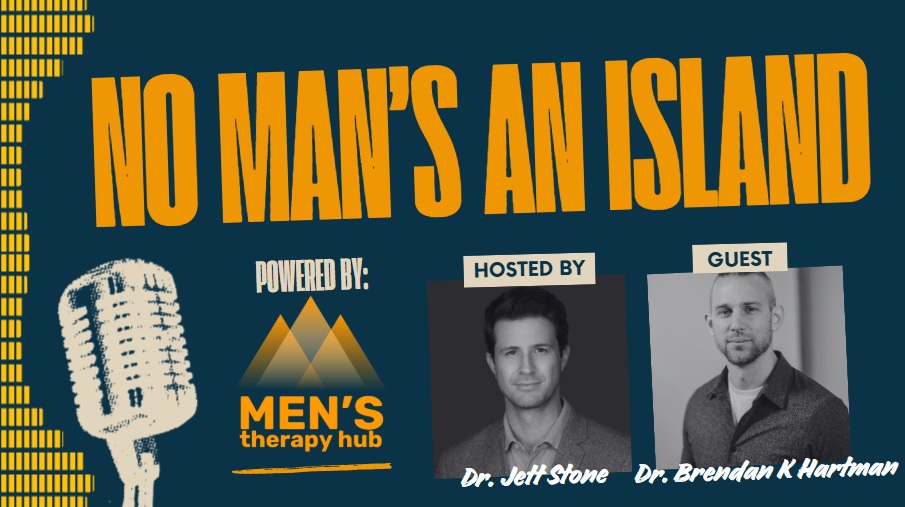
In this insightful episode of No Man’s an Island, Dr Jett Stone speaks with Dr Brendan K Hartman, sociologist, educator and founder of Re.Masculine – a project exploring how boys and men develop emotionally, socially and spiritually in a changing world.
Brendan shares how his work began in the classroom, when the suicide of a student set him on a path to better understand men’s emotional lives. What followed was a career dedicated to bridging the gap between research and reality – exploring how culture, fear, friendship and belonging shape how boys learn to express or suppress emotion.
Together, Jett and Brendan unpack his groundbreaking research on emotional suppression in teenage boys, the lasting impact of loneliness and the pressure to “fit in”. They discuss how these patterns carry into adulthood and what it takes for men to reconnect with themselves and others.
Brendan also challenges conventional ideas about masculinity and offers his own alternative to Scott Galloway’s “Three Ps” (protect, provide, procreate): a new framework he calls “Build Safety, Show Up and Give a Damn.”
What we cover
- Brendan’s journey from teaching to sociology after losing a student to suicide
- Why most emotionally restricted boys remember when and why they began suppressing emotion
- How fear of judgement, burdening others and past loss drive suppression
- The link between popularity and loneliness in teenage boys
- The difference between belonging and fitting in
- How buy-in and trust are essential for engaging men and boys
- Brendan’s model for healthy masculinity – Build Safety, Show Up and Give a Damn
- How to move beyond checklists of masculinity toward emotional integrity
- The role of therapy in helping men “meet themselves”
Listen and watch
🎧 Listen to all episodes here: No Man’s an Island
🎧 Watch on YouTube
🎧 Listen on Apple Podcasts
🎧 Listen on Spotify
Takeaways for men
- Suppressing emotions often begins as protection, not weakness.
- Belonging means being accepted for who you are – not changing to fit in.
- Therapy is a way to meet yourself, not to fix yourself.
- Emotional awareness starts with curiosity, not criticism.
- Healthy masculinity is about integrity, connection and care.
Quotes to share
“One of my favourite students died by suicide. That’s what got me focused on mental health in general.” – Dr Brendan K Hartman
“None of the boys said they’d always been emotionally closed. Every single one remembered when and why they started to suppress their emotions.” – Dr Brendan K Hartman
“All of the most emotionally restricted boys wanted more emotional connection with their male friends – but most thought none of their friends wanted the same.” – Dr Brendan K Hartman
“The opposite of belonging is fitting in. Belonging is being accepted for who you are. Fitting in is changing who you are to be accepted.” – Dr Brendan K Hartman
“My three principles are simple – build safety, show up and give a damn. They’re not checklists. They’re ongoing processes of becoming.” – Dr Brendan K Hartman
“Therapy counts as a chance to meet myself. And if I’m resistant to that, I get curious about why.” – Dr Brendan K Hartman
Resources and links
- Dr Brendan K Hartman – Re.Masculine
- Instagram – @re.masculine
- Men’s Therapy Hub – Find a Male Therapist
- Episode 14 – Men, Therapy and Belonging with Dr Zac Seidler
Episode credits
Host: Dr Jett Stone
Guest: Dr Brendan K Hartman
Produced by: Men’s Therapy Hub
Music: Raindear
TRANSCRIPT:
Jett Stone (00:02)
Welcome to no man’s an Island, podcast powered by men’s therapy hub, a directory of mal therapists for mal clients. I’m Dr. Jetstone and my guest today is Dr. Brendan K Hartman, a sociologist who’s become an important voice when it comes to the social and emotional development of boys and men. I’m excited to have him on today because he can take the complexity of masculinity and make it digestible with research. If you’ve seen his Instagram account re masculine.
You know what I mean. It’s engaging, informative, and it lands home, at least for me. Brendan’s not perched in academic ivory tower. He’s out there in the field doing work with individuals, schools, families, and businesses. And I think we need thinkers and academics like Brendan who can help us navigate boyhood and manhood in engaging ways with humility, which is why I’m honored he’s here today. So Brendan, thanks so much for coming on.
Brendan K. Hartman (00:58)
Thank you. That was a really nice intro. And nice isn’t like a really descriptive word, but thank you. I feel seen in that intro.
Jett Stone (01:02)
My pleasure.
Yes,
yes. So I did a little bit of research. You started as a teacher before becoming a sociologist. And I’m curious what your turning point was. What do you see in your male students in the classroom that made you realize you wanted to study this more deeply? Let’s start there.
Brendan K. Hartman (01:11)
Yeah.
Yeah, it is primarily catalyzed from a tragedy. One of my favorite male students in my second year teaching died from suicide and that got me focused on mental health in general. I would say that prior to that, I had a weird draw to disruptive students in the classroom because that was so different than my experience because I was
For lack of a better term, I was a good boy, if not a teacher’s pet, through lot of my high school years. And so I think I was genuinely captivated by people who weren’t afraid.
to be disruptive. And so I felt like there was a pull and a draw towards that. But when I was doing my master’s in special education, where I was focused on mental health and emotional behavioral disorders, I found out that 81 % of students diagnosed with emotional behavioral disorders are male. And so I was like, okay, how much of this is biology? How much of this is socialization? How much of it is girls being underdiagnosed, boys being overdiagnosed? And so that got me to really look at masculinity as
as a force for good or for a force that kind of exasperates some harmful outcomes for boys and men. And then I led a year-long intervention for grade 11 boys diagnosed with behavioral disorders, and that’s an air quote. I don’t love the term behavioral disorders. And that experience…
Jett Stone (02:56)
Mm-hmm.
Brendan K. Hartman (03:00)
it broke a lot of stereotypes because these boys are the ones that have like the bad reputations in schools. And it was kind of like every teacher was okay with them skipping their class to do my intervention because they’re like, yeah, do whatever you can with them. like, not that they’ve given up and definitely not all teachers, but there’s kind of this receptivity to like, okay, let’s see, see what happens. And these boys opened up were extremely vulnerable.
and they acted as mentors the next semester for grade six boys from a nearby elementary school who are also struggling. And so I got to see them like in a mentorship role in all of these things, which kind of broke a lot of stereotypes that I think a lot of people can have around boys.
That was mainly the catalyst. And I kind of went into my PhD research where I focused specifically on the most emotionally expressive grade 12 boys and compared them to the least emotionally expressive grade 12 boys. And I think part of it, I came in with this bias that… ⁓
emotional expression might be a silver bullet to kind of help boys and men’s mental health, help ⁓ reduce even like sexism and misogyny. And the long story short is that emotional expression is really important. However, it’s not the silver bullet for solving all the ills that are associated with gender dynamics in the world today.
Jett Stone (04:22)
Mm-hmm.
So interesting. I wanted to talk a little bit about your research. Sometimes it can be ⁓ triggering to bring up the word dissertation once you’re finished and all done. I’m not, okay? So I’m curious, you you tackled emotional ⁓ suppression in your research and you were hoping, you just said that like, you know, emotional expressivity isn’t
Brendan K. Hartman (04:37)
I’m okay with it. Okay, fair enough.
Jett Stone (04:54)
you know, the silver bullet. did you find? What were some of more ⁓ interesting findings that came out of your research there that you maybe weren’t expecting?
Brendan K. Hartman (05:05)
Maybe I’ll tell you my top three. My top three, the most humbling ⁓ finding was that when I talked to the most emotionally restricted, the most emotionally suppressive grade 12 boys, I thought that some of them, if not all of them, would say, I’ve just always been this way, this is who I am. Like, I don’t even know how to answer the question of my emotional suppression. But none of them said that. They all remembered when and why they started to suppress their emotions.
Jett Stone (05:08)
Okay.
Brendan K. Hartman (05:35)
And then that ties into number two, let’s say, like the top three reasons why teenage boys started and continue to suppress their emotions was fear of judgment being considered weak by themselves or by others. Tied with that was fear of being a burden. Often parents divorce was a huge factor of like, my parents are going through enough stuff as it is. I don’t want to add to their plate. ⁓
Jett Stone (05:53)
Mm-hmm.
Brendan K. Hartman (06:01)
it’s selfish perhaps to unleash my emotional problems on someone else. And then the third was, ⁓ now call it, past experiences lead to fear of future loss, which is a complicated way to say that these boys had been emotionally close with someone in the past, but then that had ended tragically through death. But I think what’s actually almost more salient
are the boys who like, was my best friend moving away in grade six and there was like never any closure. It was just like kind of all sudden he was gone. And I don’t want to get close to someone again because I know it’s like to be that way and to lose that. So I don’t want to try again. And then my maybe third thing that I think was interesting for my research was that my dissertation supervisors are when I had to
past my proposal, my first year of my PhD, the concern about doing my research was if you’re researching the most emotionally expensive grade 12 boys and the least emotionally expensive grade 12 boys, they might be so different that you might not find anything really valuable to compare them with because they might be so far apart from each other.
Jett Stone (07:07)
Mm-hmm.
Brendan K. Hartman (07:13)
That wasn’t the case. They were so much more similar than not. But the one main area of difference was that the boys who were highly emotionally restricted, highly emotionally suppressive, had a much higher sense of loneliness in their life. And by loneliness, I don’t want people to just assume like no friends.
Jett Stone (07:30)
Hmm. Mm-hmm.
Brendan K. Hartman (07:36)
because a lot of those boys were actually extremely popular from the outside and they had lots of friends, but it’s more of they felt emotionally alone. It’s kind of like Dr. Brene Brown’s research, which found that the opposite of belonging was fitting in. And the teenage years are like the epitome of the fitting in culture because belonging is being accepted for who you are, fitting in is changing who you are to be accepted. And these boys felt emotionally alone in their experiences. And I guess this is my fourth top point is that
Jett Stone (07:49)
Mm-hmm.
Brendan K. Hartman (08:06)
that literally all of the most emotionally restricted teenage boys I talked to, they all wanted more emotional connection with their male friends, but the vast majority of them thought that none of their other male friends wanted the same thing.
Jett Stone (08:06)
Mm-hmm.
Those are some, like all of those hit home to me. Like you’re talking about adolescent boys, but that extends into manhood. It extends into the client population that I work with in psychotherapy. Like these things have such staying power. yeah, and you know, when I think about, you know, one of the things that I find interesting is that there are benefits to emotional restriction, costs and rewards, of course.
Brendan K. Hartman (08:41)
such staining powder.
Jett Stone (08:53)
⁓ And I wonder like what were the rewards of emotional restriction and what were some of the rewards of ⁓ emotional expressivity? Because I think you talk a little bit about that and it matters to psychotherapy, which maybe I’ll follow up on, but I’m just curious like what you find.
Brendan K. Hartman (09:13)
Absolutely, and I think it’s important that when I mentioned the rewards of emotional suppression I Don’t always know when I’m talking to boys whether these are literal rewards or whether they’re perceived Awards because there’s like a perception gap does it really matter? Whether this actually has this benefit or do we just think that it has this benefit so sometimes that can be hard to prize apart ⁓ and I’ll try to do that as I go through it, but ⁓
Jett Stone (09:38)
Mm-hmm.
Brendan K. Hartman (09:42)
What I heard from teenage boys in answering this question is that emotional suppression, I got bullied less at school when I started to suppress my emotions more. So I would say the main factor was around less social ostracization. But again, here’s the catch-22. So they felt like they had more, were able to fit in, be less socially isolated, but then also at their extremes, they felt more alone.
even if they felt like they had proximity to friends. And so that was the of like the cost benefit. ⁓ In my research, called, I kind of identified willing adhears, reluctant adhears, and resistors to masculine pressures. And so one of the main ones is suppressing your emotions. And so willing adhears, they’re like, ⁓ this is the type of man I should be. I see my dad or my stepfather.
Jett Stone (10:27)
Mm-hmm.
Brendan K. Hartman (10:40)
being emotionally suppressive, I don’t see anything wrong with that. This is the man I should be, like the shoulder to cry on, not the one crying on someone else’s shoulder. So I just wanna mimic that, like that’s what I think. And here’s the other aspect, is like they think like this is what girls want. ⁓ And I’d be lying if it wasn’t true that some girls absolutely do want men to be not vulnerable.
Because we all have our own biases against men showing their emotions and vulnerability and so then you had the reluctant adheres who hated those Who didn’t like being emotionally suppressed, but they were stuck for two reasons one because they didn’t know how to change They’re like, okay, you’re telling me and I believe you that emotional expression is really important. But like how do I actually do that? So it was like a lack of Knowing how to do it. And again, the other thing that kept them stuck was
Jett Stone (11:07)
Mm-hmm.
Brendan K. Hartman (11:35)
fear of losing their social circle. Like boys were telling me things that were almost hard for me to remember how hard the teenage years were. But they were like, if I tell my friends that I’m sad or depressed, like I might lose, my whole social world will crumble. And they were telling me like, yeah, like no one wants to hang out with a sad kid. No one wants to invite their friend. Maybe they’ll do it once out of pity, but I don’t want to be pitied. So.
There was a lot of self-protection in why they suppress their emotions, believing that people can’t handle it. And maybe people can handle it. I remember from my master’s thesis, I defended it and the Dean of Education at UBC was my external examiner. And he, the very first thing he said, I was not prepared for this. He was like, what you’re doing is dangerous. I was like, ⁓ And he’s like, you’re getting these boys who often are deemed at risk to…
Jett Stone (12:12)
Mm-hmm.
You
Brendan K. Hartman (12:31)
be vulnerable to open up, get in touch with their emotions and things that they might go back to their settings and environments and it’s not safe to do so. And so in a sense, like you might be opening Pandora’s box. And I don’t know if you’ve seen this in the work that you do of people, have clients who go into therapy and they’re like, ⁓ isn’t ignorance kind of bliss? Like now that I’ve kind of opened up these things. Yeah.
Jett Stone (12:54)
Yes, it’s usually in the beginning stages of therapy,
but also, know, gosh, I mean, each one of those, could the willing, reluctant, resistant, you can unpack each each one of those and bring it into the ⁓ therapy room. You know, one of the most important things I found doing work with men, I work with adults, ⁓ is that you have to sometimes we call it honor the function of a behavior, meaning that ⁓ give it
Brendan K. Hartman (13:19)
Mm.
Jett Stone (13:22)
some airtime. Yes, this thing has worked for you, right? In the case of emotional restriction, right? It’s helped you become a leader or it’s helped you in the job that you have. You really have to almost start there. Give them a sense of, okay, these are the moments in your life where it works for you. And then slowly get them to the point of saying, and they make for a really lousy husband or, you know, a lousy boyfriend, whatever it is.
And that to me, it’s like you get buy-in. When someone sits across from you and says, dude, I totally, I get, I get like this works for you, it works for me. ⁓ And then you sort of move them into the space of saying, but how is it also breaking down, ruining your relationships? So that’s the part of your research that I really did appreciate because it has a real clinical applicability.
Brendan K. Hartman (14:17)
And I think most research shows, for better or for worse, that working with adolescent boys and older men, or not older men, just men in general, that buy-in becomes so paramount. Like, it’s not all about buy-in, but in another sense, I’m okay making that declarative statement. Like, it almost is all about buy-in. And yeah, I always get teenage boys to defend…
I talk about the three most harmful messages that are associated with masculinity, which is suppress your emotions, be hyper-independent, and be dominant. And I always get them to start defending those things first.
Jett Stone (14:44)
Mm-hmm.
Yes. And what also happens with that is once you can defend it, then you become a better advocate out there in the world. You know, coaching someone else, being a good friend to someone else because you have the language for it and it’s practiced. ⁓ It’s so, so important. You know, when you look at your research and you look at the workshops that you run, ⁓ schools, organizations elsewhere, like what
Brendan K. Hartman (15:07)
Yeah.
Jett Stone (15:23)
What are the moments, like how do you connect it to yourself? Like do you ever, ⁓ know, let’s say in your research, any of these findings that you have, like did anything stand out to you and speak to you directly in particular? I know it’s kind of a vague question, but was there anything that, okay.
Brendan K. Hartman (15:40)
That doesn’t feel vague to me. That feels like so easy to answer
because almost every talk I give, one of the caveats I start is saying that there’s a saying in the social sciences that all research is me-search. And I found that to be more and more true the more I research it.
Jett Stone (15:54)
Mm-hmm.
Brendan K. Hartman (16:01)
Okay, this is what stood out to me the most from a me search level of, in my interviews, I would ask boys, like if you had to describe what it’s like being a teenage boy in one word, what would you say? And there was a lot of different answers, but the most common one at the time was lonely.
And that made me reflect back to my own teenage years. And I was like, was I lonely? Like, I’m just curious, like, how was my teenage years, how would I have answered that question? And I feel like they really gave me language to understand that, yeah, grade eight and nine.
Or the fact that all these 18-year-old boys were saying that grade 8 and 9 was by far the hardest years, where they felt like they had to posture the most, that the masculine pressures and fitting in those pressures were at its zenith. That made me go reflect back and be like, yeah, I hated. Like, I had such a hard time in grade 8 and 9. And I was changing friend groups. I had zits. I wasn’t feeling confident.
Jett Stone (17:03)
Mm-hmm.
Brendan K. Hartman (17:06)
go transitioning to a different high school. And it made me have way more compassion and understanding. And I do this exercise a couple of times. I started that maybe two years ago. And that’s directly inspired by these teenage boys who kind of give me language to better understand my teenage self, which my grandmother, before she passed, she gave all her grandkids a scrapbook and she kept all the pictures of our grades from kindergarten to grade 12. And I go through…
And I’m a huge fan of IFS model therapy. And I like looked at all the pictures of myself at each age and I asked myself like, what is the hardest age for me to look at? And it’s almost, it was for so long, it was that grade eight self because that boy represented like the epitome of uncool.
Jett Stone (17:35)
Mm-hmm. Mm-hmm.
Brendan K. Hartman (17:53)
And so I have sat a lot more time trying to give some curiosity and compassion around my grade, grade eight boy self. And I feel like, yeah, he was lonely. He was struggling. And the fact that I have a repulsion towards him is like, yeah, how much self repulsion do I have to, as that grade eight, because like I wasn’t cool. I wasn’t fitting in, even though from the outside people would have thought that I was like.
a very good athlete, like I would’ve had things going for me, but I absolutely did not feel that on the inside. And so, my favorite thing teenage boys have taught me is that they’ve given me a mirror to myself, and then my favorite feedback to hear is when I give a talk or do a workshop with teenage boys, and they’re like, you just described my experience, and like gave me language to understand myself that I didn’t have. And I’m like, dude, teenage boys gave me that, and I’m so glad that I can help.
Jett Stone (18:22)
Mm-hmm.
Brendan K. Hartman (18:49)
⁓ Give vocabulary to help you feel that way too.
Jett Stone (18:53)
I mean, that eighth grade and ninth grade, those years are so emotionally challenging. And when you were talking about the loneliness of it, I felt it too, but didn’t have the language for it. It’s like, there was this sense of like you, I was an athlete, but I was also like in band, right? And doing like, you know, like reading books and poetry and thinking about things. So had this like outward life.
Brendan K. Hartman (19:15)
Yeah.
Jett Stone (19:23)
that I love, by the way, of being an athlete and it helped me socially in so many ways. And I had this private life that I felt like I had to keep hidden in some way. ⁓ And it’s just that period of time in your life where you’re where I guess based on your research, it was like I was in the willing camp of your emotional expressive, but with attention with the reluctant.
Brendan K. Hartman (19:32)
Yeah.
Jett Stone (19:52)
You know, like I was negotiating the two of those different categories. And then there was people ⁓ mostly in my life, I would say men, coaches especially, male figures who were clearly in the resistant camp, right? So was like a flood of messaging about masculinity during those eighth grade and ninth grade years, right around the time where you’re like emotionally turbulent while also your prefrontal cortex is coming online and you’re starting to…
Brendan K. Hartman (19:52)
Hmm.
Jett Stone (20:21)
you know, think critically about things. So it’s just like mayhem up there. And I think this is a good time to transition into the question that I’ve wanted to ask you since seeing your videos and just the conversation around the national conversation around masculinity is like defining it. Like I have my own idiosyncratic way of defining masculinity, but you know, it’s in your Instagram handle, it’s in your research. Like it’s so complicated.
and seemingly so easy because we all use the word so, you know, in everyday conversation, like how do you understand masculinity in a way that you can then present it to somebody out there in the world who isn’t in your field, who isn’t a sociologist or psychologist or an academic? How do you understand it and present it in a palatable way? Try, because I mean, that’s the best you could do.
Brendan K. Hartman (21:10)
Yeah. Great. Let me try to it here.
So I would say that people actually agree upon this definition, but where they argue is what’s more complicated to unpack, so I’ll try to do both. So, masculinity are beliefs, behaviors, and roles commonly associated with the male sex. But where people disagree about, and I picture a Venn diagram of three ⁓ overlapping circles, or some people view them completely separately, they argue,
Jett Stone (21:27)
Mm-hmm.
Mm-hmm.
Brendan K. Hartman (21:46)
or they disagree on whether those beliefs, behaviors, and roles are biologically rooted, whether they’re socially constructed, or whether they’re spiritual realities. I always represent things like, so in that triangle of circles, overlapping circles, that like, from one side you get way more fixed, and one side you get way more ⁓ flexible. So the most, two most common gender roles associated with the male sex across,
Jett Stone (21:56)
Mm-hmm.
Brendan K. Hartman (22:16)
cultures is men as protectors and providers. So let’s look at this from people who think it’s biologically rooted. They’d say, okay, if you think it’s 100 % biology, then the fact that men on average have a bigger muscle mass, gives them… ⁓
a skill, a proficiency for providing to mean like providing for food or for a hunter type of society. And so that’s the reason why a protective provider, because they’re better skilled at doing those things. And so that’s their basis for masculinity. Then you look at a social constructionist and a pure someone who’s all the way over the social constructionist would say that masculinity
like doesn’t exist outside of the meaning that we give it. So we look at the two terms of protector and provider and we say like, ⁓ so that is narrowly defined to be physical protection and financial provision. But I can redefine those terms in an instant to mean something else. So the fact that the number one ⁓ cause of death for pregnant women in the United States, do you know what that is?
Jett Stone (23:21)
Number one cause of death for pregnant women. ⁓
No, I’m not going to just take a guess. I was like, there’s something landmines.
Brendan K. Hartman (23:27)
Okay, maybe I shouldn’t gamify tragedy. definitely. I think that’s the
teacher in me that was like, let’s not just lecture, let’s get some student involvement. But yeah, it’s ⁓ partner violence, gunshot wounds. ⁓ And so you could look at that and be like, well,
Jett Stone (23:39)
Thank
Yes.
Okay, yep.
Brendan K. Hartman (23:53)
we have this idea of men as protectors, but clearly there’s a host of evidence that you could easily say that men are not protectors. And so just as quickly as we can define protectors, we can undefine it. And same with provision. We look at provision as financial provision. ⁓
However, like there’s a lot of ways that you could provide beyond just finances like can you provide emotional safety? or the fact that like we refer to like as a a mother who breastfeeds as like a caregiver or nurturer, but they’re also providing like my wife had twins it’s like do you know how much Breastfeeding and how much time she spent and like how much energy? She provided like it’s how we define those terms could totally change the meaning of those terms so that’s a social constructionist perspective and then
a spiritual perspective can either be much more rigid or could be much more flexible. So they would look at protecting provider and some people would argue from a religious or spiritual standpoint being like, yeah, it’s a God given attribute that men are like the leaders, like that is somewhat based on biology, but it’s also based on a spiritual mandate. And then you could have a more flexible spirituality, which is like, ⁓ could be like indigenous, two-spirited about people not really conforming to either masculine or feminine or having
kind of both essences or Carl Jungian, the anima and animus, that you have a feminine inside the masculine and masculine inside the feminine. And so things can be a lot more fluid within a spiritual belief as well. And I would argue that that’s where we fight about where, where do we find our belief around masculinity? Is it like a combination of spiritual? I would argue that like, tends to be, some people are arguing it’s a combination of biological and spiritual that’s more rigid and other people saying it’s like, no,
Jett Stone (25:39)
Mm-hmm.
Brendan K. Hartman (25:41)
completely all made up, socially constructed. And so I know where I am on that continuum, but I also think that it’s possible and I’m okay with people being elsewhere on that continuum.
Jett Stone (25:45)
Yes.
Where are you on that continuum?
Brendan K. Hartman (25:56)
Yeah, so I’m not a f- Okay, so like my confession is that like I actually really like mythopoetic archetypes of masculinity and I really know the harms because it can definitely resort to a biological rigid essentialism. It can’t just be repackaged, ⁓ repackaged oppressive gender traits. But personally, ⁓ I would say that-
Jett Stone (26:01)
You
Mm-hmm. It’s really interesting. ⁓
Brendan K. Hartman (26:24)
Here’s my progression. Before my PhD, I was like, masculinity matters to me. During my PhD, I feel like I unlearned it and I deconstructed it and thought like, I’m evolved past needing masculinity, I’m just human. But that didn’t feel right for me. And so maybe six months after I finished my PhD, it was kind of a sense of reclaiming like masculinity. I intellectually could argue against any belief I hold around masculinity, but I just know for myself that the
that I feel more me and more authentic knowing that masculinity is at least a myth that makes me feel more aligned with who I am. And I don’t mean myth in the way that people often assume myth, like I think it could be a true myth. ⁓ And so for me, I would say that I am…
I’m not fully socially constructed because I also, used to be a biology teacher and I think that biology also impacts how we move through this world. ⁓ I don’t think it has to be true for all people, but like…
Jett Stone (27:19)
Mm-hmm.
Brendan K. Hartman (27:28)
If I, I think that our experiences of the world are shaped by our physical appearance, just like our height, my experience being a man who’s six foot two is also different than my experience being a man who was like five foot two. Like I would say our biology plays a role in our identity, even as masculinity. And so like our periods are a lack of periods or the fact that we have penises and can pee standing up or like in the wild, like it kind of changes how we.
Jett Stone (27:37)
Mm-hmm.
yeah.
Brendan K. Hartman (27:55)
Interact in the world. So I would say my biology has something to do with I’m not purely social constructionist, but I’m definitely much more ⁓ understanding that my masculinity One I don’t believe like the the consensus in academia is that there’s multiple ways to be a man. There’s multiple masculinities There’s not just one so my masculinity I would say I can’t visualize this map or I can visualize it, but I can’t really indicate it but I would say that I would ⁓
Yeah, I’d say it’s maybe mostly spiritual actually for me. Like that’s the highest one and more of a flexible spiritual belief for me.
Jett Stone (28:29)
Mm-hmm.
This
is the conversation that I wish I had in the therapy school. ⁓ I don’t know, it’s training is different for sociology, but for clinical psychology, masculinity to me, the way that we learned it, it was a very deficit based approach. I mean, if you looked at the research, every traditional masculine norm had some terrible outcome.
Brendan K. Hartman (28:38)
Mmm.
Mmm.
Jett Stone (29:03)
You could literally just play a game like, guess the outcome variable and then you’d know that there was a traditional masculine one that led to it. And it was ⁓ kind of sad actually when you look at it because it’s not that I didn’t want to see it. It was true. There’s a real validity to it, but it was just painted a bleak picture of the academic world of masculinities and men. And it was actually unhelpful.
clinical work that I was doing, I was working, you know, let’s say in the VA system, which was disproportionately male, and you see a lot of male trauma there. ⁓ And so this sort of deficit approach, obviously, has changed. Now, there’s a lot of, you know, ⁓ positive masculinity coming in, but it’s not necessarily integrated into therapy school. And so the conversation you’re, we’re having right now where you’re breaking down the spirituality, the piece, the biological piece, the social constructivist piece and like,
Brendan K. Hartman (29:31)
Hmm.
Absolutely.
Jett Stone (29:58)
marrying them and not totally sure if you’re more here or there. Like that’s the kind of nuance and color and dynamism that ⁓ we need in this field because the feminist movement, I’m on a little soap box here for a second, I’ll shut off, but the feminist movement did that. They wrote about it. They deconstructed it, as you said, and then reconstructed and deconstructed and re, and so ⁓ that’s, think, the period that we’re in, my opinion, the period that we’re in right now of deconstructing and trying to reconstruct.
masculinity and you’re obviously a voice in that. so I, this is just a long window of saying, I appreciate sort of the tentativeness and sort of thinking on the spot you put into that answer. And so my bleak experience with it in training, did you have that too? Like, did you feel like, or did you feel like there was a picture being painted of men and masculinity that you could work with? was exciting. Cause I struggled with that.
I didn’t come to this space so long after my doctorate.
Brendan K. Hartman (30:57)
Mm.
The short answer is no, I don’t feel like I’ve really experienced that because like, I think it’s around 80 % of all masculinity research is negatively focused. Because like almost negatively focused. So like they focus on the harms and I think that that makes chronological sense that like when the rise of masculinity research came up in the 1980s during like third wave feminism.
Jett Stone (31:12)
are negatively fo- sorry, so they are- okay.
Brendan K. Hartman (31:31)
Yeah, third-way feminism. I think it makes sense that it needed to be deconstructed of like, this is what’s harmful. And it’s only fairly recently where we’re trying to make more positive measures to be not so negatively focused. Cause there’s an important discussion to be had of does the way that we even measure masculinity at the academic, does that leak through the narrative that gets headlines?
And does that also create its own myth around masculinity that ⁓ isn’t so helpful? So I would say like two things. One, that the academic, my experience academically is much heavily weighted on social constructionist. ⁓
Jett Stone (32:15)
Yep.
Similar to mine, but yeah.
Brendan K. Hartman (32:19)
And yet my academic exposure to feminism and feminists also like deeply cared about boys and men’s well-being and issues. And I know that like
So I say this and so many boys and men nowadays and I know Gen Z is the least likely to identify as feminist out of like previous generations and my generation, millennials, are the most likely as men to identify as feminists. And I feel like my exposure to feminism was from a more academic and a really like we’re all in this together. think like, I think Bell Hooks’ book, which is, she’s a very prominent ⁓ feminist writer.
Jett Stone (32:46)
Mm-hmm.
Mm-hmm.
Brendan K. Hartman (33:01)
She, her book, I think is like a love letter to boys and men. And I think that with the onset of the internet, what I would call fourth wave feminism, I think that the main aspect of fourth wave feminism is just the medium has changed and that has like, you can find anyone to support or to be like, ⁓ to prove that like, they hate men or all these other things. And so like, I think it’s a really difficult time to be exposed.
Jett Stone (33:11)
Mm-hmm.
Brendan K. Hartman (33:31)
I think it’s not difficult, it’s a tenuous time that you can be exposed to feminism in a ton of different flavors ⁓ nowadays as opposed to what I think in like intersectional third-wave feminism, my exposure was a bit different. so I didn’t, like I said, in my PhD, I kind of totally went over to social constructionism. And there was just a part within me that like, ⁓ I think I…
Jett Stone (33:38)
Good point.
Brendan K. Hartman (33:58)
understand why people are there and I think that that could totally be… Okay, pause. Let me reframe. The question that I care most about is not about what do we label things or having to be on the right page.
Jett Stone (34:04)
Go for it. Go for it.
Brendan K. Hartman (34:11)
about it’s more of like when it’s the idea of almost anything can be a medicine or a drug depending on its intent. So like when does masculinity become harmful? When does masculinity become helpful? And I really don’t care about the agenda about like toting the right line. I really care about whether your masculinity
Jett Stone (34:18)
Mm-hmm.
Brendan K. Hartman (34:32)
is helpful to you and though to the people and world around you or if it’s harmful. And so that’s kind of my guiding pillar as opposed to having the correct thought or fundamentalist attitude towards this conversation.
Jett Stone (34:51)
Yeah, I think I think we have alignment there in the therapy world. There’s something called the functional contextual approach, right? It’s like, how is this working for you? Is this effective or not? Right as determining whether the masculinity for you is healthy or unhealthy. So it’s a good it’s a good simplified way of thinking about it based on what function it serves in a given moment and the context of it, which brings me to
just again, the national conversation on masculinity. And like, maybe you’re sick of hearing his name, but Scott Galloway came up with the book. not, you know, I’m not here to promote the book, but it is a code that he’s presenting and it is a simplified version of masculinity. Although it has nuances, right? When you think of the three Ps, I’ll just put it out there, protector, provider, ⁓ procreator, that he’s not taking those literally like as we might think.
⁓ of their definitions. is expanding them. And so I guess what do you think he gets right and wrong? ⁓ And by the way, I’ve seen some of your content. I know that you appreciate him. I appreciate him a lot. think he’s bringing a lot of ⁓ material into this space. But I also know there’s been critique. And so just giving you a chance to ⁓ critique him and maybe you could say something so inflammatory that he brings you on his podcast.
Brendan K. Hartman (36:18)
That would be great. Literally
today I’m going to post a blog on my, it was going to be a TikTok, but then it ended up being longer where I am unpacking what I think Scott Galloway, what he’s trying to do is great. My critiques of what he’s proposing and then I’m going to offer an alternative. So.
Jett Stone (36:19)
You ⁓
Go for it. Well, how about
this? Workshop it here, okay? And then when the time comes, ⁓ you’ll be ready.
Brendan K. Hartman (36:43)
Great.
So Scott is a great speaker and great at marketing. And what he’s doing really well that I think puts even academia, who are experts around this topic, at a bit of shame is that he has identified that there’s a need for an aspirational version of masculinity.
for people to look up to. Because here is where the red-pilled ecosystem has been much better at having their messages be like black and white and clear, even though they’re really harmful for boys and men and for the world. It offers stability or it offers direction, especially when you’re searching for identity. And so he’s doing something that a lot of academics like myself have been very hesitant to do, which is like prescribing something of masculinity. And
I think that’s a, I actually am very supportive of that. think it’s long overdue. I think he even lit a fire within me to be more bold because it’s easier to deconstruct than it is to reconstruct because reconstruction, once you’ve deconstructed, you realize that reconstruction is never going to be perfect. ⁓ It’s going to be dangerous if you actually start thinking your reconstruction can be perfect because then it’s just going to become oppressive and tyrannical in a different way again. So
It’s harder to reconstruct than it is to deconstruct. That said, I know that he is expanding the definitions of protect, provide and procreate. but he’s fundamentally not changing the game around masculinity because like those three things, just even working with every thousands of boys and men this year, like
So I agree we need more guidance, a positive guidance for boys and men who would want guidance, but those three things are already what boys and men are associated with being a man. They really want to protect, provide, and procreate. And I know Scott Galloway is expanding the definition of those things in way better ways than traditionally, but they still fall into what I would call achievement-based or like checklist outcomes of like, I do these things and that’s…
when things get harmful, like any kind of code of masculinity becomes harmful when it’s rigid and restrictive. And so when it becomes a checklist, ⁓ that is inherently problematic, I would say, as well as literally the three things that he talks about, like protect, provide, and procreate, have been well researched that like the stress to do those things has really negative psychological impacts for boys and men. And so,
I don’t really feel like I think a paradigm shift is needed and paradigm shifts are harder ⁓ by all means. So I think he’s using, I think it’s very marketable and memorable, the three P’s, and it’s not controversial enough because it kind of just speaks to where people are already at. And it’s just like, I think people are so happy that someone that’s more like on the left is just saying something positive about masculinity. And so there’s so much buy-in for that, but they’re not.
Jett Stone (39:35)
Mm-hmm.
Brendan K. Hartman (40:01)
but it’s not actually what’s going to transform boys and men’s well-being or the world’s well-being around gender dynamics because there’s not really any mention or acknowledgement of the social-emotional worlds or processes that boys and men need. So here’s my three things. ⁓ Yeah, and I’ve workshopped it with teenagers as well and all these other things and so, but yeah, I’ll put this out on my blog post soon.
Jett Stone (40:15)
Mm-hmm.
Okay, let’s workshop it.
Brendan K. Hartman (40:30)
And I’ve actually talked on other podcasts about it as well.
Jett Stone (40:32)
Mm-hmm.
Brendan K. Hartman (40:35)
So for me, would be build safety, show up and give a damn. And these are all process oriented, not like checklists. They’re, they’re ongoing. So building safety, first of all, one of my reasons for that is because when I look at the two most common gender roles for men, which is protect, provide, and the two most common for women, care give and nurture to me, all of those essentially are about building safety. And so building safety to me is about building safety with inside yourself.
Jett Stone (41:01)
Mm-hmm.
Brendan K. Hartman (41:05)
as well as for others around you. And building safety can absolutely include protection and provision, like financial stability. That can absolutely bring safety to your partner, to your wife and to your family. ⁓ But the most main element of building safety is also providing emotional safety. And that requires emotional intelligence to be listening because what creates safety can change over time.
So for instance, sometimes building safety with my family looks like taking on more work and more jobs so that I can provide more financial security. Sometimes building safety with my family is actually saying no to certain jobs, having certain boundaries around different times of the year so that I can be physically and emotionally present with my family. And so it’s not like, it’s an ongoing thing. It’s not like, I’ve checked this, I’m done. It’s like, this is constant. And then my second one, show up, to me involves
three things. So showing up means showing up in integrity so your actions align with your values and beliefs. Showing up also means being service oriented so you’re like following through, you’re showing up and being dependable for community, for others that you follow through on your word. And showing up, maybe most importantly, means showing up to face discomfort, especially the discomfort of accountability because so many men are socialized to when they feel shame.
respond either with anger or withdrawing and so showing up means avoiding either of those reflexes and like can I face myself in the mirror to enter to kind of witness and see all the parts with inside myself even the contradiction parts of myself so that’s showing up and then third is give a damn which You can look at it two ways one like give a damn is kind of the fuel that can maybe start the other two But give a damn is really in response
Jett Stone (42:38)
Mm-hmm.
Brendan K. Hartman (43:01)
to the rise of apathy, aimlessness, kind of that, it’s not that deep bro culture that permeates a lot of young men’s lives nowadays. And the teenage boys that so many parents, teachers, and coaches tell me are the hardest for them are not the boys that are angry. It’s the boys that seem to like not care about anything. They’re just apathetic is what they seem like.
And there’s a huge caveat here, is that sometimes people who appear like they don’t give a damn is from a trauma response because it wasn’t actually safe to give a damn, so it was much safer for them to disengage. And that’s why my first one is build safety, because sometimes in order to give a damn, you actually need safety first. And sometimes give a damn can be the fuel that motivates you to do the other two things, but they’re all kind of interrelated. And so give a damn ⁓ is like…
the idea of it’s easier to steer car once it’s moving. And so sometimes growth needs momentum. So it means like care about yourself, care about others, care about growth and care about the impact of your actions or inactions. So that’s, I still have to, I could use Scott Gallo’s help to market these better, but what are your thoughts?
Jett Stone (44:16)
Yes,
I do. The give-a-damn-you need an S in there. You gotta get the three S’s somehow. But I love the plain language of it. And it’s pretty all-encompassing. I would say that, to critique it, would say that the social political realities of being a young man today look far different than when we did. I don’t know, how old are you? I’m 40, almost 41.
Brendan K. Hartman (44:43)
Mm.
Jett Stone (44:44)
It’s like, you know, as people who are lucky enough to have families and find a career that they find meaningful, like there are a lot of guys out there who are younger, who are looking ahead and saying, I’m never going to be able to afford a house. I don’t even know if I’m going to be get a job because of AI. That there’s a economic reality and economic strain is so correlated to mental strain. ⁓ That it’s this sense of disaffection.
Brendan K. Hartman (44:59)
Mm-hmm.
Jett Stone (45:14)
and alienation that you do talk about. And I wonder if there is like, you know, a way to connect it to the material reality of what a lot of young men are going to be facing that they’re looking ahead and it’s bleak and there’s this kind of this like fuck it attitude about it. Like, I don’t know, like, and this is what you’ve presented is aspirational and it is the medicine in my opinion.
It’s like, how do you make it such that it’s like, okay, but I also need to be able to be economically, feel economically viable when I date. The first thing I get asked is, what do you do? Now, who are you? Right? you know, once you get married, have a father-in-law or someone who’s saying like, how’s work? Before they’re saying, how are you? Right? And so it’s presented to a lot of young men that like, and I think what’s going
Brendan K. Hartman (45:55)
Yeah.
Yeah.
Jett Stone (46:11)
Calloway does is provide like sort of some practical steps. He’s in, he talks a lot about money. So that’s my critique of it is that it’s great. And I just wonder if that disaffected that alienated young man would be like, well, how the fuck am I going to make a living? Like I need to, I need to do that before I could think about anything else. Like, do you get where I’m going with that?
Brendan K. Hartman (46:30)
Mm.
No, I 100 % do. No, I appreciate that. And I think my two initial things are, one, I guess my first more defensive response would be that the three things I mentioned require building skills and emotional intelligence. And having higher emotional intelligence is correlated with higher success in the workforce, higher success in relationships. And so like the skills required that are embedded within those three things would…
help ⁓ in the pursuit of all these things. Because the more you know yourself, the more you can make actions or show up confidently, ⁓ the more able you’re able to navigate conflict. so maybe making that connection clearer is ⁓ great feedback.
Jett Stone (47:20)
Yes, that would be, that’s huge.
It’s like, make like tying those two of knowing thyself and how that materially can affect like how you show up confidently. ⁓
Brendan K. Hartman (47:31)
Yeah, it was interesting
because I think I genuinely am really loving this workshopping because I kind of wrote my whole blog post last night and I was like, the interesting thing is that I believe that all the things I mentioned will actually lead to what Scott wants, which is like men as protectors, providers and procreators. Like it actually.
ties into that. But I think, and so this is the thing about the paradigm shift, is that men, Scott offers a to-do list, which is super great for so many boys and men who are desperate for a to-do list, because we’ve also been socialized of what can we do to do these things. Just like the stereotype in a lot of heterosexual marriages of like, I don’t.
my wife sometimes just wants me to hear her and not fix it. Like I want to go to action right away. And so there’s that realistic reality of like we need to give practical things that give people hope. Like we should be scared that boys and men who consume more red-pilled content have a higher sense of optimism about their futures. We should be worried about that because like, ⁓ even though
Boys and men who consume more Red Bull content have like so much worse outcomes for their well-being and aggression, violence, really negative outcomes for those around them. Their own sense of self is that like, I have more optimism, there’s more direction. And so there’s a reality that I think Scott does a good job of speaking to. ⁓ But at the end of the day, I don’t think that’s actually going to be transformational because Protect, Provide and Procreate have always been
existing and so he’s offering some more tangible ways to do that. ⁓ But the paradigm shift is like getting rid of like our value as men is beyond just to do, it’s how do we be? And like this is where the tension I feel like when I work with boys and men about their emotions is that some of the times emotions can feel like it’s in the way of accomplishing things.
Jett Stone (49:23)
Mm-hmm.
Brendan K. Hartman (49:45)
I feel that. feel like sometimes why do I have to feel my feelings again? Like can’t I just override them? And I’ve spent a lot of my life overriding my emotions, but I have increasingly learned that I’m not against my emotions, that like actually feeling my feelings weirdly helps me be more productive in a deeper way. And so there’s like a whole paradox here that is really hard.
Jett Stone (50:10)
Yeah, I yes. And I think that a part of it, too, is the messenger. I think you’re a great messenger of it. But I also know that online, when a kid’s poking around and, you know, finding videos, it’s someone who exudes status in some way. ⁓ You know, and like whether that not necessarily like driving around like a Bugatti or something, but just like, you know, Scott’s talking about how how much money he’s made unabashedly.
Brendan K. Hartman (50:26)
Yeah.
Yeah.
Jett Stone (50:39)
And so I think that that cues ⁓ people. like, okay, right? It kind of pulls them in. there’s a messaging, it’s a messenger as well as a message, although that’s, know, we can’t control who we are as people. So ⁓ I hope that your safety show up, give a damn. You can put that out there and I hope it does take hold ⁓ because it’s really good.
Brendan K. Hartman (51:03)
This is the
thing about Scott. Scott, I would love to engage with you because I don’t want to, I don’t love the terms the left, but when I do a lot of work in America, I feel like it’s pretty polarized. Not just America, around everywhere. it’s the idea of calling in. I think,
Jett Stone (51:18)
Yeah, it’s pretty polarized, huh?
Well, everywhere, yeah.
Brendan K. Hartman (51:32)
that Scott has visibility in the platform and there’s the reality of, yeah, the fact that he makes millions of dollars is going to give him more cachet, just like Andrew Tate gives boys and men cachet or did, he still does to certain segments ⁓ based on how he flaunts his wealth and all these other things, that that’s gonna be the buy-in that gets some boys and men to listen. And I both feel like, okay, let’s use the buy-in that we have. And also I hate that that is the buy-in.
⁓ Just like the research shows that like, how do you reduce homophobic bullying in schools? Well, it turns out that gay-straight alliances in schools only significantly reduce homophobic bullying if straight popular males are also involved. Yeah, so like we need the buy-in for all these people. So like I’m not against Scott. I want to work with Scott. I think we need collective efforts. ⁓
Jett Stone (52:08)
Mm-hmm.
Well, it’s such an important piece. There, yep.
Good. I hope you do. ⁓
Brendan K. Hartman (52:33)
We don’t need opposing, yeah, we need like refinement of like how can we get our messaging better?
Jett Stone (52:37)
that.
It’s good intentioned and I know that you can see that. Speaking of calling in, I’m curious if you’ve had any experiences in therapy or if you’ve done it. interestingly, Scott talked about therapy again. That made its rounds. He said that talked about the therapy calls and I’m curious if it’s something that you’ve thought about or tried or what your relationship with it is.
Brendan K. Hartman (53:01)
Yeah, absolutely. I first went to therapy…
when my wife was pregnant with my first kid. ⁓ cause I was like, I want to work on some things before I become a parent slash. wish I had done it earlier. Absolutely. Cram it in. Yeah. but yeah, no therapy is a regular part of my life. ⁓ sometimes some seasons more, some seasons less, and I view it. ⁓ yeah. I think the way that I like to view it the most is like, ⁓
Jett Stone (53:17)
Just cramming it in, you know?
Brendan K. Hartman (53:38)
I get to meet myself. And the fact that I’m so resistant to meeting myself sometimes, this is how I try to approach my journaling, because I really hate journaling as well, but it’s very effective when I actually do it. And so it’s like, okay, I get to meet myself in these different circumstances and get this clarity often.
Jett Stone (53:49)
Mm-hmm.
Brendan K. Hartman (54:01)
Sometimes it’s confusing in the moment, but I get more clarity about myself and the fact that I’m so resistant means like, why don’t I want to meet myself? And then I can be curious about like, yeah, why would I not want to meet myself? And then I picture my younger self or I picture my kids being like, I want them to be so in, I want them to be so in love with themselves at every single age that they aren’t resistant to meeting themselves. And I know that’s a pipe dream that’s not realistic, but it helps me get into the mode of like,
therapy counts as a chance to meet myself.
Jett Stone (54:32)
That’s, I think that’s an inspiring and intimidating way to talk about it. So I love it. ⁓ You know, you’re also a dad. ⁓ We talked about this offline for a minute, to daughters. And, you know, you’re working in this space where you’re thinking a lot about masculinity and boys and men and tackling these, tackling the complexities of it. What is it like simultaneously being a father to girls?
while also like intellectually and practically going out in the field and talking to so many boys. I’m like, how do you reconcile that? I mean, I have my own process of trying to do that.
without saying more, just general thoughts on that experience.
Brendan K. Hartman (55:21)
Generally, I actually don’t know… I keep on feeling like it should feel weirder than it does feel to me. I think because I was doing this before I ever had kids… I don’t know what I should feel around it. It feels pretty…
Okay, like doesn’t feel like I have this cognitive dissonance I need to reconcile. In fact, what I would say is that the majority of the work I end up doing before I can even do any of it or I guess it’s all connected. But before I like we can kind of go deeper into these topics, it’s reducing the temperature of the room because there’s so much zero sum game. The idea that like, okay, all of this masculine experts coming in, is he against LGBTQ? Is he against girls and women? There’s so many of those factors. And so like I’ve
healing is so interconnected that the well-being of boys and men, directly orient that in my work to the well-being of girls and women and gender expansive individuals. Like I am so against the zero-sum game. Like I know there’s gonna be tensions. That’s a realistic part about like, wait, where are we prioritizing focus? But my fundamental belief that we are all interconnected and that we need…
We need people to be focused on all of these different groups. ⁓ It’s like, I grew up hearing the opinion of like, of that person rescues animals. Animals are so less valuable than humans, like kind of why are they wasting their time? And like now I just look back at that and be like, I’m so glad that some people really care about rescuing animals. That’s not, I’m not against rescuing animals, but that’s like not where my heart is. Like I…
so care for the well-being of boys and men, but I also don’t view that as opposed to the well-being of others. So I think maybe having daughters is a boon to help people lower their temperature that like, don’t just care about this for boys and men’s sake, I care about this for everyone’s sake.
Jett Stone (57:19)
Yeah, as someone with daughters, that speaks to me as well. It’s that the well-being, it’s not a zero sum game. Compassion for boys and men doesn’t mean lack of compassion for girls and women. And I think that, know, my working with a lot of men in psychotherapy, it’s like, it’s just a small dent in making the world a better place for them. That, you know, at the very least, if I can help, you know,
20 guys in a week, you know, show up better for their partners. They’ll have daughters one day that my kids, you know, it’s like, there’s an ecological approach that you’re not just working with boys and men, you’re working with humanity. Like, it’s much more than just, you know, I’m working with boys and men because I have a son. So there’s a synergy between boys, girls, and.
⁓ all genders. So ⁓ it’s added a lot of meaning to my work too because I see the way that they play their interests and I’m harkening back to when I was nine years old and it just puts a lot of questions in my head and ⁓ it’s softened me in a way in the sense, not softened is the right word, let me rephrase that. It’s… ⁓
Brendan K. Hartman (58:22)
Yeah.
Jett Stone (58:45)
made me more present and I could see the kid in the psychotherapy clients that I have, right? Like they just, it’s not just that they’re daughters, but they just give me a sense of like, I can see the child within you. Like you talked about those pictures of your eighth grade years. Do you know, like it’s, I’m seeing them come up through the age and I’m able to kind of access that part of myself and then bring it into the therapy room. ⁓ So.
Brendan K. Hartman (58:52)
Mm.
Yeah.
Jett Stone (59:14)
long-winded way of just reflecting on what you said. ⁓
Brendan K. Hartman (59:20)
I appreciate that and I think children are some of our greatest catalysts for healing ourselves if we let them be. And I think maybe the only thing is that I would imagine that if I had a son, thing, I would be curious what different things would come up.
Jett Stone (59:29)
you
Brendan K. Hartman (59:37)
But that would also be true every child I’ve had different things have come up for me because each child pushes at different things. And so like here’s my controversial belief about gender reveals because most of my field would be like very anti gender reveals. One I think sure they’re actually more accurate to be called sex reveals than gender reveals might be helpful. I think that at its I think gender reveals
Jett Stone (59:47)
Mm-hmm.
Brendan K. Hartman (1:00:03)
could be great if people use them as a time to reflect on gender disappointment is an actual thing of what comes up for you. I’ve talked to some of male friends who when they had a daughter, ⁓ two daughters, ⁓ they were like, ⁓ my dream of like…
I play, like, playing baseball with a son. It’s like, okay, let’s explore that more and like, let’s not avoid that. Like, I’d rather like, let’s openly talk about what gender excitement or disappointment we have and like, what are the biases underneath because the people that assume that they’re not biased are the ones that actually demonstrate most biased behavior. And so it’s like, let’s just be open about like, okay, like every time I see an Instagram video of like that dad, like just being so stoked it’s a boy. ⁓
Jett Stone (1:00:38)
Interesting.
Yep.
Brendan K. Hartman (1:00:49)
It’s like, interesting. Like, let’s be curious about this. Like, I would love to be in a therapy session with that guy. ⁓ Yeah.
Jett Stone (1:00:52)
It is.
It’s a business. can start that business of coming
in, you know, with a reflective voice. What does it mean that, ⁓ you know, you’re disappointed that you had a girl? To me, you what I see and practice a lot with working, I work with a ton of dads, is that their sort of imagination of fatherhood is impoverished in a way. That early on, they don’t necessarily imagine, like play the tape forward, like what kind of dad would they be at, you know?
as a teenager or 20s that were not as likely to be socialized into thinking about fatherhood as, you know, a girl, young woman might be into motherhood. And so, you know, in working with young men, it’s kind of fun to say, to ask them, like, how do you imagine you would be as a father or in leading up to, you know, becoming a first time father? Like, what do you imagine? And you can see that there’s like not a lot of language around it. And I was the same way. I was like, when I’m a dad, I’m just going to throw spirals, footballs.
spirals to my son. That was like, that was the extent of it.
Brendan K. Hartman (1:01:51)
I think that’s such a good point because
I think that is where, if anything is developed in like a future vision, it is around playing sports, maybe with your son. So like that’s what they have to latch onto.
Jett Stone (1:02:04)
Yep. Yes. And so getting out ahead of it and talking about it explicitly brings in a gendered conversation. so wrapping up here, I want to ask just a couple more questions for you and then let you go. If you were given unlimited resources and total freedom, what would you do to try and advance the cause of men’s mental health? Unlimited.
Brendan K. Hartman (1:02:33)
This is such a…
Jett Stone (1:02:35)
We asked this of all of our guests, so I…
Brendan K. Hartman (1:02:37)
man, should have… Okay, let me try to do this succinctly. This
is… I like take these types of hypotheticals so seriously.
because I feel like I’m gonna forget something that’s actually so crucial. So…
I’m just going to go with this very intuitively, like where my mind goes. So this is going to be, I’m to take you down an ADHD dancing thought path. So one of the best ways to reduce misbehaviors in school, ⁓ that’s really basic, is just feeding kids breakfast at school for free before the day. And so I’m thought, I thought of all these lofty things to do. And then I thought, ⁓
Jett Stone (1:03:10)
Yeah
Brendan K. Hartman (1:03:34)
poverty, socioeconomic status, hunger, that creates a lot more ⁓ disconnect. Like I talk a lot about the ways that boys and men have been disconnected from ourselves and others. And so I have a of lofty fancy things, but also just having basic needs met ⁓ could go a long way. ⁓
my goodness. then, okay.
Jett Stone (1:04:03)
You could stop there and be okay
if you have to. Like that’s a wonderful, simple thing, but continue.
Brendan K. Hartman (1:04:07)
Yeah, okay, this is, I think there’s better ways, but I feel like
I’m anticipating like I’m in front of the UN right now and I have one chance and if I get this right, then they’ll give me the money. So a dream that I think would be great would be…
Jett Stone (1:04:16)
Yes.
Brendan K. Hartman (1:04:28)
taking a bunch of men, let’s start with fathers, that’s an entry point. ⁓ Men, getting them all connect, training these leaders, getting them connected in a local community so that there’s like solving like the friendship and the lack of community and it’s in a connection, collaboration and it’s kind of like social emotional growth and development and really about how to like model.
Jett Stone (1:04:34)
Mm-hmm.
Brendan K. Hartman (1:04:56)
and live in integrity. And then they have already they have children where they can actively go out and do that with. ⁓ And there’s support, there’s structures around place. ⁓ There’s programs that gets people connected to more face to face interactions. It’s not just to have to be male centric, but there’s male role models, there’s community, there’s connection, and there’s intergenerational shifting of knowledge. And
And there is a time period every day where the wifi is turned off for the whole country. And it’s about connecting with people in real time. And then you might see the rise of third places where, okay, okay, there’s two hours, maybe now our community is gonna have a bowling alley or the library or something else to go into. And…
Jett Stone (1:05:36)
Mmm, I like that part.
Brendan K. Hartman (1:05:56)
⁓ And I would also say that like, maybe this is just what I ended up talking to teenage boys so much about this past month. I do these workshops and I don’t just do workshops with boys and men, a lot of it’s mixed gender, but when I do just boys, I often do this workshop where like talk about the things that you feel like you can’t talk about. And so what often comes up is addictions and addictions to cell phones and pornography. And so I think that
There’s lots of conversations to be had around pornography, but the conversation that I don’t feel like people are having is what emotional need is it meeting? um, cause I think mental health loneliness, how many times does an, addiction become a soothing behavior or it doesn’t have to be an addiction, but like pornography can definitely be a, um, what’s the word? There’s a debate in the, I got stuck on the debate, whether it’s an addiction or a con, what’s the word?
Jett Stone (1:06:31)
Mm-hmm.
Mm-hmm.
Brendan K. Hartman (1:06:57)
something you can’t control, compulsion. So there’s a bit, there’s a divide of what people believe. I don’t really care about the debate, but people, I know many people want to stop, and many boys and men want to not look as porn as much as they do. And so I feel like so much of it is a huge societal shift around not just the normalizing of it, but like getting to the root of it, like not trying to purity culture shame aspects, but like
Jett Stone (1:07:00)
compulsion. I see. Yeah.
Brendan K. Hartman (1:07:25)
I think so many industries need to get such more of a backbone and to realize that like we are not like humans aren’t just product that humans are people. And I think that if we, often think about how we want teenage boys to get out of the cages that society and masculinity can put on them. But like so many adults aren’t willing to get out of the cages that they are in, in their own industries. So like why are
we having higher standards for boys than we do for ourselves in the context that we’re in. So I don’t know what actually creates that, but I do know that in a society, you need around 2 % to have like a revolution, but in a culture of an organization, you need around 30 % buy-in to change that culture. So I’d be focused on changing the culture, like within a school community, get 30 % parents buy-in about some sort of issue.
about maybe we’re gonna turn off our phones for an hour or two each day. But then of course, the realities of the current global ⁓ market of like, parents have to like work, both parents have to work jobs, which is a different thing. So that’s my long-winded answer.
Jett Stone (1:08:41)
Well, as the UN secretary
general, I’m going to have to give you a thumbs down. It’s too expensive. Okay. I’m joking with you. I think, I think those are some great ideas. And, and, and, you know, the point about, um, digital addiction and pornography and, you know, with my male clients, I talk about that and not very many other people in their lives do. And so sometimes it means like going into the tougher spots where you don’t necessarily know how to phrase things or it feels uncomfortable that, you know,
Brendan K. Hartman (1:08:47)
Okay.
Hmm
Jett Stone (1:09:11)
arming people with the comfort of being able to de-shame these conversations about, let’s say, pornography is so important. I’m actually working on a presentation right now where I’m trying to find some research on what lives beneath porn addiction or just porn use in general. It’s pretty hard to find. There’s not a lot of great research out there, but there are underlying longings.
Brendan K. Hartman (1:09:33)
Mm. Mm. No.
Jett Stone (1:09:41)
there that if you ask someone usually it’s about like relieving tension or like you know I don’t know it’s just what I’ve always done but it’s deepening it is important that was just one of the things but it just caught my attention so before we wrap up I if where can listeners find you
Brendan K. Hartman (1:09:49)
Yeah.
Yeah, absolutely.
My website is where everything is kept. So remasculine.com. I’m most active on Instagram, re.masculine, but ⁓ that might be changing or I am so far behind all the posts I want to create. That’s my own journey though. I always am slower to create than I want to be.
Jett Stone (1:10:20)
Okay.
Well, I think the slowness is fine, because when you put something out there, it’s really good. It’s like, it’s really engaging. So everyone out there, follow him. think you’ll learn a lot. Thanks so much for coming on. It’s been an absolute delight. And ⁓ hopefully we can have you back sometime later on.
Brendan K. Hartman (1:10:38)
YouTube jet.
Sounds great.