What Therapists Get Wrong with Dr Jett Stone
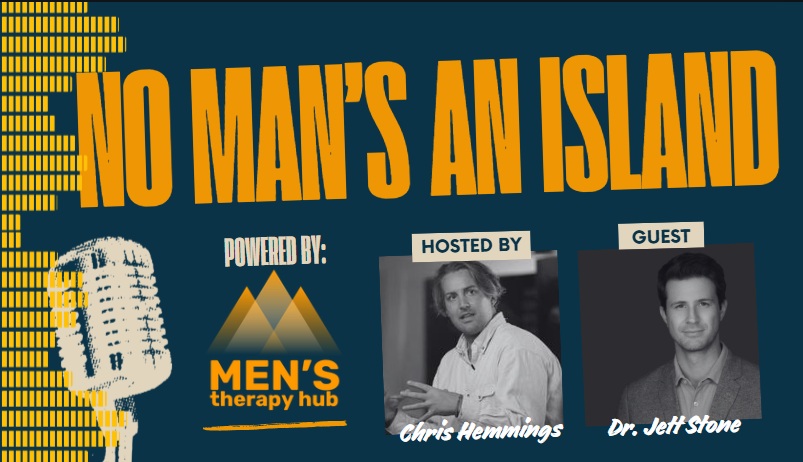
Launch day for Men’s Therapy Hub and episode one of our new podcast, No Man’s an Island. Chris Hemmings talks with co‑host Dr Jett Stone about boyhood, therapy that fits men, and why men need spaces where they belong. This page gives you the essentials, links, and the full transcript.
What we cover
- Why so few men become therapists and why that matters
- Early exits from therapy and how to build a better first session for men
- Directness, plain English and appropriate self‑disclosure
- Strength and sensitivity as compatible traits
- The provider–protector story and the burden myth
- Practical ways men can start feeling instead of armouring up
Listen and watch
- Listen to all episodes here: No Man’s an Island
- Watch on YouTube – https://youtu.be/rjaBDeINXR8
- Listen on Apple Podcasts – https://podcasts.apple.com/us/podcast/changing-therapy-to-work-for-men-with-dr-jett-stone/id1849171262?i=1000734934520
- Listen on Spotify – https://open.spotify.com/episode/7uTO3zautdOKn5gj1U6mQ7?si=AUD0Jo1XQFm4zZmgDe_n3g
Takeaways for men
- You are not a burden when you speak your pain – silence spills out elsewhere later
- Vulnerability is not tears alone – try small experiments with someone you trust
- Therapy is a relationship – shop around, choose the person who feels safe
Quotes to share
- “Everybody’s worst experience of pain is their worst experience of pain.” – Chris Hemmings
- “You do not ask men to change before they come to therapy – change the therapy to fit men.” – Jett Stone
- “Success in vulnerability comes from micro moments that build up over time.” – Jett Stone
Episode credits
Hosted by Chris Hemmings with Dr Jett Stone. Produced by Men’s Therapy Hub. Recorded November 2025.
TRANSCRIPT:
Chris (00:00)
Welcome to No Man’s an Island, a podcast powered by Men’s Therapy Hub, a directory of male therapists for male clients. And breathe, Chris. I am incredibly proud to say that this is episode one of the podcast and also day one of Men’s Therapy Hub’s public launch week. It has been one heck of a journey to get to this point.
My name is Chris Hemmings and I’m one of the co-hosts of this podcast. The other host is Dr. Jet Stone and he’s actually the guest on today’s show. We figured if we’re going to ask others to share their stories, it was only appropriate that we share ours too. So before we do that, I do just want to explain a little bit about how we got to this point. I started training as a therapist back in 2020. On my foundation course, I was one of three men out of a class of 18. Then on my post-grad,
I was one of three men who graduated out of a cohort of 24. In the years before that, I’d been studying men’s mental health and masculinity as a journalist. And so already had a specific focus on it with my life and my work. My experiences on my two courses kind of cemented my belief that men aren’t being properly served by the psychological professions. And that is in part what this podcast is going to be about. It’s also in very big part what Men’s Therapy Hub is about.
Jett (01:16)
Got it.
Thank
Chris (01:24)
So in February, 2024, I read an article by a guy called Jet Stone and it was called, Why is it so hard to find a male therapist? I felt compelled to reach out to him because it spoke to so much of what I was experiencing. Jet and I met online, I was in London, he was in New York and had a great conversation about all things men’s mental health. And we discussed the possibility of one day setting up a men’s therapy network or advocacy group.
We ended the call with a wish that one day we might work together on a project like that. I then started to discover some alarming statistics because even though I was no longer a journalist anymore, the journalist in me was still interested in understanding what was going on. Statistics such as in the UK, only 20 % of therapists are male. Fewer than a third of therapy clients are male. And the big one for me is that men drop out of therapy at an alarmingly high rate. So clearly,
Jett (01:54)
you
Chris (02:21)
something isn’t working for men in terms of the therapeutic profession. Then in November 24, I had an idea. Why not create a therapy directory that is by men for men to show men that there are men out there who want to work with them, a man. And so I started the process of creating Men’s Therapy Hub.
I messaged Jet and now the UK site is launching today, November 3rd, 2025. The US site will follow suit in early 26. We already have 160 male therapists signed up and ready to go in the UK. But we’re more than just a directory. We have therapists writing for our voices section. We have this podcast. And most importantly, I think we’re donating 10 % of subscriptions to men’s mental health charities, nonprofits, organizations.
The four episodes we’re releasing this week as well as this one are with the heads of the charities we’re supporting in the UK. The US ones will follow. And then next week’s episode will be Jet interviewing me. You didn’t think I was going to get away with it, did you? And so here we are, no man’s an island because we all need help, whether it be with our personal growth, advocating for others or definitely launching a new business.
So thank you for all being here and thank you most of all to Jet for agreeing to support me on this mad journey that we’re about to embark upon together. So welcome Jet, thank you for agreeing to help me. It’s been incredible to have someone to bounce off. But the first question, as always to everybody on this podcast is going to be, how did you get into this space?
Jett (04:01)
Well, first off, wonderful introduction and meeting you changed my life a lot because I found someone who was on a similar track with a similar ambition, similar passion for this work that I have. ⁓ And kudos to you for launching Men’s Therapy Hub. I’m honored to be along the ride on this journey. I think it’s the coolest thing and I’m really excited to move this project ahead. I’m sure we’ll talk more about it.
later, but masterful job launching this whole thing. I’m really proud of you. think it’s awesome. How did I get into this work? Well, there’s professional reasons. There’s personal reasons. I’ll weave in the two of them. You know, I grew up in the Midwest in the Chicago land area and I pretty much grew up in locker rooms, ice hockey locker rooms. And I was around a lot of boys and coaches in the form of men who
Chris (04:34)
Thank you, Jet. I appreciate it.
Jett (05:00)
⁓ just exhibited so many different forms of, ⁓ masculinity, some might call traditional masculinity. There’s so much anger in the room. There was so much pride. There was so much joy. It was a hodgepodge of feelings and emotions. And I think I, there’s a part of me that got along with the rough and tumble crowd. It’s a very physical sport. ⁓ there’s a lot of joking, a lot of, you know, playing under pain, you know, one of the biggest things you could do.
⁓ to earn your stripes was to, you know, get your teeth knocked out and still play, break your nose, still play, bleed, get down, get back up. And those were all actually positive things for me in many ways. They built a lot of resilience, but I always had this other side to me. I I like to call it like the poet side. was literally writing like songs, ⁓ know, quietly in the corner of the room. Like I felt like I fit in, but I didn’t really fit in. I wanted to know more about who.
my teammates were, who my coaches were, who my dad was. Honestly, my dad was a very cool, calm, collected, unemotional brand of masculinity. And so I had a lot of curiosity what lived beneath the surface of these male archetypes that I was living amidst. And so that just kind of, you know, I didn’t know I was going to go into working in men’s mental health at that point in my childhood, but I just, that was kind of the start of it. There was a lot of
curiosity. I wanted to lift the hood of who these people really were. I wasn’t often getting it from them, including my dad. I wanted to know more. So fast forward, you know, many years later, I’m in college and I’m an English major, unfortunately, to my parents to grin, you know, always my dad, you know, wanting me to go to medicine. I moved in reading the great novels and books and reading literature and writing and
writing essays and thinking about the humanities in that way. to me, there’s no greater psychologist than authors in many ways. And I didn’t know I was going to be a psychologist at that time. And I moved to New York City for journalism school, actually. So that’s where some of our paths cross there, Chris. And in journalism school, ⁓ I got very interested and I was working in a borough, Greenpoint, Brooklyn, got very interested in the people there, the
⁓ the, the businesses and I was thinking of psychological bent on a lot of it. started also working at psychology today at that point. And I was interviewing psychologists was interviewing researchers and sitting on the subway and looking across from somebody and saying, like, where are they going? I want to know what they’re thinking. I want to know how they feel. I, there was like, I had an insatiable appetite to know someone’s story. Yes, there was a part of me that wanted to help. and as a journalist.
Chris (07:50)
Hmm.
Jett (07:53)
you there was, or as a training journalist, I should say, there was a lot of what we used to call like seduction and betrayal, meaning you’d get the interview, you’d get the quotes, the things you need, you did the reporting, then you might not see them again. And so moving into ⁓ therapy was a natural transition because you’re doing all this quote unquote reporting, right? It’s much, much deeper than that, obviously. But you’re building a relationship. And so my switch from journalism to psychology came from working at psychology today.
Chris (08:06)
Yeah.
Jett (08:22)
The financial crash of 2008, I started taking courses in psychology and eventually ended up in a PhD program. And similar to you, once I made the transition from writing and a bunch of other jobs that we could talk about if you want, but I made the switch into a doctoral program in clinical psychology in New York. And I was in a cohort of probably, I’d say 16, 17, I was one of two.
males in that program. And I was like, we are learning so many interesting things about the human condition. You know, like, why is this a space that is predominantly female here? Why my cohort of ⁓ women, my core, they’re they were brilliant. They were awesome people. But the question just remained inside. Like, why? Why is this something that just a fraction of a percentage of men are going to be experiencing? And you said 25 % or 30 % or
male therapists overall. Yeah, 20 in the US, it’s 25 or depends on what your look at the stats. But when you look at the younger demographic under 30, I think it’s even lower. At least as of 2023, it was we can look back at the stats, but that was really concerning to me. And then that’s when I came into the space of men’s mental health. And I’m thinking, I want to go to a place where I’m needed. I want to go somewhere where I feel like I can contribute. You my background, it’s not
Chris (09:22)
in the UK 20.
Jett (09:51)
remarkable, you know, but it is remarkable in the sense that I didn’t hadn’t met anyone else who was raised in hockey locker rooms or had a sort of the same rough and tumble boyhood and then we’re entering this quote-unquote softer profession, right? So there’s a duality between strength and sensitivity that I wanted to dive into and I didn’t just I didn’t see a lot of other guys in my program or in the surrounding New York City area. I worked in hospitals and clinics. You know, I can count on one hand.
those that I came across who had something that even rhymed with that background. And I men are needed in this field and I’ll end on that point.
Chris (10:31)
There’s so much crossover between you and I, and that was what our initial conversation was way back in early 24. It feels like a lifetime ago for me now. In terms of the sporting background, the journalism background, the having never even been told that psychology was a thing that existed basically.
And you will hear all of this when Jet interviews me, but when somebody suggested to me to be a therapist, I laughed in their face. Like, what? I can’t be a therapist. I’m some, the American equivalent would be jock, right? Like I’m some rugby lad, lad is the thing in the UK, right? I’m some rugby, like reformed rugby lad. What the hell? But that realization, like you’ve just said of, but there are men like me who need support.
Jett (11:08)
Yes.
Chris (11:25)
And I’m gonna read now ⁓ a little excerpt from that article that Jett wrote, because to me it speaks to what we’re talking about here. So I’ve prepped Jett for this, he knows it’s coming. So a commonly cited reason for ending treatment among men is the quote, lack of connection or understanding with their therapist. According to one study, men are less likely to seek therapy and drop out sooner, hindering the effectiveness of treatment.
Men may be more likely to consider and then enter treatment if they believe that they belong. And part of that may mean perceiving that a practitioner has also traversed boyhood’s treacherous terrains. Beautiful writing. When communicated between men, seemingly banal phrases such as I hear you man, depending on their pitch and intonation can land like a melody full of meaning. It may directly single love, signal love, or be a more subtle nod to the shared experience of enduring play.
through pain culturing programming. As one of the only men during my doctoral training, I often felt like a reluctant ambassador for nearly half of the human population and it was alienating. It was meaningful to have a male therapist of my own.
And I love that because when I read that, all I could think was the whole time we were training, I kept thinking, but this concept, this approach, this counseling technique doesn’t sit well with me. I trained, my foundation course was psychodynamic. And I recall in the experiential group, which is where you sit and you…
Jett (13:00)
Mm-hmm.
Chris (13:05)
talk about what’s going on in the space between you. The psychodynamic, the kind of classic Freudian therapists are completely blank screen. They don’t give you anything back. And I thought like to me as somebody who is still learning how to open up, that was really off putting. And I’m somebody who’d already done work on myself. I’d already been to therapy. So what was it for you, Jet, in your training and in your understanding of the kind of male condition?
that made you want to start focusing on men and realize what men need may be a different approach.
Jett (13:43)
I began with the Psychodynamic Foundation similar to you. ⁓ And there’s so much diversity even within psychodynamic psychotherapy, right? Freud was many years ago and contemporary psychoanalytic thinking has changed a lot. ⁓ But nevertheless, there has been this sense of using silence in the room that you alluded to, the…
You know, not bringing a lot of your own character or personality into room as a therapist, the blank screen sort of mentality. And I, like you, was taking all of this in. And, but the difference is with clinical work is that you then have to apply it. So you’re not just learning it and typing about it and writing papers on it and theorizing about it. You actually have to implement it. You have to take it from an idea into a practice. What I was finding is like,
You know, was mainly working with women because that’s who came to therapy in these clinics that I was working at the time. But when I started to work in, let’s say hospitals, addictions units, ⁓ dual diagnosis, meaning that someone had a substance use issue alongside another clinical ⁓ problem they were dealing with, you start to see more men. I then worked in the VA system, Disproportionately male veterans, although there’s many female veterans now as well.
And so what I began to learn was, my gosh, these interventions weren’t necessarily landing. there was a big problem within the VA system of there was a, know, quoting from the clinical notes, lost to follow up. It was just scattered all over. And I was thinking there’s something happened. Yeah. Lost to follow up meant that like there’s a male veteran who came in for therapy, maybe for the first time.
Chris (15:30)
What does that mean, lost to follow up?
Jett (15:39)
felt like it wasn’t a match, felt like he didn’t belong, speculating, know, say the reasons why. And then when the clinician tried to follow up, they didn’t respond. They were just kind of gone. They were off into the ether. And so that there’s a, I got, that’s the US language in the notes, like lost to follow up. I’m like, you know, think to myself, what is going on? And over the course of time, it became clear that those beginning sessions of psychotherapy, you can really lose a guy in those.
Chris (15:52)
I
Jett (16:07)
moments. It’s such an alien experience as I wrote in that piece you said it was. ⁓ You don’t want to ask men to change before they come into therapy. That doesn’t make sense. We have to change therapy to tailor to men. And I didn’t see that anywhere. just no one was doing that. There were some authors who were talking about it. A guy named Gary Brooks written a book, ⁓ you know, years earlier, but there just wasn’t a lot out there for me to.
latch onto and say, how do I work with a Marine sniper who has never looked another man in the eye and told him anything remotely close to his feelings? This is a foreign experience here. And, you know, I felt like I actually had some of the tools of doing that because I had to relate to that archetype of mal before in my childhood. And so a lot of my thinking in the last 10 years is how do I bring in
Chris (16:42)
Right.
Jett (17:06)
the research, my own personal experience and my clinical experience to make therapy work for men. And the type of ⁓ client that I work with is I’ll quote from an actual email I got recently. Well, I’ve never really been a big believer in therapy, but I’ll give it a try. Right? But here I am. Exactly. It’s the pre-contemplative, contemplative state of change that you’re seeing them in, that you’re taking them in. And so,
Chris (17:25)
Here I am, right.
Jett (17:36)
You know, we could talk about sort of the different interventions that you can use to build a therapeutic alliance. And hopefully in this podcast, we can dive into things like that. It’s there’s a burgeoning research body that are showing some of the things that do work for men. And, most of all, and I think you’ve said this in your, your writing and in our conversations that it’s like, you have to bring your authentic self into the room.
with a guy, you cannot be a buttoned up, you cannot be overly professorial or pedantic or you have to ⁓ give them something and often give them something valuable early on is what I’ve learned. ⁓ And there’s a lot of things to do to build trust, to build that therapeutic alliance. so that’s one of the things that, ⁓ you know, I noticed and that I want to bring to this field as much as I can.
Chris (18:33)
One of the things that’s been most fascinating for me about starting Men’s Therapy Hub is I have been witnessed to men creating their therapeutic profiles. And I have also seen more male therapy websites than I ever thought I would, as I’ve been reaching out to people, but also like, who is this guy who signed up and looking for guys who have a specialization in working with men. ⁓
On my course, I very specifically remember one Saturday day, like where we have an eight hour on a Saturday, which I enjoyed, by the way. I enjoyed being at school on a Saturday. I enjoyed being at school for the first time. So that was a big ⁓ barometer for me to say I was in the right place. Was our lecturer saying ⁓ the absolute importance of not self-disclosing as a therapist, so not bringing yourself into the therapy room in terms of your personal experiences.
Jett (19:16)
You
Chris (19:30)
So I put my hand up and I was like, well, I’ve been a journalist for 10 years I’ve read I’ve a book which was semi autobiographical a lot of my writing has been almost all of my writing is Here’s a little snippet of how my experience marries up with this and then here’s research and here’s my opinion And so I was like the cat’s out the bag man. Like I can’t and he’s like, okay Well from now on no more and I remember sitting in the room just being like no
Jett (19:51)
You
Chris (20:00)
Like, no, because if I’m gonna be a therapist, I’m gonna be me as a therapist and I will live and die by that. And if my clients don’t like it, I wouldn’t have any, you know? And they won’t stay. And then maybe I’ll rethink. But what you talked about there is this burgeoning understanding of we need to somehow show the men in the room.
You know, sometimes therapy is about, ⁓ it’s not only about mirroring and reflecting, it’s also about leading by example. And so if a client is really struggling to open up, one of the things that I say to my clients, for example, is you have to remember that long before I was a therapist, I was a man. And so I know this space. I don’t know your exact struggles, but I know the struggle of opening up emotionally. yeah, right.
Okay, because I’m not just an expert at this I’m learning still too and I have a therapist and I’m actually on a break from my therapist right now But like I I have been in therapy so I know how hard this is. All right And what you talked about there was you’ve now to the world of the eight people listening to this first episode Explained your history in your background, which we’re not supposed to do but I’m interested to know more because there are so many men out there who have a
similar, sporty, jock, lad culture, unemotional father, you know, the kind of archetypes, the traditions that we’ve gone through as men who are coming to therapy. And so how much of that do you bring? How do you decide when to bring it? And how much do you actually share of yourself?
Jett (21:52)
Well, when it comes to therapeutic self-disclosure, it’s different than the self-disclosure you don’t know that you’re doing, which is when you get Googled or someone puts your name into ChatGPT, whatever it is, and the name that I have is, for better and for worse, somewhat unique, so there’s not that many of me around. So if you Google me, there’s a good chance it’s me and maybe some other kid in New Mexico who shares my name. And so they’re going to find articles.
Chris (22:19)
Yeah, there’s
one guy who works at PricewaterhouseCoopercore Chris Hemmings that I know of and basically that’s it. It’s me and him.
Jett (22:23)
no. Yes. Yeah.
Yeah. Well, you should connect. one day I’ll connect with the other Jetstone that I know out there that I’ve heard of out there. ⁓ so there’s that. So there, don’t know the degree to which they’re, they’re, you know, building a dossier on you, right? Before they even meet you. But then there’s the therapeutic, ⁓ self-disclosure. And that’s been written about endlessly, especially by psycho dynamic writers. And I would say the second dynamic world is much more cautious about self-disclosing. That’s.
what I was originally trained in. But when I went more into the CBTs, the third wave behavioral therapies, they were less hung up on that question of self-disclosure. And where I’ve come to on that is that, you know, I’m going to self-disclose when I feel like it’s in the service of the treatment, when it’s in the service of this person that I’m sitting across from. If it’s just to get something off my chest or just to, for the sake of, you know, ⁓ catharsis, it’s not
You know, it’s not the end of the world if that happens, but it’s it’s unhelpful. And so I try to be as pointed with my self-disclosure. Like I’m a dad, too. I know what it’s like to feel like you want to pull out your hair when your kid is not, you know, getting into the bath or leaving for school. Like, yeah, man, that’s a that’s a that’s so incredibly frustrating. Let’s talk about what’s living beneath the surface of that for you. ⁓
or even something to the effect of, man, I know what it’s like to grow up in a culture where it feels like it’s really dangerous to express how you really feel. ⁓ So it has to be in the service of something. And so usually before I say it, it’s like, what is this adding to the picture? Sometimes I failed doing that, honestly. ⁓
If I have to share something, ⁓ you know, there’s a member of my family who has that, who’s had that same issue that your member of the family has. It’s like, it doesn’t really land. Why are you saying that? So I guess my thing is I have to answer the question to myself. Why am I saying this before I say it? This isn’t a friendship. A therapy relationship isn’t, you know, I had a supervisor, he’s like, this isn’t a cocktail party we’re doing here.
And I think we have to bring something different, especially with men to the table, that I am not your friend. I can be friendly. I could speak a similar, you know, dialect that could be plain language. But I am not your friend. And that’s why this relationship is beautiful. Because you can tell me the things you would never even tell your friend or someone else. And so in order to build that trust, sometimes it means, yeah, man, sometimes I don’t know what the hell I’m doing either when it comes to
I always bring up parenting. It’s a great domain to self-disclose, but that’s just one that comes to mind right now. So I’m judicious when it comes to self-disclosure, I would say, but much more open to it than I was in my training.
Chris (25:23)
Hmm.
One of the beauty, ⁓ sorry, one of the beautiful things that can happen with self-disclosure is that moment of mutual empathy, which can really soften somebody. A guy who is, I openly specialize, it says on my profile, I specialize in guys who haven’t been to therapy before because they’re the guys that I want to help. They’re the guys that I really want to say like, come on, like come in. It makes sense that I then run men’s therapy hub. ⁓
It all makes sense to me, but to these guys coming in, I think sometimes we forget, we know, we hear this, that, men just need to talk more. Men just go to therapy. And you just spoke about that, like, all through our formative years, as many of us as men, and not all men will have had the same experiences of this, we grew up, you and I, by the sounds of it, very similarly, in environments where, to self-disclose,
was to risk a huge amount.
how has it been for you on this journey from, you know, hockey jock to increasingly emotionally intelligent, let’s call it, right? That’s, yeah, yeah, yeah, it’s never ending. And the joke I make to my clients is the more I learn about psychology, the less I realize I know. This huge transition, because we’re asking, you and I are.
Jett (26:48)
It’s a project man.
Chris (27:03)
in essence, inviting men, asking men to take on a journey and a task that we have done ourselves. So one of the questions I’m going to ask ⁓ guests on the show, and we’re recording these out of order, so I haven’t actually asked the next few guests, but I will do. I’m not going to ask you, because the question is, have you been to therapy? I know that you have. But I guess the question is, what was it like for you?
Jett (27:22)
Mm-hmm.
Chris (27:33)
to take those first initial steps into a therapeutic space, to throw off the shackles of years of, you know what, generations of ⁓ suppression hardwired into us.
Jett (27:49)
Yes. ⁓ I was the first, so I, I went to, I entered into therapy when I started, ⁓ therapy training and, at least in the U S like it’s, it’s an unspoken rule. If you’re going to train to be a therapist, you have to have to have experience in your own therapy. ⁓ but I also had a lot of things that I was dealing with. also very much needed it. I was, I was the, you know, like you had said earlier, I didn’t.
Therapy? becoming a therapist? was not on my bingo card when I was a kid. It’s not something that I had ever imagined doing. It kind of like made me squirm a little bit, even just saying it at the time. ⁓ I’m shedding that, right? And so when I first entered into therapy, it was an alienating experience. I went to one therapist, felt like it wasn’t matching. By the way, I was looking for a male therapist. I was… ⁓
in a room, I was, you know, I just married thinking about maybe starting a family. I don’t know. I had a lot of confusion. I wanted a male therapist to answer to answer to me and, know, and be a another father figure in my life to complement what my father gave me and what he didn’t give me. And so when I came to therapy, I was like, you know, well, didn’t land with this one. went into another one who was a better fit for me.
And I just remember sitting across and over the course of time, it was very, very tense and kind of like, you know, sort of performing. And then over the course of sessions, like I started to let my hair down a little bit, loosen up and sort of begin to understand what this was about. And that’s when I started to understand some of the self-hatred that I carried with me, despite being well liked. I didn’t really love myself.
and I, you know, I hadn’t tackled my own defensiveness. I was a very defensive person. was very quick to the, ⁓ quick witted, quick to the punch, right? And I wasn’t getting into fights, but I was definitely like, it was, it was difficult for me to take some criticism, you know, let’s say on the ice or on the field playing, like I was, I was the one who loved, I loved trash talking. I loved it. I was, I was very good at it.
Despite my, you know, pleasant looking maybe exterior of being a nice person, I could be a nasty son of a bitch. And I allowed that out on the playing field. didn’t know, you know, I was able to contain it. But anyhow, so when I was in therapy, I’ll just give you an example of something that I learned. You know, I felt like my therapist, who I will not name, but he’s a wonderful person, was kind of mailing it in and was annoying me session after session. I was like, he’s just kind of like,
passive, like step up to the plate, give me something here, man. It was kind of like what I was afraid to say to him. And so what ended up happening was I came in and I walked into one session and I handed him the check for therapy. This was back when it wasn’t all automated and, and he, he took it, right. And then the next session, he’s like, you know, when you handed me that check last week, you made me get up out of my seat and walk to you.
Chris (31:03)
Hmm.
Jett (31:15)
to grab it. He just made that observation to me. And I was like, I did? No, I didn’t. That sort of defensiveness came online. And then it occurred to me, I was like, holy shit, I did. I did do that. I was being like, you know, very passive aggressive, you know, with a lot of emphasis on the passive part there, because it wasn’t like I punched them or said something nasty. But then it occurred to me is like,
I sort of bury some of that. And he pointed it out to me. And it took me a long time to kind of come to terms with like, yeah, that’s the type of thing that I’m capable of. And so it took me a while to sort of go from like tightly wound to opening up and observing myself. And that’s an example of how you can use the therapeutic relationship. And this is more psychodynamic, but I think it’s a great example of it. You can use the therapeutic relationship itself as a way to help.
direct men towards healthier behaviors, better connection, and turning down some of their defensive moves. I’ll… ⁓
Chris (32:22)
To point out
what is happening in the room that is kind of, you will still try to deny it, but in the long run is undeniable.
It’s so interesting and I’m getting to know you more on this podcast because we haven’t been speaking about our personal journeys, but my first proper therapeutic relationship after about seven or eight sessions, I said to my therapist, he’s male, was brilliant. And I said to him, I feel like you’re letting me get away with stuff. Like, I’m not going as deep as I think that I can. And so then he…
goes away and I realize now he speaks to his supervisor. And he comes back the next week and he says, right, you are banned about talking about your book. You are banned from talking about any of this work you think you have done on yourself previously. No, done. You have to stop and you are only gonna be talking about what’s going on in this room. And there was just this like,
Jett (33:16)
He comes back the next week and he says…
Chris (33:38)
Okay. All right. It’s like now we’ve both arrived here. Like I needed that like compassionate dad voice. That’s what my supervisor calls it, right? The compassionate dad. I needed somebody to be stern with me, but in a compassionate way because he’s like, just because you’ve written a book doesn’t mean you know squat about like your psychology. Like you’re not an expert on this. You’re an expert on yourself, but.
Jett (33:40)
There you go.
Yep.
Chris (34:06)
I was using it as a cover to explain things away. And so what happened with both of us is our therapist goes out on a bit of a limb and takes a risk. And I’ll say this to my clients, like, actually by saying this, I feel like I’m taking a bit of a risk, but I feel like if I don’t say it, then we’re missing something. And please correct me if it’s wrong, but X, Y, Z. And that’s where I think men are more used to being spoken to.
Jett (34:24)
Yep.
Chris (34:36)
in that way and so they’re less likely to be offended by
Jett (34:37)
There you go.
Yes. ⁓ What you said just sparked so much because you’re talking now at the level of intervention too with men that I was on. So I was on a bus a few months ago and I was listening into other people’s conversations as I do. And there was these two guys sitting next to each other and they were talking about their therapy. And I was like, my gosh, I’m going to I’ll miss my stop to make sure I ⁓ gather this information. And one of the biggest takeaways was
from it was, I want my therapist to step up to the plate and just say the thing, quote unquote. I wrote it down. That’s verbatim what he said. And the other guy was like, me too. I wish he would just take that shot. And these are metaphors that they’re using here. But it’s exactly what you said that actually one of the interventions is, and it was helpful for me as it was for you evidently, was that a therapist who just went in there and said, you know what, I could be wrong here.
but it really sounds like you’re X, Y, trying to, right? I always say, swap this away if you feel like this doesn’t make sense or you want to edit it, but this is what I’m thinking. And I oftentimes do that early on because I want them to see that this is not a passive experience here at therapy. It’s like, I’m going to take my shot. I’m modeling to you. You can take your shot with an intervention that feels like it’s or an interpretation that feels like it’s kind of, you know,
difficult to say or vulnerable. so step up to the plate. Right. ⁓ And sometimes being upfront early on can really be helpful to men to know that, this is a therapist who’s going to like not just bottle up and say things, you know, they’re going to. It’s therapeutic style, but they’re going to say the thing sometimes they’re going to give me feedback as well. So I love that you you phrased it.
that way because the other intervention is in there is men, and this is research shows us too, is appreciate directness in plain English or plain language, depending on what language you’re speaking, right? It’s ⁓ direct and in the psychodynamic term is experience near, meaning that like the language that you use with a male client can be very helpful if it reflects
Chris (36:49)
Mm-hmm.
Jett (37:10)
his inner world and how he would speak. So it’s not necessarily that you have to speak a different language to be on the same page as him. It’s that you can use his words and the way that he describes things to then put it back at him. If they call themselves a real asshole at work, I’m like, well, you’ve just given me permission to call you an asshole.
Chris (37:37)
Hmm. Yeah.
Jett (37:40)
Um,
safely. And so I, I’ll come up and step up the plate and try to say something like, is this one of those moments where you’re being a total asshole? Right? Like, I’m just giving you like, you know, a very raw example.
Chris (37:49)
Right.
Yeah. And a great example for me would be ⁓ unsurprisingly, given I work entirely with men, I know you don’t work entirely with men. I have a lot of men who have drug addictions, alcohol addictions. And one of the things that I’ve become quite adept at is allowing my clients who take drugs to know that I have taken drugs in the past without specifically saying I have taken drugs in the past.
It’s the use of the language, the terminology, know, the buying a bag, like, you know, going out and having a pint and then making a call, you know, like all those sorts of things that those who don’t know what any of that stuff means, good on you. Those who do, good on you. ⁓ Like, and it’s about helping them to recognize that like they’re not alone in this world, even though like I’m a professional, like.
Jett (38:25)
Mm-hmm.
Chris (38:50)
I’m also a human outside this room too. And I have my own challenges and my own vices and my own many different things, but there will also be a time when a client is completely refusing to understand the challenge that he’s facing when I will say, well, do you know what? Cocaine was my vice after the death of my dad. I used it to cover up all of the pain that I was feeling.
So I understand what it’s like to use drugs in that way.
Jett (39:21)
Mm-hmm.
Yes.
Chris (39:23)
And I won’t go into any more detail about it. And I will specifically say, and there’ll be no more questions about that, right? But that’s just so you know that I haven’t, but that’s not like day one. That would be day 20. That would be session 20, you know, only at the right time to bring something in to say, I feel you, I know you. And also I know more about this than probably you realized before, because sometimes I need to show that it’s okay to be vulnerable because otherwise like we haven’t had.
Jett (39:36)
Right.
Chris (39:53)
role models, vulnerable role models as men. I didn’t have a single one growing up. So I have to be that for my clients. I feel that deeply.
Jett (40:00)
Yes. Yes. And you back pocketed that self-disclosure for a time when it was right to use. And because part of the therapeutic alliance is knowing as a therapist, like, you know, what a client would be able to take in and metabolize and what they might not be able to. Right. It’s like you have a better sense of that. You had the sense that session 20, whatever it was, that he could hear that and not feel, ⁓
You know, dysregulated by it. Right. Right. I mean, basically what we’re talking about here is using language to to regulate their help regulate their nervous system in a way like to help put them in a place where they can breathe easier and open up and look inward and look at their relationships. And all of what we’re talking about is one way. To do that. Through the use of.
Chris (40:32)
Yeah, like, railroaded by my experience. Yeah.
Jett (40:59)
language and building the therapeutic relationship through self-disclosure.
Chris (41:02)
Yeah,
I think the most powerful one from my personal experience with therapy is with clients, particularly young clients who come in struggling with their sexuality. And actually ⁓ I have to try to explain to them ⁓ internalized homophobia because many of them have never come across that terminology. They don’t know what it is. For those of you that don’t know what internalized homophobia is, so I’m bisexual. I didn’t come out as bisexual until I was 27 years old. And I hated that side of myself.
because I’d grown up in a culture that was homophobic. So I had internalized that homophobia and pointed that hatred back at myself. It’s the same with internalized racism, internalized misogyny, internalized ableism. There’s lots of it. And actually sometimes with those clients, in session three, I will be like, all right, I need to meet you in this because you actually don’t have any point of reference for it.
So I can say, well, here is a point of reference, here’s my experience of it. Does that help you to understand your experience? And mostly it does, right? And that can be powerful, but I think it can also be…
Jett (42:02)
Yes.
Chris (42:16)
It can be overused, it can be misused. And where do you find that the line is for that? How do you figure that out? Is it just a case-by-case basis?
Jett (42:27)
It’s a good question and I wish I had an elegant answer for you, but it really is a case by case basis. One of the things that I track is, ⁓ you know, in my caseload of people that I see, there’s a spectrum of how much I feel seen as a therapist in the room with them. I don’t mean like they’re asking me questions necessarily.
But there’s a sort of a relational dynamic where does it feel like you’re talking with this person or this person is talking at you, right? Sometimes that points at personality that helps direct you. And, and I think there, like when you track that, like, what does it feel like to sit across from this person? Is it a give and take? Are they listening and taking in? Are they using it as a soapbox for themselves? Like there’s just different variations of that. And so sometimes self-disclosure,
you’ll get like a blank face and it’ll mean nothing. Sometimes you’ll get self-disclosure and like we’ve just talked about, could be make you feel so, make a person feel so seen and connected and understood and that, you know, here’s another guy I’m sitting across from who is modeling self-disclosure and vulnerability. And then sometimes you’ll get someone who you’ll say something and it’ll be silent and you could tell that it’s, ⁓ you know, it’s,
knock them off like they didn’t want to hear that. And from a psychodynamic framework, you’ve ruined their ability to project upon you, meaning that they can they no longer have the fantasy of who their therapist is, because you’ve ruined it with reality by telling them, you know what mean? And so there are some therapists who would say, well, you’ve kind of scuttled an opportunity here, because you could have instead of saying
If they ask, how do you identify sexually? And you just tell them that you could have asked, well, what do you imagine? I don’t know if I ask.
Chris (44:29)
Yeah.
Why is it important that you know?
Jett (44:33)
Exactly. And I think that is a great question. And I tend to be the type of person who will say, look, I want to know what your fantasy is about that. And I’m okay answering it, but first let’s talk about the fantasy. Right? So I could just kind of put it easy. Like I’m not this dodging of questioned person. I want to be direct with you, but I also, that’s an important part of therapy. I am not your friend. I am not your dad. I’m not your coach necessarily, unless you’re doing coaching. ⁓
And yeah, that’s part of it is ⁓ sussing out who the person is at a personality level, what they can take, their relational style. All those things come together in like a very non-quantifiable picture of like, should I use self-disclosure or not?
Chris (45:19)
Mm.
We’re talking here about one aspect of changing the game. Because what you said before is what I’ve been saying for a long time. And it’s the kind of the Zack Seidler approach who’s going to be, Zack’s going to be coming on at some point soon. ⁓ He was like, ⁓ I’m busy. I’m on the road. And then I see he’s on the stage with Prince Harry. And I’m like, busy were we? Like, you know, I’m a big fan of a lot of Zack’s work. It’s the, need to change the model to fit men.
Jett (45:37)
Awesome.
Hahaha
Mm-hmm.
Chris (45:53)
For you, with your experience, and you have many more years experience in session with clients than I do, what are the most classic or the most common challenges that your average Joe who comes into therapy, who’s never spoken to somebody about their feelings before, what are the biggest hurdles that that guy has to overcome?
Jett (46:25)
Not even, so not even having a sense of what that would look like sometimes. If you haven’t been vulnerable or you haven’t felt deeply in a very long time, because most of these guys who come in who are maybe the most shut down walled off, it’s not like they have less emotions than a more emotional counterpart who come to therapy. No, no, no. It’s they’ve built up all of these protective mechanisms that
make it so difficult for them to even know what that means to open up.
Chris (46:59)
Right,
they have just less access to them.
Jett (47:02)
Yes, they have less access to them. so part of the alienating experience of therapy is like, am I just supposed to come in and walk into the room and like, start crying? Is that like what I’m supposed to do? And so like vulnerability isn’t tears, crying that that can be a powerful indicator of vulnerability, but that’s not the thing. And there’s, there’s risk, there’s, there’s exposure that you take. There’s, you have to slow things down. And so for that guy, the most, let’s say walled off,
is that don’t, you know, you can’t push that person to become more emotional. Can’t wait either with silence. You have to ask the right questions. You have to slow things down enough. And oftentimes I think starting semantically with the body. Like what’s showing up in your body when you think about getting bullied as a kid or getting shouted down by your father.
when he came home from work and smelled of alcohol. Right? You start there. And a lot of times with men is you call it inner child work. Now we’re sort of advancing past, once you have the therapeutic relationship and you’re trying to get them to open up more and feel more deeply is they will have more compassion and ability to see themselves as kids or to see their own kids than they can to see themselves as dependent adults who
need others. And so I think orient. So one of the tools that I use that I’m building a presentation around some of these tools now is like helping men ⁓ orient like with sensory cues, like almost like in type of exposure, right? Therapists have been doing this for many, years with chair work and inner child work, but I’ve been doing it more and more having
men close their eyes and sort of taking to them to the place where maybe they felt the most shame, where they were a wounded or vulnerable kid. ⁓ and they learned to take on these defense mechanisms or coping styles or moves. So one of the things that I do before I expect tears and vulnerability is to sort of walk them back into their history a little bit to access like some of the scenes of where this began. And then over the course of time,
Once you say, yeah, it makes a lot of sense that you became shut down. was, we sometimes called like the intelligence of the adaptation. It’s an intelligent thing that you learned how to do. Your dad was a scary motherfucker. Like I’m, I’m glad that you learned to tiptoe around him. Right. And shut yourself down. But like you’ve taken, you’ve become a master. You could teach a masterclass on that right now. Right.
It’s helpful at your work. You walk into the law firm and it’s the same thing. But whatever you learned as a kid is making you into a really difficult person to be married to, let’s say, or to be in a relationship with, just general. And so once they start to see the kid within and they slow things down, you help them feel that in their body first.
It’s like then they start to get more connected and then you can give them words like fear, shame, or whatever it is. You want to speak their language a little bit. You don’t want to go straight into the core emotion right away. So I’m, I guess I answered your question by saying they come in with no tools and it’s our job as therapists to help find a windy road to take them to a place where they can start to feel. And look, I’ve failed at that.
at times in my career, it’s very, hard to do. ⁓ A lot of times it stays in the cognitive intellectual space more than I would like it to. But every once in a while you can find an inroad and elicit that more deeply feeling part.
Chris (51:07)
Hmm. ⁓
There was a part of that that really struck with me, which was the slow it down. One of the earliest thoughts I had in terms of repeat experience with clients was, dude, are you trying to win at therapy? Are you, you’re six sessions in and you’re kind of becoming frustrated that things aren’t changing for you? To which I then remind them,
in my introductory session that I told them this will get harder before it gets easier. And sometimes I make the joke, or I’ll give you your money back. Like it has to get harder before it gets easier. It is not just an upward trajectory from day one. And I think that’s part of the misperception of therapy is it’s like I go to the doctor, they give me tablets and things get better. It’s like, no, we have to re expose the old wound. We have to bring stuff up that has been
⁓ Shut off that has been people overuse the term compartmentalize but like the things that have been suppressed or repressed the only way that we can change our responses to them is To bring them to the surface because therapy isn’t about changing your past. It’s about changing your relationship to it But a lot of men come and say well, okay, I want in eight weeks I want this and I want this to happen and I won’t change and I
Jett (52:24)
Mm-hmm.
Chris (52:44)
One of the big challenges for us as therapists working with men is how do we convince them that this is not one of those times where we can just like hammer in a couple of nails and we have a new structure. This is about semi dismantling the structure and rebuilding it in a new way with stronger foundations.
Jett (53:09)
Yeah. And you’re pointing to something important that a lot of the research does show when, you know, working with men, it’s important to have structure and be clear about goals. I mean, it’s important for anyone who’s in therapy, but maybe more important for men. And I think what you’re pointing to is that from my experience, and I don’t know what else, what other research would support this, it’s that
To me, that’s yes, that’s important, that structure and giving them a sense of how long therapy is, plain English explanation of therapy, basically. Up front is our job to psychoeducate and do that upfront. we say like you said, it could get worse before it gets better. ⁓ The problem is that therapies can wind into different rows and it’s not so linear. It’s not like six sessions and then you’ll be, you know.
cured. And there are some psychological issues out there where yes, insomnia, you could do a short-term treatment. There are some treatments that are short-term and do work, but most of time it takes a little bit of time to undo some of the things that have taken decades to come about in the first place. And I always say, my metaphor is like if the river’s been flowing in one direction for 30 years, it’s not going to take three sessions for it to start.
you flowing in a different direction. takes a lot of work. ⁓ And so that’s part psychoeducation. like, I think the clarity upfront, so front loading clarity is a very important intervention with men. can’t assume that they know what the hell is going on. I didn’t in therapy. Be clear. ⁓ It’s not about lying on a couch and spilling your guts. It’s building a relationship with someone who
Like I said, it’s not your family, not your friends. You can sort out what’s going on and help you see blind spots, figure out what to do next.
Chris (55:09)
and I’m gonna be here every week, rain or shine.
Jett (55:12)
That’s right. Yes. I’m not your drinking buddy. I’m saying that maybe too much here, but I think that that’s part of it is that when you get, when you’re spoken to as a guy, as someone who’s not a family member or a friend, it’s, it’s different. It’s a different experience. You might sound like a buddy of yours. I might have that same sort of intonation and style, but I’m here for a different reason.
And one of the things I also see, I’m sure you do as well, is that there’s a fear in a lot of guys starting therapy that, oh God, I don’t want this to be a pity party. I’m a pretty privileged dude. I don’t want to feel like the issues that I have are, look at the people in Sudan or in the Middle East who are suffering far more than I am. There’s a lot of undoing, a lot of couching in saying, well, my problem is minimizing.
You see that in a lot of guys. And so you have to kind of take that down. Say that’s not what this is about. We’re not comparing. So there’s a fear of, you know, being handled too softly or being pitied or that it’s an ick. It’s the male ick. ⁓ So I think that that is, that can derail therapy too.
Chris (56:32)
I think that speaks to the ⁓ provider protector role that is deeply ingrained in the male psyche because, so I spoke to Ellen O’Donoghue who is the CEO of James’s Place, one of the charities that we’re supporting. James’s Place is a place that is almost immediate triage for men who are suicidal. And they get multiple sessions and they are seen within like two days. And she said that the biggest barrier that she faces
or the practitioner’s face is men coming and saying, well, I don’t believe that I’m worthy of this time. To which James’s place have to explain to them like, we exist specifically for you right now, my man. Like that’s why you’re here. But these guys are like, well, but there’s somebody who is more worthy of it than me. And, you know, my parents said to me and many of my clients parents said to them, well, there’s kids starving in Africa. It’s like, yeah, I know.
Jett (57:09)
Yes.
Chris (57:31)
that there is, but that doesn’t mean that my pain right now is any less real because everybody’s worst experience of pain is their worst experience of pain. I really hope that we move away from this kind of trauma contest that we live in, right? ⁓ Where, well, know, being violently abused as a man is somehow less problematic for that man because it’s a man that’s doing it.
And it’s therefore more problematic for a woman if it’s a man abusing a woman. And it’s like, well, why does it matter that it’s more or less? The reality is, is that it’s traumatic for both in their own way. And I think a lot of men struggle with that because they have swallowed the rhetoric of male privilege. They’ve swallowed the rhetoric of the provider protector, particularly the protector of, actually shouldn’t have any problems.
Jett (58:23)
Mm-hmm.
Chris (58:30)
And you you’re a father, I’m not. ⁓ For you, how did you overcome that? Because there has to be a point where you realize I am worthy of care and compassion and love, and I am worthy of speaking my pain, and I have to somehow begin to recognize that I’m not a
burden on others when I do. In fact, I become more of a burden on others when I don’t, because in the long run, my behaviors start to explode out in places that they shouldn’t because I haven’t dealt with it. How did you begin to, the Movember terminology is the rucksack, right? How did you begin to put that rucksack down that you’ve been carrying for so many years?
Jett (59:05)
Mm-hmm.
Yes.
Mm-hmm.
I carried it with me, meaning that I carried it with me. I had to make conscious throughout my day, and still do, by the way, ⁓ my propensity to feel unworthy. For example, I still have lot of holdups crying in front of my wife.
That’s changed. But I felt like if I break down into tears, I break down and I no longer become the man that she needs me to be. Or my kids need me to be. Yes, yes, yes. I annihilate some part of myself. ⁓ It’s a dissonance. I am strong. I’m sturdy. That’s part of my sense of what it means to be a man, meaning that like
Chris (1:00:12)
that you permanently lose something.
Jett (1:00:28)
I want people in my presence to feel like things are going to be okay. Right? In a very visceral sense. When I’m in the room, shit’s going to be alright. That’s one way I define my brand of manhood. At the same time, that rule, if I live governed by it in a rigid way, becomes detrimental to me. And so I carry that around with me, literally. Sometimes I…
I carry pictures with me or I have post-it notes or I have ⁓ visuals that kind of remind me of that. And so I’m checking in on it sometimes. This is why therapy is not just in session. It’s practice you bring throughout the week. So I’m thinking to myself, like, is this one of those moments where I feel like I want to share something and cry from a movie or whatever it is? And it’s like, why, why, why am I so held up about this? And it was just experimenting with it.
Vulnerability to change it. I use that word with my male Patients a lot of them all my patients, but it’s like okay fine I get it you don’t feel like you can cry or you want to or doesn’t even come up or you don’t feel like you can be vulnerable in any way and Like why don’t you experiment with talking about your fear? To your you know to someone you trust why don’t you experiment talking about you know, what it was, you know Why it’s so hard for you
to work through this addiction problem that you have, why you don’t want to live anymore. Like, what would it be like? And they’re like, no, no one wants, I’m a bird and it’s gonna, you know, I don’t want to lay that on somebody. I have that messaging still too. And so it’s not until you start to do these behavioral experiments and slowly prove to yourself, oh, I actually, that person like got to know me more. I’m more seen, I’m more understood. And over the course of time, that just becomes
You become better at it. You become more three-dimensional, more human, actually. And that’s one of the things that I tell men is like.
It’s barping more like humanize yourself. Right now you were the superhero. Right now you are this big Oak to your kids. Let’s say, tell them a little bit about yourself. Tell them a little bit about the things that you were scared about when you were 10. ⁓ and so slowly experimenting with that and getting good feedback. And one of the phrases that a master therapist named George Feller, he’s an emotionally focused therapies, ⁓ and an awesome guy. He calls it success and vulnerability, meaning
that these micro moments of success and vulnerability build up and build up and build up and build up over time to the point where you become more free and more open, more relational. So I guess it’s just a long-winded way of saying exposure and in small ways building up.
Chris (1:03:17)
Hmm.
and to use gym language, which lands with a lot of men, I talk about, need to do the reps. You have to go out. this is where, I don’t know where other therapists would be on this, but there will be a point where I say, do you know what? We’ve talked about this enough. Your homework is to go and have that difficult conversation with that person who we’ve been talking about. And I’m not saying that you have to do it this week, but this is an aim that we have.
Jett (1:03:31)
Yep. Yes.
Yes.
Chris (1:03:54)
that
we are now building towards you having that difficult conversation. And sometimes, do you know what, Jet, clients will leave because they don’t want to have it. And the reality is I don’t feel like I failed there because maybe on occasion I have, but actually therapy is one thing. But if you don’t take the work out into the field afterwards, then you don’t get the benefit from it. But what you’ve talked about there is the micro successes because a client can say,
Oh, but you know, I’m just not moving anywhere and I’m still feeling all of the shame and blah, blah, And I’m like, what do you mean you’re not moving anywhere? You’ve just told me how you feel on a deep emotional level. 10 weeks ago, you were just going, I don’t I don’t know. And now you’re able to tell me. So we’re one down. There’s one human in the world who knows how you feel. So that is a success. And I’m not huge on positive psychology, but I do like parts of it.
Jett (1:04:45)
Mm-hmm.
Chris (1:04:53)
And I think it’s also our job as therapists to be like cheerleaders for our clients. Because one of the biggest frustrations I had with my whole training was when I have a client who comes to me like, I’ve had a fucking awesome week. We weren’t trained how to be like, yes, yes, great. Like, how do we sit for the next 45, 50 minutes and talk about how awesome you are this week? How do we big you up? You know.
Jett (1:05:12)
Yes, you’re right. Right.
Yep, yep.
Chris (1:05:22)
I make this joke, like, I’m not fully down with the Buddhist concept of all life is suffering, but you know what? Quite a fucking lot of it is. So when we’re having a good week, can we sit with our clients and go, can we talk about what it feels like to be in a good place?
Jett (1:05:38)
Right.
Yep.
Chris (1:05:42)
And to be their cheerleader, because therapy isn’t just, tell me about your deepest pain and trauma. Therapy can be laughter, therapy can be ⁓ terrifying, therapy can be, you know, I can make a fool of myself as the therapist. You’re like, we are two humans in a space, being human together and trying to find a way to increase our mutual humanity.
Jett (1:06:08)
Yeah? Yes?
Chris (1:06:10)
And
I think that we need to somehow find a way, I mean, we’re trying to do it right now with this, trying to find a way to help more men to understand that therapy is not a kind of a middle-aged woman with glasses with the chains on that come down, looking over it with a notepad while you lie down and talk about the fact that you wanted to have sex with your mom. Like very few people wanted to have sex with their own mom. My suggestion is maybe Freud wanted to have sex with his own mom.
Jett (1:06:33)
Right.
Heh.
Chris (1:06:39)
and
created an entire fucking therapeutic framework around it. dude, but that’s not what therapy is now. Therapy is changing. And there are so many therapists work integrative, which means they work in a whole different variety of, again, the term is modalities, types of therapy. And we need to somehow let men know that people like you and me are here and people who are…
Jett (1:06:43)
Yes.
No, no.
Chris (1:07:07)
Like there’s a guy on Men’s Therapy which is like calls himself like, I think he’s like the nerd therapist or the gamer therapist. And then there’s the guy who’s the masculinity therapist. And it’s like, cool. It’s like, yes, and yes, and yes.
Jett (1:07:18)
Yep. Yes. I mean, you said so much, so much there. It’s like, ⁓ just to go chronological, if I can remember all the beautiful nuggets there is that putting the, putting the emotion in emotion is what I’ve framed it as. Maybe I didn’t, you know, I can’t claim that’s my own, but that’s the way that I think about it. It’s like, once you get to this place of feeling deeply, it’s like, is it very helpful with guys to say, okay, let’s do a behavioral experiment this week. Let’s take it home. Like.
Chris (1:07:29)
You
Jett (1:07:48)
Make this, try to integrate this into your daily life, what we’ve gotten from therapy today. ⁓ and then, you know, when they do do well, it’s like being the cheerleader. You’re exactly right. So if anyone is listening right now, who knows someone who’s ever researched or studied how to celebrate success or join patients in moments of pride, I would love to know what’s out there. Like I’ve never heard of anyone studying how to be with someone during success in a way in the therapeutic realm. It’s a really.
interesting. ⁓ And I think it’s so important for guys, especially to say like, you’re doing the thing. Like I tell them that I said, it’s like, you know, you were this is like, you were getting an A plus in therapy right now. Like, like, awesome. And I don’t try not to do it in like a terminally nice way that can be off putting is I want to do it in an authentic way again, back to the language piece. It’s like, that is awesome.
how you just like explain that whole thing to me. Like, I am so happy for you, genuinely. And I mean that. And so just that is also something we don’t see enough of in therapy. I just want to touch on that because it is so true. We don’t think enough about how to deal with success like that.
Chris (1:09:09)
No, and that is a big issue that I think a lot of men don’t really understand what therapy can be. And therapy is not one thing, it is infinite things. I don’t work with any two clients the same. ⁓ But like I’ve said many times before, like if you watch the video of this and you see, ⁓ you know, me with my stupid hair and my earrings and my hoodie and think, I don’t wanna work with a guy who looks like that.
and you, Jett, who looks much more quote professional than I do and think, well, maybe you might be a better fit, there is, between me and you, there’s everything and more, right? There is, and there are people out there who will work with you. And what would be your advice to a man who is thinking about therapy and is unsure where to start? And of course, tell them to go to men’s therapy hub. ⁓ But when they are trying to genuinely
Jett (1:09:49)
Yes, yes.
Chris (1:10:09)
look for a therapist because one of the things Jett and I have agreed on very resolutely, men’s therapy hub is not about saying that men should only have a male therapist. We’re not about saying that men can’t or shouldn’t work with a woman. We’re not about saying that women can’t be great therapists for men because they can. We are purely about saying here is a load of men who want to work with you as a man, as I said at the start, but
Let’s say a man does come onto the men’s therapy hub directory. Like my advice is go with the photo, look at the photo. Does he look like a sort of guy you want to chat with? And then have a look to see if he sounds like someone you want to chat with and then have as many calls as possible to figure out who you might want to work with. But what would your advice be to a man who is listening to this and thinking, all right, these two guys have kind of convinced me that maybe therapy isn’t what I thought it might be.
Jett (1:11:05)
Mm-hmm.
Chris (1:11:06)
What’s next?
Jett (1:11:08)
Yeah, there’s no, there’s no getting around the trial and error aspect of it. went through it myself. ⁓ you know, reach out to several different therapists. ⁓ you know, it’s a visceral sense. Like you said, you look at the picture, you kind of get an overall gestalt of who this person might be just from the available, the available information. And then you reach out and you know,
most of them are going to offer a consultation call or first session. Everyone has a different style and just take them, you know, kind of round robin take 15 minutes, 20 minutes to talk to somebody, take 15 minutes and 20 minutes to talk to somebody else. And when you’ve spoken to about two or three or four, um, you know, it’s, it’s not a science. saying, I, I, I feel a sense of comfort, psychological safety, whatever you want to.
however you want to phrase it when I’m on the phone with this person. And you’re not going to know the reasons why necessarily you connected with that therapist until later on. there’s something reminiscent of, you know, the big brother that I never had, or he sort of reminds me of this guy or sounds, you know, like little things bring you closer to a therapist. A men’s therapy hub, you know, they’re all accredited. They’re all trained properly. And so you can rest assured on that part.
⁓ the question is like just that physical sense shop around and, and by the way, therapists are, are used to doing console calls and then having someone not, you know, want to schedule a first therapy meeting with them. Like that’s okay. If you’re a therapist, that’s true too. That’s right. You’re right. Yes. This is not dating, although there are some similarities in terms of swiping across spaces.
Chris (1:12:51)
or a few sessions and then them saying, this isn’t working for me, or being ghosted.
Jett (1:13:01)
So don’t worry about if you’re the type of person who worries about other people’s feelings Practice putting that away for a minute. Don’t worry about the therapist feelings and just think about what you need at this point in your life, what would work and There’s a period in my life where I really felt like a male therapist was important to me. I found one more recently I was like, you know what? I think I could benefit from a female therapist and that’s what I found So it’s about choice. You’re right. That’s why I’m here with you
It’s not that female therapists or male therapists or any gender is better than any other. It’s that we have to give a sense of community around male therapists and that therapy isn’t ⁓ for one type of person or another type of person. We have to create a sense of ⁓ like, we’re in this together. We are men who are trying to help men find male therapists and there’s nothing wrong with that. We want to make this available to you.
⁓ we were trying to change the conversation. It’s been for the last like 50 plus years, women have done a brilliant job of organizing, you know, feminism has brought so many changes. They’ve been talking about women in work and life and, know, they’ve written the brilliant books written a lot of ink spilled about, ⁓ femininity and women. And now I think part of changing the conversation is not
silencing them. It’s saying, okay, now it’s our turn as guys to step up to the plate, start to build community, start to talk about what it’s like to be a man and masculinity and go into therapy. So we’re creating a space to fill a void. And so I would say that that’s my hope with this project. And I hope that if you’re looking for a therapist, you find other therapists who are on board with that.
Chris (1:14:54)
And that brings me, you and I have the ability to talk for a long time. ⁓ And on weeks where we either can’t be bothered or we can’t find somebody to join, you and I will jump on and do a quick 45 minute blitz on a topic. I’m actually looking forward to those. So I’m going to wrap this up here with our final question that I ask everybody. And you will ask also. You will ask me. So I need to think of my answer for this.
Jett (1:15:22)
Mm-hmm.
Chris (1:15:23)
I am going to give you the keys to the vault. You have unlimited funds to do something in terms of bettering men’s access to support, men’s outcomes from support, something to improve the lives of the internal lives of men, let’s call it. What do you do? How do you do it?
Jett (1:15:50)
I graduated college and there was a period of time where I didn’t know exactly which direction I was going to go. I joined something called AmeriCorps, which is an organization that basically puts you into different high need places in America. And for a year you do national service and in some domain it’s of importance.
I worked at an anti-poverty organization. I wrote grants. I was a good writer. So I was like, you know what? Let me lend that skill to an anti-poverty organization. So I wrote grants for an entire year. Was it the greatest experience? No. But it gave me a young man, sense, a source of meaning and fulfillment that I needed in a time in my life where I felt very disoriented.
And I think for what I would do with that unlimited sum of money is I would focus it on young men, age range, whatever, 16 to 30 or 25. don’t have a, you know, exact range. And I would say, let’s men in this really uncertain economy where the scripts of masculinity are getting ripped up ⁓ and there’s no clear replacement.
Let’s give them something that this country or any country or the world needs, right? Men will rush to a place when they’re needed. It’s part of masculinity. Like it’s such a, it’s a, it’s a trope. And so I think if I had the money, I would create a national service organization where it would help direct men towards projects, whether it’s energy projects, healthcare, whatever the domain is.
we would find a place for them in this economy where they are needed. I California is actually starting to do that. ⁓ The American Institute of Boys and Men are helping out with bringing a lot of great policy ideas to the table. So if you’re interested, definitely go there and take a look. But I would use it towards a big, you are needed, with a finger pointing back in World War, that sort of iconic.
symbol of World War II, but in the version of pointing towards young men, like, we need you, dude. Like, we need you to write grants. We need you to put out fires and dry climates. We need you on the front lines of putting up solar panels. I don’t know. I don’t care what it is. I think getting them out and out of their heads, of their, off their computers, off their off our screens and sort of into the world, into the
engines of the economy, so to speak. That’s what I would do. Am I the perfect person to run that organization? No, but that’s where I’d funnel the money.
Chris (1:18:56)
And the beauty of that is what you’re tapping into is the kind of innate maleness, right? To say that there’s nothing wrong with being productive. There’s nothing wrong with showing courage to fight fires. There’s nothing wrong with being brave and tough and strong. In fact, those are all wonderful traits. And one of the things that I do with my clients specifically is how can we harness those traits and point them in a direction that is not harmful to the self or others?
Jett (1:19:10)
That’s right.
Chris (1:19:26)
And I love that. And that’s why I like this question because everyone’s answer so far has been so different. Thank you, Jet, again. Thank you for coming on. Thank you for ⁓ being a Patsy for this through me so far of being like, Jet, what do you think of this idea? So I’m not just a classic man on his own, you know, because no man’s an island, right? I’m a founder who found somebody to bounce ideas off.
Jett (1:19:31)
Mm-hmm.
You
Chris (1:19:52)
to share space with, and I really appreciate that. And I love how your mind works. And I think the more we talk, the more similar we’re gonna realize that we are, which maybe isn’t great for two podcast hosts, but it’s fine because we’re not on it together very often. So yeah, I really appreciate it. And usually I’ll ask people where they go to find you, but I mean, menstherapyhub.com, which is the US site. We’re hoping that’s gonna be launching sometime in the new year.
Jett (1:20:00)
Yes.
Right.
Chris (1:20:22)
menstherapyhub.co.uk, which is the UK site has launched today, November the 3rd, 2025. And I’m really grateful for those of you that have made it to the end of this podcast. I hope that you listen to the rest of them. I hope that you listen to all the ones this week and I hope you either use our site yourself or point somebody in the direction of men’s therapy hub to say, Hey, look, here’s a load of men who want to work with you because that’s what this is about. We’re not
Jett and I are not in this to become millionaires. If we wanted to be millionaires, we wouldn’t be therapists. ⁓ We’re in this because we want to help. ⁓ And I really hope that in the long run that we can. So thank you, Jett. And I will speak to you again soon.
Jett (1:21:06)
Thank you, it’s been so much fun.