The Policy Blind Spots with Mark Brooks OBE
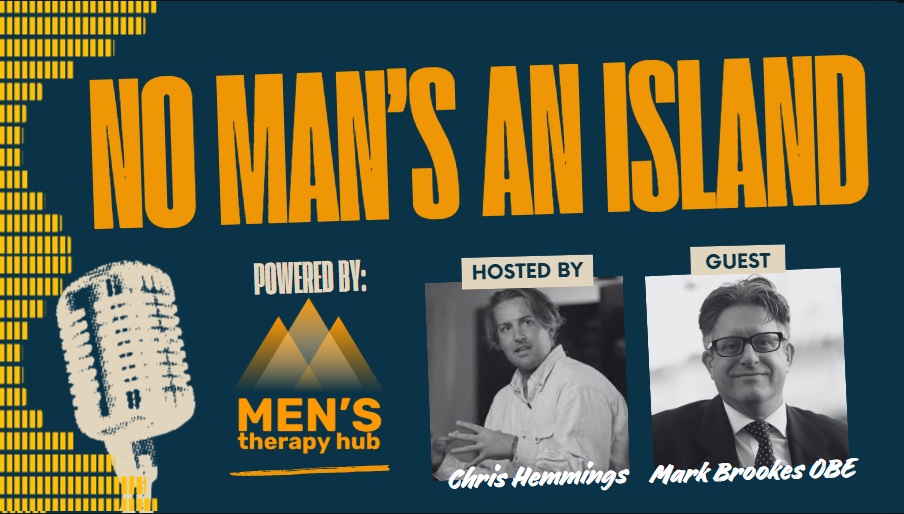
Launch week continues at Men’s Therapy Hub and our new podcast, No Man’s an Island. Chris Hemmings sits down with Mark Brooks OBE – chair of the Mankind Initiative, policy advisor to the All‑Party Parliamentary Group on Issues Affecting Men and Boys, co‑founder of the Men and Boys Coalition and National Ambassador for International Men’s Day. Mark has spent two decades pushing men’s health and inclusion into the mainstream and helping build practical services that meet men where they are. In this conversation we dig into how policy actually shifts, why language and evidence matter, and what works on the ground when engaging men. We cover domestic abuse against men, the men’s health strategy, boys’ education, the empathy gap and how to design services that feel like a fit rather than a fight. If you are building anything for men – or you are a man wondering where to start – there is a tonne here you can use today.
What we cover
- Mark’s route into men’s work – from local politics to national policy
- Moving men’s issues into the Overton window – normalising the conversation
- The All‑Party Parliamentary Group – why cross‑party support matters
- Men’s health strategy and suicide prevention – evidence first
- Domestic abuse against men – services, stigma and the empathy gap
- Boys’ education – culture, literacy and role modelling without clichés
- Designing for men – on men’s terms, turf and tongues
- Anonymous routes, consequence‑free first steps and action‑led support
- Collaboration across charities – why funding stability unlocks teamwork
- Practical calls to action for therapists, employers and community leaders
Listen and watch
- Watch on YouTube – embedded player goes here
- Listen on Apple Podcasts – link
- Listen on Spotify – link
Takeaways for men
- Start anonymous if you need to – consequence‑free first steps count
- Action helps – ask “what do I do next” and follow through
- If you face domestic abuse, you are not alone – there is specialist help
- Therapy should fit you – directive, practical and compassionate can coexist
- Progress is upstream and downstream – small moves add up
Quotes to share
“Helping men and boys is a good in itself.” – Mark Brooks
“We can think two thoughts at once – support women and girls and support men and boys.” – Mark Brooks
“Meet men on their terms, on their turf and in their tongues.” – Mark Brooks
“Men often see suicide as a life problem – the help must match that reality.” – Mark Brooks
Resources and links
Episode credits
Hosted by Chris Hemmings with guest Mark Brooks OBE. Produced by Men’s Therapy Hub. Recorded November 2025.
TRANSCRIPT:
Chris (00:00)
Welcome to No Man is an Island a podcast powered by men’s therapy hub
the UK’s first directory for male therapists, specifically who are looking to work with more male clients. And today we are going to be talking to Mark Brooks, OBE. Mark is the chair of the Mankind Initiative. He’s also a policy advisor to the All-Party Parliamentary Group on issues affecting men and boys. It’s a bit of a mouthful, but very important. And we’ll get to that.
He’s the co-founder and trustee of the Men and Boys Coalition and a National Ambassador for International Men’s Day, November 19th. He holds an OBE, as mentioned, and an honorary doctorate for his contribution to men’s health, inclusion and domestic abuse policy. recently, Mark was speaking to a colleague of mine, Will Adolfi, who you’ll hear from in a future episode, and he described me as an OG of men’s work in the UK. So if I’m an OG, Mark, I don’t know what we call you.
because you’ve been doing this since I was in journalistic nappies, so to speak. So welcome, Mark. Thanks for being here. And yeah, I guess the first question that I want to ask you is how long have you been doing this for and what drew you into this work in the first place?
Mark Brooks (01:09)
Well thank you Chris and that’s very kind and you know I’m a certain vintage as well so I’m not quite sure what an OG is. What is an OG?
Chris (01:18)
An OG is an original. original. Yeah. Yeah.
Mark Brooks (01:22)
⁓ all right. Well, that’s cool then. That’s good. you
if you said I was a goat, you know, greatest of all time or whatever, that’s as a doing sport. Well, no, no, it wouldn’t. It wouldn’t do. I would have been like suitably embarrassed and gone red. And also because it’s all, you know, we’re all part of a collective team on this. So I’ve been really ⁓ active in this field for 15 to 20 years now. And there’s a number of things that brought
Chris (01:30)
that would have been appropriate with it.
Mark Brooks (01:50)
brought me into it. I’m a working class guy, South East London, if you didn’t pick up the accent. one of the things was that I managed to get to university. I ended up getting into politics as well. I had a commercial and professional career as a marketing and comms director at two national charities. So a lot of my work in the men and boys field until recently has actually been voluntary.
So I’ve been doing most of this in my spare time and how my wife hasn’t actually divorced me is another conversation. So my journey is quite lengthy. So I tried to be a politician, I’ve stood for election a couple of times, not got elected, but I did used to be a local councillor. So an elected local councillor in Bexley where I live. And at the time I was
⁓ supporting a chap who was a victim of domestic abuse. was in a council flat with his two kids and his partner was ⁓ abusive towards him, physical coercive control for example and she had a caution for this but the council wouldn’t rehouse him ⁓ and his children because they didn’t understand a man could be a victim of domestic abuse and I’m talking 25 years ago.
Going forward, I then didn’t get elected. ⁓ I stood down from the council, but I didn’t get elected to parliament. And then I decided that I wanted to do some voluntary work in my spare time. I remember this case. I got involved in a mankind initiative who was already set up, became the chair of their board. Every charity has to have a board. And I took it from there. I started to see some other injustices. There was things in…
political party that was involved in at the time, which I felt were quite discriminatory against men. So they kind of lumped all men together and, you know, being a working class son of a van driver, you know, I’m like, I don’t see much privilege I have. But they were lumping me in with guys that had gone to Eaton and Arrow. And that kind of really irked me.
And then part of that, I then started to meet other people who were starting to work in the field. And this is a kind of early age as the internet and web. So a lot of people, a few people doing things, but we weren’t connected, but the web started to connect us. Met up with colleagues like Glenn Paul, who now runs Australian Men’s Health Forum, Ali Fogg, Duncan Craig, Ben High and a few of those people about.
15, 20 years ago and we kind of coalesced and think we’re all working on different issues that start to coalesce as a group and start working together as well as reaching out to kind of organisations that were starting to be set up or had been around, Fatherhood Institute, Families Need Fathers, Future Men, Men’s Sheds were just being set up around that time. So we kind of brought the constellation of different groups together and that’s how we’ve
move things on. We weren’t popular ⁓ politically because we were starting to ask questions, writing policy papers, writing campaigns on all of the issues, mental health, education, domestic abuse, etc. And we were almost kind of gate-crashing the gender politics and policy world, but in a very mature way because, you know, we
Chris (05:14)
Hmm. Hmph.
Mark Brooks (05:41)
I mean we’re all in our 50s now, a couple of maybe late 40s, but we were all in our 50s, so at the time we were early 40s, late 30s, but we knew, we were mature enough that we had to come across as not as men’s rights activists, we had to be producing real services and campaigns, and also making sure that we were vehemently not anti-women, we were pro-anti.
we were pro women and girls as much as we were pro men and boys. So, and that just comes with wisdom and experience. If we were 20 year old hotheads, we may come across a bit differently because we were immature, not because we didn’t want things for women and girls, but we’ve seen some university groups who have tried to set up men’s health organizations or groups within a university and they haven’t quite got.
Chris (06:16)
Hmm.
Mark Brooks (06:40)
positioning right but that’s due to immaturity and naivety rather than anything malevolent so we were just older and wiser and knew how to ⁓ manage reputation.
Chris (06:54)
Yeah, it’s interesting this idea that in order for men’s work to work and to gain traction, the messaging has to be extremely careful. And you’ve just touched upon it there. ⁓ when you talk about your own experience of growing up as the son of a van driver and being told, well, you’re a white man, so you’re privileged.
And of course the emotional pushback from that has to be, hey, fuck you. Like, you know, I am privileged, I’m privately educated. ⁓ but actually my biggest privilege is not financial, is, which I do have some financial privilege. My biggest privilege is that I grew up in an emotionally stable household. And for a lot of men, I think the Center for Social Justice report recently said that there is more 12 year olds with mobile phones than there are like stay at home, live in dads. And.
That is a big example of a lack of privilege for a young boy. And I guess for you through the work that you’ve done, how difficult has it been to be heard and to be seen and not to be seen as a counter narrative and not to be seen as the kind of the hashtag not all men brigade and not to be seen as somebody who is trying to undo the work of
Third and fourth wave feminism, let’s call it.
Mark Brooks (08:20)
Yeah, so, so, yeah, I mean, there’s a lot to unpack there. And I think, I think certainly ⁓ looking at, I was looking at data because I’m, I’m sorry, you know, I love data. I’m sitting there like, you know, data is, data is a storytelling device, in my opinion.
Chris (08:37)
Well, you’re the policy
guy, right? So I should hope so.
Mark Brooks (08:40)
Well, yeah, exactly. also the problem is that you start looking at data sets. I was looking at one about over 50 male unemployment. And I was spending hours looking at all different angles. And it was like, my god, am I the only one who gets excited by over 50 male unemployment figures in the northeast of England? Well, I mean, I do. So. ⁓
Chris (09:06)
Well I’m glad that you do Mark.
Mark Brooks (09:08)
Yeah, I do. It tells so many stories. But yeah, in terms of, and I really do like that point about the stable background being a particular privilege and so much of kind of privilege is driven by kind of class and place and race. Those three aspects more than it is driven by gender. So that’s always been an issue.
for me and you know I’ve always used the analogy of saying you know are people being really serious if they’re saying that a woman a young woman who went to Rodine and went to and a dad was a that was a stockbroker mother a barrister in Dulwich and I use it quite and in Dulwich is more privileged or is less privileged than a black British working class boy in
living in Peckham, going to a poor school ⁓ and on a council estate that’s got crime problems. But the narrative says that he’s more privileged than she is. you know, that just said that kind of jars. And so, so I mean, there’s different types of privileges and they happen at different times. you know, he may be more privileged in some settings than her. So it’s like everything’s like a Rubik’s Cube. I always describe things, everything, you know, intersectionality and
not just about protected characteristics but also including class and place is like a Rubik’s Cube and it depends where you’re at at that time. but there’s been this narrative, a political narrative with a small p, there’s been really, I call it a grand narrative and my friend Glenn Paul coined it and I think it encapsulates it. The narrative has tended to be that all women and girls have problems.
and all men and boys are problems and if men and boys do have problems it’s their fault and what the journey the lot of us have been on is that yeah women and girls have problems men and boys have problems as well many of them which are different and if we want women and girls to succeed men and boys need to succeed too
but helping men and boys is a good in itself. And one of the things that I’ve certainly started to see is that you do see a narrative about, yeah, yeah, we wanna help men and boys, but actually the underlying message is that the primary reason for helping men and boys is to help women and girls. It’s what I call othering. I’ve started, I do see that when actually…
Richard Reeves and you know I’m part of this new Centre for Policy Research on Men and Boys coined this really great phrase about we can think two thoughts at once. So the journey that myself and colleagues have been on is broadly about let’s keep a focus on women and girls but we need to broaden the focus so includes the challenges that men and boys face. But it has been difficult I mean I mean
I think the biggest difficulty around the domestic abuse sector and the work I’ve done there has often been just an ideological position that won’t accept that women can or has difficulty accepting women ⁓ commit domestic abuse against men. And, one of the groups I say is probably the most marginalised group in the domestic abuse sector is actually women in abusive relationships with other women.
because that is quite ⁓ difficult to deal with ideologically for so many in the domestic abuse sector. And I’ve been upfront about saying that, so I’m not telling tales. But I think what it’s led to is that it’s led to this, what I call an empathy gap. And what it means ⁓ in the issues that men and boys have had.
just not being seen or recognised and seen and recognised as an issue that needs to be dealt with even though the evidence is there. And this is the key thing that myself and my colleagues, including my colleagues I’m working with, you know, the new Centre for Policy Research, is everything has to be posited in almost an unemotional, evidence-based setting. So…
There’s an emotional input because it’s why you’re looking at the figures and you you’re looking at the injustices, you’re looking at people not doing well when they should be. So that drives you to look at the data, but actually you have to then look at the data very coldly and in an evidence-based setting. And ⁓ some of the findings we’ve found are interesting, Chris. So one of the things we did on the all party group,
and one of the reports we did is that we looked at boys education. And one of the things that we thought that the magic bullet around boys education, I mean, their relative underperformance as opposed to girls, was that we just need to get more male teachers in. But what we found, A, there wasn’t any evidence that male teachers were better at teaching boys than female teachers. But what we did find was that there’s a whole
cultural issues about boys not being pushed enough at school, not being made very clear what the point of learning is, lack of parental engagement, their sense of unfairness, not being celebrated enough and also more nuts and bolts issues about literacy, their literacy not being good enough, not enough malteachers to be seen, malteachers.
act as role models even if they’re not consciously doing it because boys see male teachers thinking well learning is something boys do. So that’s why evidence is important because we thought male teachers was the magic bullet and it isn’t. It’s part of the solution but isn’t. So the way we’ve counted it is being evidence-based has been very inclusive.
Chris (15:35)
Right.
Mark Brooks (15:53)
So all the organisations we’ve set up and campaigns have all had and still do have lots and lots of women involved, ⁓ including incredible women. So we’ve got academics, we’ve got lead researchers, et cetera. ⁓ And so that’s really helped normalise it to be really 360 in a language.
bringing women into the tent and using evidence base and just being bloody minded in the just keeping on going stoical keeping on going because it can be can be hard and we’ve seen some you know recent victories you know got men’s health strategy which will come out the end of ⁓ the end of ⁓ this year and you’ll be pleased to know that one of the arse that
Chris (16:29)
Hmm.
Yeah.
Mark Brooks (16:49)
myself and others been pushing is to increase the number of male psychologists. So, you know, we keep, we keep went straight to the Secretary State and we’ve given, I gave evidence to a parliamentary group in July that was looking at what the, was a suicide prevention groups, there’s a few of them in parliament and they had a few of us talking. And one of the things I said, we need proactive.
campaigns within schools and colleges and universities to get boys and young men to take psychology degrees, to get them into counseling, psychotherapy, psychology, because four in five psychologists are female. Men need, we need more men in the field, but also it’s a great job. So we need more men doing great jobs. And, you know, we’re missing out on loads of
Chris (17:41)
So yes. Yeah.
Mark Brooks (17:47)
talent and I suspect a lot of boys, young men think about careers, it’s just not even told psychology is an option. So we’ve been promoting that, but we’ve been able to promote that because we’ve said to the Department for Health, here’s some evidence, know, too many young men are unemployed, about 230,000 young men are unemployed at the moment. ⁓ And it’s like, we need to get them into work and meaningful careers. So as you would have seen,
Chris, I talk a lot. But hopefully that was okay. Hopefully it was alright, bit of a tour de force but I’m pretty passionate about this stuff.
Chris (18:19)
Hehe.
Absolutely. It’s really, no, no, it’s, it’s, it’s the beauty
of a podcast where we have more time to let things breathe. and also I’m a therapist, so I’m trained not to interrupt people. it’s, it’s, it’s interesting though. So one of the things you talked about there was very recently, ⁓ the labor government has engaged with a men’s health strategy. One of the things, cause I was a BBC journalist for
10 years or so before I retrained as a therapist. One of the things that always stuck out for me when I was focusing on men’s, what I described it as was I focused on issues that affect men and that men affect. And most often when I was speaking to politicians in, when I was speaking to politicians who showed an interest in this area, they were almost always conservative politicians, so more right-wing politicians. And
Barack Obama mentioned this recently that actually the Democrats in the US have done a disservice to men and boys. It doesn’t surprise me actually that left leaning parties are hemorrhaging men in terms of supporters. What do you see? Because you’ve come from political party and you’re now involved in the APPG within parliament. What have you seen in terms of what’s changed from the left?
where they’ve suddenly gone because I was having a conversation with a friend just earlier today about how being progressive, if you are progressive, it seems you are progressive in nature towards everybody except white men. You accept and understand that everybody needs tailored, bespoke, ⁓ direct support and access to services that are made for them. And yet when you mentioned that maybe
some straight white guys need help. It’s met with eye rolls or has been met with eye rolls. And to me, it’s not being as progressive as they think they are. And only very recently in the last 12 months or so has that message started to trickle through to the left and they’ve started to go, shit, maybe this is something we need to look at.
Mark Brooks (20:41)
Absolutely. I’m just making some notes. So shall I just talk at you for another five, ten minutes as long as listeners and viewers don’t turn off. Well, yeah. Well, well, well. Yeah. So you’ll see your viewing figures drop off after I got he’s on another talk. Right. So so I’m going to I’m going to start on the political journey. So what what has happened in
Chris (20:46)
Please.
I can edit you later Mark, it’s fine.
Mark Brooks (21:10)
in the last six, seven years is, and we’re on stage two of this now. So stage one, and it was quite deliberate for a lot of us, was that we wanted to mainstream politically men and boys issues as a field, a distinct field of acceptable public policy. And there’s something called the Overton window. Now that has kind of political science to
But basically it means that subjects which were once taboo or ⁓ off-grid or unacceptable become politically acceptable when they move within this Overton window. The reason it’s called Overton window is because of a political scientist who was called Overton.
any kind of phrase and so what we wanted to do was like move men and boys issues into the Overton window ⁓ and there was two or three ways we did that first of all was that brought the piece I spoke about previously about who and who and how we were talking about those issues secondly picking on issues that you can’t argue about men’s health suicide suicide
boys under achievement and also bringing in that concept about that we need to focus on not the problems that men and boys cause, that some cause, but the problems that some men and boys have ⁓ and that we wanted to move the whole subject into that field. So I worked with number of colleagues. Yeah, the shifty Overton window. yeah, the shifty Overton window. And so,
Chris (22:53)
to shift the Overton window on it. Yeah.
Mark Brooks (23:02)
We mainstream things like International Men’s Day, which is huge now in the UK. We also were launching really positive campaigns. The Men’s Health Strategy campaign is a 10 to 15 year old campaign that we’ve got over the line, but that’s been a long campaign. And so one of the things we did is that we sell up a number of us. ⁓ chap called Mike Bell, sell it up, got me involved as a policy advisor.
brought in other groups is that we set up this all-party parliamentary group which is for those who don’t know is a interest groups within parliament made up of MPs and ⁓ peers in the Lords from all parties so they’re informal but there’s rules and regs around them ⁓ and we set up this all-party parliamentary group because some MPs mainly Tory at the time
were interested in the subject matter. And what we did was that we then held hearings, almost like a select committee, where we basically picked some topics, we got experts in, we wrote a report, published a report, then held some parliamentary debates on the report, did some media around it. And as the last parliament, to 24,
went on, we were starting to be mainstreaming issues. So we did a couple on boys, one on education, one on what it was like to be a boy, and then two health related, one on the men’s health strategy, one on male suicide. And we infused things about we need a minister and government. so we normalized in parliament those subjects. We had an annual International Men’s Day debate.
So parliamentarians got used to speaking about men and boys and so many of them Chris had fallen for what I call a folk devil syndrome. What I mean by that, they’re scared of things that don’t exist. So they were scared and lot of MPs and civil servants and others, ministers are scared of talking about men and boys issues because they think that they will get some massive backlash.
And then when they start talking about them in a very positive, proactive, inclusive way, lo and behold, they find there isn’t a backlash. So they’re scared of…
Chris (25:39)
When you’re making,
when you’re making good points, evidence-based points, right.
Mark Brooks (25:43)
Yes, absolutely.
And a positive tone, inclusive tone, lots of women involved in the debates, etc. Suddenly they’re all thinking, my God, know, like if I talk about boys education, there’ll be a massive backlash. And then they look around and there isn’t one, especially a line I use is that no one fights harder for sons than mums. And so, so, you know, suddenly they’re finding there’s no, there’s no real backlash against this.
And so what we did in the last parliament, we normalised and mainstreamed the political discussion. Other things were happening. Richard Reeves’ book of Boys and Men, his superb book really helped to normalise the conversation around that as well. And also the last government were then starting to look at a men’s health strategy. But obviously, you know, general election happened. A number of factors in the UK parliament have happened since then.
is that, mean, first of all, the left generally have recognised that they’ve missed the trick in not including men and boys as a disadvantage group in certain areas. Basically, the view was that men and boys had all the advantages, there was no disadvantages. And so what we’ve seen is a recognition of the men and boys and women and girls that support them.
were turning away from them because they were seeing all the groups that they did support and men and boys weren’t on it. The clearest example is the presidential election in obviously ⁓ in America last year where the Democrats, and they admit they made a mistake, have spoke to quite a lot ⁓ and I know there’s been lots of debates in America on it, had a list of all the groups they were going to support. Men and boys wasn’t one of those.
And although men and boys will have been wrapped up in terms of men of colour, veterans and stuff, but men and boys explicitly weren’t included. And yeah, exactly. And so what then Trump did, you know, was exploit that. Didn’t offer any policy solutions, but just said, we see you and we know there’s a problem and we know the left are ignoring you. So, so that really helped them get over the line. And so Trump got about 50
Chris (27:40)
And it’s only 50 % of the electorate.
Mark Brooks (28:00)
54 % of the male vote. And it’s interesting about the discussion around who votes that way because he got 54 % of the male vote, but people still forget. So it’s like, oh, the, you know, men got him over the line and everything. And I’m like, but 46 % of men still voted Democrat. It’s not like 60, 40. And the same, you know, mean, Trump got about 44 % of the female vote as well.
So again, it’s not like just men vote for Trump and women voted for Kamala Harris. It just doesn’t work like that. again, some of the narrative around it. So fast forward. So in this parliament, more Labour MPs and Liberal Democrats and still Conservatives are more involved. Some of that is just a numbers game. What I mean by that is that there’s far more Labour MPs now and far fewer Tories because
Sometimes that can be forgotten. There were far more Tories who in the last part.
Chris (29:05)
Sure, but from my reckoning, was zero Labour MPs heavily involved initially. If we’re talking five years ago, was all… Lib Dem and Tory, maybe.
Mark Brooks (29:06)
Have good
Yeah, exactly. we brought
them on because it was an all party group. So you can’t function as an all party group unless you’ve got Labour and Liberals and Greens and we had other parties involved as well. It’s not legally a PPG if you just fill a Tories. But what we have seen is that we’ve seen this change and
Some of it’s political because a lot of these new Labour MPs have seen, you know, seen men in distress in their constituencies, especially in those in what’s termed, I don’t quite, you know, left behind or economically disadvantaged areas, but coastal towns, northern towns, pockets in other areas as well. And secondly, the generational shift because, and this is why I spoke a lot about
because a lot of the MPs up until 24 of all parties were kind of elected around 2010, 15 and before and they were of certain vintage that broadly, very broadly, they were Generation X, like people like me, 50s, late 40s upwards, know, aged now. And so they had a certain worldview, very traditionalist worldview, quite a black and white worldview.
Whereas now ⁓ the new cohort of MPs of all sides are millennial MPs and they have a different outlook that they’re far more ⁓ invested in diversity and equality and inclusion and not all of course, they see it as a 360 degree Rubik’s cube type issue. So
They’re still very much vested in women and girls have a range of disadvantages, you know, and, you know, never argue against that. But they’re far more open-eyed and broad-minded about the issues that men and boys face. And the new issue that’s been really chucked into the political melting pot is around fatherhood, importance of fathers, paternity pay, parental leave. So even the last parliament, that wasn’t discussed.
But that is very much a live issue in this parliament. And again, we’ve got women and male ⁓ and female MPs interested in this because of devolution. We’re seeing lots of interest from regional mayors, West Yorkshire, the York and North York’s mayor, David Scaife, Andy Burnham in Greater Manchester, taking real interest policy-wise in men and boys issues. So we have seen this.
change. My last point, a great example of this is that we’re entering party conference season. The Centre for Policy Research, we decided that we would have fringe meetings and party conferences. So if you haven’t, if you’re not a political geek nerd like me, these are basically, you’ve got the main conference and then there’s kind of side debates, almost like breakout sessions, but they’re
and they’re part of the conference but they’re not sponsored by the parties, sponsored by and organised by organisations. So we are at the Lib Dems, Labour and the Conservative conferences. Our debate is what’s happening to men and boys. We ⁓ have got all three of them jam-packed with MPs speaking. All three, Labour, Liberal and the Conservative. ⁓ I’ve got
four at the Liberal Democrats plus two other experts. I’ve got four at Labour with two other experts and I’ve got ⁓ three, ⁓ two MPs and a police and crime commissioner at the Conservative one. And you know, that shows you the political movement because I would expect that if I had held ones at Labour in the Liberal Conference, not I in the organisation.
five years ago, we would not have got people interested.
Chris (33:38)
or not MPs, you would have been asking people like me or other men to come and speak who do the work, but not the people in positions to actually make the change. And I’m going to ask a very therapist question now, because my interest here is from a personal perspective, you’ve been working at this for 15, 20 years, right? You’ve been doing this for heck of a long time. And I remember when I was a journalist speaking to you,
Mark Brooks (33:59)
Yeah, yeah, 20 years, yeah, I’d say.
Chris (34:06)
way back when and getting you on and, it wasn’t a particular popular conversation back then. How is it for you now to, to say what you’ve just said, which is we’re now going to three party conferences and suddenly this thing that you’ve been trying to batter the door down off for decades. Suddenly there’s been a shift and I don’t, I don’t want to mention adolescence. ⁓ but like in the past eight months, even
I have noticed that there has been a, like a consciousness, collective consciousness shift. And what’s that like for you as somebody who has cared for so long about this? Do you ever take a moment to sit back and go, fuck, I did good.
Mark Brooks (34:51)
Yeah, I mean, yeah, ⁓
bit but yeah I’ve never really thought about that a bit I mean sometimes I’ll have a nice scotch and I’ll sit there and think yeah that’s great you know done some great work so yeah I’m pleased with the programme I mean I’ve been given a few bauble and things which you mentioned so you know it’s nice to be recognized from that perspective and you know but my you know the domestic abuse charity man
still going great guns and you know I mean what’s pleasing is about seeing more and more people coming in and running campaigns and you know because I’m know mid-50s now and I think there will come a time where I will think well I’ve done my bit ⁓ and I think a few of and said a few of us are all the same vintage and I think for me ⁓ it’s been positive and I know that myself and my colleagues have made a difference.
but there’s still loads of work to do. And I still get really aerated about various things. so for me, it’s nice that we’re on a journey, but the journey’s not complete. ⁓ And so I’m still, know, the fire hasn’t gone out. I mean, one of my favourite bands has just got a new album out, it’s out today. But I’ll call you Swade.
which were my favorite of the bands, they’ve got a new album out. basically, yeah, yeah, yeah, well, they came out around Brut, but that’s a discussion for another day. But, ⁓ they’re really not, I mean, if you listen to the Swade album, then their Oasis album, then completely, yeah. Anyway, and the thing is, because they’re a little bit older than me, but it’s sort of like, it’s a great new record.
Chris (36:27)
classic Britpop man, Swade.
Mark Brooks (36:52)
really full of kind of fire and brimstone and whatever and I’m kind of like thinking yeah the fire hasn’t gone out yet you know I probably I probably better manage myself so from so what one of the things I’ve learned you know and you’ve listened to psychologists like yours and therapists and others is about self-management and my great friend who I mentioned Duncan Craig who who’s the chief executive we are survivors
has always said, you you’re no good to anyone if you’re burnt out. And I think there were times when I was probably burnt out, but just kept on going. And, you know, when you just get older. And I think the pandemic really helped with a lot of men sort of like thinking about like where they’re at and actually really, I don’t know if you’ve seen that, but.
men sort of realised they need to self-manage themselves a bit more. So my self-management was broadly, I was like working till one, two o’clock on policy papers and emails. So now I switch the computer off at 11, if not earlier. So, so, and then of course, because I was a, Marcom’s director at national charities, I was then still sort of, you know, ⁓ a pressurised work, you know, senior position.
Chris (38:02)
Yeah.
Mark Brooks (38:15)
managing whole teams of people and all sorts of campaigns outside of this sort of thing. So I’ve kind of learnt to manage myself far better and that comes with age and wisdom really. But yeah, I’m really pleased but it’s still all two steps forward, one step back the whole time because we still haven’t got ⁓ boys education ⁓ as a issue that needs to be addressed. ⁓
And this September, there’ll be about 30,000 fewer 18-year-old British-based boys going to university than girls of the same age. University isn’t everything, but there’s no reason why there should be that gap. And a lot of the things I’m thinking about as well is around some of the political narrative shift.
because there still are issues. And if I can give you a good example, Chris, if I’m not cantering away, is that there was a great report published by the Department for Education in July about student suicide. And that’s why I’m raising it, because it’s obviously within your kind of field. And it did a whole lot of research on…
the methods and the causes and importantly the interactions that students had ⁓ before they took their own life. ⁓ But the shocker, and it is a shocker and I’m really still like, I’m angry about it, was that ⁓ it did not, at the beginning it mentioned it kind of like there are more male student suicides. ⁓
but the female student suicide rate has been going up and that has to be a cause of concern. And I’m like, well, yeah, but isn’t the fact that more male students are dying by suicide a real concern too? And then they had in the opening section, they had a list of student characteristics of the suicides they looked at, about 200. Well, 200 in overall, but 120 in depth. And they did not list…
how many and the percentage of those student suicides that they looked at in T2 120 were male. How can you not do that? They talked about race, they talked about class, they talked about types of university, they talked about X, Y and Z. And it’s only when you get to page 22, page 22, it suddenly mentions almost in passing that 71 % of the student suicides in the cohort they looked at were male.
and that is then the only and then they never mention it again. That is shocking. That is outrageous. And this was done by a DFE. But importantly, it was done with some professors who oversaw this and it was done with a number of other kind of researchers. And I cannot get my head round how they could not have even referenced that until page 22. I find it shocking.
Chris (41:30)
Yeah.
Mark Brooks (41:34)
and ends, that still fuels the fire. That fuels the fire when I see that. fuels the fire. It’s outrageous. Yeah.
Chris (41:39)
I was just going to say it. I can hear the frustration in your voice and clearly that fires you up. And that
leads me to the next question because part of your, the major part of your work has been around domestic violence. And if and when we speak about domestic violence, even now in my mind, I see male violence against women, right? If you hear domestic violence, that’s what we assume because that is
that has been the narrative and yes, the majority of domestic violence is male and female. However, 40 % of victims of domestic abuse are male. And I know that what can happen and it’s the same when we talk about violence. I’ve sat on many panels when the conversation has come up around violence against women and girls. And I often make the point that
The vast majority of people who experience violence, just general violence, are male. We’re not talking domestic violence here. Out on the street, violence between peer groups. Most violence and violent crimes are male or male crimes. And then what can happen is the rebuttal to that is, yeah, but that’s men who are carrying it out. And to me, that’s victim blaming, which is specifically one of the issues that we’re trying not to do to victims is blame them.
So just because I’m male and I happen to have been battered and beaten up by a guy, it’s what? It’s my fault because I’m the same gender, sex as him. Like that seems to be completely unfair. And with your work, I presume that you still get the eye rolls. I presume that you still get the pushback when you dare to talk about domestic violence in terms of
men as victims as well as perpetrators.
Mark Brooks (43:38)
I do, but it’s occasional now. So I think 15, 20 years ago it was most common and also it’s most common for the men themselves. So if you like, 10 plus years ago, men when they turned up to police stations or if they contacted the council or the council services or the NHS or wherever.
they would get the eye roll or they would not be taken seriously and that was the feedback we were getting from our helpline so our helpline takes about two and a half thousand calls a year so you know the team and the team are great nearly all women actually who answer the calls and but that’s primarily because only women apply for the jobs it’s not which is yeah yeah which is a whole nother nother
Chris (44:29)
We can get on to that.
Mark Brooks (44:32)
They’re all wonderful women. ⁓ So I still get the eye roll, but very rarely. ⁓ And even though, again, the charity and the work and the people involved in it is more female victims or whatever. So we still do get the eye roll. But occasionally, we still get excluded from conversations around domestic abuse.
and some of the things I see I’m like that’s just quite clearly ⁓
play to minimise male victims including obviously gay male victims as well, know, elderly male victims, domestic men of colour, all of ⁓ that and obviously boys as well. So the one I often use is that if you’re not supporting a dad who’s a victim of domestic abuse,
you know, what’s your position on the fact that he’s got two daughters? And that’s been, you so, you know, sometimes you use arguments like that, but the eye rolls ⁓ are less. It’s not helped by the fact that, you know, the government, so it’s not this government, previous, it’s been a 15 year plus issue where if you’re a male victim of domestic abuse or sexual abuse, ⁓ stalking,
forced marriage, you are described and classed by governments as being a victim of violence against a woman or girl and that’s kind of misgendering on an industrial scale. mean the last O &S figures, we always use O &S figures because you can’t argue against O &S figures. So last year there’s about two million men who were victims of sexual abuse or domestic abuse, stalking etc. ⁓
But they’re all classed as being a victim of violence against a woman or a girl, which is like, you know, I’ve said this to ministers, I said, this is Orwellian, because like a man is not a woman and a sexually abused boy is not a victim, is not a girl. And so what our argument, again, is being smart, but also being inclusive in saying, look, let’s keep the violence against women and girls strategy and… ⁓
focus on that but let’s take men and boys out of that and let’s have our own parallel strategy and whatever so again ⁓ if you were if you were looking at it ⁓
from a politically unwise position, you would argue for a gender neutral strategy around domestic abuse, sexual violence and whatever. But actually, in reality, wouldn’t serve anybody because it wouldn’t take into account the nuances around sex, gender. But also politically, wouldn’t rightly, you would never get the women and girls sector. So we need to not have a…
a women and girls in the violence against women and girls strategy, nor should you want to. So again, being wise about this, but the eye rolls occasionally, but it’s occasional now. And it’s more mainly down to certain individuals rather than a collective eye roll. And what I used to get was a collective eye roll. Things are moving on. It’s good. It’s good.
Chris (47:58)
Hmm.
Right.
Yeah. And the launch of so many different organizations right now, there’s been a boom, know, Men’s Therapy Hub is an example. There’s been a boom in the past two years, three years of men’s organizations run by men, for men, and that’s fantastic. And as an OG, I’m wondering what your advice would be because there are…
Mark Brooks (48:15)
No.
Chris (48:35)
And I know from anecdotal evidence and also from speaking, you know, a lot of men through men’s therapy hub and starting up this, this platform, but there are a lot of men out there now in the therapeutic sphere who want to engage more men. There are a lot of organizations like yourselves, Andy’s Man Club, James’s Place, who are trying to understand men better. And the challenge for you as an organization is.
How do you get your own phones ringing? Right? So how do we as an organization get men onto our directory? How do James’s place get the men who are at risk of suicide through their doors? And I think for a long time, the messaging has been about men. And I think the messaging is shifting now as being to men. And what would your advice be?
to me, partly I’m asking for myself, to me and our organisation, but to all the organisations out there about what can we do to better engage men? Because like you said, for mankind initiative, most of the people on your phones are female. Most therapists are female. Most doctors now are female. And a lot of the kind of care and health settings and education settings, most teachers are female. How can we actually better engage men in
helping to deliver services for men and boys better in the future.
Mark Brooks (50:08)
Yeah, thank you. know, that’s something I’ve been thinking about for a while and also, you know, pulling that into practice. And as said, my professional is a marketing and comms and branding and reputation. So I look at things from that lens because, you know, it’s my professional background. You know, I used to be run the press office of premium bonds some years ago. you know, yeah.
Chris (50:34)
Okay,
rich and varied career mark.
Mark Brooks (50:38)
Yeah, yeah, yeah, yeah, yeah, yeah, yeah, yeah, yeah, yeah, yeah, yeah, yeah, yeah, yeah, yeah, yeah, yeah, yeah, yeah, yeah, yeah, yeah, yeah, yeah, yeah,
Chris (50:51)
Well, as a therapist, would say, is anybody normal? What is normal?
Mark Brooks (50:53)
well yeah well well
yeah yeah eccentric or whatever i quite like that someone called me that the other day and i that’s quite cool and yeah it ⁓ but anyway so i i got this model and it’s partly based on you know where men men are out meeting where men are out which has come from elsewhere but i’d i’d had a similar thing is about how men are
Chris (51:00)
Yeah, I’ll take that.
Mark Brooks (51:19)
And basically, and what I mean by how men are, it’s like meeting men on their terms, on their turf and in their tongues. And what I mean by that is that on men’s terms, don’t try and change men. Don’t say masculinity is a problem. Accept how men are, that they have these, I mean, broad traits of wanting to be of service.
they want to be success, they want some level of respect, they want a sense of belonging and family and want to be needed. ⁓ And just accept men how they are. Also accept the fact that ⁓ in terms of ⁓ how a lot of men firstly, want consequent free conversations or information and I use that word a lot. So that’s why
anonymous helplines and websites are absolutely vital. Also, looking at strength-based positive messaging and talking about life experience-based and positive men’s health as being a mental health and the need for therapy about dealing with life problems, not mental health or clinical health problems.
Because one of the work that we did on the suicide report, which is still used a lot actually, it was a really important piece of work that we did, was that men see suicide as a life problem, not a clinical or mental health problem. I mean, they see it as problems within their life they can’t solve, and they see suicide as a rational answer.
or suicide ideation is a rational answer to deal with those problems because they’ve tried and haven’t fixed them. And that was a real eye-opener for us, but also for a lot in the health sector, because they’ve all seen it as mental health, clinical health issue. Now, an outcome of that is obviously all of that, but men don’t frame it like that. know, so respect basically on men’s terms, don’t try and change men, on men’s turf, where they go.
⁓ And so that is online, community groups online, and then more traditional things around sports, barbers, ⁓ et cetera. And then of course, the second, third area in men’s tongues, men speak shoulder to shoulder, wouldn’t be anonymity, consequence-free ⁓ conversations, ⁓ and they wouldn’t want to know that they’re not going to be judged.
badly because they’re If you’ve got those three things in play and you express them, the men will come. So I’ve seen some great adverts and I’m to do some more research and thinking on it in the next year, you know, rather than saying, see some great from Andy Mann’s clubs and others, you know, have you had a crap day? You know, ⁓ if so, call us. ⁓
Or basically you get other guys saying, you know, like Dave, I’ve got a good line, you know, like it’s basically, you know, Dave from Durham or, know, Dave from Darlington say, Dave from Darlington called our help, called us anonymously. And he said he had X, Y and Z and we were able to support him on A, B and C. Cause the other thing is, but it’s guys need.
action. So as I said, meet men how men are and so this is basically said on men’s terms. They want action. They want to speak to you and they want to be told what do they do next. You know, they want action. So a lot of men will say, okay, right, so what do I do? Tell me what I need to do. And that’s what they want. And you know, they’re not there, a lot of a guy, they might want to get things off their chest.
but they want people to help them fix stuff. It’s just the way guys are wired. Generally speaking, know, what’s it about like women like people and feelings men wouldn’t like tools and things to do. Generally speaking, mean, I don’t, mean, you’re the expert on that Chris. So it’s basically on men’s terms, on men’s turf and in men’s tongues and basically ⁓ be pro male.
Chris (55:53)
It’s interesting.
Mark Brooks (56:08)
where for men, where here to help, all of that, be very pro men. Cause I’ve seen some mental health organisations do posters where it’s basically, we’ve got this new mental health clinic, et cetera. A is only open nine to five, which isn’t a help. But also with posters of women. And I had one say, come to me, saying, you know, why aren’t we getting any men? I said, well, send me your comms. And I went X, Y, and Z.
Chris (56:33)
Right.
Mark Brooks (56:34)
website and to be fair this was what see this is a lot of people don’t know what they don’t know and they were basically saying Christ you know we just hadn’t thought about that you’re completely right and they revamped all of the stuff and then within a year they were getting you know still a trickle but it was they had none and they would get more men coming forward so that how men are accept how men are and leverage off of that
Chris (56:59)
It’s something that I have been thinking about in terms of there’s been a lot written about how in the medical profession, women were treated as if they were just differently shaped men. So there wasn’t a lot of research done onto women’s bodies and how medicines would interact with the female body. And the way that I am recognizing it now is that health and psychological services
particularly in psychology, know, Freud and Rogers and all of them were a load of white men who created psychological frameworks and theories based around women’s psychology because quote, men didn’t have problems. And so what has happened is over time, we’ve just kind of normalized that psychological help is for women. And maybe the belief structure is, well, men are just
⁓ psychologically the same as women, but with different shape bodies. ⁓ it is very clearly not the case. And what is being proven in the work that we’re doing and the conversations that we’re having is within our, within our training, almost all of us were told don’t self-disclosed, don’t be directive. And during my training, I challenged that because I think.
The number one thing that helps when we used to go into, when I used to go to schools and when empath goes into schools and when organization is going to schools is when we stand in front of young lads and self-disclose and say, Hey, we fucked up in the past. We’ve messed up. We’ve made mistakes that gets the lads on board. And like you say, men want action. So my clients, it’s very clear come. And when I say, I’m going to call you on your bullshit.
I’m going to be direct. I’m going to be challenging. I’m going to be encouraging. I’m going to be also empathetic and compassionate. hope too. A lot of men, not all of course, but a lot of men go, ⁓ that feels different because a lot of the pushback that men have to traditional therapy is it just felt like an arm around the shoulder, which felt nice for a time, but then what? And so with the men that call into mankind initiative, I presume that action plans are
vital for them. That is what they’re calling for.
Mark Brooks (59:25)
Yeah, so it’s that kind of process and also you see that with other anonymous groups but also you see that with Annie Mann’s clubs and Men’s Sheds, whatever, that often it’s a springboard elsewhere. mean, you know, the great thing is that those sorts of organisations and, you know, we’re trying to get some research funding to look at them is that they’re a gateway into people like yourself, basically, aren’t they? They’re a gateway into… ⁓
professional settings. So men turn up to these things because they’re worried about X, Y and Z and then, you know, they should be then gate-wayed into, well, you might want to speak to the men’s therapy hub if you need more professional support and that’s how it should be. So with things like Mankind Initiative, mean, basically what we do is a triage system. It’s a listening and triage system.
guys ring us up, they want validation that they actually are a victim of domestic abuse. So they will run through what’s happening and the team will say, yes, you are a victim of domestic abuse, et cetera. And then we, so we provide a listening service and then, and then the, then we basically give them some basic information and then we signpost them. So we will then signpost them, right, you need to go to the police. This is what you need to do.
take to the police, you might want to get some legal help, here’s a list of solicitors that said they would support male victims. If you want some psychological help, we’ll refer them to psychologists, obviously now your therapy hub, we will signpost them on and that’s the end of our… Yeah, well, great, exactly. then the thing is what we will then do, but then we will end the relationship there.
Chris (1:01:11)
And we’re grateful for the referrals already, Mark. Very grateful.
Mark Brooks (1:01:21)
What I mean by that is that we don’t hold them as clients. We don’t take their names. Some obviously might ring up and say, I’m Tom from Taunton or wherever, but they venture that. We don’t ask their names. It’s anonymous. We don’t take any contact details. We don’t contact them back. But that’s why men ring. So 60 % of the men, we survey them when they call, we have like a script and get some demographic information and whatever as well.
But 60 bits, so three in five of the guys who called us would not have called us if we weren’t an anonymous helpline.
And, you know, again, I come back to that point, my framing is about, you know, how men, in men’s tongues, accepting sort of like on men’s terms, they will want to, those sorts of issues, a lot of men will want ⁓ to ⁓ talk anonymously. And that’s why websites are so important. Honestly, I talked to employers, I said,
Even if you’ve got an intranet and it lists organisations that help men, don’t underestimate how important websites, web, websites, there’s obviously communities and more on the social side of Facebook, but websites are absolutely important. Get your search terms right, get your homepage right, it’s actually so important, unbelievably important.
Chris (1:02:52)
Because one of the things that is very clear is how quickly you can lose a man from the ecosystem that you and others are trying to create for them. One misstep, I always use this term with schools, is that the young lads, they’re constantly looking for an off ramp. They want any excuse not to engage. They want any excuse to say, yeah, to confirm my bias that this is not for me, that I am going to be judged, as you said, that it’s not going to be confidential.
that something here is going to feel bad for me. And we have to try as much as possible to remove any barriers to access. And you’ve been doing a great job of that. There are amazing organizations out there. I am just going to say if you are somebody who has experienced, if you’re a man who’s experienced domestic violence, the helpline for mankind initiative is 01823334244.
⁓ 01823334244. Please do call. are people who want to help you. If you’re looking for a professional therapist, you can try our website, menstherapyhub.co.uk. The number one thing is you have to use, and I talk about this a lot, Mark, we hear masculinity derided so much and yet it takes incredible courage and strength of character to reach out and ask for help.
my wife will still ask me, why didn’t you ask for help? And I’m like, because I was a man way before I was a therapist and it’s still so hard to ask for help. And so we understand how hard that is, but there are people who are ready and willing to hear that. So thank you, Mark. ⁓ The reason that I got Mark on is not just because he’s awesome, as you’ve heard, because we have, Men’s Therapy Hub has partnered with Mankind Initiative and we’re going to be donating.
10 % of the subscriptions from the site to our four mental health charities, which are Mankind Initiative, Andy’s Man Club, Men’s Minds Matter, and James’ Place, all four brilliant organizations who are doing the work at the Colface. And it’s a privilege to be conjoined with you like that, Mark, and to hear about the work that you’re doing. And I really do hope that you keep having the success that you’re having because…
me and many others are standing on your shoulders from the work that you’ve done for years before us. So thank you so much and it’s been a privilege to have you on.
Mark Brooks (1:05:26)
Thank you very much Chris and I would just say it’s a team game. So, know, myself and number of people working on this some years ago, but it’s people like you Chris and Will and all of those other people who are all part of this wider team and taking this forward. So it’s a team game, my friend, a team game.
Chris (1:05:46)
Thank
you. I’m working on taking compliments better. So thank you, Mark.