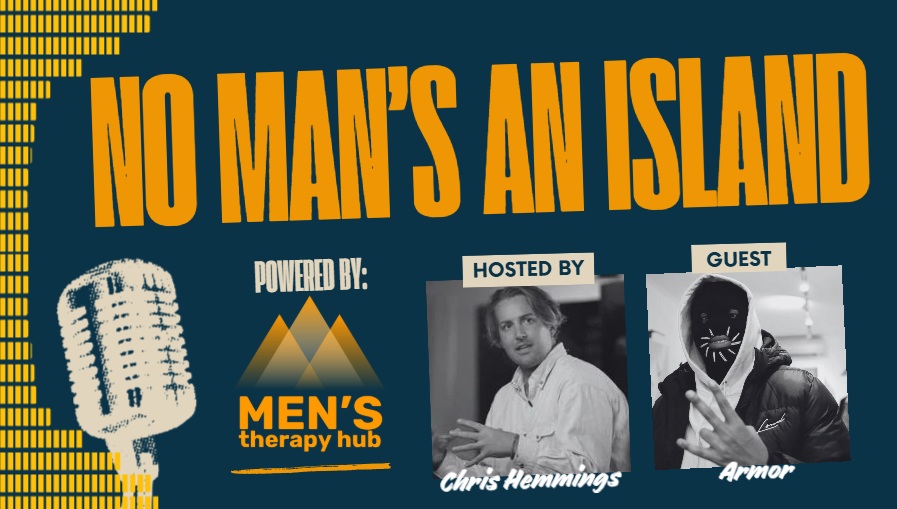
In this episode of No Man’s an Island, Chris Hemmings speaks with East London rapper Armor, an artist whose music and life story are deeply shaped by trauma, prison and long-standing struggles with mental health.
Armor’s musical journey began while serving time in prison for GBH, but his story starts much earlier. Growing up in East London, he experienced domestic violence at home, emotional shutdown, early exposure to drugs and a search for belonging that eventually led him into street life. Alongside this, Armor has lived with anxiety and depression from a young age and speaks openly in the episode about suspected autistic traits that shaped how he related to others and to himself.
In this conversation, Armor reflects on how fast money, peer validation and distorted ideas of manhood can feel irresistible when other forms of stability and guidance are missing. He explains how prison became an unexpected turning point, giving him the space to reconnect with music, develop self-awareness and begin telling the truth about mental health through his art.
Chris and Armor explore the emotional cost of “hood anxiety”, substance use as a coping strategy rather than recklessness and the long process of rebuilding identity, purpose and self-worth. This episode is an honest account of how vulnerability, creativity and accountability can coexist with strength and ambition.
What we cover
- Growing up with domestic violence and emotional instability
- Fatherlessness, male role models and street-based masculinity
- Why fast money and crime can feel like survival rather than choice
- Anxiety, depression and suspected autistic traits
- Substance use as a way of numbing pain and fear
- Prison as a moment of forced reflection and reset
- Discovering music as a vehicle for expression and empathy
- The psychological reality behind “hood anxiety”
- Rebuilding identity after prison and trauma
- Fatherhood, responsibility and redefining success
Listen and watch
- Listen to all episodes here: No Man’s an Island
- Watch on YouTube: No Man’s an Island – Episode 20
- Listen on Apple Podcasts
- Listen on Spotify
Takeaways for men
- Not all destructive behaviour comes from recklessness. Much of it comes from survival.
- Mental health struggles often begin long before anyone notices them.
- Substance use can be a coping strategy, not a character flaw.
- Prison doesn’t define you, but what you do afterwards can.
- Purpose grows through honesty, not image or status.
- Redefining success can mean stability, self-respect and connection rather than money or reputation.
Key concepts explained
Hood Anxiety
The constant psychological tension of living in environments shaped by poverty, violence and hypervigilance. It includes fear, numbness and the pressure to perform toughness while suppressing vulnerability.
Fast Money Mentality
A survival-driven belief that short-term financial gain is the only viable route to dignity or independence when legitimate opportunities feel inaccessible or meaningless.
Music as Emotional Processing
For Armor, music functions as a safe container for emotions that are difficult to express directly, allowing vulnerability without exposure and connection without confrontation.
Quotes to share
“I’ve been battling with mental health problems for so many years. I’m diagnosed with anxiety and depression.” – Armor
“I never really viewed it as doing something wrong. It was normalised. It didn’t feel bad at the time.” – Armor
“When I went to prison, I thought, fuck it, this is something I really enjoy and I’m good at. This is what I want to pursue.” – Armor
“I’m only now getting glimpses of understanding myself. I’m 32 and I feel like it’s only just starting.” – Armor
“If you go with the flow without intention, you can end up somewhere you never meant to be.” – Armor
Practical advice for men
- Check in with yourself regularly
Ask what you’re actually feeling, not just what you’re reacting to. Awareness changes behaviour. - Separate survival habits from identity
What helped you survive once might not serve you now. That doesn’t make it wrong, just outdated. - Channel emotion safely
Whether through music, movement or writing, expression reduces pressure before it becomes destructive. - Redefine success on your terms
Stability, integrity and connection are achievements, even if no one applauds them.
Resources and links
Armor – Youtube: https://www.youtube.com/@armoruk
Men’s Therapy Hub – Find a Male Therapist
Episode credits
Host: Chris Hemmings
Guest: Armor
Produced by: Men’s Therapy Hub
Music: Raindear
TRANSCRIPT:
Chris (00:00)
Welcome to No Man’s An Island, a podcast powered by Men’s Therapy Hub, a directory of male therapists for male clients. Today I’m joined by East London rapper, Armour. His musical journey started when he was serving time in prison for GBH, but there’s much more to the story than that, as we’ll hopefully find out. Armour reached out to me because he wants to tell his story to a wider audience. I was curious at first, but after listening to his music, it made sense. He’s part of a wave of artists mixing their craft with messages about mental health,
and trying to move away from a hypermacho culture that can lead people down paths that don’t end well. His work has already been picked up on by BBC One Extra and BBC Asian Network. As early as 2024 he released Don’t Leave Me Hanging, which is a plea to reach out when you’re struggling, and his latest LP Excuse My Mess includes the song Hood Anxiety, exposing the reality of a lifestyle that is often glamorised but doesn’t turn out to be all that. Hey, Armour.
Armor (00:55)
Yes man, how you doing man?
Chris (00:57)
I’m all right, thank you. Yeah, thanks for coming on. First question we always ask, and I’m particularly interested in this for you, is how did you end up in this space? So for you, the question is, how did you end up from being in prison? And you can tell us how you ended up in prison if you want. I’m not necessarily interested in that, but I know that your musical journey started in prison, and then how did you end up making music about mental health?
Armor (01:20)
So, ⁓ well, that’s a question, man. I feel like it’s been two separate paths that have kind of like intertwined in terms of I’ve had a journey with music from when I was maybe 11 years old. simultaneously I was having like a journey with mental health from around the age of like 12 as well.
both of these have grown in their own way in terms of my relationship and path with making music and also my relationship and path with my mental health. I’m diagnosed with anxiety and depression.
But I really believe that it kind of started around those times when I was around like 12 years old. And ⁓ to be fair, so the music journey, I took it more seriously as a career ⁓ when coming out of prison. And my journey with mental health has just kind of been ongoing. Like I’m 32 now and that was like 12 years old. So it’s like for like 20 years I’ve been battling with.
issues with mental health.
when my music path matured to a certain ⁓
point and maturity and age and level. feel like
it just kind of collided around the point of like the end of 2022 up until the beginning of 2024. That like two years was like a really difficult time for me. So yeah, it just kind of happened naturally to be fair, man.
Chris (02:56)
Yeah, okay. And so for you, the music was a way for you to express some of the difficulties that you’d been experiencing for many years before then.
Armor (03:06)
Yeah, definitely. because I’ve been battling with mental health problems for so many years, ⁓ I’ve got to a point where through things like therapy and research and whatnot, I’ve found the mechanisms that work for me. ⁓ because of that, it’s making it much easier for me to deliver them via the message of music.
You know what mean?
Chris (03:32)
The fans describe you as Newham’s finest. So you grew up in East London. What was it like growing up in East London and what have the challenges been for you growing up in that part of the world as somebody who has been struggling with their mental health?
Armor (03:37)
Yeah.
it’s more than just growing up in East London and Newham. also think it’s a combination of like the time that I’m growing up in as well, you know, like social media, like blowing up and there’s a lot of poverty in East London and you know, like online comes a lot of,
comparing yourself to other people and a lot of exposure to like lifestyles and things that just don’t seem as they don’t seem like what it is in real life if you know what I mean like when you look at someone else’s for example social media it may appear or seem that someone else’s situation or life or ⁓
path looks better than yours, do you know what I’m saying? And I feel like social media has exposed like a lot of people to that way of thinking. ⁓ so I’ve not only grown up in East London in a place where it’s like crazy multicultural, there’s a lot of poverty, a lot of homelessness, a lot of crime, also coupled with I think people’s mental health just being on a decline in general
So I feel like there’s been a lot of ⁓ factors contributing to the man I’ve become today, like environmental factors. So yeah, it’s been a time.
Chris (05:02)
Mm.
Yeah. Can you tell us a little bit about that background and about your history? Like, what was it like for you growing up? What was your family situation like?
Armor (05:23)
I was first growing up with my parents and my older sister. So there was four of us in the home at the time. And then
my parents got divorced and I wasn’t sure that till this day, I can’t remember exactly when that was. I might have been 13, 14 or 15 or 16, something like that. But there was like a lot of violence in my home, like, you know, domestic violence. There’s lot of arguments. And I just kind of like used to block it out and ignore it, you know.
That was kind of my defense mechanism, let’s ⁓ So, yeah, yeah, so I had difficulties at home. used to not speak to people about it, not mention it at school and things like that. ⁓ But yeah, man, it was bad. My mum’s been in hospital, my mum’s been seen by mental health people herself ⁓ due to domestic violence.
And yeah, man, it was a turbulent household for that period,
Chris (06:33)
How much was that kind of like normalized by you and maybe by people around you? You you say that you don’t talk about it. You know, this is a podcast about men’s mental health. So we know that it’s hard for men to talk about things, but particularly when they are normalized around us, how much was that normalized around?
Armor (06:44)
Mm-hmm.
And therefore,
like very normalized, almost to a point where it became predictable, you know? and…
As a child, I was expecting moments like that to happen every few months or so, you know? ⁓
during the time that my parents were going through a lot, in that time, I was
I was kind of just doing my own thing in terms of like I was like 13, 14 years old and I was like having sex. I was going to parties where I shouldn’t have been. I was coming home at times I shouldn’t have been home. I was being around people that I shouldn’t have been around. ⁓ so when I was 14, I actually ⁓ got my child’s mother pregnant and I ended up having a child when I was in school at 15.
because I was going through such a turbulent time with so much happening, someone that cared about me reached out and brought me ⁓ to a church. And at that time, I don’t know, I just like, because I was into music and the church was like pretty creative, it had like artists, actors.
They used to do a lot of creative stuff. I got drawn into going to church, which also led me into reading the Bible and all these things. And that lasted for about four years. And I feel like when I look back at it now, that was happening around a time where there was a lot of domestic violence in my house. My parents were getting divorced. it almost seemed like a bit of an escape. ⁓
because the kind of church that it was, it was keeping people so busy, like events every day, there’s like a big sense of community, stuff like that. so I was in church from 14 to 18. And when I came out, I think…
Chris (09:01)
How come you stopped?
Armor (09:04)
As I was turning at 18 and I think you know when you’re just kind of like turning from a child to an adult it’s like
I don’t know, a lot of things just weren’t connecting with me as they used to. ⁓
Yeah, quite a few reasons, man. Like, I was like questioning my beliefs. I was like open-minded about other religions. I was realizing how narrow-minded I was becoming.
it just wasn’t for me anymore
Because I was going to church for four years so heavily, that became my whole social blanket, if we can call it that. All my friends were church-related. Any friends that I had that were like… Even family, people that were not going to church or not agreeing with my involvement with church so much, I found myself distancing from them.
So by the time I came out and stopped going to church, it was like starting again in terms of friends, like social life, hobbies, all this kind of stuff, So basically what ended up happening is I ended up like hanging out with my old school friends. And by this point, they were like local drug dealers,
you know criminals, like a real street life you know and I feel like falling into that path that put me in positions of you know taking drugs myself, selling drugs myself and I don’t know like this is kind of how like my adulthood
Chris (10:36)
Mm.
Armor (10:55)
kind of started and was progressing and as time passed, like I started to have, you know, a little bit more money in my pocket and disposable income and things like that. prior to this, ⁓ my parents were always arguing and going through a divorce. So I didn’t really ask them for much. I just felt like they had their own issues going on.
I just like never had money at these times. So when I started like hanging around with people that are like on the street and making fast money, I just kind of got enticed by that lifestyle and the benefits of it like having more disposable income, feeling a bit more like
Chris (11:45)
Yeah.
Armor (11:45)
more confident because you know like i don’t know jack the lad kind of vibes let’s call it ⁓ and i feel like this is what kind of led me to go into prison because
⁓ As I was kind of like establishing myself as like my own person, like you know I don’t go church like going to church was like my previous identity, you know. So coming out of it, like it was like I was building a whole new identity for myself,
Chris (12:14)
Mm.
Before we get onto the prison part, can we just explain, like, I think for people who haven’t been exposed to what you call the street lifestyle, the fast money, you talked about how enticing it was when you’re growing up in an area of deprivation and there aren’t a lot of, like, good job opportunities, which some people take for granted.
Armor (12:22)
Mm-hmm.
Mm.
Mm.
Chris (12:45)
I think it can be quite easy to judge people for falling into drug dealing and violence, but how hard would it have been for you to say no to that when you looked around you and saw what was actually available to you?
Armor (13:00)
you
⁓
It wasn’t impossible. Like, I’m not going to sit here and say that I had no other choice and things like that. it felt like I was being accepted into their social circle again, you know.
So I never really viewed it from that perspective at the time. I just thought, okay, these are my friends from school. I’m rekindling relationships with them. the way I would say it started was from ⁓ their smoking weed. And I’ve started smoking weed, so we’re smoking weed together. And then before it turned into anything to do with crime or street life,
or earning any money illegally, it was purely just chilling out and smoking weed with friends. That’s how it started and I feel like the habit was building of smoking weed and eventually it was like unsustainable because like it can be an expensive habit
So I feel like what kind of edged me towards it more than obviously there was like influences from the people around me because that’s what they’re doing. But I would say that they never really necessarily encouraged or told me to do it. For me it was like ⁓ I lent that way because I wanted to like cover my addiction, you know, and then that that kind of like spiraled into something bigger.
So I feel like even though there wasn’t like a crazy pressure to get involved with street culture, I feel like it just kind of happened based on a series of decisions.
that series of decisions definitely was available because of the environment and because of the fact is more of a as a byproduct but there are a series of smaller choices made by myself
Chris (15:07)
Yeah. Do you look back and think there was a point where you could have pulled the plug and you could have got out or was there not really an escape route available to you?
Armor (15:18)
⁓ while this was all happening, I was actually at the same time going to university and ⁓
I was going to university to study early years education. So I was training to be a primary school teacher. ⁓ the reason why I got into that is because before I made the decision to stop going to church and stuff, I was trying to fight that decision internally because it had been my whole identity for the last few years.
that is what I claim that my principles were all based around and so I ended up
doing early years education just kind of luck of the draw almost like it was between that and psychology. So I guess.
yeah there was potential but at the same time even though I was doing that and going to uni and stuff at the same time I was doing things that were like counterproductive towards any career in teaching because I was getting arrested for possessing weed I
I think I’ve been arrested ⁓ on the supply of cannabis before as well and this was all in the times where I was going to uni so if I actually went for a teaching job I would have to explain why my DBS or CRB at the time had so many cannabis convictions and driving convictions and you know like so yeah like there was there was other avenues for me but
They just didn’t make me feel as fulfilled as the street life did.
There’s a perception that I had at the time that just made me feel that like being part of the streets and selling stuff and making my own money and being a bit more in control of my finances and lifestyle just made me feel a bit more fulfilled and more manly, let’s say, rather than like when I was doing the teaching degree, I was the only…
⁓ man in my class and like growing up like in the time that my parents and that were having problems and getting divorced there was a lot of times where my dad like wasn’t around and stuff so I feel like my male figures that I was respecting and looking up to were all people from the street you know and I didn’t really have other men that
Chris (17:51)
Yeah.
Armor (17:53)
that I could look up to to ⁓ even make me consider that another path is worth following, if that makes sense.
I feel like as men we take advice from men who we respect and like I would say that we want to be like in terms of know certain characteristics and traits and elements and I feel like we’re more inclined to you know take advice from people like that.
I don’t know if you would agree, but that’s how I felt at the time.
Chris (18:31)
Yeah, and that’s what I was going to suggest was it’s almost a cliche. It’s like a stereotype of young lads who fall into what is considered gang culture. I don’t know if you would describe it that way. It’s often there is this undercurrent of like fatherlessness. And there are these men, like you say, who are enticing them in with at least the perception of a glamorous lifestyle and easy money.
Armor (19:00)
Hmm?
Chris (19:00)
And you talk
there about how that fed into you this idea of manhood and manliness. So again, like it feels like it’s a trap, but it feels like a trap that’s very hard to avoid given the backstory and the context of your life. And I guess was that also true for the lads that you were hanging out with?
Armor (19:08)
Yeah.
Yeah, I would say so. I feel like pretty much all of us had
either absent or distracted or oblivious fathers who never really knew or talked much
I want to say interest but it’s more than interest it’s actually like taking active part you know in in the raising of their sons
Chris (19:53)
What influence do you think that had on you in particular?
Armor (19:57)
I used to like and I could recognize it at the time as well because I remember actually saying it to myself out loud that the men that were in my life at that time were like father figures like that’s where
would learn how to like kind of integrate because you know what there’s another there’s another layer to this year haven’t been diagnosed so you know feel free to throw it out in court but like i’m i’m like 99 sure that i’m that i’m autistic right and um this has been like
something that I’ve been dealing with my whole life when I look back and it’s like…
Growing up secondary school, college, going to church, I’ve definitely ⁓ struggled a lot with social situations. Not reading the room correctly, saying the wrong thing, saying things too bluntly that upset people and offend people unintentionally. it was around the time where I
left church and came ended up on on that you know in the street where I kind of recognize these things about myself that the situations I’ve got in the fallouts with people that I’ve had
it was like i was looking up to the the the men around me to also like i was learning from them even in terms of like just socializing and you know like social cues and
Yeah, so I feel like I’ve had a lot of influence like throughout my whole life. I’ve been dealing with mental health, music, like struggles with like autistic traits. I would say autism, but let’s say autistic traits because I’m not diagnosed, whatever. Yeah. But a lot of this has been like in my 32 years of life, a lot of it has been like self-learning.
Chris (21:47)
Hehehe.
Armor (21:59)
And a lot of the learning I would say has happened in like the past decade. And prior to the last decade, it was like, you know, not being aware, Like, yeah, I was like very not aware of my unawareness, you know.
Chris (22:18)
Yeah, you don’t know what you don’t know.
Armor (22:21)
So I was definitely like learning many skills from the guys around me. So not just to do with crime and making money, but also mentality, how to treat people, what does it mean to be like a good friend and things like that.
Chris (22:38)
Yeah, and I think people can assume easily that the sort of lifestyle that you’re talking about is only creating negativity, right? And, you know, we talk about this in like sports teams and like locker room and people think that it’s inherently negative. But what you’re saying is, and correct me if I’m wrong here, it sounds like what you’re saying is you also learned how to be like a good friend, like you said, like camaraderie, looking after each other, like…
It wasn’t all bad.
Armor (23:08)
No, it wasn’t all bad at all and it didn’t like it didn’t feel bad at the time the only things that made me realize ⁓ shit this is a bad thing is when like I see police and or I’m hiding weed from my mum and things like that you know what I’m like but away from like being caught with with drugs or my mum finding out that I’m up to no good in myself
It was all normalized. I didn’t feel like I was doing anything inherently wrong, you know, because ⁓ the friends that I was around were like, away from like the criminal activities that my friends were involved in and which I got myself involved in. We still prided ourselves on being pretty moral and like ⁓ trying to be like level headed people, you know.
And like, yeah, so yeah, it wasn’t all bad. I definitely think there was like a lot of positive experiences that I got from experiencing the street culture. But I don’t think, I’m not saying that to say that street culture is great and it’s going to be great for everyone. I think it’s just because of the combination of factors that I had experienced that I was able to like.
take and understand the good out of my situation, you know, even though it wasn’t the best or in hindsight could have been better or other people might look at it like it’s not a noble path or you know what saying?
Chris (24:48)
you’ve come out of the church and you’ve rediscovered your friends and you’ve got into some stuff that you describe in great detail there. And then you end up going inside. And I know that previously, as I said before, you have said that this was out of character.
Armor (25:02)
Mm-hmm.
Chris (25:07)
And yet it still happened. tell us as much as you want to tell us about that, but also what happened next,
Armor (25:14)
I started drinking heavily ⁓ because that’s what we would kind of do. Like we would like deal drugs during the day and in the night we would meet up and get a bottle of spirit and drink it until, you know, it’s like four in the morning or whatever and then we would go home. like I started drinking pretty heavily.
so it was just a combination of, you know, building a new identity, having more disposable income in my pocket, drinking much more. I went out on a night out for my friend’s birthday, but also a celebration for myself because I had just graduated. And yeah, I ended up in like a
altercation at the club which led to me being in prison for GBH. There was a guy that ⁓ I felt was like being like a bully inside the club, a proper tall guy, was like 6 foot 7, he was like athletic
and he was like barging people, was like making remarks with people and basically he barged into me in the club and I had already seen him doing this with other people so I don’t know if it was intentional from his end or he was just like drunk and unaware and ⁓ I’m not sure but basically when he bumped into me I had a word with him about it.
And that word never really went too well and then it led later on in the night to me attacking him with a bottle and ended up breaking his eye socket and knocking a few of his teeth out which led to me going to prison.
Chris (27:07)
How do you look back on that incident now and that like, I don’t know, it, you say it’s out of character so you hadn’t had like a violent outburst like that much before.
Armor (27:19)
You know what? I feel that prior to that moment, I’ve never really been much of a confrontational person. I’ve always been someone that’s tried to be a bit of a peacemaker, a peacekeeper, and someone that might mediate between friends and things like that. I’m not really into conflict and whatnot. But at the same time, in saying that, I don’t really like…
you know bullies and stuff like that so I feel like I’ve done something out of character that day because my first thought isn’t like really ever attack is usually to defuse and I feel like that day I stood up to the bully in my own way and
attacked regardless of any consequences or what it might lead to after and I feel like there was a lot of factors to it I feel like the alcohol played a part the guy was definitely like very disrespectful and ⁓ I was also like my ego was high as well because
I’m like two, three years into drug dealing now and I’m seeing a bit more success from it. So I’ve got money in my pocket. I’m feeling like the man. I’m feeling myself, you So I feel like all of these things coupled together and mixed with alcohol made me react in a way that I wouldn’t usually,
So when I look back at it now, thankfully, and it’s taken like a lot of work to get here, but because I’m like, right now pretty content with who I am and where I am and like the journey that I’ve had, that when I look back now,
I just kind of see things, even things that other people might see as like negative or undesirable or a disadvantage, let’s say. Like for me, I feel like every experience I went through was necessary.
it’s helped me grow and learn and deal with issues that might arise later on in life and people might think I’ve had like like negative experiences like for example going to prison is like a big one but the way
All of these negative situations have had a positive impact in my life. I just feel like they were supposed to happen, if that makes sense.
Chris (29:54)
Yeah, and it’s positive way of looking at things because actually it was only by being in prison that you discovered music
Armor (30:02)
I knew I had a talent for music from being 11 or 12 years old. That’s when it started. ⁓ I went to prison at 23 and that’s when I decided like, fuck it, I’m gonna try and make a career out of this. Because when I was like talented at it, even when I was younger, it was just a passion thing. There was like no one like tangible.
Chris (30:08)
Okay.
Armor (30:32)
who I knew or knew of that made a successful career out of music. But by the time I reached 23, it was like much more common for people coming from like places that I come from and living lifestyles that I live being successful in music. I didn’t wanna, so when I was on the streets between like 18 and 23,
I didn’t want to do music even though I knew I was like talented and good at it. I didn’t want to do it because of the criminal activity that I was involved in. And I feel like when I went to prison, it made me kind of like be like, fuck it. Like this is something that I really enjoy, really passionate about something I’ve been good at since I was 11 years old. And ⁓
yeah this is what I want to pursue as a career and I’m happy and I don’t mind talking about the things that I’ve been doing like in in street and drug culture because if it’s successful I won’t need to do those things anymore you know so
Chris (31:44)
Yeah.
that’s something that has been, you know, hip hop, grime, know drill now as well, are all genres where people talk about the lifestyle that they’ve lived. You are talking about it in a slightly different way, which we’ll come on to. But I also, I would love to hear about you used your smarts when you were in prison so that you could spend more time in the music space than normal. Tell us about that.
Armor (31:54)
Yeah.
Yeah.
every prison has like a routine right and it’s like kind of in conjunction with like normal people’s working hours in terms of like 8 a.m. Wake up, and your day working day finishing around five or six and then you know between like six and ten you have your you have your food and watch your telly and
That’s the kind of structure that there is in prison, but the way that they do it is that in between the hours of like nine and three, they expect you to either be working or learning.
So, and that’s how they kind of they reward you with that by they incentivize that by, you know, giving you extra money every week. They basically pay you to go work, work in the prison, like doing a job. And that could be like a cleaner or various things, you know, that they’ve got various jobs. And they also have an education department. So.
In the education department of one of the prisons I was in, there was a music technology class. in the music technology class, you could learn how to basically make beats and make music. And there was a microphone and a booth. And you could essentially like literally record your own songs, record your own music, and they’re teaching you how to do it.
Basically that was only I believe like a 12-week course or something and then you get the certificate and then you have to move from the class basically So once once you get your certificate from the class that the prison has funded your learning and you getting that qualification and then You basically have to move on to something else. So I got so comfortable in this music class That I never wanted to leave. So what I done is I got myself a job
as the cleaner in the education building. literally I would like, go there like nine o’clock or whatever, do everything I need to do in like the first hour. And then I’ve got like from 10 to 12 in the music class, same thing when it comes to the afternoon, like the first hour I everything done and then just go sit in the music class. And I had a good relationship with the teachers and whatnot. And then like,
Chris (34:19)
nice.
Armor (34:41)
I turned it up a notch because I’d done a course for peer mentoring where you can be like an assistant, you as the prisoner can be like an assistant in whatever education class, helping your peers out, you know, like. So I’d done the peer mentoring course and once I got that qualification, I was able to then be the peer mentor in the music class. So once I had that, was set. I was in the music class all the time.
that people.
Chris (35:10)
When did you
first start to really discover your sound or the sort of music that you wanted to create and put out that you would become, like when did you become Armour, basically?
Armor (35:25)
because of the time I was growing up in, so when I was in year seven in school, this was 2005. So this is like the emergence of like Gram and UK rap
Yeah, quite young ⁓ I discovered my talent and sound and it was very much inspired by the current music at the time in the rap space, the grime space, like, you know, urban music culture kind of space.
Chris (35:57)
So then prison basically gave you an opportunity to actually put that into action without the distraction of the street lifestyle that you’d been drawn into.
Armor (36:06)
Yeah, exactly. Exactly.
Chris (36:09)
There’s a question, if anybody’s watching this, rather than just listening to it, there’s a kind of elephant in the room here, which is you wear a mask. So you’ve got a black hood, I can see your eyes, and you’ve got a white pattern around your mouth. Why the hood? Why the anonymity? What is it about your life or your choices that have led you down that decision?
Armor (36:24)
Yeah.
it started in prison. So I was trying to get my music out there online and basically in the rap culture, people are really drawn to people that rap that come from prison and people that are rapping in prison. don’t know. I feel like for the audience, feels more real and more authentic.
⁓ So basically I was like making videos, rapping and putting them online. But ⁓ like in prison there’s already like high profile people, people that are well known online or they’re like small celebrities or whatnot.
And basically ⁓ if the prison finds out that you’re uploading to social media, they can give you extra time. They’ll come into your cell with like 20 of them and search everywhere and find your phone, which can also give you extra time. ⁓ So that’s the reason for the anonymous side, because I was making videos in prison.
and wanted people to know my voice and sound but not my face because I didn’t want to get extra time I didn’t want to draw any attention to myself in prison when it came to like the officers and the gobs and whatnot so that’s the reason for the mask my mate made me a mask in prison ⁓ out of a t-shirt and some thread which was like very similar to this one like literally
like holes for the eyes, holes for the mouth, some white stitching around the mouth. yeah, that’s why I’m wearing this one to kind of continue the brand that I started building while I was in prison. Because when I was in prison and dropping like, freestyles and people would see me like in different cells, with different prisoners behind me and whatnot, it started getting…
Traction online, like like rap blog pages and people that, you know, like rap DJs and producers and labels and managers were all contacting me via social media because my freestyles were getting traction in that space. So because they were getting traction and like our audience was building slowly, I just felt that I needed to maintain the image and the brand.
but that’s why I’m still wearing the mask today.
Chris (39:06)
Mm.
Does it also give you a sense of anonymity out in the world a little bit?
Armor (39:13)
Definitely, definitely because when I go out on a normal day like you know I used to have a lot of anxiety around going outside and being ⁓ like being accessible to people because coming from you know street life and drug dealing culture and whatnot I always felt that
someone’s watching me or trying to rob me or trying to harm me or stuff like that. So I used to really be anxious about being outside and not being in a car or being in a public place or do get what I’m saying? I used to avoid these kind of scenarios. It’s only more recently where I’ve like…
I feel like I’ve been improving with my mental health and facing my anxieties and whatnot. That I’ve kind of concluded not wait hold on I don’t really have problems with people you know I can walk around if as long as I just mind my business and whatnot like you know I’m unnoticed sometimes because you know I’m 32 now I started doing all these things at 18 and I went to prison at 23.
So yeah, basically I was, I’m more safe than I thought I was outside, if that makes sense. So basically now I’ve started to really enjoy going on walks, which I never, it wasn’t my hobby before. I was known as a person that is so lazy, doesn’t get out of the car. If we pull up to a shop and I’m driving, my mate already knows that I’m too lazy to get out. He’s gonna have to go in and what not. You know what saying?
Chris (40:41)
Mm. Yep.
OK.
Armor (41:03)
So
I built this reputation for myself for being like that kind of lazy person that does things slow and whatnot. now because like I’m building a profile online with my music and long story short, I’ll go out without my mask and it’s peaceful. A lot of nice walks. I enjoy getting about and
when I’ve got my mask on outside, which I do sometimes because filming content or, you know, doing like a music video or, you know what I’m saying, or going to an event, there’s often times where I’m wearing my mask outside and like people that recognise me approach me and it’s always, it’s always ⁓ positive when people approach me. But I can imagine that
If I wasn’t wearing my mask and people recognized me and it could just happen anytime, it would be like pretty frustrating, you know?
Chris (42:08)
Yeah, there’s an Irish artist called Blind Boy who wears a plastic bag on his face and he’s been diagnosed with autism. And he says that what it means is that he doesn’t have to deal with people coming up to him constantly just having small talk with him, which is awful. ⁓ And he knows that when he is Blind Boy that that will happen, but otherwise he is an… I actually don’t know his real name and I don’t know yours and that’s not important.
Armor (42:13)
Okay, yeah.
No way.
Yeah.
Chris (42:38)
So it makes sense to me that it gives you a level of freedom. So ⁓ really cool that you do that. of course this is a mental health podcast. I wanna play, I mean the first song of yours that I listened to was Don’t Leave Me Hanging and on the cover of the track there was a noose, right? And so.
Armor (42:41)
Thanks
Chris (43:01)
With your permission, I just want to play a little bit of the track now for listeners.
Armor (43:05)
Yeah, please do man.
Chris (43:07)
The lyric there, feel you’ve got nothing to live for and you can’t find your purpose. You know how to make us smile and laugh, but I’m seeing what’s behind the surface. That’s powerful. And a lot of that song was also about like, know, drug taking and using substances to mask. Like, how much was that a big part of your own journey and the people around you? And where was the inspiration for that song?
Armor (43:33)
So that song was like
For me, a very, very special song that I’ve put out. I feel like I’m speaking with a voice that’s much bigger than mine and hopefully can speak to people that my normal voice wouldn’t reach, if you know what I’m saying. I genuinely feel like that song, I can’t lie, I’ve said this to a few people and I might sound so crazy when I say it, but…
This is genuinely how I feel. Basically that song, I feel like I didn’t write it. I just delivered it. I feel like it was delivered to me and I passed it on to you guys because literally…
every line I didn’t have to think much about I was so decisive about it’s like it just kind of came out of me man like literally like usually when I’m writing lyrics I’m overthinking a lot I’m trying to like get rhyming patterns right I’m trying to do clever things with this it literally just flowed out like it was a tap and ⁓
Basically, the inspiration behind it is, before I made it, I knew I was gonna make a song with that theme and topic of like, you know, like encouraging someone to hang in there in dark times. And it’s inspired by a number of people that are like close to me in my life, like close friends that I’m just, you know, worried about, let’s say, you know, like you need to check on your friends and whatnot.
it was in a time where I felt like I was neglecting a lot of friends that are going through hard times and that I’d like dealing with suicidal thoughts and You know the feelings of hopelessness and whatnot so Yeah, I’ve got like a handful of friends that I had in mind when creating that song
But yeah, man, I’m glad you like it because I’ve always wanted to make music that kind of move people and music that’s that powerful and that can change lives and inspire people and, you know, maybe change their perspective or just, you know, like have an impact on someone’s life with my music. And I feel like Don’t Leave Me Hanging might be the actual first song that I made that I feel like could have that impact.
So I’m really glad that was the first one you checked out and I’m glad you liked it.
Chris (46:06)
And I wonder, because I know this is true for many artists, I’m not an artist, so I can’t speak from personal experience, but sometimes it’s easier to say what you want to say through your art than it is through day-to-day conversation. So was it easier for you to speak to those guys through the music rather than actually go into them face-to-face?
Armor (46:28)
Yeah, because I’m really, and I’m blaming it on the autism again, but I’m really, really bad at showing empathy, being comforting. It’s something that I’ve acknowledged and that I’m working on because it upsets people that are close to me. ⁓ But yeah, I find it really hard to have big conversations with people ⁓ at the drop of a hat.
and I definitely feel like I’ve been a person where it’s easier to have like deeper meaningful conversations with people that I care about after I’ve had a drink or after I’ve, you know, like taken a pill or, you know, done some other drug or whatever. And this became like a pattern. So, ⁓
Yeah, is easier to share in music sometimes.
Chris (47:24)
does the industry respond to you because these aren’t the traditional themes of your genre of music?
Armor (47:32)
do you know what it is here?
The industry recognizes me and respects me, but we’re living in a time where, and it’s not just for artists, it’s for a lot of businesses and creators and anyone that’s providing a product or a service. There’s so many niches these days and there’s so many…
people of different interests, there’s different algorithms. If I go on your YouTube and you go on mine, gonna see, you might see completely different stuff, you know? And it’s like, because there’s so many different tribes and pockets of people that have like different interests and whatnot, there’s like much less big superstars or big things these
Back when the telly only had five channels, ⁓ like certain shows would be so big because the whole country is watching it or like maybe the whole world or whatever you know what I mean? But now because
Chris (48:41)
Yeah,
it was like a monoculture.
Armor (48:44)
Yeah, you know what I’m saying? And now because we’ve been dispersed into so many different interests, there’s much more like highly concentrated tribes. So they might have less people, but they have the people that are really into that thing, whether it’s don’t know, tennis or anime or you know what I mean? And so I’m on a journey of
Chris (49:07)
Yeah, yeah.
Armor (49:13)
Finding I’m building my tribe that understand my perspective or are entertained by it, you know, so like My whole thing with the industry these days is that they have to Respect me because of the work ethic and the work that I put in but more so than the industry I’m more interested in building my tribe because That’s what the industry has become the industry favors people who have a tribe
⁓ That’s what it’s turned into these days.
Chris (49:44)
And a lot of the music in hip hop and grime has been glamorizing the lifestyle. Your latest track that came out was Hood Anxiety, which I only listened to yesterday. ⁓ And in essence, what that’s doing is like shining a mirror back and saying, perhaps it’s not as glamorous as you think it is. So do you mind if we have a little listen to that as well? All right.
Armor (49:58)
Hmm.
Yeah.
Yeah, no, definitely.
100 % man, let’s do it
Chris (50:14)
Tell us about the inspiration for that and why you wanted to shine that light back on the lifestyle that you came from.
Armor (50:22)
in 2023 and a bit of before it and a bit of after it, like I was going through real turbulent times that was affecting my mental health a lot. I would say it’s like that’s the time of my biggest struggle with mental health, I would say. And that was due to my closest
business partner that I’d always done everything with. He was ⁓ in prison and he has five kids. So I was given a lot of energy into supporting his family. And also one of my close friends who actually when I first started drug dealing and when I came out of church was one of the friends that I was like closely around.
he was like he got addicted to some drugs and he was quite bad off the drugs and one day he was off his face and he tried to harm and steal things from me so that one like really shook me as well and as I said I had my daughter when I was 15 I’ve ⁓ been like not in her life from
I was seeing her for the first three years of her life and then her mum like put a block to me seeing her so…
I was having a journey of trying to rekindle my connection with my daughter. My daughter is 16 now. So when my daughter was 13, I believe, is when I came out of prison and my probation officer was helping me go through family court to reconnect with my daughter. So while I was in the family court, I found out
information about my daughter that really like sent me down a crazy spiral as well. I found out that she’d been ⁓ self harming. So when I found that out mate it was crazy like the feelings of like guilt and shame and just like you know feeling responsible like really took over my mind. So finding out.
that my daughter was self harming. One of my closest ⁓ people, was really close with, trying to harm and steal things from me. My partner being in prison ⁓ and also in that time, like after hearing the news about my daughter, I just completely went off the rails. That year I tried the most drugs I’ve ever tried.
Yeah, like to try just escape my mind because my mental health was on the floor at that time. So I was like getting myself into like very, very toxic relationships. Like being around people that I knew were like just not good for me and didn’t match the path I’m trying to go down.
Chris (53:18)
to try and mask the pain.
Armor (53:46)
just out of like comfort and you know feeling lost I just found myself like you know with the wrong people yeah so basically
When I made the track called Anxiety, it’s like…
feel like had been damaged from all these experiences and hood anxiety basically is like a encapsulation of the perspective that I kind of built after going through all of that cause.
The first line of both verses of Hood Anxiety is what’s this life about? And I literally went through
all the topics that I could think of that like you know what people place value on where people find their purpose because one thing I’ve noticed is that obviously we’re all here living this life on this earth but we all find our purpose in different things and some don’t find their purpose you know what I’m saying but we’re all drawn to to different paths and hood anxiety is just kind of me
describing and explaining my perspective of that because for me it felt like
Like after going through all that I felt so numb. I felt like I didn’t know how to feel and how to think. It’s like my mental health is coming from such a low place that I felt like I needed to rebuild myself back up with all the information that I’ve learned along the way. ⁓ And you know, all the experiences that I’ve gone through, like what I’m
taking away from them to kind of get on the other side of it and come out.
Like, you know, still have some fight in you after going through so much tough stuff, you know? And I feel like, yeah, that’s what good anxiety is. It’s like my expression of my thoughts of rebuilding myself back up, even considering everything that I had been through and everything that I feel like I know,
Chris (55:45)
Hmm.
how have you done that? how have you taken yourself away from that life and from the excessive drug taking and from the violence and you you mentioned earlier on that you’d been to therapy, like tell us a little bit about that. Like what did you discover about yourself and what is your hope for yourself moving forward?
Armor (56:29)
So I would say that my last few years has been like a major self-awareness journey and like
And I feel like obviously, I guess everyone’s journey is different, but for me, I feel that when it comes to self-awareness, it never stops, you know, because you’re always constantly changing and learning new things and adopting new perspectives and going through new experiences and whatnot. So I feel like the self-awareness journey doesn’t end, but I just feel like mine started way later than.
the average person I feel like. So for me, I feel like I’m at a place where I understand who I am, where I am, my principles, where I want to go to, which took ages. I’m 32 now and I feel like I’m only getting glimpses of understanding myself now and it’s helping me make more meaningful decisions that sit.
well with me. Like I’m ⁓ very much a person and this is because of my journey with mental health. I’ve ⁓ very much become a person that I’m very firm about only doing things that sit right with me, you know. And I feel like they’re contributing to me and myself, like positively rather than
being something that’s detrimental. And so for me, I’ve realized things that are important to me is that I want my music to reach people and have an impact on people. And I want my tribe to find me. ⁓ When it comes to friends and family, just building my meaningful relationships.
building a strong relationship with my daughter means one of the biggest things to me. So I feel like being a legend in the UK rap music space, a proper father to my daughter and a relationship that we’ve missed out on so much. I haven’t parented my daughter for basically her whole life.
Me rebuilding that connection. Me not parenting my daughter for such a big chunk of her life makes me feel so shit. You know, it makes me feel like I haven’t fulfilled one of my purposes and duties, you know. yeah, being a father to my daughter, being a legend in music, keeping my mind.
balanced and sharp and not trying my best to not go down rabbit holes of negative mental health. I’ve been down so many rabbit holes now of negative mental health that I kind of know now what to avoid and what is good for my mental health and what’s bad for my mental health. So.
Chris (59:51)
And what is that?
What do you see as the changes in terms of keeping yourself sharp, as you say, and avoiding those rabbit holes now?
Armor (59:59)
So I would say some very like practical and easy things is like simply sleeping at good times, getting enough sleep, drinking a lot of water, having a good diet, looking after your body. I feel like just those things alone give you a decent base level when it comes to mental health. You know what saying? If you can, if you’re a person that’s got negative mental health and
you suffer with depression or anxiety or like anything that makes it tough to do stuff like if you can manage to do those things and you know what like I’m saying it like those things are easy those things are not easy like maintain do you know saying they’re so not easy so I’m not not I’m not here trying to say they’re easy but I’m saying they’re they’re a good go-to if you don’t know where to start
Chris (1:00:46)
No, they’re really not.
Armor (1:00:58)
I feel like when it comes to mental health as well, for me, like one thing that is like a big problem for me, even in this, even in everything I’m trying to achieve and whatnot, when I’m feeling down, which still happens, because I think the ups and downs, never really go away, but you might get better at managing the ups and downs, right? And I feel like when I’m down,
which definitely happens often. One thing that I do to manage it is that I feel like momentum, momentum is a word that I’m using a lot these days when I think about my mental health because when my mental health is low, my productivity is low, my motivation is low, sometimes it’s hard to get out of bed.
Sometimes it takes me like two hours to do a task that should take two minutes. know, like procrastinations have. I feel like when I’m in a place where I’m in a bit of a, in a bit of a like, in a bit of a low mental place. ⁓
momentum helps me a lot and this is something that I’ve learnt through therapy and my therapist actually pointed it out to me quite recently because I still receive therapy once a week. ⁓
Just a reminder that you’re not competing with the rest of the world and that your journey is your journey. feel like when you lose the momentum in terms of doing positive things for yourself and being kind to yourself, one thing that helps me is just wind it back down to just even try and accomplish one thing a day for yourself.
Chris (1:02:45)
Yeah, and I love all of that. And I want to like, commend you so much because what you talked about at the start was leaving that church life, going into the street life and being drawn in literally by the opposite of what you’re talking about now of this comparison culture. Look at what all these people around me have and I don’t have it. And actually I can have it if I go against
Armor (1:03:01)
Yeah.
Chris (1:03:08)
what you weren’t really fully aware of at the time your principles were, but now you realize we’re against your principles, wasn’t really who you wanted to be, but it was quick money, quick lifestyle. And now what you’re saying is, and I love this, it’s strangely a theme that’s come up on this podcast so many times already. It’s redefining what success looks like and success for you on one day is, have I got up and had a shower? Yeah, okay, cool. Well, that’s my success for that day.
Armor (1:03:36)
Yeah, literally.
Chris (1:03:37)
I really like what you’re doing. I’m really happy that you came on. I’m to ask a slightly different question to you than I ask others at the end of the podcast, because I would love to know if you could go back and speak to yourself when you were about 18. And if you had the air of a load of young lads who are considering entering into the lifestyle that you did and are struggling, like, what would you say to them? And what would you have said to yourself back then if you could? What message do you want to send?
to young men right now who are struggling to find their purpose.
Armor (1:04:12)
⁓ one thing that springs to mind right now and feels like the right one is I think it’s important to basically life is what you make it, right? So I feel like it’s important to craft your life
First, regularly check in with yourself, even if it’s like once a week, once a month, once a day. As often as you can, check in with yourself and ask yourself questions and get to know yourself. Think about what your values are, what you think is right and wrong, stuff that might differ to other people, things that make you unique, uniquely you. Yeah. And then
hopefully that might give you an idea maybe if it’s not exactly but a rough idea of where you want to go and what kind of person you want to be and once you’ve done that I would say based on that surround yourself by surround yourself with peers that are like-minded with you
and I wanna get to…
similar place or be you know have similar similar values or you know I’m saying you guys are both on a on a journey of trying to get somewhere and you guys understand each other like try have as many friends around you like that based on not just because you guys went to school together or not because you know like what other stupid reasons you your mate is your mate actually be intentional about
the people that you have around you make like craft your life to be surrounded by a people that’s you know trying to get to where you’re going and basically within that realm within saying that try have peers that are on the same level as you that you’re like-minded with try have people around you that you look up to and they’re like
I don’t know whether you want to call it a father or big brother figure or just someone that you a role model, know a role model have role models and also try surround yourself with people that you can be their role model as well and I feel like having these three things that people that are your role models people that’s your peers and people that see you as a role model can often help you
Chris (1:06:26)
model.
Armor (1:06:49)
stay on the right path of where you’re trying to get to because one thing I’ve realized for myself is that when you go with the flow and you go without intention you might end up somewhere where you never thought you would end up and you might not be happy with it so try be intentional yeah
Chris (1:07:07)
Hmm.
That’s nice. Great
message to end on. And just as we always do to end, if people want to find you, where do they go? Where do you recommend they go? What should they listen to?
Armor (1:07:23)
⁓ So my socials is rmr.uk that’s a-r-m-o-r.uk and that’s on Instagram, TikTok, YouTube is rmr.uk, X is rmr.underschool.uk and ⁓ go listen to the latest tape called Excuse My Mess which is like a picture of my mental health journey over the last two years and how I’m recovering from it.
Chris (1:07:49)
Yeah, and I can highly recommend going listening to it. Even if it’s outside your usual listening style, I think you’ll enjoy it. So thank you for coming on, Armut. Really appreciate it. Thank you for reaching out to me. Keep doing the work, keep pushing the message. I really respect what you’re doing. So speak to you soon.
Armor (1:07:58)
I appreciate you for having me man. Yeah, no, of course man.
Thank you Appreciate
you brother man. Good speaking to you.