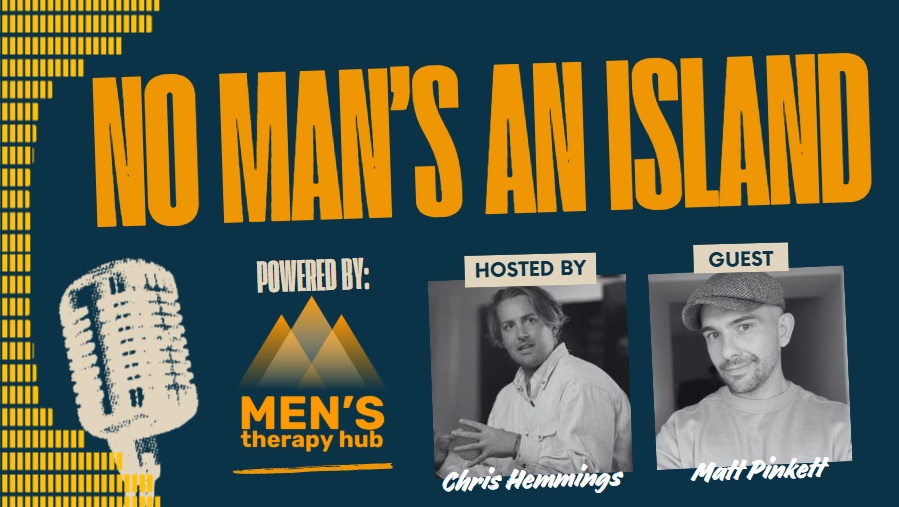
In this episode of No Man’s an Island, Chris Hemmings speaks with Matt Pinkett – teacher, author and one of the UK’s leading voices on masculinity, boys’ mental health and tackling misogyny in schools.
Matt shares the moment that changed the course of his career – a conversation in the staff room that exposed how bias and banter can shape the way teachers see and treat boys. From that point, he began exploring how unconscious expectations about masculinity can harm young men’s confidence, learning and emotional growth.
The conversation moves beyond the classroom. Matt opens up about his own struggles with violence, mental health and alcohol, describing what it means to grow, make amends and keep trying to be better. Together, Chris and Matt explore how teachers can support boys without excusing bad behaviour, why the phrase “toxic masculinity” still divides opinion, and what happens when men choose honesty over performance.
It’s an unflinchingly honest look at education, empathy and the inner battles that shape men’s lives.
What we cover
- The moment that inspired Matt to focus on boys and masculinity in schools
- How unconscious bias and low expectations impact boys’ confidence
- Why talking about “toxic masculinity” still sparks defensiveness
- The link between shame, behaviour and emotional literacy in boys
- How teachers can challenge misogyny without alienating pupils
- Matt’s personal story of mental health, regret and recovery
- Why empathy and accountability must go hand in hand
- The importance of listening before judging boys’ experiences
- His hopes for the next generation of young men
Listen and watch
🎧 Listen to all episodes here: No Man’s an Island
🎥 YouTube: Watch on YouTube
🎧 Apple Podcasts: Listen on Apple Podcasts
🎧 Spotify: Listen on Spotify
Takeaways for men
- Boys learn how to be men from what they see, not what they’re told.
- Shame and silence keep cycles of harm alive – honesty breaks them.
- It’s possible to own your mistakes and still move forward.
- Strength and sensitivity aren’t opposites – they’re partners.
- The best lessons for boys come from men willing to keep learning.
Quotes to share
“I think boys deserve a little better than that.” – Matt Pinkett
“We can only get men to talk if we start listening to them.” – Matt Pinkett
“You don’t want to be 41 years old and looking back with regret.” – Matt Pinkett
“Most men are good men – but we still need to talk about what harms us.” – Matt Pinkett
“I’m not perfect, but I’m trying to be better – and that’s what I tell the boys too.” – Matt Pinkett
Resources and links
Boys Do Cry book – https://www.routledge.com/Boys-Do-Cry-Improving-Boys-Mental-Health-and-Wellbeing-in-Schools/Pinkett/p/book/9781032168692
Men’s Therapy Hub – Find a Male Therapist
Episode credits
Host: Chris Hemmings
Guest: Matt Pinkett
Produced by: Men’s Therapy Hub
Music: Raindear
TRANSCRIPT:
Chris (00:00)
Welcome to No Man’s An Island, a podcast powered by Men’s Therapy Hub. I’m Chris Hemings and on this episode, I’m joined by Matt Pinkett. Matt is a teacher, author and speaker specializing in masculinity, boys’ mental health and tackling misogyny in schools. He spent over a decade in the classroom and has become one of the UK’s leading voices on how schools can better support boys without falling into the old boys will be boys script. He’s the bestselling co-author of Boys Don’t Try, Rethinking Masculinity in Schools and the author of Boys Do Cry.
which explores how we can improve boys’ mental health and wellbeing in education. Hey, Matt.
Matt Pinkett (00:35)
Hey, how are you man? You alright?
Chris (00:37)
I’m all right, thank you. Yeah, it’s really interesting to speak to you because you and I have been working in the same field and have had a lot of back and forth online, but we’ve never actually spoken in person.
Matt Pinkett (00:47)
no we have a very it’s weird i i want to see i’m honored to uh… is so nice to uh… yes feature person
Chris (00:53)
Yeah, likewise. Likewise. I’ve been a fan of your work for a while. So the first question on this podcast is always the same. been a teacher for longer than you’ve been doing this work with boys. So what happened? What was the moment that changed for you that thought actually you really needed to focus on this in a specific way?
Matt Pinkett (01:11)
Yeah, I may have told this story before but I can pinpoint the exact moment I decided that I needed to think about boys and how people were treating them. Do you want to hear the story? ⁓
Chris (01:25)
Yeah, go for it.
Matt Pinkett (01:27)
Yeah, so I was an English teacher in a school of predominantly women teachers on my team and there was this day when we were looking at a book of poetry, it was called Banned Poems for Boys and there was this poem in there ⁓ called The Minnow and it was basically about this young lad who’s on holiday, like a lad’s holiday, a napa, somewhere like that and he goes in the sea and the sea’s really cold
and it does to his appendage what the cold sea would do to a man’s appendage. ⁓ Anyway this girl that he fancies ⁓ starts she appears on the shoreline and starts beckoning him out the water ⁓ and he it’s the whole poem was about his internal like kind of anxieties about
the size of his appendage basically and not wanting to get out the water and this girl to see that he wasn’t necessarily the man she thought he might be or whatever. And there was all these clumsy metaphors in there and we were all having a good laugh about it, this poem.
Then I remember I just said, look, to be honest, there might be boys, know, the amount of pornography boys are watching nowadays. Some of them might have like this body insecurity ⁓ that’s exacerbated by their porn watching, you know, about things like their penis size. And I just remember there was like this deafly silence. then after about, it seemed like 30 seconds, but it was probably only three seconds, this lady just said to me, well, you would say that you’re a man. All you think about is sex.
and then they all laughed and left the room and I was just standing there sitting there thinking I think boys deserve a little better than that you know and so yeah and then I just started looking into bias and teachers attitudes towards boys parents attitudes towards boys and that’s what’s led me to where I am now
Chris (03:06)
Wow.
⁓ And so this experience that you had left you feeling isolated.
Matt Pinkett (03:28)
I guess, yeah, certainly isolated in terms of…
I mean, yeah, if that’s how they’re talking to me, how might they be talking to boys? And yeah, certainly I think it wasn’t very… I’m a feminist, right? And as an English teacher, of course, there’s lots of opportunities for us to discuss feminism. ⁓ For a left-leaning professional like teaching, obviously the feminist agenda is a priority, I think. And so actually in 2016 or whenever it was, maybe just even before then, to be…
one of the only people writing about boys and kind of think, saying like, well, let’s have a look at how boys are being treated. ⁓ I think, I’m not gonna say it was lonely, but there weren’t many people doing it, I guess, at that time. And so I guess at times I did feel a little bit, particularly as a male in a predominantly female profession, I guess I did feel a little bit, I wouldn’t say isolated, but outside of everybody else’s way of thinking, perhaps.
Chris (04:34)
Yeah, I mean, as you well know, I’ve done a lot of work in schools myself and I, you know, from 2016, 2017 onwards, I understand the challenge of trying to convince a profession that understandably has been focusing on the challenges that girls face because they have been ignored for decades, let’s say. And so for you, you know, as you say, you are a feminist and you identify as such.
Matt Pinkett (04:56)
Yeah.
Chris (05:04)
And yet, suddenly you have your eyes opened to, well, the boys need help. What did you start to see around you in your school? And then maybe as you started to look in wider school environments that were missing for boys, the targeted approaches or the ways that boys were being spoken about that actually weren’t helpful.
Matt Pinkett (05:30)
Yeah, I think, ⁓ I mean, the research picture backs this up as well. There’s this tendency for adults to see boys as like less mature, as incapable of nuance, as kind of emotionally vapid, as naughty, as disruptive. And in the same way…
people bring a lot of preconceptions as to how women and girls might behave or act. We do the same with boys, but certainly in the teaching profession, I think that what the research picture shows is that lots of teachers, not intentionally, it’s often unconscious because of stereotypes about gender. They bring this kind of deficit model of male achievement to how they think about boys and how they conceptualize boys as learners.
⁓ But that academic deficiency, kind of intertwined with that, is also, I think, a narrative about ⁓ behavioral deficiencies, emotional deficiencies as well, ⁓ which I think are quite problematic and often self-fulfilling.
Chris (06:42)
Can you explain a little bit more for those who don’t know what the deficit model is and the impact it can have?
Matt Pinkett (06:48)
Yeah, okay, so I mean there’s a really famous study back in 2004, Deborah Myhill and Susan Jones out of ⁓ XT University, ⁓ they went around the country and just asked teachers, are boys as capable as girls? And the majority of teachers when asked will say yes, of course boys can perform in line with girls. However, what researchers also did during formal interviews was they were observing the kind of things that these teachers that said, yes, boys can do as well as
⁓ They were observing the way they spoke about them when they didn’t necessarily know that they were being monitored for how they spoke about boys and girls. ⁓ And yeah, almost every teacher in the study, even though they say yes, boys can do as well as girls at school, they were far more likely to say things like boys don’t like reading, boys don’t like writing, boys are disruptive, boys aren’t mature, ⁓ boys don’t talk about their feelings, boys mess around.
Boys have messy handwriting. So even when a teacher says, yeah, I think boys can do as well as girls at school, the reality of their discourse suggests otherwise, ⁓ which the researchers concluded is indicative of ⁓ an unconscious bias, a bias that positions boys as academically deficient in relation or in comparison to girls.
Chris (08:16)
when you were training as a teacher or even in the training now, is this the sort of thing that is picked up on? As a therapist, we’re taught a lot about unconscious bias in the therapy room, how to deal with race, religion, ethnicity, all these different things that we need to bring into our awareness. Is that something that teachers go through in terms of gender?
Matt Pinkett (08:21)
And that was something that’s been rockin’ in this country.
Yes.
No, I don’t think so. think men are often seen as the blueprint or as the default. ⁓
mode of being and so ⁓ we don’t focus enough on these areas. ⁓ There’s quite a lot of evidence to suggest that teachers will actually ⁓ be punitive in the way that they mark a piece of work.
if they’re aware that it’s a boys piece. Again, I don’t think that’s a conscious thing. It’s an unconscious idea that boys perform less well. I remember when during COVID, when the government announced that schools and teachers would be giving year 11 kids their GCSE grades. I remember I put this tweet out and said, look, all the evidence suggests that if you’re a boy, if you’re black, if you’re from a poorer socioeconomic background,
Or if you speak English as an additional language, your teachers will be biased in the grades they award you. So if the government are going to make us do this, then we need some sort of mandatory anti-bias protection training. ⁓ And the response I got from Twitter was so negative. People absolutely refusing to accept that the teaching profession, for example, ⁓ would ever be biased. ⁓
It was all underpinned by this kind of belief that teaching being a noble profession…
Chris (10:03)
You’re all too
good for that.
Matt Pinkett (10:05)
somehow makes teachers kind of impervious to all the natural kind of stereotypes and bias that the rest of the general population succumb to and are susceptible to, simply because they’re human. Stereotyping and bias is actually quite a natural human function, it’s a survival function, but the only problem comes is when we refuse to admit that an unconscious bias we might have could affect someone negatively, and if we refuse to accept that, ⁓ then I think we’re less
we’re letting a lot of people down. Interestingly, when you look at the attainment gap, as I believe it, both at Key Stage 2 and Key Stage 4, if you look at the gender gap then, the year in which teachers had to assign grades was when the gaps between boys and girls was its widest.
Chris (10:53)
So
there was at least some evidence to back up what you were saying. Yeah. And I guess when that happens, I presume there’s a part of you that feels vindicated, but a part of you that feels equally sad to be vindicated.
Matt Pinkett (10:56)
Yeah.
Yeah, of course. And then you look at the, you know, let’s say we close the gap and all of a sudden boys start doing better than girls in school.
Well then we’ve got another gap to address. I think it’s a difficult one. You’re never in a school setting gonna get boys and girls, poor children, rich children, white children, black children, EAL children, native. You’re never gonna get every cohort within a school all scoring equally on tests. It’s an impossibility. So for me now, I think
think
as my work moves forward, I’m less concerned with the academic disparities ⁓ and more concerned with social injustices or gaps. ⁓ I’m quite aware about things like mental health, the way that black boys are spoken about, ⁓ misogyny. ⁓
punitive kind of behavioral sanctions ⁓ that affect boys disproportionately, that sort of thing. ⁓ But I don’t want to sound like a male rights activist. I’m definitely not that, you know.
Chris (12:28)
No, and the fact that you even have to protest that is something that we’ve spoken about on this podcast. This is, you know, we’re in the early throes of this podcast and it’s come up multiple times that as men, when we are talking about these things, we have to make it very clear that we are still supporting women. And that’s actually the question I was going to ask you next was about misogyny because you are quite focused on misogyny in schools. And I got two questions for you on this.
Matt Pinkett (12:31)
Yeah.
Mmm.
Chris (12:57)
The first one is right now there seems to be at least an upswell of fear about misogyny in school. In the time that you’ve been a teacher and done this work, do you see that there has been an increase in misogyny in schools?
Matt Pinkett (13:05)
Yeah.
Intuitively, I would say yes. I’m also always aware of the fact that the more I write about misogyny, the more I read and research about it, the more hypersensitive I am to hearing it or seeing it. I probably, I would argue, are more aware of it than most people, simply because it’s the nature of a lot of the work I do. ⁓
Chris (13:40)
Most men, for sure.
Most men, for sure.
Matt Pinkett (13:43)
Most men,
yeah, yeah, yeah, that’s an important thing to say. Yeah, you’re right there. ⁓ I also think that we’re limping, limping very slowly towards…
greater female empowerment. So people often ask me the question, has there been an increase in misogyny or are we just more aware of it now? And I don’t really know the answer, to be honest. I certainly think there’s a lot more brazen misogyny. I think we went through a period where…
where it was something maybe we didn’t speak about out loud. certainly know anecdotally speaking to teachers, ⁓ certainly women teachers that I speak to are shocked by just how kind of.
out there it is in terms of boys speaking out loud about it and it’s now almost become a part of the costume of masculinity but I mean like the outward-facing costume like you know it’s the jumper or the tie rather than whereas before it might have been the underpants that no one could see you know. Now I think ⁓ it’s something that men are wearing more openly but whether it’s increased or not I think it’s quite difficult to tell. Certainly what we can’t deny is that there is a greater increase of online misogyny
yeah through TikTok and and other social media sites you know.
Chris (15:14)
How do you counter that in school? How do you counter that pervasive narrative that young boys are being fed? And again, I don’t want to demonize the quote, manosphere in totality because some of it is healthy, some of it is positive, some of it is telling boys to look after themselves, but some of it is sprinkled with misogynistic language.
Matt Pinkett (15:35)
Yeah, I think you’ve got to connect to boys. When we look at, if we look at say incels, okay, so involuntary celibates, a group of men who believe that they are biologically deficient in terms of physical attractiveness and as a result, they will not be able to form romantic or sexual relationships with women. Incels, ⁓
They have much higher rates of depression, much higher rates of anxiety, much higher rates of suicidal ideation than the general population. They are more likely to say that they were bullied at school. And so I think for young men who are at risk of being radicalised into this extreme misogyny by incel groups and stuff like that.
I think what we’ve really got to do is find ways of connecting with boys so that when they do face romantic rejection or romantic failure or sexual embarrassment or humiliation, whatever it is, rather than going home and being suckered in or taken in by this misogynistic content, rather than going to that space, they will come to us. So I think we really need to focus
on connecting with boys. I think that begins by not demonising them for a start. You know, I think we need to be very… ⁓
We need to be very direct with boys. If you take sexual harassment, for example, so many of the boys that I speak to, the things that they think are banter or flirting are actually sexual harassment. But nobody’s ever just sat them down and said, right, just so you know, this is what sexual harassment is. So.
Once they know, for example, what sexual harassment is, they can make the active choice not to sexually harass people because now they know what it is they didn’t realize before. ⁓ And then what that means is then all of a sudden when people, when boys are reading the headlines about increases in male violence against women and girls or increases in sexual harassment, they can rest assured that they are not part of that problem. They could actually be a solution to it rather than… ⁓
part of the problem. So I think actually just speaking to boys so often, we just don’t do that. You we think that boys are incapable of emotional nuance. ⁓ you know what, maybe some of them are because that’s what gender can do to men. You you probably know that more than anyone that some men find it really difficult to talk. ⁓ But we can only get men to talk if we start to listen to them and start practicing talking with them, you know. ⁓
I think there are other problems. think the way we stigmatise the watching of pornography is quite problematic. I mean, I can’t say too much as I’m still, you know, up until the end of this academic year, I’m still a teacher. But some of the way that people in our field, in the field of gender and gender studies and whatever you want to call it, gender politics, masculinity, ⁓ so many men and women are…
vehemently anti-pornography. ⁓ I’ve always found this a little bit Victorian. ⁓ Some of the things that we might see in pornography are ⁓ terrible, know, exploitation of women, ⁓ know, ⁓ deep fakes, all that horrible stuff, but there are…
Chris (19:20)
Just
unrealistic views and visions of human bodies.
Matt Pinkett (19:26)
Exactly, But there are ethical sites and there are ways to watch pornography responsibly. But I think as a society, ⁓ certainly as adults, what we tend to do is we talk about pornography as this filthy, disgusting thing, totally ignoring the fact that for thousands and thousands of years human beings have been aroused by sex and seeing sex. ⁓ And I think that if all we do is we talk about young boys who are engaging in pornography.
this country the average age for a boy to first watch pornography is 11 years old in this country. If all we do is make boys feel dirty or sexually deviant for having watched it, I think we put up a real barrier there and it makes it very difficult for them to ask questions about that.
content that they might have seen that they might find upsetting or distressing or make them anxious. ⁓ you know, it’s not just we need to talk to boys. I think we also need to think about what we’re talking about and how we’re talking about it sometimes.
Chris (20:29)
big point that you made there is we have to find a way to connect with boys. And I think one of the big frustrations for me and the work I’ve been doing for a long time in schools trying to work with boys is I always felt like empath was trying to combat the narrative the boys had heard that they were toxic, problematic, whatever it might be, the language. You understand that helping boys will also help girls.
I think one of the problems we have is some of the, lot of the messaging is we need to help boys specifically so that we help girls. That the boys are second, like the boys are secondary in their own needs for support. So we need to help boys because if we do, then the girls will be okay. How do you combat all of that? Like what message do you take in when you go to schools or when you speak to parents or teachers around the country? What are you saying to them about what needs to change?
Matt Pinkett (21:08)
Yeah.
Yeah.
Chris (21:30)
in terms of the approach we have to boys and how we actually call them in rather than calling them out and pushing them away.
Matt Pinkett (21:38)
Yeah, mean, three things I’d say off the back of that. You’ve made me think about I’m often in a lot of trouble because I still use this phrase toxic masculinity. ⁓ Yeah, people don’t like me using it. People hate me using it. I’m always very upfront with the boys. So today I was with some boys and I said to them, look lads, I always use this phrase and I get a lot of stick for it. ⁓ Their first question is always why? And I say, well,
Basically people think that when I say the phrase toxic masculinity, ⁓ what I’m suggesting is that simply by virtue of being masculine or a boy or a man, you’re automatically noxious or harmful in some way. They’re like, okay. I’ll say in actual fact, I love men.
A bit of internalized homophobia means that some of them laugh when I say I love men. ⁓ But then, you know, then I explain why I still use the phrase toxic masculinity. I say there are certain behaviors in society, certain things that are going on that I think are really harmful. You know, boys are three times more likely to die by suicide than girls. That’s a masculine behavior. It’s a harmful one. It’s tragic ⁓ that men and boys are taking their lives because they feel
that they can’t openly be vulnerable or seek support when they’re in times of need. You you look at street violence, gang violence, boys are more likely to be the victims of those things. They’re also more likely to be the perpetrators of those. You know, there’s all sorts of reasons. And I actually find that when you actually talk to the boys, all right, and I say to them, look, I don’t think men are toxic. I think that…
most men are good men, but I like the phrase for me because it gives me a benchmark to measure myself against. And I think that a lot of the critics of me using that phrase are actually doing boys a disservice. They’re talking about boys as if they’re these empty vessels that just soak up every message that they’re ever told, as if me going toxic masculinity makes them automatically feel all sad and toxic. If only it was that easy, you know, my job as a teacher,
and the results I’d get every year would be through the roof. The fact is boys are very capable of emotional nuance. very…
You know, they’re very thoughtful and they’re willing to discuss these things and wrestle with the ideas and they can see the goods in In in the phrase and they can also see the bad, know, and I do think there is room for nuance ⁓ and and the fact that So much of what we do in gender and I think again This is relevant to getting boys and connecting with boys this idea that everybody has to be a saint You know and you have to be perfect and to have got it right first time I think that puts so many boys
off you know and men I’m always very upfront with the boys you know the way I’ve treated women over the years has been deplorable I think of homophobic comments and jokes that I used to say violence as a kid you know and I think when we’re honest about that
with boys, they can see, okay, well, you there’s somebody up here saying this and you know, they’re not perfect, but they’re trying to get better and maybe I can too. Yeah. ⁓
Chris (25:09)
I like this because this gives me a live opportunity to disagree with you, but also to understand your perspective because I don’t use the term toxic masculinity. It’s why I gave the faux as you said it, because research, there’s research that shows that around the world, roughly, and it’s different in every part of the world, but roughly about 80 % of men worldwide identify as masculine.
Matt Pinkett (25:15)
Yeah, good. Yeah.
Yeah.
Chris (25:39)
So while I understand the etymology and the usage of the term toxic masculinity, for men who identify as masculine to then be told, or at least then the perception of being told, that a part of them that they identify as is toxic can be disconnecting from themselves. And actually what it does potentially is create a negative
Relationship to their masculinity now. Here’s the caveat to that Because I know that what people are saying is not that all of masculinity is toxic I know that what is being said is that there are aspects of what is perceived to be masculinity that are toxic But that’s where I would say actually and it’s not as pithy Actually what we’re talking about are toxic behaviors associated with rigid male expectations But that has been
Matt Pinkett (26:35)
You’re right that’s
not as pithy. ⁓
Chris (26:37)
It’s not as painfully right? Exactly.
So it’s toxic behaviors associated with rigid male expectations. And it’s not the masculinity that’s toxic. It is the rigidity of the pressures that we put on boys. So I do understand why I use it actually in the masculinity workshop that MPath does, we do talk about the traits associated with toxic masculinity. So we do like a…
you know, shout out some of the traits that you would associate with toxic masculinity and actually when you boil them down I’ve never done one and I don’t know if the lads have because I haven’t checked where a hundred percent and this is what the workshop tries to show a hundred percent of the behaviors associated with the idea of toxic masculinity is about dominance it’s about male dominance and it is about this rigid idea that as a man
I have to prove all the time that I am the best, that I am superior, and I will climb over my mates and I’ll climb over women, and I will literally fight my way to the top if I have to. Does that make sense?
Matt Pinkett (27:42)
Yeah, yeah, I do get it. like I said, I mean, in my first book, Mark and I, my co-author, we said, get rid of the term. It’s harmful, it’s not a great term. In my second book, I said the exact opposite. In my third or fourth, I might change again. know, I do, I do.
Chris (28:02)
Well, can use
Ridgid Expecta, you can use my pithy one if you want.
Matt Pinkett (28:06)
Yeah, rigid, yeah. I mean, I do see the problem with the… Yeah, I tried to gloss over that. Yeah, I do see the problem with the terminology. ⁓ I just think, I think it’s very, it’s widely used. I do try and…
Chris (28:08)
It’s really memorable, right?
Matt Pinkett (28:25)
I’m quite self-reflective and I often ask the question, I think when I first started hearing the term, I think I would become quite defensive, quite angry, but now I’m in a space where I’m perfectly happy with the term. And sometimes I just ask myself the question, what is it about me? What have I gone through this past six or seven years since I first heard the term and published a book in which I said it was disgusting, we shouldn’t be using it.
what’s happened over the six or seven years to get me to a place where I’m now comfortable with it. And what I would say for that is education, all right, learning and listening to women, which I never did before, learning from women and about the female experience, also reflecting and accepting that some of my own behavior has been unacceptable. I think before I was always so defensive against that.
But since accepting that where my own flaws and where I’ve let myself and women down, for example, ⁓ and listening to women, I’m now in a space where I’m actually okay with the term and I don’t see it as an affront to my own masculinity. ⁓ I’m quite proud of my masculinity. I think I present as quite a masculine man, whatever that means. ⁓ And I see the paradoxes in that.
Certainly in many ways I’m trying to break down certain expectations of masculinity, but other times I embrace them. ⁓ And again, I’m kind of okay with that. ⁓ I kind of think of masculinity, I’ve already used the analogy before, as like a wardrobe, you know? And there are certain items of clothing that just don’t look good anywhere, all right, wherever you wear them.
But there are other items of clothing that work well depending on the dress code of the place that you’re in. I’m just trying to be a savvy dresser and not offend anybody with my outfit.
Chris (30:33)
That is a conversation that we could probably do an entire podcast on. What I will say is I love that you’ve gone from using it to not using it. Sorry, from not using it to using it. I’ve gone from happily using it to not using it. And I think that shows there isn’t a right or wrong answer when it comes to topics on gender. Listeners will already know, because I’ve told the story of doing a talk in a school and then teachers complaining because 100 %…
Matt Pinkett (30:37)
Yeah.
yet.
Chris (31:03)
of the staff didn’t agree with me. And it’s like, what? That’s not ever gonna happen when you’re having conversations around gender. And you and I, who are specifically pulling in an almost identical direction, disagree on something. And that’s great. Because actually what that means is there is diversity of thought out there. And actually, in a sense, what your whole work has been about is to challenge the orthodoxy of…
Matt Pinkett (31:18)
Yes.
Chris (31:32)
Boys are just this way and they always have been and they always will be.
Matt Pinkett (31:37)
Yeah, I wonder what a boy would say listening to our conversation in the past 10 minutes. I’d be, you know, 16 year old lad. I wonder what he’d make of it. ⁓ You’d hope it would be a positive, you know? Like you say, both two blokes just pulling in the same direction, but…
being reflective about the language we’re using and stuff. That’s something that not a lot of men, well, that not all men can do very well, I think, is think about the words and the language that they’re using. Yeah, yeah, yeah, without punching each other. Yeah.
Chris (32:10)
and disagree respectfully. Yeah, yeah, you’re bastard. Yeah.
I’m interested partly because of your accent and partly because of what I’ve seen you speak about and you just said there also, you just said that in your life you’ve done deplorable things to people and I presume to yourself as well. So what was your formational…
Matt Pinkett (32:22)
Yeah.
Chris (32:38)
experiences like as a young man, like growing up in some part of East London, I’m guessing.
Matt Pinkett (32:47)
Yeah, I actually grew up in Medway in Kent and then I’m now I now actually live in Surrey, you know, but but I grew up I grew up ⁓ When all the Guy Ritchie films came out and stuff, you know And so we were all speaking like the gangsters we saw in those and then all of a sudden it that cockney sort of twang Which was mock me at one point
Chris (32:54)
Okay.
Matt Pinkett (33:10)
is now just how I speak. don’t know how I’d actually speak. was actually, and I was born in Devon as well, so I’m all over the place. you know, talking about deplorable things, I think, I think violence and being intimidating, I think…
Chris (33:16)
Alright, okay.
Matt Pinkett (33:35)
casual homophobia, I objectifying women. I think in recent years I’ve used my poor mental health as an excuse for mistreating people that I love. you know, not, just being too selfish really and not being self- ⁓
And I think I’ve lost a lot as a result of that, you know, and ⁓ it does mean now I’m sitting here at 40 years old and, you know, with a lot of regret in my life. And that’s what I always say to boys, you know, about tackling misogyny and stuff and the homophobia and the violence and the glorification of violence. said, you don’t want to be 41 years old lads and looking back.
with regret and with shame and with guilt. You don’t want to be doing that, you know? So it’s, you know, I passionately believe that tackling misogyny, yes, it’s great for girls, but it is really good for boys too and they deserve it, you know? They deserve a life without bitterness, resentment, guilt, shame.
Chris (34:53)
that’s how you feel about, and to use your wardrobe analogy, the violence, the misogyny, the homophobia, they were staples in the wardrobe, right? That was an outfit you wore most days when you were around other lads.
Matt Pinkett (35:06)
Well, no, I mean, when I say like the homophobic, was never, you know, ⁓ never bully or be violent to someone who was gay. ⁓ In fact, somebody got in touch fairly recently to say that they always remember me from school because I was the only person that would stick up for them when people were ⁓ homophobic. But…
you know, in conversations, you know, just as a kid, like, those trainers are gay and that just like that language thing, you know, ⁓ in terms of the violence, you know, I wasn’t in gangs or anything like that. But certainly when I was very young, you know, scrapping and ⁓ I was I was I was tall for my age and ⁓ we lived in Kent growing up in Kent in the 90s and my mum married an Indian man ⁓ and that meant a lot of
We got a lot of racist abuse directed at us. My mum walking down the street, people ⁓ spitting in her face and stuff. ⁓ So at school, ⁓ as somebody that was lot bigger than the other lads, I’d be hearing racism and I thought that because I had an Indian stepfather that maybe it was my responsibility to tackle.
racism when the other boys were being racist to other kids and and unfortunately It looked like me lamping them rather than actually sitting down and talking it calmly through with them, you know and educated but you know when you’re 12 10 9 whatever years old, you know, you you don’t do that. I think I think ⁓
I alcohol as well, know, think that’s quite, you know, like drinking culture at university and that hasn’t done me a lot of favors either. you know, it’s…
⁓ I do spend a lot of time thinking about that. ⁓ I guess it’s almost like that imposter thing, right? Like, here I am doing this work and at times I feel like a fraud, you know? So I wanna be very honest about the fact that ⁓ I’ve never been a saint. I’m trying to be one now.
Chris (37:37)
It’s hard work, though, isn’t it?
Matt Pinkett (37:39)
Of course, you make mistakes, don’t you? You make mistakes. ⁓ And, you know, I guess when I make mistakes, they just eat me up a little bit, you know? ⁓
Chris (37:52)
Where does that come from? Because I’ve seen you online and you are extreme. For a teacher also, you’re extremely honest about your failings and you’re also very honest, as you just were a moment ago, about the challenges you have with your mental health at the times that they’re happening. So where do you find that courage to do that? And I guess I’m also curious to know, do you ever take a step back and think maybe you’re being
Matt Pinkett (38:10)
Yeah.
Chris (38:20)
overly critical of yourself like a bit harsh on yourself
Matt Pinkett (38:24)
good point. ⁓
Yeah, yeah, some… No, I never think I’m being too harsh on myself. There are times when I wonder…
Am I possibly being too harsh on myself? But generally the answer I always come up with is no. I think the mental health thing’s an interesting one. I I went for so many years without getting medicated for it. And then back in 2017, 18, I saw something that really affected me.
without going into too much detail I saw somebody have a seizure ⁓
I didn’t deal well with that. I had a mental breakdown. I was off work for about four weeks. ⁓ I went on the pills then, but then I came off them again. Then I had a breakup fairly recently and I was not in a good place. ⁓ Now I’m on the meds. I am a lot more measured. ⁓ But of course, being on the meds and ideally being sober.
means that you do get clarity and lucidity and so perhaps I have a tendency to overthink.
It’s always a battle between doing the wrong thing that will give me mental ease and help me to forget ⁓ some of those things I want to forget, but also doing the right thing for my physical health, my mental health, and my family and my daughter. ⁓ And the payoff ⁓ of that, of things like sobriety and taking the meds is that…
Unfortunately, you do get a little bit, or fortunately, you get a little bit more clarity and sometimes you linger on those unpleasant experiences.
But hey, at least I’ll live longer, you know, and hopefully I can be a dad for longer. the way I was carrying on wouldn’t have necessarily ended that way, you know, so.
Chris (40:48)
When is that a daily fight for you to not slip back into old habits?
Matt Pinkett (40:52)
Yeah, yeah, every waking moment is a bit of a battle, yes. And you know, like…
Yeah, it’s just an exhausting conversation with myself quite a lot of the time. I’m in my own head all of the time. But, you know, again, that does have its benefits, you know? I think there are situations where that maybe pays off for me. Maybe there are times where I’ve been a little more empathetic than somebody else or more empathetic than I would have been.
in a past life. ⁓
I think it reminds me of this, people often tell me I’m too sensitive and I don’t like the way we stigmatise sensitivity. think that, yeah, okay, it’s not great being sensitive and constantly thinking and beating yourself up about stuff. But also, I guess, you know, I’m more sensitive if that’s what being sensitive is, to love, to happiness, to joy when it comes, you know.
So, but yeah, in answer to your question, ⁓ it’s a pretty constant kind of internal dialogue with myself, you know, about making the right decision. And you can never, never, never really be complacent with it, you know.
Chris (42:35)
And you’ve been working in schools for a decade now and you’ve said that you’re about to end at the end of this academic year. I will come on to that in a second because I’m curious to know what the next step is for you. But I think sometimes we forget that teachers are also humans dealing with the same shit that all the other humans deal with. And then also dealing with the shit of 20 odd kids in front of you for an hour at a time. How do you go about
Matt Pinkett (42:55)
Hmm.
Chris (43:04)
the separation of kind of the church and state of as a teacher, a lot of teachers like the fact that I can go into a school and be honest about my drug taking and my mental health challenges and my bisexuality or whatever it might be because I won’t see those kids again. So for you, what is it like for you when you’re really struggling and you’re really down and you’ve going through a breakup, but you’ve got to go to work on Monday?
Matt Pinkett (43:23)
Yeah.
Chris (43:32)
and you’ve got to sit in a classroom of kids and not just be a complete car crash.
Matt Pinkett (43:37)
Yeah.
I struggle in all honesty, yeah, I really struggle. And it’s part of the reason I’m leaving now. I’m now a place where there are things that I need to talk about. There are things that I feel morally obligated or morally obliged to talk about and to discuss, to think about, to speak about that I simply can’t because of my role as a teacher. ⁓ And also I think that mental health wise, I’m not strong, I’m no longer strong.
strong enough to be a teacher. ⁓ I think that the job is a difficult one ⁓ and it’s one that I’ve no longer got the strength to do anymore, you know, so. ⁓
I’m gonna dig in deep and give the kids that I still teach the best deal that I can give them. ⁓ But in answer to your question, there are things that you just can’t say. And professionally, that’s quite frustrating. Some of the media stuff I’ve been asked to do, having to turn it down because you don’t want kids knowing.
everything about you. ⁓ But also at the same point, I guess part of what certainly what people say they like about me and my shtick and my writing and is that I’m quite blunt and direct and quite honest. ⁓ And so again, that’s getting a kind of an exhausting tightrope to to walk along, you know. And so it’s best I jump off before I fall off, you know.
Chris (45:21)
And that in itself is an act of courage and bravery to recognize your own ceiling in a sense. And I wonder if I could take you back to your like 15 year old self and say, one day you are going to, for the good of your own mental health, step down from a job that you have.
learned so much from and loved and been a part of and that has formed you so much because you wouldn’t be doing this work with men and boys if you hadn’t been a teacher. Maybe you would, but in a different way. Do think that that would be something that you would believe that you’d be capable of doing? Because what you’re doing goes almost directly against the boy code, the man code of don’t show weakness. Yeah.
Matt Pinkett (45:53)
Yeah, yeah.
Stoicism.
Probably not, know. ⁓ Probably not. ⁓ But it’s where I am now, you know. But yeah, certainly at 15 years old. ⁓ I don’t think it would have been beyond the realms of, you know, I wouldn’t have been able to.
not faffing it, you know, I’ve always been sensitive even as a 15 year old, I would have thought, you know, if someone said, Oh, one day you’re have to leave your job or one day you’re gonna leave your job to protect your mental health. I probably would have thought, possibly. But
But certainly I’d be sceptical of that idea. I’d have mixed feelings about it. But right now I think it’s the best thing. There’s a lot of great teachers out there and I’m just tired. I’m just so tired.
Chris (47:10)
Have you ever been to therapy?
Matt Pinkett (47:12)
Yes, yeah, ⁓ yeah, I’m not, you know, yeah, I’m very skeptical. ⁓
Chris (47:21)
You’re allowed to be
skeptical here, Matt, it’s okay. This is…
Matt Pinkett (47:23)
Yeah,
know, the way I, know, things I’ve said to therapists in the past is like, did Ed Sheeran write that? Or like, just because you’ve seen it on a poster, you know, with a sunset on it, doesn’t mean it’s not true. Like, I’m very skeptical of those kind of therapy platitudes and stuff, you know? ⁓
You can’t love somebody else until you love yourself. I’m like, there’s no objective truth to that. Where’s the book that says, what if I don’t love myself, but loving other people helps me to better love myself? I sometimes think that some therapists I’ve met, it just seems like they’re reading out of like a…
Instagram therapy post book, you know, and just saying all the things that you hear like people from school post on Facebook or MSM Messenger status updates, you know? Yeah, yeah, yeah. So I am skeptical. I’m also skin, you know, like, ⁓ you know, it’s, I do think ⁓ as a society, certainly, ⁓
Chris (48:19)
Showing your rage now.
Matt Pinkett (48:37)
Certainly I’m looking to do some work into making therapy or setting up some sort of charity or fun where I can give people in need the money that they need to go to therapy. ⁓
I’ve tried all the free kind of texting online stuff, CBT, that doesn’t work for me. Now if it works for other people, brilliant. But I do think there’s something that needs to be done to make it more affordable for people. ⁓
Chris (49:10)
Yeah,
I strongly agree with that. And actually, if you do ever think about setting that up, then please do let me know because Men’s Therapy Hub would love to be a part of that because what I say to a lot of people is that the therapy profession is really shit at marketing itself because every year there are hundreds, if not thousands of people who are available for, like I did two years for 20 quid a session, Low cost, affordable therapy.
Matt Pinkett (49:15)
Yeah man, yeah let’s do it, you know.
That’s amazing.
Chris (49:40)
because I was training
and that’s available right now, but people don’t know about it. And, you know, I charge 85 quid for an hour of recession, but I also have an unemployment ⁓ rate, which I have two slots available, unemployed students or apprentices for 50 quid, right? And I fully understand that the cost is a factor, but I think the frustrating thing for me is what you’ve just articulated there is you actually made it a couple of times.
Matt Pinkett (49:54)
Yeah.
Chris (50:09)
And we lost, like our profession lost you because the quality of the therapy doesn’t sound like it was very good, but also, and the research suggests this, it sounds like you didn’t really feel much of an affinity with your therapist.
Matt Pinkett (50:23)
Yeah, yeah, that might be true, yeah. Yeah.
Chris (50:27)
Like would you
have needed to actually be kept in and stay longer aside from more cash?
Matt Pinkett (50:33)
I think I could never play the long game. think therapy needs to be an ongoing thing. I think I often like to see practical outcomes. want to feel like I’m getting better. I think a lot of, first I think a lot of my therapy that I’ve done was kind of performative. It was just me.
it was a way I could signpost to family members or girlfriends, look, I’m doing the work. Whereas actually maybe when I was in there because of my cynicism, I wasn’t really doing the work, you know? ⁓ So I think in answer to your question, what would I have needed? ⁓
I needed to see the long game, again, the long game costs money, you know? And for me now, as you know, I don’t live with my daughter. And so what happens is I have to pay my own rent, but also obviously, you you pay, pay.
I want to and I choose to pay certain sum of money for my daughter ⁓ on top of what I spend when I see her, there’s bills and everything else. ⁓ When you’re with someone, it’s like everything gets halved. When you’re not with someone, it’s like everything gets doubled. So ⁓ I just can’t really legitimately afford to pay for therapy long-term because that’s money that’s…
that my daughter’s not getting or that’s the rent that ain’t getting paid, you know? But yeah.
Chris (52:11)
Yeah,
I get that and I really do understand the financial barrier. ⁓ You are here, you’re talking openly about your troubles, you stand on stages and you talk openly about your troubles. ⁓ Do you find that therapeutic? And as a follow on, like, where do you go for therapeutic relief now that maybe you didn’t? Because you’re not…
Matt Pinkett (52:14)
Mm.
Chris (52:39)
self-medicating with substances. You know, you’re not slipping into old patterns to avoid your experiences. You’re actively engaging with them now. So where do you go to seek that comfort?
Matt Pinkett (52:50)
Yeah. Well,
actually the place I would go would be the pub, right? It would be the pub. ⁓ And after a few drinks, I can loosen up and talk and have these, the amount of beautiful, beautiful friendships I’ve cultivated in drinking establishments is amazing. But sadly, that drink is not good for me. And as a result of that, I then lose those connections and…
that feeling of being able to talk. I’m quite socially quite awkward ⁓ without, you know, without medication, be it self medication or whatever, I find it very difficult to talk to people. ⁓ You know, when I’m off the booze, ⁓ all people do, and it does my head in, know, people, know, Matt, you.
don’t drink so much or whatever, it’s like, okay. And then as soon as I meet them in a social situation, they go, you’re being grumpy, you’re quiet, you’re grumpy, you’re quiet. I’m not grumpy, I am just quiet. This is how I am. My default setting is I find it difficult to talk to people. I don’t enjoy not being able to talk. I’m just sitting inside hating myself, trying to think of something interesting to say, but I just can’t, I’m not very good at it.
Chris (53:55)
I’m sober.
Matt Pinkett (54:11)
But I do find the work therapeutic, standing up on a stage, talking to you now and talking about these things. It’s the only thing that gives me a buzz that the other things could. ⁓
So I enjoy the work and that’s another reason I need to pursue it and leave teaching and pursue the writing and the speaking stuff ⁓ because it’s something I do really, really enjoy, you know? ⁓ And there’s not much, you know, apart from time with my daughter, there’s not much I do enjoy. And so it’s really important that if I find something I enjoy, I…
I latch onto it and bleed it dry for all I can for as long as I can. Because yeah, gives me that buzz, that little adrenaline. It’s fun.
Chris (55:09)
Is that what gives you the courage to, you know, if you’re not somebody that is naturally inclined to speaking up and talking openly, actually, is that what gives you the courage to do it? That when you do do it, you realize, actually, this feels good.
Matt Pinkett (55:24)
Yeah, I do think also, it’s not all noble either. Sometimes it’s space. Like I like attention, you know, I’m often quite insecure. So actually standing on stage and having people, you know, look, listening to you laughing along with you, taking them on a journey, whether it be through an anecdote or a story or even a piece of education and, having them come up and say, thanks for that. didn’t know that. Or you’ve made me think about this differently, you know, on a, on a very crass,
kind of baser level, it just feels good, doesn’t it? To have people say, like what you said today, or, you know, I think you’re a good speaker or whatever. So there is that, of course. ⁓ But I guess on a deeper level, I do think that… ⁓
You know, I gave a talk fairly recently and five minutes after the talk, a girl disclosed that her father was raping her. ⁓ And it was only after seeing my talk that she felt that she could stand up and say to a teacher that that’s what’s been happening. Now, that’s a very extreme example. It’s a very sad example, but… ⁓
That’s powerful work, isn’t it? And I do think that this misogyny work and this masculinity work is, think right now at the moment, it’s where I’m having the most positive impact on the world. Probably more so than my teaching.
Chris (57:03)
gonna let you go, because we’re trying not to drag this out Joe Rogan style for like nine hours. ⁓ Couple of questions. You are moving out of the teaching profession and you are about to embark upon doing this professionally long-term. And like, yes, I’m so glad that you are doing that because your voice has been so powerful for so long in this space and you still have so much to say very clearly from this brilliant conversation. What is your hope?
Matt Pinkett (57:07)
Hahaha
Yep.
Chris (57:32)
What is your biggest hope? Because I think we can focus so much on where are the boys fucking up, right? But what’s your biggest hope for, are we at Gen A now in schools, Generation Alpha? I lose track. It’s the thing with the crossover from Gen Z and Gen A. But for this next generation of boys who are currently in school, what do you see in them that maybe isn’t being spoken about, that we aren’t saying, do you know what, the boys are all right because of X. What is that?
Matt Pinkett (57:44)
Yeah.
Yeah, think, every day when I’m going into schools, I’m seeing boys, laddy, blokey boys come up to me and say, thanks for that. We needed to hear that. So I guess what I would hope is that one day boys, ⁓
Even typically masculine laddy boys can be unashamedly vulnerable, be unashamedly vocal in the way they advocate for women and support women. I’d like to see bisexual LGBT gay boys be proud and out there and have heterosexual allies.
And you do see it, you know, it is happening. I do think that a lot of the narrative about masculinity is missing, is the good boys. And there are so many, you know. And, you know, again, when you talk to boys, just…
They can be very vulnerable. are capable of emotional nuance thought and I just want them to become a little less ashamed of that and be more openly vocal ⁓ and supportive of one another and supportive of women. That’s what I really like.
Chris (59:31)
And just to reflect on my own experiences, the thing that kept me going was exactly what you just spoke about there. Like some really harrowing disclosures like that girl disclosed to you, ⁓ which is really important step in her life, or those boys who at the start of the talk are dicking around and trying not to listen. And then they come up to the end and they go like, yes, sir. And they like give you a little knuckles and like, yeah.
Matt Pinkett (59:54)
Yeah.
You see them change, don’t you? They
come up with so much hostility and or either hostility or yeah, like you say, like dicking around. ⁓ And then, you know, when you talk to them, you can see them like come around to your way of thinking and or or certainly they want to at least listen. And that’s a step forward. So, yeah, I recognize that that experience that you just said.
Chris (1:00:21)
And those moments are the energy, right? Because when you have that, it’s like, okay, I can go to the next one and do that work. And that’s what keeps coming up in this podcast is this idea of, let’s stop thinking of success here as changing the entire world. But if we can change one lad’s mind, like if one person listens to this podcast and changes their mind about one thing, then you and I have done a good job here today, right? This is not going to change the world. ⁓ However,
Matt Pinkett (1:00:24)
Yeah.
Chris (1:00:51)
and regular listeners will know I love a bad segue and this is a really bad one. I am going to give you a chance to change the whole world now because the final question is a hypothetical question, right? If I give you the keys to the vault, you have unlimited funds to make one social change that is going to help in this space in some way, what would you do with that money? Where do you think the biggest change socially?
would happen.
Matt Pinkett (1:01:24)
What a question. What a question. ⁓
Are you talking specifically the area of gender? Yeah, masculinity. ⁓ I mean, the first thing I think is something needs to be done about religious ⁓ intolerance. know, that, ⁓ you know, in the light of what’s happened in Australia yesterday, you know, I think, you know, I think.
Chris (1:01:38)
Not necessarily if you think there’s another area that would benefit.
Matt Pinkett (1:01:57)
A lot of that is masculinity though, know. Yeah, you know, there’s something needs to be done about that in schools of getting and exposing children to experiences and beliefs that are different from their own. I think that ⁓ it’s only when we listen to one another ⁓
Chris (1:02:02)
It’s usually male shooters, isn’t it?
Matt Pinkett (1:02:26)
that we can begin to change. I asked the question earlier, you know, what was it about me that means six years ago or seven years ago, I didn’t like the term toxic masculinity, but now I’m okay with it. And I do think it is been questioning myself and learning from the women in my life and actually seeking out advice and reflections and saying to people, it to me straight. You know, I want to understand. ⁓ And certainly, yeah, for young people,
I mean, I do think it’s intersectional with masculinity. Something desperately needs to be done about ensuring that young people are exposed to different cultures from a young age. I’m not smart enough to figure out how to do that, ⁓ but that would be great, it?
Chris (1:03:16)
to create spaces where you can have dialogue with people with different thought processes, different backgrounds, different race, religion, disability, sexuality, all of that, and have it moderated, basically.
Matt Pinkett (1:03:31)
Yeah, yeah, I mean, yeah, I would go as far to say, you know, if you could formalize that sort of thing, you know, somehow. ⁓
Yeah, I think it’d be great. I’m not a religious education teacher, but often it’s a lesson that’s children are, it’s pointless, it’s pointless. I can’t think of anything more relevant learning about Judaism, Christianity, Islam, seek it.
Chris (1:03:43)
It’s a good idea. I like it. Yeah, I like it.
Matt Pinkett (1:04:04)
I can’t think of anything more relevant in today’s multicultural society. Maybe it’s the approach with which we take it. Maybe the end aim shouldn’t be just the acquisition of facts, but maybe if we worded the way we do it as the end goal isn’t just to know lots about Islam or Christianity, the end goal is understanding and a reduction in fear and scare amongst
Chris (1:04:35)
to move away from maybe just religious studies and do like religion and culture studies to learn about different cultures. Great idea, I love it. It’s in the files now with all the others. I’ve had some great ones so far. Thank you, Matt. Thank you for spending your time with us. I really appreciate the work that you do. I’ve admired it for so long. I’m so happy to hear, well, I’m not happy to hear that you’re leaving teaching because you’re not okay, but I’m happy to hear that you are gonna be going all in on helping young boys because…
Matt Pinkett (1:04:39)
Yeah, yeah, I think yeah.
Brilliant.
Chris (1:05:04)
I know how powerful the work you do can be. I know that you inspire so many. I know that there will always be the boys sitting in every room that you’re in speaking who isn’t telling you just how powerful the impact you’re having on him will be. And that’s what I tell all of the facilitators at empath when they join is don’t forget about the boys who aren’t telling you who in three, four years from now will be emanating the message that you brought. So it’s such a powerful message, Matt.
And I’m really grateful that you were here today. And thank you for your time and I’ll speak to you again in the future.
Matt Pinkett (1:05:36)
Brilliant. ⁓
Yeah, we need to get we need to think about this this idea, don’t we about getting getting therapy out there to or some sort of charity or fund. Let’s talk about it.
Chris (1:05:46)
But let’s
chat about it. love it. I’m always up for that. All right. Cheers, Matt. Cheers.
Matt Pinkett (1:05:50)
All right,